Tuesday, October 14, 2014

TV/Movie Set : Doctor Dolittle ( 1967 )

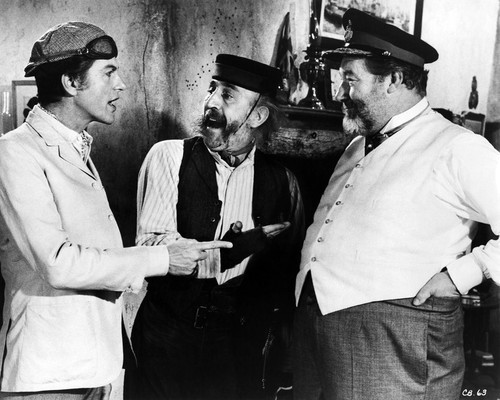
For this edition of TV/Movie sets we will be looking at the beautiful home of Dr. John Dolittle, known to his friends simply as Doctor Dolittle or "that maahvelous man". Rex Harrison was the titular star in the extravagant 1967 musical based on the children's classic by Hugh Dowling. Dolittle was one of the very first veterinarians, an animal doctor who was not only sympathetic to animals, but understood them as well. Literally. Polynesia, Dolittle's pet parrot, taught him how to speak 499 animal languages....just a drop in the bucket to the nearly 2,000 languages that Polynesia spoke herself. 

Doctor Dolittle is a wonderful film, very entertaining and very underrated. It's a simple story about the doctor trekking off in quest of the Giant Pink Sea Snail...after he deals with a number of smaller tasks at home. Anthony Newley portrays Dolittle's friend, Matthew, who decides to join Dolittle on his quest along with his little pal Tommy ( William Dix ). Samantha Eggar tags along as well, not having anything better to do.


When Doctor Dolittle was released it was not a smash hit. In fact, it was a downright flop, retrieving only half of its $18 million dollar budget in ticket sales. Children were not interested in listening to Rex Harrison "sing" through seven different songs, and its 152 minute run-time, crawling along at a snails pace, was much too long for children to sit through. But, from an adult perspective, it is quite entertaining and, above all, it exudes the most happifying mood. This is a great deal due to the beautiful cinematography, sumptuous costumes, and most importantly - the sets. 


While all the sets are beautiful in the film, for this post we will be looking at one in particular - the home of Doctor Dolittle. This animal lover lives in the small village of Puddleby-on-the-Marsh, in a stone cottage near the outskirts of town. While practicing as a medical doctor he resided here with his sister, Sarah, but after she discovered pigeons in the linen closet, snakes in the drawer, and mice in the cupboards, she huffed out of the place. 


After her abrupt dismissal, Dolittle went about making a few changes to make his cottage more comfortable..namely, cluttering the place up. Nothing like a good mess to give a home the nesting feel! 

In the pre-veternarian days, Dolittle had a clean desk.
One of these changes was making the house more accessible for his patients. The double row of stairs would never do for cows, horses and such, especially injured ones, and so, a ramp was installed leading down into the living room. 


Paintings of Grecian goddesses were replaced with practical drawings of animal anatomy and bird plummage and every little empty nook and cranny was converted into a home for a stray animal. Even a ladder was built along the stair rail to assist the birds in climbing to the upper chambers. 


Dolittle is quite at home living with the animals and never complains about it, unless they decide to snitch his breakfast. When Tommy Stubbins first meets the doctor, he is trying to communicate with a flock of goldfish. The next day, he gets to see the doctor in action and assist him when his patients come streaming in...


which includes a mother fox and her cubs; and helping a clumsy mouse who continually gets his tail bent in a trap. Dolittle devised a particularly clever machine to straighten mice tails.


Italian art director Mario Chiari was put in charge of the production design of Doctor Dolittle, and it was this man who supervised the design and construction of all of the sets featured in the film. Prior to Doctor Dolittle, he had worked on only a few films as a production designer. Chiari wore many hats, including that of a writer, costume designer, director, assistant director, set decorator, and art director. 

Look at the fabulous stationary set!
Doctor Dolittle was the most important motion picture that he worked on during the 1960s and was undoubtedly the best of his career. Working closely with him were art directors Ed Graves and Jack Martin Smith who had designed the sets for Our Man Flint, Von Ryan's Express, Meet Me in St. Louis, The Valley of the Kings,The Best of Everything, Cleopatra, and Tora Tora Tora!, to name a few.


Jack Martin Smith's work dates back to the early days of Hollywood, and it was his sketches of Emerald City that were used in the final sets for The Wizard of Oz. 

The nook looking like an ark.
What is most impressive is the sheer amount of detail that can be seen in each of the sets. The pictures on the wall, the loose feathers in the corners, the bric-a-brac of a doctor of the mid-1800s, the worn look of the furniture, etc. These small details can all be attributed to the keen and artistic eyes of the set decoraters, Stuart A. Reiss, and Walter M. Scott.

The nook before the animals moved in.
Stuart Reiss was an excellent set decorator and had worked with Jack Martin Smith on The Best of Everything, The Second Time Around, Mr. Hobbs Takes a Vacation, Five Weeks in a Balloon, What a Way to Go!, Fantastic Voyage and many other films. 


Dolittle's house appears to be built on a sloping hill with the living room being the lowest level in the house. From the wide and inviting entryway a visitor would make a left turn and take six steps down to get into the living room, which is a very bright and cheerful open space. French doors lead out to a stone terrace which also acts as an exit door for Dolittle's four-legged patients. 

Dolittle's Foyer
The stairway in the photo above leads to upper rooms which are not shown in the film. Presumbably these rooms are occupied by Dolittle's long-term patients. 


Cheetah, the chimp, doesn't have time to monkey around. She acts as the resident housekeeper and cook and prepares Dolittle's strictly vegetarian meals in the wood burning fireplace near the nook. We're sure she is a far better cook than sister Sarah. This appears to be the only "kitchen" we see in the house. In the early 19th century few houses had separate kitchens. Especially in England.

The door to Dolittle's bedroom. The linen closet is to the left.
At the head of the stairway situated in the living room is the bedroom where Dr. Dolittle sleeps. It is not much bigger than an attic storage room, but that has no effect on Dolittle. In this scene he is dreaming of what he could accomplish once he acquires the skill of talking with animals. 


The set design for the interior of Doctor Dolittle's house is similar in style to those used for the homes of Professor Lindenbrook in Journey to the Center of the Earth ( 1959 ), and George Wells in The Time Machine ( 1960 ); each of them featuring a rustic and strongly masculine style of decoration. 


The outside of Dolittle's cottage features typical Cotswold architecture, with its stone and stucco walls and fairy-tale style sloping roofs. One wonders how the grass was cut in the mid-1800s. Whatever method other people employed, Dolittle probably took a shortcut and talked some of the local cows into chewing his grass down to a manageable height. 

Even though he was considered a "quack" in the village, we really envy the doctor's lifestyle and especially his home. As Mr. Blossom so aptly put it, "I've never seen anything like it in my life!".

Sunday, October 12, 2014

Hollywood Home Tour - Claude Rains

The Hollywood Homes Tour was temporarily cancelled the last few weeks owing to motor trouble, but now the bus is fixed and revving to go and Al, our driver, is here to tell all the passengers where the bus will be taking them next. 

357 Rt. 109, Sandwich, New Hampshire

"Hello everybody! It's good to be back in the driver's seat today, and to thank you for your patience, I've got a real treat in store. We will be going on an extended journey for this outing. In fact, we won't even be anywhere near Hollywood. So if you want to take a bathroom break please do so now, because we will be on the road for 46 hours. We're off to Sandwich, New Hampshire! Did I not tell you that you will be getting your money's worth for this ticket price?

"If you want to grab a sandwich, it might be a good idea to get that now too, for who knows if they serve sandwiches in Sandwich. In spite of the long hours, it is well worth the road trip to drive past the home of one of the greatest character actors Hollywood ever saw the likes of - the great Claude Rains. 

"Rains began his acting career at the age of 10 when he performed on stage in his hometown of London, England. By 1914 he was in New York working at New York Theatre Guild, and by the end of the 1920s was in Hollywood, where he stayed for the remainder of his career after becoming a smash success in the 1933 Universal horror classic The Invisible Man

"As much as he loved acting, he never desired to live among the glitter and glamour of Hollywood. Rains always wanted a farm and in 1933, at the age of 44, he used his savings to purchase a 50-acre farm in Hunterton Hills of New Jersey. Once he was raking in the big-dough he upgraded to a 320-acre estate in West Bradford Township, Pennsylvania where he, his fourth wife, and only daughter, lived from 1941-1956.

"It was after Rains married his sixth wife in 1960 that he decided to move to New Hampshire. His friend Charles Uhle, was a summer resident of Sandwich and often invited Rains to visit him there. The quaint town touched his heart and he purchased this stately country house at the junction of Little Pond Road and Rt.109 in 1963. He believed in honoring the integrity of historic homes and kept much of the house as it was when he purchased it, except for updating the kitchen and turning an ice house into an art studio for his wife Rosemary.

"Rains is an avid reader and this house boasts a bookshelf that reaches from floor to ceiling with books that Rains cherishes. He also takes pride in the yard and, as you can't see ( because it is autumn ) it is brimming with magnolias, hydrangeas and lilacs. Townsfolk claim he often takes long walks but since we won't be staying long I'm afraid we probably will not be catching a glimpse of him outside the house. Too bad, for they say he wears a cape, broad-brimmed hat and dark glasses so as not to be recognized. Perhaps he really is invisible under that disguise!

Up-to-Date Info : Claude and Rosemary Rains died in the late 1960s and are buried at Red Hill Cemetery in Center Harbor, New Hampshire. On his stone is the epitaph "All things once/Are things forever/Soul once living/lives forever"

Monday, October 6, 2014

Nugget Reviews - 14


The Adventures of Robin Hood ( 1938 ) 24k


When Prince John takes over the throne of England in King Richard's absence, Sir Robin Hood of Locksley, dons the green tights and rallies up the Normans to fight against Prince John's tyrannical rule.  Errol Flynn, Olivia de Havilland, Basil Rathbone, Alan Hale, Claude Rains, Eugene Pallette, Patric Knowles. Warner Brothers. Directed by Michael Curtiz.

There just isn't any adventure film more entertaining than this gem! Errol Flynn, Olivia de Havilland and the whole cast were in their prime and they clearly were enjoying their roles. The beautiful cinematography, especially during the Sherwood forest sequences ( filmed in Bidwell Park, California ), make this a storybook tale come to life. 
___________________________________________________________


That Certain Age ( 1938 ) 14k


A young girl falls in love with a visiting reporter at her family estate. He tries his best to snap her out of her puppy love. Deanna Durbin, Jackie Cooper, Melvyn Douglas, John Halliday, Irene Rich, Nancy Carroll. Universal Pictures. Directed by Edward Ludwig. 

Ah yes, the puppy love age. In this case, who could blame Alice for falling in love with the dashing Vincent ( Melvyn Douglas )? Sigh. The film starts off rather slow but picks up in pace midway through with Durbin singing the lovely tune "My Own". Cooper was just seventeen when this film was made and he plays again with his co-star from The Champ ( 1932 ), Irene Rich. That Certain Age marks the final film appearance of silent actress Nancy Carroll, who was rumored to have received more fan mail than any other actress in Hollywood during the 1930s.
___________________________________________________________


Stanley and Livingstone ( 1939 ) 14k


New York Herald reporter Henry Stanley is assigned to deepest darkest Africa to discover whether Dr. Livingstone is still living or not. The Herald's competing newspaper, The London Globe, claims he is dead. Spencer Tracy, Charles Coburn, Walter Brennan, Cedric Hardwicke, Nancy Kelly, and Richard Greene. 

Spencer Tracy really enjoyed picking meaty roles in the 1930s. This one he got to sink his teeth firmly into and did quite well with it....until his character came to the realization of the importance of spiritual matters. Here, Tracy floundered and couldn't quite convince the audience of his transformation. Acting can only go so far, Mr. Tracy. Walter Brennan and Charles Coburn are splendid supports, and overall this is a really fine adventure film. Makes one feel like trekking across Africa even today!  
___________________________________________________________


Wife, Husband and Friend ( 1939 ) 18k


A woman decides to take up opera singing, against her husbands pleas of protest. She discovers she is a flop, and in the mean time, her husband finds he has quite a voice hidden within him! Loretta Young, Warner Baxter, Binnie Barnes, Eugene Palette, Cesar Romero. 20th Century Fox. Directed by Gregory Ratoff.

Warner Baxter was such an underrated talent. He was a most versatile actor and excelled in musicals, mysteries, and dramas alike. Here, he plays for laughs and, once again, is great. After the success of Wife, Doctor, and Nurse ( 1937 ), Young and Baxter teamed up for this spoof and they proved to be a winning duo. Too bad they didn't make more films together. Nunnally Johnson penned the screenplay to this amusing screwball, which was remade as Everybody Does It ( 1949 ).
___________________________________________________________


A Date with Judy ( 1948 )  18k 


Judy Foster falls in love with the new soda jerk in town, much to the chagrin of her steady beau, Oogie. Whilst in the rapture of puppy bliss she discovers that her father is seeing another woman...a rumbo teacher! Jane Powell, Scotty Beckett, Robert Stack, Elizabeth Taylor, Wallace Beery, Selena Royle, Carmen Miranda, Xavier Cugat. Metro-Goldwyn-Mayer. Directed by Richard Thorpe.

Some movies have a special place in your heart just because of the memories they bring to mind. This film we often watched on a Saturday morning while our mother gave us breakfast in bed. We'll forever classify it along with Bachelor and the Bobby Soxer and Good News. Re-watching it recently, we find it to be just as fun as we remembered, if not more so. Beery is such a lovable papa...maybe he wasn't at all like his character in real life, but he sure knew how to act like a lamb. Two thumbs for this film's "feel good" quality alone. Simply delightful. 

Tuesday, September 30, 2014

Rob Roy : The Highland Rogue ( 1953 )

" It’s so easy to set the heather on fire, so hard to put it out "

The dying words of Lady Margaret MacGregor are a warning for her beloved son, Rob Roy, to cease his warring ways and make peace with his enemies. Ay, Rob Roy MacGregor, leader of the rebellious MacGregor clan, learns the hard way the truth of his mother's words. 

The setting is Scotland in the early eighteenth century. England has just crowned King George, who is by birth a German. The Scottish people are bitterly disappointed that James Stuart, the son of the exiled King James II, was not crowned instead and they rise in rebellion. England's armies march into the Highlands crushing every uprising until only the small but stubborn band of MacGregor clansmen are still willing to keep the flicker of rebellion alive. 

The King's secretary of state for Scotland, the Duke of Argyll, is sympathetic to Rob and all his fighting men, being a Highlander himself. But when the villainous Duke of Montrose discovers this weakness, he uses it against the Duke of Argyll to usurp his position. He then sets out to capture Rob Roy in the hopes of gaining favor with the new king.


Rob Roy : The Highland Rogue was not the first film depicting the life of the Scottish clan chief. In 1922 a silent version starring David Hawthorne and Gladys Jennings was released in Great Britain. Walt Disney's version brings the pages of history, altered as they may be, to life and through its beautiful cinematography, filmed on location in Scotland, it transports audiences into the heart of the Highlands. What scenes could not be found in Scotland were amply provided for by the marvelous brushstrokes of matte artist Peter Ellenshaw.

Richard Todd is excellent as Rob and he makes it clear to see why this roguish chieftain inspired such loyalty from his clan. Todd gets plenty of support from such talented players as James Robertson Justice, Glynis Johns ( as his beloved Helen Mary MacPherson ), Finlay Currie, and Jean Taylor Smith. Michael Gough and Geoffrey Keen also star. Members of the Argyll and Sutherland Highlanders, who had just returned from service in the Korean War were recruited as the MacGregor clansmen. 

This was Walt Disney's fourth live-action film shot in Great Britain. After WWII the assets of American companies were not permitted to be taken out of that country due to the economic devastation England suffered. Since Walt had made great profits overseas from the release of his animated films, he decided to set up a production team in the United Kingdom and use these profits to create more films. Richard Todd and James Robertson Justice had previously teamed up for The Story of Robin Hood and The Sword and the Rose ( with Glynis Johns ), both directed by Ken Annakin. Disney had hoped this film to be directed by Annakin as well but due to contractual obligations Annakin was unable to direct and Harold French stepped in instead, doing an admirable job.

Leonard Maltin considered the film to be "an uncommonly heavy-handed production" with the story doing "little to inspire the audience", but Maltin must have seen Rob Roy with blinders on to give it such off-the-mark criticism. It is an engrossing and briskly paced adventure film filled with well-developed characters. Only the rather abrupt ending leaves more to be desired.


Rob Roy : The Highland Rogue was loosely based on the life of Rob Roy, a Scottish Robin Hood, who became a legend in his own times when a book about his daring rebellions was published in 1723. Even King George I was moved enough to grant him pardon for his crimes. In 1817 Walter Scott wrote a novel about the exploits of this man. This production was based on neither Scott's interpretation nor historical fact, but nevertheless screenwriter Lawrence Watkin wove a grrrrrand tale about the life of this bold renegade.

Monday, September 29, 2014

The Disney Films - A Book Review

Author and avid-Disney fan, Leonard Maltin, wrote The Disney Films as a comprehensive guide to all films Disney. At the time it was a novel idea. Disneyania had yet to strike households across America. Today, books with similar subjects can be found in bookstores and libraries in every city, but nevertheless Maltin's original guide remains one of the best. Two hundred illustrations highlight excellent reviews covering each feature-length Walt Disney release from Walt's first resounding success, Snow White and the Seven Dwarfs ( 1937 ) to the last film that he personally oversaw, The Happiest Millionaire ( 1967 ). Each review features behind-the-scenes facts, quotes from the directors, animators, and leading actors and box-office release information, making it a highly-entertaining read. Published by Crown Publishers in 1973.

The Jeer : The 200+ images are great to look at, but it would really have been nice to see them in color. The fourth edition of the book is practically just a reprint of this original. 

The Cheer : Reading in-depth reviews of some of Walt Disney's rarer films, such as Moon Pilot and Dr. Syn, is a real treat. These films are almost always overlooked by "serious" critics. 

The Skinny : Leonard Maltin has written a book that is a must-have on the bookshelf of any true Disney fan. Today, you can pick up a copy for less than $5.00, which simply means there is no excuse for not owning one yourself. 

Friday, September 26, 2014

James Robertson Justice - A Beloved Bear

If ever there be a man who embodied the qualities one would expect of a highly-educated and distinguished lord of the manor, it be James Robertson Justice. His characters were often authoritative, unswerving, staunch and independent and they were not unlike the true nature of Justice himself. Buried beneath that great ginger beard was a man with a large and lusty passion for life. Like a true Scotsman, he had an equal appetite for pleasure and work. 

James Norval Harald Justice was born in Lee, South London on June 15, 1907. His father, James Justice, was a geologist who had been born in Scotland but turned his back on the country. The younger James saw little of his father growing up, owing to the fact that he was often away travelling the world. 

Justice attended boarding school at Marlborough College in Wiltshire and then preceded to follow in his father's footsteps, studying science at University College in London and geology in Bonn, Germany, but a spot of the highly contagious wanderlust got the best of him and he quit both schools early to try his hand at a variety of odd jobs, including selling insurance, working on a barge, digging sewers, playing rugby, working as a lumberjack, mining gold, teaching in Canada, joining the Mounties, and playing professional ice hockey in London. Another one of his endeavors included working as a reporter for Reuters while both Ian Fleming and Sir Peter Ustinov's father were employed there. It was around this time that Justice developed a love for linguistics, a passion shared by Peter Ustinov as well. He spoke at least seven different languages. 

James had a myriad of interests in addition to this, notably race car driving and falconry, becoming one of the founders of Sir Peter Scott's Wildfowl Trust. During the 1940s Justice met the Duke of Edinburgh through their shared love of falconry. As his friend, the Duke once said "James was a large man with a personality to match. He lived every bit of his life to the full and richly deserves the title 'eccentric'". 

In the late 1930s his wanderlust carried him to Germany once again and here he joined with the League of Nations police force. After the Nazis came to power, Justice turned to fighting in the Spanish Civil War, whence he grew his famous bushy beard. He finally returned to the foggy isle of Britain to join the Royal Naval Volunteer Reserve, where he was soundly pensioned off after sustaining an injury in battle.

It was during a visit to the Players Club theatre that Justice took up acting for the first time. He stood in for the announcer, Leonard Sachs, during a music hall performance and happened to be spotted by a talent scout in the audience. On the strength of that performance he was recommended for a part in the film For Those in Peril. Justice was 37 years old at the time. He realized that acting could be a very lucrative profession and for once in his life stuck with a job....and a job was all that he considered acting to be. As he often boomed, "I am not a star! I am in this profession to make money." He must have done fairly well, for he drove a Rolls Royce, hobnobbed with the Royal family, and threw lavish parties to entertain his friends. He was known for being very generous and, in the words of Elspeth Huxley, "he was a brilliant raconteur, indifferent to money". Alas, his generosity did not extend to helping his mother, who died of malnutrition just a few years after his father's death in 1953. 


Justice may not have considered his past very exciting and instead enjoyed embellishing the truth by weaving stories to his friends about how he was a Scotsman by birth and was born under a whiskey distillery in the Isle of Skye. 

He began his career in films inauspiciously with a number of minor roles for Ealing Studios, one of which was Vice Versa ( 1948 ) directed by a young Peter Ustinov. Robertson Justice was perfectly cast as the gruff headmaster Dr. Grimstone. In real life, Justice was voted as Rector of the University of Edinburgh and served two three-year terms between 1957 and 1965. Later that year he starred in Whiskey Galore ( 1949 ), a film about the love Scots have for their drink. 

In 1952, Walt Disney cast James as the burly Little John in The Story of Robin Hood and his Merry Men. Like Alan Hale was to Errol Flynn, Justice was an excellent supporting member to the leading actor, Richard Todd, and the following year they were teamed up again in The Sword and the Rose. This time Justice portrayed King Henry VIII. In their final teaming - Rob Roy : The Highland Rogue - James donned the kilt and grew his hair long for his role as the Duke of Argyll, a proud Scotsman acting as a mediator between the British army and the hostile MacGregor clan led by Rob Roy ( Todd ). 

These were the roles that fit him best and in spite of his ease in comedy films, it was the dramatic pictures that really showcased his natural acting ability. However, as author Richard Gordon once said," Every performance was himself ".


In 1954, Robertson Justice was cast in the comedy medical film Doctor in the House. It was a low-budget production with a cast of relatively unknown actors, but it became the surprise smash hit of the year, launching Dirk Bogarde to stardom and spawning a series of similar sequels. Dr. Lancelot Spratt, the steam-rolling chief surgeon of St. Swithins, became Justice's most memorable role.

Off the set, he was continuing his enjoyment of lusty living. He married nurse Dillys Hayden in 1941, but only a few years afterward his roving eye fell on the beautiful Molly Parkin. She became one of his many mistresses in the coming years. When James and Dillys' only son, James Jr., drowned in 1949, at the age of four, their marriage fell apart and, although they remained married for nineteen more years, they were living separately. Justice used the payment he received for his role as Lancelot Spratt and purchased a cottage in Spinningdale, Scotland, where he lived for the next two decades and indulged in his hobbies of collecting hawks, moths and orchids.

During the mid-1950s, Justice was cast in a number of meaty roles, including that of Vashtar, the master builder in Land of the Pharoahs ( 1955 ), James MacDonald in Campbell's Kingdom ( 1957 ), and Captain Boom in Moby Dick ( 1956 ) which starred Gregory Peck. Justice lent his presence in a total of four films with the American actor, including David and BathshebaCaptain Horatio Hornblower R.N, and The Guns of Navarone, which James also narrated. His powerful voice was in high demand by film studios at this time and he was selected to become the host of Scotland's very first television program This is Scotland in 1957. 

In the UK, Leslie Phillips was fast becoming one of the leading comedic actors and Justice was cast in a number of films starring the smooth-talking Phillips - Raising the Wind, Very Important Person, Crooks Anonymous, and The Fast Lady


Another delightful film he made during this time was the Miss Marple mystery Murder She Said ( 1961 ), starring Margaret Rutherford. Here Justice portrays the irrascible Lord Ackenthorpe, a man who enjoys the good life despite his poor financial state. In real life, Justice was nearing the end of this good life as well. In 1968, shortly after he had completed Chitty Chitty Bang Bang ( as Truly's father, Lord Scrumptious ), his wife Dillys divorced him and shortly after sued him for not paying her £50 per month alimony. His beloved cottage in Spinningdale was sold in order to pay the lawsuit. 

Destitute, he turned to his friend Toby Bromley, heir to the Russell and Bromley shoe fortune, to help him out. Bromley offered Justice a cottage on his Hampshire estate and together the two went on to make several wildlife documentaries about their love of falconry.

1968 was a terrible year for Justice and he suffered from a severe stroke on top of it all. He was beginning to look and act like an old disgruntled bear. A series of strokes followed in the coming years and while he continued to make films, they were fewer in between. 


On July 2, 1975 James Robertson Justice passed away at the age of 68. Beside him at the time was actress Irene Von Meyerdorff, his lover of fifteen years, whom he had married just three days before.

Be sure to check out this video of Robertson Justice hosting the television program This is Scotland on Youtube.

Friday, September 19, 2014

Murder is Easy ( 1982 )

The person in question is just the last person anyone would suspect. And so long as no one suspects you...murder is easy "

Who would dream that an English respite could lead to danger and romance? That is exactly what happened for Luke Williams in the television adaption of Agatha's Christies' 1939 novel, "Murder is Easy". Onboard a train en route to London, the visiting American computer analyst meets a little old lady who confesses to him her suspicions of a murderer in her village, along with the name of the next victim. "I feel certain Dr. Humbleby will be next!"  Soon after, she finds herself applied to the pavement in a most unladylike manner and, donning his deerskin hat, Luke sets off for Wychwood to warn Humbleby of his impending doom and unmask the culprit himself. 

Murder is Easy was originally released on January 2, 1982, on CBS. The television movie was one of several Agatha Christie productions ( A Caribbean MysterySparkling Cyanide ), that producer Stan Margulies released in the 1980s. Negotiations for the rights to convert Christie's novels into TV features took three years and, once approved, Margulies immediately set to work in bringing the stories up to date to appeal to American audiences. 


Murder is Easy is headed by a stellar cast, featuring Bill Bixby in the lead role along with a slew of British stalwarts such as Helen Hayes as Miss Fullerton, the little old lady; Lesley Anne Down as Bridget, the requisite love interest; Timothy West as Lord Easterfield, a man who is certain that God is pronouncing vengeance on his enemies; Jonathan Pryce as Ellsworthy, an antique dealer who deals in more than antiques; Olivia DeHavilland as Miss Waynflete, the clever neighborhood spinster; and Shane Briant, as the young needle-jabbing Dr. Thomas. A host of familiar English actors also have brief parts, notably Patrick Allen, Freddie Jones, Leigh Lawson, and Anthony Valentine. Now what is the probability of finding a mystery with such a great cast?


Helen Hayes is delightful but has a much too brief role as Miss Fullerton, the intrepid old gal on her way to reveal her suspicions to Scotland Yard. With the inclusion of this film in the Agatha Christie Miss Marple DVD collection, some fans have mistakenly believed Murder is Easy to be a Marple mystery and found themselves in for a disappointment. Fullerton and Miss Marple share a lot in common however: Fullerton may have appeared to be a dotty old spinster but she had a keen eye for human nature and quickly recognized "that look in the killer's eye before striking". You see, after three times one knows. Alas, Miss Fullerton did not realize that the killer knew what she knew and the poor dear quickly becomes victim number four. 


"This story is quite strange," explained director Claude Whatham in the original publicity notes, "There is no murder at the beginning, just a number of unexplained deaths, which as far as our computer expert is concerned defies the laws of probability. So we have an air of menace, but without anyone to solve a murder. What I'm trying to get is something which is ordinary, but which looks slightly threatening. As far as the visual looks go, I would say it has the brightness you get before a thunderstorm. Everything looks idyllic, but it has an unreal quality about it. For the actors, there are two interpretations for what they do - one is normal, the other is slightly suspect."


Indeed, Whatham did a stellar job in keeping all of the characters looking suspicious. Every one of them has a plausible motive for killing and the available means. Luke Williams finds himself as baffled as the audience and turns to his "bread and butter", his trusty computer, to see if it can uncover the identity of the killer for him....but he finds it takes more than ram power to crack open this case.

The filming of Murder is Easy went underway on July 15, 1981, with the tennis match being the first scene filmed. Lesley-Anne Down had not held a racket since her school days but managed to pull off looking like a respectably good player. Down also was new to driving. She obtained her driver's license only a week prior to filming and, for one scene, was given a $70,000 Aston Martin to drive in keeping with her role as the lady of the manor - the manor being Ashe Manor, which was really filmed at Binfield Manor in Berkshire. 


The picturesque village of Wychwood was in fact the tiny hamlet of Hamleden, an old Roman settlement, with a population of only 150 inhabitants. The town boasts a Norman church, a pub, general store, and butcher's shop, and that's about what we get to see in the film. Hambleden also appeared briefly in Chitty Chitty Bang Bang and Candleshoe.

Bill Bixby was delighted to be in England for the first time and took off during an afternoon lunch break to visit the nearby village of Bix, hoping it might be his ancestral home. It turned out to be a Roman-named village, with "B IX" standing for Plot B Nine. Unfortunately, he didn't get to see much else of England except for some location driving.


Olivia de Havilland, who stems from an illustrious English family, was also happy to be on British soil and playing the role of an English lady, which oddly enough she had not yet done. She was also delighted to be performing with Helen Hayes, whom she had met only once before.


Helen Hayes arrived in London in a Concorde, flying for the first time in one with her young god-daughter. She was excited to be in London for the upcoming royal wedding of Prince Charles and Lady Diana and decided to stay after filming wrapped, to stand with the other tourists outside St. Paul's Cathedral and get a glimpse of the preparations. 

The acting of all of these members is far from award-winning. Some of the dialogue is delivered with exaggerated emphasis, but somehow that makes screenwriter Carmen Culver's lines all the more memorable because of it. Who can forget such remarks as "Amy, we're wanting tea!" or "I'm beginning to remember now why I don't get involved with people"?


Murder is Easy is a charming and absorbing whodunnit. It features lovely location filming, a grand cast, and a plot filled with twists and turns. Overall it is a perfect mid-summer mystery to be savored on a warm afternoon with your beloved Wonkey-Pooh and a cup of Earl Grey.