Showing posts with label 20th Century Fox. Show all posts

Saturday, May 16, 2026

It Happens Every Spring (1949)

Yes, it happens every spring - baseball fever. And it hits us sports fans hard. For Professor Vernon Simpson, he becomes a different person altogether when baseball season starts. As the dean of the college where he works says, "Every spring he seems to undergo a peculiar change, he becomes absent minded to a degree. It's like spring fever - only it lasts all summer."

20th-Century-Fox released a number of comedies in the late 1940s-early 1950s, many of which featured plots involving some kind of fantasy element. It Happens Every Spring (1949) is all about a chemistry experiment gone wrong. 

Vernon Simpson (Ray Milland), a college chemistry professor, is working on a formula that repels insects from wood when a baseball crashes through the window and knocks over his experiment. The ingredients to his formula get all messed up and eureka! a new discovery is made. The baseball sitting in the fluid acts like a magnetic repulsion to any object of wood that it gets in contact with - including wooden baseball bats! Being the clever professor he is, he requests a sudden leave of absence from the college, takes his invention to the big league, and offers himself as a pro pitcher who can strike out any hitter. He gives his name as Kelly and hopes to stay anonymous, but naturally that doesn't happen when "King" Kelly becomes a pitching sensation. 

Why is he attempting all of this? Well, back in the day, college professors were underpaid and Vernon wants to marry his girl Debby (Jean Peters).... one season of baseball would set them up for years. The only trouble is, Kelly's roommate Monk Lanigan (Paul Douglas) keeps using Kelly's "hair tonic" (his formula) and when their St. Louis team head to the World Series, Kelly finds he has no more of his magic potion left and attempts to pitch a clean game himself. 

It Happens Every Spring is one of those laid-back kind of comedies that is entertaining to watch no matter how many times you've seen it. Ray Milland does a great job in the role of Vernon, even though he seems a bit old for the part (the other characters refer to him as a "young man" and "kid"). Also in the cast is Ray Collins as Debby's father and the dean of the college; Jessie Royce Landis as her mother, and a young Alan Hale Jr. Oddly enough, the film would have worked equally well even if the entire cast was changed. One can imagine Charles Coburn taking the role of Ray Collins, William Bendix playing Paul Douglas' part, Jean Hagen in Jean Peters place, and Robert Cummings or Danny Kaye as King Kelly and it would still be fun. 

Vernon is actually a cheat for using the fluid to win the ballgames but, refreshingly, this isn't addressed in the film and even to the end, he calmly lets everyone think he was the greatest pitcher of the season. 

Lloyd Bacon, a veteran Hollywood director of dramas, did a great job filming this comedy. It Happens Every Spring premiered on May 26th in St. Louis and then opened in theaters across the country on Memorial Day weekend and reaped a comely profit for Fox studios. They followed it up with films like Father was a Fullback, Everybody Does It, and Monkey Business. Walt Disney Studios would later adapt experiments-gone-wrong plots similar to this in such classics as The Absent-Minded Professor and Now You See Him, Now You Don't

Friday, March 20, 2026

The Daughter of Rosie O'Grady (1950)

In 1943, Betty Grable starred in the colorful Fox Technicolor musical Sweet Rosie O'Grady. Seven years later, her screen sister, June Haver, was featured in a sort of follow-up film, The Daughter of Rosie O'Grady, which was equally colorful and just as entertaining. 

In this film, "Junie Baby" (as Fred MacMurray would call her) played Patricia O'Grady, the daughter of Rosie O'Grady, a once-popular music hall entertainer. Along with her two sisters, Katie (Marcia Mae Jones) and Maureen (Debbie Reynolds), Patricia resides with her father, Dennis O'Grady (James Barton), a stern Irishman who works as a trolley conductor. He loves his daughters and wants to keep them by his side. He also wants them to go nowhere near the theater district for fear they will want to become performers themselves and, as Papa claims, "That's no life for anyone!" He and his dear departed Rosie spent years living out of a trunk and traveling from one town to the next. He wants his daughters to marry college-educated men and settle down.

Little does he know that his eldest daughter is already secretly married to a policeman and about to have a child, and that darlin' Patty has fallen in love with none other than Tony Pastor (Gordon MacRae), the owner of the local musical—and, saints preserve us!—wants to join his acting troupe!

You can guess that there is enough drama in the film to fill its 105-minute runtime. Nevertheless, squeezed in between the Irish fighting spirits are plenty of musical interludes, including a lovely rendition of the titular song. When Gordon MacRae isn't singing, Gene Nelson entertains the audience with his impressive dancing skills. June Haver was quite a dancer herself and does many a fancy step with Gene, while S.Z. Sakall adds some comic relief as Papa O'Grady's co-worker and family friend.

Overall, it's an entertaining entry from the Fox film factory, although not very memorable... Within a year of viewing, you'll probably get this title confused with Sweet Rosie O'Grady or When Irish Eyes are Smiling!

Saturday, December 14, 2024

From the Archives: Come to the Stable (1949)


This photo from Come to the Stable (1949) shows Dorothy Patrick, Hugh Marlowe and Louis Jean Heydt in one of my favorite scenes. Dorothy is singing "Through a Long and Sleepless Night" which they all agree will be composer Hugh Marlowe's best song yet... until they hear the nuns from the convent across the lawn singing an old French melody that sounds just like the piece. The set design for Hugh Marlowe's house is marvelous - who wouldn't want that great big fireplace!

From the Archives is our latest series of posts where we share photos from the Silverbanks Pictures collection. Some of these may have been sold in the past, and others may still be available for purchase at our eBay store: http://stores.ebay.com/Silverbanks-Pictures

Sunday, February 25, 2024

Rewind Review: Journey to the Center of the Earth (1959)

Back in 1864, Jules Verne penned "Journey to the Centre of the Earth", a novel about a group of intrepid individuals who undertake a subterranean journey to discover the very center of our Earth. Why would anyone want to take such a journey? As one of the explorers in this expedition explains, "Why does man freeze to death to try and reach the North Pole? Why does man drive himself to suffer the steam and heat to discover the Amazon? Why does he stagger his mind with the math of the sky? Once a question arises in the human brain the answer must be found, whether it takes a hundred years or a thousand years." 

It is the spirit of adventure that is celebrated in the act of exploring the unknown, and the ultimate aim of all Science is to penetrate this unknown. Scientists spent years exploring the many features of the earth's surface but who has penetrated its depths? Arne Saknussemm has! Or so this movie claims. The 16th-century Icelandic alchemist was ridiculed for his preposterous attempt to reach the Earth's core, but 350 years later, Professor Oliver Lindenbrook ( James Mason ) stumbles upon evidence that proves he did just that, and ventures forth to go there himself. 

By the time he leaves, the party has grown to five members: Alec ( Pat Boone ), a student of his at the University of Edinburgh; Carla ( Arlene Dahl ), the widow of a fellow explorer; a burly Icelander named Hans ( Peter Ronson ) and his pet duck Gertrude ( excellently played by herself ). Spending a year beneath the surface, they encounter a cavern of luminescent crystals, large deposits of salt, an ocean, the lost city of Atlantis, and even another explorer...bent on making sure his own name goes down in history as the first man to reach the center of the Earth!

Journey to the Center of the Earth was released in 1959 by 20th Century Fox and was the first film adaptation of Verne's popular novel. Producer Charles Brackett called the original story "a delightful book, written for young people. We simply couldn't have any solemnity about it. I wanted very much to do it at this time. I'm tired of all these films based on thoughts at the back of sick minds......Our picture describes action and events, with not the slightest shadow of Freud. The serious thing about Jules Verne is that all he does is tell a story in exciting episodes, but his stories have always pushed man a little closer towards the unknown. What we've tried to do is retell his story in the best way of all - in the Verne vernacular."
Indeed, the film captures all of the excitement of the original novel without getting bogged down with Verne's scientific details. Walter Reisch ( Gaslight, Niagara ), who had written a number of science fiction stories, was called in to adapt the novel into a script. He cleverly added story elements that made it more palatable for filmgoers, including adding an extra member of the expedition - Carla Thompson. This provided an opportunity for a touch of romance between her and Professor Lindenbrook. Arlene Dahl was excellent in this part. She made Carla an independent-thinker, strong-willed and capable and yet retained her feminine charms. Carla took on the mother-role of the group providing moral support and cooking skills and enjoyed letting the men provide for her and the rest of the group's practical needs.

The comradery between all of the members of the expedition - and the actors who portrayed these characters - is what makes Journey to the Center of the Earth particularly enjoyable to watch. They strike out on an adventure into unknown territory and, like true Victorian explorers, are heedless to the dangers that lie ahead. In jolly spirits, they take all they encounter in stride, carefully making detailed observations for those who may follow in their path, never doubting that they will return to the surface of the Earth to show others the way.

Reisch also added some introductory material to his adaptation and set the events in Edinburgh, Scotland. Here, we witness Professor Lindenbrook in his native habitat, teaching geology at the University of Edinburgh. The events leading up to the journey unfold when his prize pupil Alec, gifts him with an unusual volcanic rock, a lump of lava that contains a hastily scrawled message from long-lost explorer Arne Saknussem. The intrepid professor endeavors to set off at once to follow in Arne's footsteps, but soon discovers that his secret discovery is not so very secret. Two men are already on his trail and set to foil him, one of them being the villainous Count Saknussem ( Thayer David ), a burly descendant of Arne. 

James Mason was tailor-fit for the part of the professor and gives a rousing performance. Surprisingly, Mason was not the first choice for the part. Clifton Webb was originally cast but, having recently undergone surgery, had to withdraw from the production just before shooting began because the physicality of the role would have been detrimental to his health. 
Pat Boone was obviously cast to make the film appealing to younger audiences. He does an excellent job as well, singing only two songs throughout the film ( he had more musical numbers but they were later cut ). Diane Baker was added as his love-interest, the lovely Jenny Linden. The poor girl patiently waited two years to see her sweetheart re-emerge from the depths of the earth. Also in the cast is Alan Napier, Ivan Triesault, and Edith Evanson. 

Journey to the Center of the Earth did extremely well at the box-office, raking in nearly $10,000,000 ( it had a $3.4 million budget ). It had incredible fantasy elements and showed its audience that a whale of a good time could be had beneath the Earth's crust. The Lindenbrook expedition encountered everything from man-eating lizards and giant mushrooms to the lost city of Atlantis, all without the benefit of CGI. 
The film was nominated for these special effects as well as for its art direction. The talented Lyle Wheeler was responsible for these sets, which were highly imaginative and colorful. Wheeler captured the atmosphere of old Edinburgh in the opening scenes, created the beautiful interior sets of Lindenbrook's house ( including an impressive library ), and served up a veritable smorgasbord of fanciful sets for the center-of-the-Earth sequences, including a beautiful cavern of fluorescent rocks. 

Walt Disney's 20,000 Leagues Under the Sea (1954) was one of the first color film adaptations of a Jules Verne novel and its success created a whole new genre of Victorian adventure films. Like Leagues, Journey to the Center of the Earth not only boasted beautiful sets but a striking color palette that set the tone for all other films in its genre, including The Time Machine (1960), The Lost World (1960), Mysterious Island (1961), and First Men in the Moon (1964). 
It also had an impressive score by Bernard Herrmann. The opening theme heralds the approaching adventure to be enjoyed and the rest of the score captured all the beauty, thrills, and wonderment to be found in the caverns of the deep.

Sixty years after its release, Journey to the Center of the Earth remains one of the best adventure films ever made because at the core of the film is rock-solid entertainment, pure movie magic that ignites your imagination and inspires you to set off on your own adventure. And that is the stamp of excellence for any adventure flick. 

Thursday, June 15, 2023

Mr. Belvedere Rings the Bell ( 1951 )

In 1948, 20th Century Fox released Sitting Pretty, a comedy featuring a character named Lynn Belvedere who was unlike any other that ever appeared in books, radio, or film. Belvedere was an author and lecturer and a very well-educated snob. He didn't just know a little bit about everything, he was an authority in every field. Mr. Belvedere was a bonafide genius and knew it. He was terribly vain and would make sure that everyone else knew he was a genius as well. 

"I have a very ordinary face. It's only my eyes that reveal my amazing intelligence."

Belvedere had a keen wit, a superior air, and a biting tongue that could quickly put others in their proper place: beneath him.

The one quality that Mr. Belvedere had and did not often boast about was his benevolence. Under his crusty exterior, he was a do-gooder at heart and delighted in helping those whom he deemed worthy of his aid. 

In Sitting Pretty, Clifton Webb portrayed Mr. Belvedere, and he was able to convey both of these sides of his nature brilliantly. Very few actors could have tackled this part, yet Webb did so easily and made Belvedere an all-around lovable character. 

Sitting Pretty had Mr. Belvedere take on the job of a nanny and attempt to prove that he could raise three rambunctious children better than their parents. The film was such a hit at the box office, that Fox followed it up with two more Mr. Belvedere pictures. 

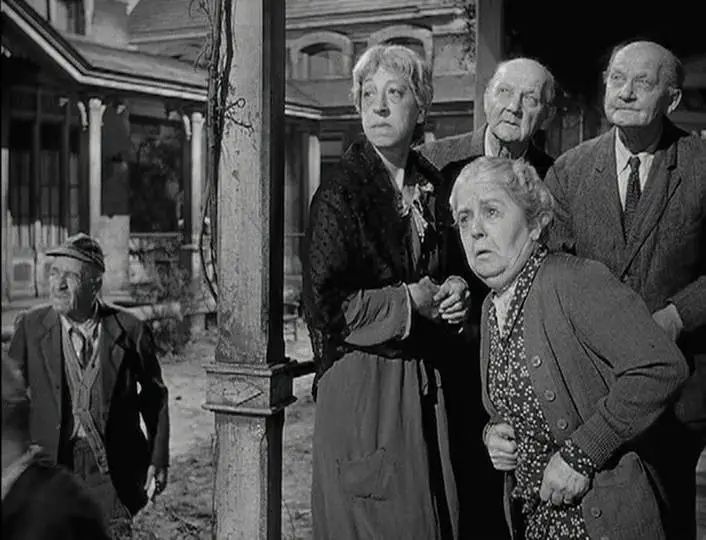
Mr. Belvedere Rings the Bell, released in 1951, was the third in the series and the best of the three. It was also unique for featuring a plot set in the unlikeliest of places - a nursing home. 

While on a lecture tour, Belvedere overhears some elderly people in a park complaining about life and their various ailments. The idea of getting old before his time intrigues him and he wonders whether there is "any point in living to be 80." 

Being the man of action that he is, he abandons his tour - much to the chagrin of his publicity agent (Zero Mostel) - and decides to enter himself into the Church of John Home for the Aged to see what life in a nursing home is like. Entrance is not as easy as it seems for they do not accept people under 70. But fortune favors the bold and Mr. Belvedere is mistaken to be a Mr. Erwenter, a 77-year-old man who had already enrolled...so he simply assumes his identity. 

The inhabitants of the old age home welcome him with excitement because "Mr. Erwenter" isn't a bit like themselves. He has a zest for living and, strangely enough, doesn't look like he is 77 years old at all!

"We're very happy to have you with us, Mr. Erwenter. It will make a nice change." - Nurse Harriet

"You've no idea how much of a change it will make!" - Mr. Belvedere

Belvedere's original intention in coming to the Church of John may have been to preview his future but once he arrives and sees the downhearted spirits of his fellow lodgers, he makes up his mind to become an instigator of change, an intentional gust of wind to stir their minds and blow new life into their dull and uneventful lives. 

Each of the inhabitants is touched in a profound way by this one man. Mr. Beebe (Billy Lynn) is especially affected by Belvedere's arrival. Mr. Beebe has no interest in life. He is waiting for spring, even while knowing that the spring to come will only resemble the winter that was. 

Mr. Cherry (Harry Hines) is downhearted, too. He eats the food that is set before him but wishes the church had the funds to buy him a new set of teeth. Ms. Hoadley drinks ("Nobody has a right to be that happy, " a fellow lodger comments); Ms. Sampler only talks of "love, love, love" and the three marriages she had; and saddest of all is Mrs. Hammer (Doro Merande) who hides her loneliness behind snarky - although amusing - remarks. 

"Eat and sleep, sleep and eat. The only action we get around here is in our stomachs."

Nurse Harriet (Joanne Dru) always has a cheerful smile and tries her best to tend to their needs and liven their spirits. "Someday we'll have a wonderful garden with green grass and pretty flowers," she says. "Flowers won't grow here. The whole place is old, even the ground. You ought to be ashamed to run an old dump," Mrs. Hammer replies. 

Harriet is in love with Reverand Watson (Hugh Marlowe) but he seems oblivious to her. The reverend wants the best for the elderly left in his charge but he has become so preoccupied with bills and the needs of the church that he has neglected their spiritual needs. 

"Bills, bills, bills! Religion has become so expensive, only the wicked can afford it."

They all need a shot of vitality and this is what Mr. Erwenter aka Mr. Belvedere provides in the form of a secret youth potion. He tells them of the days he spent with the great Lo Chin Po, a 112-year-old Tibetan, and how together they discovered a formula for restoring youth. "I will write to Lo Chin Po and ask him to send me some more pills for you," Mr. Erwenter announces. The excitement of the thought of being young again makes everyone come alive. 

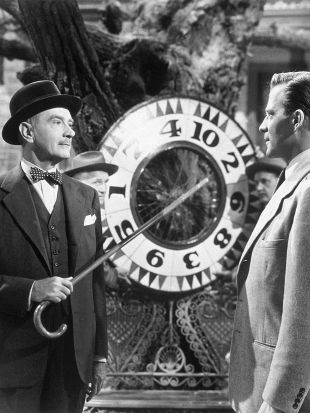
Mr. Erwenter also arranges a bazaar to help the church raise money for Mr. Cherry's new set of teeth and Mrs. Hammer's appendix operation. He gives them all something to look forward to, a new lease on life. But the happiness they feel and their faith in Mr. Erwenter crumble suddenly when they discover that he is not Mr. Erwenter at all, but a 45-year-old author named Mr. Belvedere who has been "feeding us lies."

With a plot such as this you would imagine that Mr. Belvedere Rings the Bell is a depressing film to watch. After all, it is set in a rundown nursing home filled with characters who are waiting to die. But it is quite the contrary - it is a gem of a comedy. The script, by Ranald MacDougall, is marvelously witty and benefits from having talented character actors deliver the lines with such humor. 

Doro Merande is especially wonderful in the role of bitter Mrs. Hammer. Most of the actors were much younger than the characters they were playing but they tottered around looking convincingly old. Billy Lynn, as Mr. Beebe, gives a touching performance of a heartbroken old man. Like a child who just discovered that Santa Claus is only a fable, Mr. Beebe is hurt more so than the others by Mr. Belvedere's "betrayal" because he had the most faith in him.  

"Being young is the way you think! Live every moment as if it is going to be the last one you will ever have. Believe you're young and you will be young. That's my secret."

Hugh Marlowe is wonderful as always as the kindly minister whose life and outlook of life is changed by Belvedere's arrival, and Joanne Dru, as Harriet, is a lovely ray of sunshine in their bleak world. Also in the cast are Warren Stevens, Jane Marbury, and Hugh Beaumont as a policeman. 

The story was based on the play "The Silver Whistle" by Robert E. McEnroe, which featured a cheerful hobo named Wilfred Tasbinder who takes on the persona of Mr. Erwenter and helps the lives of those in a nursing home. Ranald MacDougall took the character of Belvedere from Gwen Davenport's 1947 novel and blended him into McEnroe's story, sprinkling the script with wry humor. 

20th Century Fox released a number of fine light-hearted comedies like this in the late 1940s and early 1950s. They all were given a healthy budget and a great production staff. Henry Koster (The Luck of the Irish, Harvey) was put in charge of directing Mr. Belvedere Rings the Bell and he had a marvelous flair for making films that were both sentimental and humorous...and shared a message. This picture was ideal for his talents and featured a story about a beneficial intruder not unlike the leading characters found in The Bishop's Wife and Come to the Stable, both of which he directed. 

Mr. Belvedere Rings the Bell has a beautiful message about enjoying life and making every moment count. At one point in the film, Belvedere asks Harriet, "It's close to 10 o'clock now. 9 o'clock is gone and we can never bring it back and live it over. What have you done with the thousands of moments in the past two years?" This question is directed at Harriet the nurse and yet it is asked of the audience as well. Mr. Belvedere, in his vast 45 years of age, has lived a full life. In the one brief week he spends at the Church of John Home of the Aged, he stepped into the lives of the people there unexpectedly and touched each one with his presence. With the thousands of moments we all have, it makes you wonder if you cannot do the same and see how rich life can be. 

This post is our contribution to The Intruder Blogathon being hosted by yours truly, Silver Scenes, from June 16-18, 2023. Click here to read more reviews of films featuring characters that "intrude" in the lives of others and touch them for the better. 

Sunday, December 20, 2020

All I Desire ( 1953 )

Naomi Murdoch is returning to the small town of Riverdale to see her daughter perform in a high school play and the town is in a gossiping uproar. Nearly ten years earlier, Naomi left Riverdale, her husband Henry (Richard Carlson), and her three children to pursue a career on the stage as an actress. The townsfolk - and her family - have not forgiven her... all except Lily (Lori Nelson), Naomi's younger daughter. It was a letter from Lily that brought Naomi on her homeward journey. 

Once back in Riverdale, Naomi comes to realize how much she has missed her family and her home. But she feels that it is too late to make amends. Henry and she argue the first night she arrives and their eldest daughter Joyce (Marcia Henderson) is particularly bitter towards her. To make matters worse, Dutch Heinemann (Lyle Bettger), a local shop owner, thinks that because Naomi is back in town they can pick up where they left off with their affair. 

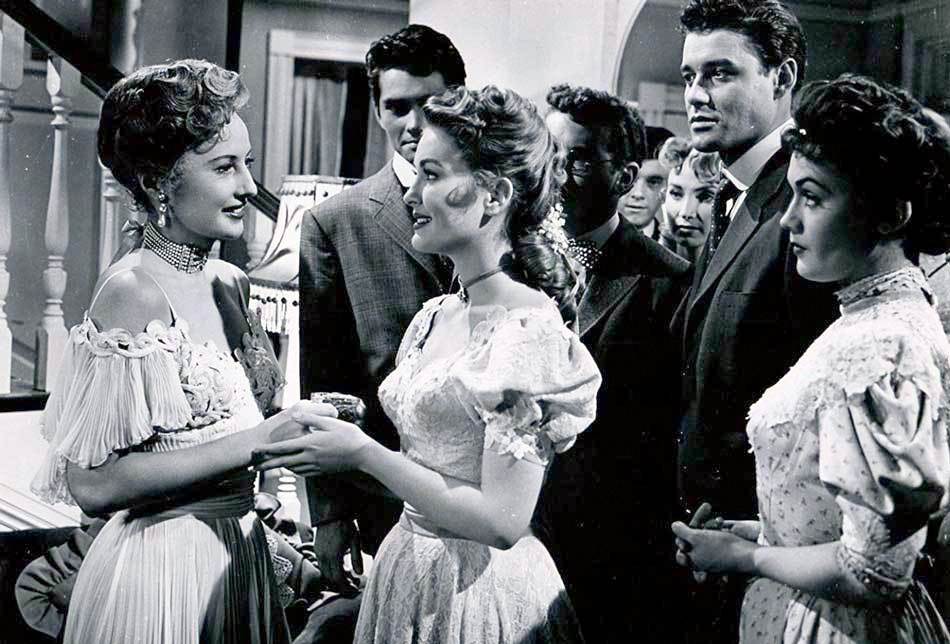
All I Desire was directed by Douglas Sirk and, like most of his films from the 1950s, it is bubbling with soapy melodrama. Most of his films were shot in color, but this one was black-and-white and it was a good decision to film it in monochrome because of the emphasis it gives to the low lighting and shadows that were beautifully captured by cinematographer Carl Guthrie (Caged). 

The script was an adaptation of Carol Brinks' novel "Stopover" and, even though the film's runtime is only 80 minutes, it manages to pack in quite a lot of drama in such a short span - with, surprisingly, no loose ends. 

Barbara Stanwyck was ideally cast as Naomi and looks stunning in the turn-of-the-century period costumes designed by Rosemary Odell. Naomi is a weary, hardened woman who never truly achieved success in the theater world yet she chooses to portray herself as an elegant and distinguished actress to make her family proud. Few actresses could have embodied this role with as much conviction as Ms. Stanwyck.

Richard Carlson is also well-suited in the role of Henry, the mild-mannered school principal who is shocked by his wife's return. Henry was beginning to grow attached to Ms. Harper (Maureen O'Sullivan), the school's drama teacher, but when Naomi comes back into his life, he has to re-evaluate his feelings. 

Also in the cast is Billy Gray as Naomi's son Ted, Lotte Stein as the Swedish housekeeper, and Richard Long as Joyce's charming beau. Stuart Whitman and Guy Williams have small parts as Lily's school companions. 

The publicity department at 20th Century Fox probably thought that the film's period setting would turn away audience members and so they created poster art that, amusingly, had nothing to do with the film. One poster has a background of storm clouds while a man (presumably Richard Carlson) kisses the neck of a negligee-clad woman who looks a lot like Barbara Hale. Another has a dark-haired Barbara Stanwyck cradling the head of Robert Mitchum, both of them wearing outfits that look like they came out of the 1940s (!). 

All I Desire did not need the pulp-fiction publicity to sell it, because the film is a fine production all around and is one of Barbara Stanwyck's best films of the 1950s. 

Saturday, June 20, 2020

Voyage to the Bottom of the Sea ( 1961 )

"Dive! Dive!"

Film producer/director Irwin Allen let audiences dive deep into the waters of adventure with Voyage of the Bottom of the Sea, his second of three feature films that he made at 20th Century Fox studios in the early 1960s. Prior to gaining a reputation as "The Master of Disaster" because of his disaster-themed films of the 1970s, Allen tried his hand at writing, producing and directing adventure pictures. His first production for Fox - Lost World ( 1960 ) - was co-written by Charles Bennett and its success at the box-office led to the two men collaborating on another Jules Vernes-like story. They took some inspiration from "20,000 Leagues Under the Sea" and created a clever story about a modern era atomic submarine 

Walter Pidgeon stars as the cigar-chomping Admiral Nelson, inventor and commander of the newly-built atomic sub Seaview. The Seaview is on diving trials in the Arctic Ocean when they discover boulder-size pieces of ice crashing into the sea around them. They surface and find that temperatures are over 100 degrees and the sky is aflame. A meteor shower had pierced the Van Allen radiation belt and caused it to catch on fire. Admiral Nelson and his right-hand man, Commodore Emery ( Peter Lorre ) believe that the Earth can be saved from burn-up if a missile were to be shot into the Van Allen belt to create an explosion. According to their calculations, this missile can only be launched from the Mariana Islands, and so the Seaview races to the south to reach the islands before the entire world burns. 
Along for the ride is Dr. Susan Hiller ( Joan Fontaine ), a psychologist who is studying crews for their reaction to stress, Vice-Admiral B.J. Crawford ( John Litel ), and Congressman Parker ( Howard McNear ). The voyage progresses smoothly until doubts begin to arise in the mind of Captain Lee Crane ( Robert Sterling ) as to whether the admiral is making a sound and safe decision. Lt. Connors ( Barbara Eden ) has complete faith in the admiral but cannot explain the unusual happenings onboard the Seaview...acts of sabotage that appear to be of Admiral Nelson's doing. 
Voyage to the Bottom of the Sea is a fun adventure flick packed with action. The race-against-time element makes the story exciting enough, but Allen threw in a touch of mystery with the added story of the saboteur. There are also two octopus attacks and a great mine-field sequence. 

The Van Allen radiation belts had only recently been discovered when Irwin Allen began writing Voyage to the Bottom of the Sea, and so much about them was still unknown. The idea of the Van Allen belt catching on fire was later proven to be impossible, but at the time, it probably sent shivers down audiences thinking about it being an actual possibility. 

Even though most of the film takes place within the confines of the Seaview, the film never feels stagebound. The sets, created by Herman Blumenthal, were very imaginative ( they were later reused for the television series ). The Seaview itself is an especially good design. 
Irwin Allen plunged $1.5 million dollars into the making of Voyage to the Bottom of the Sea and it paid off handsomely. Critics gave the picture mixed reviews but audiences loved it and the movie raked in over $8 million dollars. 

Teen singing-sensation Frankie Avalon helped to lure in the young female audience. His part was not very dramatic and, surprisingly, he didn't sing in the film but you can hear his voice crooning the opening credits. 

Also in the cast was Michael Ansara ( who fell in love with and married Eden after making the movie ), Regis Toomey, Henry Daniell, Skip Ward and Mark Slade. 

Tuesday, February 25, 2020

Journey to the Center of the Earth ( 1959 )

Back in 1864, Jules Verne penned "Journey to the Centre of the Earth", a novel about a group of intrepid individuals who undertake a subterranean journey to discover the very center of our Earth. Why would anyone want to take such a journey? As one of the explorers in this expedition explains, "Why does man freeze to death to try and reach the North Pole? Why does man drive himself to suffer the steam and heat to discover the Amazon? Why does he stagger his mind with the math of the sky? Once a question arises in the human brain the answer must be found, whether it takes a hundred years or a thousand years." 

It is the spirit of adventure that is celebrated in the act of exploring the unknown, and the ultimate aim of all Science is to penetrate this unknown. Scientists spent years exploring the many features of the earth's surface but who has penetrated its depths? Arne Saknussemm has! Or so this movie claims. The 16th-century Icelandic alchemist was ridiculed for his preposterous attempt to reach the Earth's core, but 350 years later, Professor Oliver Lindenbrook ( James Mason ) stumbles upon evidence that proves he did just that, and ventures forth to go there himself. 

By the time he leaves, the party has grown to five members: Alec ( Pat Boone ), a student of his at the University of Edinburgh; Carla ( Arlene Dahl ), the widow of a fellow explorer; a burly Icelander named Hans ( Peter Ronson ) and his pet duck Gertrude ( excellently played by herself ). Spending a year beneath the surface, they encounter a cavern of luminescent crystals, large deposits of salt, an ocean, the lost city of Atlantis, and even another explorer...bent on making sure his own name goes down in history as the first man to reach the center of the Earth!
Journey to the Center of the Earth was released in 1959 by 20th Century Fox and was the first film adaptation of Verne's popular novel. Producer Charles Brackett called the original story "a delightful book, written for young people. We simply couldn't have any solemnity about it. I wanted very much to do it at this time. I'm tired of all these films based on thoughts at the back of sick minds......Our picture describes action and events, with not the slightest shadow of Freud. The serious thing about Jules Verne is that all he does is tell a story in exciting episodes, but his stories have always pushed man a little closer towards the unknown. What we've tried to do is retell his story in the best way of all - in the Verne vernacular."
Indeed, the film captures all of the excitement of the original novel without getting bogged down with Verne's scientific details. Walter Reisch ( Gaslight, Niagara ), who had written a number of science fiction stories, was called in to adapt the novel into a script. He cleverly added story elements that made it more palatable for filmgoers, including adding an extra member of the expedition - Carla Thompson. This provided an opportunity for a touch of romance between her and Professor Lindenbrook. Arlene Dahl was excellent in this part. She made Carla an independent-thinker, strong-willed and capable and yet retained her feminine charms. Carla took on the mother-role of the group providing moral support and cooking skills and enjoyed letting the men provide for her and the rest of the group's practical needs.

The comradery between all of the members of the expedition - and the actors who portrayed these characters - is what makes Journey to the Center of the Earth particularly enjoyable to watch. They strike out on an adventure into unknown territory and, like true Victorian explorers, are heedless to the dangers that lie ahead. In jolly spirits, they take all they encounter in stride, carefully making detailed observations for those who may follow in their path, never doubting that they will return to the surface of the Earth to show others the way.

Reisch also added some introductory material to his adaptation and set the events in Edinburgh, Scotland. Here, we witness Professor Lindenbrook in his native habitat, teaching geology at the University of Edinburgh. The events leading up to the journey unfold when his prize pupil Alec, gifts him with an unusual volcanic rock, a lump of lava that contains a hastily scrawled message from long-lost explorer Arne Saknussem. The intrepid professor endeavors to set off at once to follow in Arne's footsteps, but soon discovers that his secret discovery is not so very secret. Two men are already on his trail and set to foil him, one of them being the villainous Count Saknussem ( Thayer David ), a burly descendant of Arne. 

James Mason was tailor-fit for the part of the professor and gives a rousing performance. Surprisingly, Mason was not the first choice for the part. Clifton Webb was originally cast but, having recently undergone surgery, had to withdraw from the production just before shooting began because the physicality of the role would have been detrimental to his health. 
Pat Boone was obviously cast to make the film appealing to younger audiences. He does an excellent job as well, singing only two songs throughout the film ( he had more musical numbers but they were later cut ). Diane Baker was added as his love-interest, the lovely Jenny Linden. The poor girl patiently waited two years to see her sweetheart re-emerge from the depths of the earth. Also in the cast is Alan Napier, Ivan Triesault, and Edith Evanson. 

Journey to the Center of the Earth did extremely well at the box-office, raking in nearly $10,000,000 ( it had a $3.4 million budget ). It had incredible fantasy elements and showed its audience that a whale of a good time could be had beneath the Earth's crust. The Lindenbrook expedition encountered everything from man-eating lizards and giant mushrooms to the lost city of Atlantis, all without the benefit of CGI. 
The film was nominated for these special effects as well as for its art direction. The talented Lyle Wheeler was responsible for these sets, which were highly imaginative and colorful. Wheeler captured the atmosphere of old Edinburgh in the opening scenes, created the beautiful interior sets of Lindenbrook's house ( including an impressive library ), and served up a veritable smorgasbord of fanciful sets for the center-of-the-Earth sequences, including a beautiful cavern of fluorescent rocks. 

Walt Disney's 20,000 Leagues Under the Sea ( 1954 ) was one of the first color film adaptations of a Jules Verne novel and its success created a whole new genre of Victorian adventure films. Like Leagues, Journey to the Center of the Earth not only boasted beautiful sets but a striking color palette that set the tone for all other films in its genre, including The Time Machine ( 1960 ), The Lost World ( 1960 ), Mysterious Island ( 1961 ), and First Men in the Moon ( 1964 ). 
It also had an impressive score by Bernard Herrmann. The opening theme heralds the approaching adventure to be enjoyed and the rest of the score captured all the beauty, thrills, and wonderment to be found in the caverns of the deep.

Sixty years after its release, Journey to the Center of the Earth remains one of the best adventure films ever made because at the core of the film is rock-solid entertainment, pure movie magic that ignites your imagination and inspires you to set off on your own adventure. And that is the stamp of excellence for any adventure flick. 

Friday, July 12, 2019

Charlie Chan in Egypt ( 1935 )

In this eighth installment of the 20th Century Fox Charlie Chan series, the famous Hawaiian detective sets off for Egypt to investigate the theft of archeological treasures....and unwraps a case of murder instead!

Detective Chan ( Warner Oland ) dons his sun hat and journeys to Egypt on behalf of the French Archeological Society to investigate the whereabouts of errant artifacts purloined from Professor Arnold's recent excavation of Ameti's tomb. Once he arrives, he discovers that Professor Arnold has left on an archeological dig weeks ago and sent only one mysterious letter in his absence. His son ( James Eagles ) and daughter ( Pat Paterson ) are both worried about him and for good reason... the following evening Charlie, along with Professor Thurston ( Frank Conroy ) and Arnold's young assistant Tom ( Thomas Beck ), discover his body concealed within the sarcophagus from Ameti's tomb!

"Varnish on 3000-year-old mummy case not completely dry." - Chan 

Screenwriters Robert Ellis and Helen Logan were making their series debut ( they would go on to pen nine Chan films ) and weaved an exotic mystery that combined all the elements audiences would hope to see in a Chan film set in Egypt: hot desert sands, an ancient Egyptian curse, a secret chamber in a tomb, and of course, mummies. 
Warner Oland is always delightful to watch as the honorable Charlie, but he seems lonesome here without the presence of his Number One son Lee to distract him in his investigation. Instead, to add humor, there is Snowshoes ( Stepin Fetchit ), a hired hand at the dig site who hopes to find his ancestors among the mummies. Also in the cast is a young Rita Hayworth ( billed Rita Cansino ) who has a small part as a maid at the Arnold residence. 

While Charlie Chan in Egypt boasts a great setting and is an entertaining entry in the series, it lacks the zip of some of the other Chan films. Most of the picture is set within the Arnold estate and grounds which gives it the confined feeling of a stage play and the suspects are not plentiful. The presence of Lionel Atwill or George Zucco as a shady antiquities dealer would have given the film the boost of an additional sinister suspect. But as Chan would say, "It takes very rainy day to drown duck". 

Friday, April 19, 2019

Charlie Chan in Panama ( 1940 )

Detective Charlie Chan finds himself once again in the midst of treachery and danger when he heads down to Panama in this 22nd installment of 20th Century Fox's Charlie Chan film series.

A sinister criminal by the name of Reiner is intent on destroying the U.S naval fleet as it passes through the Panama Canal. Chan, who is working undercover in Panama City, has only one clue to Reiner's identity - he or she was one of the nine passengers aboard the Trans-Panama Airways clipper ship that arrived in Panama City the morning of the death of Chan's contact agent Mr. Godley. Within 48 hours, Chan - with the aid of his Number 2 son - must unmask Reiner and discover how this mastermind will attempt to destroy the fleet.

There were 28 Charlie Chan films made for Fox studios and Charlie Chan in Panama ranks high as a fan favorite. It was based on the 1934 film Marie Gallante starring Ketti Gallian and Spencer Tracy. Screenwriters Lester Ziffren and John Larkin heightened its entertainment value immensely by adding numerous suspicious characters and clever red herrings.
Among the suspects are novelist Clivedon Compton ( Lionel Atwill ), scientist Dr. Grosser ( Lionel Royce ) who is experimenting with infecting rats with the bubonic plague, engineer Richard Cabot ( Kane Richmond ), schoolteacher Miss Finch ( Mary Nash ), tobacconist Achmad Halide ( Frank Puglia ) and a cabaret singer by the fanciful name of Kathi von Czardas ( Jean Rogers ). 

"Bad alibi like dead fish, cannot stand test of time."

Sidney Toler is always wonderful to watch. After Warner Oland's untimely demise, Toler took over the role of the world-famous Honolulu detective and added his own unique touches to the character. Victor Sen Yung makes his fourth appearance as Jimmy Chan, Charlie's Number Two son, and he is a delight as well. Later, he would become famous on television as the chef Hop-Sing in Bonanza
As in most of the Chan films, the atmospheric settings are excellent, with credit going to art director Richard Day ( How Green Was My Valley ) for his beautiful sets. Charlie Chan in Panama was tautly directed by Norman Foster who helmed most of the Mr. Moto series of films. 

Saturday, March 9, 2019

Down Argentine Way ( 1940 )

Betty Grable and Don Ameche head south of the border in one of the most delightful Fox musicals of the 1940s - Down Argentine Way. Sparkling Technicolor, musical melodies to tickle your fancy, an amusing script, and Carmen Miranda chica-chica-booming in her tutti-frutti way are just a few of the pleasures it offers.

"Where there are rhumbas and tangos
To tickle your spine
Moonlight and music and orchids and wine
You'll want to stay down Argentina Way"

Don plays Ricardo, an Argentinian who comes to New York to sell some horses. Glenda Crawford ( Betty Grable ) wants to buy one and they make a deal, but the moment Ricardo discovers her last name is Crawford, he calls the sale off! His padre ( Henry Stephenson ) has a long-standing feud with the Crawfords and will not sell horses to them at any cost. So, in a huff, Glenda takes a trip to Argentina with her Aunt Binnie ( Charlotte Greenwood ) to settle the score...under the guise of purchasing some fresh studs for their stable. Naturally, she finds sweet romance under the Pampas moon with Mr. Ameche instead.

Bedecked in eye-popping Travis Banton costumes, Betty Grable is a veritable feast for the eyes in this picture. She jiggles her way through the samba-inspired "Down Argentine Way" dance number wearing a gorgeous two-piece ensemble adorned with blue beads and looked equally radiant in a sheer puffy-sleeved white dress singing "Two Dreams Met" with Don Ameche.

Betty Grable had made nearly 50 films before she was cast as bubbly Glenda Crawford. Not knowing what to do with her, Fox had just decided to try Grable out as a dramatic actress with a lead opposite Tyrone Power in A Yank in the R.A.F when they discovered that Down Argentine Way, which was released one year prior, was raking in profits. Thank heavens! Betty may never have been a musical star if it wasn't for the success of this film. And Hollywood would have missed out on such a vibrant and adorable personality!

As critic Stephanie Zacharek so aptly described her, "Grable's appeal in Down Argentine Way...radiates from a place that has nothing to do with strict acting chops. She's a persistently warm, accessible presence; there's something kind and forthright about her." It is undoubtedly this quality - and her million dollar legs - that made Grable the pin-up gal favorite with the soldiers overseas during the war years.
The top attraction of the film, for me, was the presence of Don Ameche. Dapper Don, with his bright beady eyes, has such an infectiously happy personality and he even gets to sing two numbers in his pleasant tenor voice. Betty and Don were so well-suited to each other in Down Argentine Way that Fox studio teamed them up again the following year in Moon Over Miami. 

Down Argentine Way features a cast of excellent character players including Leonid Kinskey ( in a role originally intended for Cesar Romero ), Charlotte Greenwood, J. Carroll Naish, and Henry Stephenson. There is also an appearance by Carmen Miranda who was making her first US feature film. She got a chance to perform three upbeat tunes ( "Mamãe Yo Quero", "Bambu Bambu", and "South American Way" ). The movie is chock-full of musical and dance numbers and alongside Miranda, the Nicholas Brothers entertain with their tap-dance routines, Six Hits and a Miss perform the delightful "Two Dreams Met", and the Flores Brothers Trio gently croon "Nenita".
The film raked in nearly $2 million in profits, becoming 20th Century Fox's biggest hit of the year. It was originally made in response to President Franklin Roosevelt's request for Hollywood to make films to encourage the "Good Neighbor Policy" towards Latin America. Unfortunately, Argentina banned the picture during its initial release for its misrepresentation of the real culture of the country: inaccurate traditional costume designs and mixing rhumba and Spanish flamenco with the tango was a no-no. Even Miranda's presence was considered insulting because she was Brazilian, not Argentinian! 

Most Americans didn't recognize any of these errors and just enjoyed the film for what it offered - plenty of sunshine and merriment. And that alone probably boosted South American tourism and Good Neighbor relations!

Wednesday, October 31, 2018

Victorian Thrillers of the 1930s & 1940s

Victorian London, steeped in a dark and romantic aura, has always been the ideal setting for murders and mysteries in films of the 1930s and 40s. Lurking beneath the white facade of stately manors inhabited by fashionable ladies and gentlemen with high morals and social sensibilities lay seedy districts reeking with crime and misery....districts where foul deeds were not uncommon. Opium-addicts, prostitutes, music hall wenches, and rum-guzzling sailors were wildly cavorting with Destiny on a nightly basis.

It was this contrast between wealthy society and dredging poverty that gave birth to so many tantalizing stories of horror in the "Penny Dreadful”'s of the day; stories with characters like Sweeny Todd the Demon Barber of Fleet Street and Jack Sheppard. All of them were loosely based on news accounts these authors were reading about on a daily basis of the serial killer Jack-the-Ripper.

In these gentle times even whispers of innuendo were received by ladies with a good dose of smelling salts, nevertheless, these tales of true-life terror were repeated throughout the city and developed into short stories of legendary fame. They featured crimes that super-sleuths like Sherlock Holmes could solve on a weekly basis or settings that gentlemen thieves such as Raffles could prowl around in. Once motion pictures gained popularity, these stories were brought to life in visual splendor. One of the earliest films to depict this atmospheric era to perfection was Dr. Jekyll and Mr. Hyde (1931) starring Frederic March, Mariam Hopkins, and Rose Hobart. Director Rouben Mamoulian's pre-code horror classic transported audiences to a dark and dangerous London of the late 1800s, where they were able to witness first-hand the transformation of the reserved Dr. Jekyll into the hideous Mr. Hyde. 
Here are a few more well-known Victorian London thrillers brought to the silver screen :

The Mystery of Mr. X (1935) - This decisively Jack-the-Ripperish story features Robert Montgomery as our light-fingered gentleman hero who is being implicated as the killer of nine grisly London murders done by a murderer who always strikes in a different neighborhood and leaves his mark next to his victims…the signature of Mr. X! Peter Lawford starred in a remake of this tale in MGM’s The Hour of 13 (1952). 
The Adventures of Sherlock Holmes (1939) - A grisly midnight murder in a secluded city park, mysterious South American funeral dirges, suspiciously heavy footprints, missing crown jewels from the Tower of London and a puzzling drawing of an albatross add up to making this one of Sherlock Holmes’ most intriguing cases. Ida Lupino and Alan Marshall star with Basil Rathbone and Nigel Bruce in this second Sherlock Holmes feature from the 20th Century Fox studios. A visual Victorian feast for the eyes it be.

Dr. Jekyll and Mr. Hyde (1941) - MGM pulled out all the stops in this ultra-glossy gas-lit masterpiece based on Robert Louis Stevenson's classic tale of a man's double nature - the law-abiding Dr. Jekyll and the positively hairy sexual sadist Mr. Hyde, the creature within himself that he created whilst experimenting to scientifically suppress the evil nature residing within mankind. The all-star cast includes Spencer Tracy in the title role, Ingrid Bergman as buxom barmaid Ivy, Lana Turner, Donald Crisp, and Ian Hunter. Directed by Victor Fleming. 
The Lodger (1943) - Laird Crager, a great burly hulk of an actor, portrayed the very essence of a creepy social recluse in The Lodger where, as Slade - a quiet pathology student residing at the home of the Burtons (Sir Cedric Hardwicke and Sara Allgood) - he is suspected of being none other than Jack the Ripper. Gasp! The gorgeous moody photography of John Brahm transports us into the cobblestoned mire of Whitechapel through its heavy fog-encased settings, period detail, and its disturbing visual vignettes. George Sanders and Merle Oberon also star.

Gaslight (1944) – Charles Boyer, Ingrid Bergman and Joseph Cotton star in this intrepid MGM remake of the 1940 British classic Gaslight featuring Anton Walbrook and Diana Wynyard. Twenty years after a wealthy woman was murdered in her home in Thorton Square her niece moves into the London dwelling with her husband, a suave and sinister gentleman who plots to drive his wife mad because he has a dark secret to hide. MGM attempted to destroy all available prints of the English version of this psychological thriller but fortunately a few remained and today we can enjoy both editions on DVD. 
The Picture of Dorian Gray (1944) - Oscar Wilde's fantasy about the inner state of the soul of one Dorian Gray was given A-class treatment in director Albert Lewin's pet project The Picture of Dorian Gray, released through MGM. Silky smooth 26-year-old Hurd Hatfield played the title character (a role which made him very unpopular in Hollywood) along with an impressive cast including George Sanders, Donna Reed, Angela Lansbury, Peter Lawford and Sherlock Holmes veteran actor Miles Mander. Incidentally, Basil Rathbone wanted the role of Lord Henry but was overlooked because he was already being too closely identified with the legendary detective of Baker Street. Stunning cinematography, a strong narrative, and eye-popping Technicolor sequences make this a most memorable film.
Hangover Square (1945) - Laird Cregar returned to the screen as another downright suspicious madman, this time as a pianist who had to struggle with mental turmoil - and the compulsion to wreak destruction - whenever he hears the ping! of a certain note.John Brahm’s filming is atmospheric and eerie in its dreamlike sequences and the film has a great cast including George Sanders and Linda Darnell.