Saturday, July 6, 2013

Hollywood Home Tour - Buster Keaton

"We're going to be heading a bit off course for today's featured home...we got a special request to drive by Buster Keaton's Los Angeles mansion so that's where we'll be going right now" 


"It's a good thing the Silver Scenes bus can not only take us back in time but knows where she's heading to as well, for I sure don't know where to go this time! I lost our L.A map back in front of Rochester's home. I'll have to ask the Metzinger gals if they can get me another copy. 

"Here we are folks...I'll park a little in front so you can get a better view. This grand manor was one of thirteen homes that Buster Keaton owned while living out here in California. This may have been one of the houses he lived in during his marriage to Natalie Talmadge.  


"That was a rather unhappy marriage. They hopped around from house to house and finally settled on building a elaborate estate to rival that of her sisters Constance and Norma. It was a huge 10,000 square ft residence over in Beverly Hills that Buster called the "Italian villa". We'll visit it a little later in the tour. Right now I'd welcome any information about this house. Just holler out if you got something to share!


"Our tour would be cut short if we stopped here, so since we are in the neighborhood let's swing on over to the prostegious Hancock Park so everyone can get a look at his other home...

"This beautiful Tuscany estate was designed by Smale & Blaize architects in 1923. It spans nearly 6,000 square feet, with six bedrooms and six bathrooms, a grand foyer entrance and a beautiful water fountain in the back. The house was featured in Architectural Digest a few years later but by 1926 Norma Talmadge was tired of the place and plans were underway to have the Italian villa built. 

"Yes, it's no wonder Buster has a sad face....such opulence and yet such discontentment."

543 South Murfield Rd, Los Angeles

Up-to-Date Note : The South Murfield house looks as glamorous as ever and recently sold for $3,895,000. 

This post is apart of the Silver Scenes Hollywood Home Tour, hosted by Al the bus driver.

Thursday, July 4, 2013

Happy Birthday America!


Happy Birthday dear dear America!

You're going through rough waters right now Lady Liberty but hold in there, you've been waving your torch for 237 years and we want to see it shining brightly another hundred years. 

May God always protect our country and restore it to the land of liberty and freedom it once was, and should always remain. 

Now it's time to bring out the fireworks!! 


Tuesday, July 2, 2013

The Nugget Reviews - 2


The Satan Bug ( 1965 )  14k


With the help of the government, an ex-spy races to recover a stolen vile of virus that a madman intends to use to destroy the people of Los Angeles and then the world. George Maharis, Anne Francis, Richard Basehart, Dana Andrews. Directed by John Sturges. Mirisch Corporation. 

George Maharis is excellent here as a fast thinking ex-agent. He should of been the star of a spy series all his own. "The Satan Bug" is a taut thriller with nice desert locales, a helicopter chase, and a surprise villain ( I thought for sure Dana Andrews was our evil mastermind in disguise ). Oops, did I give something away?

___________________________________________________________


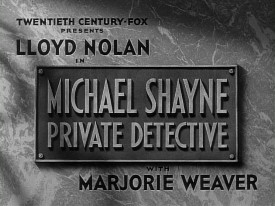
Michael Shayne, Private Detective ( 1940 ) 14k


Michael Shayne tries to clear his name of a murder wrap when the boyfriend of the rich gal he is hired to protect is found dead...supposedly shot with Shayne's gun.  Lloyd Nolan, Marjorie Weaver, Joan Valerie, Walter Abel, Elizabeth Patterson. Directed by Eugene Forde. 20th Century Fox.

The quick witted Miami detective, Michael Shayne, is first introduced this fast-paced film about a switcheroo at the horse track. Elizabeth Patterson is a doll as the aunt who loves to solve Baffle Book mysteries and tags along with Shayne for thrills. It gets a bit confusing near the end, but all the actors are so entertaining to watch understanding the plot isn't really an issue. Or as Chief Painter put it, "You may understand but it's all Hungarian goulash to me!".

          ___________________________________________________________


Crash Dive ( 1943 ) 14k 


A lieutenant and a submarine commander fall in love with the same girl but must work together to destroy a Nazi ammunition dump. Dana Andrews, Tyrone Power, Anne Baxter, James Gleason. Directed by Archie Mayo. 20th Century Fox. 

Very entertaining as far as war films go. ( That wasn't a crack, we're big fans of action flicks ). This one was obviously catered to the feminine crowd as well for about half of the movie is about the blossoming romance between Anne Baxter and Tyrone Power. Stunning color, great special effects and an exciting commando raid make this an all-around 'A' picture. 

           ___________________________________________________________


Francis in the Navy ( 1955 ) Elct.


Lt. Peter Stirling finds he has a doppelganger in the Navy. When Francis gets auctioned off for the Navy, Peter finds he can't escape back into the Army because of his missing twin. ( Sorry folks, that's the best I can do....the plot eluded me as well. Look how confused Hyer looks in that poster ). Donald O'Connor, Jim Backus, Martha Hyer, Richard Erdman. Directed by Arthur Lubin. Universal Pictures. 

Francis the mule entering the Navy seemed like a promising plot situation that could of taken many turns but what screenwriter Devery Freeman came up with was terribly disappointing. Francis doesn't even get much of a part. Most of the movie has Donald O'Connor running around in his underwear. A young Clint Eastwood and Martin Milner play fellow sailors. 

          ___________________________________________________________


Boeing Boeing ( 1965 ) 14k 


A news correspondant in Paris has a man's dream schedule worked out - he has three different fiancees that he lives with, all airline stewardesses, whom he juggles in between their flights. When the new "super-thrust" engine gets installed on all the Boeings his schedule gets all mixed-up. Tony Curtis, Jerry Lewis, Thelma Ritter, Dany Saval, Suzanna Leigh. Directed by John Rich. Hal Wallis Productions. 

Clearly a stage comedy, "Boeing Boeing" features that popular 1960s frantic-romantic theme with lots of characters going in and out of doors and hiding from each other. ( The tag line to the film was "The big comedy of Ninety-Sexty-Sex"...oh brother ) Thelma Ritter is great as Curtis' maid, uttering "it ain't easy" in between cooking knackwurst and saurkraut, but the film is too long and gets tedious near the end. Add to that Tony Curtis' overly-nervous acting and it becomes sub-par to the other comedies of the era. 

Saturday, June 29, 2013

The Films of Joan Davis - A Slapstick Sensation

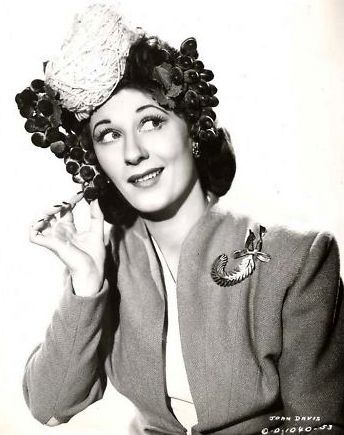
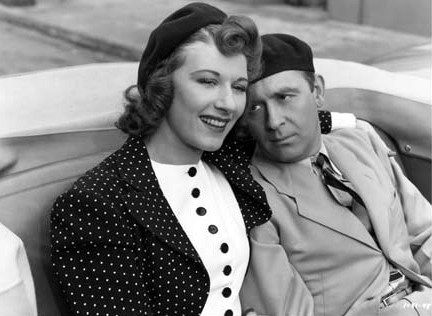
Joan Davis was a master of zany comedy. She was the feminine variant of Danny Kaye, Oscar Levant and Billy de Wolfe all rolled into one. But mostly she was uniquely Joan Davis : rubber-faced, loose-limbed and shamelessly outrageous. A lost species from the bygone era of vaudeville.  

It was in vaudeville that Joan got her start. Billed as "The Toy Comedienne" she toured all around the states during the 1920s and by the time she reached her upper teens had performed on virtually every vaudeville circuit in the country. Her broad sense of comedy appealed to the masses and after entering films she quickly became one of the most popular comedians of the 1930s and 40s. Some critics hailed her as "the world's funniest woman". In over 45 motion pictures she exercised her raucous voice and muscle-straining grimaces in wet-your-pants-funny gags.  

Like Eve Arden at Warner Brothers, Twentieth Century Fox often utilized Davis as "comic relief" to their box-office stars, Shirley Temple and Sonja Henie. She played second-fiddle to Alice Faye in several films ( "On the Avenue", "Wake Up and Live", "Tail Spin", "Sally, Irene and Mary" ) and got to take center stage in a number of musical showcases such as "Around the World" and "Sun Valley Serenade" where she performed solo in several short skits.  It was in these vaudevillian style skits that she really excelled. In the 1937 Sonja Henie film "Thin Ice" she performs 'Olga from the Volga' and 'My Swiss Hilly Billy' with adroit burlesque.


"Gee, if I only had your face. You know, when I was born, my father took one look at me, called up the insurance company, and said 'I want to report an accident.'" ( Show Business ) 


It was after leaving Twentieth Century Fox however that Joan Davis got starring roles in films at other studios such as Republic Pictures and RKO. In 1941 she teamed up with Jinx Falkenberg in "Two Latins from Manhattan", a film that proved to be enough of a success that the two were teamed again in "Two Senoritas from Chicago" ( 1943 ). She was paired with Eddie Foy Jr. in "Yokel Boy" ( 1942 ), Jack Haley in "George White's Scandals" ( 1945 ) and Eddie Cantor in the wonderful "Show Business" ( 1940 ) and "If You Knew Susie" ( 1948 ), one of Cantor's last films. 


Although she was a versatile comedian and could perform in any scenario with success, it was in Joan Davis' dance performances that her forte in humor lay. She would enter a dance with such an expression of seriousness and then as the number would continue, and get progressively worse, it would clearly turn into a farce, with Joan usually ending up on her rump by the conclusion of the dance. The "Swan Lake" dance with Lou Costello in Abbott and Costello's "Hold That Ghost" ( 1941 ) was Joan at her prime...no matter how many times that scene is watched a gigantic belly-laugh ensues. It remains one of the greatest shticks in any Abbott and Costello film. 


In the mid-1940s she starred in several comedies written especially to suit her unique comedic style - "Kansas City Kitty", a musical about a piano teacher literally falling for her music publisher, played by none other than Bob Crosby, and "Beautiful But Broke" where she plays a secretary who slaps together an all-girls orchestra at short notice. 


Over at Universal Joan Davis made two little gems, "She Gets Her Man" ( 1945 ) , a fast-paced mystery about the daughter of a former police chief having to fill his shoes and catch a mysterious blow-gun killer at large, and "She Wrote the Book" ( 1945 ) , a humorous tale revolving around a college professor who takes the place of a steamy bestselling author to save the real author from embarrassment only to receive a bump on her head and suffered a brief case of amnesia where she believes she is the scandalous author. Oh my.

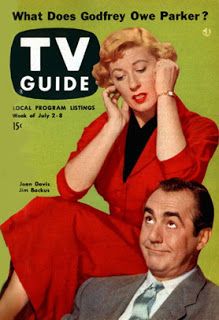
By the late 1940s, the public's taste in humor was changing and the wild and wacky slapstick of Joan Davis wasn't selling tickets anymore. Yes, it was time to move to television! Anything goes there. Her last film was "Harem Girl" ( 1948 ) and then Miss Davis took the plunge...all the way. She formed her own production company and vigorously plugged herself as America's favorite comedienne starring in the now-obscure I Married Joan television series. The show featured the misadventures of a scatterbrained housewife married to a lawyer, a pre-Magoo Jim Backus. Whilst on-air there was an all-out war between NBC's I Married Joan and CBS's I Love Lucy which premiered one year prior. The stations battled it out and Lucy won, hands down. 

Despite the results for the shows, if Lucille Ball and Joan Davis were to go head-to-head in a battle of the dippy dames, Joan Davis would emerge the victor. She was the batty blonde to top all. 

Today Joan Davis is little known, even among film buffs. Cable channels have neglected to play her films and the I Married Joan series has yet to get an official dvd release. But as is evident in this clip from "Yokel Boy", she is a delight to watch and in our opinion remains one of the greatest film, tv and radio comediennes. 

Joan Davis ( June 29, 1907 - May 22, 1961 )  Happy Birthday Joan! 


This post is our contribution to the Funny Lady Blogathon hosted by Movies Silently where over 35 bloggers shed the spotlight on the greatest funny ladies of the silver screen. 

Thursday, June 27, 2013

Million Dollar Baby Found!

After months of searching for the elusive Million Dollar Baby we finally found it! We bought it at an auction along with some other goodies and for a mere two dollars we had the bundle delivered right to our doorstep. With anxious fingers we unwrapped our package and behold...the shiny dvd glimmered with glee at being brought to its new home. ( You didn't really think we found a million dollar baby did you? ) There's such a great thrill in finding a rare film. 


Here's the low-down on the plot and cast : 

Wealthy Cornelia Wheelwright ( May Robson ) discovers from her new lawyer ( Jeffrey Lynn ) that her father's fortune was obtained by swindling his former business partner, Fortune McAllister. Feeling guilty for her ancestor's skulduggery she seeks to make restitution by searching out the only living heir to McAllister, a young woman named Pamela ( Priscilla Lane ), and bestowing upon her the sum of one million dollars. Before handing her the sumly amount though, Miss Wheelwright wants to see what kind of a woman she is, and so she takes a room at the girl's boarding house under an assumed name and comes to know Pamela better, quickly becoming her fairy godmother. 

"Million Dollar Baby" was directed by Curtis Bernhardt and released by Warner Brothers in spring of 1941. Apple Annie May Robson is delightful as crotchety Miss Wheelwright and Priscilla Lane and Jeffrey Lynn are as lovable as can be but its Ronald Reagan's performance as Peter the pianist that really shines in this Cinderella story. He plays the All-American hero once again here as Pamela's boyfriend, a good-clean lad who wouldn't even think about letting his gal support him, even though it would mean giving him the breaks he needs. 

Although "Million Dollar Baby" was entertaining overall and had some witty dialogue the film lacked the good punch it could have had under a more capable director such as Frank Capra. Leonard Spigelgass' story would of been prime material for him in the 1930s as a feature film for a young Jean Arthur. 


The moral of this story is "money can't buy you happiness"...it has a familiar ring to it doesn't it? Unlike the Four Daughters series, Jeffrey Lynn does not come away putting a ring on Priscilla Lane's finger and nobody ends up with a million dollar baby....except us, of course. 

Tuesday, June 25, 2013

The Films of Ray Harryhausen

Ray Harryhausen was one of Hollywood's most famous stop-motion animators and most influential special effects innovators. Prior to the development of computerized special effects, stop-motion animation played a key role in adventure and sci-fi filmmaking from the 1940s up until the 1980s. Of those that were skilled in this technique there were relatively few. Ray Harryhausen not only mastered the slow and delicate art of animation but he made large strides in what can be done - with a little bit of patience - using simple models and photography. 


When "Jason and the Argonauts" hit the big screen in 1963 audiences were in awe of Jason's fight against the army of skeletons. Harryhausen breathed life into those inanimate objects with bone-clattering violence. A pterodactyl silently swooping down upon a lone cave woman, a goddess taking the form of a ship's figurehead, a giant bronze statue creaking to life to wreak vengeance on the men who stole the sacred treasure of the gods, these were all memorable moments on screen that not only seemed amazing in youth but continues to astound today, even in the midst of mind-boggling CGI effects. 

George Lucas, claimed that "if it hadn't been for Harryhausen there would have never been a Star Wars". Directors Peter Jackson and James Cameron also cite Harryhausen as their inspiration and his films their incentive to pursue film-making as a career. 

This post is called The Films of Ray Harryhausen because, although he was not an auteur filmmaker and his role in the movies that he made could not be confused with that of the director, he did much more than his simple credit of "special visual effects" justified. It was often Harryhausen who proposed the initial story concept, scouted the locations, helped work on the script, the art direction and the design of the film. It's no wonder that these films have a distinguishable style that sets them apart from other adventure films of the era. They all bear the Harryhausen stamp. 

Ray Harryhausen ( June 29, 1920 - May 7, 2013 )


Mighty Joe Young ( 1949 )

A young girl in Africa raises a gorilla and must decide whether to expose him to the "jungle" of New York when a promoter decides to exhibit the creature. Terry Moore, Ben Johnson, Robert Armstrong. Directed by Ernest Schoedsack. 

The stop-motion Pioneer Willis O'Brien, was approached by a teenage Ray Harryhausen in the early 1940s and asked if he could study under him, O'Brien told him to go to art school and practice his craft all he can. He did, and later, in 1948, O'Brien asked him if he would like to work with him on his upcoming picture "Mr. Joseph Young of Africa". Did he! "Mighty Joe Young" was essentially a remake of Willis O'Brien's own classic "King Kong" ( 1933 ), but it became the launching pad into a world of feature film animation for Ray Harryhausen. 


The Beast from 20,000 Fanthoms ( 1953 ) 

Scientists discover that a prehistoric dinosaur was reawakened to life during an Arctic atomic bomb test. Paul Christian, Paula Raymond, Cecil Kellaway, Kenneth Tobey. 

"The Beast from 20,000 Fanthoms" was Harryhausen's first solo project and the film where he developed the split-screen animation technique which was later to be known as Dynamation. "Beast" was a great commercial succcess and opened the doors to greater projects for Harryhausen. 


It Came From Beneath the Sea ( 1955 ) 

Radiation from bomb tests conducted in California change the feeding habits of an octopus by creating a ferocious appetite! Kenneth Tobey, Faith Domergue, Donald Curtis, Ian Keith. 

Following the success of "The Beast from 20,000 Fanthoms", came this creature flick from out of the primordial depths of Charles Schneer's imagination. The young producer from Columbia Pictures was introduced to the budding animator and together they created this monster classic - as well as a partnership that spanned over three decades. 


Earth Vs. The Flying Saucers ( 1956 ) 

A scientist is contacted by alien beings who secretly plan to enslave all inhabitants of Earth. Hugh Marlowe, Joan Taylor, Donald Curtis, Grandon Rhodes. 

What better way to follow up a monster movie than to make a sci-fi film? And no sci-fi film would be complete without retro UFOs. "Earth Vs the Flying Saucers" contains an excellent sequence of the alien flying discs attacking the nation's capital, Washington D.C. 


20 Million Miles to Earth ( 1957 ) 

A giant reptilian-like creature from Venus stows away on the return flight of a US spaceship and wreaks havoc in Europe. William Hopper, Joan Taylor, Frank Puglia. 

The death of the giant prehistoric Ymir - part dinosaur, part fish - at the close of this film was reminiscent of Willis O'Brien's classic "King Kong". Harryhausen always wished to create his own legendary figure that would move an audience to feel pathos at the creature's demise, much like Kong did, and with "20 Million Miles to Earth" he succeeded in doing just that. 


The 7th Voyage of Sinbad ( 1958 ) 

Sinbad undertakes a quest to a mysterious island to obtain the ingredients to cure a princess of a curse she received by a wicked magician. Kerwin Matthews, Kathryn Grant, Richard Eyer, Torin Thatcher. 

"The 7th Voyage of Sinbad" was Harryhausen's first foray into the realm of color filmmaking. Although he had done a number of short stop-motion animation films in color this was the first time he would experiment with Dynamation in color. Within his studio confines he had the added hassle of matching the lighting and coloring of his filming with that used in the live-action sequences. The result was stunning. "The 7th Voyage of Sinbad" remains one of Harryhausen's most memorable movies. 


The 3 Worlds of Gulliver ( 1960 ) 

A man is washed away during a storm at sea and lands on an island inhabited by little people...Lilliputians. Kerwin Matthews, June Thorburn, Jo Morrow, Lee Paterson. 

"The 3 Worlds of Gulliver" is one of the least known films of Harryhausen, notably because of the lack of any large beastly creature. It has, however, some really great special effects and was the first of his films to be billed as using the "Superdynamation" process. 


Mysterious Island ( 1961 ) 

A group of prisoners of war during the Civil War escape in an air balloon and are washed ashore on an island inhabited by strange beasts and a mysterious visitor. Michael Craig, Joan Greenwood, Michael Callan, Gary Merrill. 

After Ray Harryhausen's modifications to Jules Verne's 1874 novel, "Mysterious Island" did not bear much resemblance to its source, which is just as well. Verne's sequel to "20,000 Leagues Under the Sea" did not contain much excitement in itself, but with Harryhausen's additions of a giant man-eating crab, an underwater city, a prehistoric baby bird attack, a 15ft. tall bee, and pirates, it was a beaut. 

Jason and the Argonauts ( 1963 ) 

The Greek hero, Jason, sets off on a voyage, along with a hand-picked crew, to the land of Carcus to capture the golden fleece. Todd Armstrong, Nancy Kovack, Gary Raymond, Laurence Naismith. 

Undoubtedly Harryhausen's most famous film ( it is his personal favorite as well ). This mythological classic featured the stunning skeleton sword fight, Talos the giant guardian of the god's treasures, and the six-headed hydra. Although it was not a box-office success upon its release it gained momentous popularity in the decades since and is now regarded as one of the greatest adventure films of the 1960s. 


One Million Years B.C ( 1966 ) 

The life of a lone caveman and his mate in a land inhabited by dinosaurs and hostile neighbors. John Richardson, Raquel Welch, Percy Herbert.

Harryhausen had a chance to return to creating dinosaurs in Hammer Studio's production of "One Million Years B.C". It was a loose remake of "One Million B.C" ( 1940 ) which featured very poorly done special effects. With the addition of Raquel Welch's own special eye-popping effects "One Million Years B.C" became a huge international success. 


The Valley of Gwangi ( 1969 ) 

In the Forbidden Valley in Mexico resides a Tyrannosaurus Rex whom a cowboy captures to gain fame by exhibiting in a circus. James Franciscus, Gila Golan, Richard Carlson. 

Back in 1941 Willis O'Brien conceived of a dramatic dinosaur western and called it "Gwangi". His pet project was never realized until Ray Harryhausen pitched the idea to Charles Schneer in 1967. "Gwangi" contains one of Ray's most elaborate animation sequences - the roping of Gwangi by cowboys. 


The Golden Voyage of Sinbad ( 1973 ) 

Sinbad meets a vizier who has part of a golden map, one of the which parts matches Sinbad's own, and together they voyage out to solve the riddle of the map, with an evil sorcerer on their tail. John Phillip Law, Caroline Munro, Philip Baker.

After the completion of "Jason and the Argonauts" in 1963, Ray Harryhausen wanted to develop another Sinbad adventure, intending on calling this feature "Sinbad's 8th Voyage". The idea was placed on the back-burner however until 1969 when it was put to simmer once more and developed into what became "The Golden Voyage of Sinbad". The dancing statue of six-armed Kali and the one-eyed centaur are just some of the highlights of this rousing adventure. 


Sinbad and the Eye of the Tiger ( 1977 ) 

Sinbad helps a cursed prince by sailing on a voyage to a dangerous island to seek a cure, whereupon a witch attempts to thwart their plans. Patrick Wayne, Taryn Power, Margaret Whiting.

Sinbad returned to the screen once more in this thrilling installment which included the classic baboon prince and the evil sorceress Zenobia. Harryhausen developed a plot treatment of the story back in 1974 but it was not until 1976 that filming began. 


Clash of the Titans ( 1981 ) 

Perseus goes on a journey to save the Princess Andromeda and encounters Kraken, a sea monster and Medusa along the way. Laurence Olivier, Maggie Smith, Harry Hamlin, Claire Bloom.

"Clash of the Titans" was given an enormous budget of $16 million by MGM to make ( Columbia had turned down the project ) but it went on to become a worldwide success raking in $41 million in the U.S alone. Beverley Cross, the screenwriter who worked on almost all of Harryhausen's films, developed the premise for this story, which was billed as "An Epic Entertainment Spectacular".


The dynamic threesome of Charles Schneer, Ray Harryhausen and Beverley Cross teamed up once more to create another classic legend epic, this time to be called "Force of the Trojans", a story about the journey of Aeneas from Troy to found Rome. MGM once again agreed to finance the project but over the years it languished. 

Hence, "Clash of the Titans" became the final film in Harryhausen's fantastic filmography. Perhaps in the future one of his ardent fans, such as Peter Jackson, may resurrect "Force of the Trojans" and make it the classic it would have undoubtedly become. Although, they must be careful how they go about it for as Harryhausen once said " If you make things too real, sometimes you bring it down to mundane "

Bibliography : 

Ray Harryhausen's Fantasy Scrapbook : Models, Artwork and Memories from 65 Years of Filmmaking - Ray Harryhausen and Tony Dalton. Aurum Press. 


Further Reading : 


The Art of Ray Harryhausen - Ray Harryhausen and Tony Dalton. Aurum Press 

Ray Harryhausen : An Animated Life - Ray Harryhausen and Tony Dalton. Billboard Books.

Saturday, June 22, 2013

Ray Harryhausen and the Creation of Dynamation


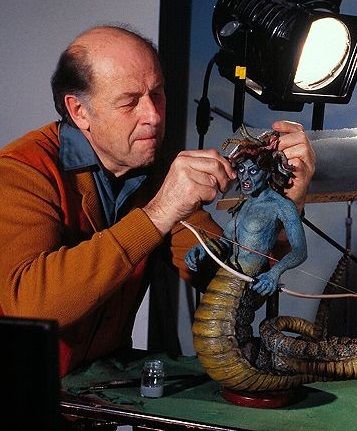
Ray Harryhausen was the stop-motion animator extraordinaire behind such fantasmagorical creatures as the fighting skeletons, the cyclops, Medusa, Kraken, and the beast from 20,000 fanthoms in such classics as "Jason and the Argonauts" ( 1963 ), "The 7th Voyage of Sinbad" ( 1958 ), and "Clash of the Titans" ( 1981 ). 

As part of our tribute to the late Ray Harryhausen we thought we'd include a brief introduction to the process he created known commercially as DynamationIt can also be called the "split-screen" process because of the way the screen appears to be split while the animation is being enacted in the middle layer.  

Prior to Harryhausen's development of this technique most animation was created for sequences that did not require "live" actor interaction within the scene. For instance, in an adventure film a group of archaeologists may come across a dinosaur grazing on grass in the distance. The director of the movie would film the actors expression of surprise upon seeing the dinosaur and an animator would film the stop-motion sequence of the dinosaur but when completed these scenes would remain separate...actors in one scene, animation in another. However, with the split-screen process, viewers were able to see the actors directly interacting with the animation..e.g a dinosaur with a man struggling to get free from his grasp.

In three-dimensional stop-motion animation, an object, or a poseable model, is photographed one frame at a time using a traditional film camera. In between each frame the animator moves the arms or legs of the model a fraction of an inch before photographing the object again. When these still shots are run through a projector the rapid succession of images creates the illusion of movement. A standard 35mm film projector runs the film at 24 frames per second, and so 24 separate photographed frames have to be taken to make each second of animation on screen. Hence, a 2-minute sequence of a giant cyclops eyeing a tasty morsel for dinner would take 2,880 separate frames to compose. Quite a time-consuming task! 


Stop-motion animation can be traced back to the beginning of movie-making, in the late 1800s.  Some of the earliest animated films include Vitagraph's "The Humpty Dumpty Circus" ( 1897 ) by Albert E. Smith and J. Stuart Blackton, featuring a circus of acrobats and animals coming to life, and "The Haunted Hotel" by J. Stuart Blackton ( 1907 ). 

Willis O'Brien was the resounding king of animation during the early days of talking pictures. He brought to life the prehistoric creatures of yor in First National Pictures adaption of Arthur Conan Doyle's "The Lost World" ( 1925 ) and later, in one of the most iconic films of the century, "King Kong" ( 1933 ), where he created a creature so lifelike in appearance and emotion that many viewers were brought to tears at his demise at the end of the film. 

It was Willis O'Brien's work on "King Kong" that instilled in Ray Harryhausen the desire to make stop-motion animation his career. The Eighth Wonder of the World inspired the young 14-year-old Ray to attempt creating his own model Kong, which led to his discovery of the stop-motion animation process. 


Under O'Brien's tutelage, Harryhausen learned the filmmaker's craft from the ground up and by 1948 was working alongside O'Brien on his first feature film, "Mighty Joe Young" ( 1948 ). O'Brien had utilized the multi-dimensional process of interacting animation with the actors through the means of sandwiching his models between two glass paintings, one of which was painted foreground, and shooting "through" them with the camera.

It was while working solo on his second feature film ,"The Beast from 20,000 Fanthoms", that Harryhausen realized what a tiresome and time-consuming process painting foreground could be and knew that it would never work for that particular film due to the low budget the production had. He had been experimenting with using mattes as far back as 1938 to create a "split-screen" and so on "The Beast from 20,000 Fanthoms" he put those tests to use. 


The split-screen was a simple process that used mattes to block out portions of the film. Since film only develops from the light that escapes through the eye of a camera, any portion that is blackened out remains undeveloped. If the film is rewound the portion that was blackened can then be used again. This technique was used as far back as the early 1900s.

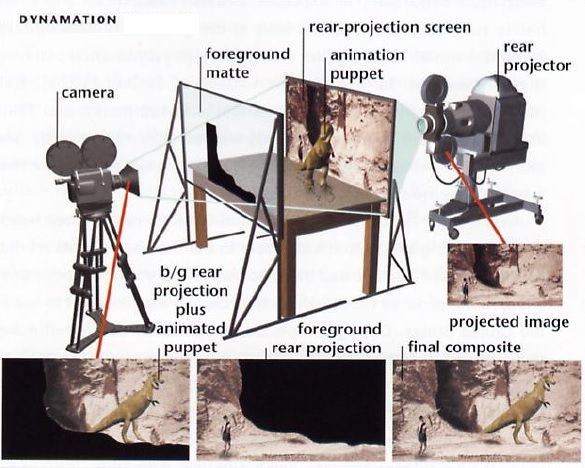
Dynamation however, used a model in between the matte and the background image to create a three layered image. The first step in the Dynamation process was to plan out in detail the movements the model, or creature, was to make and then to film the live-action scene with the actors and usually a stick or stand-in crew members to represent the movements and position of the creature. 


This film was developed and rear-projected on a screen. Harryhausen would place his model on an animation stand in front of this screen and then place a large pane of glass in front of that. On this glass he painted in black the foreground that he wished to block out. After filming the animated sequence so that the creature interacted with the actors as planned, he then rewound the film and filmed through the glass again, this time with the image he had previously filmed blackened out. 


Although it sounds like a very tiresome process, it was actually much easier to utilize mattes then to build and film miniature sets for the models to move in.

In 1957, Charles Schneer, the producer of many of Harryhausen's films during the late 50s and 1960s, dubbed this split-screen technique Dynamation. He was sitting in his Buick one day while waiting for traffic and noticed the Dynaflow logo written on the dashboard...he thought the prefix dyna would be the perfect marketing term for Harryhausen's animation process. 

Harryhausen used Dynamation in "It Came from Beneath the Sea" ( 1954 ), "Earth Versus the Flying Saucers" ( 1956 ), "The Animal World" ( 1956 ) and "20 Million Miles to Earth" ( 1957 ) but it was not until "The 7th Voyage of Sinbad" ( 1958 ) that it was exploited as a merchandising feature. 

"Dynamation will be brought to the screen for the first time in COLOR!"


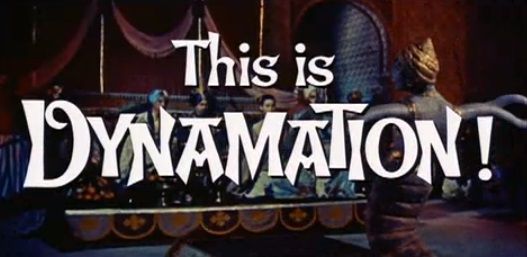
In the short trailer "This is Dynamation!" ( 1957 ) used to promote "The 7th Voyage of Sinbad", the narrator announces the glorious wonders of the technique and how "anything that the mind can conceive can now be brought to the screen". 


Dynamation was utilized on all of the Ray Harryhausen films up until his final feature motion picture, "Clash of the Titans" in 1981. Today, most special effects are created using computer graphic programs ( CGI ) but somehow, in spite of the amazing realism provided by digital graphics there is something very unique, very alive, about Harryhausen's technique. Perhaps the creatures we see created by computer effects have lost their awe because we know the secret behind their existence  The mysterious process of Dynamation was kept from the public during the release of many of his biggest films... and this was one more element that added to the magic of the Harryhausen pictures. 

Cyclops     Gwangi