Showing posts with label Anthony Quinn. Show all posts

Wednesday, January 24, 2024

The Savage Innocents (1960)

This is not a family film. This is not a movie you would see on a date-night or enjoy with friends. This is a movie you would most likely watch by yourself when you are in the mood for a docudrama ...or if you just happened to catch it late at night on television. I can't imagine sitting in a theater enjoying it; unless you are a couple who walked into a dark theater to neck and stayed to watch the film through. 

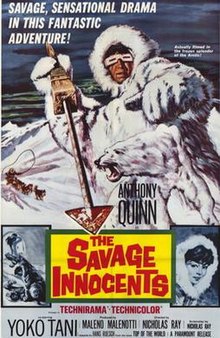
The narrow potential audience of The Savage Innocents made it a risk for producer Maleno Malenotti so, to cut his chances of having a complete box-office failure on his hands, he decided to put a Hollywood "name" on the marquee - Anthony Quinn. This as an unfortunate move because the film is about "the savage innocents" - Eskimos. It is about their social and living habits: how they hunt, how they build, how they mate, dance, eat, fight, feel and their viewpoints on birth and death. This is quite fascinating and, if The Savage Innocents was an Omnimax presentation, it would be a memorable documentary....but the Eskimo himself is what would make this film special, not a white man playing the part of an Eskimo. Especially not a tall, Italian-American such as Quinn. The Eskimos were indeed a savage but innocent race of people and innocence cannot be feigned. Anthony Quinn couldn't pull it off and, unfortunately, that one flaw turns what would be an otherwise enjoyable docudrama into an pretentious Hollywood production. 

The cinematography in The Savage Innocents is magnificent. It was filmed on location in northern Canada and Greenland and the second unit film crew captured the striking raw beauty of the arctic territory in sweeping wide vista shots, filmed in Super Technirama 70. Angelo Francesco Lavagnino's music is lovely, too, but these aspects were not enough to save the picture. 

Stateside, The Savage Innocents froze at the box-office. Director Nicholas Ray (Rebel without a Cause, Johnny Guitar) co-scripted the film which featured a simple story but one that allowed him to stamp with his personal touches. Ray loved movies that dealt with social issues and this film certainly had issues. 

The story follows the life of Inuk (Anthony Quinn), a lonely Eskimo who is anxious for a mate. Male Eskimos generally would accept any woman as a wife, but Inuk finds favor with Imina. Before he has a chance to pay her mother Hiko (Anna May Wong) for her hand in marriage, another man, Kiddok, weds her. Hiko offers her other daughter Asiak (Yoko Tani) to Inuk but he is enraged and decides to persue Kiddok to get his woman back. He takes Asiak and her mother with him on the journey so that he can trade them for Imina when he finds Kiddok, but by the time he reaches Kiddok he realizes he wants Asiak for his wife after all. 

Inuk, Asiak, and her mother, then journey on, continually following the nearest source of food to hunt and building igloos along the way. At nights, Inuk and Asiak "laugh" together (have sex) and in the day Inuk hunts. 

Inuk's hunting is another reason this film found disapproval among some critics and its audience. The film, an Italian-French-Anglo co-production, did not flinch from showing the plight of animals at the hands of Eskimos. Before the credits even roll, a polar bear is shown happily swimming in the water when a spear is thrown off-camera and it suddenly dies. This production cannot claim that "animals were not harmed in the making of his film". It is indeed savage. 


For Eskimos, however, hunting was - and is - their only means of survival and, as the narrator exclaims in one scene, "[they accept] without bitterness Nature's eternal tragedy: that the flesh must perish so that the flesh might live." They sacrifice their old and injured and sick to the animals of the land so that the animals may live and one day be food for others. This is what becomes of Hiko, who willingly waits to become food for a hungry polar bear. 

When they stop at a white man's settlement, Inuk offers his wife to a missionary in a gesture of kindness, but the white man is shocked by this and Inuk accidently kills him in their ensuing argument. According to Eskimo law, Inku committed no crime but in the law of the white man, he is a murderer. After Inuk leaves to return to his land, two troopers (Carlo Giustini and Peter O'Toole) are sent to pursue him and bring him back to "civilization" for execution. 

This finale of the lawmen chasing the criminal throughout the Arctic added excitement to the film, but once again, it featured some visually disturbing scenes that could have been omitted. The Wild North (1953), featuring a similar plot set in Canada, is a better film.

As one of the troopers, Peter O'Toole gave a memorable performance in his first screen role. If his distinguished English voice sounds different than usual, it is because he was dubbed by an Italian who was attempting a gruff American accent. He plays a determined law-enforcer but his notion of what is right and wrong is tested when Inuk saves his life. 

The Savage Innocents is one of those films that could have been something wonderful but falls short. Real Eskimos should have been cast in the leads and the animal slayings need not have been shown on camera. Nanook of the North (1922) and MGM's Eskimo (1933) featured unknown Inuit actors in the lead roles and both were profitable at the theaters so, in spite of Bob Dylan's praise of "The Mighty Quinn", his presence in this film was unnecessary. 

The Savage Innocents is available on DVD, Blu-Ray and also by streaming via Amazon Prime.

Thursday, May 20, 2021

The Black Orchid ( 1958 )

The Classic Movie Blog Association is hosting the Hidden Classics Blogathon giving film bloggers a chance to share a little-known or underrated gem with other film buffs. As some of you already know, underrated classics are what I love to write about most. There are hundreds of little-known treasures that deserve to be shared, one of which is The Black Orchid

The Black Orchid stars Sophia Loren and Anthony Quinn as a middle-aged widow and widower who fall in love and want to get married. The first half of the film follows happy-go-lucky Frank ( Quinn ) as he attempts to woo "the Black Orchid" Mrs.Rose Bianco ( Loren ). Some people in their Brooklyn neighborhood label her "no good" because she drove her first husband into a life of crime, an activity that eventually led him to be fished out of a river dead. Her neighbor Mrs.Gallo ( Naomi Stevens ) knows this isn't true and she encourages Rose to pay more attention to Frank. 

When he finally wins her affection, they encounter two roadblocks to the alter: Rose's son Ralphie ( Jimmy Baird ) who is spending time at a state work farm/juvenile center and Frank's daughter Mary ( Ina Balin, making her film debut ). Mary is about to wed her sweetheart Noble ( Peter Richman ) and move away into a house of her own but when she discovers that her father plans to wed, jealousy and bitterness consume her. Ralphie likes the idea of Rose remarrying but when he hears the wedding plans may be canceled, he runs away. 

Like most Hollywood films, The Black Orchid has a happy ending and if tears flow easily for you, you will probably need a handkerchief or two to dab your eyes when you see the sweet reconciliation between everyone. 

The Black Orchid was released by Paramount Pictures in 1958 and over the years has gotten some poor reviews for a very simple reason - the film is often misclassified as a comedy when it isn't. It is a drama. It has some humorous moments but it is far from being comedic. If you know you are about to watch a drama rich with emotion then The Black Orchid won't disappoint. 

The film was beautifully shot in black-and-white by Robert Burks ( Vertigo, North by Northwest ) who is best known as being Alfred Hitchcock's favorite cinematographer. It also features a good score by Alessando Cicognini and costumes by Edith Head, but what makes it stand out is its script. This was Joseph Stefano's first script. He would later become famous for penning the screenplay to Psycho ( 1960 ). Stefano created characters with depth and even though his dialogue is common-place, it is the natural-sounding tone of the lines that make this story seem so believable. Frank's first wife was mentally ill and so when Mary begins showing signs of bitterness, a dark underlayer begins showing through the story turning the romance into a psychological drama. 

Anthony Quinn and Sophia Loren give excellent portrayals of two tough Brooklyners from "the old country". Such a beautiful romance blossoms between them that it is painful to see how close their children came to breaking it up. Ina Balin gives an especially good performance as Mary, displaying her sweet gentle side in one moment and jealously and stubbornness in the next. 

Also in the cast is Virginia Vincent as Mary's friend Alma, Whit Bissell as the sympathetic director of the juvenile center, Joe Di Reda, and Frank Puglia. 

The Black Orchid is available on DVD and through streaming via Youtube and Amazon Prime. 

Click on the link here to read more reviews of little-known gems from the Hidden Classics Blogathon. 


Thursday, February 25, 2021

Against All Flags ( 1952 )

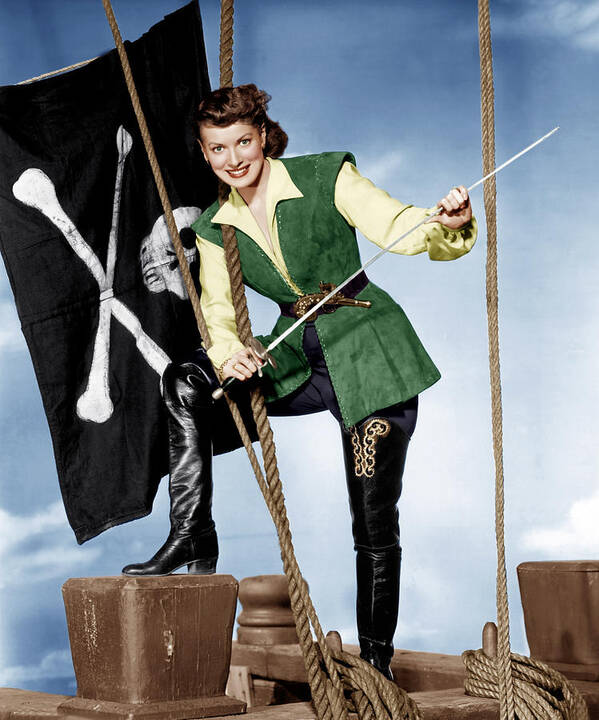
On the coast of Madagascar lies a pirate's hideaway - Diego Suarez - a fortress for thieves. A narrow harbor is the only entrance to the city and this is heavily defended by cannons. The British Royal Navy wants to destroy this base and capture every pirate on it but they cannot find a way to enter the harbor without damaging their fleet. Lieutenant Brian Hawke ( Errol Flynn ) has a plan: he poses as a deserter and hopes to gain entrance to the base by joining their band and gaining the trust of the pirates. Captain Roc Brasiliano ( Anthony Quinn ) is suspicious of this new recruit but "Spitfire" Stevens ( Maureen O'Hara ), another pirate leader, approves of him. She dislikes men in general but this handsome rogue intrigues her. She gives him the use of one of her ships and even agrees to marry him ( who wouldn't! ), but Hawke's plan backfires when he is discovered by Captain Roc signaling to the British fleet and is captured. As the British warships are just about to enter the bay, Hawke must find a way to free himself and save the fleet from destruction. 

Against All Flags is a grand little pirate flick. The story, by Aeneas MacKenzie and Joseph Hoffman, is easy to follow and packed with action and a dash of humor. George Sherman's direction is taut and the settings are colorful, looking gorgeous in Technicolor. The film also boasts a strong supporting cast that includes Mildred Natwick, Harry Cording, Phil Tully, and Lester Matthews. Robert Warwick has a great part as the infamous pirate Captain Kidd. However, it is the three leading stars that make this film special. 

Against All Flags was made seventeen years after Errol Flynn became famous as a swashbuckling hero in Captain Blood ( 1935 ). He wasn't as youthful but he certainly was just as dashing. Douglas Fairbanks Jr. was originally slated to star in the film but when Universal Pictures purchased the rights to the script they managed to snag Errol Flynn for the lead instead. This turned out to be Flynn's last Hollywood swashbuckler. 

Anthony Quinn signed on early to play the villain. He was probably delighted to find out that Maureen O'Hara was going to star in it as well. This was the fourth time these two cronies would be united - and the third pirate-themed film they would make together. Quinn is wonderful as the jealous Captain Roc. He wanted to make Spitfire Stevens his woman but could never arouse romantic feelings from her, hence he becomes doubly jealous when the handsome Lt. Hawke not only earns her admiration but her love as well. 

Maureen O'Hara was initially hesitant to star opposite Errol Flynn after he made an amorous advance towards her years earlier, but "he had won me over. I respected him professionally and was quite fond of him personally. Father Time was slowly calming his wicked, wicked ways, and deep within that devilish rogue, I found a kind and fragile soul."*

Her character is aptly named Spitfire Stevens because she has a fiery temper and a jealous streak, too. O'Hara always had a knack for playing women who were very strong and independent and yet still feminine with not a trace of tomboyism. She looks particularly dazzling in this film. 

Against All Flags premiered on Christmas Eve in New York and was a great success at the box office. Variety wrote that it "takes a tongue-in-cheek attitude towards the plotting at times without minimizing the story's chief concerns with swashbuckling movement." The plotline really took a comedic turn when it was later remade as The King's Pirate in 1967 ( starring Doug McClure and Jill St. John ). 

Hamlette's Soliloquy is hosting a pirate's party - We Love Pirates Week - running from February 22-26th. If you want to be reading more posts about pirates matey, then be sure to head over here and check out the entries! 

* 'Tis Herself - A Memoir by Maureen O'Hara. Thorndike Press ( 2004 )

Wednesday, September 12, 2018

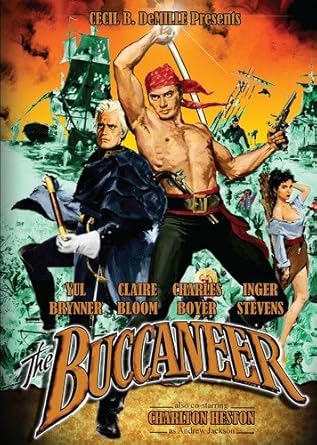
The Buccaneer ( 1958 )

"There comes a time when a man wants to change...belong to something, or maybe someone."

The pirate and privateer Jean Lafitte had warehouses of stolen loot, a beautiful house on the private island in Barataria Bay, and freedom to do as he pleased, but he lacked respect from the one woman he loved, Annette Claiborne. This woman instills in him a love for the still infant American nation strong enough to make him surrender his pirating ways and seek to become a citizen. But first he must prove to Governor Claiborne, Annette's father, that he is not in league with the British who are about to send thousands of troops into Louisiana to squash General Andrew Jackson's defense of the territory. 

In 1956, director Cecil B. DeMille had found great success with the remake of his silent film The Ten Commandments, and so he undertook another remake of a favorite film of his, The Buccaneer, first made in 1938 with Fredric March in the lead. During the making of The Ten Commandments, DeMille had suffered a heart attack but he had sufficiently recovered to believe that he was capable of undertaking another epic production. He was wrong. Shortly after the initial planning of The Buccaneer, DeMille realized that his health would not permit him to make the film and so he passed the directorial wand to his son-in-law, Anthony Quinn. 
Quinn had never directed a feature film but was willing to give it a try with his father-in-law helping to guide the production. This was the primary reason DeMille had selected Quinn - in order to have full control of the final production. Both came to regret this decision. DeMille was displeased with the film that Quinn had helmed and made editing changes to it before its release that Quinn did not like. 

Just why Cecil B. DeMille and Anthony Quinn were dissatisfied with the final result is difficult to fathom. While it is true that The Buccaneer lacks the compelling drama of The Ten Commandments, the film is colorful, entertaining, and does pack quite a bit of adventure into its 119-minute runtime. The battle scene at the end of the film is particularly thrilling with the bagpiping British troops appearing from the fog (a scene that Walt Disney's Bedknobs and Broomsticks would later echo). 

Unfortunately, the script to The Buccaneer, based upon the 1938 film, has mere threads of real history in its plot. Instead, the screenwriters (Jesse Lasky Jr., Berenice Mosk) fashioned a script that captures merely the flavor of the era and its setting. You can't ask for everything.

Yul Brynner, sporting a rare mop of hair, gives a convincing portrayal of the good-hearted privateer longing for a place to anchor. Lafitte is a likable and sympathetic character, as is his companion General Dominique You, played by Charles Boyer. "Of all the men in the world, I never wanted to fail you," Lafitte tells the General in a poignant scene when Lafitte realizes that his friendship with the General may be the price he has to pay for American citizenship. 

Charlton Heston, who is always a pleasure to watch, gives a powerful performance as General Andrew Jackson, reprising a role that he had played in The President's Lady (1953). Taking care of "Old Ironface" Jackson, making sure that he drinks his hot milk every night, is Mr. Peavy, played by the great character actor Henry Hull. 

The ladies are equally engaging. Inger Stevens, that icy blonde from Sweden, stars as the beautiful Annette Claiborne. She is in love with the pirate and is willing to surrender her status as a Southern society belle to sail off with him into the open sea. The marvelous Claire Bloom plays Bonnie Brown, a feisty tomboy who wants Lafitte as well. But her love is so deep she would rather see him wed to Ms. Claiborne than be with her. 

"You're a fool! She's everything you ever loved and fought for. You gave up everything you had, everything you are. Jean, even I don't want to see you lose her now."
Also in the cast is E.G. Marshall, Lorne Greene, Ted de Corsia, Douglass Dumbrille, and Fran Jeffries. 

At the box-office, The Buccaneer did poorly, bringing in only $3 million dollars in revenue, not even recuperating its $5 million dollar budget. When discussing the films of Cecil B. DeMille, The Buccaneer is rarely mentioned, even though his handiwork is clearly evident in many of the scenes. DeMille is also credited at the beginning of the film before the titles appear. But perhaps modern critics consider the production too run-of-DeMille to be even mentioned among his works.