Showing posts with label Fred MacMurray. Show all posts

Thursday, March 17, 2022

Dublin's Fair City - My Three Sons ( 1964 )

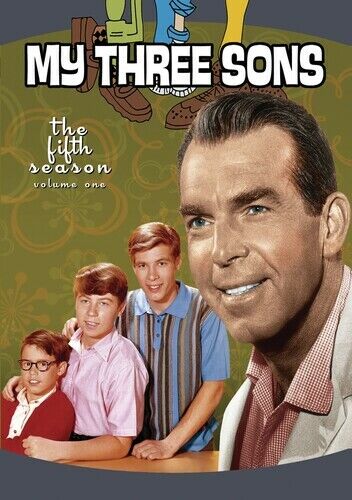
There were a great number of episodes from classic television shows of the 1950s and 1960s that featured characters visiting Paris and Rome, but there were very few that had characters going to Ireland. Since today be St. Patrick's Day, we'll be sharing with ye one of the best of these rare episodes - it be the 1964 classic "Dublin's Fair City" with none other than Steve Douglas and his brood of winsome lads visiting the Emerald Isle. 

This 2-part episode begins with William "Bub" O'Casey ( William Frawley ) receiving a letter from his cousin in Ireland announcing that he won the Irish sweepstakes. Bub had been sending his cousin money from time to time to buy sweepstakes tickets and they finally won the jackpot. With his share of the winnings, Bub decides to treat his family to a trip to Ireland to visit with his Irish side of the family. 

In Ireland, Bub reunites with his cousin ( Robert Emhardt ) and his aunt ( Jeanette Nolan ) and Steve Douglas finds himself being pursued by a young woman ( Mariette Hartley ) anxious to wed and come to America. The boys have little to do in this episode but strangely enough, their absence is not noticed.  
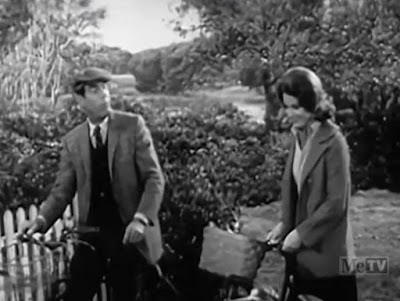
"Dublin's Fair City" is a fun episode to watch, primarily due to the presence of Jeanette Nolan as 103-year old Aunt Kate. She's a feisty biddy, yet lovable. Nolan steals every scene she is in and clearly enjoys spewing out nonsensical Irish sayings like "A man who mumbles often stumbles." She has a strong hold on her son Mickey and treats him like a little boy, even though he be in his 50s. One afternoon, when she catches him leaving his wood shavings on the ground outside after a bit of whittling, she sends him to his room without supper. Bub remarks that "that's telling him" and then she promptly sends Bub to his room, too! Mickey is portrayed by Robert Emhardt, who is best remembered for playing the visiting businessman in The Andy Griffith Show episode "Man in a Hurry". 

There is also a fun bit of not-so-romantic play between Mary Kathleen Connelly ( Mariette Hartley ) and Steve Douglas ( Fred MacMurray ). Mary takes a shine to Steve when she learns that he is a single man from America but her boyfriend Tom Grogan ( Sean McClory ) doesn't take to this lightly and, with his slingshot, aims acorns at Steve's head anytime he sees him with his girl. 
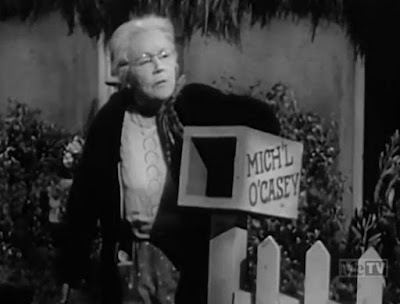
Naturally, the countryside of California becomes "Ireland" for the episode but it is really set quite well. With Irish music playing in the background, the episode does indeed have an Irish air to it and makes you feel like you went traveling with the Douglas' overseas. 

If this episode is new to you, then it is well worth checking out. Watching it may become a new St. Patrick's Day tradition in our house. 

Tuesday, May 12, 2015

Alice Adams ( 1935 )

Margaret Perry is hosting The Great Katharine Hepburn Blogathon for the second year in a row and for our participation in the event we chose to write about one of Hepburn's greatest and most overlooked films - Alice Adams ( 1935 ). 

Katharine Hepburn had made a successful start of her Hollywood career in the early 1930s with a string of fine pictures including Morning Glory and Little Women. However, several misfires ( The Little Minister, Break of Hearts ) put her star-status in danger. RKO was eager to have her regain her popularity with the public and so, to accomplish this, Hepburn and producer Pandro S. Berman decided her next part should be the titular role in the film adaptation of Booth Tarkington's 1922 Pulitzer Prize winning novel, "Alice Adams". 

In his novel, Tarkington had penned a satiric and shrewd observation of the claustrophobia and class distinction prevalent in small town America shortly after World War I. Alice Adams is an optimistic wisp of a girl who strives to rise above her commonplace existence by putting on the airs of a socialite, hoping to be accepted by her upper-class peers. However, her pitiful attempts at climbing the social ladder only lead to her being sneered at and shunned by her classmates. 

Alice is a resourceful girl and, much like another literary character, Anne Shirley, she strives to create a realm of beauty in the most crude setting. At the beginning of the film we see Alice eagerly awaiting the night of the Palmer's ball, the most elite social dance of the year. With her two-year old dress and a corsage of wilted violets, Alice attends the dance with her brother as escort. While there, she puts on a brave face while being ignored by everyone at the party. Never was there a lovelier, more quietly desperate wallflower than Hepburn's Alice. 


Upon leaving the dance however, Alice meets her Prince Charming, the handsome and very wealthy Arthur Russell ( Fred MacMurray ). He quickly sees through Alice's facade and, unbeknownst to her, comes to love the sensitive girl hiding within. But Alice, in her eagerness to hide her social status, papers over their growing love with lies. Later, while her family is on the brink of disaster, Alice strives to keep Arthur's interest and keep up the illusion she fancies she created. 

Katharine Hepburn gave a marvelous performance of Alice, bringing out all the charm and pathos of the character. Like most people, Alice's personality changes when she in among people outside of her family and it is a testament to Hepburn's skill as an actress to portray two unique sides of one character. When Alice is with Russell she becomes overwrought, expressing her feelings through nervous chatter. At home, especially when she is alone with her father, she displays a beautiful soul and a heart filled with great compassion. 

"You know, the other day when you walked home with me, I got to wondering what I wanted you to think of me in case I should ever happen to see you again"

"And what did you decide?"

"I decided I should probably never dare to be just myself with you. Not if I cared to have you want to see my again. And yet here I am, just being myself after all".  

- Alice, to Arthur, not truly being "herself" at all

Fred MacMurray is wonderful as the amiable young Russell. Unlike Alice, he cares little about social status. His feelings for Alice are sincere but he worries over the rumors in town being spread about the integrity of Alice's father.

Fred Stone, a very popular musical theatre actor and circus performer, took on his first feature-length talking role as Alice's father, Virgil. He gives a very compassionate performance as an ill man badgered by his family.

Rounding out the fine cast is Ann Shoemaker as Alice's ambitious mother, Frank Albertson as brother Walter, Evelyn Venable as the stately Mildred, Hattie McDaniel as the impertinent maid-for-hire, and Charley Grapewin as Virgil's boss, Mr. Lynn. 

Alice Adams is also notable for being the first dramatic film directed by George Stevens. The work he did on this picture propelled him to new heights as a director. Hepburn initially wanted William Wyler to take the helm, but at the insistence of Pandro S. Berman, and on the basis of Steven's knowledge of the book, she was willing to give him a try. As filming progressed, she found Stevens to be "a really brilliant director" and he went on to direct her in two other pictures - Quality Street ( 1937 ) and Woman of the Year ( 1948 ).


Alice Adams is a lovely genteel film filled with a delicate blend of humorous and heart-wrenching scenes. Stevens, and the entire cast, managed to create a film with just the right mixture of highly amusing comedy and captivating social drama. Strains of a beautiful violin melody by Max Steiner underscore the emotional moments adding just the right amount of whimsical romance to the picture. 

Critics praised Alice Adams upon its initial release with the New York Times calling the film "an oddly exciting blend of tenderness, comedy, and realistic despair". Since the picture was released in the midst of the Depression, the ending of Alice Adams was changed from the original Tarkington novel, which was much more downbeat. The optimistic ending altered the tone of the whole film and it became a huge favorite with audiences and helped put Hepburn back on top at the box office. The film was nominated for Best Picture at the Academy Awards and Katharine Hepburn received her second nomination for Best Actress for her heartfelt portrayal. Bette Davis, who won the Award for her role of Mildred in Of Human Bondage, often claimed that Hepburn was the one who deserved to win that year. 

Saturday, June 21, 2014

The Happiest Millionaire ( 1967 )

After having completed Mary Poppins in 1965, Walt Disney's enthusiasm for musical films was at an all-time high, and with the recently purchased rights to Cordelia Drexel Biddle's book/play "The Happiest Millionaire" in his hands he couldn't resist turning the story into a musical in the vein of Poppins. And how fortunate that he did! With a 172 minute run-time - Disney's lengthiest feature film to date - it allowed for over 80 minutes of musical sequences ( 14 different songs ). Every principle player got to showcase their talent with a song and dance routine - many who never sang before. 

The film focuses on the family life of Anthony J. Drexel Biddle ( Fred MacMurray ), one of Philadelphia's most prominent citizens, albeit a bit eccentric... you see, he likes to keep alligators in the house ( the eldest, George, has a habit of escaping ) and he teaches boxing to students through his Biddle Bible Class. Within the walls of his ornate mansion resides a household of non-conformists; a beautiful family united in their belief that one should be true to oneself and not change to satisfy Society's expectations.

Before we meet the family, we are introduced to John Lawless ( Tommy Steele ), a newly arrived Irish immigrant, who obtains the not-so-coveted position of Biddle butler, and he becomes our on-and-off narrator throughout the movie. 

After a brief appearence from the two sons ( Paul Peterson and Eddie Hodges ) performing the 'Watch Your Footwork' number, they are sent off the school and we see them no more. But this is where our heroine Cordy comes in ( the lovely Lesley Ann Warren ). The Biddle's only daughter, she is at the age of doubting whether being independently-minded is worth the price of being labeled a social outcast, for she's beginning to realize that boys do not like girls who can throw a left-hook. So naturally Cordy is enthralled at the idea of attending the finishing school her strait-laced Aunt Mary (Gladys Cooper ) suggests she attend. While there she receives instruction in the art of 'bye-yum pum-pum', that oh-so mysterioso quality of making yourself alluring to men. But it seems that her first suitor Angie (John Davidson ) finds her attempt at this laughable. In fact, he likes her just the way she is - different! Now isn't that how it always works out?


Besides, she shows an interest in automobiles, his true passion in life. It is the year 1916, and with automobiles in their formulative stage, there is a world of innovation in the future. Angie wants to go to Detroit and be apart of this age of mechanical wonder, and Cordy stands by him in this belief... now if only his mother would consent. Angier Buchanen Duke just happens to be the heir to a great tobacco fortune and his mother, the socially prominent Mrs.Duke ( Geraldine Page ) expects him to follow in his father's footsteps.

And this is where we come to the basis of the film - to do or not to do. Hold on to your beliefs or follow what others tell you. Stick to your guns or bear the white flag. Yes, this is the underlying theme of the picture. If you are a Disney fan then the outcome is easy to guess.

BEHIND THE SCENES

The Happiest Millionaire opened at the Lyceum Theatre in New York on November 20th, 1956 starring Walter Pidgeon and Martin Ashe. Kyle Crichton and Cordelia Drexel Biddle's play was based on her novel, 'My Philadelphia Father' published in 1955.

Shortly after the premiere of Mary Poppins work began on The Happiest Millionaire and many of the Poppins production team were brought together again to work on this movie, including choreographers Marc Breaux and Dee Dee Wood, cinematographer Edward Colman, songwriters Richard and Robert Sherman, art director Carrol Clark and special effects maestro Peter Ellenshaw. Keep an eye out for the beautiful title card backdrops in the opening credits. These were painted by Alan Maley, who later became a famous artist of Victorian scenes.

Having a tremendous budget with which to work with, the team freely used it : over 3,000 complete outfits were made for the production, valued at $250,000, and an entire replica of Biddle's Philadelphia mansion was built, filled with more than $450,000 worth of furnishings and antiques.


When the The Happiest Millionaire was released in theatres, close to 30 minutes of footage was cut; much of which was the overture, entracte, and closing credits. But one notable scene that ended up on the cutting room floor was the ending - Mr. and Mrs. Biddle ( Greer Garson ) are feeling down in spirit, now that their children are either married or away at school, and they sing the beautiful song, "It Won't Be Long 'Til Christmas". This was a lovely scene so fortunately it ( and various other segments ) were reinstated in the DVD roadshow version released by Disney Studios.

The Happiest Millionaire did not fare well at the box-office upon its release and it is not really a surprise, for the script lacks a focus. Unlike Mary Poppins, The Happiest Millionaire features a story that would not appeal in the least to children and yet its production and the advertisements for the film have a bright look that seem to be geared towards youngsters. It's also much long for one sitting, so we'd recommend spreading it out over two nights, but overall it is a charming movie...colorful sets and costumes, lively tunes, bravado performances by talented actors, and an air of "fortuosity" hovers throughout it all. The movie also holds the significance of being the last live-action film Walt Disney saw completed before his death.


If you have the opportunity to see The Happiest Millionaire then by all means do so. Regardless of what some critics say about it, we thoroughly enjoy watching this film... over... and over... and over again... and "What's wrong with that?"

This post is our contribution to the highly entertaining 1967 in Film Blogathon hosted by Silver Screenings and The Rosebud Cinema. Be sure to check out all the other great posts on your favorite films of that pivotal year in Hollywood, 1967. 

Tuesday, June 3, 2014

The Shaggy Dog ( 1959 )

In the mid-1950s, Walt Disney gave ABC network their very first full-hour western television program - Davy Crockett. The series was such a success that the network soon launched many other similar series such as Maverick, Wyatt Earp, and Lawman. These westerns brought ABC so much income that in 1957, when Walt Disney approached them with a fresh idea for a sitcom (sans the gun belts and tumbleweed) they turned him away. This minor detail didn't bother Mr.Disney in the least since he turned the material that he had offered ABC into a feature film release. The Shaggy Dog became one of the top-grossing films of 1959 earning $9,000,000 at the box-office and out-performing The Diary of Anne Frank and North by Northwest. That's something to bark about. 
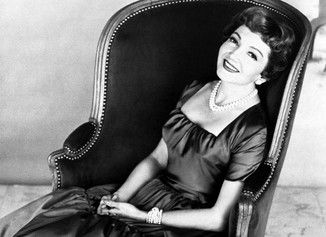
What made this low-budget comedy such a smashing hit? For one thing, it was a novelty. After a decade of musicals, crime dramas, spectacles, and method-acting melodramas, here was a little film that played out like a television series, a Leave it to Beaver versus Enemy Agents. It was unique. It was fun. And above all, it was great family entertainment. Walt knew how to appeal to all ages and The Shaggy Dog provided entertainment and humor for the young and old alike. It was filled with excitement, clever dialogue, and plenty of visual gags. The studio went on to recycle many of these gags in their recurring films.

Unlike the other box-office hits of 1959, The Shaggy Dog did not have any moments of great splendor, instead it leisurely followed the story line only to stop occasionally to wittily comment on the social status at the time or sprinkle gentle humor. Writer Bill Walsh penned the amusing screenplay based on the 1930 novel, "The Hound of Florence", by Austrian author Felix Salten (Bambi).


The Shaggy Dog follows the adventures of a junior scientist who accidentally recites an ancient Borgia curse that releases a 400-year-old shape-shifting spell. With the magical words "In Canis Corpore Transmuto," Wilby Daniels transforms himself into a big, shaggy dog - a Bratislavian sheepdog to be precise - belonging to the new neighbors on the block. It is while being in the four-footed state that Wilby overhears a plot to steal a secret missile plan at the nearby air base. It's Shaggy to the rescue then as he tries to convince his father, and the local authorities, that Continental spies are at work in the neighborhood!  

"In Canis Corpore Transmuto...In Canis Corpore Transmuto....it's a dosy do and awaaaay we go!"

The Shaggy Dog boasted a fine cast of young players, all of whom would come to be associated with the Walt Disney Studios. Tim Considine took a radical turn from his wholesome Spin and Marty role to play Wilby's scheming friend Buzz. At the expense of his good ol' pal, he whizzes around in his hot-rod wooing the most eligible girls in town. One of these girls just happens to be Allison, played by Annette Funicello in a brief part, her first film appearance. She is soon replaced as Girl No. 1 when sophisticated Franceska Andrassy (Roberta Shore) moves in with her father in the big Victorian manor across the street. If this street looks familiar, it is because it is the Universal cul-se-sac featured in The Munsters, The Burbs and Leave it To Beaver. 

Tommy Kirk proves to be in top form as Wilby Daniels. Although he made many more films with Walt Disney during the 1960s, none of his roles would be as appealing as Wilby. Tagging along as a mischievous helpmate is his little brother Moochie, naturally played by Mickey Mouse Club "Moochie" himself - Kevin Corcoran. Moochie doesn't display much surprise when he discovers his brother is a dog, but rather jumps at the notion of having a pet playmate to take on walks and throw sticks to. Corcoran later went on to become a producer with the Walt Disney studios in the 1970s and 1980s. 


Unlike the childish, bumbling crooks seen throughout the Walt Disney productions of the 1990s, The Shaggy Dog featured some pretty normal rough-and-tough criminals (played by Anthony Scourby and Jacques Aubuchon), although in this flick they are spies and quite debonair to look at. In fact, they are so suave that our damsel-in-distress does not even realize they are up to no good until after they kidnap her. Our devious villains conjure up images of the sophisticated foils that were so popular in series of the 1940s, such as those seen in Sherlock Holmes, Michael Shayne, or The Three Stooges shorts. These criminals are upstanding citizens loaded with wealth which they love to lavish on their collections of fine art and furniture. No one in the community would even dare consider them to be enemies of the state.

Fred MacMurray had been making films covering every possible genre since he began his career back in 1929. After making a number of mediocre pictures during the 1950s, Disney asked Fred if he would be willing to try his hand at comedy once again. The Shaggy Dog marked the beginning of a seven picture association he had with Walt Disney Studios. In the film, MacMurray plays a retired mailman and the father of our two leading lads. He has an allergic reaction to dogs that makes him despise the mere mention of their name and prompts him to bring out his trusty double-barreled shotgun from the hall closet. 

"You know that dog thing is all in your mind"

"All in my mind?! I itch, my sinuses are bloating up, my throat is constricting so that I can hardly breath, those old Pekingese wounds on my ankle are throbbing like bongo drums...and you say it's all in my mind!" 

One of Fred's best scenes involved him trying to convince the head of security at the missile plant that his son is a dog. Variety magazine noted, "It's a pleasure to see such a master of timing and emphasis as Fred MacMurray back in comedy again, even though he is somewhat limited in his material. Where he has a good line, he shows that he has few peers in this special field of comedy". 

Playing his wife is the lovely Jean Hagen, another gal who had her share of duds before snagging this wholesome part. Cecil Kellaway, Paul Frees (a legendary voice-over actor for Walt Disney Studios), Forest Lewis and Gordon Jones rounded out the great cast, but let's not forget the film's star player - the shaggy dog. "Chiffon" was in fact Sammy's Shadow, a talented pooch belonging to a California State Division of Highways clerk. He had an illustrious pedigree and, after enrolling in William Koehler's obedience training classes at the age of 4 months, he joined the Allied Movie Dogs firm and landed this wild and woolly part. Twenty sheepdogs had been tested for the part but Koehler knew he had a winner with Sammy and it is truly the dog performing all of the stunts seen in the film ( except for one talking sequence where a hand puppet was used ). Sammy went on to win the 1960 PATSY (Picture Animal Top Star of the Year) award for his performance in The Shaggy Dog


The Shaggy Dog has held up well over time, which is a testament to the enduring strength of a simple story told well. It is also notable for instigating important changes within Disney's production outlook for the coming decades. It was the first film to use animated title sequences and the picture's success told the studio that live-action comedy films were a profitable venture not to be overlooked. Unfortunately, they held to its "formula" so closely that many of the later Disney productions lacked novelty. 

This post is our contribution to the Snoopathon, a celebration of spies and agents being held over at Movies Silently. Be sure to check out the site and read  all of the great posts!

Sunday, June 1, 2014

Above Suspicion ( 1943 )

"My love is like a red, red rose...." 

MGM journeys into the realm of espionage with Above Suspicion (1943), a witty jaunt into spy-laden pre-World War II Europe. 
Fred MacMurray plays Richard Myles, an Oxford college professor, who is happily ready to embark on a Continental honeymoon with his bride Frances (Joan Crawford). Before they depart however, a former colleague of his, now with the foreign office, asks the couple if they would do a favor to him, and jolly ol' England, by inquiring into the whereabouts of a scientist who has disappeared within the confines of the Fuhrer's Vaterland. He holds the secret plans to the Nazi's latest diabolical invention - underwater magnetic mines. As honeymooners they would be considered above suspicion and could look into the matter discreetly. Or so they are told. Ach du lieber!...before they can utter "uberraschung" they are caught up in a web of intrigue that leads them from Paris to the pine-laden Alpine forests of Innsbruck. 


Above Suspicion, based on the novel by Helen MacInnes, is an easy-to-follow and briskly paced thriller with some rattling good moments of excitement. Its purely escapist plot is given credibility through its deft handling by director Richard Thorpe (Night Must Fall, Ivanhoe) and its stellar cast. The film plays out along the lines of Desperate Journey with grand morale-boosting elements but very little plausibility.....but perhaps that's what makes both of these pictures so entertaining. Above Suspicion was released at the height of World War II, a time when so many American and British citizens were eager to make an active contribution to corking up the war for good. 

"Darling, the less you know, or appear to know, the better"

At one time or another we're all drawn in by the allure of being a spy; deciphering codes, staking out suspicious bookshop fronts, wearing disguises, hiding out in secluded chalets and, of course, capturing public enemies. Richard and Frances are no different, and Frances is especially thrilled to help the British secret service but, unlike his wife, Richard realizes the danger ahead. En route, our American heroes stumble upon cryptic clues, all the while being spied on with peering abnormality by dubious faces and sundry characters. Their only key to unmasking friends from foes lies within the lyrics to Robert Burns eighteenth century melody. 

In addition to our leading cast, Above Suspicion features some excellent character support from Basil Rathbone, Felix Bressart, Reginald Owen, Richard Ainley, Bruce Lester and Sara Haden. Conrad Veidt is especially appealing in his role as Herr Seidel, one of the Brit's loyal allies within Germany. Veidt was often pigeon-holed as villains and it is a pleasant change of face to see him play this underground hero. Veidt died of a massive stroke shortly after filming commenced and Hollywood lost one of its most talented actors because of his passing. His entertaining dance floor sequence is a highlight of the film. 


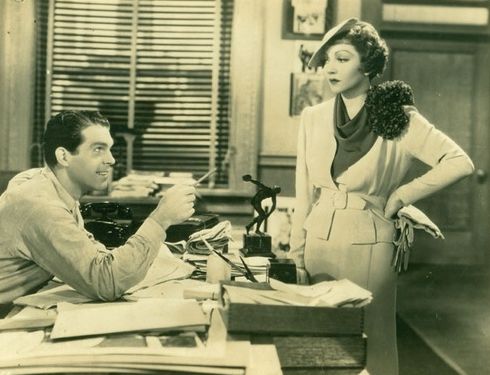
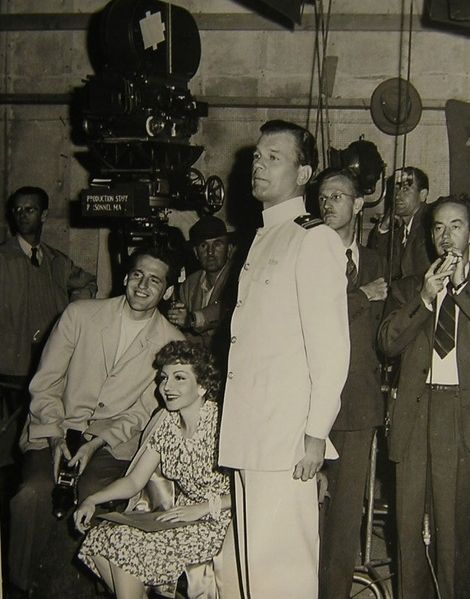
Fred MacMurray was making a departure from his recent Claudette Colbert comedy teamings to take a dramatic turn and this role suits him quite well. Incidentally, Colbert would have made an excellent Frances had Crawford declined the part. 


Joan Crawford had been loyal to Metro-Goldwyn-Mayer since they gave her her start in 1925. She made seventeen films with the studio but by the early 1940s her star-status was beginning to wane and fresh faces like Lana Turner, Hedy Lamarr, and Greer Garson were receiving all of the choice scripts. Eager to showcase her acting ability, Crawford accepted a lower salary and switched to the less prestigious Warner Brothers studio after the completion of Above Suspicion. Within one year she was up for the Academy Award for Best Actress for her portrayal in Mildred Pierce.

Within Above Suspicion are hidden elements of Hitchcock-like suspense, featuring a labyrinth of twists and turns, car chases, and an assassination attempt at an opera, a scene taken right out of The Man Who Knew Too Much (1934). Overall, the film is like a tasty strudel filled with chunks of drama, comedy and action, all enfolded within thin layers of plot to make up a taut 90-minute thriller.


This post is our contribution to the super-sneaky Snoopathon hosted by Movies Silently. Be sure to check out all the great posts about the nefarious spies, agents, and Mata Hari's that appeared in films from 1920-1965. 

Friday, May 17, 2013

Claudette Colbert - So Proudly I Hail

One of my favorite actresses of classic Hollywood is Claudette Colbert...a lovely lady and a very talented actress of the American stage and screen. Her illustrious career spanned sixty-four years from 1923 until 1987 with over sixty film and television performances to her credit as well as numerous theatrical performances.  

Emilie Claudette Chauchoin was born to Georges, a baker, and his wife Jeanne on September 13, 1903 in Saint-Mande, Val-de-Marne, France. She had an older brother named Charles, who was five years older than she was. With an uncle already living in New York City, Emilie and her immediate family, as well as her maternal grandmother Marie and an aunt, emigrated to the United States in 1906 and made their home in New York City taking up residence in a fifth-floor apartment on 53rd Street.

Young "Lily", as was her nickname, had two passions: art and theater. As a student at Washington Irving High School, Lily excelled at art and hoped to become a fashion designer. When she was 15 years old, her speech teacher encouraged her to audition for a part in a high school play called "The Widow's Veil", which she won.

Though she enjoyed being on the stage, her desire to study fashion was strong and after she graduated from high school in 1923, she got a job in a dress shop to help pay for her tuition as a student in the prestigious Art Students League of New York.

That same year, Lily attended a party and fellow guest, writer Anne Morrison, offered her small part in her Broadway play "The Wild Westcotts". It was at this time that Lily decided to change her professional name to Claudette Colbert, Colbert being her grandmother Marie's maiden name.

Claudette's great talent and grace brought her much success on Broadway from 1925 until 1929, most notably in "The Barker" (1927). During that time, Claudette married actor Norman Foster, who would later become a director of films like:  "Think Fast, Mr. Moto" (1937), "Charlie Chan at Treasure Island" (1939), "Journey into Fear" (1942), "Rachel and the Stranger" (1948), and "Davy Crockett: King of the Wild Frontier" (1955).


When the Great Depression hit America in the late 1920's, good parts were hard to find on the New York stage. It was during a performance of "The Barker" that Claudette was noticed by theatrical producer Leland Hayward, who offered her a part in a film entitled "For the Love of Mike", which was filmed on Paramount Pictures' Astoria, Queens, New York City studio lot. This was to be her very first film role.

The film was directed by the great Frank Capra and it told the story of three men who adopt a baby boy together named Mike and raise him the best way they can. Despite its tender plot, the film tanked at the box office. Mr. Capra was left without a job and the movie-making experience made such a poor impression on Miss Colbert that she eagerly returned to the theater and famously quoted "I shall never make another film!"


While she held firmly to her belief, movie roles were easier to get than roles on the stage, so Claudette found herself more and more often in front of the camera making films, among them being several pictures in which she played alongside handsome actor Fredric March, like in "Tonight is Ours" (1933) and "The Sign of the Cross".

Frank Capra and Claudette's paths would meet again in 1934 when Mr. Capra cast her for the part of heiress Ellie Andrews in what would become her ticket to stardom in "It Happened One Night". In addition to the success the film made at the box office, Claudette would win a Best Actress Academy Award and Frank Capra would win a Best Director Academy Award. This memorable film showcased Miss Colbert's natural comedic skills and the audience came to recognize her as a bright and shining new comedy star.

In August 1935, Claudette's divorce from Norman Foster was finalized and four months later on Christmas Eve, she married Dr. Joel Pressman. Claudette's happy marriage and a successful movie career made the next fifteen years joyful and busy for the new star.


Some of her best performances were given during this productive time in her career like:

"Imitation of Life" (1934): Fannie Hurst's emotionally stirring novel tells the story of a young widow who starts a profitable flapjack establishment yet she and her maid (Louise Beavers) face bitter challenges involving their daughters. The film was nominated for an Academy Award for Best Picture and it was re-made in 1959 with Lana Turner, John Gavin, Sandra Dee and Susan Kohner.

"The Bride Comes Home" (1935): When Jeannette finds out that her supposedly wealthy father is actually penniless, her close friend Jack (Robert Young) offers her job as a secretary for the new men's magazine he has just started. Though Jack is very much in love with her, Jeannette finds herself slowly falling in love with Jack's tough talking friend, bodyguard and fellow staff writer Cyrus (Fred MacMurray).


"Midnight" (1939): Claudette dazzles as Eve Peabody, a penniless girl in France who is hired by Georges (John Barrymore) to attract the attention of a gigolo (Francis Lederer) who is making a play for Georges' wife Helene (Mary Astor). Don Ameche is Tibor, a kind-hearted taxi driver, who has fallen in love with Eve and decides to throw a wrench into her plans by pretending to be her devoted husband! I love this film for its snappy one-liners and the romantic tension between Eve and Tibor. Though, deep down in her heart, she loves Tibor, she is drawn to the promise of a future with financial security. Luckily, Eve comes to the realization that love is more important than anything in the world ( and it is, too! )


"Drums Along the Mohawk" (1939): Magdelana (Claudette) and her husband Gilbert (Henry Fonda) along with other colonists battle attacks with Indians and Tories in New York's Mohawk Valley during the time of the American Revolution. The film was directed by John Ford from a novel by Walter Edmonds. It featured a wonderful cast with character actors like Edna May Oliver, Arthur Shields and Ward Bond.

"Palm Beach Story" (1942): Gerry (Claudette) impulsively travels to Palm Beach, Florida to obtain a divorce from her inventor husband Tom (Joel McCrea) and then snag a millionaire, played to perfection by good-hearted Rudy Vallee. Her plan is to fund her soon-to-be-ex-husband's new invention with money from her new husband. Preston Sturges wrote and directed this witty comedy which is sure to tickle your funny bone!


"So Proudly We Hail" (1943): Allan Scott's story focused on the lives of three brave nurses (Claudette, Paulette Goddard and Veronica Lake) going beyond the call of duty to help the sick and the injured during World War II. This gem featured an excellent cast and it rightly earned four Academy Award nominations.  


"Since You Went Away" (1944): This is my favorite Claudette Colbert film! After her husband leaves for basic training, loving wife Anne (Claudette) bravely continues on with her life at home raising the couple's two teenage daughters Jane and Bridget (Jennifer Jones and Shirley Temple). Anne is a symbol of the wives and mothers who did their duty by helping the men and women fighting overseas and by trying to make life as comfortable as possible on the homefront. The film was based on Margaret Buell Wilder's book and it is beautifully acted and filmed. I love it more each time I watch it.

"The Egg and I" (1947): Bob (Fred MacMurray) is a spirited man who brings Betty, his sophisicated Boston-bred wife, to the country and attempt to raise chickens on their rundown farm. This hilarious film was based on Betty MacDonald's beloved story and it became a hit movie which also helped launch the 'Ma & Pa Kettle' film series with Marjorie Main and Percy Kilbride, who made their debut in "The Egg and I".


"Family Honeymoon" (1949): Katie Armstrong (Claudette) is a widow with three rambuctious children ( Peter Miles, Jimmy Hunt and Gigi Perreau) who marries botany professor Grant Jordan. The newlyweds take off on a honeymoon with the children aboard a train and they make a stop at beautiful Grand Canyon. Mr. Jordan makes every effort to win his stepchildren's approval, though it proves to be a harder task than he had originally thought. Along the way, Grant runs into his former sweetheart Minna (Rita Johnson) who would very much like to re-kindle the fire between Grant and herself. Oh my! 

With the advent of television in the 1950's, Claudette was able to land numerous top notch parts on programs like: "The Ford Television Theater", "Climax!", "The Loretta Young Show", "Robert Montgomery Presents", "Playhouse 90", "The Colgate Theater" and others. She also played Ruth Condomine in "Blithe Spirit" in a 1956 T.V. movie as well as Sister Benedict in the "Bells of St. Mary" in 1959.  


In addition to her T.V. work, Claudette narrated Anne Morrow Lindbergh's memoir "Gift from the Sea" in 1955. That same year, she returned to the stage in "Janus", in which she replaced actress Margaret Sullavan during the spring and summer season. Two years later, from 1958 until 1960, Claudette brought her signature sparkle to the Plymouth Theatre in "The Marriage-Go-Round", co-starring her very dear friend Charles Boyer and Julie Newmar. Claudette's performance earned her a Tony Award nomination in 1959.  

Though her work schedule kept her extremely busy at this time, Claudette and her husband were able to relax and they divided their time between an elegant apartment on Fifth Avenue in New York City and a 200-year old plantation home on the tropical island of Barbados in the Caribbean where they entertained guests such as close friends Mr. and Mrs. Ronald Reagan and singer Frank Sinatra.


Though Claudette possessed the maternal quality that made her the perfect mother on the silver screen, she and her husband did not have any children of their own, which is very sad because I feel as though she would have been a wonderful mother in real life, too.

Miss Colbert's last film appearance was as Troy Donahue's mother Ellen McLean in the 1961 drama "Parrish" which also starred Karl Malden, Connie Stevens and Diane McBain. After the completion of the film, she went into semi-retirement. She would return to the stage in "Julia, Jake and Uncle Joe" and "The Irregular Verb to Love". 

Sadly, Claudette became a widow in February 1968, when her husband Dr. Pressman passed away. Their loving marriage had lasted thirty-three happy years. 


In the years that followed, Miss Colbert played alongside the great English actor Rex Harrison in two plays, "The Kingfisher" for 181 shows from 1978 until 1979 and "Aren't We All" for 93 shows which debuted in 1985. Claudette made her last television appearance in 1987 in the T.V. movie "The Two Mrs. Grenvilles" which also starred Ann-Margret, Stephen Collins and Elizabeth Ashley. She won a Best Supporting Actress Golden Globe Award in 1988 for her portrayal of Alice Grenville. 

At the age of 80, Claudette, looking radiant as ever, was honored with a special tribute by the Lincoln Center in May 1984. She was greeted by a cheering, applauding audience and she thanked them for coming to the event. 

Claudette tragically suffered a series of strokes in the 1990's and on July 30, 1996 she passed away in Speightstown, Barbados at the age of 92. 

The beautiful vivacious Lily Chauchoin delighted us and inspired us with her engaging personality and warmth, and she continues to do so today for each new generation of classic movie fans. Thank you Claudette for all the happiness your films bring into the lives of millions of people around the world!


Written by Diana Metzinger
There were so many wonderful pictures of Ms.Colbert that I had to add some extras to share below :

image name image name image name image name