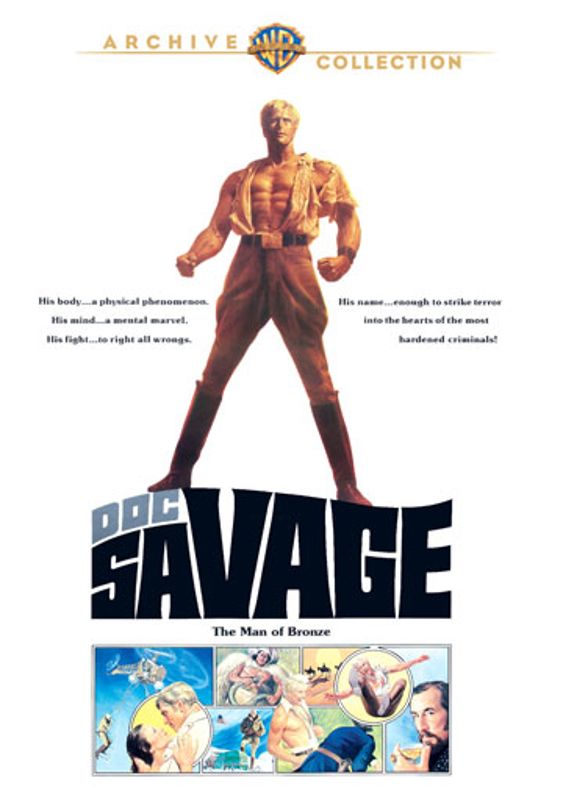
Have no fear, Doc Savage is here!
The intrepid Doc Savage and his Fabulous Five journey to the wilds of South America to investigate Doc's father's death in the jungles of Hidalgo. En route, they encounter numerous dangers as the maniacal Captain Seas tries to thwart them as they come closer to discovering his vast treasure of stolen Incan gold.
Doc Savage: The Man of Bronze is a delightful globe-trotting adventure film based on the popular 1930s pulp fiction character. It features some exotic locales, great set design, plenty of excitement, and loads of tongue-in-cheek humor...much in the vein of the original Batman! television series.
Savage is indeed a "man of bronze". He's an American who has Herculean strength, shiny white teeth, perfectly groomed hair, and impeccable manners. He also has the morals of a Boy Scout and would never hesitate to aid an old lady crossing the street. When asked what he would like to be served onboard Captain Seas' yacht he responds, "A Coke, please".
His Fabulous Five are equally honorable and, like typical comic book characters, have a range of capabilities to help their leader in times of trouble. There is Monk, a chemist ( Michael Miller ); Major Roberts, an electrical wizard ( Paul Gleason ); Littlejohn, an archeologist ( Eldon Quick ), Ham, the "brains" ( Darrell Zwerling ), and Colonel Renny, a construction engineer aka "the strongman" ( William Lucking ). Like Doc, these men, devote their lives to traveling around the world for the sake of justice.
Also in the cast are Pamela Hensley as Mona, a love interest for Doc; Carlos Rivas, and Paul Wexler as the diabolical Captain Seas.
The character of Dr. Clark Savage Jr. originally appeared in magazine format in 1933, written by Lester Dent under the pseudonym Kenneth Robeson. The series lasted for 181 issues and was brought to even greater fame in the 1960s when artist James Bama created new cover designs for the Bantam Books paperback re-issues. By the mid-1970s, over 20 million Doc Savage stories had been sold around the world. Hence, he was a fantastic character to bring to the silver screen.
This idea was considered in 1966 after the James Bond films proved to be such box-office attractions. Chuck Connors was to star in the filming of the 1934 story "The Thousand-Headed Man", but the securing of the film rights failed and it was shelved. It was not until 1974 that producer George Pal decided to make a Doc Savage film and obtained both film and television rights with the plans of creating a televised adventure series after the picture was released.
Pal originally hoped to cast Hercules-legend Steve Reeves as Savage. But he changed his mind eventually and selected Ron Ely ( Tarzan ) for the part instead, dying the man's hair blonde for the role. He was an excellent Doc, exuding charm and uttering his campy lines with dead seriousness.
"Mona, you're a brick!"
However, in spite of all its merits, the film bombed at the box-office. The timing of its release was just a matter of ill fortune. This was the mid-1970s and not many people wanted to watch a 1930s-themed adventure film with such goody-two-shoes humor. By the late 1970s, the mood had changed and the similarly campy Wonder Woman did very well on television. Perhaps Doc Savage would have performed better if it was geared towards adults and made into a dramatic adventure flick instead.
It truly is unfortunate that Doc Savage became such a loss for George Pal ( it was the last film he produced ) because, while it isn't a comedic gem, it really is colorful and quite entertaining. So entertaining, that it is disappointing to learn that the sequel ( promised at the end of the credits ) was never put into production! It would have been great to see the follow-up.
Showing posts with label George Pal. Show all posts
Saturday, February 9, 2019
Saturday, August 20, 2016
7 Faces of Dr. Lao ( 1964 )
"Mike, let me tell you something. The whole world is a circus if you know how to look at it. The way the sun goes down when you're tired, comes up when you want to be on the move. That's real magic. The way a leaf grows. The song of the birds. The way the desert looks at night, with the moon embracing it. Oh, my boy, that's circus enough for anyone. Every time you watch a rainbow and feel wonder in your heart...every time you pick up a handful of dust, and see not the dust, but a mystery, a marvel, there in your hand...every time you stop and think, 'I'm alive, and being alive is fantastic!'....every time such a thing happens, you're part of the Circus of Dr. Lao."
In a game of solitaire the passerby frequently notices a card play that you yourself neglected to see. The obvious is often hidden among the familiar. For the townfolk of Abalone, Arizona, it took a Chinaman and the strange attractions of his miserable looking little circus to open their eyes to see the value in their small town, their own suppressed desires, and the corrupted nature of the town's businessman, Mr. Stark.
Tony Randall gives a tour-de-force performance as Dr. Lao, an ancient Chinese ringmaster who journeys to the sleepy town of Abalone to share his circus of marvels with its residents and, in turn, create a life-altering effect on the community. These marvels include Medusa, Pan the God of Joy, Merlin the Magician, Apollonius of Tyana, and a talking serpent. Each of these attractions act as a mirror, reflecting the hidden personalities and desires of the character viewing it.
For librarian Angela ( Barbara Eden ), a step into the tent of Pan, the God of Joy, made her realize just how lonely she had been since her husband died, and how strongly she desired the affections of the local newspaperman Ed Cunningham ( John Ericson ). The town's greedy businessman ( Arthur O'Connell ) finds a remarkable resemblance of himself in the face of a snake, while for the vain widow, Mrs. Cassin, a visit to the tent of the seer, Apollonius of Tyana, a blind man cursed to tell only the truth, provides insight into her empty future.
In a game of solitaire the passerby frequently notices a card play that you yourself neglected to see. The obvious is often hidden among the familiar. For the townfolk of Abalone, Arizona, it took a Chinaman and the strange attractions of his miserable looking little circus to open their eyes to see the value in their small town, their own suppressed desires, and the corrupted nature of the town's businessman, Mr. Stark.
Tony Randall gives a tour-de-force performance as Dr. Lao, an ancient Chinese ringmaster who journeys to the sleepy town of Abalone to share his circus of marvels with its residents and, in turn, create a life-altering effect on the community. These marvels include Medusa, Pan the God of Joy, Merlin the Magician, Apollonius of Tyana, and a talking serpent. Each of these attractions act as a mirror, reflecting the hidden personalities and desires of the character viewing it.
For librarian Angela ( Barbara Eden ), a step into the tent of Pan, the God of Joy, made her realize just how lonely she had been since her husband died, and how strongly she desired the affections of the local newspaperman Ed Cunningham ( John Ericson ). The town's greedy businessman ( Arthur O'Connell ) finds a remarkable resemblance of himself in the face of a snake, while for the vain widow, Mrs. Cassin, a visit to the tent of the seer, Apollonius of Tyana, a blind man cursed to tell only the truth, provides insight into her empty future.
"Tomorrow will be like today, and the day after tomorrow will be like the day before yesterday. I see your remaining days as a tedious collection of hours full of useless vanities. You will think no new thoughts. You will forget what little you have known. Older you will become, but not wiser. Stiffer, but not more dignified. Childless you are, and childless you will remain. Of that suppleness you once commanded in your youth, of that strange simplicity which once attracted men to you, neither endures, nor shall you recapture them."
"You're a mean, ugly man!" replies Mrs. Cassin.
"Mirrors are often ugly and mean. When you die, you will be buried and forgotten, and that is all. And for all the good or evil, creation or destruction, your living might have accomplished, you might just as well never have lived at all."
7 Faces of Dr. Lao was based upon a short novel by Charles Finney written in 1935 entitled "The Circus of Dr. Lao". Like the main character in the story, Finney was himself a newspaperman who lived in a dusty outpost in Arizona during the Great Depression. He wrote the novel while he was in his thirties and was going through a period of doubting whether humankind did indeed have any spark of nobility in their souls or were merely "vicious, possessive, vulgar animals" as shyster Stark puts it. Hence, the entire novel is cynical and dark, and, depending on whether you read it before or after viewing the film, you will find it better or worse than the MGM adaptation.
Charles Beaumont, a veteran screenwriter best remembered today for his imaginative Twilight Zone scripts, found merit in Finney's story and, interestingly enough, decided to combine the best elements of the book into a family film. He had difficulty peddling it to the studios, until he offered the script to producer-director George Pal, a great lover of science fiction, who was delighted with the project.
The first twenty minutes of the film meanders along and impishly teases the audience to continue watching. However, once Dr. Lao's circus arrives, those who were willing enough to pay the price of time for admission were amply rewarded. It is then clear that the story offers much more subsistence then your average family drama. Like The Wizard of Oz, 7 Faces of Dr. Lao combines fantasy and allegory with children's fare, all neatly wrapped into one appealing package.
"My specialty is wisdom. Do you know what wisdom is?" - Dr. Lao
"No sir." - Mike
"Wise answer." - Dr. Lao

Tony Randall shines in his performance of the mysterious Chinaman, keeping a smile on his face and a glint of mischief shining in his eyes while he alternates his mode of communication from stereotypical Chinese pidgin talk to eloquent English. In addition to Dr. Lao, it is Randall disguised in the garb of most of his mystical creatures...including Medusa. His most touching role is that of Merlin the Magician, an old man who fails to find an audience among all the skeptics calling his magic simply "parlor tricks".
Make-up artist William Tuttle won an Special Achievement Oscar for his remarkable make-up work on this film and Jim Danforth was also nominated for the keen visual effects ( the snake is especially fun to watch ).
Rounding out the cast is a selection of great character actors including Royal Danno, Frank Cady, Minerva Urecal, John Qualen, and John Doucette.
There is a proverb that states that youth is wasted on the young, and, in regards to some children's films, that is true. 7 Faces of Dr. Lao is a simple film, at moments childish, that is often overlooked by adults but beneath its garb of innocence it offers a philosophical tale of self-reflection that makes it well worth watching. We could all do with a visit to Dr. Lao's Circus of Marvels.
"No sir." - Mike
"Wise answer." - Dr. Lao

Tony Randall shines in his performance of the mysterious Chinaman, keeping a smile on his face and a glint of mischief shining in his eyes while he alternates his mode of communication from stereotypical Chinese pidgin talk to eloquent English. In addition to Dr. Lao, it is Randall disguised in the garb of most of his mystical creatures...including Medusa. His most touching role is that of Merlin the Magician, an old man who fails to find an audience among all the skeptics calling his magic simply "parlor tricks".
Make-up artist William Tuttle won an Special Achievement Oscar for his remarkable make-up work on this film and Jim Danforth was also nominated for the keen visual effects ( the snake is especially fun to watch ).
Rounding out the cast is a selection of great character actors including Royal Danno, Frank Cady, Minerva Urecal, John Qualen, and John Doucette.
There is a proverb that states that youth is wasted on the young, and, in regards to some children's films, that is true. 7 Faces of Dr. Lao is a simple film, at moments childish, that is often overlooked by adults but beneath its garb of innocence it offers a philosophical tale of self-reflection that makes it well worth watching. We could all do with a visit to Dr. Lao's Circus of Marvels.
Friday, November 20, 2015
Robinson Crusoe on Mars ( 1964 )
In the not too distant future, a two-manned spacecraft, the Mars Gravity Probe 1, nearly avoids a collision with an asteroid on its route to the red planet. The ship cannot hold altitude after altering its trajectory so the crew eject from the vessel, making a crash landing on Mars.
Only Commander Kit Draper (Paul Mantee) and the ship's monkey Mona survive. His commanding officer Colonel McReady (Adam West) is killed in the collision. Draper leaves the wreckage behind and, with Mona in tow, proceeds to find shelter on Mars. He assesses his situation, takes stock of his supplies and begins to determine his needs. He finds the atmosphere thin and breathable for only short periods of time and so maintaining a continuous air supply becomes Draper's first priority. Later, he discovers sources of food and water. When alien spaceships come to Mars to recapture an escaped slave (Victor Lundin), Draper is relieved to find another person to converse with and helps the slave "Friday" hide from their watchful eye until they depart.
Robinson Crusoe on Mars is unlike other science-fiction films of the era. While most pictures that were set in outer space pitted a crew of astronauts against a creature or creatures unknown, Robinson Crusoe on Mars focused on one man all alone in unfamiliar territory and his struggle to conquer loneliness, a beast more fearsome than any two-headed martian.
Kit Draper strikes us as a modern intelligent human, not giving in to panic and capable of managing in extreme situations. He is a well-trained astronaut. Draper underwent months of vigorous pre-flight training and simulations of what he would encounter on Mars. He is prepared for any and all circumstances...or so he believes. What he is not prepared for is the chasm of loneliness he would feel in his new surroundings. He is grateful for the companionship of his monkey but longs for human conversation. Robinson Crusoe on Mars depicts interaction between people as a vital element to human survival, as necessary to man as oxygen or water and it is this facet of the film that makes it more realistic than other sci-fi films of the 1950s.
Paul Mantee considered Draper a difficult character to portray since he had no one to interact with, but he handled the part beautifully. Unlike many films that portray solitary characters, Robinson Crusoe on Mars avoided giving audiences a mental voice-over from the main protagonist and instead we discover Draper's thoughts only through his discussions with Mona and his "diary", his recordings of his actions onto video and audio tape.
Victor Lundin had parts in television westerns and other series (primarily portraying Native Americans) before he was given his first starring feature film role as the intergalactic mining slave, Friday. Adam West had very little screen time and what little dialogue he had was uttered in his usual stilted manner but he more than made up for that by his surreal materialization in one truly spine-tingling hallucination sequence. Mona the monkey was portrayed by a talented newcomer named Barney who had to humble himself and endure wearing not only the miniature space-suit costume for the part but a fur-covered diaper as an undergarment.
The premise of Daniel Defoe's beloved 1719 novel "Robinson Crusoe" was transported into the space age by screenwriter Ib Melchoir who set out to create a realistic portrayal of an astronaut's experience on an unexplored planet. A heady task considering it would be five more years before mankind would even set foot on the moon.
He retained all of the key elements of Defoe's novel - Crusoe's determination to survive, his methods of survival, and his struggle with loneliness - replacing only the cannibals with alien slavers to make the story more plausible. Ironically, it is Melchoir's faithfulness to the book that bogs down the final chapter of the film. Draper's solitary experience of survival and his encounter with the aliens would have made a fascinating picture in itself. The Egyptian-like slave sequence was unnecessary and tiresome.
Like the novel, Robinson Crusoe on Mars retains a strong religious subtext running through the film. At just the right moments, Draper's life is spared by the hand of God. Heat, shelter, food, companionship, all become available to him in his hour of need. While Draper may be all alone in the new world, he knows he always has God looking after him, giving him hope.
Crusoe's director, Byron Haskin, had a career stretching back as far as the silent era when he worked as a cinematographer to D.W. Griffith. During the 1930s and 40s, he headed up the visual effects department at Warner Brothers, working on such classics as The Sea Hawk, High Sierra, and Dive Bomber. Haskin had directed some iconic sci-fi films and television series (War of the Worlds, Conquest of Space, and several episodes of The Outer Limits) before taking the helm of Crusoe.
His experience in visual effects is demonstrated in the marvelous long shots where we witness Draper exploring one vast territory of desolate landscape after another with only Albert Whitlock's matte paintings being utilized to create the backdrops of space. This skyline looks majestic and peaceful compared to the steaming hot surface of Mars or its cool polar icecaps. Location footage was shot in Death Valley where the clear skies were used as a natural "blue screen" and enabled the matte paintings to be implemented.
Some of the other special effects in the film seem primitive and will look dated to modern viewers but Robinson Crusoe on Mars stands out for these dynamic visualizations of Mars. An entire harsh ecosystem is conveyed through its simple sets. Over fifty years later, it is impressive to see how accurately Mars was depicted in 1964. Wouldn't it be ironic if astronauts of the future land on Mars only to find the same landscape depicted in this film? This post is our contribution to the Criterion Blogathon being hosted by Criterion Blues, Speakeasy and Silver Screenings. To view the impressive line-up of film articles visit any one of these blogs for a complete list.
Subscribe to:
Posts (Atom)


