Like many films before it, World War I provided the setting for Hollywood's favorite love triangle formula - two boys and a girl - in Howard Hawks' The Road to Glory.
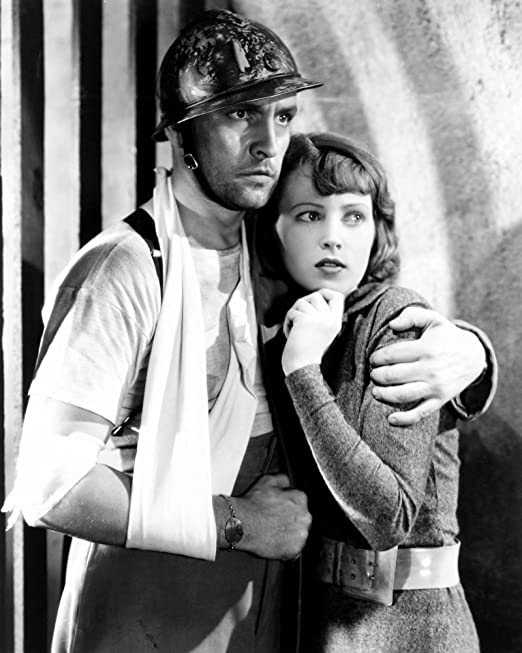
Warner Baxter and Frederic March star as the two men who vie for the love of June Lang, a pretty nurse. It is a simple formula that never gets tiresome, providing it is well-acted and in The Road to Glory it certainly is. Screenwriters William Faulkner and Joel Sayre used this formula as the basis of their script, but the real meat of the story was its depiction of the brutalities of the war itself and the courageousness of the soldiers who fought it.
Warner Baxter stars as Captain La Roche, a soldier who has witnessed death first-hand many times in the trenches of France. His company of the 2nd Battalion of the 39th Regiment is often called upon to fight in the most dangerous situations and most of his men do not come back from the trenches alive. La Roche is always receiving new replacement soldiers which he must, in turn, send out on perilous missions. He is disgusted with death and the ravages of trench warfare and he drowns his disgust in liqueur and aspirin. His only comfort is Monique La Coste ( Lang ), a young nurse whom he met when he first came to his post. She is drawn to him out of pity and gratitude for his kindness to her and her family. Monique thinks she loves him but realizes what true love is when she meets Lt. Michel Denet ( March ), the new officer in La Roche's regiment.
La Roche and Denet get off to a bad start when they first meet, but as Denet fights alongside La Roche, he comes to admire his captain and serves proudly under him. Naturally, when he discovers that his newfound love is his captain's sweetheart, he feels torn between being loyal to La Roche or being true to his heart.
Howard Hawks was one of the most versatile directors that ever came out of Hollywood and while The Road to Glory is not often regarded as one of his most famous films, it certainly bears his trademark stamp of excellence. In fact, The Road to Glory should rank as one of the finest WWI films ever made. The cinematography is dark and moody and the depictions of all of the battle scenes are impressive. It is excellently paced and features all of the elements of a good drama...including a touch of humor. The film bears many resemblances to The Dawn Patrol ( 1930 ), which was also directed by Hawks. Both films are set in World War I and focus on the relationship between an officer and his commanding officer. Both also realistically depict the horrors of war.
Trench warfare was brutal. Just looking above the trench meant risking your head being shot off. One poor soldier gets stuck on barbed wire and wails for hours. The few soldiers that attempt to rescue him are shot down and, eventually, La Roche decides to shoot him just to put him out of his misery - like a horse with a wounded leg.
Warner Baxter is excellent as Captain La Roche. This hagged officer has such a burden to carry on his soldiers and then his father ( Lionel Barrymore ), an old veteran of the Franco-Prussian wars, secretly enlists in his regiment and adds to his concerns. Throughout their missions, he now worries whether his father will come through unscathed. Barrymore does not make his first appearance until twenty minutes into the film, yet being the legendary character actor that he was, he makes his part as compelling as the two leading roles.
Fredric March gives a fine performance ( as usual ) and June Lang is equally well-cast. Also in the cast is Gregory Ratoff as a whistling Russian soldier, Victor Kilian as a loyal sergeant, John Qualan, Paul Fix and Leonid Kinsky.
Showing posts with label WWI. Show all posts
Sunday, March 15, 2020
Thursday, October 15, 2015
The Dawn Patrol ( 1938 )
They roared through the dawn...with death on their wings!
Yes indeedee, rip-roaring action abounds in The Dawn Patrol. Where Errol Flynn walks, how can adventure help but follow?
It's 1915. In central France the 39th Aerial Squadron of the British Royal Flying Corps is losing men like flies to enemy fire. Major Brand's ( Basil Rathbone ) nerves are shattered as he receives orders each day to send mere boys to the skies to face their death.
Amateur aviators fresh out of school, all eager to soar into the heavens to shoot down a Gerry, come to the squadron regularly. Naive, and blindly brave, they boast of what they'd do if they receive their flying orders. But the "old hands" Captain Courtney and Lt. Scott ( Errol Flynn, David Niven ) know better. It's no easy game. With a well-trained enemy on your tail at every moment it's a face-off to the death.
They eye Major Brand with hatred burning in their hearts, knowing any one of these boys might be sent next, and without sufficient aerial combat experience what chance had they of surviving? They blame him for sending them to the slaughterhouse of the skies.
"You know what this place is? It's a slaughterhouse, and I'm the butcher!"
Major Brand
Brand realizes this too, and hates himself even though he is simply doing his duty. However, when Brand gets promoted to wing commander, and Courtney gets selected as his replacement, Courtney finds what it feels like to be in the Major's boots : very dirty. And those who were once his friends, are now giving him the evil eye as well.
The Dawn Patrol was released in 1938 to critical acclaim for it's strong focus on the men who fought the hawk-like battles in the air. John Monk Saunder's Oscar-winning original story was first put to film in 1930 by director Howard Hawks, featuring Richard Barthelmess and Douglas Fairbanks Jr. in the lead roles. Hawks captured some outstanding aerial footage of dogfight scenes and many of these shots were reused in the 1938 remake, interspersed with scenes of Flynn in the pilot seat.
The aerial scenes were not entirely old footage - Warner Brothers Studios reconditioned nearly two dozen vintage Nieuport and Fokker bi-planes which were used for additional dogfight footage as well as close-up scenes at the headquarters. The famous stunt flier Douglas "Wrong Way" Corrigan was asked to fly some of these Nieuports but Corrigan wanted $100,000 to appear in the film. That was one stunt where he did indeed go the wrong way - the studio was not willing to pay such an amount and nixed him from the production.
Basil Rathbone is excellent as Major Brand, and Errol Flynn is as powerful and charismatic as ever as Captain Courtney. Flynn thoroughly enjoyed working with friends and the comradery between him and David Niven seen on film was true to life - Niven was one of his best chums. Keep a sharp eye out for Rodion Rathbone, Basil's son, who was making his film debut as "Russell" one of the inexperienced fliers.
The Dawn Patrol remains one of Flynn's most memorable pictures and it's message of the senseless brutality of war packs a punch over a half century later. Commanding officers of the armed forces today go through the same agony when they must carry out orders from "higher up" knowing the steep price it costs on human lives...lives they personally know.
Film critic Llewellyn Miller made an accurate prediction in his 1938 review of The Dawn Patrol :
This post is our contribution to Classic Movie Blog Association's Planes, Trains, and Automobiles Blogathon running from Oct. 19 - Oct. 24th. Be sure to head on over to CMBA's blog to find links to all the great articles on your favorite modes of transportation.
Yes indeedee, rip-roaring action abounds in The Dawn Patrol. Where Errol Flynn walks, how can adventure help but follow?
It's 1915. In central France the 39th Aerial Squadron of the British Royal Flying Corps is losing men like flies to enemy fire. Major Brand's ( Basil Rathbone ) nerves are shattered as he receives orders each day to send mere boys to the skies to face their death.
Amateur aviators fresh out of school, all eager to soar into the heavens to shoot down a Gerry, come to the squadron regularly. Naive, and blindly brave, they boast of what they'd do if they receive their flying orders. But the "old hands" Captain Courtney and Lt. Scott ( Errol Flynn, David Niven ) know better. It's no easy game. With a well-trained enemy on your tail at every moment it's a face-off to the death.
They eye Major Brand with hatred burning in their hearts, knowing any one of these boys might be sent next, and without sufficient aerial combat experience what chance had they of surviving? They blame him for sending them to the slaughterhouse of the skies.
"You know what this place is? It's a slaughterhouse, and I'm the butcher!"
Major Brand
Brand realizes this too, and hates himself even though he is simply doing his duty. However, when Brand gets promoted to wing commander, and Courtney gets selected as his replacement, Courtney finds what it feels like to be in the Major's boots : very dirty. And those who were once his friends, are now giving him the evil eye as well.
The Dawn Patrol was released in 1938 to critical acclaim for it's strong focus on the men who fought the hawk-like battles in the air. John Monk Saunder's Oscar-winning original story was first put to film in 1930 by director Howard Hawks, featuring Richard Barthelmess and Douglas Fairbanks Jr. in the lead roles. Hawks captured some outstanding aerial footage of dogfight scenes and many of these shots were reused in the 1938 remake, interspersed with scenes of Flynn in the pilot seat.
Basil Rathbone is excellent as Major Brand, and Errol Flynn is as powerful and charismatic as ever as Captain Courtney. Flynn thoroughly enjoyed working with friends and the comradery between him and David Niven seen on film was true to life - Niven was one of his best chums. Keep a sharp eye out for Rodion Rathbone, Basil's son, who was making his film debut as "Russell" one of the inexperienced fliers.
The Dawn Patrol remains one of Flynn's most memorable pictures and it's message of the senseless brutality of war packs a punch over a half century later. Commanding officers of the armed forces today go through the same agony when they must carry out orders from "higher up" knowing the steep price it costs on human lives...lives they personally know.
Film critic Llewellyn Miller made an accurate prediction in his 1938 review of The Dawn Patrol :
"A few...a very few pictures are timeless in their appeal. A very few pictures may be revived year after year without seeming quaint or out-dated or downright silly. The Dawn Patrol is one of the very few films which will survive this year and next and as many years to come as there are people who remember wars. I wish it might be included in every course in American history in every school in the land. I hope that it is revived every year, so long as bullets are being cast and battleships are being made, because, like every great war film that the motion picture industry has produced, it says 'Where is the glory, where is the great adventure, where is there anything but criminal waste in such insanity?'"
This post is our contribution to Classic Movie Blog Association's Planes, Trains, and Automobiles Blogathon running from Oct. 19 - Oct. 24th. Be sure to head on over to CMBA's blog to find links to all the great articles on your favorite modes of transportation.
Subscribe to:
Posts (Atom)


