Thursday, July 18, 2013

The Nugget Reviews - 3


The Princess and the Pirate ( 1944 )  14k


A travelling actor is chosen as the bearer of a secret pirate map marking the whereabouts to treasure in gold, by a crazy old man, one of the Hook's disloyal men. Disguised as a woman he escapes with a captured princess from the pirate ship but finds himself in the scurviest town he ever laid eyes on, with Hook chasing after him and the secret map. Bob Hope, Virginia Mayo, Walter Slezak, Victor MacLagen. Paramount, 1944. Directed by David Butler.

This film features sumptuous color, exceptional sets, beautiful costumes, the lovely Virginia Mayo and Bob Hope, always quick with the one-liners, but the plot is rather flat and the actors seem at a loss at what to do with the story. A shame too, because this could of been a real gem....now it just remains a routine comedy.

                 ___________________________________________________________


Crosswinds ( 1951 ) 14k


An adventurous sailor takes on a job of using his beloved yacht as a diving vessel, searching for pearls, but finds he has been framed in an illegal activity and his yacht confiscated  He joins forces with two water rats and a beautiful lady and hunts after the culprit who is now searching for stolen gold in the jungle. John Payne, Rhonda Fleming, Forrest Tucker, Alan Mowbray, John Abbott. Paramount, 1951. Directed by Lewis R. Foster.

This was a fun film to watch. The entire movie was obviously filmed in Florida, and not New Guinea, and John Payne could of had a little more punch to his character but the color was wonderful, the settings were great and Rhonda Fleming looked ravishing, so who's complaining? The ending was very abrupt though..within three minutes Fleming changes her attitude of disgust with Payne to love and they sail off in the sunset. We are left wondering who got the gold and what made her change her mind. 

                 ___________________________________________________________


Henry Aldrich Haunts a House ( 1943 ) 18k


Henry Aldrich accidently drinks an experimental potion which he believes gives him super-human strength. When the school professor is found missing and believed dead in the very haunted house Henry visited the night before, he and his friends believe he is a "fiend" in disguise. Jimmy Lyndon, Charles Smith, Joan Mortimer, John Litel, Mike Mazurki. Paramount, 1943. Directed by Hugh Bennett. 

Henry Aldrich doesn't need to haunt this house...it's filled with ghouls, ghosts, gorillas and gangsters already! Jimmy Lyndon is a riot as humble Henry, always innocent and yet always getting himself into mischief. The real star of this film is Charles Smith though. As Henry's pal "Dizzy" he steals every scene he's in with shaking, quaking and stuttering. The film plays out like an original Scooby-Doo mystery. 

                 ___________________________________________________________


Pinocchio ( 1940 ) 24k


A toy-maker has his wish come true when the Blue Fairy turns his favorite marionette Pinocchio into a talking, walking little boy..although still wooden. In one short day Pinocchio gets himself into mischief by joining an acting troupe, almost being turned into a donkey, and being swallowed by a giant whale. Jiminy Crickett stands by the boy as his "conscience". Vocal talents of Mel Blance, Don Brodie, Dickie Jones. Walt Disney Studios, 1940. Directed by Norman Ferguson.

Truly a remarkable work of animation. In one scene in particular the camera pans from the top of a village church, down into the street, around the corner, and right into the house through the window. Amazing.... the story is touching, humorous, and exciting all at once. 

                  ___________________________________________________________


How Sweet it Is! ( 1968 ) 14k 


Two parents accompany their teenage son on his tour of Europe with his girlfriend. Once in Europe they find their marriage on the skids when a French playboy makes advances at mama. James Garner, Debbie Reynolds, Maurice Ronet, Terry-Thomas, Paul Lynde. Universal Pictures, 1968. Directed by Jerry Paris.

At first, judging from the first five minutes, I thought "heaven forbid, another 1960s sex romp"....which, alright, I admit, this essentially is...but its a darn good one! The comedic talents of Debbie Reynolds and James Garner make it so. They are such a good team here that it makes me wish they had a TV series together. Well worth watching, even for those who cringe at the freedom displayed by those of the psychedelic age. 

Wednesday, July 17, 2013

Barbara Stanwyck in "Annie Oakley" ( 1935 )

"Barbara Stanwyck is splendid in the role of Annie Oakley; this is indeed her most striking performance in a long time" 


Andre Sennwald, a New York Times reporter, stated the above shortly after seeing the premiere of Annie Oakley in December 1935 and there is no denying just how right he is. 

Annie Oakley is a rootin-tootin' grand picture that tells the ( albeit a bit fictional ) story of the sharp-shootin' pixie from the backwoods of Ohio - "Little Miss Sureshot" Annie Oakley, and Barbara Stanwyck is larger than life in her portrayal of the legendary star of Buffalo Bill's Wild West Show. 

Stanwyck, the tough-talking no-nonsense dame who sprang from the Bronx, was just beginning to find a footing in Hollywood in the mid-1930s. Warner Brothers studios was dishing her disappointing film projects and so she decided to take matters into her own hands and venture out as an independent player. Annie Oakley was her first feature with RKO studios and it gave her a hearty push into stardom. By 1939, she had an Oscar nomination under her belt ( for Stella Dallas ) and was raking in a hundred thousand dollars a year as salary. Miss Stanwyck had made herself a home in the limelight and would remain a shining star in the Hollywood galaxy until her dying day...and rightly so. As she proves in Annie Oakley, Barbara Stanwyck was able to take on any portrayal and truly make you believe she was the character you saw onscreen. 


The film begins with the famous match between Miss Oakley and Frank Butler, who has his name ( and character ) changed to Toby Walker for the film. The rather conceited Toby Walker, the top marksman in the country, has been recently signed to Buffalo Bill's touring Wild West extravaganza and while staying over one night at McLeod's hotel in Cincinnati he makes a bet with McLeod that he can beat any marksman in that "hick" town. McLeod pits him against Annie Oakley, the little lady who provides him with the quail for his diners...quail that are always free of buckshot, unlike the game other hunters provide him with. 


Annie, so sure of her shooting talent, puts her own money up for the bet as well as some that the townsfolk contributed from back home. When the time comes for the match however, she doesn't have the heart to beat Walker at his own game. Mainly because she thinks Toby Walker is the gosh darn prettiest fella she ever laid eyes on!

Annie's ability does not go unnoticed by Buffalo Bill's agent Jeff Hogarth ( Melvyn Douglas ) who hires her for the show regardless of her throwing the match. And then it's off to New York and all across America showcasing the marksmanship and brilliant riding skills of the cowboys and frontiersmen of the Wild West, all for the price of one dollar. 

At first, Toby Walker and Annie Oakley are rivals, but his heart of gold shines clear and bright to Annie and she falls for him hard. He teaches her tips on showmanship and they court behind the tepees all the while keeping up a front that they despise each other for publicity purposes. Preston Foster is charming as Toby Walker and they really do seem the ideal match.  

Annie Oakley boasts a chuck-wagon full of character actors such as silent comedian Andy Clyde as the cheap Scotsman, MacLeod, a superb Moroni Olson as Buffalo Bill, Pert Kelton as Toby's old flame, and small parts for Dick Elliott and Willie Best. Pert Kelton later went on to portray the first "Alice Kramden" in the original Honeymooners skits from The Jackie Gleason Show. 


Chief Thunderhead also shines as Sitting Bull, the ruler of the Souix tribe who fought against Custer in 1876. Here he grunts disapprovingly of the wild west heroics displayed by the men of the Buffalo Bill show and refuses to take a part in the public display....until Annie Oakley takes the stage, then he heartily adopts her as Little Miss Sureshot and joins the "the big happy group".

This was George Steven's first foray into the western genre and he marked this film with his signature stamp of excellence. The film wraps adventure with romance and comedy all in one briskly paced 90 minute package of entertainment, even if it does lack historical accuracy. Later, in the 1950s, Stevens would make the western genre his niche, directing such iconic films as Shane ( 1953 ) and Giant ( 1956 ). Barbara Stanwyck was another loyal cowboy; when asked what kind of film she enjoyed making most, her reply would inevitably be "westerns". 

In real life, Annie Oakley and Barbara Stanwyck were not unlike each other. Annie Oakley was a small-town gal who used her talent of marksmanship to catapult herself into international stardom. In a time when few women were celebrities she became a role model for other women, while Barbara Stanwyck was a "Little Miss Sureshot" in her own right : she aimed high at becoming a great actress in her time and she hit the bullseye dead center. Always a fighter, she embodied Annie Oakley's spirit of rugged determination and confidence in one's own abilities, as can be seen in this film. 

This post is our contribution to the Barbara Stanwyck Blogathon, a stupendous collection of reviews of each of Barbara Stanwyck's films from nearly 50 different bloggers, hosted by none other than Aubyn Eli, better known as The Girl with the White Parasol.  Be sure to check out all of the participants posts on the films of our favorite leading lady, Barbara Stanwyck. 

Friday, July 12, 2013

Walter Pidgeon and Greer Garson - A Dynamic Duo

The Classic Movie Hub and Once Upon a Screen are co-hosting The Dynamic Duo blogathon, a thrilling collection of posts from over 50 different blogs highlighting the most memorable teams ever to grace the silver screen - and the small tele. Our choice of pair is handsome Walter Pidgeon and the always graceful Greer Garson. 


Greer Garson and Walter Pidgeon were the epitome of enduring love. In the majority of their films together they played married couples, a husband and wife perfectly balanced : Garson's dignified but gentle and kind nature opposite Pidgeon's strong and stable nature. They were a match made in MGM Studio's heaven and were one of Hollywood's most durable box-office teams. Off screen they were life-long friends. ''I did eight pictures with that gal and we never had a bad word between us,'' Pidgeon once told an interviewer.

In 1937, during a trip to London, MGM's head Louis B. Mayer's noticed Greer Garson in a dramatic play called "Old Music", and being very much impressed with her demeanor he quickly signed her to a contract. MGM had recently scored successes with Boys Town and Men of Boys Town, two films dealing with child welfare, and so, in 1940, Louis B. Mayer decided that adapting Ralph Wheelwright's best selling novel "Blossoms in the Dust" would be a great follow-up film and an excellent vehicle to showcase his new lovely leading lady, Greer Garson, who had triumphed as Robert Donat's wife in Goodbye Mr. Chips ( 1939 ) and opposite Laurence Olivier in Pride and Prejudice ( 1940 ).
 

Garson would be teamed with Walter Pidgeon, one of MGM's most seasoned actors, having gone through the fire of refinery by starring in a string of successful B films as detective Nick Carter. The rugged Canadian had first met Ms.Garson in a screen test and had quipped, "I'll bet we're starring together and running this studio before you know it!". Prophetic words.

Blossoms in the Dust was a heartwarming drama about Edna Gladney, a welfare worker for children who was spurned on in her maternal efforts to help children find a good home through the premature death of her own dearly loved son. The film had an air of gentility and quiet gallantry which set the tone for Garson and Pidgeon's subsequent teamings, most notably Mrs. Miniver, their second film together and one of their most fondly remembered films today.

The Minivers were an average British couple who braved the Blitz heroically, remaining courageous and hopeful even when the deaths of those near and dear to them hit hard. Although war and its ravaging effects was spreading like wildfire across Europe and Great Britain, the Miniver's proved that bravery and stability still remained in England, if not in the land at whole but within each citizen's hearts. 


Independently the fight could be daunting, but together they became an indestructible rock. As a couple, they depended on each other and drew off of each other for strength and encouragement. This was to be one of their strongest assets as a team.

Mrs. Miniver was an enormous critical and box-office success. Movie-goers around the world thrilled to it and President Roosevelt was so impressed with the film - and its propaganda value - that he ordered millions of leaflets containing the vicar's speech near the end of the picture to be scattered over occupied Europe by Allied warplanes. 


Mrs. Miniver was followed by the equally successful Madame Curie ( 1943 ), an autobiographical account of the Curie's quest to discover radium. Walter Pidgeon claimed this was his favorite film to make, and in his opinion, one of his best performances. 

While they portrayed the ideal married couple on screen, off screen there was no romantic involvement between the actors. Walter Pidgeon was wed in 1931 to his second wife, Ruth Walker and they remained happily married until his death in 1984. Greer Garson's first marriage had ended during the honeymoon. The same year that Madame Curie was released, 
Garson wed Richard Ney, the young actor who had played her son in Mrs. Miniver. Despite the fourteen year age gap, they had fallen in love during the making of the film but due to pressure from MGM postponed their nuptials until after Miniver's release. The marriage would not last. Within four years they were divorced. It was not until she met E.E Fogelson during the making of Julia Misbehaves that she found lasting love. They were married until his death in 1987. 


Garson and Pidgeon's next project together was an adaption of Louis Bromfield's novel "Mrs. Parkington". Set in the late 1800s, it followed the life of an Irish girl in America, from her early days helping her mother run a hotel out west, to her marriage to the illustrious Major Parkington, and their rise to becoming one of the most powerful industrialists in the states. It also followed - in the years ahead - what became of their children and grandchildren. This allowed Greer Garson to be "aged" from a young woman to an elderly matriarch in her eighties. Pidgeon was excellent as the rambunctious Major, ready to face any challenge that may come to America, but unaware of the tempest brewing within his own home.  


Walter Pidgeon was busy in the mid 1940s making films such as Weekend at the Waldorf, The Secret Heart and If Winter Comes while Greer Garson made The Valley of Decision and the ill-fated Adventure. By 1948, the powers-that-be at MGM thought it was time to re-team the golden couple, but fearing the public's disinterest in noble portrayals, they decided to cast the duo in a comedy - Julia Misbehaves. This proved to be a mistake. Although the film had a great cast including Elizabeth Taylor and Peter Lawford, Garson was much too prim for the flippant role of a mother who abandons her children and home-life for the stage. Her new hairstyle was not nearly as flattering either!

And so, the following year they returned to the splendor of the Gilded Age in That Forsyte Woman, an adaptation of John Galsworthy's novel "A Man of Property", part one of his epic Forsyte Saga. Errol Flynn gave one of his best performances as Soames Forsyte, the wealthy heir who dearly loved Irene ( Garson ) but, once again, it was gentle Walter Pidgeon who won her hand at the end. 


Television was slowly creeping its way into America's living rooms and the big movie studios were seeing their cash-flow slipping away. With nostalgic fortitude, MGM turned to trying to recapture its past magic with re-releases of its former box-office successes as well as turning to sequels. The Miniver Story was one such try which also proved to be a failure. It's somber tone was not welcome when audiences were clambering back to the theatres to watch grand musicals in glorious Technicolor. 

Their last picture together would be in "Scandal at Scourie" made three years later. This color melodrama returned to the theme of their first film - orphans. This time, instead of aiding orphans, they were fighting for the opportunity to keep a little girl that caught their fancy. 


Walter Pidgeon and Greer Garson were both extremely talented actors and, unlike many other actors of the era, were very much in real life the characters they portrayed so often onscreen. This brought to their characters and the pictures themselves an honesty that kept them from becoming trite.  

Garson once defined in an interview what she considered a film ought to achieve,  " I think the mirror should be tilted slightly upward when it's reflecting life -- toward the cheerful, the tender, the compassionate, the brave, the funny, the encouraging, all those things -- and not tilted down to the gutter part of the time, into the troubled vistas of conflict."

As a couple onscreen, Walter Pidgeon and Greer Garson often showed us how to live life by looking on the brighter side, ever remaining hopeful despite what conditions you face, and always helping your fellow man knowing that he often faces similar struggles.


To read about more Dynamic Duos check out the complete list of participating blogs at Once Upon a Screen, or The Classic Movie Hub. 

Tuesday, July 9, 2013

Ginger Rogers - An Exceptional Actress and Woman

What is it about Ginger Rogers that demands undying devotion and constancy from her admirers? 

For me it was when I saw her 1944 film, “I’ll Be Seeing You” on a small black and white television in my parents’ home.  As a young teenager at the time, I experienced a very personal and poignant connection with Ginger’s portrayal of Mary Marshall.  Ginger’s sincerity and interpretation of her character’s dilemma reached deep into my very being.

In the film, Mary finds herself incarcerated for manslaughter as the result of defending herself from rape.  Mary’s boss had invited her to a party at his apartment.  She had bought a new evening dress for the occasion.  Mary pinned on the white orchid corsage her boss had sent her and left for the party. Upon her arrival, Mary was surprised to find out that she was the only guest.  Mary tries to talk her way out but when that fails, she tries to leave. Her boss grabs her arm and flings her onto the ground.  When she gets up, he grabs her again.  Mary tries to fight off his advances and pushes him backward but he is able to recover quickly and seizes her again.  This time Mary pushes her boss with a fearful force.  He falls backwards and out of an open window on the fourteenth floor. 

Zach, played by Joseph Cotten, was in a military hospital recovering from shell shock caused by his experiencing the horrors of war in the South Pacific.  Zach is hesitant and slow to process those things that once were easy to him.  He is frustrated because his timing is gone. 


Mary and Zach’s lives are full of “what might have beens” with the disillusionments, limitations, boundaries, confinements, and the uncertainties of what their futures hold for them.  Mary Marshall and Zachary Morgan feel lost and hopeless because of circumstances beyond their control. They are trying to make sense out of their lives, which appear to be spinning out of their control. 

After serving three years of her six-year sentence, Mary finds herself on her way to visit her uncle’s family in Pine Hill.  Mary has earned an eight-day furlough from prison for good behavior.  Zach is venturing outside of the safe environment of the hospital for the Christmas holiday season so he can see how he copes interacting with people. 


Mary and Zach are two lonely people who find themselves sitting across from each other on a train.  They begin to talk and Zach feels comfortable in Mary’s presence and becomes more at ease and not as detached from the world around him.  When Mary gets off the train in Pine Hill, Zach follows her and asks if he can call on her at her uncle’s home. Mary gives him the address and leaves.  Zach goes to the local Y.M.C.A. for his lodgings. 


As Mary and Zach spend time together, I feel what Mary feels as she and Zach begin to fall in love. I have become one with her.  Zach invites Mary to a New Year’s Eve dance and presents her with a corsage of white orchids.  She is hesitant and does not want to wear them but she pins them to her waist.   Later Mary unpins the white orchids and they fall to the ground as she dances with Zach, I understand why they are repulsive to her.  I am glad to see them trampled underneath the feet of the other dancers because of what they represent to Mary and me. 


Mary represents strength to Zach. He sees Mary as someone who is self-assured and can stand on her own two feet.  Zach finds comfort and courage while he is in her presence.  Zach begins to believe in himself because Mary believes in him.  Even though Mary has her own self-doubts, she is strong for Zach.  Zach appeals to Mary’s sensibility of what she thinks is now lost to her because of her imprisonment.  Nevertheless, she can pretend all is well while she spends her time with Zach and her uncle’s family. 

My heart aches for Mary when her cousin Barbara lets slip Mary’s situation and of her eventual return to prison to finish her sentence.  I weep with Mary as all hope of love and romance drains from us. 
My chest begins to tense up as we walk toward the prison’s door when we detect some movement in the shadows and we stop and look.  Zach moves rapidly towards Mary and they embrace as they babble and kiss knowing that they will be there for each other.  Life renews in their embrace and is symbolized by their hitting a lamppost with thrown stones. 

My tears pour forth as my body shakes uncontrollably with the resounding affirmation that HOPE for a better future is attainable.  We can rise above the trials and tribulations of this life.  Everything is possible.  This is when I became a Ginger Rogers fan.  She grabbed my soul and profoundly touched my heart. 


Alyce Canfield interviewed Ginger on the set of I’ll Be Seeing You. Aylce was writing an article for Screen Stars.  Alyce watched the scene where Mary tells Barbara why she is serving a sentence for manslaughter.  “The silence was brittle. Everyone on that set listened, for not only were tears in Ginger’s eyes, they were in her voice.” Alyce came away convinced of what an incredible actress Ginger really was as she held the attention of everyone on the set with her gripping portrayal.  Alyce elaborated by writing, “I watched the scene and then reflected how hard it is to pass on to others the makings of stardom.  For Ginger possesses many things of which she may not be aware.  In this scene, not only was her voice tense, her whole body was tense.  Her throat was tense.  There was a suspense in her revelation of how she had come to commit murder that was intangible.  It was something she made you feel as intensely as she did.”  That was Ginger’s talent and the secret to her success.  She made you feel what her character felt with deep unshakable emotion from the moment she appeared on the screen. 

Ginger was the consummate performer but wisely realized the importance of working as a team on the screen.  She eagerly assisted her co-stars by eliciting the best out of them during their scenes together.  In this way the presentation was balanced. 

The film In Person (1935 ) was a vehicle designed to exploit Ginger’s talents and she could have made it all about her.  However, she never took away George Brent’s significance to the plot of the film.  Because of Ginger’s unselfishness, her co-stars rose to the challenge in their scenes together. 


In another example, Ginger willingly helped Harriet Hilliard in her film debut, Follow the Fleet ( 1936 ). Ginger took the screen test with Harriet, rehearsed with her, helped her with her makeup, and shared her knowledge about making films with her. Not only did Ginger have an undeniable stage presence, but she was also an independent, strong-willed, loving, and caring person. 

Ginger was equally aware of the importance of the stagehands and crew being a part of the team. An anonymous prop man praised Ginger’s sincere caring for those people who worked on her sets. “Once in a while something grand happens to someone in the movie industry that brings a warm glow of pleasure to many who stand on the sideline, like the prop man.  That’s the way I felt a few months ago when I heard Ginger Rogers had won the Academy award for her performance in Kitty Foyle ( 1940 ).  Ginger has been a favorite of mine since that day long ago when she came to my defense when a foreman was starting to bawl me out.”  Ginger had the loyalty from all those she worked with because they knew she cared. 


Ginger’s devotion and generosity towards her family and friends is another quality I deeply admire in her. Ginger’s parents separated when she was very young.  Her father, Eddins McMath, kidnapped his young daughter twice in an effort to take her from her mother, Lela.  Ginger’s Grandmother McMath later stated that she regretted her participation in one of the kidnappings.  Ginger and Lela visited Mrs. McMath during her lifetime showing the importance of and their devotion to family.  Ginger provided for her grandmother in her old age until her death in 1934.  This exemplified Ginger’s infinite commitment and affection for family.

I have an affinity with Ginger that I could never adequately explain that goes beyond my rapport with Ginger’s film personas. It was reinforced when I read about an incident that happened while Ginger was in Medford, Oregon, in 1942 on a war bond drive.  Ginger bought the 4-Rs ( Rogers’s Rogue River Ranch ) in 1940 and the people of Medford knew her well.  The local high school band was playing for the bond drive event.  The boys in the band had gone out and bought matching sport jackets for the event.  Bill McCord hurriedly called his mother from work at the Medford Postal Telegraph office so they could pool their meager funds for a sports jacket like the others boys were wearing.   


Bill’s mother was unable to afford the sports jacket and bought a coat-type sweater.  Bill was not going to play in the band wearing what his mother had bought for him because his sweater did not match the other boys’ sport jackets.  The rally was about to start on Main Street right in front of the Medford Postal Telegraph office.  Ginger stopped in and inquired after Bill because he was not in his chair with the other band members.  Bill told Ginger of his dilemma and told her he had decided not to play and he was going to go home.

Ginger walked over to Bill, straightened his tie, proceeded to put his arms in his sweater, and told him to get his horn.  Ginger walked up to the stage arm in arm with Bill.  Bill went to go to his seat but Ginger did not let go of his arm. She waved to the crowd in acknowledgement of their cheers and pulled Bill over to the microphone.  Ginger proceeded to say, “I want you nice people to meet my special guy.  He had to work all day and didn’t have time to go home and change.  I told him if he didn’t come up here and play for me, I wouldn’t come either.”


As I read this, my emotional connection to Ginger Rogers, the woman, once again overwhelmed me.  Bill went on to say, that Ginger then turned toward him “and planted a great big kiss on me before turning me loose!” Tears streamed down my face; Ginger was so perceptive of others and their feelings.  This genuine bond with people endears her to me.  Bill continued, “She made a bashful young boy feel special that night, and her encouragement changed my outlook on life.  Since then, I’ve never accepted, ‘No, it can’t be done’… I believe it’s better to try, even if you fail, than not to try at all"

This is why Ginger’s films resonate with me.  Ginger was a deeply caring person and did whatever she could to help anyone if it was within her power.  She was down to earth and personable.  She reflects this realness on the screen through her characters even when she is portraying less than honorable women like Mama Jean ( Harlow, 1965 ) or Lottie Maren ( Black Widow, 1954 ).  Ginger endowed her characters with the genuineness needed to make them believable to the viewer. 

Ginger struggled to be recognized as a serious actress and not to be considered only as Fred Astaire’s dance partner, which in itself is not a bad thing, but she was so much more.  It is a disservice to Ginger’s memory not to acknowledge and give her the credit she deserves as one of cinema’s greatest actresses.       

Written by Vivian G. Miner 

A special thanks to Vivian for graciously sharing this post with us! To read more about Ginger’s life and films go to http://www.viviantalksgingerrogers.blogspot.com. You can also check out her collection of over 1,500 Ginger Rogers photos at http://pinterest.com/gingerrogers11.

Saturday, July 6, 2013

Hollywood Home Tour - Buster Keaton

"We're going to be heading a bit off course for today's featured home...we got a special request to drive by Buster Keaton's Los Angeles mansion so that's where we'll be going right now" 


"It's a good thing the Silver Scenes bus can not only take us back in time but knows where she's heading to as well, for I sure don't know where to go this time! I lost our L.A map back in front of Rochester's home. I'll have to ask the Metzinger gals if they can get me another copy. 

"Here we are folks...I'll park a little in front so you can get a better view. This grand manor was one of thirteen homes that Buster Keaton owned while living out here in California. This may have been one of the houses he lived in during his marriage to Natalie Talmadge.  


"That was a rather unhappy marriage. They hopped around from house to house and finally settled on building a elaborate estate to rival that of her sisters Constance and Norma. It was a huge 10,000 square ft residence over in Beverly Hills that Buster called the "Italian villa". We'll visit it a little later in the tour. Right now I'd welcome any information about this house. Just holler out if you got something to share!


"Our tour would be cut short if we stopped here, so since we are in the neighborhood let's swing on over to the prostegious Hancock Park so everyone can get a look at his other home...

"This beautiful Tuscany estate was designed by Smale & Blaize architects in 1923. It spans nearly 6,000 square feet, with six bedrooms and six bathrooms, a grand foyer entrance and a beautiful water fountain in the back. The house was featured in Architectural Digest a few years later but by 1926 Norma Talmadge was tired of the place and plans were underway to have the Italian villa built. 

"Yes, it's no wonder Buster has a sad face....such opulence and yet such discontentment."

543 South Murfield Rd, Los Angeles

Up-to-Date Note : The South Murfield house looks as glamorous as ever and recently sold for $3,895,000. 

This post is apart of the Silver Scenes Hollywood Home Tour, hosted by Al the bus driver.

Thursday, July 4, 2013

Happy Birthday America!


Happy Birthday dear dear America!

You're going through rough waters right now Lady Liberty but hold in there, you've been waving your torch for 237 years and we want to see it shining brightly another hundred years. 

May God always protect our country and restore it to the land of liberty and freedom it once was, and should always remain. 

Now it's time to bring out the fireworks!! 


Tuesday, July 2, 2013

The Nugget Reviews - 2


The Satan Bug ( 1965 )  14k


With the help of the government, an ex-spy races to recover a stolen vile of virus that a madman intends to use to destroy the people of Los Angeles and then the world. George Maharis, Anne Francis, Richard Basehart, Dana Andrews. Directed by John Sturges. Mirisch Corporation. 

George Maharis is excellent here as a fast thinking ex-agent. He should of been the star of a spy series all his own. "The Satan Bug" is a taut thriller with nice desert locales, a helicopter chase, and a surprise villain ( I thought for sure Dana Andrews was our evil mastermind in disguise ). Oops, did I give something away?

___________________________________________________________


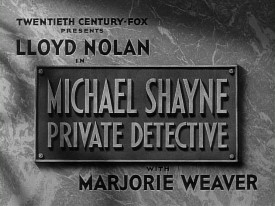
Michael Shayne, Private Detective ( 1940 ) 14k


Michael Shayne tries to clear his name of a murder wrap when the boyfriend of the rich gal he is hired to protect is found dead...supposedly shot with Shayne's gun.  Lloyd Nolan, Marjorie Weaver, Joan Valerie, Walter Abel, Elizabeth Patterson. Directed by Eugene Forde. 20th Century Fox.

The quick witted Miami detective, Michael Shayne, is first introduced this fast-paced film about a switcheroo at the horse track. Elizabeth Patterson is a doll as the aunt who loves to solve Baffle Book mysteries and tags along with Shayne for thrills. It gets a bit confusing near the end, but all the actors are so entertaining to watch understanding the plot isn't really an issue. Or as Chief Painter put it, "You may understand but it's all Hungarian goulash to me!".

          ___________________________________________________________


Crash Dive ( 1943 ) 14k 


A lieutenant and a submarine commander fall in love with the same girl but must work together to destroy a Nazi ammunition dump. Dana Andrews, Tyrone Power, Anne Baxter, James Gleason. Directed by Archie Mayo. 20th Century Fox. 

Very entertaining as far as war films go. ( That wasn't a crack, we're big fans of action flicks ). This one was obviously catered to the feminine crowd as well for about half of the movie is about the blossoming romance between Anne Baxter and Tyrone Power. Stunning color, great special effects and an exciting commando raid make this an all-around 'A' picture. 

           ___________________________________________________________


Francis in the Navy ( 1955 ) Elct.


Lt. Peter Stirling finds he has a doppelganger in the Navy. When Francis gets auctioned off for the Navy, Peter finds he can't escape back into the Army because of his missing twin. ( Sorry folks, that's the best I can do....the plot eluded me as well. Look how confused Hyer looks in that poster ). Donald O'Connor, Jim Backus, Martha Hyer, Richard Erdman. Directed by Arthur Lubin. Universal Pictures. 

Francis the mule entering the Navy seemed like a promising plot situation that could of taken many turns but what screenwriter Devery Freeman came up with was terribly disappointing. Francis doesn't even get much of a part. Most of the movie has Donald O'Connor running around in his underwear. A young Clint Eastwood and Martin Milner play fellow sailors. 

          ___________________________________________________________


Boeing Boeing ( 1965 ) 14k 


A news correspondant in Paris has a man's dream schedule worked out - he has three different fiancees that he lives with, all airline stewardesses, whom he juggles in between their flights. When the new "super-thrust" engine gets installed on all the Boeings his schedule gets all mixed-up. Tony Curtis, Jerry Lewis, Thelma Ritter, Dany Saval, Suzanna Leigh. Directed by John Rich. Hal Wallis Productions. 

Clearly a stage comedy, "Boeing Boeing" features that popular 1960s frantic-romantic theme with lots of characters going in and out of doors and hiding from each other. ( The tag line to the film was "The big comedy of Ninety-Sexty-Sex"...oh brother ) Thelma Ritter is great as Curtis' maid, uttering "it ain't easy" in between cooking knackwurst and saurkraut, but the film is too long and gets tedious near the end. Add to that Tony Curtis' overly-nervous acting and it becomes sub-par to the other comedies of the era.