“Any man more right than his neighbors constitutes a
majority of one”
Leonard Spigelgass’ poignant story of racial prejudice, “A
Majority of One”, focuses on emphasizing the truth of the above quotation as
well as teaching a gentle and humorous lesson on the folly of judging others by
their ethnicity and not by their hearts. It is a story of a cross-cultural
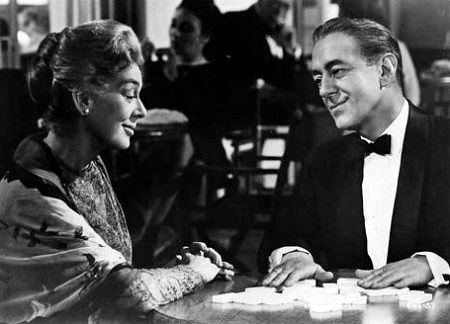
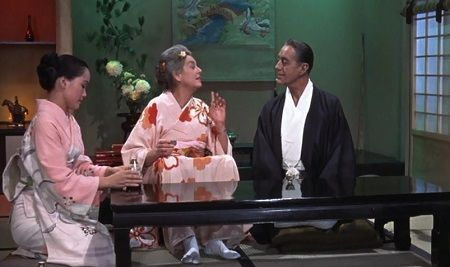
romance between two widows – Mrs. Jacoby, a Jewish Brooklynite ( superbly played
by Rosiland Russell ) and Mr. Asano ( Alec Guinness ), a Japanese industrialist.
Mrs. Jacoby spent most of her life in Flatbush and loves the
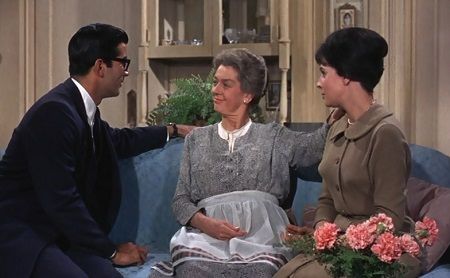
neighborhood and her apartment dearly. Her daughter Alice ( Madlyn Rhue ) and
diplomat son-in-law Jerry ( Ray Danton ) worry about “Mama” living on her own
while they spend years at a time in foreign nations moving wherever Jerry’s
position takes them. Mrs. Jacoby is not getting any younger and, as Mrs.Ruben,
her neighbor blatantly points out, the neighborhood is changing and “that
element is moving in”....a statement which brings up a conversation that sets
the tone for the film:
“What element, Mrs.Ruben?” ( Jerry )
“You know..colored, Puerto Ricans...”
“Really? I seem to remember in this very neighborhood not so
long ago they didn’t allow Jews.”
“What does one have to do with the other?”
“Everything. The only way to stop prejudice is to stop it in
yourself”.
When Jerry receives his new assignment Alice pleads with Mama
to come with them. “But you haven’t
said where”...“Japan, Mama.” Japan! Mrs.
Jacoby lost her only son in combat in Japan during WWII and the memory –and
hatred – is still painfully fresh. However, for love of her children, she
reluctantly agrees to follow, and so they’re off across the sea to the Land of
the Rising Sun. En route on the voyage they meet Mr.Asano, a Japanese
millionaire industrialist who will not only play a pivotal role in an upcoming
international trade conference that Jerry will take part in, but will change
Mrs. Jacoby’s feelings toward the Japanese in a remarkable way.
A Majority of One was penned by Leonard Spigelgass in
1958 and debuted on Broadway on February 16, 1959, starring Gertrude Berg and
Sir Cedric Hardwicke. It played for 556 performances and was a critical and
box-office success. It was nominated for four Tony awards ( Berg won for Best
Actress ).
 Jack Warner at Warner Bros. purchased the film rights to
the comedy in 1960 for the princely sum of $500,000 and approached Rosalind
Russell for the starring role. Russell was aghast. “You’ve been drinking,” she
told Warner according to her 1977 autobiography Life is a Banquet.
“What would I be doing playing a Jewish lady from Brooklyn? I’m a little Irish
girl from Waterbury, Connecticut. Use Gertrude Berg, it’s her part.” Warner
insisted however, refusing to cast Berg since she made a disastrous film at
Paramount years earlier. It was not until he suggested that Alec Guinness could
be her co-star that Russell reconsidered. “Well, that’s another cup of chicken
soup,” she told him. “I’ll think about that little item”.
Jack Warner at Warner Bros. purchased the film rights to
the comedy in 1960 for the princely sum of $500,000 and approached Rosalind
Russell for the starring role. Russell was aghast. “You’ve been drinking,” she
told Warner according to her 1977 autobiography Life is a Banquet.
“What would I be doing playing a Jewish lady from Brooklyn? I’m a little Irish
girl from Waterbury, Connecticut. Use Gertrude Berg, it’s her part.” Warner
insisted however, refusing to cast Berg since she made a disastrous film at
Paramount years earlier. It was not until he suggested that Alec Guinness could
be her co-star that Russell reconsidered. “Well, that’s another cup of chicken
soup,” she told him. “I’ll think about that little item”.
When she approached Alec Guinness with the idea he said, “I
want the dollars, so if you’ll do it, I’ll do it”. To which Russell replied, “I
want to work with you, so if you’ll do it, I’ll do it”.
So they did it. And they couldn’t have been a more delightful
combination. Russell shines in her role as the Jewish widow,
Bertha Jacoby. With just the right about of mamish chochmeh she dispenses bits
of neighborly advice – and Smith Brothers cough drops - to all she comes in
contact with. She handles herself and her children with respect but upon
occasion, when they overstep their boundaries, she can be firm and immovable.
Guinness was touching and endearing and portrayed Mr.Asano
with a graceful maturity befitting a Japanese gentleman of illustrious birth.
However, in spite of the heavy makeup and authenticity he gave to his role ( he
spent ten days in Japan prior to filming taking a crash course in Japanese
culture ), many viewers felt a Japanese actor was called for. Perhaps because a
Caucasian portrayed the role on Broadway ( interracial romance was a scandalous
subject at the time and was dealt with by using English actors in the roles of
Asians ), or because the studio wanted top drawing names, Japanese actors such
as Sessue Hayakawa were overlooked.
Marc Marno and Mae Questel were plucked from the Broadway
production for supporting roles to round out a cast which also included Frank
Wilcox, Francis De Sales and Alan Mowbray.
A Majority of One is a humorous blending of schmaltz
and saki and went on to win three Golden Globes for Best Picture, Best Actress (
Russell ) and Best Film Promoting International Understanding. How did it win
that last award? Because all cultures are different, the
movie tells us, but those differences are just superficial. As they become
acquainted, Mr. Asano and Mrs. Jacoby mention aspects of their respective
cultures that, at first, seem different but after comparison are revealed to be
relatively the same.
For
example, Japanese people worship in shrines; Jewish people worship by blessing
Sabbath candles – ultimately, "God's house is God's house," as Mrs. Jacoby says
after being invited to a Japanese shrine. Japanese people eat raw fish; Jewish
people eat gefilte fish. Japanese people toast with "Kanpai" and Jews say
"L'Chaim."
Jews
put up with a lot: "Whatever comes into your life, you take." So do Japanese:
"You transcend. It's the philosophy of the Zen Buddhists." ..."You mean, if you
have tsouris – trouble – you come out of it a better person for having lived
through it." ...."Obviously you have studied Zen Buddhism, Mrs.
Jacoby!”
In addition to emphasizing the importance of embracing other
nationalities “whether they are white, black, pink or purple!” the more subtle
lessons of forgiveness and tolerance are taught, lessons which Mrs. Jacoby - and
her children - needed to be taught. When he first makes her
acquaintance, Mr. Asano approaches Mrs. Jacoby to inquire why she is so cold
towards him. After telling him that her son was killed in action by the
Japanese, he explains that he, personally, did not want war nor did anyone he
knew, and that he lost both his son and daughter in Hiroshima. Mrs. Jacoby then
realizes that he’s had a cupful in life too and hatred quickly dispels into
kinsmanship. As the voyage progresses they find each other to be the most
pleasant of companions, with Mr. Asano particularly drawn to Mrs. Jacoby’s
warmth and friendship.
Later, as Mama considers the proposition of “crossing over the
bridge” with Mr. Asano, she must first deal with the prejudice in her own
family. In the first half of the drama we perceive Mrs. Jacoby to be
old-fashioned and set in her customs while her children are shown to be
adaptable and open to new viewpoints and new changes. However, the tables turn
midway through and we find that it is Mrs. Jacoby’s daughter and husband who are
narrow-minded. The words Jerry spoke in Brooklyn echo back to him when he faces
the prospect of Mama and Mr. Asano’s impending courtship... “If you want to stop
prejudice you must first stop it in yourself”. He must come to learn that being
friendly and welcoming should not be a diplomatic “front of face” but stem from
a sincere consideration for others.

A Majority of One is as relevant today as it was when
it was first released in 1961. The film is a hidden gem, a truly entertaining
foreign affair, completely unique and as lovely as cherry blossoms in spring; it
is sure to bring shtick naches to those who take the time to watch the film.
This post is our contribution to the fantasmagorical 2013 TCM Summer Under the Stars blogathon hosted by Sittin' on a Backyard Fence and Scribe Hard on Film. For a complete schedule to the month-long event click here.

 Captain Hornblower pointedly remarks this after embarking with his crew on a secret mission to Central America to supply armaments to "El Supremo" a fanatical rebel leader who plans on organizing an attack against France's Spanish allies. The year is 1807 and while Napoleon's forces were attacking in Europe a diversion such as this would be large enough to make France send some military support to North American defense in support of their Spanish ally. "El Supremo" is hardly the kind of man one would want to make terms with, as Hornblower soon finds out.