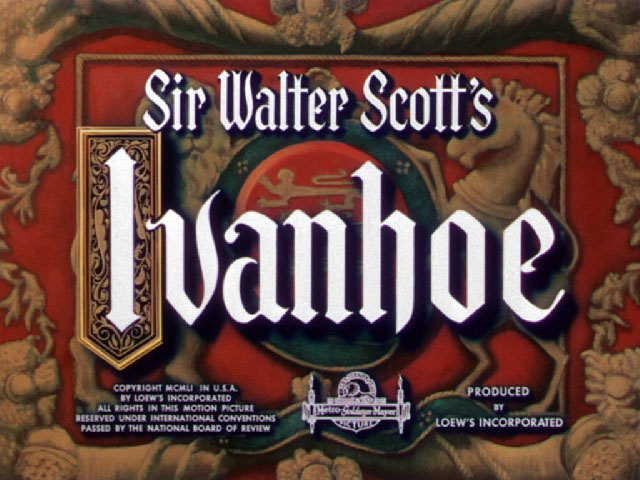
Sir Walter Scott's 1819 epic medieval novel "Ivanhoe" was brought to the big screen in 1952 as a gorgeous Technicolor adaptation released through Metro-Goldwyn-Mayer Studios. Like many medieval films of the era, it combined romance, drama, and a good deal of swordplay into an adventure-packed 100-minute runtime.
Ivanhoe was first brought to the screen in 1913, as a silent film starring King Baggot and Leah Baird. Surprisingly, it was not filmed again in the 1920s ( Ronald Colman missed out on a great opportunity here ), nor in the 1930s and 1940s.
Finally, in 1952, when Pandro S. Berman undertook to produce it, he hired that old pro at MGM, Richard Thorpe, to direct the film. Thorpe whipped together a scrumptious feast of derring-do and the success of this film lead him to helm several other similarly themed pictures, including The Prisoner of Zenda ( 1952 ), Knights of the Round Table ( 1953 ), and The Adventures of Quentin Durward ( 1955 ), two of which starred Robert Taylor, the titular hero of Ivanhoe.
Robert Taylor was "Taylor-made" for roles such as Sir William of Ivanhoe, convincing audiences that he was the embodiment of noble virtues such as bravery, honesty, gentleness, and honor. In this film, he is the famous chivalrous Anglo-Saxon knight who is on a mission to return the imprisoned king, Sir Richard the Lionheart, to his throne which has been usurped by his nefarious brother Prince John ( Guy Rolfe ). With the aid of Isaac ( Felix Aylmer ), the old leader of a Jewish community, he collects the necessary ransom amount to free the king but must first clash swords with the knight De Bois-Guilbert ( George Sanders ) before he sees Richard seated in his rightful place again.
Unlike some studios, Metro-Goldwyn-Mayer never made films in a half-hearted fashion, and Ivanhoe was no exception. It had a budget of nearly $4,000,000 which permitted the cast to be sent to England for interior and exterior shooting at the MGM British Studios in Borehamwood and Ashby de-la Zouch, villages steeped in English history. Alfred Junge designed the interiors of all of the sets, with Roger Furse ( Henry V ) providing the scrumptious costumes for the knights and ladies, which included Joan Fontaine as Rowena and Elizabeth Taylor as Rebecca.
Elizabeth Taylor was only nineteen-years-old at the time, but so expressive in her acting and certainly the most beautiful actress to ever portray Rebecca. Also in the excellent cast was Emlyn Williams as Wamba, Robert Douglas, Finlay Currie, Basil Sydney, Megs Jenkins, Francis de Wolff, and Harold Warrender as Robin Hood.
Some have claimed that Ivanhoe is not entirely faithful to the book, but surely some allowances had to be made for the sake of condensation. The thrill of seeing the story that unfolds onscreen inspires one to read the novel. This should be the aim of any great literary-to-film adaptation, and Ivanhoe accomplishes this.
Upon its release, Ivanhoe was a huge earner at the box-office, both in the States and in England, grossing over $10,000,000 in sales. It also triggered the birth of a medieval genre of films that had not been popular since Errol Flynn starred in The Adventures of Robin Hood in 1938.
Showing posts with label Swashbucklers. Show all posts
Tuesday, November 13, 2018
Saturday, July 15, 2017
Scaramouche ( 1952 )
"He was born with the gift of laughter and the sense that the world was mad"
Within the last century, Raphael Sabatini's classic 1921 novel "Scaramouche" was made into three film adaptations, including a 1956 television series, but hands down this Metro-Goldwyn-Mayer version starring the engaging English actor Stewart Granger tops them all. The film accomplished that rare feat of improving upon the novel it was based on. Scaramouche ranks as one of the best swashbuckling films of the 1950s, and even boasts the longest and most intricate fencing duel in Hollywood's history.
Stewart Granger stars as dashing hero Andre-Louis Moreau, a young lawyer who dedicates years of his life to avenge the death of his best friend (Richard Anderson) who was killed in a duel by the Marquis de la Tour d'Azyr (Mel Ferrer), a master swordsman. He joins a traveling theatre group where he dons the mask of Scaramouche, the star comedian, in order to hide from the Marquis' soldiers who have ordered Andre arrested as a revolutionary. Even with his dogged determination to pin down the Marquis, Andre takes time off from his fencing lessons to woo Lenore (Eleanor Parker), a flaming red-headed actress and Aline de Gavrillac (Janet Leigh), the pretty young ward of the Marquis.
"But who is Scaramouche? And why does he hide his face behind a mask?"
Scaramouche plunges the audience right into the action from the on-start, packing a lot of story in its 115-minute run time. It features a marvelous cast, excellent cinematography, stunning costumes by Giles Steele, beautiful Cedric Gibbons sets, and a lovely Victor Young score (the end music is especially apropos). In short, it's a rousing good swashbuckler!
Veteran director George Sidney, who was especially adept at filming musicals (Anchors Aweigh, The Harvey Girls, Annie Get Your Gun, Kiss Me Kate), took the helm of this classic, staging all of the sword-fighting sequences as though they were dance numbers. These fencing "ballets" are a highlight of this colorful film and the climatic eight-minute duel sequence between Granger and Ferrer is justly famous for it took these actors eight weeks of training to get their fencing movements precise.
"Scaramouche, you have just given your last performance!"
European fencing champion Jean Heremans provided Stewart Granger with fencing lessons and he delighted in doing all of his own stunts. Granger was ideally cast as the rakish lad born with the gift of laughter. He brought a playful exuberance to the character which was a key element in bringing Sabatini's novel to life.
Granger had seen the original 1923 silent version (starring Ramon Navarro and Lewis Stone) as a child and when he was offered a contract by MGM, he signed it on the condition that Scaramouche would be developed as a project for him.
The studio had toyed with remaking the film for years, first in 1938 with Fernand Gravet, and then as a possible musical version with Gene Kelly or Fernando Lamas in the starring role, so when Granger suggested the book as a vehicle for himself it was swiftly put into production. Since MGM studios always treated novel-based films with reverence, Scaramouche went to the top of their release schedule as an A-picture.
Elizabeth Taylor was originally slated to play the part of Aline de Gavrillac, but had to turn down the role because she was already signed for another picture. Ava Gardner was also to have been in the film, in Eleanor Parker's role. However, this was a fortunate swap for Eleanor Parker is excellent as the feisty Lenore.
Rounding out the cast is Henry Wilcoxon, Nina Foch (as Marie Antoinette), Lewis Stone, Robert Coote, and Elisabeth Risdon.
This post is our contribution to The Swashathon being hosted by Movies Silently. Be sure to head on over to Movies Silently site to check out other great reviews of classic swashbuckling films.
Within the last century, Raphael Sabatini's classic 1921 novel "Scaramouche" was made into three film adaptations, including a 1956 television series, but hands down this Metro-Goldwyn-Mayer version starring the engaging English actor Stewart Granger tops them all. The film accomplished that rare feat of improving upon the novel it was based on. Scaramouche ranks as one of the best swashbuckling films of the 1950s, and even boasts the longest and most intricate fencing duel in Hollywood's history.
Stewart Granger stars as dashing hero Andre-Louis Moreau, a young lawyer who dedicates years of his life to avenge the death of his best friend (Richard Anderson) who was killed in a duel by the Marquis de la Tour d'Azyr (Mel Ferrer), a master swordsman. He joins a traveling theatre group where he dons the mask of Scaramouche, the star comedian, in order to hide from the Marquis' soldiers who have ordered Andre arrested as a revolutionary. Even with his dogged determination to pin down the Marquis, Andre takes time off from his fencing lessons to woo Lenore (Eleanor Parker), a flaming red-headed actress and Aline de Gavrillac (Janet Leigh), the pretty young ward of the Marquis.
"But who is Scaramouche? And why does he hide his face behind a mask?"
Scaramouche plunges the audience right into the action from the on-start, packing a lot of story in its 115-minute run time. It features a marvelous cast, excellent cinematography, stunning costumes by Giles Steele, beautiful Cedric Gibbons sets, and a lovely Victor Young score (the end music is especially apropos). In short, it's a rousing good swashbuckler!
Veteran director George Sidney, who was especially adept at filming musicals (Anchors Aweigh, The Harvey Girls, Annie Get Your Gun, Kiss Me Kate), took the helm of this classic, staging all of the sword-fighting sequences as though they were dance numbers. These fencing "ballets" are a highlight of this colorful film and the climatic eight-minute duel sequence between Granger and Ferrer is justly famous for it took these actors eight weeks of training to get their fencing movements precise.
"Scaramouche, you have just given your last performance!"
European fencing champion Jean Heremans provided Stewart Granger with fencing lessons and he delighted in doing all of his own stunts. Granger was ideally cast as the rakish lad born with the gift of laughter. He brought a playful exuberance to the character which was a key element in bringing Sabatini's novel to life.
Granger had seen the original 1923 silent version (starring Ramon Navarro and Lewis Stone) as a child and when he was offered a contract by MGM, he signed it on the condition that Scaramouche would be developed as a project for him.
The studio had toyed with remaking the film for years, first in 1938 with Fernand Gravet, and then as a possible musical version with Gene Kelly or Fernando Lamas in the starring role, so when Granger suggested the book as a vehicle for himself it was swiftly put into production. Since MGM studios always treated novel-based films with reverence, Scaramouche went to the top of their release schedule as an A-picture.
Elizabeth Taylor was originally slated to play the part of Aline de Gavrillac, but had to turn down the role because she was already signed for another picture. Ava Gardner was also to have been in the film, in Eleanor Parker's role. However, this was a fortunate swap for Eleanor Parker is excellent as the feisty Lenore.
Rounding out the cast is Henry Wilcoxon, Nina Foch (as Marie Antoinette), Lewis Stone, Robert Coote, and Elisabeth Risdon. This post is our contribution to The Swashathon being hosted by Movies Silently. Be sure to head on over to Movies Silently site to check out other great reviews of classic swashbuckling films.
Monday, November 9, 2015
The Prisoner of Zenda ( 1952 )
Movies Silently is currently hosting the great Swashathon celebrating sword-wielding heroes and the films that featured them dating from the 1920s through the 1960s. This post is our contribution to the event.
The 1937 Ronald Colman classic The Prisoner of Zenda is often considered the definitive film adaptation of Anthony Hope's novel of the same name and you won't hear any statement to the contrary from us, however the 1952 Metro-Goldwyn-Mayer remake packs quite a punch on its own and since it is highly underrated we have decided to spotlight this swashbuckler instead.
Hope's 1894 novel tells the story of a commoner, Rudolf Rassendyll, who is thrust into the royal household when he is called upon to impersonate his look-a-like, King Rudolf of Ruritania, who was drugged by the king's half-brother, Michael, the night before his coronation. At first he is unwilling to cooperate, especially since his visit to the Balkan country was purely for recreation, but after he meets the lovely Princess Flavia, the King's bride to be, he decides to comply, feigning the role of the king during the coronation and aiding the king's supporters in preventing Michael's conspiracy from taking over the country.
Stewart Granger was quickly becoming one of Metro's most popular leading actors when producer Pandro S. Berman decided to cast him in the duel role of the Rudolfs for The Prisoner of Zenda. Granger had made his American film debut two years prior in King Solomon's Mines, which became a box-office hit.
After the highly successful swashbuckler Scaramouche was released in the summer of 1952, MGM thrust their new leading man into this sword-clashing costume drama and wasted no time in its production either. The Prisoner of Zenda took a mere thirty days to film and was released in November, 1952. Considering the scale of the production this is an amazing feat in itself.
Stewart Granger was just the kind of star MGM was hoping for....he had a noble appearance, an affable nature, and the charisma and agility of the famous swashbucklers of past generations ( Douglas Fairbanks, Errol Flynn ) making him ideally suited to historical adventure films. After Zenda, he would go on to make Salome, Young Bess, All the Brothers Were Valiant, and Beau Brummel for the studio.
The lovely English rose, Deborah Kerr, was cast as Granger's leading lady, Princess Flavia. Kerr and Granger had met during a European stage tour of Gaslight during the mid-1940s and this was their third US film together. Rudolf and Princess Flavia share many a tender moment together.
Robert Douglas is featured as the King's nemesis Michael, but it is James Mason who captures the crown of villainy as Rupert of Hentzau, one of Michael's Nazi-like henchmen. Louis Calhern, Robert Coote, and Jane Greer also have strong supporting roles and the great character actor Lewis Stone makes an appearance as his eminence, the Cardinal. Stone had portrayed the leading role in the silent version of The Prisoner of Zenda so it was a nice touch to have him return to Ruritania thirty years later. Unfortunately, the political situation in the country hadn't changed any since he left.
"The Prisoner of Zenda" is one of the all-time great swashbuckling stories and this marked the fifth time the tale was brought to the screen. Metro-Goldwyn-Mayer had purchased the rights to Hope's novel in addition to buying the rights to United Artists 1937 adaptation starring Ronald Colman. Exactly fifteen years had passed since audiences thrilled to Colman's performance as the commoner-turned-hero and it was high time that audiences were given a chance to relive that thrill - this time in Technicolor. MGM did not want to tamper with success and so Richard Thorpe was called upon to smother his directorial skills and create a carbon-copy version of the original, utilizing a moviola projector on the set to duplicate even the same camera angles.
The film is often underrated because of this lack of originality but in truth The Prisoner of Zenda is distinctive on its own merit. It possesses all of the elements of an iconic swashbuckler - a dashing hero, a beautiful damsel in distress ( Princess Flavia was trapped into what she thought would be a loveless marriage ), a nefarious power-seeker who happens to be an expert swordsman, an exotic Balkan setting, and resplendent costumes ( by Walter Plunkett ) and marvelous split-screen special effects. One of the highlights of the movie is the swordfight scene during the finale. Fencing master Jean Heremans ( The Three Musketeers, Scaramouche ) was called in to train Granger and Mason for this fight scene, and the actors clearly take passion in attempting to destroy each other utilizing every object in the room as weapons. Granger even underwent stitches after receiving a wound near his mouth. This sterling bit of swordplay becomes the epee apex of the picture.
'Tis true, if one were to compare the two filmings of The Prisoner of Zenda, Colman's version will emerge the victor, but these films were not meant to be seen back to back. This was a telling of the story for a different generation and MGM captured the thrills and passion of the original with an entirely new cast - and the bonus attraction of Technicolor. Now honestly, if you take off your comparison-glasses and sit back and make yourself comfortable, you have a darn good swashbuckler to enjoy.
Head on over to the silent headquarters, Movies Silently, to check out all the great posts on more swashy films from the golden age of cinema. To get more of Zenda, check out Now Voyaging's review of the 1937 classic and Scribblings line-up of the Ruperts of Hentzaus throughout the ages.
The 1937 Ronald Colman classic The Prisoner of Zenda is often considered the definitive film adaptation of Anthony Hope's novel of the same name and you won't hear any statement to the contrary from us, however the 1952 Metro-Goldwyn-Mayer remake packs quite a punch on its own and since it is highly underrated we have decided to spotlight this swashbuckler instead.
Hope's 1894 novel tells the story of a commoner, Rudolf Rassendyll, who is thrust into the royal household when he is called upon to impersonate his look-a-like, King Rudolf of Ruritania, who was drugged by the king's half-brother, Michael, the night before his coronation. At first he is unwilling to cooperate, especially since his visit to the Balkan country was purely for recreation, but after he meets the lovely Princess Flavia, the King's bride to be, he decides to comply, feigning the role of the king during the coronation and aiding the king's supporters in preventing Michael's conspiracy from taking over the country.
Stewart Granger was quickly becoming one of Metro's most popular leading actors when producer Pandro S. Berman decided to cast him in the duel role of the Rudolfs for The Prisoner of Zenda. Granger had made his American film debut two years prior in King Solomon's Mines, which became a box-office hit.
After the highly successful swashbuckler Scaramouche was released in the summer of 1952, MGM thrust their new leading man into this sword-clashing costume drama and wasted no time in its production either. The Prisoner of Zenda took a mere thirty days to film and was released in November, 1952. Considering the scale of the production this is an amazing feat in itself.
Stewart Granger was just the kind of star MGM was hoping for....he had a noble appearance, an affable nature, and the charisma and agility of the famous swashbucklers of past generations ( Douglas Fairbanks, Errol Flynn ) making him ideally suited to historical adventure films. After Zenda, he would go on to make Salome, Young Bess, All the Brothers Were Valiant, and Beau Brummel for the studio.
The lovely English rose, Deborah Kerr, was cast as Granger's leading lady, Princess Flavia. Kerr and Granger had met during a European stage tour of Gaslight during the mid-1940s and this was their third US film together. Rudolf and Princess Flavia share many a tender moment together.
Robert Douglas is featured as the King's nemesis Michael, but it is James Mason who captures the crown of villainy as Rupert of Hentzau, one of Michael's Nazi-like henchmen. Louis Calhern, Robert Coote, and Jane Greer also have strong supporting roles and the great character actor Lewis Stone makes an appearance as his eminence, the Cardinal. Stone had portrayed the leading role in the silent version of The Prisoner of Zenda so it was a nice touch to have him return to Ruritania thirty years later. Unfortunately, the political situation in the country hadn't changed any since he left.
The film is often underrated because of this lack of originality but in truth The Prisoner of Zenda is distinctive on its own merit. It possesses all of the elements of an iconic swashbuckler - a dashing hero, a beautiful damsel in distress ( Princess Flavia was trapped into what she thought would be a loveless marriage ), a nefarious power-seeker who happens to be an expert swordsman, an exotic Balkan setting, and resplendent costumes ( by Walter Plunkett ) and marvelous split-screen special effects. One of the highlights of the movie is the swordfight scene during the finale. Fencing master Jean Heremans ( The Three Musketeers, Scaramouche ) was called in to train Granger and Mason for this fight scene, and the actors clearly take passion in attempting to destroy each other utilizing every object in the room as weapons. Granger even underwent stitches after receiving a wound near his mouth. This sterling bit of swordplay becomes the epee apex of the picture.
'Tis true, if one were to compare the two filmings of The Prisoner of Zenda, Colman's version will emerge the victor, but these films were not meant to be seen back to back. This was a telling of the story for a different generation and MGM captured the thrills and passion of the original with an entirely new cast - and the bonus attraction of Technicolor. Now honestly, if you take off your comparison-glasses and sit back and make yourself comfortable, you have a darn good swashbuckler to enjoy.
Head on over to the silent headquarters, Movies Silently, to check out all the great posts on more swashy films from the golden age of cinema. To get more of Zenda, check out Now Voyaging's review of the 1937 classic and Scribblings line-up of the Ruperts of Hentzaus throughout the ages.
Saturday, September 26, 2015
The Rogues of Sherwood Forest ( 1950 )
After the box-office success of Warner Brother's The Adventures of Robin Hood in 1938, a number of studios tried to replicate the appeal of the original by creating their own versions of the Robin Hood legends with such films as The Bandit of Sherwood Forest ( 1946 ), The Prince of Thieves ( 1948 ), The Story of Robin Hood ( 1952 ), The Men of Sherwood Forest ( 1954 ), and The Sword of Sherwood Forest ( 1960 ).
Most of these films were just standard fare, but one Columbia Pictures production stood out as a fitting sequel to ( or rather, a replica of ) The Adventures of Robin Hood, it was The Rogues of Sherwood Forest released in 1950. John Derek may not have had the charisma of Errol Flynn but he portrayed the character with a vigor suitable to the son of that knavish hero of yor.
The Rogues of Sherwood Forest is set in a post-King Richard England. With his brother dead, Prince John ( George MacReady ) - now in his 50s - takes control of the throne once again and he hasn't lost any of his youthful zest for bloodshed and tyranny. Aghast at the injustice of this malicious monarch is Robin, Earl of Huntington, son of the famous Robin Hood, who has also since passed on. He rallies up some of his father's old cronies - including Little John, Friar Tuck and Will Scarlet - and gathers a fresh band of outlaws to wage woodland war on Prince John and his cohorts.
Alan Hale costars as Little John in his final film role ( and his third outing as the stout comrade ). The lovely Diana Lynn portrays Lady Marianne ( not Marion, but awfully close ) with the now-retired merry men of the greenwood being played by Billy House ( Friar Tuck ), Billy Bevan ( Will Scarlet ), and Lester Matthews ( Allen-a-Dale ).
Gordon Douglas ( director of the Our Gang shorts ) takes the helm of this rousing Technicolor swashbuckler, which features some stunning cinematography ( by Charles Lawton Jr. ) and beautiful matte-painted backdrops.
While many of the other Robin Hood remakes/sequels are worth a gander at, we believe The Rogues of Sherwood Forest boasts the best cast, filming, and script, which comes as no surprise since screenwriter George Bruce was no stranger to writing swashbucklers. Some of his previous films included The Man in the Iron Mask ( 1939 ), The Son of Monte Cristo ( 1940 ), and The Corsican Brothers ( 1941 ).
Most of these films were just standard fare, but one Columbia Pictures production stood out as a fitting sequel to ( or rather, a replica of ) The Adventures of Robin Hood, it was The Rogues of Sherwood Forest released in 1950. John Derek may not have had the charisma of Errol Flynn but he portrayed the character with a vigor suitable to the son of that knavish hero of yor.
The Rogues of Sherwood Forest is set in a post-King Richard England. With his brother dead, Prince John ( George MacReady ) - now in his 50s - takes control of the throne once again and he hasn't lost any of his youthful zest for bloodshed and tyranny. Aghast at the injustice of this malicious monarch is Robin, Earl of Huntington, son of the famous Robin Hood, who has also since passed on. He rallies up some of his father's old cronies - including Little John, Friar Tuck and Will Scarlet - and gathers a fresh band of outlaws to wage woodland war on Prince John and his cohorts.
Alan Hale costars as Little John in his final film role ( and his third outing as the stout comrade ). The lovely Diana Lynn portrays Lady Marianne ( not Marion, but awfully close ) with the now-retired merry men of the greenwood being played by Billy House ( Friar Tuck ), Billy Bevan ( Will Scarlet ), and Lester Matthews ( Allen-a-Dale ).
Gordon Douglas ( director of the Our Gang shorts ) takes the helm of this rousing Technicolor swashbuckler, which features some stunning cinematography ( by Charles Lawton Jr. ) and beautiful matte-painted backdrops.
While many of the other Robin Hood remakes/sequels are worth a gander at, we believe The Rogues of Sherwood Forest boasts the best cast, filming, and script, which comes as no surprise since screenwriter George Bruce was no stranger to writing swashbucklers. Some of his previous films included The Man in the Iron Mask ( 1939 ), The Son of Monte Cristo ( 1940 ), and The Corsican Brothers ( 1941 ).
Tuesday, April 28, 2015
The Adventures of Robin Hood ( 1938 )
Never has there been a more joyous swashbuckler filmed than Warner Brothers' The Adventures of Robin Hood (1938). The centuries old legend of the bold outlaw who robbed from the rich to give to the poor comes to life in this glorious adaptation which brims over with thrilling swordplay, sweet romance, a stellar cast, a thousand resplendent costumes, and a rousing orchestral score by Erich Wolfgang Korngold. Verily, the film serves up a right merry feast of entertainment.
No archer ever lived that could speed a gray goose shaft with such skill and cunning as Robin, nor has any actor embodied a character as well as Errol Flynn does in his portrayal of this lusty rogue.
The legends of Robin Hood date back to the 14th-century when tales of the famous outlaw were spread across the shires through ballads. Innumerable authors have passed the stories down in various tellings throughout the ages, but it is undoubtedly Howard Pyle's inspired adaptation of the legends in his 1883 masterpiece "The Merry Adventures of Robin Hood" that set the tone for this film.
Storybook thrills abound in Norman Reilly Raine and Seton Miller's script, which weave elements of romance, comedy and adventure in its simple story of tyranny opposed and virtue triumphed. Robin Hood and his band of merry men, loyal to King Richard, set things right for England when the King's dastardly brother, the Norman Prince John, usurps the throne and wrenches tax money, yea, and the very blood, from the oppressed Saxons. The King's royal ward, Lady Marian, despises Robin Hood and his thieving ways until she sees the broken, destitute masses which he cares for in the forest. Then her heart goes out towards him and his noble cause and she becomes the outlaw's ally, eventually saving him from the gallows.
James Cagney was originally cast as the archer in green tights when Warner Brothers began development on Robin Hood in 1935. The studio was slowly expanding its output to include adventure films and prestigious historical dramas in an effort to compete with its rival Metro-Goldwyn-Mayer and reach a broader audience.
After the success of Warner's A Midsummer Night's Dream (1935), costume designer Dwight Franklin suggested that the same formula could be translated well to another period piece, that of the tales of Robin Hood. Executive producer Hal Wallis decided to reunite most of the principle cast for this project, including Anita Louise as Lady Marian, Frank McHugh and Allen Jenkins as some of the merry men, and Hugh Herbert as Friar Tuck. Ho! but during the development stage James Cagney had one of his frequent rows with the studio and walked out on his contract, not returning for nearly two years.
Since much time and money had already been invested in the story, Wallis decided to cast the studio's rising star, Errol Flynn, in the lead. The part of the charismatic Saxon knight was a glove-fit for this devilishly handsome actor who had a roguish air and an athletic knack for leaping over parapets.
Fate dealt a fortuitous hand with Cagney's departure, for Flynn's arrival precipitated a complete overhaul of the project. What resulted was a film which could not be more impeccably cast. Claude Rains cloaked himself in red as the villainous Prince John, an urbane schemer who finds the feather-capped archer's exploits wryly amusing. Basil Rathbone had a long career portraying villains and did a stellar performance as the wicked pirate Levasseur in Captain Blood in 1935. For this film he donned the garb of the egotistical Sir Guy of Gisbourne.
Lady Marian could not be envisioned more lovely than Olivia de Havilland, who had just launched her film career three years prior with her appearance as Hermia in A Midsummer Night's Dream. Once Errol Flynn was cast as Robin Hood there was no doubt that de Havilland would portray his "bold Norman beauty", since the two were such an ideal couple in Captain Blood and The Charge of the Light Brigade. They would go on to make six more films together.
Also in the cast was Herbert Mundin as cheerful Much, who casts a favorable eye on Bess, Marian's twittery lady-in-waiting, portrayed by Una O'Connor. Ian Hunter made a noble King Richard, and Melville Cooper played the oafish Sheriff of Nottingham.
Shafts of sunlight streaming down through the leafy canopy of Sherwood Forest were captured in the splendor of three-strip Technicolor by the perceptive eyes of cinematographers Tony Gaudio and Sol Polito, who were utilizing the newly developed Technicolor cameras. This was a cumbersome and costly process, but it lent the film an unsurpassed richness in color. This beloved Sherwood of Robin's just happened to be Bidwell Park located in Chico, California. Never had England seen so much sunlight in one summer.
Director Michael Curtiz took over the scepter of command from William Keighley midway through production and deserves much credit for the sprightly pace of The Adventures of Robin Hood. He captured the grand-flourishing manner of silent day swashbucklers with their crowd-pleasing heroics and bold swordplay. Some of the sequences were even filmed "undercranked" which sped up the action on screen in silent-era fashion.
The Adventures of Robin Hood was an enormous hit upon its initial release on May 14, 1938, with critics praising its sheer exuberance and audiences of all ages coming to take a pilgrimage to the land of medieval fancy. Robin's arrows soared through the air to land with a resounding ffffrupp! on the bullseye of entertainment. Warner Brothers gathered nearly $4 million into its purse and the film went on to win three of the four Oscars it was nominated for at the Academy Awards (losing the Best Picture award to You Can't Take it With You).
The Adventures of Robin Hood remains a favorite amongst cinephiles nearly eighty years since Robin made his heroic entrance into Sherwood Forest. It is still considered one of the best films of its type and possesses all of its initial zest and vitality, in no small part due to Errol Flynn's exuberant portrayal of Robin Hood. He shows us a character so supremely alive that to him all of life is a lark. What makes him so wonderful to behold is he lights the fire of life within the audience as well. Our cares disappear and we wonder why we take our petty problems with such seriousness when Robin could face death innumerable times without ever losing a feather in his cap.
Numerous remakes have been undertaken over the years but none have been able to capture the essence of Robin Hood without cynicism or postmodern mockery. This film was made with sublime innocence in a decade when righteousness and evil could be presented to the audience in simple black and white imagery without brushing virtues and sins together into murky grays. The cast and crew of Robin Hood set out to make the picture, not as a technical masterpiece, but purely for the aim of providing entertainment to the masses, and verily, this task was accomplished with thunderous success.
Monday, September 30, 2013
The Medieval Films
So, without more ado, here we present to share with thee the most popular
moving pictures that were set in the merry times of the medieval era. But
first, what years constitutes the medieval era, thee asketh? That be a fair
question and well do we know that many a scholar has been confounded by what
other folk may consider a proper answer, but it seemeth to us that the great
battle of Hastings be a good mark as any as to when the medieval era began, and
the birth of that right lusty fellow, Henry VIII, be as good a closing mark as
any. In simpler words, 1066-1490 A.D. Yea, truly these be the prime middle ages...
when the kingfolk were fat and unruly, the peasants merry and poor, the men
stout and strong, and merry England was filled with the breathing spirit of a
people... idle and content to be so.
Prythee read further, if thou be so inclined:
The Crusades ( 1935 ) - Cecil B. DeMille's film was one of the earliest epics to be set in the
medieval ages. Aside from a few major silent film productions, most
screenwriters stood clear of the Middle Ages because box-office sales for this
genre had never been too well received. DeMille changed that status and created a medieval pageant of spectacle with The Crusades. Richard the Lionheart sets off on his holy wars and falls in love with the Princess of Navarre, Berengaria, en route. Loretta Young and Henry Wilcoxon star.
A Connecticut Yankee ( 1931 ) - Will Rogers starred as
the rambunctious yank in this adaption of Mark Twain's classic novel "A Connecticut Yankee in King Arthur's Court" about a mechanic who bumps his head and finds himself in Arthurian Britain. It was remade as a color musical with Bing Crosby in 1949.
Romeo and Juliet ( 1936 ) - William Shakespeare's immortal tale of young love was brought to the screen in this beautiful MGM production starring Leslie Howard and Norma Shearer. George Cukor as director, Cedric Gibbon set designs, and a supporting cast featuring Basil Rathbone, John Barrymore and Edna May Oliver all combine to make this a superb film. It was remade in color for Zeffirelli's stunning 1968 version of "Romeo and Juliet".
The Adventures of Robin Hood ( 1938 ) - There be no finer medieval film than this... A perfect cast, magnificent color cinematography and a scrumptious Max Steiner musical score highlight this entertaining swashbuckler featuring Errol Flynn ( sigh! ), the lovely Olivia de Havilland, Claude Rains, Alan Hale, Basil Rathbone and Patric Knowles. The film went on to win three Academy Awards and was the second-highest grossing picture of the year. A sequel, "Robin of Locksey" was developed in the wake of its success but never went into production.
The Flame and the Arrow ( 1950 ) - Burt Lancaster, at his tip-top fittest-finest acrobatic best, leaped and
bounded in this rousing good yarn about a rebel leader, Bartoli, in medieval Italy during the time of Barbarossa.
Virginia Mayo, Robert Douglas, and Aline MacMahon co-starred in this Jacques Tournear production.
Ivanhoe ( 1952 ) - Sir Walter Scott's epic romance was brought to the screen in stunning
Technicolor and headed with the dynamic Taylors, Elizabeth and Robert. If ever
there was a man fit for heroic knighthood, it be Robert Taylor. The success of
this feature spawned MGM to launch several other middle-aged adventure yarns
within the next few years, starring robust Robert. Joan Fontaine, George
Sanders, Emlyn Williams, and Finlay Currie co-starred in this wonderful froth
of derring-do.
The Knights of the Round Table ( 1953 ) - MGM followed up the success of Ivanhoe with
this aptly titled blockbuster about the knights of King Arthur's legendary
round table. It was the studios first film in the new Cinemascope process, and
the result was spectacularly vibrant color cinematography. This time Ava Gardner
played the heroine, Fair Guinevere of all women, with Robert Taylor as Sir Lancelot,
noble and loyal to King Arthur ( Mel Ferrer ) up until her beauty gets the best of him.
King Richard and the Crusaders ( 1954 ) - Sir Walter Scott film adaptations were all the rage in the mid-1950s over at MGM and so Warner Brothers joined the bandwagon and released "King Richard and the Crusaders", this too being their first film with Cinemascope. George Sanders decided to play the good-guy for a change and took the role of Richard the Lionheart, but the real star of the show was Rex Harrison as the Sultan Saladin. The beautiful Virginia Mayo co-starred as Lady Edith Plantagenet.
The Black Shield of Falworth ( 1954 ) - Torin Thatcher plays a delicious villain in
this amiable men-in-tights romp. Tony Curtis stars as the son of a disgraced
knight who - noble by birth, noble by nature - attempts to thwart this
villain's attempts to the throne of King Henry IV. Janet Leigh plays our
lovely damsel and distress and David Farrar, Barbara Rush and Herbert Marshall
round out the stellar cast.
The Adventures of Quentin Durward ( 1955 ) - MGM followed up their "Ivanhoe" success with another Walter Scott based film, Quentin Durward. Once again Robert Taylor headed up the cast in this story about a penniless Scottish knight who becomes involved in court intrigue. Kay Kendell and Robert Morley co-starred. This was the third film in a trilogy of medieval adventure/romances directed by Richard Thorpe and produced by Pandro S. Berman.
The Court Jester ( 1955 ) - Danny Kaye, a minstrel to the Black Fox, masquerades as a court jester to help aid in a plot to usurp an evil ruler who has overthrown the rightful king. The Court Jester was the most expensive comedy film produced at the time and bombed at the box-office but since then it has become one of the most beloved of Kaye's films and a television classic. Glynis Johns, Basil Rathbone and Angela Lansbury also starred.
"The pellet with the poison's in the vessel with the pestle; the chalice from the palace has the brew that is true!"
The Dark Avenger ( 1955 ) - This film marked Errol Flynn's last sojourn in the historical adventure genre that he had rose to stardom in. It follows the adventures of Edward, the Black Prince, son of King Edward III and heir to the throne of England, as he tries to liberate the people of Aquitaine from the cruel grasp of France. Joanne Dru and Peter Finch provide steady support to Flynn in the film that the New York Times labeled as "corn...every step of the way". Oh well, its good to have a serving of corn every once in awhile.
The Vagabond King ( 1956 ) - Oreste and Kathryn Grayson starred in this eye-popping Technicolor musical about the life and loves of the 14th century French poet and rebel, Francois Villon. This is the fifth screen re-telling of the story. Ronald Colman starred in "If I Were King" ( 1938 ), the non-Frimlized version.
The Magic Sword ( 1962 ) - All great actors were relegated to playing in cheap sci-fi/horror films during the final days of their career....in Basil Rathbone's case, he got a few fantasy/adventure films thrown into the lot as well. This film, aimed more at the children's crowd, told the story of a sorceress' son and his quest to save a princess from the hands of an evil wizard ( Rathbone ). Anne Helm and Gary Lockwood portrayed the young princess and her savior.
Camelot ( 1967 ) - Beautiful cinematography highlighted this movie about the life of the legendary King Arthur, focusing mainly on his marriage to Guinevere and her affairs with his comrade, Sir Lancelot. Joshua Logan's lusty film adaption of the popular Lerner and Lowe Broadway
stage musical starred Richard Harris, Vanessa Redgrace, David Hemmings and
Lionel Jeffries as the principal Camelotians. Alas, like many other musicals of the late 1960s, it was cast with actors who could not sing. Julie Andrews was sorely missed here.
The Lion in Winter ( 1968 ) - Katharine Hepburn and Peter O'Toole stage a scrumptious feast of witty banter in this story about Henry II and his estranged wife, Queen Eleanor Acquitaine and their Christmas reunion. The two thespians chatted and drank their way through a film that earned six Academy Award nominations, and one win for Hepburn. A young Anthony Hopkins makes this screen debut as Prince Richard.
Thursday, August 15, 2013
Captain Horatio Hornblower, R.N ( 1951 )
"War breeds strange allies"
Captain Hornblower pointedly remarks this after embarking with his crew on a secret mission to Central America to supply armaments to "El Supremo" a fanatical rebel leader who plans on organizing an attack against France's Spanish allies. The year is 1807 and while Napoleon's forces were attacking in Europe a diversion such as this would be large enough to make France send some military support to North American defense in support of their Spanish ally. "El Supremo" is hardly the kind of man one would want to make terms with, as Hornblower soon finds out. The first three novels in C.S Forester's Hornblower saga ( Beat to Quarters, Ship of the Line, Flying Colors ) were purchased by Warner Brothers in 1938 for material for their swashbuckling star, Errol Flynn.
C.S. Forester had made a name for himself during the 1930s as an author of novels with military/naval themes ( Brown on Resolution, The African Queen, Death to the French ). He was called to Hollywood to write up an adventure story, working under Arthur Hornblow and Niven Busch. Forester came up with a tale about a pirate in seventeenth century England. Unfortunately, Warner Brothers was in the process of making Captain Blood with Errol Flynn and it used the same key historical elements he was hoping to use. Instead of starting on another project he bounded on a freighter for home and met a photographer, Barbara Sutro, onboard. During the voyage he had his new novel worked out with its lead characters...Hornblower, Bush and Lady Barbara!
The Hornblower series became a success and Hal Wallis considered making the film with Laurence Olivier and Vivian Leigh as the stars but difficulties within Warner Brothers studio hampered the production and it was shelved for many years.
Then in 1948, the project was once again brought up but quickly quenched when studio heads saw the disappointing box-office receipts for The Adventures of Don Juan, starring Errol Flynn. Clearly the public's taste in gung-ho adventures were changing they surmised...or else their boyish hero Errol Flynn was starting to show his age. Warner Brothers was already in the process of grooming a younger actor to replace Flynn as their adventure star - Burt Lancaster - but the role of the grunting British sea-captain Hornblower did not seem suitable for Lancaster. Hence, they chose Gregory Peck on loan-out from David Selznick studios to lead. ( Stewart Granger and Richard Todd could have been other possibilities but who knows what contractual arrangements they were tied to at the time. )
One-eyed Raoul Walsh, a master of filming the adventure genre, was called in to direct and filming commenced in the summer of 1950. Most of the interior shots were filmed in the United Kingdom, while the outdoor locales were filmed on location in Villefranche-sur-Mer, France, on board the HMS Victory, and on the set of the former Hispaniola built a year earlier for Walt Disney's production of Treasure Island. She got a fresh paint job and a new name, the HMS Lydia, and was back in action. But as Errol Flynn would have told the production crew, "It's bad luck to rename a ship".
Although Peck gave a fine performance as Hornblower, he lacked the charisma that would have inspired his men to lay down their lives for him. The bosom-buddy comradery was missing between Hornblower, Lt. Bush ( Robert Beatty ) and seaman Quist ( James Robertson Justice ) that would endeared them to the audience more. This is where the Errol Flynn/Alan Hale teamings of yor were sorely missed.
However, in spite of this, Captain Hornblower manages to pack an adequate punch, full of adventure, beautiful sets, and colorful characters. It remains a top swashbuckler for many Brit and Yankee buccaneers and features some spectacular naval battle sequences including one particularly rousing broadside exchange between the 36-gun HMS Lydia and a 60-gun command ship led by "El Supremo" in the waters of the Pacific Ocean.
Captain Horatio Hornblower was released in the UK on April 10, 1951 and in the US five months later. It received good reviews from critics both abroad and in the states and became one of the top ten box-office hits in the UK that year.
This post is our contribution to the wonderful 2013 TCM Summer Under the Stars Blogathon, hosted by Sittin on a Backyard Fence and Scribe Hard on Film. For a complete schedule to the month-long event, click here.
Subscribe to:
Posts (Atom)