Showing posts with label Dean Stockwell. Show all posts

Monday, November 7, 2016

The Secret Garden ( 1949 )

"Aye, I know wha' tis said. He locked the gate and buried the key, and nary's been in there since."

A secret garden. It has been locked up for years and is now overgrowing with weeds and bramble for want of anyone to tend to it. When the young orphan Mary Lennox first discovers this enchanted place at the estate of her uncle, she views the garden as an amusing diversion from her loneliness and boredom, but she soon finds that the key that unlocked its door may hold the answer to unlocking the buried secret in her uncle's past. 

The Secret Garden was based upon a 1910 novel by the beloved children's book author Frances Hodgson Burnett. To this day it remains her most popular book, along with "Little Lord Fauntleroy" and "The Little Princess", all of which were adapted to film numerous times over the years. The enduring popularity of these stories can be attributed to Burnett's flair for writing about story elements that children find appealing such as mysterious passageways, orphans from exotic lands, strange characters, locked doors, and hidden gardens. Her stories also consistently featured children as the heroes.


Mary Lennox (portrayed by Margaret O'Brien) is a strange heroine, however, for a book or a film. She is bratty and spoiled having been accustomed to servants waiting on her hand and foot in India. After her parents die from cholera, she is shipped off to England to reside in an oppressive mansion with her uncle, Lord Archibald Craven (Herbert Marshall), a bitter brooding man. Each night Mary hears a screaming voice echoing through the myriad hallways. The servants attempt to quench her curiosity, explaining it simply as "the wind howling from the moors", but Mary finds that they are coming from the bedchamber of a small boy, Colin Craven (Dean Stockwell), her uncle's son. From constant coddling, Master Craven has become an invalid and, believing that he will grow into a hunchback one day, finds living futile. Mary finds her match in Colin because he, too, is spoiled and prone to screaming tantrums. It is only after Mary befriends Dickon, a neighbor boy, and discovers the secret garden, that she learns to find contentment in the simple pleasures of life. 
The Secret Garden is a Clarence Brown production and his visual style is evident throughout the film, but most of the credit for the quality of the film should be given to director Fred Wilcox who established a wonderful moody atmosphere through great use of light and shadow. As an added touch, a Technicolor sequence was utilized to give that extra emotional punch, while the beautiful Cedric Gibbons sets bring the story to life in a fashion that even location filming could not have equaled. 

Metro-Goldwyn-Mayer excelled at adapting novels to lush film productions and, like most of their output in the late 1940s, The Secret Garden featured some of the best talent to be found in Hollywood, both in front and behind the camera. Those tried-and-true child actors, Dean Stockwell and Margaret O'Brien, were excellent in their roles, as was newcomer Brian Roper in the part of Dickon (interestingly, he was 20 years old at the time). 

The adult roles are so well cast that one tends to forget that they are mostly caricatures: Dame Gladys Cooper as the stern housekeeper; Elsa Lanchester as the irrepressibly happy maid; dour Reginald Owen as the old nosy gardener. Even the small cameo performances sparkle with Metro's character talents: Billy Bevan as an overheated British soldier in India; Dennis Hoey as Marshall's stern valet; Aubrey Mather and George Zucco as young Stockwell's doctors; and Norma Varden as his wise nurse.

Thursday, November 13, 2014

Kim ( 1950 )

1885 Lahore, India: 

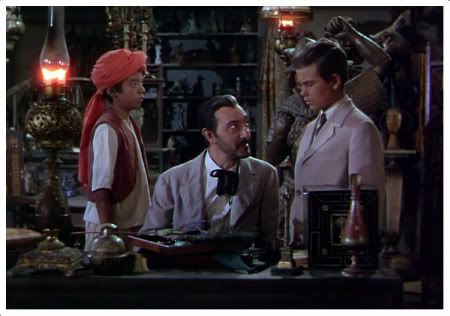
Colonel Creighton, head of the British-India Secret Service receives a report that the Russians are planning an attack on India via the Khyber Pass…where and when they plan on attacking is unknown. With the help of “Red Beard” Mahbub Ali, their top agent who disguises himself as a horse trader; the “Fat Man”; and an orphan English boy named Kim, they try to uncover the Russian’s plan before it is too late. 

Rudyard Kipling’s thrilling adventure novel “Kim” was brought to the screen in 1950 in brilliant eye-popping Technicolor and boasted a splendid cast with Errol Flynn as the magnificent Red Beard, Cecil Kellaway as the Fat Man, Paul Lukas as the Holy Man ( a Tibetan monk with an unusually strong Austrian accent ), and Dean Stockwell as our boy-hero Kim - a young English lad who learns how difficult it can be to play to spy for the Great Game, especially when he learns that he must forsake his scavenging ways and don the manners of his own people.

"You belong with your own people. A true man, like a true horse, runs with his own breed"


Kipling's novel was based on real-life spying methods during the era of the Great Game. This was the familiar term for the rivalry the British Empire had with Russia for gaining territory ( and supremacy ) in Central Asia. The "game" began in 1813 and continued on for nearly 100 years. In 1885, the year that Kim was set in, the two powers nearly declared war on each other when Russia seized Afghan territory near Panjdeh.

Filmed on location in Rajasthan and Utter Pradash, India ( as well as Lone Pines, California ), the movie gives us a grand tour of India and how it may have looked during the Age of Imperialism, when British troops paraded on grounds outside city walls and wily dangerous characters lurked in dark corners of crowded sadaks. 


The rights to Rudyard Kipling's popular adventure novel were purchased by Metro-Goldwyn-Mayer in the mid-1930s with the intention of casting Freddie Bartholomew in the title role. For unknown reasons, this project was abandoned and not taken up again until the late 1940s.

During this time, Errol Flynn was loaned to MGM from Warner Brothers for two pictures. The first one was That Forsyte Woman where, opposite Greer Garson, he was cast as the unloved Soames Forsythe. His second feature was a choice between King Soloman's Mines or Kim. Both were to be filmed on location. Errol opted for India over Africa and the lead role of Allan Quartermain in King Solomon's Mines was turned over to English actor Stewart Granger...in a very enjoyable version of the story too, if I say so meself. 


Kim is a wonderful adventure film as well – enjoyable for all ages – but alas, it fails to be a truly memorable film, mainly due to its heavy reliance on voice-over narration rather than pictures and dialogue. However, when there is dialogue, it is spoken right from the pages of Kipling’s novel and pleasantly plays on the ears in lyrical fashion.

" You should believe only your eyes…and not the voices of others."

" This is a child’s game, Mr. Luzor "

" It is part of a Great Game ". 

Sir Robert Baden-Powell, the famous British Army scout and founder of the Boy Scout movement, would of fully approved of the lessons this film teaches…..key lessons on observation and judging character; always being aware of one's surroundings and being prepared.


Dean Stockwell is particularly noteworthy as the English sahib living life as an Indian boy. Devoted to his Holy Man, Kim acts as his chelah ( a servant to a monk ) while travelling across India with him in quest of the sacred River of the Arrow. Begging on the streets, climbing across rooftops, cursing passerby's, and donning a dark tan, he is an unlikely suspect to his enemies and hence...becomes a master player of the Great Game.

This post is our contribution to The British Empire in Film Blogathon being hosted by The Stalking Moon and Phantom Empires. It's a ripping good event covering all the grand and glorious films set in the age of Imperialism. Be sure to check it out!