Showing posts with label 1940s. Show all posts

Friday, March 20, 2026

The Daughter of Rosie O'Grady (1950)

In 1943, Betty Grable starred in the colorful Fox Technicolor musical Sweet Rosie O'Grady. Seven years later, her screen sister, June Haver, was featured in a sort of follow-up film, The Daughter of Rosie O'Grady, which was equally colorful and just as entertaining. 

In this film, "Junie Baby" (as Fred MacMurray would call her) played Patricia O'Grady, the daughter of Rosie O'Grady, a once-popular music hall entertainer. Along with her two sisters, Katie (Marcia Mae Jones) and Maureen (Debbie Reynolds), Patricia resides with her father, Dennis O'Grady (James Barton), a stern Irishman who works as a trolley conductor. He loves his daughters and wants to keep them by his side. He also wants them to go nowhere near the theater district for fear they will want to become performers themselves and, as Papa claims, "That's no life for anyone!" He and his dear departed Rosie spent years living out of a trunk and traveling from one town to the next. He wants his daughters to marry college-educated men and settle down.

Little does he know that his eldest daughter is already secretly married to a policeman and about to have a child, and that darlin' Patty has fallen in love with none other than Tony Pastor (Gordon MacRae), the owner of the local musical—and, saints preserve us!—wants to join his acting troupe!

You can guess that there is enough drama in the film to fill its 105-minute runtime. Nevertheless, squeezed in between the Irish fighting spirits are plenty of musical interludes, including a lovely rendition of the titular song. When Gordon MacRae isn't singing, Gene Nelson entertains the audience with his impressive dancing skills. June Haver was quite a dancer herself and does many a fancy step with Gene, while S.Z. Sakall adds some comic relief as Papa O'Grady's co-worker and family friend.

Overall, it's an entertaining entry from the Fox film factory, although not very memorable... Within a year of viewing, you'll probably get this title confused with Sweet Rosie O'Grady or When Irish Eyes are Smiling!

Monday, December 8, 2025

From the Archives: The Pied Piper (1942)


Anne Baxter makes sure that Monty Woolley has his scarf wrapped around him before heading out in this original still from the classic Fox war drama The Pied Piper (1942). That's the talented Roddy McDowall standing next to Monty. 

From the Archives is our latest series of posts where we share photos from the Silverbanks Pictures collection. Some of these may have been sold in the past, and others may still be available for purchase at our eBay store: http://stores.ebay.com/Silverbanks-Pictures 

Friday, November 7, 2025

From the Archives: Song of Surrender (1949)


Wanda Hendrix and MacDonald Carey display a striking pose in this original Paramount Pictures publicity photo where they play two lovers caught in a "song of surrender."

From the Archives is our latest series of posts where we share photos from the Silverbanks Pictures collection. Some of these may have been sold in the past, and others may still be available for purchase at our eBay store: http://stores.ebay.com/Silverbanks-Pictures 

Wednesday, November 5, 2025

The Spiral Staircase (1946)

Few thrillers have ever wrapped terror in such beauty as Robert Siodmak's The Spiral Staircase (1946). Adapted from Ethel Lina White's novel "Some Must Watch", it is one of the crown jewels of the "old dark house" tradition. 

The story takes place in 1916 in a quiet New England village that is shaken by a killer who is stalking women he deems "imperfect." Inside the great Warren mansion, the latest potential target, Helen Capel (Dorothy McGuire), a young mute servant girl, tends to her bedridden employer Mrs. Warren (Ethel Barrymore), unaware that danger lurks within the corridors of the house she calls home. 

Director Robert Siodmak, fresh from his work at Universal, infused the picture with the eerie elegance of German Expressionism. His camera glides through the Warren house teasing us with glimpses of views through mirrors and banisters, as though we were the unseen watcher. The most iconic frame of the film is undoubtably his close-up of the killer's eye and its reflection of the titular staircase. 

Dorothy McGuire gives a remarkable delicate performance as Helen. One forgets her muteness entirely, instead we sense her vulnerability and every thought of fear through her expressions alone. The grand old dame Barrymore gives a barnstorming turn as the sharp-tongued ailing dowager, a role which earned her an Academy Award nomination. George Brent and Gordon Oliver are each cloaked in just enough mystery to keep the viewer guessing, while Kent Smith lends a touch of romance to the proceedings as the young Dr. Parry who is anxious for Helen to regain her speech. The always appealing Rhonda Fleming costars as Mr. Warren's secretary; Elsa Lanchester brings some tipsy humor to the household gloom, and Sara Allgood and Rhys Williams round out the cast of servants. 

Visually, the film is a feast. Nicholas Musuraca's cinematography - that deep-focus chiaroscuro he perfected in Cat People and The Seventh Victim - breathes life into Albert D'Agostino's rambling and gloomy Victorian sets. 

The mystery itself may not stump many modern viewers, but The Spiral Staircase was never about surprise...it is about suspense - that exquisite tightening of the nerves as Helen's silence grows unbearable. In its refinement and restraint, The Spiral Staircase anticipates the psychological thrillers of decades to come and remains a Gothic masterpiece preserved on celluloid.

Thursday, October 9, 2025

The Onedin Line Re-Imagined

A few days ago, my sister and I were watching
The Heiress (1949) and seeing the 1850s period costumes and setting reminded me of that excellent 1970s British series The Onedin Line which was also set during that time, except in England not in Washington Square. Then it occurred to me that The Onedin Line would have made a fantastic film in the 1940s and Olivia de Havilland would have been ideally cast as Captain James Onedin's first wife, Anne. Of course, that led to the question of who would have been cast in all of the other roles if this was indeed a Hollywood production from the 1940s.....

Before I get into my casting picks for this imaginary production, check out Wikipedia's summary of the long-running series if you are not familiar with it. Like Upstairs, Downstairs, it will probably be re-vamped into another popular PBS mini-series in the near future but, for now, let's have fun with doing a backdated casting of The Onedin Line. 

James Onedin, who was so perfectly played by Peter Gilmore, would have been the most difficult character to cast. The role called for a man who is headstrong and aggressive and yet very likeable.... such as James Cagney. He would have been a little old for the part in the late 1940s and Onedin is a tall man, so that led me to choose Burt Lancaster. Thanks to the magic of Midjourney, you can picture this choice in the beautiful rendering below. Olivia de Havilland is ideal as his wife Anne. James married her for her dowry but she proved to be such a good wife and business partner that he fell in love with her later. Her father - who liked to tipple - could have been played by Charles Coburn, and Joseph Cotten would have performed the part of James' brother Robert splendidly. 

Now Jame's sister Elizabeth, who was both beautiful and impetuous, could have been played by Lana Turner, and Zachary Scott could have tackled the role of the debonair Mr. Frazer. Lastly, there was Daniel Fogarty, the handsome seaman who loved Elizabeth.... ideally played by Alan Marshall. 

After doing these imaginary castings, I wondered what choices ChatGPT would have made. Every once in a while I like to throw it a question to test its capabilities, so this seemed like a fun question to pose.... and it responded with some surprisingly good picks! 

This is the answer to the question, "If The Onedin Line was a feature film made in 1948, who would you have cast in that film? It could be a British production or a Hollywood production."

That’s a marvelous what-if! The Onedin Line — with its blend of maritime adventure, class struggle, and passionate ambition — would have made a magnificent 1948 feature film, whether produced by Ealing Studios or a Hollywood studio like MGM or Warner Bros.

Let’s imagine two versions — one British (authentic, gritty, and character-driven), and one Hollywood (lavish, romantic, with a stronger focus on spectacle and glamour).


British Production (Ealing Studios or Rank Organisation, 1948)

Director: Charles Frend (Scott of the Antarctic) or David Lean (Great Expectations, Oliver Twist)

James OnedinTrevor Howard
→ Rugged, determined, with that flinty intelligence and undercurrent of pride. Perfect as a man clawing his way up from poverty to respectability.

Anne Webster/OnedinJean Simmons
→ Fresh-faced, tender yet strong-willed. She’d bring the quiet emotional backbone that tempers James’s ambition.

Elizabeth FrazerValerie Hobson
→ Elegant and high-born, with that refined coolness that makes her both sympathetic and formidable.

Robert OnedinMichael Redgrave
→ Polished and respectable, in contrast to James’s rougher edge; his moral conflicts would play beautifully in Redgrave’s hands.

Captain Webster (Anne’s father)Cecil Parker
→ A kindly but stubborn sea captain with a moral compass and a soft spot for his daughter.

Daniel FogartyStewart Granger
→ Handsome, brash, and charming — a perfect rival for James both in love and ambition.

Mrs. Sarah Onedin (James and Robert’s mother)Flora Robson
→ Warm, weary, and wise — the moral heart of the family.

Music by: Alan Rawsthorne or Ralph Vaughan Williams
→ For sweeping maritime grandeur and emotional resonance.

Cinematography: Guy Green (beautiful North Sea light and dramatic shipboard scenes)


🌊 Hollywood Production (Warner Bros or MGM, 1948)

Director: Michael Curtiz (Captain Blood, The Sea Hawk) or Victor Saville (Green Dolphin Street)

James OnedinGregory Peck
→ Strong, stoic, with moral gravity and a romantic streak. Perfectly suited to a man rising from sailor to shipowner.

Anne Webster/OnedinDeborah Kerr
→ Graceful, compassionate, with quiet strength — the ideal moral and emotional counterweight to Peck’s intensity.

Elizabeth FrazerGreer Garson
→ Elegant and poised, but with hidden vulnerability — she’d elevate Elizabeth’s role into one of quiet tragedy and dignity.

Robert OnedinDavid Niven
→ Urbane and slightly superior, but ultimately loyal; a perfect foil to Peck’s intensity.

Captain WebsterCharles Laughton
→ Gruff but warmhearted, with a deep love for the sea. His scenes would be unforgettable.

Daniel FogartyTyrone Power
→ Dashing, ambitious, and romantic — an ideal rival for both Anne’s heart and James’s business.

Mrs. OnedinGladys Cooper
→ Regal and reserved, representing the family’s dignity amidst turmoil.

Music by: Erich Wolfgang Korngold
→ Lush, heroic, and sweeping — full of salt air and stormy romance.

Technicolor cinematography by Sol Polito or Jack Cardiff
→ Tall ships in the Mersey glinting under golden sunlight, with lavish seascapes and tempestuous skies.


Optional Alternate Visions

  • Powell & Pressburger version (1948) – beautifully surreal, with Roger Livesey as James, Wendy Hiller as Anne, and Anton Walbrook as Robert — a more allegorical, poetic take on ambition and love.

  • British Lion Studios version (grittier) – Richard Burton as a younger, more volatile James; perhaps made in black and white with a social realist tone, emphasizing class conflict.


I like the casting for the Powell and Pressburger and British Lion productions, too. Spot on! Look at the director choices, too. How did it know I was thinking about Green Dolphin Street? Eerie. I then ran this same question in Microsoft's CoPilot to see what it generated and it has some excellent choices, too. Again, it placed the British production first and its Hollywood version second. 

🎬 Hypothetical 1948 Casting for The Onedin Line


🧭 James Onedin – The ambitious, brooding shipping magnate

  • Trevor Howard – Known for his intensity and gravitas (Brief Encounter, The Third Man), he'd bring a steely resolve to James.

  • Michael Redgrave – A commanding presence with emotional depth, perfect for portraying James’s inner conflicts.

  • Stewart Granger – Handsome and charismatic, with a flair for adventure (Scaramouche, King Solomon’s Mines), ideal for the romantic and ruthless aspects of James.

💼 Robert Onedin – The pragmatic, business-minded brother

  • Nigel Patrick – Slick and sharp, often cast as urbane professionals, he’d suit Robert’s calculating nature.

  • Cecil Parker – For a slightly older take, his dry wit and businesslike demeanor would fit Robert’s role well.

  • Jack Hawkins – Solid and dependable, with a commanding voice and presence, he could portray Robert’s more grounded side.

💃 Elizabeth Onedin – The strong-willed sister navigating a patriarchal world

  • Deborah Kerr – Elegant and intelligent, with a quiet strength (Black Narcissus, The Life and Death of Colonel Blimp).

  • Jean Simmons – Youthful but fiery, she could capture Elizabeth’s ambition and emotional complexity.

  • Margaret Lockwood – Known for her spirited roles and dramatic flair (The Wicked Lady, The Man in Grey), she’d bring edge and charisma.

🎬 Hypothetical 1948 Hollywood Casting for The Onedin Line


🧭 James Onedin – The ambitious, brooding shipping magnate

  • Gregory Peck – Tall, commanding, and morally complex (Captain Horatio Hornblower, Gentleman's Agreement), perfect for a man torn between love and ambition.

  • Tyrone Power – Dashing and intense, with a flair for adventure (The Black Swan, Nightmare Alley), ideal for James’s romantic and ruthless sides.

  • Humphrey Bogart – For a grittier take, Bogart’s edge and charisma (The Treasure of the Sierra Madre) could make James a darker antihero.

💼 Robert Onedin – The pragmatic, business-minded brother

  • Fred MacMurray – Often cast as the affable businessman (Double Indemnity, The Apartment), he’d bring a smooth, calculating charm.

  • Edward G. Robinson – Sharp, shrewd, and intense (Key Largo, The Woman in the Window), perfect for a more hard-nosed Robert.

  • Joseph Cotten – Thoughtful and understated (Shadow of a Doubt, The Third Man), ideal for a quieter but strategic sibling.

💃 Elizabeth Onedin – The strong-willed sister navigating a patriarchal world

  • Olivia de Havilland – Graceful and resilient (The Heiress, To Each His Own), she’d bring depth and dignity to Elizabeth.

  • Barbara Stanwyck – Fierce, independent, and emotionally complex (Sorry, Wrong Number, Double Indemnity), perfect for a woman fighting for agency.

  • Gene Tierney – Elegant and enigmatic (Laura, Leave Her to Heaven), she’d add mystery and allure to Elizabeth’s arc.


Interestingly, both selected Trevor Howard in the lead, which as you can see in the rendering at the top of the post, does indeed seem to be a good choice. Now we just have to wait five years and by that time I can probably prompt these AI chats to create the whole film. Exciting! 

If you are familiar with The Onedin Line, share your top casting picks in the comment box below. Who would you have cast?

Tuesday, October 7, 2025

From the Archives: Somewhere in the Night (1946)


Looking to watch a good thriller? Then check out Somewhere in the Night (1946) featuring John Agar and Nancy Guild, who looks remarkably like Gene Tierney in this Fox publicity photo. 

From the Archives is our latest series of posts where we share photos from the Silverbanks Pictures collection. Some of these may have been sold in the past, and others may still be available for purchase at our eBay store: http://stores.ebay.com/Silverbanks-Pictures 

Saturday, August 9, 2025

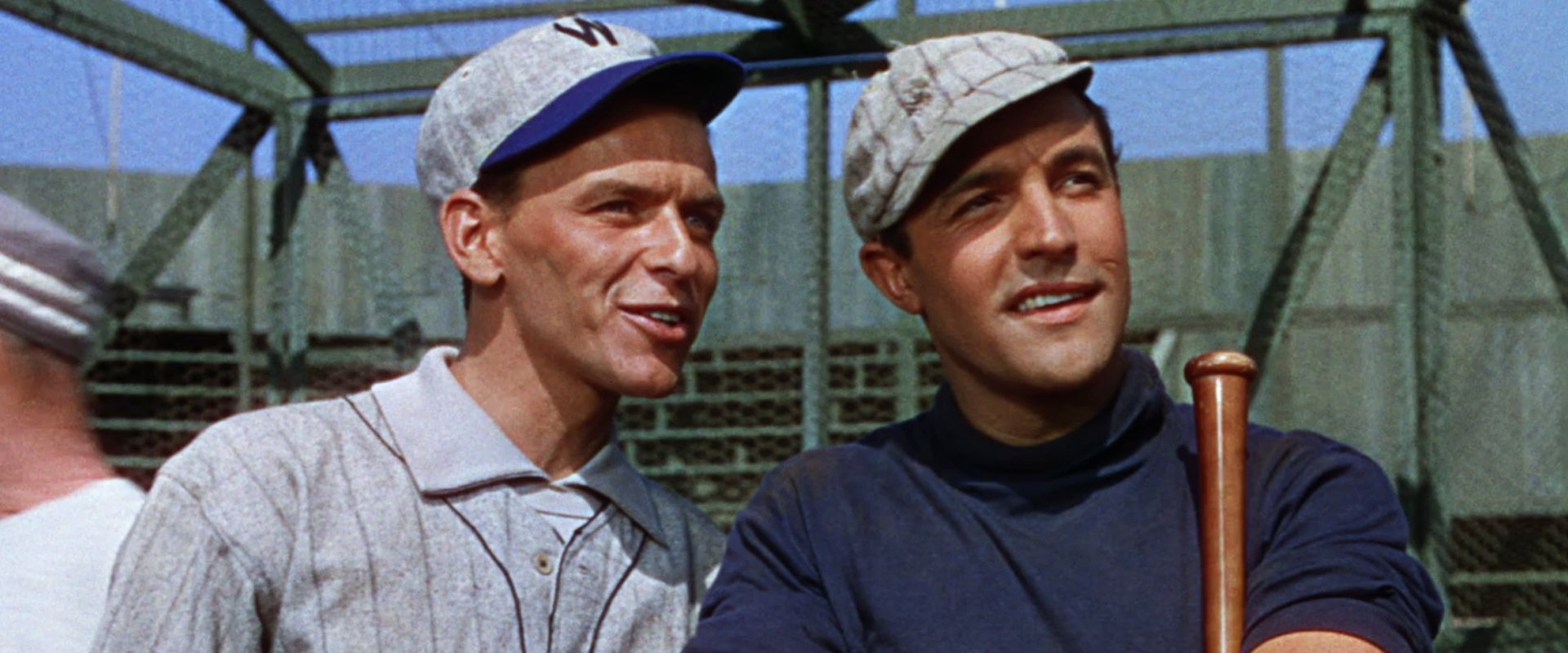
Take Me Out to the Ball Game (1949)

In 1948, Busby Berkeley was hired to direct the all-American musical Take Me Out to the Ball Game but midway through production he had to withdraw due to health issues. That's when Gene Kelly stepped up to the plate and hit a homerun with a blockbuster! 

Take Me Out to the Ball Game was the first film to team Gene Kelly, Frank Sinatra, and Jules Munshin and this winning threesome were so entertaining they joined forces right afterwards for the classic On the Town, both directed by Stanley Donen and Gene Kelly. 

The Donen-Kelly duo were also responsible for penning this story, a wholesome blend of Americana, baseball, and good ol' gambling. Gene Kelly stars as Eddie O'Brien, short-stop of the fictional Wolves pro-ball team. When playing with his buddies, first baseman Dennis Ryan (Sinatra) and third baseman Nat Goldberg (Munshin), they're unbeatable. The owner of the Wolves recently passed away and his niece K.C. Higgins (Williams) arrives to take a "hands on" approach to ownership. At first, they resent this, but then they come to admire her.... all except Eddie, who is steamed that she moved up their curfew and increased the fine for breaking it. Eddie likes to entertain the girls at night, so that cramps his style. 

Eddie likes to entertain, period. When he isn't playing ball, he is cutting capers. Off season, he and Dennis are a popular vaudeville act. When Joe Lorgan (Edward Arnold), a big gambler in town, bets heavily against the Wolves, he uses Eddie's love of show business to lure him away from training. But when Eddie learns he has been made a stooge he rallies back to help the Wolves - and his buddies - win the pennant. 

Take Me Out to the Ball Game was a box-office success on its release and raked in nearly $3,000,000. It had that magical aura that only the Arthur Freed unit at Metro-Goldwyn-Mayer could create. This one also bore the unique stamp of Busby Berkeley, Stanley Donen, and Gene Kelly, who directed most of the dance sequences. 

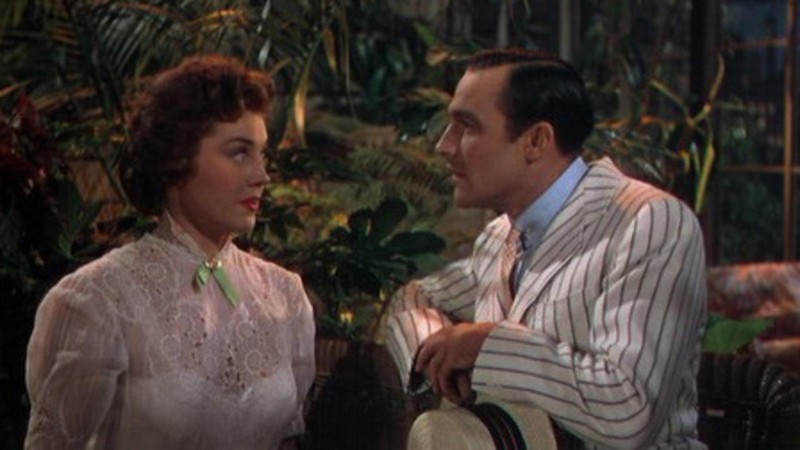
Berkeley and Kelly originally wanted Judy Garland to play the leading lady but she was having substance problems, so Ginger Rogers was cast as her replacement. Ginger then backed out a month prior to filming and Esther Williams took over. What a jim dandy substitute! 

Williams was ideal for the role and perfectly cast. She was already a leading star and this role let her take a quick break from swimming - she only had one simple pool routine in the picture. However, as Williams put it in her autobiography, filming Take Me Out to the Ball Game was an experience of "pure misery." Kelly was too demanding as a director and, along with Donen, seemed to resent her. 

Betty Garrett, who had a wonderful role as a boy-crazy girl chasing the girl-shy Dennis Ryan, had a different experience. In her autobiography she wrote that "making Ball Game.. was pure joy and Frank was an absolute delight to work with." 

"Why don't you pick on somebody your own size?"

"There ain't nobody my size!"

Jules Munshin was making his breakthrough screen role in Take Me Out to the Ball Game. He had previously had a bit part in Easter Parade (1948) as a waiter and, on the strength of that performance, got this role. He made a great "third wheel" and was even more entertaining in On the Town.

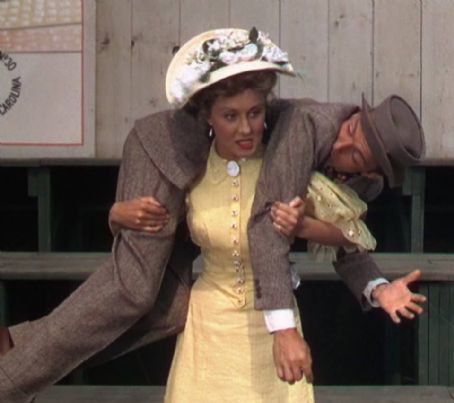
Take Me Out to the Ball Game included a number of pleasant - albeit forgettable - musical numbers, the best of which feature Gene Kelly dancing. "O'Brien to Ryan to Goldberg" and "It's Fate Baby, It's Fate" are the most fun to watch, but the patriotic "Strictly U.S.A" number is classic MGM - lavish and entertaining. 

All in all, Take Me Out to the Ball Game is a pitch-perfect blend of song, slapstick, and sentiment and - with Gene Kelly and Frank Sinatra rounding the bases - the film scores big in every inning so, if you're in a baseball mood, this one's a grand slam in entertainment. 

Sunday, March 23, 2025

Kirby Grant and Chinook in the Royal Mounted Police Movies

In the late 1940s and early 1950s, Kirby Grant starred in a series of Mountie films with "Chinook," a white German shepherd. Each film featured a mixture of adventure and mystery plots set in the wild Northwest territory of Canada. Grant played Corporal Roy Webb, a very personable officer of the Royal Mounted Police who traveled nowhere without his heroic companion Chinook. All of the stories featured Webb being assigned to a district to investigate a murder, robbery, or other crime. Usually when he arrives, he dons the garbs of the local folk and tries to weedle information from the suspects while incognito. 

The 10 films, released by Monogram Pictures, are all less than 70-minutes each and are very entertaining... even though they follow the same formula and tend to be forgotten within a week after watching. This formula included having the crime take place within the first three minutes of the film, Corporal Webb being assigned to the case, another murder to follow shortly after, Webb or Chinook being attacked and later recovering, a chase through the woods and over lots of large boulders, and finally, Webb catching his man... as all good Mounties are told to do. 

All of the Chinook films were based on novels written by James Oliver Curwood who, oddly enough, was not a former Mountie but rather a reporter who was hired by the Canadian government to tour Canada and write about the land to encourage tourism. Whether his stories helped to increase tourism is unknown, but they certainly made Curwood famous! He became one of the most popular adventure writers in the world and the highest paid writer of his era. 

The action in these pictures is better than most B-films and the stories keep you guessing. Sometimes the criminal is obvious and other times it is someone surprising like the kindly shopkeeper, the man who called the police in the first place (a clever way to divert suspicion), or even the sweet young woman whom Corporal Webb was beginning to fall in love with. The action scenes don't hold back on the grisly attacks either.... sometimes Webb gets shot, Chinook gets roughed up by a lone wolf or a mean hunter, or even the hero of the story might get killed suddenly. 


Kirby Grant does a wonderful job of playing the heroic Mountie and Chinook is good in the role, too, although he doesn't have the acting chops of Lassie. The series provided some B-actors with jobs and occasionally featured players who went on to more fame, such as Martha Hyer. 

Here are some short plot summaries to each of the films:

Trail of the Yukon (1949) 

In retaliation for jumping their mining claim, Matt Blaine and his son rob Dawson's Bank. While escaping, the men they hired to help them double-cross them and kill Matt. Corporal McDonald (he later became Webb) is then sent on the case to recover the bank's money and solve the murder. 

The Wolf Hunters (1949)

Four fur trappers have been slain and their furs stolen from them, so Corporal Webb investigates and saves the life of a fifth trapper enroute. Chinook has the only clue to the killer, a torn piece of cloth from the man's coat. Edward Norris and Helen Parrish star. 

Snow Dog (1950)

A fur-trapper and his sister help Corporal Webb track down a killer wolf while searching for their late uncle's treasure which is supposedly hidden in the woods. Elena Verdugo and Milburn Stone star.

Call of the Klondike (1950) 

Men are disappearing near an abandoned gold mine and Colonel Webb is sent to investigate. He finds a disgruntled foreigner causing trouble and the bodies of two of the men who went missing. Tom Neal and Anne Gwynne star. 

Yukon Manhunt (1951)

Payrolls from a mining camp are being stolen enroute to the men, so Corporal Webb is called in to help discover who could be robbing the payroll deliveries. Gail Davis, Margaret Field and Rand Brooks star.

Northwest Territory (1951)

Corporal Webb escorts recently orphaned Billy to his grandfather Pop Kellogg who lives in the woods of the Northwest Territory but finds Pop murdered and his "worthless" stake in land being scouted by a number of suspicious characters. Warren Douglas and Gloria Saunders star. 

Yukon Gold (1952)

The owner of a gambling saloon in the Klondike is tied in with a recent murder and Webb is sent to investigate. Martha Hyer and Frances Charles star. 

Fangs of the Arctic (1953)

A trapper is killed in Blackfoot Crossing territory and illegal beaver pelts are being smuggled out. Webb disguises himself as a trapper and investigates as more bodies pile up...including his new deputy. Warren Douglas and Lorna Hansen star. 

Northern Patrol (1953)

Corporal Webb hunts for the killer of a man who supposedly committed suicide in his cabin and gets tied up in a love triangle in the process. William Phipps, Marian Carr star. 

Yukon Vengeance (1954)

Corporal Webb travels to the wilds of Bear Creek to investigate the murders of three mail carriers, all of whom were mauled by a bear. Webb goes undercover as a mail carrier to see if the "bear" is of the two-footed variety. Monte Hale and Mary Ellen Kay star. 

All of the Kirby Grant and Chinook films have been beautifully restored and released by Warner Archives on DVD in three volumes.

Saturday, December 14, 2024

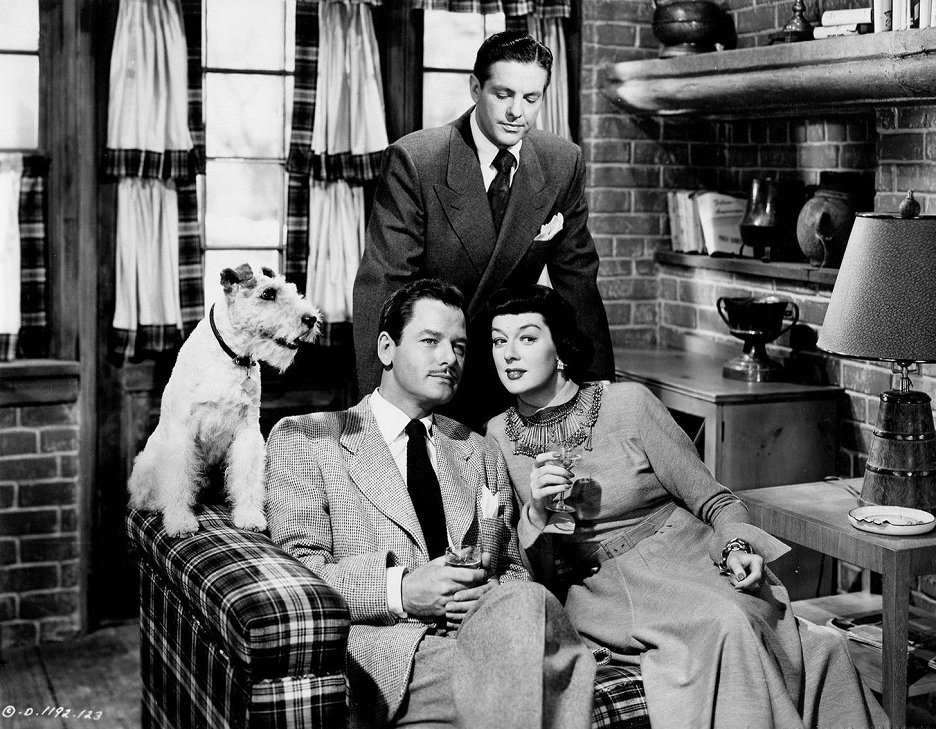
From the Archives: Come to the Stable (1949)


This photo from Come to the Stable (1949) shows Dorothy Patrick, Hugh Marlowe and Louis Jean Heydt in one of my favorite scenes. Dorothy is singing "Through a Long and Sleepless Night" which they all agree will be composer Hugh Marlowe's best song yet... until they hear the nuns from the convent across the lawn singing an old French melody that sounds just like the piece. The set design for Hugh Marlowe's house is marvelous - who wouldn't want that great big fireplace!

From the Archives is our latest series of posts where we share photos from the Silverbanks Pictures collection. Some of these may have been sold in the past, and others may still be available for purchase at our eBay store: http://stores.ebay.com/Silverbanks-Pictures

Saturday, November 30, 2024

Tell it to the Judge (1949)

Rosalind Russell and Robert Cummings seem like an unlikely pair of actors to play a married couple but they were a delightfully entertaining twosome in Paramount's 1949 comedy Tell it to the Judge

Roz was top-billed as a would-be Federal Court judge who is being wooed by ex-husband Robert Cummings who wants her back. He remarries her only to lose her once again when Marie McDonald, a curvaceous client of his, reappears in the scene. Gig Young adds to the merriment as a debonair playboy whom Russell snags to spite her husband. 

Tell it to the Judge is chock full of witty barbs that Rosalind Russell and Bob Cummings enjoy throwing at each other and there are plenty of visual gags, too. It is one of Paramount's better comedies of the late 1940s and it brought back the bubbly vibes of the 1930s screwball comedy genre. In fact, had this film been released ten years earlier it could have been an excellent MGM comedy starring William Powell and Myrna Loy. ("Let's Fall in Love" would have been a perfect title to this imaginary production).

The film bounces along at a spritely pace with director Norman Foster making sure there was never a dull moment. The setting jumps from Washington D.C. to Palm Beach to the snowy Adirondacks and the art direction - by Carl Anderson - is wonderful. However, it is the cast that makes the picture. Rosalind Russell and Robert Cummings were in top form. Cummings is especially hilarious when he acts drowsy after taking four sleeping tablets! The rest of the cast is made up of seasoned pros such as Harry Davenport, Douglas Dumbrille, Marie McDonald, Fay Baker, Louise Beavers and Clem Bevans.

Tell it to the Judge is available on DVD and can also be seen frequently on the Cinevault Channel on Roku. 

Saturday, September 7, 2024

From the Archives: The Princess and the Pirate (1944)


In this still from The Princess and the Pirate (1944), Bob Hope is in the company of dangerous pirates and knows it! What he doesn't know yet is how to get out of the sticky situation that he is in... but he'll think of something. He always does! 

From the Archives is our latest series of posts where we share photos from the Silverbanks Pictures collection. Some of these may have been sold in the past, and others may still be available for purchase at our eBay store: http://stores.ebay.com/Silverbanks-Pictures

Wednesday, August 14, 2024

Rewind Review: William Holden in "Dear Ruth" (1947)

When most people think of William Holden and the parts he played, they think of gritty characters such as Sheers (The Bridge on the River Kwai) and Pike Bishop (The Wild Bunch), or military men like Major Ferris (The 7th Dawn) and Lt. Col. Black (The Proud and the Profane), or even perhaps businessmen such as MacDonald Walling (Executive Suite); but very few think of him as "that handsome and pleasant young star of light-hearted comedies". Yet, that is exactly how one movie-goer dubbed him in a 1940s fan magazine. 

William "Bill" Holden was indeed a handsome and pleasant young star during his days as a Paramount contract player, starring in such comedies as Those Were the Days (1940), Meet the Stewarts (1942), The Fleet's In (1942), and The Remarkable Andrew (1942). After his marriage to Brenda Marshall in 1941, he even gained a reputation as being a devoted family man. It was not until he was cast as Joe Gillis, the ambitious screenwriter, in Sunset Boulevard (1950) that he received recognition for his dramatic acting ability. 

One of the best of his "handsome and pleasant young man" portrayals was that of Lieutenant Bill Seacroft in Paramount's Dear Ruth, released in 1947. 


Norman Krasna's "Dear Ruth" was one of the funniest comedies to hit the stage in the years following World War II. There wasn't a theater in America that wasn't putting on their own version of "Dear Ruth" at the time. John Dall had starred in a successful Broadway performance of the play (it ran for 20 months); Guy Madison and Diana Lynn were raising the roof in a performance at the newly-created La Jolla Playhouse in California (founded by Gregory Peck); and William Talman, who would later find fame as District Attorney Hamilton Burger on the Perry Mason television series, also starred in a successful run of "Dear Ruth" in New York. It wasn't surprising then, that Hollywood would snag the opportunity to replicate its success on film. 

Dear Ruth centered around the Wilkins family, primarily their teenage daughter Miriam ( Mona Freeman ). Believing it to be her patriotic duty to support the morale of soldiers overseas, she begins writing letters to an Air Force lieutenant, Bill Secroft (William Holden), signing them with her older sister's name - Ruth. As might be expected, when the airman gets his leave he decides to make a surprise visit to meet the girl he has fallen in love with through her letters. Ruth (Joan Caulfield), surprised and unaware of Miriam's military pen-pal, decides to play along with the charade only until the soldier's leave is up, much to the chagrin of her fiance (Billy De Wolfe). Only it becomes apparent that Bill's intentions are marriage, and Ruth finds she does not want to brush off the soldier after all. 

Director William Russell kept the cast busy throughout handling one comedic situation after another in the film. Edward Arnold and the inimitable Billy De Wolfe stole all the scenes, but it was William Holden who really shined as the bewildered airman. 


At first, Bill Seacroft strikes audiences as a rather brash fellow, walking into the Wilkins household unannounced and boldly declaring to Ruth's father his intentions to marry his daughter...without even having met her. Once he does meet her, we see that it was just nervousness that made him so bold. All those hours spent in a bomber over Germany with only Ruth on his mind...it was a long awaited first-meeting finally coming true for him. To find that the girl he thought so much about was even more lovely in person would naturally make him puff his feathers. 

Seacroft was a part that suited William Holden to a tee (in real life he served in the Air Force during WWII as a lieutenant) and he brought an innocence to the role that made audiences, just like Ruth, feel sorry for him and yet love and admire him at the same time. 


The film's success with the movie public left it wide open for a sequel and it arrived, albeit two years late, in the equally amusing Dear Wife (1949) with, thankfully, the complete cast intact. This film focused on Bill and his father-in-law, Judge Wilkins (Edward Arnold), vying for a Senatorial seat. 

If William Holden's roles in comedies are unfamiliar to you, then I would highly recommend viewing Dear Ruth and Dear Wife. Both of these films showcase Holden in top form and at his most endearing. 

Friday, June 21, 2024

June Bride (1948)

Hours before embarking on an assignment, magazine editor Linda Gilman (Bette Davis) has been thrust with a new reporter who happens to be her old lover, foreign correspondent Carey Jackson (Robert Montgomery). The two bickering sweethearts are heading to Indiana with a staff of workers to cover the wedding of two young lovebirds for the June issue of "Home Life".

From the onset, Linda finds herself beset with problems: the McKinley-era house needs updating to bring it into Truman-era style, the February snow outside the windows needs to be disguised to look like June sunshine but, worst of all, the bride needs to be found after she runs off with an old beau named Jim! 

This last problem Linda blames on Carey whom she believes lured Jim back with the intent to break up the wedding. Why? Because she thinks Carey sneers at old-fashioned happily-ever-after wedding stories and would rather have a fresh "angle" to an article then pen a simple straightforward love piece. 

Over the course of one busy week, Linda finds she may have misjudged Carey. 

If June Bride plays out like a filmed adaptation of a popular Broadway comedy, it is because it was a play, but one that went unproduced - "Feature for June" by Graeme Lorimer, Sarah Lorimer and Elaine Tighe. Screenwriter Ranald MacDougall adapted it but something was lost in the translation. The script is witty enough (it earned the Writers Guild of America award for Best Written American Comedy) and the players all handle their parts capably but, overall, the picture lacks punch...zip...verve...snap. In short, it falls flat. Whether this is director Bretaigne Windust's fault is difficult to determine but June Bride certainly could have been enhanced in the hands of a better director. Preston Sturges would have done wonders with this material and cast! 

Nevertheless, on its release it was a critical and box-office success and Bette Davis' contract with Warner Brothers was renewed for four more pictures (Bette only made one more film with the studio before walking out on her contract).

Bette Davis looked chic and youthful in the film and was bedecked in outfits designed by Edith Head. In spite of playing a successful single working woman, her character would be pooh-poohed by modern feminists because ultimately she chooses to "carry the bags" and walk two steps behind her man. 

Supporting roles went to Tom Tully (a fine actor in every film he made), Fay Bainter, Jerome Cowan and Mary Wickes. The younger roles were well-played by Betty Lynn (The Andy Griffith Show), Barbara Bates and Raymond Roe (The Major and the Minor).

Sunday, March 17, 2024

Little Nellie Kelly (1940)

Mix together Judy Garland, George Murphy, a little romance, and some lovely Irish folk tunes and what have ye? Little Nellie Kelly, that's what. This MGM musical from 1940 features Judy Garland playing not one, but two parts. You may be sad to see her character Nellie Kelly die within the first 20 minutes of the film but shortly after she pops again, this time in the form of the daughter of Nellie Kelly. 

Nellie is the apple of her father's eye and when she elopes with Jerry Kelly (George Murphy) behind his back, he fills his heart with spite against the young man. Jerry takes his new bride and his father-in-law Michael (Charles Winniger) to America, gets a job as a policeman in New York, and faithfully supports both of them. When Nellie dies giving childbirth, Michael's stubborn anger towards Jerry increases but the two remain together to raise little Nellie.

Time goes by and Little Nellie (Garland again) eventually finds a beau of her own and then decides it is about time that her grandfather made peace with her father.

While Little Nellie Kelly is titled after its main character, most of the story revolves around Michael Noonan (Winniger) and his stubborn Irish ways. "If only he would work, then he wouldn't have so much time to complain," Jerry Kelly declares. And how right he is! I have an uncle just like Michael Noonan. He worked once when he was in his 20s and never again. So, without any hobby to fill his life, he spends all his time complaining... mainly about what his family is up to and how they should be supporting him. Mchael Noonan may seem like an improbable character, but he is quite common in many households, Irish or not!

Charles Winniger does a wonderful job at playing this curmudgeon, who's likeable in spite of his biting tongue, but some may find his stubbornness just too much to bear. Dear Jerry Kelly must have had the patience of St. Patrick himself to put up with him all those years! George Murphy gives a grand performance as the winsome lad whom Nellie first comes to love in Ireland and, later, he convincingly ages to become Little Nellie's father, a captain of a New York police force no less.

It is Judy Garland who is the star attraction, however. Little Nellie Kelly was based on the 1922 stage musical by George M. Cohan and it was rumored that Cohan sold the rights to MGM studios expressly on the condition that it be a vehicle for Judy Garland. She's a little sweetheart in this film. Had MGM decided to groom her as a rival for Deanna Durbin, she would have been wonderful in similar ingenue roles.

Several Irish songs that were supposed to be in the film were cut from the final release, including the famous "Danny Boy", but Judy does get to sing the lovely "A Pretty Girl Milking a Cow" as well as "It's a Grand Day for the Irish", which she sings with her Babes in Arms co-star Douglas McPhail. 

McPhail had a marvelous baritone voice and, in Little Nellie Kelly, he plays Nellie's sweetheart Dennis Fogarty, the son of Michael Noonan's friend Timothy Fogarty (Arthur Shields). Like Jerry Kelly, Dennis is patient enough to put up with Nellie's grandfather for her sake and eventually wins his approval. 

Little Nellie Kelly is one of those MGM classics that you watch once and soon find yourself re-watching it every year... on St. Patrick's Day, of course. While the film on a whole is entertaining, the first scenes set in Ireland are my favorite and I cannot help but wonder what a wonderful film this could have been had the entire picture been set there. 

Friday, March 15, 2024

The Luck of the Irish Airing Tomorrow

St. Patrick's Day, that most honored of Irish holidays, be comin' o'er the week-end and if ye be feeling for a bit o' whimsy then look no further than The Luck of the Irish, a gem of a film starring himself, that handsome lad Tyrone Power. 

Tyrone Power plays a freelance writer named Steven Fitzgerald who befriends a leprechaun ( Cecil Kellaway ) while he is stranded in a village in Ireland. He manages to capture him and demand his gold but, not wanting to take the old man's life savings, returns the pot to him. The leprechaun is so grateful he follows Fitzgerald back to New York City and helps him realize his heart's desire.

The Movies! channel will be airing The Luck of the Irish (1948) on Saturday at 11am EST and again on Friday, March 22nd, at 7:20am EST. 

To read our review of the film, click here. To read Movies! TV Network's article on a behind-the-scenes look at the film click here. 

Saturday, January 20, 2024

British Pathe: Matchstick Models (1941)

British Pathe released a number of entertaining short pieces on arts and crafts and some of the best featured talented model-makers. One of these was Harold Gough, a 16-year-old (in 1941) whose hobby was building mansions made of matchsticks. The rainy season in England must indeed be long! Never mind that Harold looks closer to 30 than 16, he is a very creative lad. In addition to building houses of matchsticks, he even constructed a double-decker bus.

Click here to watch: Matchstick Models (1941)

Young Terry Summers is another talented miniature carpenter, aged 16. He constructed the entire British Houses of Parliament buildings out of balsa wood. They measure one yard long and are built to scale. Impressive indeed! 

Click here to watch: Model Houses Of Parliament (1951)

The most entertaining of all is Model Villages, a 2:52 minute clip showing T.F. Dobbins, designer of a model village in Southport, Merseyside. Tiny visitors enjoyed this outdoor "Land of the Little People" for years before it was demolished to make way for a supermarket. 

Click here to watch: Model Villages (1962)

Other similarly themed British Pathe shorts:

House of Commons Model (1949) - 2:08 minutes

Bristol Model (1951) - :35 minutes

Model Houses (1954) - :52 minutes

Gannymeade Model Village (1967) - 1:03 minutes


Friday, November 10, 2023

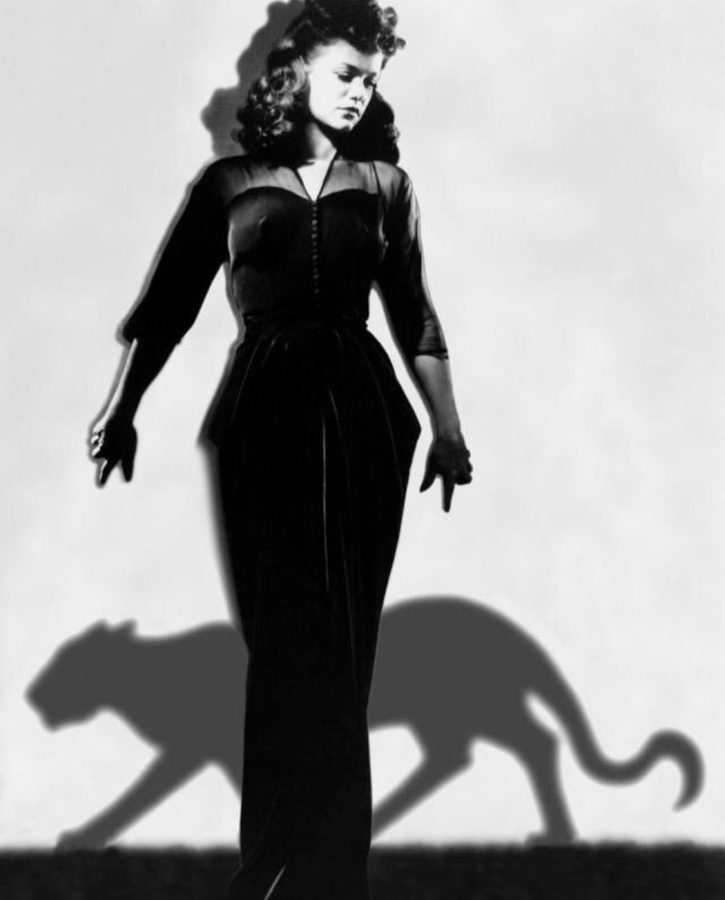
Irene Dubrovna in "Cat People" (1942)

The Classic Movie Blog Association is hosting the Blogathon and the Beast blog event this week. This theme gives us bloggers a chance to write about a film character who has a beast within themselves. 

All of us have a sleeping beast within who, hopefully, never awakens in our lifetime. As the old saying goes, "Let sleeping dogs lie." I always had the notion that my sleeping dog was the Beast of Jealousy which, thankfully, has never had cause to open its eyes. 

Irena Dubrovna (Simone Simon) in Cat People (1942) was not so fortunate. She had what I believe was the Beast of Jealousy within her and, one afternoon, an unexpected encounter at the zoo began a chain of events that caused this sleeping dog (or rather, cat) to wake. 

Irena was a sketch artist for a fashion design company. She had an apartment that was a short walk away from the New York City Zoo, and she enjoyed spending her afternoons there sketching the animals...namely, the resident panther. 

One day at the zoo, she meets Oliver (Kent Smith), a marine engineer, and within a few hours, they become romantic friends. 

Unlike most of us who are unaware of our inner beasts, Irena knows very well what hidden danger may be inside her. She tells Oliver a story about a certain group of evil people from the village in Serbia where she came from. They were known as "cat people" and were, supposedly, pushed back from her village by King John quite a long time ago. However, Irena always feared she may have been an ancestor of these people, and her suspicion is later confirmed when, on her and Oliver's wedding night, a mysterious woman greets her as one of the "cat people".

The cat people destroy the ones they love. Like real felines, they are averse to strong displays of affection, especially if it creates an unwanted bond of dependency. Irena believes that if she were to kiss Oliver, she would have to kill him, and so months pass with their marriage unconsummated. Meanwhile, Oliver grows more and more apart from Irena and her obsession with this belief in "old folklore". He turns to Alice, a longtime friend and coworker, for advice and, later, for comfort. 

This arouses Irena's feelings of her "inner cat" even more and one evening she follows Alice home. She begins by walking a good distance behind Alice but shortly she takes on the physical appearance of a cat - a panther - and actually stalks Alice like prey. 

"There is, in some cases, a psychic need to loose evil upon the world. And we all of us carry within us a desire for death. You fear the panther; yet you are drawn to him again and again. Could you not turn to him as an instrument of death?"

Larry Talbot in The Wolf Man (1941) went into a mental fog when he transformed into the wolf and he was afraid he would harm someone unknowingly while he was a wolf. Irena's transformation is quite different. She seems to be well aware of whom she is stalking and attacking as a panther. 

Irena is quite a shy and gentle woman by nature and dreads having a duel-personality, especially one that is an animal. She willingly agrees to undergo psychiatric treatment to be cured of this belief, but at the same time seems to take pleasure in her predicament and clings to it. Typical feline complexity. 


In one eerie scene, she follows Alice to the indoor pool of her apartment complex at night and prowls and growls in the shadows around the pool. After Alice screams and others come into the pool room, Irena transforms back into her human self and innocently remarks "
I'm sorry I disturbed you, Alice. I missed you and Oliver. I thought you might know where he is." Clearly, she was enjoying herself. 

Irena's cat personality may not have been entirely a beast of jealousy but this emotion was a strong trigger for it to come forth into the physical realm. Thank goodness the evil nature we sometimes suppress, be it ever so small, does not take the physical form of an animal. Although... dating back to ancient times, people's inner personalities were referenced in relation to animals. In Western and Chinese astrology, human character traits are linked with animal counterparts. And all of us, at some time or another, refer to others as animals.... "He's like a timid mouse"... "She's like a frightened rabbit". But how strange it would be to see these animal natures take form! 

Irena had no control over her unusual situation. Whether she wanted to be a cat or not, she became one. She was just an innocent victim of presumably an ancient gypsy curse in her village. Sadly, her husband Oliver thought her fear of being transformed into a cat was only a problem of her mind...an issue he later got bored with when it made him unhappy. At one point, Irena was willing to cast aside her fears and superstitions and concentrate on being a good wife to Oliver, but by that time it was too late. Oliver now loved Alice and Irene was then more than willing to unleash her inner beast....knowing very well it meant her death. 

Wednesday, May 31, 2023

Rewind Review: Those Were the Days ( 1940 )

William Holden displays the good ol' Siwash spirit of horseplay in Paramount Pictures minor wisp of nostalgia Those Were the Days set in the fictional college of Siwash at the turn of the century. 


After getting himself in a scrape that ought to land him six months in jail ( the film proves that collegians were wild hooligans even in 1904 ), Petey Simmons ( Holden ) ardently woos the judge's daughter in order to win favor with her pop ( Vaughn Glaser ) when it comes time for the sentence to be ruled. The hapless youth finds his weasel of a plan backfires when he falls in love with the sparkling lass, played by Bonita Granville. 

Squeaky-voiced Ezra Stone, famous for portraying Henry Aldrich on radio and later directing The Addams Family series, provided ample support to Holden and his hi-jinks. Also cast were Judith Barrett, William Frawley, Richard Denning, and Alan Ladd in a flash one-line part. Those Were the Days aka Good Ol' Siwash was based on the popular Siwash stories written by Knox College alum George Helgeson Fitch.


To promote the film, Paramount's publicity team strapped Jeanne Cagney and William Henry in a 1902 runabout and set them off puttering to a gala hosted by the Los Angeles Horseless Carriage Club.

William Holden started his career at Paramount where he was one of the members of the studio's "Golden Circle" of young players in 1938, along with Susan Hayward, Betty Field, Robert Preston, Patricia Morison, Ellen Drew, Louise Campbell, William Henry, and Evelyn Keyes. Columbia Pictures borrowed Holden for Golden Boy and then returned him to Paramount a star. 

Those Were the Days gave Holden his first star billing and a chance to demonstrate that winsome charisma that would soon launch him to stardom. Alas, that's about all it did. Unlike the splendid A Yank at Oxford ( MGM, 1938 ), the film failed to capture a love for the college nor sympathetic support for its hero. Theodore Reed's direction was sluggish from the start and the script could have used a greater dose of humor and wit. Today, Those Were the Days is forgotten along with good ol' Siwash University. 

This post was originally published on Silver Scenes in July 2014. 

Sunday, April 23, 2023

A Foreign Affair ( 1948 )

During World War II, the American, British, and Russian forces bombed Berlin until it was a heap of concrete rubble. After the war, the US Army decided to leave some troops behind to help clean up the mess. This included capturing Nazi members who may have eluded them earlier and also aiding the Germans in getting back on their feet. Both tasks could be rather demoralizing - especially in such a battered environment as post-war Berlin. In order to see just how well the "boys" overseas were coping, Congress decided to send a committee to check up on them...or so the story goes in Billy Wilder's 1948 comedy A Foreign Affair. 

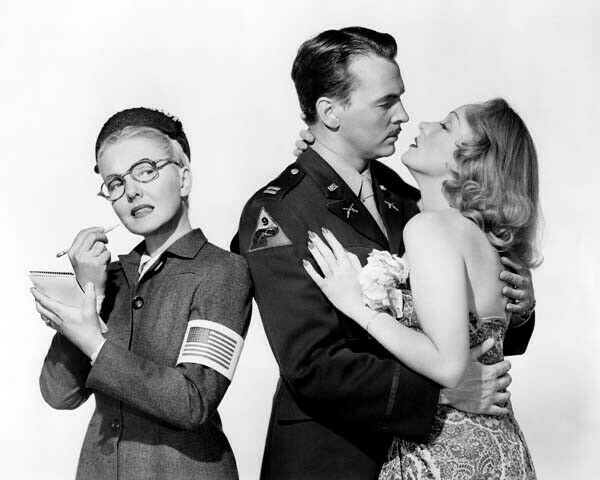
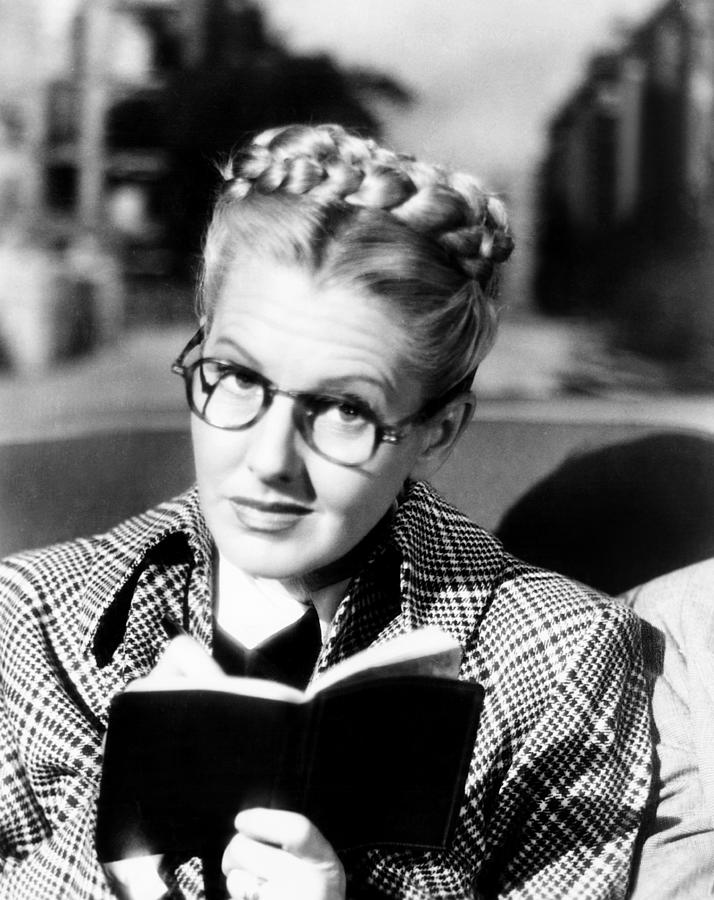
This committee, comprised of five men and one woman, is given a 3-day tour of Berlin in order to make their report to Washington. But as Congresswoman Ms. Frost ( Jean Arthur ) points out, this is a carefully crafted tour designed so that the members see only what the US Army wants them to see. 

Ms. Frost chooses to remove her blinders and what she sees surprises her! American soldiers are engaging in the black market, openly fraternizing with the frauleins, and clearly enjoying themselves. Just one chocolate bar can buy a guy a lot of favors in Berlin. 


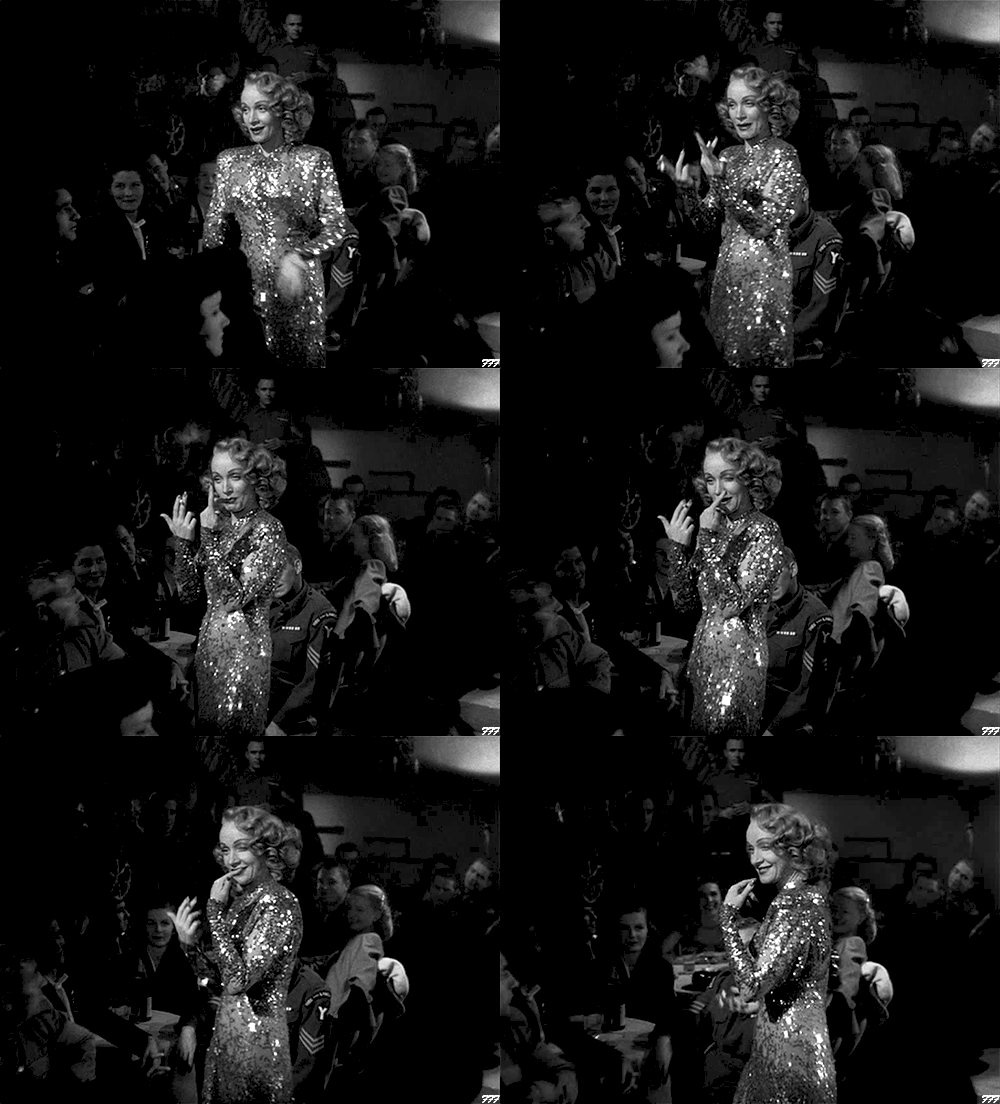
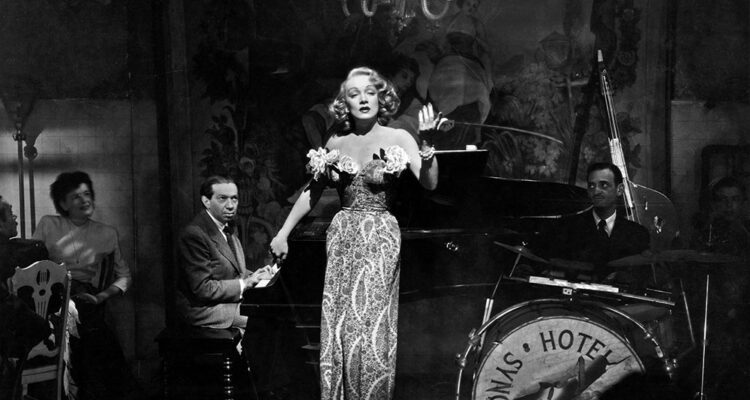
Nightclub singer Erika von Schlütow ( Marlene Dietrich ) certainly knows how to use a soldier to her best advantage. She remembers what it was like in Berlin right after the war. 

"We've all become animals with exactly one instinct left - self-preservation....What do you think it was like to be a woman in this town when the Russians first swept in? A living hell. And then I found a man, and through that man, a roof, and a job, and food, and I'm not going to lose him."

That man is Captain Johnny Pringle ( John Lund ), an officer at the very camp that the committee is visiting. He is well aware that Erika is a hot potato, a woman who once had affiliations with Nazi party members, but he pulls a few official strings to shield her because he is enthralled by his "gorgeous booby trap". 

Ms. Frost discovers the curvaceous performer one night at the Lorelei club and overhears that she is being protected by an American officer, so she enlists the aid of fellow Iowan Captain Pringle to help her ferret out the name of this man, little realizing that it is Pringle himself that is Ms. von Schlütow's sugar daddy.

A Foreign Affair is one of director Billy Wilder's lesser-known films but it nevertheless bears his trademark style, especially in the cynical but humorous script, penned by Wilder, Charles Brackett, and Richard L. Breen. The cinematography is beautiful and the music, by Friedrich Hollander, perfectly captures the feel of post-war Germany, but what makes the film really work is the performances from its three principal actors: Jean Arthur, John Lund, and Marlene Dietrich. 

Growing up, I was familiar with Jean Arthur only from her role as Marian in the classic western Shane ( 1953 ). Then, in my teen years, I discovered all of her marvelous films from the 1930s and realized just how popular an actress she was. This decade was really the peak of her career, and she starred in such comedy classics as Mr. Deeds Goes to Town ( 1936 ), You Can't Take it With You ( 1938 ) and Mr. Smith Goes to Washington ( 1939 ). She was Columbia Studios' top actress up until her retirement in the mid-1940s. Wilder enticed her away from college to make this picture. 

Jean gives a wonderful performance here as the stern Ms.Frost, playing her icy cool from her entrance and then peeling away layers of her personality as the film progresses. Frost is a fastidious, independent, prudish, Iowa-born-and-bred, no-nonsense kind of woman, who - living up to her namesake - is particularly cold to men after having been used by a man several years back. When Captain Pringle realizes that she is gunning down his liebling Erika - and himself - he knows he will receive no sympathy or mercy from her. So, he undertakes a really courageous task - that of wooing the unwooable woman. And boy is he in for a surprise! After a few kisses, Ms. Frost suddenly becomes "Pheobe" and before he knows it, he's polishing his shoes and whistling "Shine on Harvest Moon".

Marlene Dietrich is also alluring as Erika. Wilder had her in mind for the part as he was writing the script and there really was no other actress who could have played her part as well. She is best in the nightclub sequences, entertaining the soldiers as she so often did in real life during the war. 

John Lund also shines as Captain Pringle. Few actors could play comedy as well as Lund could, plus he was a believable "ladies' man". Cary Grant could have tackled this role with equal ease but Grant does not seem like the kind of man who would be having an affair with the former mistress of a Nazi officer. Also in the cast is that old pro, character actor Millard Mitchell as Pringle's commanding officer. 

A Foreign Affair is available on Blu-Ray DVD and via streaming through the Criterion Channel.

This post is our contribution to the Shades of Shane Blogathon being hosted by Rachel at Hamlette's Soliloquy. Be sure to visit her blog to check out other film reviews featuring actors who starred in the classic western Shane.