Showing posts with label John Lund. Show all posts

Sunday, April 23, 2023

A Foreign Affair ( 1948 )

During World War II, the American, British, and Russian forces bombed Berlin until it was a heap of concrete rubble. After the war, the US Army decided to leave some troops behind to help clean up the mess. This included capturing Nazi members who may have eluded them earlier and also aiding the Germans in getting back on their feet. Both tasks could be rather demoralizing - especially in such a battered environment as post-war Berlin. In order to see just how well the "boys" overseas were coping, Congress decided to send a committee to check up on them...or so the story goes in Billy Wilder's 1948 comedy A Foreign Affair. 

This committee, comprised of five men and one woman, is given a 3-day tour of Berlin in order to make their report to Washington. But as Congresswoman Ms. Frost ( Jean Arthur ) points out, this is a carefully crafted tour designed so that the members see only what the US Army wants them to see. 

Ms. Frost chooses to remove her blinders and what she sees surprises her! American soldiers are engaging in the black market, openly fraternizing with the frauleins, and clearly enjoying themselves. Just one chocolate bar can buy a guy a lot of favors in Berlin. 
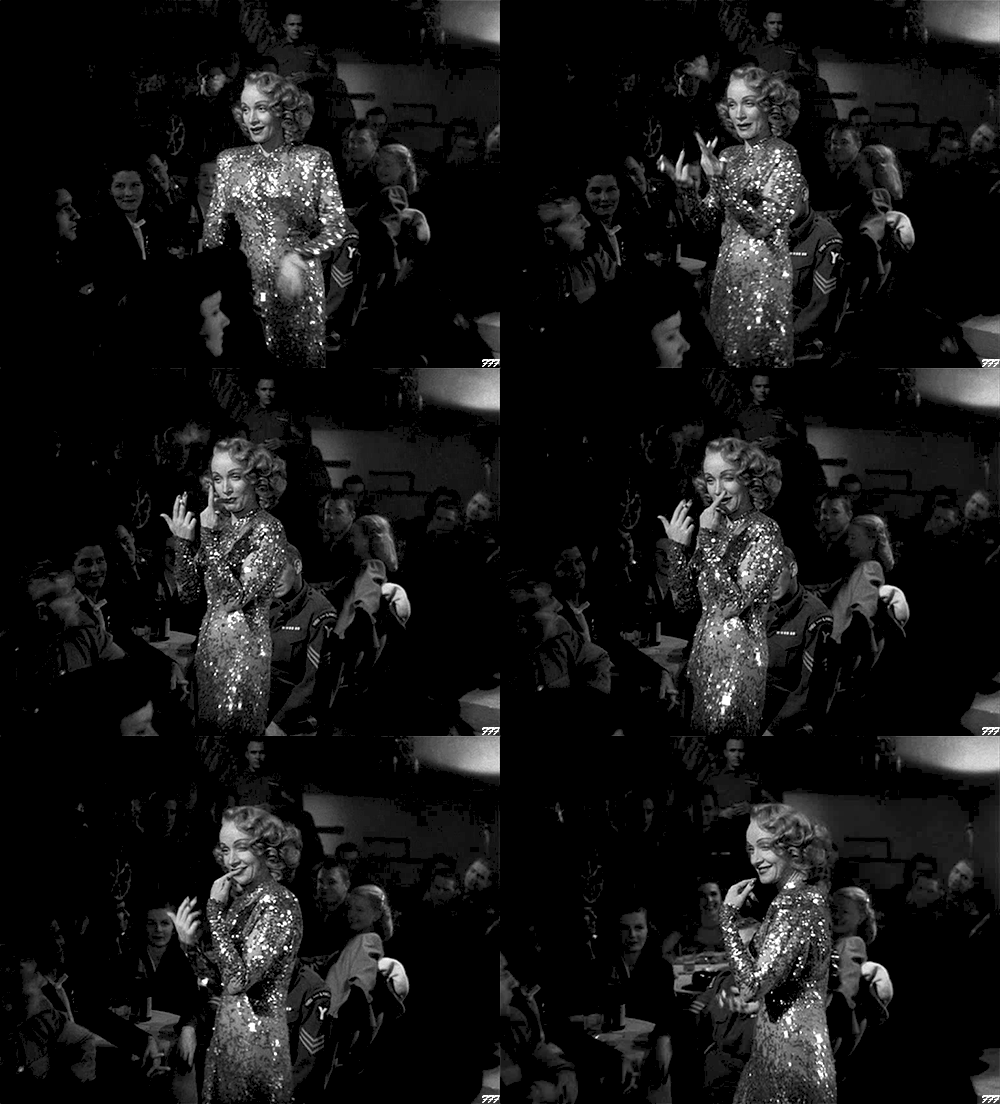

Nightclub singer Erika von Schlütow ( Marlene Dietrich ) certainly knows how to use a soldier to her best advantage. She remembers what it was like in Berlin right after the war. 

"We've all become animals with exactly one instinct left - self-preservation....What do you think it was like to be a woman in this town when the Russians first swept in? A living hell. And then I found a man, and through that man, a roof, and a job, and food, and I'm not going to lose him."

That man is Captain Johnny Pringle ( John Lund ), an officer at the very camp that the committee is visiting. He is well aware that Erika is a hot potato, a woman who once had affiliations with Nazi party members, but he pulls a few official strings to shield her because he is enthralled by his "gorgeous booby trap". 

Ms. Frost discovers the curvaceous performer one night at the Lorelei club and overhears that she is being protected by an American officer, so she enlists the aid of fellow Iowan Captain Pringle to help her ferret out the name of this man, little realizing that it is Pringle himself that is Ms. von Schlütow's sugar daddy.
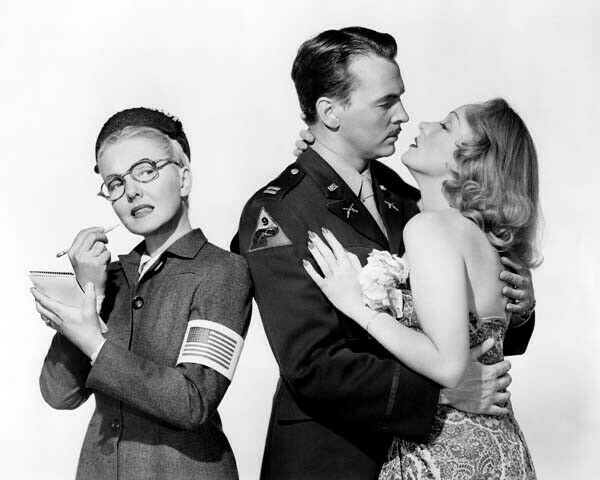
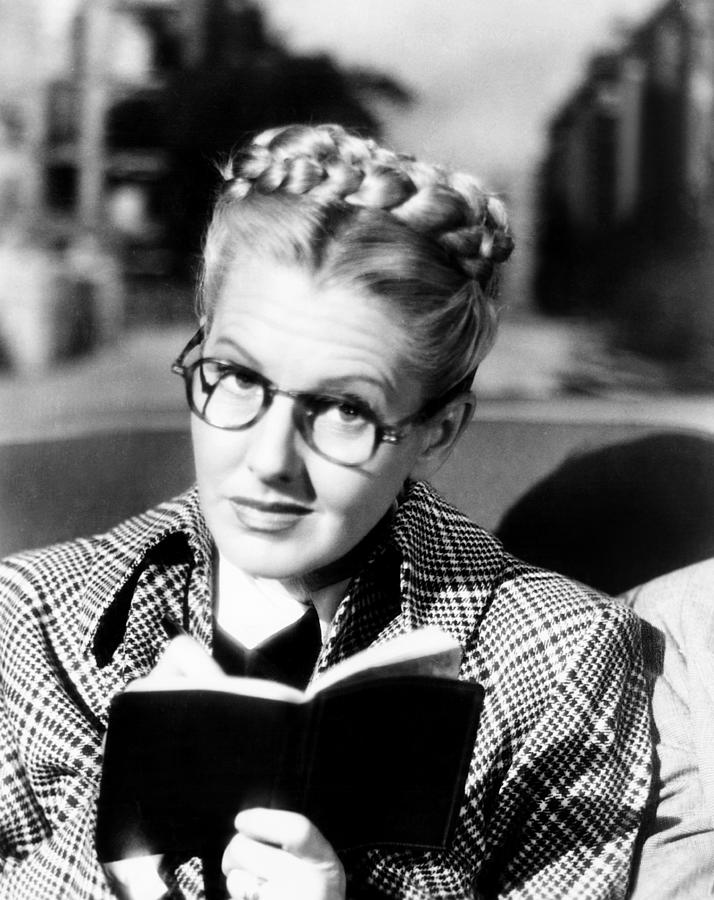
A Foreign Affair is one of director Billy Wilder's lesser-known films but it nevertheless bears his trademark style, especially in the cynical but humorous script, penned by Wilder, Charles Brackett, and Richard L. Breen. The cinematography is beautiful and the music, by Friedrich Hollander, perfectly captures the feel of post-war Germany, but what makes the film really work is the performances from its three principal actors: Jean Arthur, John Lund, and Marlene Dietrich. 

Growing up, I was familiar with Jean Arthur only from her role as Marian in the classic western Shane ( 1953 ). Then, in my teen years, I discovered all of her marvelous films from the 1930s and realized just how popular an actress she was. This decade was really the peak of her career, and she starred in such comedy classics as Mr. Deeds Goes to Town ( 1936 ), You Can't Take it With You ( 1938 ) and Mr. Smith Goes to Washington ( 1939 ). She was Columbia Studios' top actress up until her retirement in the mid-1940s. Wilder enticed her away from college to make this picture. 

Jean gives a wonderful performance here as the stern Ms.Frost, playing her icy cool from her entrance and then peeling away layers of her personality as the film progresses. Frost is a fastidious, independent, prudish, Iowa-born-and-bred, no-nonsense kind of woman, who - living up to her namesake - is particularly cold to men after having been used by a man several years back. When Captain Pringle realizes that she is gunning down his liebling Erika - and himself - he knows he will receive no sympathy or mercy from her. So, he undertakes a really courageous task - that of wooing the unwooable woman. And boy is he in for a surprise! After a few kisses, Ms. Frost suddenly becomes "Pheobe" and before he knows it, he's polishing his shoes and whistling "Shine on Harvest Moon".

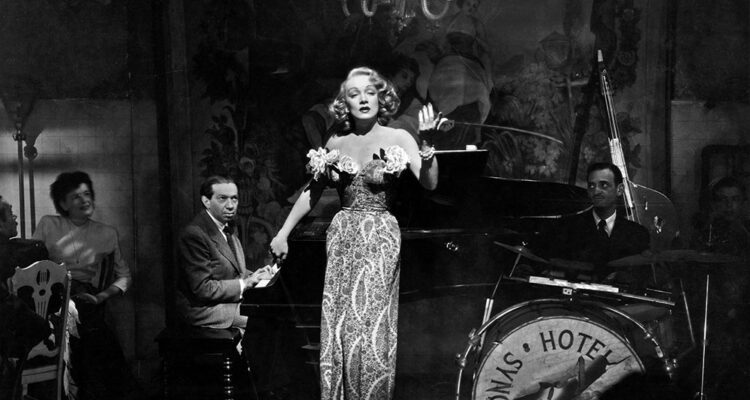
Marlene Dietrich is also alluring as Erika. Wilder had her in mind for the part as he was writing the script and there really was no other actress who could have played her part as well. She is best in the nightclub sequences, entertaining the soldiers as she so often did in real life during the war. 
John Lund also shines as Captain Pringle. Few actors could play comedy as well as Lund could, plus he was a believable "ladies' man". Cary Grant could have tackled this role with equal ease but Grant does not seem like the kind of man who would be having an affair with the former mistress of a Nazi officer. Also in the cast is that old pro, character actor Millard Mitchell as Pringle's commanding officer. 

A Foreign Affair is available on Blu-Ray DVD and via streaming through the Criterion Channel.

This post is our contribution to the Shades of Shane Blogathon being hosted by Rachel at Hamlette's Soliloquy. Be sure to visit her blog to check out other film reviews featuring actors who starred in the classic western Shane.

Tuesday, January 9, 2018

Darling, How Could You! ( 1951 )

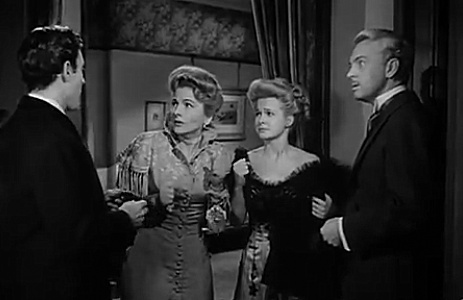
Scottish novelist James M. Barrie is today best remembered for penning the classic children's story "Peter Pan" (1905), but during the turn-of-the-century he was one of the most popular playwrights in England, writing such plays as "The Little Minister," "Quality Street," and "The Admirable Crichton." He had a flair for comedy and one of his best comedic plays "Alice-Sit-by-the-Fire" (1905) - a story of a couple's reunion with their children after several years absence - was brought to the screen in 1951 as the charming Darling, How Could You! starring John Lund and Joan Fontaine.

Dr. Mark Gray (Lund) and his wife Alice (Fontaine) return home to Boston after having spent five years in Panama aiding in the yellow fever epidemic during the construction of the Panama Canal in 1900. Their three children, Amy (Mona Freeman), Cosmo (David Stollery), and baby Molly (Maureen Lynn Reimer), had remained in Boston and were being cared for by Mark's mother and a nursemaid (Angela Clarke).

Both Mark and Alice are impatient to be reunited with their children, but while Mark builds a rapport with the children in a snap, Alice is overly-anxious for instant love and finds the initial greetings awkward. She also has to contend with jealousy from the nursemaid who grew attached to baby Molly while they were away. Meanwhile, their imaginative daughter Amy is convinced their mother is having an affair with a friend of the family (Peter Hansen) after having accidentally seen a theatrical play that portrayed the "seamy side of life". 

Darling, How Could You! is a little-remembered comedy today and yet it boasts a great cast of pros that handle their parts with ease and features some very humorous moments ...two qualities which should make it more memorable. 
While the film starts off rather slow it builds up considerably when Lund and Fontaine enter the scene and ends with a tickling good comedic sequence involving Alice's misunderstood romantic entanglement.

John Lund is especially charming as the understanding Victorian father of the family. He cuts a dashing figure and is an admirably loving husband to Alice. Joan Fontaine didn't often get a chance to play comedy parts so she tackled her role with gusto and looked particularly beautiful while doing so. And the children were perfectly cast: David Stollery, later a veteran of Walt Disney television series such as Spin and Marty, is adorable as Cosmo, their little tough-talking son, while the underrated Mona Freeman displays perfect comedic timing as their winsome teenage daughter Amy. 

It may seem strange today that any young couple would choose to be separated from their children, but James Barrie's original play was set in London with the Grays returning home from British India. It was quite common at the time for couples who were residing in India to send their children back to England to be cared for by family members or nannies due to the risk of disease or uprisings in India. For the film, the setting was changed to Boston to appeal to American audiences, and so the yellow fever epidemic in Panama was given as the reason for the Grays absence for such a long period. Pretty clever. 

Darling, How Could You! is currently not available on DVD but can be rented and viewed online through Amazon.