Showing posts with label John Mills. Show all posts

Wednesday, January 25, 2023

The Family Way ( 1966 )

The Family Way is one of those films that you have probably heard a lot about but never bothered to watch, thinking it to be just a routine British drama. But it is not routine. And it is worth watching. The plot may sound simple, certainly not something one would build a film around, and yet it is deceptively rich. This is because the characters are so well created and so very well performed. 

Playwright Bill Naughton's tale focuses on a working-class family in England. Arthur Fitton ( Hywel Bennett ) has just married his childhood sweetheart Jenny ( Hayley Mills ) and they are both looking forward to taking their honeymoon in Majorca. Unfortunately, the travel agent absconds with their money and they find themselves starting their marriage in the upstairs room of Arthur's parents' house...where the walls are "paper thin". Arthur is a sensitive young man and he finds it difficult to make love in a house where one can hear every whisper. So he sits and listens to Beethoven while Jenny patiently waits for him to come to bed. Their marriage remains unconsummated several weeks later and Arthur and Jenny begin to feel frustrated - for different reasons. Jenny feels she may not appeal to Arthur and Arthur thinks something must be wrong with himself. Their struggle with arousing sexual urgings generates much of the humor of the story but it also stirs up revelations from Arthur's parents about their own marriage which leads into the real heart of the story. 
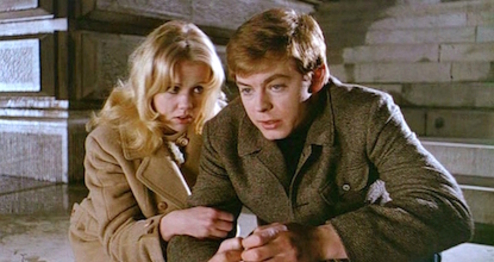
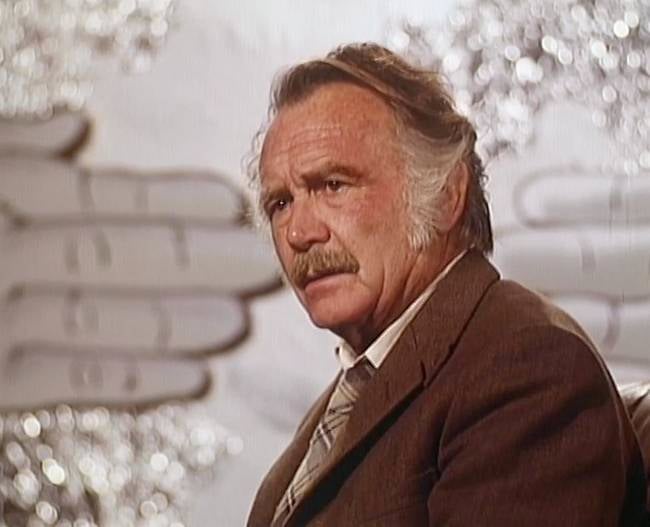
John Mills and Marjorie Rhodes give stellar performances in the role of Arthur's parents, Ezra and Lucy. The Frittons are an everyday family from Yorkshire with Papa Fritton going off to work each morning leaving his wife to tend to the washing and cooking. Arthur works, too, but, unlike his father, he does not spend his free time in pubs drinking with his friends. He is a loner who would rather spend time at home reading and listening to his records. This clash in personalities has made Arthur feel distant from his father and closer to his mother. 

The Frittons have another son, Arthur's younger brother Geoffrey ( Murray Head in a non-singing role ). Geoffrey is not like his father either but this does not seem to bother Ezra much, perhaps because he is not the eldest. Ezra wants Arthur to be a man and his quiet interests make him worry that Lucy's gentle upbringing of the lad has made him queer. 

Surprisingly, when Jenny's parents come to the Fritton's house for a private talk "about Arthur", we discover that Ezra's friendship in his youth with an old pal named Billy may have looked strange to outsiders as well. After all, how many newlywed men take along their best friend on their honeymoon?

Lucy's recollections of her unorthodox first days of marriage bring up memories best forgotten. This old friend, Billy, who "suddenly left" one day without a word may have meant more to Ezra and Lucy than both are willing to admit. 

Ezra's final line "He looked just like Billy" ( speaking of Arthur as he was leaving ) makes one wonder whether Arthur even was Ezra's son at all, and not Billy's. Naughton's script gives the audience only vague hints about the Frittons' past, which lends the story a richness that would have been spoilt had all been revealed. 

The Family Way began as a television play ( titled Honeymoon Postponed ) by Bill Naughton for ABC's Armchair Theatre in 1961. Naughton later adapted it into a theatrical play that premiered in 1963 with Bernard Miles in the role of Ezra Fitton. John Mills happened to catch this performance and was so enthralled with the part that he went backstage hoping to discuss purchasing the film rights as a vehicle for him and his daughter. He was told that the Boulting brothers and an American had already purchased the rights. Roy Boulting had hoped to make the film with Peter Sellars in the lead but after the project was put on hold for several years, he contacted John Mills, who was tickled pink and considered it to be "the best part I've had since Hobson's Choice". 

Indeed, it was. Mills gave a wonderful performance of a lower working-class father whose thoughts and ways are quite different from his more sensitive son. Marjorie Rhodes deserves equal credit for a powerfully understated performance. Also excellent are the two young leads. Hayley Mills, whose acting always standouts, looks especially lovely in this film. Perhaps it was the glow of a young woman in love captured on film ( Mills was having a romance with The Family Way's director Ray Boulting at the time ). 

Hywel Bennett was relatively new to film but had experience in theater. The success of The Family Way led to a contract with British Lion films and two more pictures opposite Hayley Mills ( Twisted Nerve and Endless Night ). Roger Ebert called Bennett "one of England's best young actors" in 1969. Today, he is best known for his role as James Shelley in the popular sitcom Shelley ( 1979-1984 ) and for his voiceover work for the British Rail television adverts of the 1980s. Also in the cast are Liz Fraser, Avril Angers, John Comer, and Barry Foster. 

In addition to its empathetic script and fine performances, The Family Way is noted for its soundtrack, particularly its theme song by Paul McCartney. It is George Martin who really deserves credit for creating the score, having just a 15-second piano piece from Paul to work with. He turned a simple tune into a beautiful and subtle score. 

You can watch The Family Way for free on Tubi ( via Roku or online at tubitv.com ) or on DVD. 

Wednesday, May 8, 2019

From the Archives: The Chalk Garden ( 1964 )

At the dinner table, "Puppy" ( Felix Alymer ) relates a juicy tale to Laurel ( Hayley Mills ) about one of the criminal cases he had to judge years ago. Maitland ( John Mills ) looks on in this lobby card scene from the delightful mystery/drama The Chalk Garden ( 1964 ). 

From the Archives is our latest series of posts where we share photos from the Silverbanks Pictures collection. Some of these may have been sold in the past, and others may still be available for purchase at our eBay store : http://stores.ebay.com/Silverbanks-Pictures

Tuesday, August 26, 2014

Swiss Family Robinson ( 1960 )

"It was a good thing we set out to do. We were right, and all that hasn't changed just because we were shipwrecked."

Papa Robinson's plans of providing a new home for his family in the burgeoning colony of New Guinea go awry when the ship carrying them from Switzerland to the new land gets shipwrecked in the Pacific Ocean after a fierce storm. Robinson ( John Mills ), his wife ( Dorothy McGuire ), and their three sons Fritz ( James MacArthur ), Ernest ( Tommy Kirk ), and Francis ( Kevin Corcoran ) find themselves abandoned by the ship's crew and left to survive on their own. They construct a raft and make their way to a nearby island where they build a home and make a new life for themselves, all the while awaiting to be rescued.

Swiss Family Robinson is loosely based on Johann Wyss' classic novel of the same name published in 1812. Wyss' story had potential but it lacked the action that Disney was seeking for this family adventure film. 


As director Ken Annakin recalled...

"While we were in the mountains near Zermatt shooting Third Man on the Mountain, I remember Bill Anderson saying to me that The Swiss Family Robinson was the subject Walt was toying with as a next picture. I read the book. It was very old-fashioned, and I wondered what Walt's approach was going to be. Bill Anderson and I returned to Burbank and we sat down with Walt. He said, 'Well now, let's throw the whole book out the window. Let's just keep the idea of a Swiss family emigrating, trying to emigrate to America. They get shipwrecked, but they are able to save all the things in the ship. They then make a life on an idyllic island, I think you ought to think of all the things you might like to do, all the animals you could use in an entertaining way. Let's make it a wonderful show for the whole family, with all ideas possible.'"

Walt Disney assigned sketch artist John Jensen to work with director Ken Annakin in creating a storyboard for Swiss Family Robinson. Every scene and every camera angle was plotted in detail. Disney then took the storyboard to screenwriter Lowell S. Hawley and told him to write a story based on what was drawn. It was a novel way to pen a script and turned out to be an excellent way! 

Swiss Family Robinson became Walt Disney's grandest live-action film to date. The entire film took 22 weeks to shot at a cost of approximately $4,000,000. It was also one of the few Disney pictures to be filmed in widescreen. No Hollywood studio sets were used in the making of the movie. It was shot entirely on the Caribbean island of Tobago, providing an authentic tropical backdrop for the intrepid family's escapades. A menagerie of animals were assembled - exotic birds, snakes, tigers, zebras, elephants, lizards and monkeys - and flown to the island to give the appearance that the Robinsons got stranded on a South Pacific island filled with wild creatures. 


The elaborate jungle sets, designed by John Howell, John Hoestli, and Peter Murton, took 5 months to build. The most impressive was, undoubtedly, the tri-level family treehouse which included a stove, hot running water, a skylight roof, and a pirate-proof living room....all the comforts of home. The treehouse became such a beloved edifice that it was given a permanent home at Disneyland, where it was re-constructed in 1962.


"The world is full of nice ordinary people living in nice ordinary little houses on the ground. But didn't you ever dream of a house up on a tree top?"

A previous film version of Swiss Family Robinson was released by RKO in 1940 starring Thomas Mitchell, Edna Best, Tim Holt, Freddie Bartholomew and Terry Kilburn. This adaptation focused on the father's desire to stay on the island and have his sons grow into capable men through the survival skills they were learning on the island, while his wife pined to go home to London to resume her social life.


Walt Disney's version had a much happier tone and the Robinson family displayed the proper attitude that one should have when getting stranded ( in any situation ) : to make the best of it.

As with most Disney films, casting was paramount and Swiss Family Robinson was filled with seasoned and attractive players.  John Mills is ideal as the patriarch of the family striking just the right note of commanding know-how, tempered with humor. Clearly he was a man not disappointed with the situation but thoroughly enjoying the whole escapade. 


Unlike Edna Best's portrayal of Mother, McGuire has her become a woman who supports her husband in his decisions and keeps quiet about the trials of the island...unless worry prompts her to cry out.


The lovely Janet Munro joins the cast as Roberta, the young woman whom Fritz and Ernst rescue from pirates when they take their kayak journey around the island. MacArthur and Kirk were certainly a drawing feature for the young female audience who no doubt would have loved to have been stranded on an island with the boys. Moochie is the only performer who gets out of hand in the film, and seems to be bent on getting himself, and the family, into danger. Rounding out the cast is the legendary Japanese actor Sessue Kayakawa as the leader of the pirates, and Cecil Parker as Roberta's grandfather.


Swiss Family Robinson was released just before Christmas, on December 21, 1960. Critic reviews for the film were mixed, with the New York Times calling it a "grand adventure yarn" while other reviewers found it overlong and the final pirate attack a slapstick travesty. Those critics had their blinders on and failed to realize that the film was made in the spirit of fun and reckless abandon. Nevertheless audiences realized this and they came in droves to see it. The film became the No.1 grossing picture of 1960, earning over 20 million dollars at the box office, nearly twice the return of the second top-grossing film of the year, Psycho.


Swiss Family Robinson gives audiences a ripping good adventure to enjoy and makes for ideal Saturday morning viewing. It has all the key ingredients of an entertaining film - a great story, perfect cast, stellar special effects, and beautiful cinematography. Through the Robinsons we can vicariously enjoy the life of castaways and live out the dream of having a sprawling tree pad...and all within the short span of two hours.  

Sunday, August 3, 2014

The Chalk Garden ( 1964 )

"The only hold we have on this world is the truth"...

Only the occasional cry of seagulls pierce the silence at Belle Fountain, a secluded country estate overlooking the chalky cliffs of Dover, which shelters an unusual array of individuals, each of them yearning for growth in its stifling environment. Here, Mrs. St. Maugham ( Edith Evans ) lives in contented bliss amidst the opulent facade of a well-ordered life. She is a regal dowager hearkening from an era of refinement - a time when two glasses were used for one wine. 

Living with her is Laurel ( Hayley Mills ), her granddaughter, a precocious and slightly neurotic darling whom Mrs. St. Maugham feels is in need of yet another governess. The "poor helpless child" ran away from her mother after she chose to marry another man. Casting aside the reality of her mother's love, Laurel has hardened herself with an artificial maturity, relying on no one for comfort. Suppressing her emotions she is "plagued with the compulsion to burn the house down" and has an insatiable appetite for mystery. Together with their beloved manservant Maitland ( John Mills ) Laurel is collecting "The Great True British Crime Series". In her desire to rid herself of caregivers she undertakes to expose them...one by one. "Everyone has something in their past. Some dark and terrible secret, " she explains. "I find it out and tell it to my grandmother".


The haughty Mrs. St. Maugham dotes on the child incessantly and believes she is nurturing Laurel as fastidiously as she has her beloved garden; but her garden is growing in chalk. When Miss Madrigal ( Deborah Kerr ) arrives, without references, for the position of governess, Mrs. St. Maugham is willing to hire her solely on the basis that she was once put in charge of a garden. Her past, shrouded in mystery, proves to be a challenge to Laurel's probing detective skills. Madrigal observes in Laurel shadows of her former self - a child who surrounded herself in lies and fantasies.  It takes the quiet strength and wisdom of this enigmatic stranger to revitalize the garden and each of the inhabitants of Belle Fountain. Faced with the opportunity of altering the girl's future Madrigal attempts to reunite her with the one person she feels she needs most - her mother. 

"The flowers need nourishment...you can't give them what they do not have"

"Then you give them what they need. You're in charge of my garden"

"Am I? I wasn't sure. I'll do my best to help with your garden, and the child. Their problems are similar"

Enid Bagnold's "The Chalk Garden" is a wonderfully odd psychological mystery which thrives on the confines of its solitary setting. Ten years after its successful stage run it was brought to the screen in Ross Hunter's lush production. The skillful hands of screenwriter John Michael Hayes pruned and weeded the overgrowth of characters and tangle of Bagnold's original play to bring out the literary blossoms of wit that her "Garden" had to offer. Hidden within the bright and cheery tones of its Technicolor palette is a highly engrossing cat-and-mouse thriller, pleasing to both the eyes and ears. 

Director Ronald Neame displays a green thumb as he guides the story and its cast with a steady hand, keeping the suspense taut as, midway through, the film changes viewer focus from Laurel to Miss Madrigal. Arthur Ibbetson's slanting camera angles and Malcolm Arnold's marvelous score emphasize the tension of the film. Strains of The Chalk Garden reverberate in Arnold's 1975 score for David Copperfield

Gladys Cooper, who had originated the role of Mrs. St. Maugham on stage, was Hunter's original choice for the screen adaptation, but the clever Edith Evans hoodwinked the producer into casting her in the part instead. Hunter was immensely pleased with her performance, as were the critics, and Evans was nominated for Best Supporting Actress for the role at the 1965 Academy Awards.


"Go ahead and cry Laurel. Cry as long and hard as you want.... God made tears to shed"

Hayley Mills gets to demonstrate her underrated dramatic acting ability in her second onscreen pairing with her father, John Mills. As Laurel, she plays the part with glib malice while retaining her childlike innocence. Sandra Dee was the original choice for the part of Laurel, but discovering that she was pregnant, had declined the role. 

The extremely talented Deborah Kerr is delightful as Madrigal, and although she does not possess a glimmer of mystery about her, manages to keep the audience in suspended bafflement until the conclusion. Felix Aylmer and Elizabeth Sellars round out the small cast in the role of Judge "Puppy" McWhirrey, one of Mrs. St. Maugham's former lovers, and her daughter Olivia, respectably.


The Chalk Garden is a simple story and yet one of multiple facets. Miss Madrigal's arrival at Belle Fountain disrupts the lives of each of the characters and through her they come to learn about themselves and grow as individuals. She instantly sees through Laurel's intricately tangled web of deceit and attempts to break down her barriers of falsehood by challenging her every lie. Laurel at first feels antagonistic towards her and then as the challenge of exposing her takes on the thrill of a game-hunt "Boss" Madrigal becomes a beloved enemy, until finally, near the climax, a surrogate mother and a true and trusted friend. In turn, Madrigal finds that the fear she dreaded most - exposure - has in truth set her free. 

"At our last meeting I died. It alters the appearance."

The Chalk Garden is rich and satisfying entertainment that has aged gracefully over the years. It provides the pleasure of the companionship of an old and dear friend, and like a glass of fine port, its tone improves with each subsequent viewing.

This post is our contribution to the British Invaders Blogathon being hosted by A Shroud of Thoughts. Be sure to check out all of the great posts on classic British films! 

Tuesday, November 5, 2013

The Quatermass Report - Part Two

In our continuing look at the influential Quatermass series of the mid-century we turn the spotlight onto Nigel Kneale's final serial of the 1950s - Quatermass and the Pit, as well as the final episode, simply entitled Quatermass from 1979. Part One is available to read here. 


QUATERMASS AND THE PIT

Andre Morrell, who had been the original choice for the role of Professor Quatermass when Kneale first conceived of the character in 1953, had finally consented to portray the now-famous bow-tied Brit. This third installment, released in 1958, combined the same elements of the previous series - an alien invasion through human takeover and a time-ticking race on Quatermass' part to stop this - but in a new and completely absorbing way. In fact, Quatermass and the Pit is one of the best of the series. 

"The last adventure, which I called Quatermass and the Pit, went way past the concerns of the time and into an ancient and diabolical race memory," said Kneale in an interview in 1996. "It sought to explain man's savagery and intolerance by way of imagines that had been throbbing away in the human brain since it first developed. Racial unrest, violence and purges were certainly with us in the 1950s, and I tried to speculate on where they first came from."


During routine engineering work at Hobbs' End underground station ( "Hob" is a folk name for Satan ), a group of bones and half complete skeletons of ape men are discovered, apparently drastically predating the era that scientists had established for those creatures. Later, an unusual metal container is unearthed. The authorities, led by the unimaginative Colonel Breen ( Julian Glover ), believe it to be an unexploded bomb left over from WW2, but when Professor Quatermass arrives on the scene, he proves otherwise. The contents inside reveal to him a discovery which shatters the accepted theory of Darwin's evolution and offers a dire warning for the future of mankind. 


Kneale ambitiously attempted to rationalize the nature of both supernatural hauntings and human concepts of the devil and, surprisingly, he translated those ideas into a convincing and plausible, if improbable, script. 

Quatermass and the Pit was broadcast in December 1958 and received much acclaim from television critics, with several reviewers praising Morell for having given the definitive portrayal of Professor Quatermass. Cic Linder, Anthony Bushnell, and John Stratton rounded out the great cast. 


As with the previous two serials, Hammer purchased the film rights to these monumental Pit episodes, however, partly due to the declining box-office receipts of Quatermass 2, Kneale's refusal to tolerate a drunken Donlevy once again, and Columbia disinterest in the series ( Hammer had recently struck a distribution deal with Columbia Pictures ), it was not brought to the big screen until February 16, 1968.

Instead, Hammer plunged into another film adaptation of a Kneale teleplay - this time of "The Creature" ( 1955 ), which they retitled The Abominable Snowman

Roy Ward Baker undertook the directorial responsibilities when Quatermass and the Pit was put into production in February 1967. Baker had directed a number of fine films during the 1950s, notably The October Man and A Night to Remember, but several recent failures made him turn to television, directing episodes of such popular crime-fighting series like The Saint and The Avengers. 


Kenneth More was Baker's original choice for the part of Quatermass, but eventually he selected Andrew Keir to replace Morell, who had turned down the chance to play the role again. This was a stroke of good fortune, for Keir brought an excellent steely determination to his characterization of the professor as well as injecting a very human fragility and vulnerability. 

James Donald adds great support to Keir, and Barbara Shelley, one of Hammer's most popular and prolific leading ladies, is excellent as fellow scientist, Barbara Judd. Quatermass and the Pit ( also known as Five Million Years to Earth ) was her final film for the studio. There are a swarm of delectable British character actors to enjoy as well, including Peter Copley, Bryan Marshall and Edwin Richfield.

Hammer's home base, the Associated British Studios in Elstree, Borehamwood did not allow for enough space to film and so the project was relocated to the MGM Borehamwood studios where no other film was being shot at the time, giving the crew - and especially the production designers - ample space to work with, which they utilized in creating the enormous Underground station and excavation settings. 


QUATERMASS 1979 

After Quatermass and the Pit, Hammer approached Kneale about the possibility of writing another script for a film follow-up but that idea never came to fruitation. Instead, Professor Quatermass made his final television appearance in the four-part 1979 Thames Television serial release, simply entitled Quatermass. Alas, it was a serial that should not have been made. In the mid 1960s, Nigel Kneale had written a dreary and depressing tale of the future state of London - and much of the world - where young people have formed violent gangs and attack bystanders without provocation while bands of hippies worship the ancient energies and dance around archaic stone monuments waiting to be transported by aliens into a faraway world. 


Quatermass was not put into production until late 1978, when these peace, love and hate incidents seemed oddly irrelevant.  What's worse, Professor Quatermass is no longer an optimistic man of science, but has warped into a bitter and discouraged old man. He has long been retired, living in retreat in the Scottish Highlands. His sole purpose in coming to London is to search for his missing teenage granddaughter. After a recent space mission goes horribly wrong, right before the public's eyes on live television, a young astronomer ( Simon MacCorkindale ) and Quatermass search to find the answers to this occurrence and other unusual happenings.

The series, and even the 100-minute feature film release The Quatermass Conclusion, progress along cumbersomely and convey a bleak dystopian setting, a far cry from the 1950s post-war Britain of the previous serials.

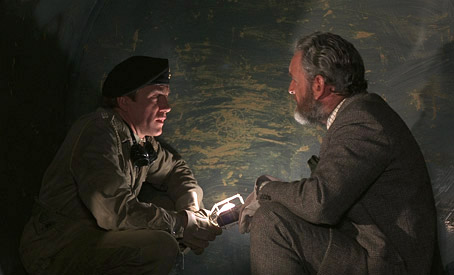
Whereas Kneale's original series were genre-defining and ground-breaking, this Quatermass lacks energy and quite frankly, fizzles out before it has a chance to begin. Not even John Mills' superb acting ability could inject new life into the character. 


THE QUATERMASS EXPERIMENT 2005

BBC Four attempted to revive Professor Quatermass for the younger generation 
in 2005, when they mounted a remake of the original Quatermass Experiment, this time with a much more youthful Jason Flemyng portraying the now tie-less Professor. More recently, Simon Oakes, the current CEO of Hammer Films has announced plans to dip into the archives and remake several of Hammer's post popular films, including the inimitable Quatermass.

The BBC Quatermass serials of yor did not rely on special effects but rather on interesting characters, good dialogue and an intelligent story, elements seen far too rarely in modern science fiction films, which hopefully will be remedied if a remake is undertaken. 

To this day Nigel Kneale's creation of Quatermass, and the serials that showcased this character, remain one of the BBC's finest achievements and influenced numerous science-fiction series including Doctor Who and Sapphire and Steele. 

Be sure to check out the Quatermass films available on DVD, as well as The Quatermass Film Music Collection.