Showing posts with label Horror. Show all posts

Friday, December 19, 2025

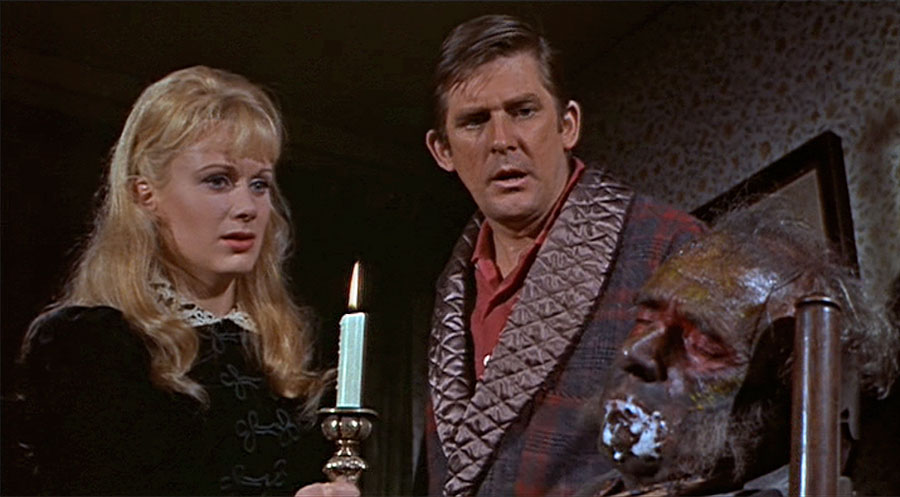
A Ghost Story for Christmas: The Treasure of Abbot Thomas (1974)

Ever since Victorian times, it has been a tradition in England to tell ghost stories at Christmastime and the BBC, in keeping with this tradition, aired an annual teleplay of a ghost story each year beginning in 1971. This series of supernatural tales were released under the title A Ghost Story for Christmas. 

They were inexpensive productions but their filming (in 16mm), by director Lawrence Gordon Clark, was excellent and the actors who starred in them were excellent as well. The series ran for 8 years and then it was revived again in 2004 and 2005 by BBC Four productions. 

Most of the original 1970s episodes were based on short stories by that legendary writer of the supernatural, Mr. M.R. James. Since his stories were short so were the episodes with most clocking in at under 40 minutes. It's not a lot of time to tell a chilling tale and yet the stories are surprisingly compact and manage indeed to send chills down your spine... especially if you watch them at night. 

One particular episode, The Treasure of Abbot Thomas, we do not recommend watching on Christmas Eve as it will leave you with a decidedly gooey feeling afterwards... but it's worth checking out this week before the holiday.

The Treasure of Abbot Thomas tells the tale of a young lord who is studying Latin under the tutelage of the Reverand Justin Somerton (Michael Bryant), a medieval historian and a clergyman. One of the documents that Lord Peter (Paul Lavers) is learning to decipher is a book written by Abbot Thomas, a monk from the 15th century who was disgraced by his involvement with alchemy. His words speak of a treasure of gold which he himself hid near the grounds of the very abbey where the Reverand and Lord Peter study. 

In the document, he shares the first clue to finding this treasure, which the twosome decide to investigate. It leads them to an old stained-glass window featuring images of four Biblical characters, each of whom have a cryptic phrase written in Latin beneath them (“They have on their vestments writing which no-one knoweth”, “On one stone are seven eyes” "He looks down high to see what is hidden"). These clues lead them eventually to a culvert where the Rev. Somerton believes the treasure may be hidden. Despite the fact that Abbot Thomas had warned that he "set a guardian" to protect his treasure, the Reverand goes in search of the fabled gold.... much to his regret. 

M.R. James' "The Treasure of Abbot Thomas" was heavily revised by screenwriter John Bowen for this teleplay but, unlike some script revisions, Bowen's improved upon the original. As in many of James’s tales, the plot follows academic characters whose rational worldview unravels when they encounter something supernatural. In the Reverand's case, we sense that he wanted to believe that there really was a legendary golden treasure to be found but at the same time, disbelieved in the message being true. It is only Lord Peter's eagerness and insistence that sparks Somerton's curiosity as well. Bowen's script adds new characters and situations to James' story but he also leaves in James' hints of ambiguity. At the end we are left wondering whether Lord Peter returned the treasure or kept it for himself. A nice touch. 

Michael Bryant and Paul Lavers play their parts so well that it makes one wish they had paired up again as these characters for a series of mysteries. It certainly would have been better than many of the crime shows that were available stateside in the 1970s. The music for this particular episode also contributes greatly to its eerie ambiance. It is a strange concoction of vocal chanting and drumming that was later mimicked in Children of the Stones (1977), another spine-tingling British television production. 

Feeling intrigued enough to watch this? Check it out on AMC+ or at this link. 

Wednesday, November 5, 2025

The Spiral Staircase (1946)

Few thrillers have ever wrapped terror in such beauty as Robert Siodmak's The Spiral Staircase (1946). Adapted from Ethel Lina White's novel "Some Must Watch", it is one of the crown jewels of the "old dark house" tradition. 

The story takes place in 1916 in a quiet New England village that is shaken by a killer who is stalking women he deems "imperfect." Inside the great Warren mansion, the latest potential target, Helen Capel (Dorothy McGuire), a young mute servant girl, tends to her bedridden employer Mrs. Warren (Ethel Barrymore), unaware that danger lurks within the corridors of the house she calls home. 

Director Robert Siodmak, fresh from his work at Universal, infused the picture with the eerie elegance of German Expressionism. His camera glides through the Warren house teasing us with glimpses of views through mirrors and banisters, as though we were the unseen watcher. The most iconic frame of the film is undoubtably his close-up of the killer's eye and its reflection of the titular staircase. 

Dorothy McGuire gives a remarkable delicate performance as Helen. One forgets her muteness entirely, instead we sense her vulnerability and every thought of fear through her expressions alone. The grand old dame Barrymore gives a barnstorming turn as the sharp-tongued ailing dowager, a role which earned her an Academy Award nomination. George Brent and Gordon Oliver are each cloaked in just enough mystery to keep the viewer guessing, while Kent Smith lends a touch of romance to the proceedings as the young Dr. Parry who is anxious for Helen to regain her speech. The always appealing Rhonda Fleming costars as Mr. Warren's secretary; Elsa Lanchester brings some tipsy humor to the household gloom, and Sara Allgood and Rhys Williams round out the cast of servants. 

Visually, the film is a feast. Nicholas Musuraca's cinematography - that deep-focus chiaroscuro he perfected in Cat People and The Seventh Victim - breathes life into Albert D'Agostino's rambling and gloomy Victorian sets. 

The mystery itself may not stump many modern viewers, but The Spiral Staircase was never about surprise...it is about suspense - that exquisite tightening of the nerves as Helen's silence grows unbearable. In its refinement and restraint, The Spiral Staircase anticipates the psychological thrillers of decades to come and remains a Gothic masterpiece preserved on celluloid.

Saturday, October 25, 2025

Alfred Hitchcock Presents: The Perfect Crime (1957)

On October 20, 1957, television audiences were treated to a rare pairing of two masters of suspense: Alfred Hitchcock and Vincent Price in, what is hard to believe, their only work together. In The Perfect Crime, the third episode of Season 3 of Alfred Hitchcock Presents, Price dons the role of Charles Courtney, a smug prosecutor with a penchant for collecting case mementos—each one neatly labeled and shelved like trophies in a macabre curio cabinet. But there’s one conspicuous gap on the shelf, reserved for what he calls “The Perfect Crime.” You can guess where this is going.

Enter James Gregory as John Gregory (yes, the names are confusing), a defense attorney with a bone to pick. He believes Courtney sent an innocent man to the gallows, and he’s got the evidence to prove it. What follows is a tense tête-à-tête that spirals into murder and a chilling twist that only Hitchcock could deliver with such dry wit.

Price is in his element here—oozing charm, arrogance, and just the right amount of menace. However, much of the episode unfolds through Gregory’s riveting narration, as he reconstructs the tragic events that lead to the innocent man's unjust prosecution. 

Hitchcock, ever the showman, introduces the episode wearing a deerstalker and puffing bubbles from a calabash pipe—a cheeky nod to Sherlock Holmes and a wink to the audience that this mystery is anything but elementary.

The episode is one of only seventeen directed by Hitchcock himself, and it shows. The pacing is taut, the dialogue crisp, and the conclusion deliciously absurd. It’s a compact gem that reminds us why Alfred Hitchcock Presents remains a gold standard in televised suspense.

So if you’re in the mood for a little murder, a lot of ego, and a kiln that doubles as a crime scene, The Perfect Crime is a must-watch. Just don’t ask what’s in the vase.

Thursday, October 31, 2024

The Reptile (1966)

Hammer Studios was the king of horror film studios in the 1960s and they offered something deliciously frightful for all appetites. 

If blood-sucking vampires, ferocious werewolves, or linen-wrapped dead people aren't your cup of tea, then The Reptile, a scrumptious bit of gothic horror from the year 1966, may wet your lips. 

In this tale, Captain Harry Spalding (Ray Barrett) and his wife Valerie (Jennifer Daniel) come to England from India due to the sudden death of Harry's brother Charles.  They want to live in the cottage that Charles left behind, but the village folk warn them against it. In fact, most of the villagers are downright hostile to the couple, except for local pub owner Tom Bailey (Michael Ripper). 

Neighboring the cottage is the mansion of Dr. Franklin (Noel Willman) and his daughter Anna (Jacqueline Pierce), a young woman who is frightened of her father. Shortly after the Spaldings' arrival, a villager dies mysteriously with bite marks on the back of his neck and foam pouring from his mouth. Harry believes his brother may have died the same way and thinks Dr. Franklin is hiding the truth about his death. 

The Reptile is one of Hammer Studio's more tamer productions and, like The Gorgon (1964), most of the film builds up to the creature-revealing climax, which in this case is a - surprise! - reptile. This climax would have been much more exciting if the title of the film, and the poster, did not give away the ending. 

In spite of its tameness, The Reptile is engrossing and well worth a watch, if only to soak in all that wonderful gothic atmosphere that Hammer productions were so good at creating. 

The cast were all capable actors (both Noel Willman and Jennifer Daniel may look familiar from Kiss of the Vampire), the music is fittingly eerie, and the color palette is marvelous. The cottage that the Spaldings stay in, as well as Dr. Franklyn's manor across the lawn, reminded me of Cherry Cottage and Cavor's home in First Men in the Moon but these were different filming locations. The Reptile was filmed in and around Windsor in Berkshire next door to Bray Studios, where the picture was made. 

The Reptile is currently available on DVD as well as on Blu-Ray. 

Thursday, October 17, 2024

The Alfred Hitchcock Hour: Don't Look Behind You (1962)

In 1962, The Alfred Hitchcock Hour premiered, expanding on the popular half-hour thriller series Alfred Hitchcock Presents. Like its predecessor, each episode opened with an introduction from the Master of Suspense himself Mr. Hitchcock, who teased his audience about the story to follow. 

"Don't Look Behind You" was only the second episode in this new hour-long format and, unfortunately, it played out like a half-hour episode stretched to fit the new timeslot. 

The episode, based on a novel by Samuel Rogers, was about a crazed killer who stalked the woods at night murdering young women in the college town of Woodside. One evening, Daphne (Vera Miles) decides to take a chance and crosses the woods as a shortcut to get to a dinner party - she makes it out alive but knows for certain that someone was following her close behind. At the party, arriving shortly later, is her fiancé Harold (Jeffrey Hunter), a psychology professor who looks a bit bedraggled. Also arriving late is Dave (Dick Sargaent) a science teacher who has a crush on Daphne. Another admirer of hers is Edwin (Alf Kjellin), a pianist who has a bent towards the morbid. 

Harold comes up with the brilliant idea of using Daphne as bait so he can catch the killer himself and throughout the episode we are supposed to wonder whether the lunatic is Harold himself, Dave, or Edwin, all of whom happen to be in the woods the same night Daphne is walking through it. All three men look crazy but Harold seems to be the most dangerous and one cannot help but wonder how Daphne can be so blind as to not realize it. 

"Pain is only a secret name for pleasure, my darling"

The wonderful director John Brahm (The Lodger, Hangover Square) directed "Don't Look Behind You" and, while the scenes through the woods are atmospheric, the episode as a whole is a letdown. This could have been a tense thriller with nail-biting "who can the killer be?" ending, but instead it is so obvious that most of the episode fails to build any tension. Jeffrey Hunter's character of Harold should have been a sympathetic intelligent man whom Daphne relies on, this would have given her plausible reason for staying in Woodside with a killer on the loose and would have made the ending have more of that Hitchcockian-twist. 

"Don't Look Behind You" features one of the best introductions of any of the Alfred Hitchcock episodes with Vera Miles walking in a flowing white dress down a secluded dark wooded shortcut, but overall, it just fails to stir up the shivers like any decent Alfred Hitchcock episode should. Nevertheless, Vera Miles gives a wonderful performance as the innocent victim and there is a cast of familiar faces including Abraham Sofaer (Elephant Walk), Madge Kennedy, and Ralph Roberts (Bells are Ringing).

Friday, November 10, 2023

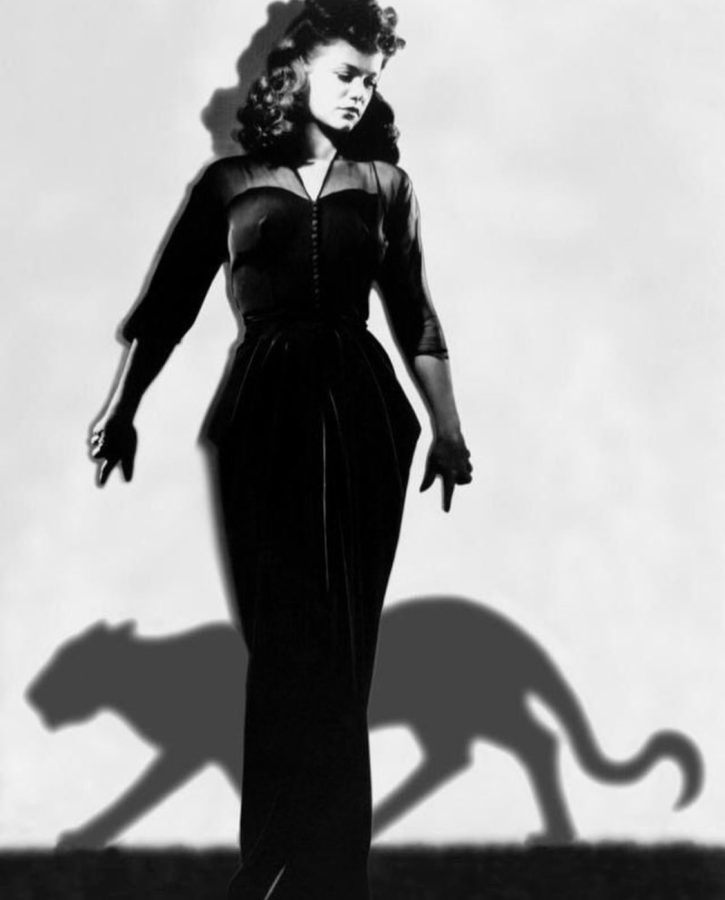
Irene Dubrovna in "Cat People" (1942)

The Classic Movie Blog Association is hosting the Blogathon and the Beast blog event this week. This theme gives us bloggers a chance to write about a film character who has a beast within themselves. 

All of us have a sleeping beast within who, hopefully, never awakens in our lifetime. As the old saying goes, "Let sleeping dogs lie." I always had the notion that my sleeping dog was the Beast of Jealousy which, thankfully, has never had cause to open its eyes. 

Irena Dubrovna (Simone Simon) in Cat People (1942) was not so fortunate. She had what I believe was the Beast of Jealousy within her and, one afternoon, an unexpected encounter at the zoo began a chain of events that caused this sleeping dog (or rather, cat) to wake. 

Irena was a sketch artist for a fashion design company. She had an apartment that was a short walk away from the New York City Zoo, and she enjoyed spending her afternoons there sketching the animals...namely, the resident panther. 

One day at the zoo, she meets Oliver (Kent Smith), a marine engineer, and within a few hours, they become romantic friends. 

Unlike most of us who are unaware of our inner beasts, Irena knows very well what hidden danger may be inside her. She tells Oliver a story about a certain group of evil people from the village in Serbia where she came from. They were known as "cat people" and were, supposedly, pushed back from her village by King John quite a long time ago. However, Irena always feared she may have been an ancestor of these people, and her suspicion is later confirmed when, on her and Oliver's wedding night, a mysterious woman greets her as one of the "cat people".

The cat people destroy the ones they love. Like real felines, they are averse to strong displays of affection, especially if it creates an unwanted bond of dependency. Irena believes that if she were to kiss Oliver, she would have to kill him, and so months pass with their marriage unconsummated. Meanwhile, Oliver grows more and more apart from Irena and her obsession with this belief in "old folklore". He turns to Alice, a longtime friend and coworker, for advice and, later, for comfort. 

This arouses Irena's feelings of her "inner cat" even more and one evening she follows Alice home. She begins by walking a good distance behind Alice but shortly she takes on the physical appearance of a cat - a panther - and actually stalks Alice like prey. 

"There is, in some cases, a psychic need to loose evil upon the world. And we all of us carry within us a desire for death. You fear the panther; yet you are drawn to him again and again. Could you not turn to him as an instrument of death?"

Larry Talbot in The Wolf Man (1941) went into a mental fog when he transformed into the wolf and he was afraid he would harm someone unknowingly while he was a wolf. Irena's transformation is quite different. She seems to be well aware of whom she is stalking and attacking as a panther. 

Irena is quite a shy and gentle woman by nature and dreads having a duel-personality, especially one that is an animal. She willingly agrees to undergo psychiatric treatment to be cured of this belief, but at the same time seems to take pleasure in her predicament and clings to it. Typical feline complexity. 


In one eerie scene, she follows Alice to the indoor pool of her apartment complex at night and prowls and growls in the shadows around the pool. After Alice screams and others come into the pool room, Irena transforms back into her human self and innocently remarks "
I'm sorry I disturbed you, Alice. I missed you and Oliver. I thought you might know where he is." Clearly, she was enjoying herself. 

Irena's cat personality may not have been entirely a beast of jealousy but this emotion was a strong trigger for it to come forth into the physical realm. Thank goodness the evil nature we sometimes suppress, be it ever so small, does not take the physical form of an animal. Although... dating back to ancient times, people's inner personalities were referenced in relation to animals. In Western and Chinese astrology, human character traits are linked with animal counterparts. And all of us, at some time or another, refer to others as animals.... "He's like a timid mouse"... "She's like a frightened rabbit". But how strange it would be to see these animal natures take form! 

Irena had no control over her unusual situation. Whether she wanted to be a cat or not, she became one. She was just an innocent victim of presumably an ancient gypsy curse in her village. Sadly, her husband Oliver thought her fear of being transformed into a cat was only a problem of her mind...an issue he later got bored with when it made him unhappy. At one point, Irena was willing to cast aside her fears and superstitions and concentrate on being a good wife to Oliver, but by that time it was too late. Oliver now loved Alice and Irene was then more than willing to unleash her inner beast....knowing very well it meant her death. 

Tuesday, October 31, 2023

The Hour of 13 (1952)

Metro-Goldwyn-Mayer Studios always had a flair for making period films, especially those with a Victorian setting.....and they made quite a number of them, too. Being quite a savvy production company, they also discovered that a good script is worth repeating. Hence, many of the Victorian-era thrillers that the studio made in the 1930s and 1940s were later remade. One such film was The Mystery of Mr. X (1935) which they remade in 1952 under the title The Hour of 13. 

Robert Montgomery starred in the original film as dapper gentleman thief Nicholas Revel. A killer known as "Mr. X" is on the loose in London targeting police constables. By a strange coincidence, his latest killing occurred the same night and in the same location as one of Revel's latest robberies. In order to clear his name, Revel decides to play an amateur detective and track down the fiend himself, all the while dodging the suspicious eye of Police Commissioner Sir Herbert Frensham (Henry Stephenson). 

The Mystery of Mr. X was based on the novel "X vs Rex", written by Philip MacDonald (The List of Adrian Messenger). Howard Emmett Rogers worked it into a quick and thrilling script and MGM had another winning Robert Montgomery picture in the theaters. 

What works once can work again, hence, seventeen years later, producer Hayes Goetz blew the dust off the script and hired screenwriter Leon Gordon to rework it into a vehicle for MGM's young star, Peter Lawford. What resulted was a charming gaslit London mystery that holds up quite well for its age. 

This time, Nicholas Revel is tracking down the killer known as The Terror. The police - primarily Inspector Connor (Roland Culver), believe that if they find the thief who stole Lady Elmbridge's emerald, they find the Terror. Since Revel stole the emerald, he wants the real Terror caught before they fence him in for a series of murders he did not commit. 

The Hour of 13 was made at the MGM-British Studios in Borehamwood, England and, while there are not many location scenes, the film sets are excellent and perfectly evoke that Jack-the-Ripper setting of old London. 

Peter Lawford is not my idea of a gentleman thief (Stewart Granger would have been excellent in this part) but he is surprisingly good. In fact, it would have been nice to see him in a series of Nicholas Revel mysteries. Playing his leading lady is English actress Dawn Addams who had a long career with MGM and an even longer career working in television. Also in the cast is Michael Hordern as Sir Henry Frensham, Derek Bond, Leslie Dwyer, and Colin Gordon. 

The Hour of 13 is available on DVD via Warner Archives.

Thursday, October 26, 2023

Hammer Horror - The Golden Era (1956-1967)

Each year along with the approach of Halloween comes the bombardment of Hammer Horror films on television. Blood, gore, and buxom babes are splattered onscreen in brilliant Eastmancolor, while sanguinary counts and grimly ghoulish characters lurk stealthily in dark corners of seedy districts intent on carrying out nefarious deeds on their unsuspecting prey.

And we…sweet, kind, gentle, innocent viewers…sit by with pizza in hand, eyes-a-goggled and heart-a-pounding as we stare transfixed at our screens while these deliciously diabolical scenes are being carried out.

Prior to the British Hammer film, there really was no such thing as a “gory” film. There were lords of tiny European hamlets suffering from lycanthropy, mad scientists making pastiches out of gently worn body parts, secluded islands inhabited by horrific animal creatures, misguided poor souls continually making themselves disappear, and of course the all-too-common haunted house filled with frustrated spirits (and the occasional runaway gorilla)……but alas, no gore. Hammer Studios had found a niche and filled it capitally.

Just what would Halloween be without Christopher Lee and Peter Cushing entertaining us?  

Hammer Productions was formed in 1934 by William Hinds, a comedian and businessman who once went by the name of Will Hammer on stage. His films were low-budget and simply made but, even with his own distribution company, he wasn’t able to find a market for them and filed for bankruptcy in 1937.

A year later, his son, along with producer James Carreras, resurrected the production company and began work on a series of BBC radio adaptions such as Dick Barton Special Agent, and The Adventures of PC 49. Many films were made during the 1940s and early 50s but nothing of noteworthy attention, until, that is…1955. This was the year Hammer Studios released The Quatermass Xperiment, a wonderfully chilling adaption of the popular BBC television series of the same name. 

Quatermass, also known as The Creeping Unknown, was about a missile sent into space with three astronauts on board. Only one of the men return to Earth and with him, brings an alien infestation which turns him into an ‘orrible blood-sucking monster. Professor Bernard Quatermass (played by American actor Brian Donlevy) becomes the first of many, many scholarly extraterrestrial/mythical/vampyr hunters to be featured in Hammer film….Van Helsing being the most famous of these.

The film became the first to ever receive an X rating certificate from the British Film Board and was so successful that similarly themed pictures were quickly put into production and released.

X- The Unknown (1956) 

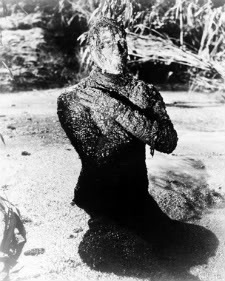
Radiation tests done by the British Army in a remote Scottish village unearth an unknown radioactive “blob” that leaves only the bodies of its burnt victims behind. Dr. Royston sets out to stop the beast before it grows bigger and bigger and feeds off of them all! Dean Jagger, Leo McKern, Edward Chapman, Anthony Newley.

Quatermass II: Enemy from Space (1957) 

Professor Quatermass explores a deadly gas that is originating from a hidden factory in rural England. Unusual creatures just may be planning something deadly for planet Earth and, once again, Quatermass is the man to stop them. Brian Donlevy, John Longden, Sidney James, Brian Forbes.

But it was when The Curse of Frankenstein came out in 1957 that the studio earned its infamous title as a House of Horror. This was, officially, the start of Hammer Horror.

The Curse of Frankenstein (1957) Using the hands of a pianist and the brains of a renowned scholar, Doctor Frankenstein sticks together a "human" from leftover bodies and finds that it didn’t quite turn out to be the success he had planned. Peter Cushing, Christopher Lee, Hazel Court.

Peter Cushing and Christopher Lee, heretofore relatively unknown company players, quickly earned worldwide recognition for their roles as Dr. Frankenstein and his Monster and for the next ten years basked in the sunshine – or rather moonlight – of success.

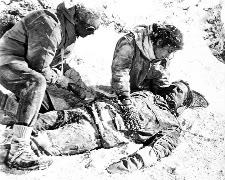
The Abominable Snowman (1958) High in the snow-covered Himalayan mountains, an English botanist and a burly American scientist lead an expedition to discover the legendary Yeti creature. Peter Cushing, Forrest Tucker, Maureen Connell.

Universal Studios was the American distributor of the Hammer horror series and since they earned such great returns off of them, they let them have access to their stock house of scripts. Numerous retellings of their horror classics were plotted out, and the studio focused all its efforts and funds on the making of these colorful adaptions.

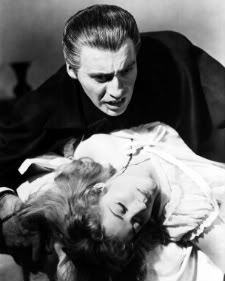
The Horror of Dracula (1958) After a man attacks Dracula in his castle (yes, bold man he be!), Dracula travels to a nearby village to seek revenge on his family and his fiancée. They turn to Professor Van Helsing, a fellow student of vampires, for help in destroying him. Peter Cushing, Christopher Lee, Michael Gough, Melissa Stribling.

The Hound of the Baskervilles (1959) Sir Arthur Conan Doyle’s famous Sherlock Holmes novel gets a colorful retelling here, as the ace detective and his doctor friend come to the aid of a nobleman who is being threatened by supernatural hounds on the moors of his estate. Peter Cushing, Andre Morell, Christopher Lee, Marla Landi

The Hound of the Baskervilles was one of the less successful films in the series though Peter Cushing made an admirable Holmes, as did Andre Morell as Dr. Watson. During 1951 – 1967, Hammer Studios' home was in Bray, near Windsor, Buckinghamshire. A house (Down Place), a large backlot, and several smaller studios were on this property. The house was included in many of the films (it added a lot to that “Hammer atmosphere”) and the backlot was turned into a European village which was used again and again in different films. First in The Brides of Dracula, then as a Spanish village in The Curse of the Werewolf, as London in The Phantom of the Opera, and then as a Russian palace in Rasputin, the Mad Monk.

From 1960 on, Hammer consigned themselves to raising their monsters from their graves in sequels or rehashings of their previous successes…with the exception of The Phantom of the Opera, Curse of the Werewolf (another misfire), and The Gorgon…which were new characters to the series.

The Brides of Dracula (1960) A schoolteacher unknowingly sets free a young man ( of the undead variety ) in Transylvania, and worse yet, finds that he’s after her students at her school for girls. Peter Cushing, Martita Hunt, Yvonne Monlaur, David Peel

The Curse of the Werewolf (1961) A young Spanish boy on a hunting trip gets bitten by a wolf, and years later moonlights as a first-class howler in this retelling of the classic Universal The Wolf Man. Clifford Evans, Oliver Reed, Yvonne Romain

The Phantom of the Opera (1962) In Victorian London, a poor musical professor finds that his life work has been stolen by a corrupt lord and, with his fire-burnt disfigured face, he hides out in an Opera house as a “phantom” waiting for his moment of revenge. Herbert Lom, Edward de Souza, Michael Gough, Heather Sears

Kiss of the Vampire (1963) A young honeymooning couple gets stranded in a southern European village and are “helped” by an aristocratic family…who have a taste for newlywed blood. Clifford Evans, Edward de Souza.

Evil of Frankenstein (1964) – Penniless Baron Frankenstein, returns to his family castle to renew his work on his beloved Monster, only to find that an evil aid, Zoltan has been using his monster for his dirty work. Peter Cushing, Peter Woodthorpe, Duncan LaMont

The Curse of the Mummy’s Tomb (1964) An Egyptian mummy is delivered to London, where it begins a rampage while under the control of a man with murderous intentions. Terence Morgan, Ronald Howard, Fred Clark

The Gorgon (1964)  In pre-WWII Germany, a small village is being plagued by a snake-haired gorgon who turns those who bear their eyes upon her to stone…only during full moons though. Professor Meister and Dr.Namaroff come to the aid of the townsfolk. Peter Cushing, Christopher Lee, Richard Pasco, Michael Goodliffe, Barbara Shelley

All of these Hammer Horror pictures really weren’t that scary (especially compared to today’s standards) but, in 1965, gore, as in bottles of oozy gooey goopy red ketchup, entered the picture. EEeeek!!

This was the year that the content of the Hammer films became more….ahem, mature…with the eyes of our blood-sucking fiendish friends glaring more fiercely, the bodices of their voluptuous prey creeping lower and lower, and pools of blood squirting to and fro, making Van Helsing’s appearance – along with his cross of Christ – all the more anticipated so we can see our anemic villains writhe in terror at their impending doom.

Dracula, Prince of Darkness (1966) Four unwary tourists take refuge in Count Dracula’s castle for the night (!). Within a few hours one of them is drained of his blood and his wife ( Shelley ) gets transformed into a vampire so the gruesome twosome can pursue the remaining two “guests”. Some hospitality. Christopher Lee, Barbara Shelley, Charles Tingwell

Island of Terror (1966) A group of doctors head to a remote island off the coast of Ireland to investigate a series of medical mysteries and discover a deadly lifeform unleashed. Peter Cushing, Edward Judd, Carole Gray, Keith Bell. 

Rasputin, The Mad Monk (1966) The story of the mad Russian “monk” Rasputin (aid to the Czars) is exploited in all its gory glory. Christopher Lee, Richard Pasco, Barbara Shelley, Suzan Farmer

Quatermass and the Pit (1967) While digging a subway in London, a construction crew discovers a skeleton and what seems to be a German missile….but in truth it is an alien spaceship. James Donald, Andrew Keir, Barbara Shelley

The Reptile (1966) While investigating his brother's death, a man and his wife move into his former cottage in a small village in England and become embroiled in a reptilian curse. Ray Barrett, Noel William, John Laurie, Jennifer Daniel. 

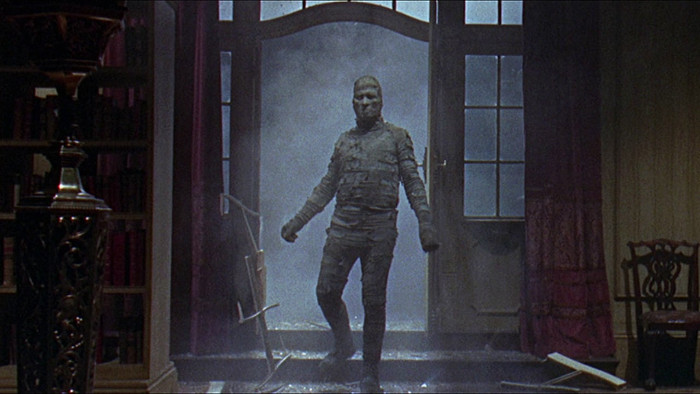
The Mummy's Shroud (1967) An archeological team discovers the remains of a mummy while on a dig in Egypt in 1920. Returning home to England with their find, the members are killed one by one. Andre Morrell, David Buck, Elizabeth Sellars, Maggie Kimberley.


There were also a number of "Scream Queens" that became associated with Hammer Horror (Hazel Court, Barbara Steele, and, later, Ingrid Pitt) but of them all, no one can top Barbara Shelley, that lovely English lady who somehow got caught in the vortex known as “the horror genre”. In total, she made seven pictures with the studio, sometimes as the victim, but not infrequently as a vampire herself.

Many believe that the golden age of Hammer Horror ended with Dracula: Prince of Darkness and that does indeed have some credibility to it, for the films made after this tend to be repetitious and rather malodorous.

All in all though, Hammer Studios had a long line of successes and it is during this bewitching month that we fans appreciate them the most. We get to sit back, have some popcorn, and enjoy Peter Cushing and those legendary ghouls give us goosebumps….what more fun could you have than that? 

Tuesday, October 10, 2023

From the Archives: House on Haunted Hill (1959)


Watch out!! Don't touch that cobweb! Props like that don't grow on trees. The spiders at William Castle Productions were working overtime to produce all of the webs seen throughout the Pritchard house in House on Haunted Hill and Carolyn Craig stepped through quite a few of them during her stay there...just like she is about to mess this one up, too. 

From the Archives is our latest series of posts where we share photos from the Silverbanks Pictures collection. Some of these may have been sold in the past, and others may still be available for purchase at our eBay store: http://stores.ebay.com/Silverbanks-Pictures

Sunday, October 16, 2022

Orson Welles' Great Mysteries

Orson Welles always loved a scary tale. In 1938, he and other players of his Mercury Theater company put on a radio play of H.G. Wells' "War of the Worlds" for Halloween that scared the heebie-jeebies out of most of his listeners. Then in 1951, while taking a break from filming Othello in Ireland, he filmed a short horror film called Return to Glennascaul about a man who unknowingly gives two ghosts a ride on a deserted country road. 

While most of his films steered clear of horror or suspense, he delved deep into the muddy waters of mystery in 1973 when he played host to a British anthology series entitled Orson Welles' Great Mysteries. The series was very similar to the classic Alfred Hitchcock Presents and, like Hitchcock, Orson Welles merely had to act as host, introducing and closing each episode with some pithy words. Unlike Alfred Hitchcock Presents, the episodes of Great Mysteries were all based on famous works or short stories by authors like Sir Arthur Conan Doyle, Wilkie Collins, Honoré de Balzac, and Charles Dickens. 

Orson Welles had a long career as a director, producer, screenwriter, and actor, but by the early 1970s he was in debt ( owing money to the IRS for back taxes ) and, unable to fund his latest docudrama F for Fake, he began to do numerous television appearances to help raise money. In the early months of 1973, he crossed the pond to England to film the intros/outros to the series at the Anglia Television studios in Norwich ( East Anglia ).

Welles was known to be a difficult person to work with and the production team at Anglia studios found this to be true ( in fact, the Sky Arts series Urban Myths made an entire episode in 2020 about his visit called "Orson Welles in Norwich" ). Nevertheless, he gave a marvelous performance as a mystery host. He donned a black cape and hat and, purring sardonic wit, he beautifully introduced each tale of the macabre in his deep silky voice. 

Orson Welles' Great Mysteries ran for two seasons with a total of 26 episodes being produced. Some of the titles included were "The Monkey's Paw", based on the short story by W.W. Jacobs, and "La Grande Breteche" by Honoré de Balzac. What made the episodes entertaining was all of the stories selected had unexpected endings, usually with a sting.

John Barry composed a haunting but typically 70s theme for the series ( it could have worked equally well for a James Bond and the Haunted House film ) and the episodes were similarly chilling like other popular British anthology series of the time ( namely Brian Clemens' Thriller and Hammer House of Horror ) but not nearly as violent or gory. 

With a 25-minute runtime, the tales entertained without getting boring. Plus, there was the added bonus of playing spot the actor with each episode featuring numerous British character actors plus acting legends such as Eli Wallach, Joan Collins, Christopher Lee, Richard Johnson, Claire Bloom, Peter Cushing, Jane Seymour, Dean Stockwell, Jose Ferrer, and Shirley Knight. 

Network Distributing released the entire Orson Welles Great Mysteries on DVD in two volumes.

Sunday, October 24, 2021

Hold That Ghost! ( 1941 )

Gas station attendants Chuck (Bud Abbott) and Ferdie (Lou Costello) happen to be present when gangster Moose Matson (William Davidson) is shot by the police during a car chase. His last will and testament leave all that he owns to those who are present at his death, hence the boys inherit Moose's fortune which happens to be a rundown roadhouse in the outskirts of town. While checking out the property they inherited, they get stranded there on a stormy night with an odd conglomerate of travelers from the cab they were sharing. Moose's old cronies believe that Matson hid a fortune in the roadhouse and so they attempt to frighten Chuck and Ferdie and the other guests away from the house so they can search for the loot. 

Hold That Ghost was the fourth of 35 films that the comedy team of Abbott and Costello made during the 1940s and 1950s and it ranks as one of their best. It has all the spooktacular features you would want to see in a haunted house comedy plus the added bonus of a great cast. Scream-queen Evelyn Ankers joins the duo as one of the guests at the roadhouse, as does Richard Carlson and slapschtick sensation Joan Davis. Marc Lawrence, one of the most famous film gangsters of the era, plays Charlie Smith who turns up stiff. Also making appearances are Shemp Howard, Mischa Auer, Bobby Barber (who later played Stinky on The Abbott and Costello Show), and Ted Lewis and the Andrews Sisters. 

Abbott and Costello never needed any help from supporting players to add to their comedic fun, but Hold That Ghost is a real treat because of the presence of Joan Davis. This marvelous comedienne made a number of films as a leading star but her best performances were in films where she had a supporting role. In Hold That Ghost, she plays a fellow passenger who is stranded at the inn. Ferdie (Costello) finds her annoying and it is in the scenes where the two banter that most of the humor is to be found. They also share one of the best comedic dance scenes put on film. Davis should have reteamed with Costello in their second mystery-comedy Who Done It? ( 1942 ) but instead that film featured Mary Wickes.

"You boys ready to leave?" - Joan Davis

"I was ready to leave when he put the key in the front door!" - Lou Costello

From its wonderful animated opening credits to its peppy closing number ("Aurora" sung by the Andrews Sisters ), Hold That Ghost never lets up on the laughs. Many of the routines that Abbott and Costello would perform in this film, such as the moving candle trick, were later reused in future films and television episodes. 

The duo had skyrocketed to stardom after their first picture was released just a year earlier and it is amazing how quickly they had to be able to come up with comedy routines thereafter. Universal Studios had screenwriters penning scripts for them and the boys were busy filming month after month. In 1941 alone, four Abbott and Costello movies were released. 


Hold that Ghost, originally titled Oh, Charlie!, was slated to be released right after Buck Privates but when that film became a blockbuster hit for Universal, the studio decided to put Oh, Charlie! on the shelf to give them time to make another service comedy in the vein of Buck Privates. In the Navy was quickly put into production and released right after completion. Since the Andrews Sisters had appeared in both films, it was decided that they would make a great addition to Hold That Ghost as well, so Abbott and Costello were brought back to the studio to film a new opening and closing that featured the singing threesome. 

In spite of the popularity of both Hold That Ghost and Who Done It?, Abbott and Costello did not return to the mystery/horror genre until 1948 when they made Abbott and Costello Meet Frankenstein, which not only brought them back to the top of the box-office charts but launched a series of similarly themed monster comedies....unfortunately, none of which were as good as this gem. 

Friday, October 15, 2021

From the Archives: The Wolf Man ( 1942 )


Poor Larry Talbot, all he wanted was to enjoy himself at the gypsy fair with his newfound sweetheart.  Instead, he got himself cursed and covered from head to toe with hair.....wolf's hair! In this publicity photo from The Wolf Man ( 1942 ), Lon Chaney Jr. dons the makeup of the wolfman and strikes this great pose with a bare tree. 

From the Archives is our latest series of posts where we share photos from the Silverbanks Pictures collection. Some of these may have been sold in the past, and others may still be available for purchase at our eBay store : http://stores.ebay.com/Silverbanks-Pictures

Saturday, October 31, 2020

Horror Hotel aka City of the Dead ( 1960 )

"Is it Whitewood you seek?" 

A tall distinguished-looking man asks this of Nan Barlow ( Venetia Stevenson ) when she comes to a crossroads one dark, foggy evening searching for an old village. It is indeed Whitewood that Nan seeks. After hearing her college professor Alan Driscoll ( Christopher Lee ) tell her tales of the witchcraft that took place in the 17th-century Massachusetts village, she decides to spend a week at the legendary Raven's Inn in Whitewood. 

This old and rotting inn was the site where Elizabeth Selwyn was burned at the stake for being a witch, way back in 1692. There is even a plaque on the wall to inform visitors about the historical significance of the inn. When Nan arrives, the town and the inn, appear to be deserted. 

The innkeeper, Mrs. Newless ( Patricia Jessel ), attempts to turn Nan away claiming that there are no rooms available...until Nan mentions that Professor Driscoll sent her. Mrs. Newless gladly gives her a room then because this misguided young woman is clearly intended to be the next sacrificial victim for the witches.

Patricia Russell ( Betta St. John ), the daughter of Reverend Russell, the sole minister in the town of Whitewood, has her suspicions about the evil lurking within Raven's Inn but she doesn't realize the danger that she herself is in until Nan disappears one evening. It is not until Nan's brother Richard ( Dennis Lotis ) and her boyfriend Bill ( Tom Naylor ) come to visit Whitewood in search of her that the centuries-old coven of witches is finally destroyed. 

"We'll be waiting for you!"

City of the Dead was a British production, yet it perfectly captured the atmosphere of New England with its legends of witchcraft. It was a budget horror film that did poorly at the box office when it was first released. The film did a little better in ticket sales when it was retitled Horror Hotel for its U.S. release a year later but has only recently gained the recognition it deserves because it really is a very chilling film and a well-made production, too. 

John Llewellyn Moxey, an Argentinian director, was making his directorial debut and he did a splendid job of packing in a lot of story and action in such a short runtime ( 76 minutes ).....not to mention a lot of fog! Moxey later devoted his time to television work and directed numerous episodes of shows such as The Saint, The Baron, Hawaii 5-0, Mission Impossible, Charlie's Angels, and Murder, She Wrote. 


The cinematography of Horror Hotel makes it seem like a production with a much bigger budget than it had. This was thanks to its cinematographer, Desmond Dickinson, who had a long career in film in England ( he photographed Hamlet, The Importance of Being Earnest, The Browning Version, and Murder Most Foul to name a few ). 

Venetia Stevenson is pretty-as-a-picture as the ingenue Nan, and Betta St. John has a good role, too, but the film's starring attractions really are Patricia Jessel and Valentine Dyall ( he portrays Jethrow Keane ). These two pros, both Shakesperian stage actors, lend their characters such devilish charm that it is almost disappointing to see their demise, especially after centuries of living at the Raven's Inn.  
Christopher Lee has a small but interesting part as Nan's professor, while Norman MacOwan, an old character actor, was making his final film appearance as Reverend Russell. His character, who fervently pleads a warning to all visitors of Whitewood, helps to increase the fear factor.

All in all, if you want a good scare on a Halloween night, then it is well worth checking out this bewitching 1960 gem. 

Want to spend an evening in Whitewood?

Wednesday, October 30, 2019

Basil Gogos and the Monster Art of Universal Horror Films

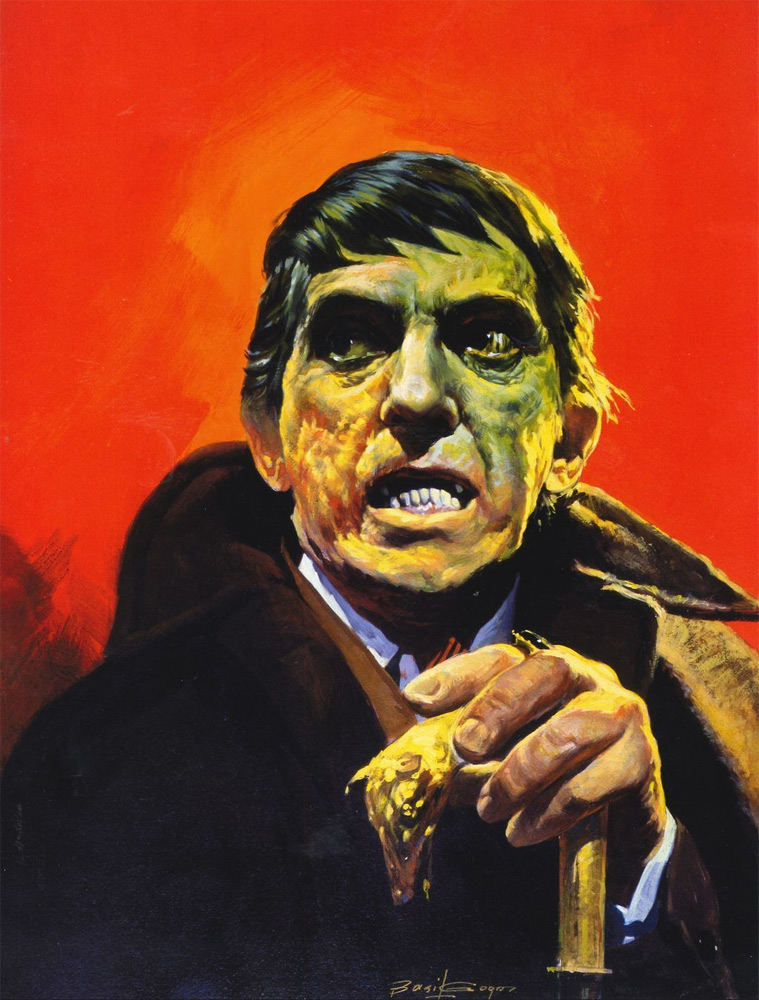
Basil Gogos was a fabulous illustrator who is best known for his movie monster portraits which graced the covers of Famous Monsters of Filmland magazines during the 1960s and 1970s. He combined his passion for art with his love of movie monsters to create these colorful and highly detailed oil portraits of such iconic creatures as Frankenstein's monster, Dracula, and the Wolf Man. 

Gogos was a Greek who came to America at the age of 16 to study art. He worked with the noted illustrator Frank J. Reilly and began his professional career of painting book and magazine covers when he received his first assignment to paint the cover to the western novel "Pursuit" in 1959. 

Throughout the 1960s, Gogos kept busy working as a commercial illustrator. The majority of his paintings were created for men's pulp adventure magazines and the monster magazines being issued by Warren Publishing ( Eerie, Creepy, Famous Monsters of Filmland ). During the 1970s, he took time off as a commercial illustrator to pursue his own personal fine art but still worked part-time at United Artists as a photo retouch artist in the ad department. His monster art found a new audience in the 1990s and Gogos returned to that genre to create more paintings that paid tribute to the great monsters of filmdom. 

Today, his paintings can be found in museums across the world and in two fantastic coffee table books, Famous Monster Movie Art of Basil Gogos by Kerry Gammill and The Monster Art of Basil Gogos by Linda Touby.

Since Halloween is just around the corner, we thought we would share some images of Gogos' best works. Let's begin with Dr. Frankenstein's monster....


THE BRIDE OF FRANKENSTEIN


THE MUMMY


DRACULA


THE WOLFMAN


CREATURE FROM THE BLACK LAGOON


OTHER MONSTERS OF FILM AND TV


THE USPS STAMP SERIES

In the 1990s, Basil Gogos had submitted these designs to the USPS for a Universal Monster series of stamps, but unfortunately, they were not chosen. They would have made fantastic stamps!