Showing posts with label Michael Rennie. Show all posts

Sunday, February 23, 2025

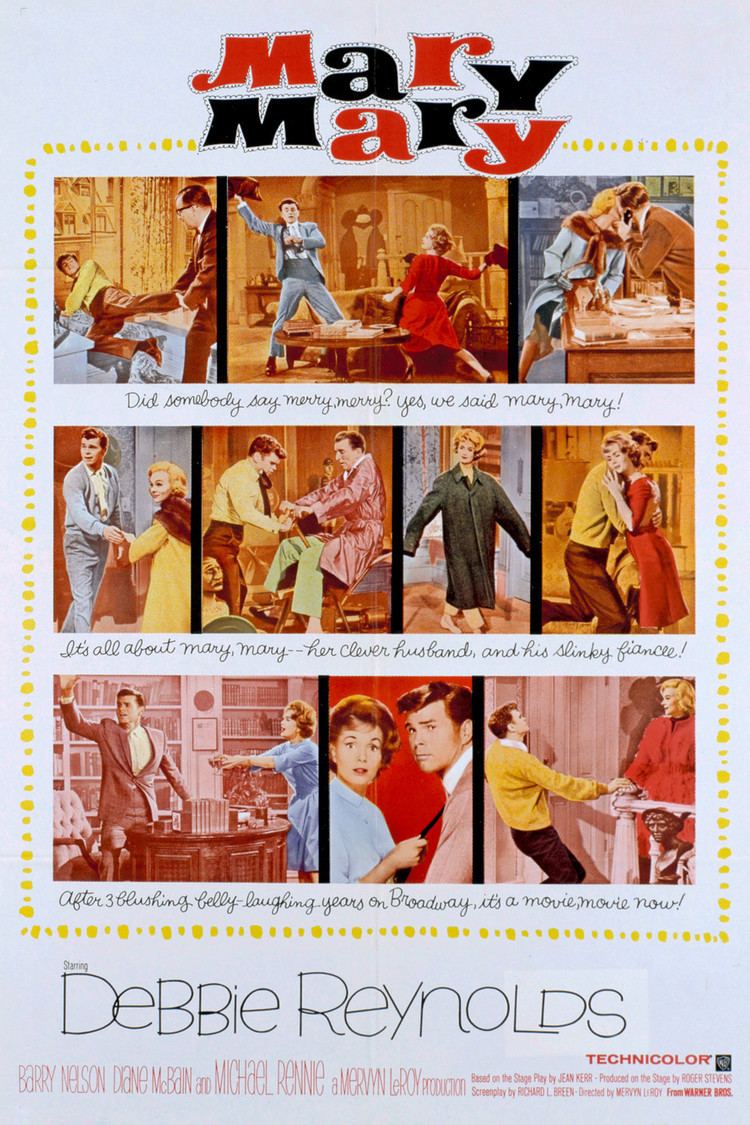
Mary, Mary (1963)

Mary, Mary is one of those titles that I have heard about for years but never watched for the simple reason that I could not find a decent version to view. It never played on television, never had a VHS release, and never was put on DVD.... that is, until Warner Archives issued it several years ago. That wonderful Warner Archives series - that sadly was put to rest. 

Anyway, after years of hearing the name of this movie but never watching it, I can say that when I did finally see it, it did not disappoint. In fact, it is quite a charming comedy and I'll probably watch it again this week. 

Barry Nelson and Debbie Reynolds star as Bob and Mary, a recently divorced couple who are brought together again for one afternoon by their lawyer Oscar (Hiram Sherman) who - for tax purposes - wants them to itemize their expenses from the previous few years. Bob, a publisher, is about to wed Tiffany, a wealthy heiress ten years his junior. He is aghast at the thought of seeing Mary again since he only recently began to quench his anger towards her. 

Mary on the other hand, is pleased to be reunited with Bob, if only for a brief moment. She arrives looking fresh and well-dressed after having a makeover ("You look like a million bucks, Mary" Oscar declares) and quickly catches the eye of Hollywood actor Dirk Winston (Michael Rennie) who stops by Bob's apartment to discuss his new manuscript. This is when Bob begins to feel pangs of jealousy and realizes how much he misses Mary. Naturally, by this time the audience can guess that the story is leading to a reconciliation of Bob and Mary. 

Mary, Mary was based on a stage play of the same name by Jean Kerr (Please Don't Eat the Daisies) which was surprisingly long-running. It premiered in 1961 and ran until 1964 (1,572 performances) making it the most long-running non-musical play of the 1960s. This is remarkable because it is a long script which made for an equally long film - 126 minutes. Director Mervyn LeRoy enjoyed the play in New York and thought it would make a great film. He wanted to retain the entire Broadway cast which included Barry Nelson, Barbara Bel Geddes, Michael Rennie and Hiram Sherman for the film adaptation. Jack Warner of Warner Brothers quickly gave him the greenlight for go but also slapped him with two conditions - that Debbie Reynolds get the lead and Diane McBain, the studio's newly groomed ingenue, play Bob's fiancĂ©e Tiffany. Both proved to be excellent casting choices. 

"I married Mary because she was so direct and straightforward and said exactly what she meant" - Bob

"Why did you divorce her?" - Oscar

"Because she was so direct and straightforward and said exactly what she meant!"

It would have been nice if the film adaptation was less stage bound then it turned out to be but most of the script was set in Bob's apartment so that is where the majority of the movie takes place. This apartment set - and the few other sets - was designed by John Beckman.

If you are not a fan of talkative New York comedies, stay clear of this one - it's a mouthful - but if you enjoy a witty wordy comedy then you'll find Mary, Mary to be a treat. Jean Kerr's script is highly amusing and an excellent character study of two distinctly different personalities. 

Through the course of one day, as Bob and Mary's discuss each other's faults, they come to realize their own. They also see their weaknesses and strengths. Bob is irritatingly sensible in everything he does, and Mary is a storehouse of wisecracks and flippant remarks. During their five-year marriage, each thought that their partner had a low opinion of each other. Mary thought that Bob considered her plain and uninteresting, yet he never expressed his feelings for her because he thought she would respond with a snide remark.... something she thought Bob expected of her, "You decided right at the beginning that I was the airy type impervious to wind and weather and small disappointments."

It is the presence of Bob's neighbor, actor Dirk Winston, that turns these characters thoughts to introspection. Dirk reveals to Mary how insecure she is and also reveals to Bob that he is the cause of it. All of these simmering emotions come to a boil when Dirk asks Mary to join him on a flight to New Orleans for a publicity tour. Then we witness a classic gather-all-the-cast-in-one-room finale reminiscent of the 1930s screwball films. 

Mary, Mary is little-known and rarely shown these days in spite of Debbie Reynolds name on the credits. This is most likely due to its 2-hour plus runtime (it could have easily been shaved by 25 minutes). If it does air on television however, it is worth watching. Barry Nelson gives a tour-de-force performance of Bob, a character he undoubtedly became after playing it for so long on stage. I wish he had appeared in more comedy films of the 1960s, he is so entertaining to watch. 

Debbie Reynolds was making her Hollywood return after her scandalous breakup with Eddie Fisher. She had her doubts that she could tackle a comedic role like this but, with the aid of MGM's resident drama coach Lillian Burns Sydney, she did an excellent job. Debbie would plunge into another comedy the following year - Goodbye, Charlie - with Tony Curtis. 

Mary, Mary is currently available on Warner Archives DVD. 

Tuesday, January 29, 2019

Trio ( 1950 ) - The Sanatorium

During my school years, William Somerset Maugham was one of my favorite authors. He is famous for his novels "The Razor's Edge", "The Moon and Sixpence" and "Of Human Bondage", but he was also an excellent short story writer and many of his best works were short stories. 

In 1948, Gainsborough Studios decided to film a selection of these stories as an anthology film. It was called Quartet and included the tales "The Facts of Life", "Alien Corn", "The Kite", and "The Colonel's Lady". These were excellent adaptations and because they were so entertaining and so well received, two more compilations were made: Trio ( 1950 ) and Encore ( 1951 ). 

Trio included three great stories - "The Verger", the story of a man who climbs to business success not even knowing how to read; "Mr. Know-All", about an obnoxious jewelry dealer who has a change of heart onboard a cruise ship; and the best of the three, "The Sanatorium". This little 45-minute gem shares the stories behind the patients of a rest home in a secluded part of Scotland. 

Most of these patients suffer from tuberculosis and, because of the care they need, have been living at the sanatorium anywhere from two to twenty years. The film focuses on the lives of four of the patients with a particular emphasis on Major Templeton ( Michael Rennie ), the latest arrival. The Major is a hero from battles in British India and is also regarded as quite the ladies' man. He was, and is, a confirmed bachelor. However, the moment he sets his eyes on Evie Bishop ( Jean Simmons ), he desires to not only woo her, but win her as his wife. Miss Bishop has been living at the sanatorium for seven years and, in spite of the lack of social entertainment and companions her own age, is cheerful, confident, and quite flirtatious. Bishop, however, shows very little interest in Templeton at first and it is only slowly that he gains her admiration - and love. 
Roland Culver stars as Mr. Ashedon, sort of the narrator of the story. We come to know the inhabitants of the sanatorium through his eyes and his astute observations of them. He is particularly interested in Mr. Chester ( Raymond Huntley ) and the way he treats his wife when she comes for her monthly visits. For a man who looks forward to seeing his wife as eagerly as Mr. Chester does, Ashedon wonders why he behaves so rudely and indifferent to her when she finally arrives. 

Then there is Campbell ( John Laurie ) and MacLeod ( Finlay Currie ), the two fighting Scotsmen. They are constantly at each other's throats over their game of chess and yet are very dear companions. 
The Sanatorium is beautifully filmed by Geoffrey Unsworth and features a stunning array of English character actors. The episode is filled with so many wonderful details and subtle interchanges between these characters. These really shine when seen over multiple viewings ( the segment's short length lends itself easily to this ), but it is the romance between Major Templeton and Miss Bishop that I find so very entertaining. Both are independent spirits who have no interest in getting involved in marriage and yet, when they find out the state of their health, it is marriage that instantly comes to the forefront of their thoughts. 

Jean Simmons was such a talented actress, even as a child, and, in spite of her youthful appearance, always acted with a maturity beyond her years. When The Sanatorium was filmed, she was twenty years old and never looked more beautiful. Simmons was often cast in films with a contemporary setting but she was so well-suited for these period films, possessing the beauty of Edwardian women.

Her character, Miss Bishop, is both independent and headstrong and yet demure and gentle, and Simmons brings out both of these qualities excellently. It is easy to see why Major Templeton is so quickly taken by her charms. 

Unfortunately, Trio is not yet available on DVD in the United States, but it is available in PAL format through Network DVD both independently and as part of the three-film W. Somerset Maugham collection

This review is my contribution to the 90 Years of Jean Simmons Blogathon running today through January 31st. It is being hosted by The Wonderful World of Cinema and Phyllis Loves Classic Movies, so be sure to head over to either of these sites to read more Jean Simmons film reviews!


Saturday, May 23, 2015

Third Man on the Mountain ( 1959 )

In the late 1950s, Walt Disney took a vacation to Zermatt, Switzerland and, upon his return home to the States, was inspired to produce a film that was as entertaining as the summer holiday he had taken. So, with his usual infallible skill in selecting personnel, Disney rounded up a crackerjack team of individuals to create an exciting adventure based upon the popular 1954 novel "Banner in the Sky" by James Ramsey Ullman. What resulted was Third Man on the Mountain, a film that captures all the majestic beauty of the Swiss Alps and the intrepid spirit of the mountaineers during the golden age of Alpining.

James MacArthur excels in the part of Rudi Matt, a young boy working as a dishwasher at an inn while yearning to become a mountain guide like his late father, who perished in a fall while attempting to climb the impregnable Citadel ( now known as the Matterhorn ). His mother and his uncle, still shaken from the death of his father, have forbidden him to do any climbing and attempt to quench his desire to conquer the mountain. But encouraging Rudi to pursue this dream are his friends Lizbeth ( Janet Munro ) and Teo ( Laurence Naismith ), the cook at the inn who helps him train for the climbs he attempts in secret. 

On one of his secret treks up the Alps, he discovers and saves the life of Captain Winter ( Michael Rennie ) an illustrious mountaineer who had fallen in a crevasse. Winter perceives the natural climbing ability of Rudi and invites him to become a bearer on his climb to examine a route to the pinnacle of the mountain. Rudi's foolhardy daring endangers the lives of the other climbers on this trip and it is then that Rudi learns what it means to be a true guide, just as his father was. These lessons serve him well when he is given a second chance and journeys once more with climbers Winter and Saxo ( Herbert Lom ) becoming the third man on the mountain. 


"It has the sort of high altitude thrills to send the viewer cowering deep in his seat and the sort of moving drama to put him on the edge of it". Variety magazine pegged the excitement of Third Man on the Mountain perfectly with their review of the film when it was released in theatres in November 1959. 

Most public schools had "Banner in the Sky" on the required reading list for its lessons of unselfishness, patience and perseverance....all lessons which Rudi had to learn himself. Screenwriter Eleanore Griffon kept all of these themes intact for the film and encompassed them in a thrilling adventure that entertains jung und alt alike. 


Third Man on the Mountain took three months to film with director Ken Annakin and the cast and crew doing extensive location shooting in the Zermatt area. MacArthur, Rennie, Lom and other cast members trained for several weeks with mountain guides to get the knack of climbing steep precipices. MacArthur recalled climbing up to 11,500 feet and, fortunately, the cast suffered no injuries. The only accident occurred when they returned to England to commence studio shots and MacArthur fell off an artificial rock.

While on location, actress Helen Hayes ( MacArthur's mother ) and Joyce, his girlfriend, visited the set and Annakin lured them into dressing up for guest appearances as mother/daughter tourists. Another bit of interesting trivia : Switzerland enraptured Walt Disney so much during the making of the film that it inspired him to add a new attraction to Disneyland - the Matterhorn. 


Third Man on the Mountain is filled with just the right mixture of drama, humor, and nail-biting tension. It captures the amazing hardiness and daring-do of the 19th century climbers who risked their lives to conquer mountains such as the Matterhorn using only their raw hands and strands of rope and the grandeur of the scenery transports the audience right to the Alpine mountains along with the climbers. These elements, along with a top-notch cast, combine to make it one of the best live-action films to ever come out of Walt Disney Studios, a film that yodel-want-to-see again and again! 

Wednesday, February 26, 2014

Omar Khayyam ( 1957 )

"Could you and I alone with Fate conspire" 

In the 1940s and early 1950s colorfully costumed Arabian adventure films were all the rage. Universal studios started this string of sword and sandal spectacles in Hollywood when it released Arabian Nights, a modest box-office success starring Jon Hall. Ali Baba and the 40 Thieves (also with Jon Hall), The Prince Who Was a Thief, Son of Ali Baba, A Thousand and One Nights, and Sinbad soon followed. By 1957, however, the genre was beginning to wane in popularity and it was in this year that Paramount Pictures decided to release Omar Khayyam starring Cornel Wilde and Debra Paget. 

Omar Khayyam was a fictional biographical account of the life of the 11th century mathematician-poet who lived in Bagdad. Since very little details of his life are known, Barre Lyndon freely took the opportunity to weave a script which included sultans, thieves, intrigue, harems, and a beautiful princess. All the prime ingredients for an Arabian night fantasy. 

It begins with our hero, the wise poet, discovering that his beloved is to become the Shah's newest bride. Forlorn at the thought of losing her, he obtains a position at the palace as chief astronomer to be near her, and lo! what does he discover here but schemes of betrayal stirring within the palace walls!


Cornel Wilde, who rose to fame in Hollywood for his swashbuckling films (he was a champion fencer), lacks the pizzazz that he had in his other pictures and understandably so since the role calls for a distressed lovelorn poet, not a swashbuckling hero. However, the supporting cast in Omar Khayyam is marvelous and more than makes up for Wilde's mild performance. Michael Rennie, always a familiar face in costumed dramas, is excellent in the role of Hasani, one of Khayyam's dear friends and later his adversary. Sebastion Cabot is also one of Khayyam's childhood friends who helps give Omar an audience with the shah, which later earns the poet the position of counselor and astronomer at the palace. 

Raymond Massey, the man of one face, looks surprisingly Arabic in appearance in his role as the mighty Shah who surrounds himself with wise counselors and his two fighting sons, played by John Derek and Perry Lopez. Yma Sumac, the exotic four-octave range singer (check out her amazing performances with the Les Baxter Orchestra) has a brief appearance to do some warbling while Joan Taylor and Margaret Hayes round out the cast of femme fetales. Debra Paget is ravishingly beautiful as ever and was well-chosen by the Shah to be his newest wife. 

Other familiar faces include Edward Platt ("Sorry about that, Chief"), John Abbott, and Dick Elliott (Mayor Pike on The Andy Griffith Show). 

The film boasts some stunning costumes by Ralph Jester who did only a handful of costume design work in films such as The Ten Commandents, Soloman and Sheba, and The Buccanneer.

William Dietrele discontinued his 27-year long Hollywood career after completing Omar Khayyam and it is no wonder he was dissatisfied with what he was being given. As colorful and vibrant as Khayyam is (it was filmed in VistaVision) the movie is a far cry from Dietrele's earlier biopics, such as The Story of Louis Pasteur and The Life of Emile Zola. One cannot help wondering how great it could have been had the film been approached differently. Perhaps with a different leading man, or even if it were turned into a musical.... with Howard Keel.


Nevertheless, for loyal followers of sword-and-sandal Arabian Nights flicks this is highly recommended viewing. Especially on a Saturday morning. As Khayyam would say, "A bowl of oatmeal, a jug of juice, and thou...great television set. Give me the sweet pleasures of life to while my days away".