Showing posts with label Debbie Reynolds. Show all posts

Friday, June 26, 2026

I Love Melvin (1953)

Melvin Hoover (Donald O'Connor), a photographer's apprentice for Look magazine, wants to impress Judy (Debbie Reynolds), a budding stage actress, and so he claims he is a photographer doing a spread for the magazine. After shooting hundreds of pictures of her, he is reluctant to admit that they won't appear in print. While Judy likes Melvin, she feels she must respond to her boyfriend Harry's (Richard Anderson) marriage proposal in order to please her parents. To stall the situation, Melvin makes a fake cover of Judy on the front of Look but then he doesn't have a chance to tell her it's not real! 

I Love Melvin was a typical musical outputted from the MGM factory. It doesn't stand out as anything extra special but it sure rates high in entertainment nonetheless, thanks to the appeal of its two lead stars. The Technicolor is beautiful and the costumes are nice but it is the songs that are especially lovely. Composer Josef Myrow (The Girl Next Door, The French Line) penned some unique melodies such as "A Lady Loves", "I Wanna Wander", and "We Have Never Met as Yet" and, if these weren't pleasant enough, their arrangements are really nice. Too bad Josef Myrow didn't get more music assignments with MGM then what he did. 

Debbie Reynolds looked cute as a button in the film (as did Noreen Corcoran as Judy's little sister), and she had clearly shed her baby fat as she rose to the ranks of leading lady. This was a great "coming out" film for Ms. Reynolds. She once wrote in her autobiography that she "worked her butt off" at MGM and I think this film in particular was what she was referring to. Debbie had a lot of dance numbers for such a short picture and, in addition to these, she had to be thrown around on stage as a football!

Robert Alton staged the dances for I Love Melvin and they are highly creative and great fun to watch. Donald O'Connor got the really exciting dance routines including one on roller skates. He has a fun Danny Kaye-style solo number, too, where he showcases not only his singing and dancing ability but his comedy style. 

As darling a couple as Melvin and Judy were, I doubt that their romance could have survived through marriage. Poor Melvin couldn't hold a job! 

Also in the cast was Allyn Joslyn, playing a role not unlike his character in Junior Miss (1945), Richard Anderson as the handsome but bland Harry, Jim Backus in a great part as Melvin's smart-aleck co-worker, and Les Tremayne as the manager of Look magazine. Keep your eye out for a brief view of the striking Look building in New York City. It was built in 1948, and since Look's management occupied the top floors, became known as the Look building. It is still standing at 488 Madison Avenue. 

A neat behind-the-scenes fact: Look Magazine actually released the cover design with the photo of Debbie Reynolds as Judy the same month I Love Melvin premiered as a tie-in. 

Friday, March 20, 2026

The Daughter of Rosie O'Grady (1950)

In 1943, Betty Grable starred in the colorful Fox Technicolor musical Sweet Rosie O'Grady. Seven years later, her screen sister, June Haver, was featured in a sort of follow-up film, The Daughter of Rosie O'Grady, which was equally colorful and just as entertaining. 

In this film, "Junie Baby" (as Fred MacMurray would call her) played Patricia O'Grady, the daughter of Rosie O'Grady, a once-popular music hall entertainer. Along with her two sisters, Katie (Marcia Mae Jones) and Maureen (Debbie Reynolds), Patricia resides with her father, Dennis O'Grady (James Barton), a stern Irishman who works as a trolley conductor. He loves his daughters and wants to keep them by his side. He also wants them to go nowhere near the theater district for fear they will want to become performers themselves and, as Papa claims, "That's no life for anyone!" He and his dear departed Rosie spent years living out of a trunk and traveling from one town to the next. He wants his daughters to marry college-educated men and settle down.

Little does he know that his eldest daughter is already secretly married to a policeman and about to have a child, and that darlin' Patty has fallen in love with none other than Tony Pastor (Gordon MacRae), the owner of the local musical—and, saints preserve us!—wants to join his acting troupe!

You can guess that there is enough drama in the film to fill its 105-minute runtime. Nevertheless, squeezed in between the Irish fighting spirits are plenty of musical interludes, including a lovely rendition of the titular song. When Gordon MacRae isn't singing, Gene Nelson entertains the audience with his impressive dancing skills. June Haver was quite a dancer herself and does many a fancy step with Gene, while S.Z. Sakall adds some comic relief as Papa O'Grady's co-worker and family friend.

Overall, it's an entertaining entry from the Fox film factory, although not very memorable... Within a year of viewing, you'll probably get this title confused with Sweet Rosie O'Grady or When Irish Eyes are Smiling!

Sunday, February 23, 2025

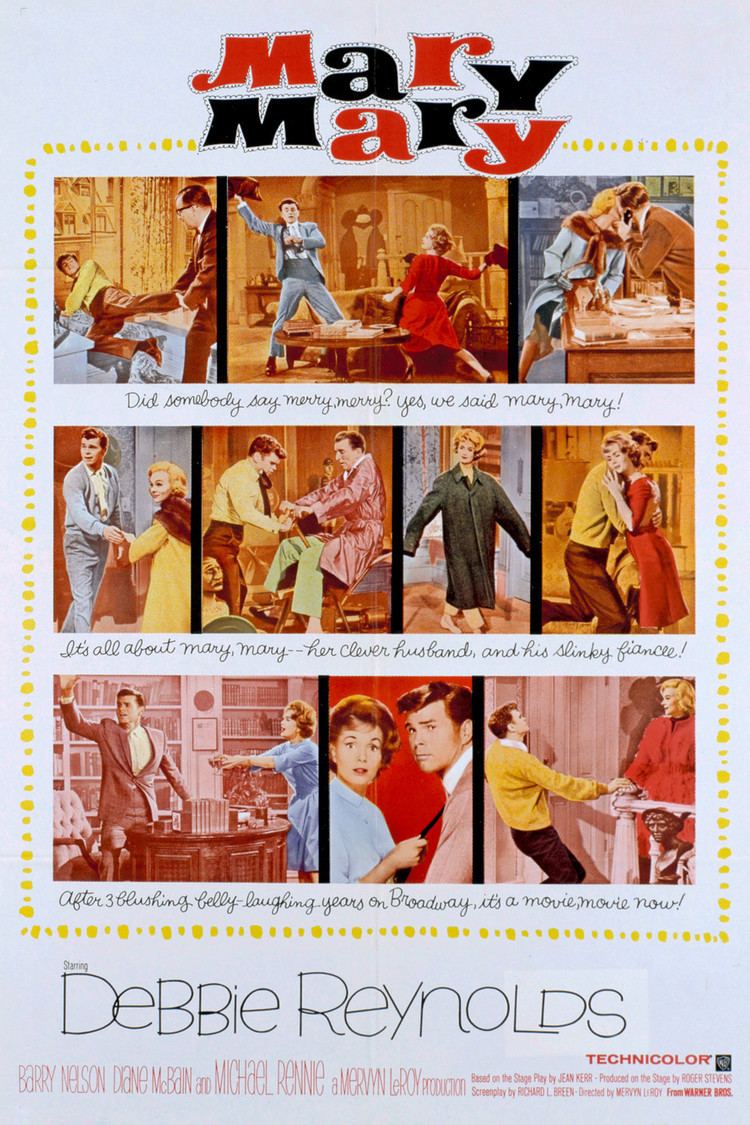
Mary, Mary (1963)

Mary, Mary is one of those titles that I have heard about for years but never watched for the simple reason that I could not find a decent version to view. It never played on television, never had a VHS release, and never was put on DVD.... that is, until Warner Archives issued it several years ago. That wonderful Warner Archives series - that sadly was put to rest. 

Anyway, after years of hearing the name of this movie but never watching it, I can say that when I did finally see it, it did not disappoint. In fact, it is quite a charming comedy and I'll probably watch it again this week. 

Barry Nelson and Debbie Reynolds star as Bob and Mary, a recently divorced couple who are brought together again for one afternoon by their lawyer Oscar (Hiram Sherman) who - for tax purposes - wants them to itemize their expenses from the previous few years. Bob, a publisher, is about to wed Tiffany, a wealthy heiress ten years his junior. He is aghast at the thought of seeing Mary again since he only recently began to quench his anger towards her. 

Mary on the other hand, is pleased to be reunited with Bob, if only for a brief moment. She arrives looking fresh and well-dressed after having a makeover ("You look like a million bucks, Mary" Oscar declares) and quickly catches the eye of Hollywood actor Dirk Winston (Michael Rennie) who stops by Bob's apartment to discuss his new manuscript. This is when Bob begins to feel pangs of jealousy and realizes how much he misses Mary. Naturally, by this time the audience can guess that the story is leading to a reconciliation of Bob and Mary. 

Mary, Mary was based on a stage play of the same name by Jean Kerr (Please Don't Eat the Daisies) which was surprisingly long-running. It premiered in 1961 and ran until 1964 (1,572 performances) making it the most long-running non-musical play of the 1960s. This is remarkable because it is a long script which made for an equally long film - 126 minutes. Director Mervyn LeRoy enjoyed the play in New York and thought it would make a great film. He wanted to retain the entire Broadway cast which included Barry Nelson, Barbara Bel Geddes, Michael Rennie and Hiram Sherman for the film adaptation. Jack Warner of Warner Brothers quickly gave him the greenlight for go but also slapped him with two conditions - that Debbie Reynolds get the lead and Diane McBain, the studio's newly groomed ingenue, play Bob's fiancĂ©e Tiffany. Both proved to be excellent casting choices. 

"I married Mary because she was so direct and straightforward and said exactly what she meant" - Bob

"Why did you divorce her?" - Oscar

"Because she was so direct and straightforward and said exactly what she meant!"

It would have been nice if the film adaptation was less stage bound then it turned out to be but most of the script was set in Bob's apartment so that is where the majority of the movie takes place. This apartment set - and the few other sets - was designed by John Beckman.

If you are not a fan of talkative New York comedies, stay clear of this one - it's a mouthful - but if you enjoy a witty wordy comedy then you'll find Mary, Mary to be a treat. Jean Kerr's script is highly amusing and an excellent character study of two distinctly different personalities. 

Through the course of one day, as Bob and Mary's discuss each other's faults, they come to realize their own. They also see their weaknesses and strengths. Bob is irritatingly sensible in everything he does, and Mary is a storehouse of wisecracks and flippant remarks. During their five-year marriage, each thought that their partner had a low opinion of each other. Mary thought that Bob considered her plain and uninteresting, yet he never expressed his feelings for her because he thought she would respond with a snide remark.... something she thought Bob expected of her, "You decided right at the beginning that I was the airy type impervious to wind and weather and small disappointments."

It is the presence of Bob's neighbor, actor Dirk Winston, that turns these characters thoughts to introspection. Dirk reveals to Mary how insecure she is and also reveals to Bob that he is the cause of it. All of these simmering emotions come to a boil when Dirk asks Mary to join him on a flight to New Orleans for a publicity tour. Then we witness a classic gather-all-the-cast-in-one-room finale reminiscent of the 1930s screwball films. 

Mary, Mary is little-known and rarely shown these days in spite of Debbie Reynolds name on the credits. This is most likely due to its 2-hour plus runtime (it could have easily been shaved by 25 minutes). If it does air on television however, it is worth watching. Barry Nelson gives a tour-de-force performance of Bob, a character he undoubtedly became after playing it for so long on stage. I wish he had appeared in more comedy films of the 1960s, he is so entertaining to watch. 

Debbie Reynolds was making her Hollywood return after her scandalous breakup with Eddie Fisher. She had her doubts that she could tackle a comedic role like this but, with the aid of MGM's resident drama coach Lillian Burns Sydney, she did an excellent job. Debbie would plunge into another comedy the following year - Goodbye, Charlie - with Tony Curtis. 

Mary, Mary is currently available on Warner Archives DVD. 

Thursday, March 9, 2023

From the Archives: Mary, Mary ( 1963 )

In this 1963 publicity photo, Debbie Reynolds is seen modeling one of the many beautiful dresses designed by William Travilla for the film Mary, Mary. Travilla should have released a special line of clothing for department stores with each dress copying a style seen in his most recent films. They would have been big sellers at Sears! 

From the Archives is our latest series of posts where we share photos from the Silverbanks Pictures collection. Some of these may have been sold in the past, and others may still be available for purchase at our eBay store : http://stores.ebay.com/Silverbanks-Pictures

Saturday, September 11, 2021

From the Archives: The Unsinkable Molly Brown ( 1964 )


Debbie Reynolds starred as Molly Brown in one of her favorite films - The Unsinkable Molly Brown ( 1964 ). Her character transformed from a wild country girl into a tough high society dame....and all along the way she had her true love, her husband Johnny Brown ( Harve Presnell ) by her side. In this miniature color lobby card, they are pictured in their youth when he was lernin' her to read and write. 

From the Archives is our latest series of posts where we share photos from the Silverbanks Pictures collection. Some of these may have been sold in the past, and others may still be available for purchase at our eBay store : http://stores.ebay.com/Silverbanks-Pictures

Thursday, December 29, 2016

A Note to Debbie

Debbie, I miss your wonderful smile already. In your youth, your exuberance and your energetic spunk were marvelous to watch. Later, as you grew older and matured, you blossomed into a beautiful young woman. Your tender rendition of "Tammy" will last for ages. I loved your pizzazz in Singin' in the Rain ( 1952 ) and your winsome country ways in The Mating Game ( 1959 ). MGM would not have been the same without you. 

You were even more beautiful in the 1960s. You were the ideal woman of the West in How the West Was Won ( 1962 ), one of your best films; and you personified Molly Brown herself in The Unsinkable Mollie Brown ( 1965 )....your favorite film. I loved when you let your hair down in The Catered Affair ( 1956 ) - a great performance - and The Pleasure of His Company ( 1961 ).....you should have kept that style. You were wildly funny in Goodbye, Charlie ( 1964 ) and How Sweet it is ( 1968 ) and you even convinced me that you were a woman of habit in The Singing Nun ( 1966 ). 

I look forward to exploring all of the films you made that I have not yet seen, but right now I just miss you. At least, you are happily reunited with your daughter and your old friends. Try not to argue too much with Eddie.....

Thursday, February 25, 2016

Debbie Reynolds in The Unsinkable Molly Brown ( 1964 ) - An Oscar Snub

"I Ain't Down Yet!"

Molly Brown hollered and bucked like a wild bronco anxious to jump the rural fence and prance into Denver society, but she was constantly being reined in by discouraging circumstances. She lost a fortune, lost her friends, lost her husband, and finally found herself sailing on the doomed ship Titanic, but each time you think circumstances would get her down, she would rise again shouting "I Ain't Down Yet!". Indeed, she was unsinkable. 

In her role as Molly Brown in The Unsinkable Molly Brown, Debbie Reynolds gave it her all in a bravado performance that breathed life into a woman that would have become just another obscure character in history. She justly deserved her Best Actress Oscar nomination for 1964. But she didn't win the golden statuette that year...and that surely must have got Debbie down. 

Who were her competitors for the Best Actress award? 
  • Anne Bancroft in The Pumpkin Eater 
  • Kim Stanley in Seance on a Wet Afternoon
  • Julie Andrews in Mary Poppins
  • Sophia Loren in Marriage Italian Style

Let's take a look at these performances. Sophia Loren had earned her first Best Actress Oscar just three years prior for her portrayal of an Italian widow who gets raped in Two Women. Another Oscar-winning actress, Anna Magnani, was intended to play the part but turned it down. Loren proved that she had acting talent in addition to a busty figure and that made quite a large splash in the Hollywood scene. Also Italian films were all the rage during the late 1950s-early 1960s so, while Loren did a great performance in Marriage Italian Style, getting a nomination may have also been the "in" thing for the voters to do.

Anne Bancroft's performance in the highly-depressing The Pumpkin Eater, was not nearly as good as her portrayal of Helen Keller's teacher Anne Sullivan in The Miracle Worker ( 1962 ) for which she did win the award as Best Actress. End of that argument. Kim Stanley did a really good job in Seance on a Wet Afternoon, and she had plenty of laurels for that part - she was nominated for a BAFTA award, won the New York Critics Circle award and won Best Actress for the National Board of Review. She could have gone for a sweep with the Oscar too, but compared to Debbie Reynold's part, it just didn't cut the grade. 

That leads me to the final competitor, and the winner of the 1964 Best Actress Award - Julie Andrews. You won't find a more devoted fan of Mary Poppins then myself but, as much as I loved Julie Andrews performance, it wasn't Oscar-worthy. Her singing was beautiful, as was Julie herself; her comradery with the children adorable, and her final-parting look touching....but it still wasn't a performance that would make you say "I hope she won an Oscar for this, because she was fabulous!". 

But that's exactly what would be said about Debbie Reynolds' performance as Molly Brown. Debbie raised a ruckus in one hell of a great performance. She hollered till her voice went hoarse, swung from a tree, was bellyed up to the bar in a rousing dance sequence, was stomped on, kicked about, and shouted at, and yet she still managed to give a touching and sympathetic performance of a rough country bumpkin. She transformed Molly from being a young illiterate backwoods girl into a glamorous world-travelling society woman with backbone. 


Molly Brown was a part that Tammy Grimes had made popular in the Broadway version of The Unsinkable Molly Brown, co-starring with Harve Presnell. Presnell reprised his role in his screen debut, but Grimes did not have a name with movie audience drawing-power. Producers Roger Edens and Laurence Weingarten wanted Shirley MacLaine for the part, but Shirley was locked in a contract at the time for another film, so Debbie was offered it. However, director Charles Walters was hoping Debbie would turn it down and even asked her to decline it. When she asked "Why?", he commented that she was too short. Like Molly Brown would have done herself, Debbie retorted "Just how short is the part?" and ended the discussion. 

Throughout the film she fought to prove the part suited her, and did it ever! Even non-fans of Ms. Reynolds can't help but agree because Debbie and the real Molly Brown share a lot in common: they are both hard-working, tough-as-nails, glamorous, spunky women, and when the going gets tough that's when they really shine. Debbie considered this her favorite film and, after she lost the Oscar to Julie Andrews, you can imagine her telling herself "I Ain't Down Yet"  

This post is our contribution to The Oscars Snubs Blogathon being hosted by The Midnite Drive-In and yours truly, Silver Scenes. Click here to read more posts on films, stars, and craftsmen who have been snubbed at the Oscars. Enjoy! 

Friday, July 3, 2015

What Price, Hollywood?

Debbie Reynolds was one shrewd cookie. On May 3, 1970, David Weisz Co. auctioned off the contents from seven sound stages at Metro-Goldwyn-Mayer studios which included 350,000 costumes. While this 20-day auction event was being held, Miss Reynolds' fellow thespians were lounging comfortably in their palatial Beverly Hills homes lamenting the final curtain call of MGM studios, while the actress herself was emptying her bank account - some $600,000 - and attending each auction, buying up all the costumes and props she could afford. She wanted to preserve some of the treasured mementos from the greatest film studio in Hollywood. 

"They literally threw away our history and I just got caught up in it", Reynolds explained. She also had the foresight to recognize that the props and costumes which were termed "worthless" would be worth quite a penny in the near future. 

Reynolds wasn't the only person to savor the thrill of owning a piece of film history and its investment potential. Movie memorabilia collecting existed long before MGM's famed auction. Why, as far back as 1938 my grandmother was saving the posters from the films that were showing at the Serbian theatre that she worked at as an usherette. Alright, she didn't realize they were of any monetary value, instead her mother used them as wallpaper in their outhouse ( she often claimed they had the prettiest - and warmest - outhouse in their village ). Nevertheless, collecting memorabilia is good business and, even if it weren't, it is too fun an activity for the average film fan not to participate in. 


Through online auction sites, you can - for as little as $1.00 - own a piece of history. Now how cool is that? We're not talking about collectibles here - that's an entirely different field ( and one not worth spending money on ). Memorabilia are genuine articles used in the promotion or making of a motion picture. Collectibles are all the knick-knacks that various companies manufacture to cash in on popular films or celebrities. That Elvis Presley lamp hiding in your uncle's basement is a collectible. If Elvis owned it himself ( how vain! ), it would be memorabilia.


When it comes to memorabilia there are several different buying routes you can explore. You can purchase original material used for publicity purposes ( movie stills, lobby cards, posters, fan cards, tickets, pressbooks ); items used in the making of the film itself ( props, costumes, set pieces ); behind-the-scenes memorabilia ( scripts, clapboards, film cameras, office memos ); or even personal items owned by a celebrity ( like Richard Burton's diary ). 

Since we're in the movie stills business, we recommend that a novice collector begin their purchasing quest buying movie stills, publicity photos, lobby cards and the like. They are inexpensive, easy to maintain, and great to frame. Movie stills were distributed by studios to newspapers, magazines and movie theatres for the promotion of their upcoming releases. They were also assembled in "key books" and archived within the studios' own libraries. With most films, several hundred photos were taken, so it is very likely that you will find a still from a favorite scene. 


Other publicity photos include posed shots of actors in costume for their roles. These are not from scenes in the films and are therefore a bit rarer. They usually include the leading couple getting cozy for the camera or a staging of one of the key scenes in the film, sans the props. Studio artists used these photos as reference when painting the poster artwork. 

The next best memorabilia to begin with would be scripts. Original scripts were printed in limited quantities ( generally less than 50-75 copies ) and therefore their price can range from $10 ( for a new film's script ) to $5000 ( eg. for a script used in the making of Gone with the Wind ). Scripts are good investments since they are made of paper. As the years go by it gets more difficult to find scripts in really good condition, hence they become rarer. 

Scripts from Battleground, Bad Day at Black Rock and Undercurrent

If you are not interested in owning a script then why not purchase a small prop? These can include items such as handkerchiefs, office memos, stationary, cuff-links, watches, etc. Small props are easy to store as well and - although their value does not increase too much - it's just neat owning a piece that was actually used in a movie. 

Once you start buying small props, it is very easy to get lured into the big game...the ultimate props. These are the iconic items that you see predominately in your favorite motion pictures. If you have a few hundred grand to spare, then these are great items to have around the house. However, since most of us cannot afford to buy Charlie Chaplin's bowler hat or Terry-Thomas' spare teeth, we thought we'd share photos of these iconic items instead ( along with the prices that they sold for ). The workers at those film studios never knew what treasures they were handling on a daily basis! 


Harpo Marx gifted Debbie Reynolds with one of his beloved hat and wig combos but after keeping it for years Debbie realized she had no use for Harpo's wig since she wasn't planning on donning his garb and honking at anyone. The wig went up on auction two years ago and sold for $22,500. Now she has something to honk about!


The great Paul Lukas wore this beautiful tweed coat in his role as Professor Bhaer in the original 1933 film version of Little Women starring Katharine Hepburn. Walter Plunkett designed the coat for the picture and oddly enough, it only sold for $275. It costs more to buy a coat like that new. 


Mae West's dazzling ensemble fetched quite a bit more than Professor Bhaer's coat. It sold for $8,500....$3,500 more than anticipated. Travis Banton was the creative mind behind this design, which was worn by Miss West in Belle of the Nineties ( 1934 ).


If you think that amount is a lot to spend on one costume, someone paid $150,000 to have just the head of Gort the robot. The famed alien helmet from The Day the Earth Stood Still ( 1953 ) was made of wood and fiberglass and held up very well over the years. Aliens always did know how to keep their heads intact.


This prop is more in line with our budget. In the 1985 James Bond film A View to a Kill, Max Zorin ( Christopher Walken ) pulls out his checkbook and write a $1,000,000 check paid out to Stacye Sutton ( Tanya Roberts ). Stacey promptly tears it up so we're assuming that prop no longer exists, but someone saved a clean Zorin check...just in case she made a mistake! This one sold for $300.


If there were any two stars who could take the cake for wearing the most elaborate costumes it would be Jeanette MacDonald and Nelson Eddy. This beautiful Adrian-designed military outfit was worn by Eddy in the 1938 operetta Sweethearts. It sold for $1,100.


The ten commandments .....unbroken! Can you imagine telling your friends that you purchased the original ten commandments? No, these aren't the ones that the Lord engraved, but they are second to it in fame having appeared with Charlton Heston in The Ten Commandments ( 1956 ). Some lucky buyer purchased these fiberglass tablets for the mere sum of $60,000 ( cough-cough ).


The person who bought the ten commandments must have also bought the ark of the covenant ( where else would you store them? ). This wooden construction cost the tidy sum of $13,000 and looks just as good as the day it appeared in David in Bathsheba ( 1951 ).


While we're on the subject of Old Testament memorabilia, here is King David's tunic from the same film. When Gregory Peck wore it, the tunic had a whiter shade to it, but then everything yellows over time. This tunic sold for $3,000.


Not all of us have the room to store a beautiful designer gown, so for those who don't want to invest in clothing...there are costume sketches to be had! This beautiful rendering by Helen Rose was created for High Society ( 1955 ), MGM's remake of their own A Philadelphia Story ( 1940 ). It sold for $4,000.


Of all the memorabilia from past auctions this piece amazed us the most. This is the title lettering artwork for My Fair Lady ( 1964 ). It was painted on a 22 x 31 inch plate of glass with the white letters in "Warner Bros Pictures" being painted on the front and the black shading on the back of the glass ( to give it depth ). This plate of glass sold for $10,000... Yikes!


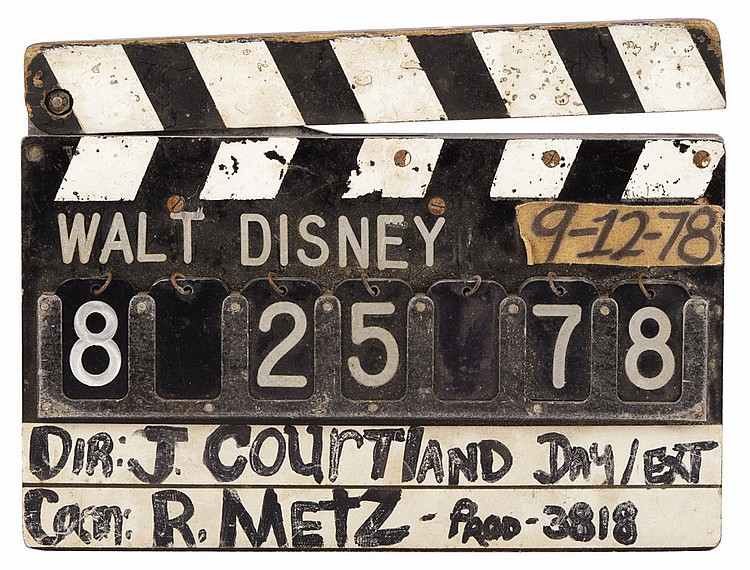
Jerome Courtland used this clapboard while directing an episode of Walt Disney's The Wonderful World of Color in 1978. You would have thought that they wiped the names of the crew cleaned and just reused the clapboards, but perhaps they thought this one was old enough to retire as is. It sold for $2,250 on auction. 


The vamp of the silent era - Theda Bara - wore this bejeweling brassiere in the 1917 silent classic Cleopatra. By itself it doesn't look like much, but on Theda..wow. Someone obviously thought they could pull off wearing it just as well as she did and forked over $8000 to buy it. 


The ultimate Star Wars prop would probably be Darth Vader's helmet, but second best would be this DL-44 blaster owned by Hans Solo ( Harrison Ford ). He zapped a whole ton of space slugs and Vader villians with this baby. Although it doesn't "blast", someone thought it worth dishing out $200,000 for. 


Lastly, a treasure to behold! The entire cast - and many of the crew members - of The Adventures of Robin Hood ( 1938 ) gathered together to sign a 1936 Rand McNally edition of Robin Hood by Howard Pyle. A truly collectible item and it sold for a truly collectible price - $8,000. 

So there you have it...a few gems that were put up on the auction block and currently enshrined in the homes of devout collectors. Every week items like these are being auctioned off across America and - unlike the prices you see above - great deals are still to be had on props that you would never have believed were preserved.

All of the photographs used in this post were obtained from Invaluable.com - the online site where the world's premier auction houses auction their valuables. The majority of these items were auctioned off between 2012-2014 from Profiles in History, which hosted Debbie Reynolds' Hollywood auctions. Click here to view and search more movie props, costumes, and rare memorabilia from past auctions!