Showing posts with label Michael Wilding. Show all posts

Saturday, May 6, 2023

Derby Day ( 1952 )

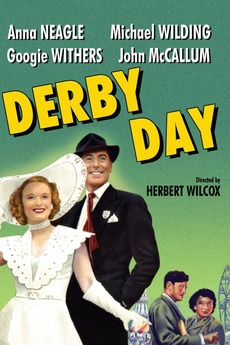
May is known in the sporting world as Derby season and taking place this evening is one of the most popular derby races in America, the 149th Kentucky Derby. If you are like most classic film fans, you will probably be enjoying a good horse-racing film tonight to tie in with the Derby. It may be The Story of Seabiscuit, Riding High or National Velvet ( check out our post Horse Racing Films of the 1940s and 1950s for other titles )....but if you want a treat that is slightly different than your usual Hollywood fare, look no further, for we have a title for you: Derby Day ( 1952 ).

Derby Day is a marvelous British ensemble drama starring Anna Neagle and Michael Wilding and a host of popular British actors from the era. The story focuses on four different groups of people, all of whom are attending the famous Derby Day race at Epson Downs. Unlike some ensemble pieces that keep all of the stories separate, Derby Day has the different groups interact with one another at the race, which is rather nice to see. 

First, there is Google Withers who is in a right good pickle. She was carrying on an affair with her lodger ( John McCallum ) when her husband returned from work early and caught them together. McCallum gives him a kick and the poor bloke takes a nasty tumble backwards down the stairs. They quickly hide his body and then McCallum heads to Epsom Downs to contact a man whom he knows can "fix it" so that he can escape from England before the police catch him. 
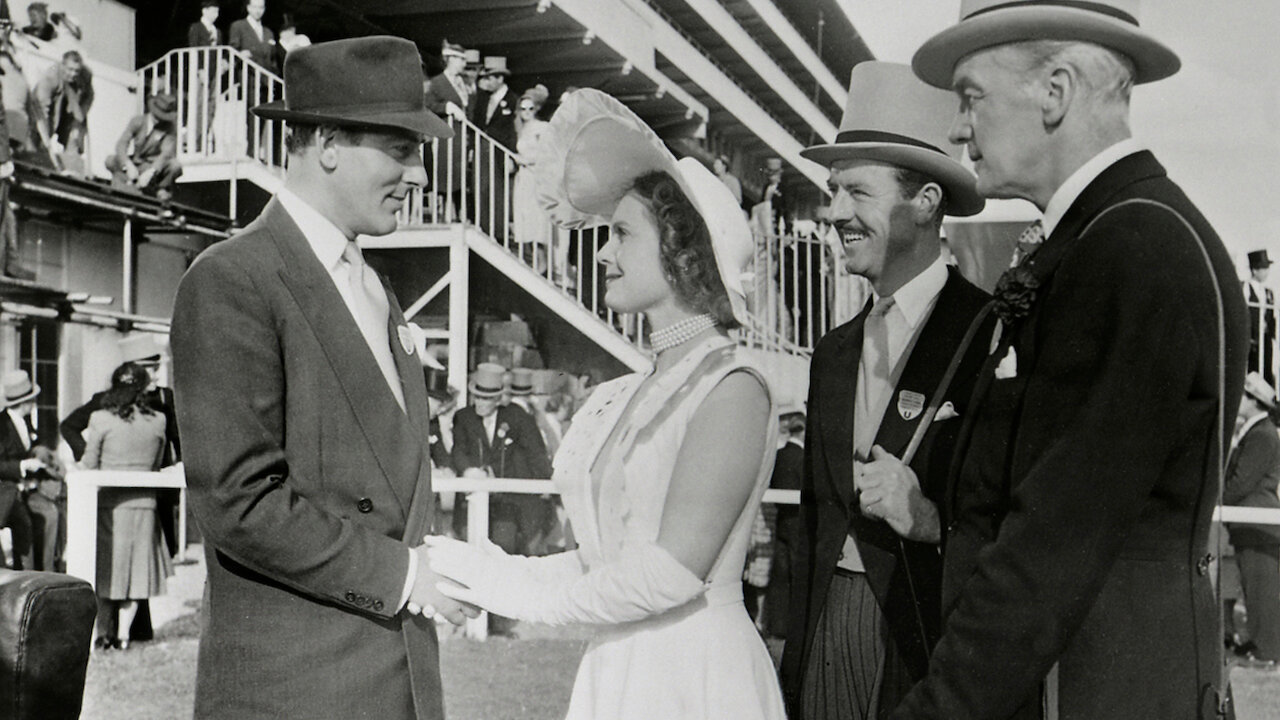
Michael Wilding is attending the race to make some sketches for a newspaper, but he really has another reason for wanting to go. The taxi he is traveling in happens to break down on the road there and he is kindly offered a lift by Lady Forbes and her brother-in-law ( Anna Neagle and Edwin Styles ). They eventually find that their lives are intertwined more than they had realized. 

Peter Graves plays Gerald Berkeley, a hammy film star, who is attending the race because he was "won" in raffle. The old woman who won a Day-with-a-Film-Star sprained her ankle and so her young and pretty French maid, Suzanne Cloutier, is taking her place....much to the delight of Mr. Berkeley. 

Lastly, Gordon Harker and Gladys Henson play a taxi-cab driver and his wife who have talked about attending Derby Day in person for the past 40 years but never had an opportunity until today. 

Each of these characters is well-developed and their happenings at the race are highly entertaining. It could have been written in such a way that Anna Neagle and Michael Wilding's characters took center stage and the other stories were not as enjoyable, but instead, they are equally engrossing. Every three or four minutes the focus changes between the characters so you never tire of any of the couple's dramas.

Derby Day was the last of six films that Neagle and Wilding were paired in, a pair that critic Godfrey Winn deemed "the greatest in British films". All of their pictures were produced and directed by Neagle's husband Herbert Wilcox, who also had his own highly successful Herbert Wilcox Productions company. 
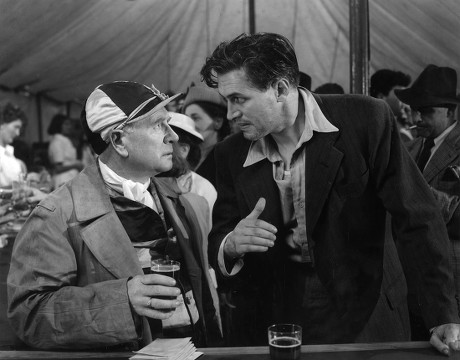
Most horse-racing films give you a look at the jockeys, horses, and all of the drama behind the scenes, but Derby Day doesn't cover any of that. It is unique because it is all about the people, the atmosphere of the Derby Day race at Epsom, and the general feeling of excitement of attending a race like that in person. 

So if you are not attending the 149th Kentucky Derby this evening and want to savor the excitement of a day at the races ( even one spent looking at the tele ), then give Derby Day a try. It is available via streaming online or on DVD from Network Distributing. 

Note: In the U.S., Derby Day was released under the title Four Against Fate.

Friday, May 10, 2013

Hitchcock's Stage Fright ( 1950 )

"Hands that applaud can also kill!"

The stage is set. The curtain is drawn. Act One begins. Eve Gill (Jane Wyman) is helping fellow dramatic art student Jonathan Cooper (Richard Todd) escape to her father's coastal home to hideout until they can smuggle him across to Scotland. He's in an awful jam you see, as he explains to Eve he has just unwillingly become the prime suspect in the murder of flamboyant stage actress Charlotte Inwood's 
husband. In a flashback of his account we see how Charlotte manipulated him, her lover, into returning to her townhouse to fetch a dress after she had stained her own with blood while bludgeoning her husband with a fire-poker, only to be seen by Inwood's maid before fleeing. 

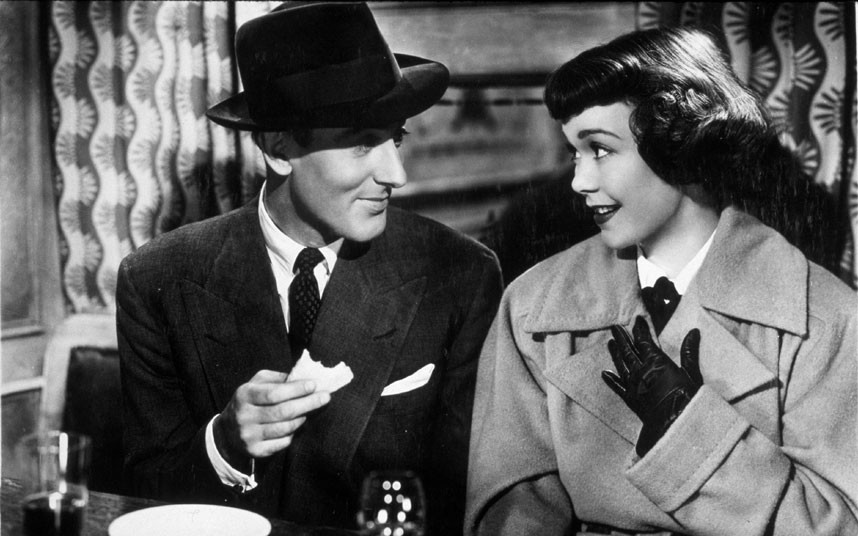
Eve sets out to prove his innocence and with the help of her father and Detective Smith (Michael Wilding) lead the police to whom she believes to be the real murderer - Charlotte Inwood (Marlene Dietrich). 

Stage Fright was released on February 23rd, 1950 and marked the first picture in a four film contract agreement Hitchcock had signed with Warner Brothers. While it garnered rave reviews by critics it was rather harshly received by the general public due to the key element in this intriguing film - the false flashback. Hitchcock himself dismissed the film in later years because of this flashback, a technique he considered was the second worst directorial mistake he had ever made in his career. 


Alfred Hitchcock had gained notoriety as a suspense film director in the UK as far back as the mid 1930s with such films as The Lodger and The Lady Vanishes. It was not until the early 1940s that he became known in America making such hits as Suspicion, Notorious,
Lifeboat and Shadow of a Doubt.                                                                                 

Stage Fright was a sojourn back to his native land. It was filmed entirely in England at Associated British Pathe Studios and boasts a superb English cast. Michael Wilding, a very charismatic actor who was popular overseas in his frequent pairings with Anna Neagle, plays a dapper gentleman detective named Smith who has his eye - and heart - on Eve. Alastair Sim, one of England's most engaging character actors, costars as Commodore Rill, Eve's father, who fancies himself a notorious criminal for having once smuggled two cases of brandy across the Scottish border. Dame Sybil Thorndike portrays Mrs. Gill, Eve's mother, a very dotty mother whose prim and properness contrast starkly with those of her husband, the Commodore. 

" Forgiveness is the secret of a happy marriage...that and good long stretches of the absence that makes a heart grow fonder "  - Commodore Rill


Although Stage Fright is mild in suspense it more than makes up for it in sheer entertainment. For viewers, it is a leisurely stroll to capture a criminal versus an energetic race to clear the guilt of an innocent man and we are sidetracked along the way by some delightful little characterizations by Kay Walsh and Miles Malleson, as well as Joyce Grenfell doing a wonderful guest appearance as a shooting booth attendant at a theatrical garden party. 


Richard Todd had previously scored a hit in the WWII drama The Hasty Heart (1949) and was fast becoming a leading star. Why Hitchcock chose not to use him in other films remains a mystery. His portrayal of the distraught Jonathan Cooper is quite chilling. Today, The Dam Busters (1955) remains his most recognized movie although he made many other excellent films throughout the 1950s including several Walt Disney live-action films. 

"She made me do it! Don't you see? I had no other choice"

Jane Wyman was dressed down for her role as Eve and plays a soft-spoken young lady who endangers herself for the sake of the man she believes she loves. When "ordinary Smith" comes into her life her affections take a new direction though. Marlene Dietrich, on the other hand, is as Dietrichesque as ever as Charlotte Inwood and is especially alluring in her final scene. Cole Porter wrote the song "The Laziest Gal in Town" for her one musical number in the film and it remained a signature song in her repertoire until her final days. 


Strangers on a Train would be Hitchcock's next picture and its success, both critically and commercially, would knock Stage Fright away from the spotlight to the back rows of obscurity. Nevertheless, it is an underrated gem from the Master of Suspense and deserves to be recognized among his fans for its charm and character, if not for its "fright".