Showing posts with label Marlene Dietrich. Show all posts

Sunday, April 23, 2023

A Foreign Affair ( 1948 )

During World War II, the American, British, and Russian forces bombed Berlin until it was a heap of concrete rubble. After the war, the US Army decided to leave some troops behind to help clean up the mess. This included capturing Nazi members who may have eluded them earlier and also aiding the Germans in getting back on their feet. Both tasks could be rather demoralizing - especially in such a battered environment as post-war Berlin. In order to see just how well the "boys" overseas were coping, Congress decided to send a committee to check up on them...or so the story goes in Billy Wilder's 1948 comedy A Foreign Affair. 

This committee, comprised of five men and one woman, is given a 3-day tour of Berlin in order to make their report to Washington. But as Congresswoman Ms. Frost ( Jean Arthur ) points out, this is a carefully crafted tour designed so that the members see only what the US Army wants them to see. 

Ms. Frost chooses to remove her blinders and what she sees surprises her! American soldiers are engaging in the black market, openly fraternizing with the frauleins, and clearly enjoying themselves. Just one chocolate bar can buy a guy a lot of favors in Berlin. 
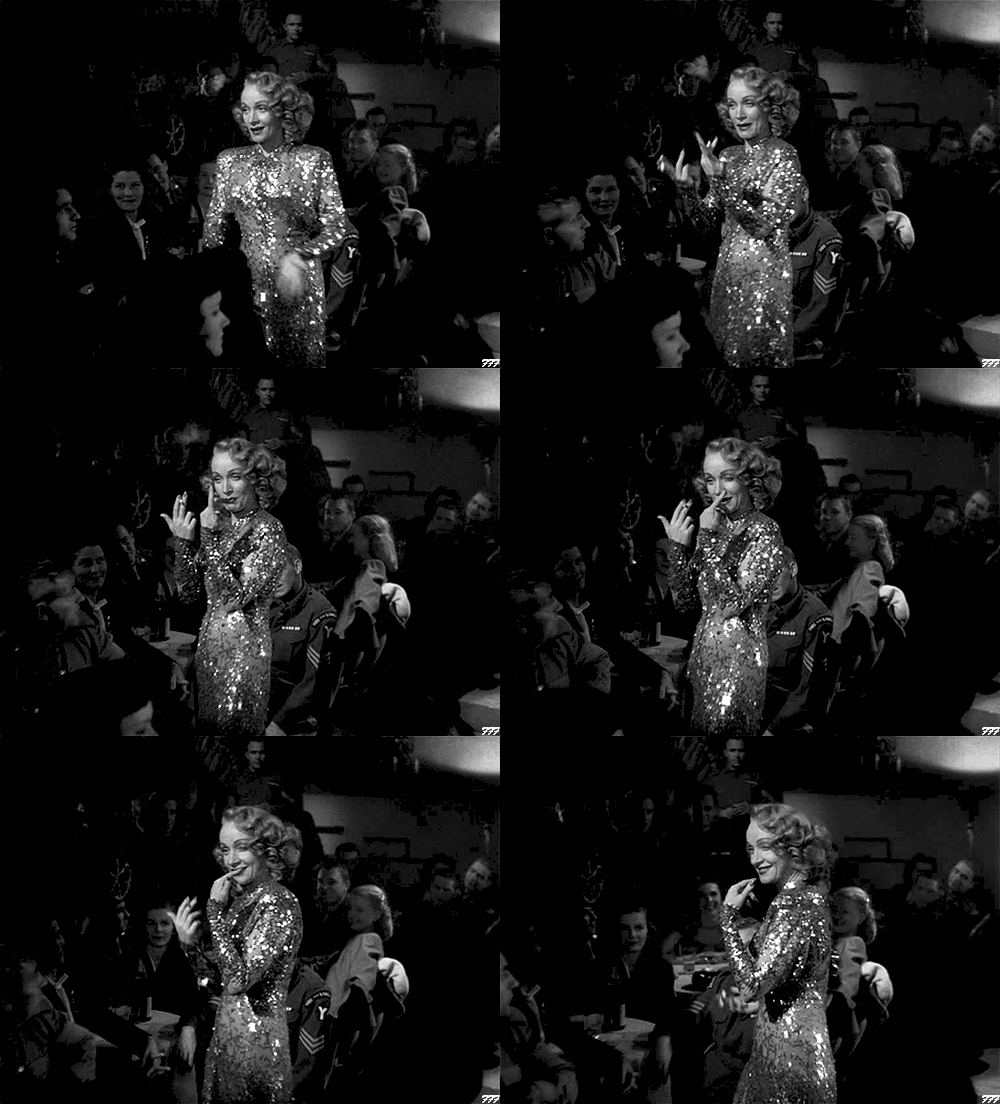

Nightclub singer Erika von Schlütow ( Marlene Dietrich ) certainly knows how to use a soldier to her best advantage. She remembers what it was like in Berlin right after the war. 

"We've all become animals with exactly one instinct left - self-preservation....What do you think it was like to be a woman in this town when the Russians first swept in? A living hell. And then I found a man, and through that man, a roof, and a job, and food, and I'm not going to lose him."

That man is Captain Johnny Pringle ( John Lund ), an officer at the very camp that the committee is visiting. He is well aware that Erika is a hot potato, a woman who once had affiliations with Nazi party members, but he pulls a few official strings to shield her because he is enthralled by his "gorgeous booby trap". 

Ms. Frost discovers the curvaceous performer one night at the Lorelei club and overhears that she is being protected by an American officer, so she enlists the aid of fellow Iowan Captain Pringle to help her ferret out the name of this man, little realizing that it is Pringle himself that is Ms. von Schlütow's sugar daddy.
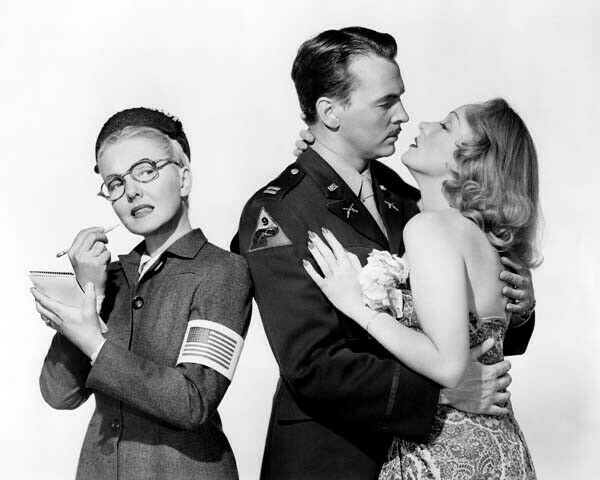
A Foreign Affair is one of director Billy Wilder's lesser-known films but it nevertheless bears his trademark style, especially in the cynical but humorous script, penned by Wilder, Charles Brackett, and Richard L. Breen. The cinematography is beautiful and the music, by Friedrich Hollander, perfectly captures the feel of post-war Germany, but what makes the film really work is the performances from its three principal actors: Jean Arthur, John Lund, and Marlene Dietrich. 

Growing up, I was familiar with Jean Arthur only from her role as Marian in the classic western Shane ( 1953 ). Then, in my teen years, I discovered all of her marvelous films from the 1930s and realized just how popular an actress she was. This decade was really the peak of her career, and she starred in such comedy classics as Mr. Deeds Goes to Town ( 1936 ), You Can't Take it With You ( 1938 ) and Mr. Smith Goes to Washington ( 1939 ). She was Columbia Studios' top actress up until her retirement in the mid-1940s. Wilder enticed her away from college to make this picture. 

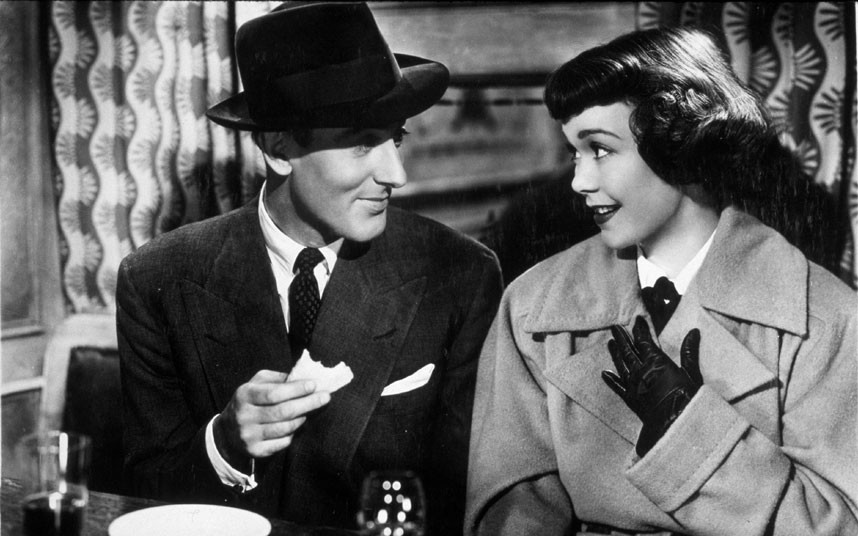
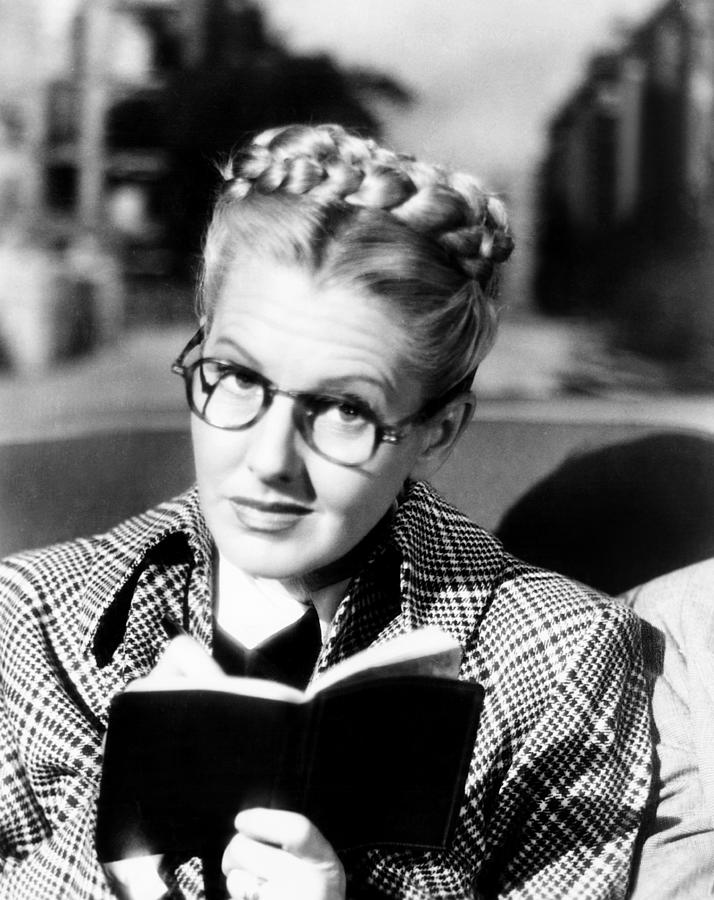
Jean gives a wonderful performance here as the stern Ms.Frost, playing her icy cool from her entrance and then peeling away layers of her personality as the film progresses. Frost is a fastidious, independent, prudish, Iowa-born-and-bred, no-nonsense kind of woman, who - living up to her namesake - is particularly cold to men after having been used by a man several years back. When Captain Pringle realizes that she is gunning down his liebling Erika - and himself - he knows he will receive no sympathy or mercy from her. So, he undertakes a really courageous task - that of wooing the unwooable woman. And boy is he in for a surprise! After a few kisses, Ms. Frost suddenly becomes "Pheobe" and before he knows it, he's polishing his shoes and whistling "Shine on Harvest Moon".

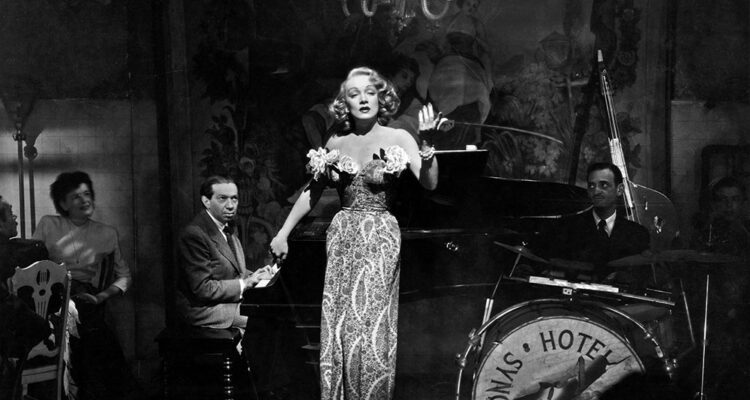
Marlene Dietrich is also alluring as Erika. Wilder had her in mind for the part as he was writing the script and there really was no other actress who could have played her part as well. She is best in the nightclub sequences, entertaining the soldiers as she so often did in real life during the war. 
John Lund also shines as Captain Pringle. Few actors could play comedy as well as Lund could, plus he was a believable "ladies' man". Cary Grant could have tackled this role with equal ease but Grant does not seem like the kind of man who would be having an affair with the former mistress of a Nazi officer. Also in the cast is that old pro, character actor Millard Mitchell as Pringle's commanding officer. 

A Foreign Affair is available on Blu-Ray DVD and via streaming through the Criterion Channel.

This post is our contribution to the Shades of Shane Blogathon being hosted by Rachel at Hamlette's Soliloquy. Be sure to visit her blog to check out other film reviews featuring actors who starred in the classic western Shane.

Wednesday, April 16, 2014

No Highway in the Sky ( 1951 )

When No Highway in the Sky was released in 1951, James Stewart had already established a reputation for playing everyday heroes and champions of social justice in such films as Mr. Smith Goes to Washington ( 1939 ) and The Mortal Storm ( 1940 ). 

In this British-made film, based on a novel by Nevil Shute ( author of the post-apocalyptic "On the Beach" ), Stewart plays a mild-mannered aeronautical engineer immersed in research conducting stress tests on the tail structures on the new Reindeer fleet of aircraft at the RAE. Mr. Theodore Honey's life consists of long hours spent at the laboratory and more hours spent at home - if he can find his home - working on calculations and raising his adolescent daughter Elspeth. 

Science is his life and mathematical truth is his goal. He has no time for people or a social life. 

"You don't understand...I'm a scientist. Science is very exacting, it requires the utmost concentration. I can't be concerned about people"


He finds, however, that science can not always be separated from the subjects it involves. Dennis Scott ( Jack Hawkins ), the new supervisor at the firm, takes an interest in Mr. Honey's research and his startling statement that the tail on every Reindeer will break off after 1440 hours of flight time. He orders Mr.Honey to go to Labrador, Canada to observe the wreckage of a former Reindeer flight that crashed. It is en route that Mr. Honey's life becomes changed and his principles re-examined when he discovers that he is on board a Reindeer plane that has reached the 1400 hour limit. He must convince the pilot to turn back before the point of no return or else see the lives of every passenger endangered.

Theodore Honey is a timid, introverted man; his shoulders are slightly stooped and his appearance is disheveled. He is a nondescript character whom one would not readily approach and yet, Miss Corder ( Glynis Johns ) and Monica Teasdale ( Marlene Dietrich ), an airline stewardess and a famous Hollywood actress whom he befriends on the flight, are drawn to him. They see a gentle, caring man who is willing to put their lives before his very own. Like Mr. Honey, the imminent disaster makes them see their life in a new perspective and each become so affected by his sincere concern for them that they both return to England to help him clear a charge of lunacy.

" If you believe in something, you believe in doing something about it, don't you? " 

No Highway in the Sky is a sharply written story, with moments of humor and suspense interwoven into a taught 98 minutes. Henry Koster ( Harvey ) does a splendid job of directing this film and never lets it lose its entertainment value for one moment. It clips along at a leisurely pace and tends to grow on you as it progresses and you come to know each of the characters in turn. 

Janette Scott, as Honey's daughter Elspeth, plays a pivotal role in drawing all these characters together. We see that it is her constant praise of her father's intellectual capabilities that convince Mr. Scott that Honey may not be the crackpot scientist he seems to be. He is fascinated with Mr. Honey and at the same time puzzled at the way he lives and let's his child live. When Miss Corder and Monica Teasdale come to stay with Elspeth they too are drawn to her in love - and pity - and she quickly brings out their maternal instincts. 


James Stewart enjoyed eccentric roles such as Mr. Honey and he really bit into this part and brought to the character of this boffin the convincing persona of a man who believes in his convictions and has the courage to fight for them. Stewart made him a much more lovable and admirable character than the Mr. Honey that Nevil Shute wrote of in his novel.

Marlene Dietrich's character is not quite necessary but an highly engrossing figure nonetheless, while the always lovely Glynis Johns provides an added romantic element to the story. Keep an eye out for Kenneth More, who is featured in a brief role as the airline pilot. Two years later, with his appearance in Genevieve, Kenneth More would launch himself as a star in British films. Other familiar character actors can be spotted throughout such as Wilfred Hyde-White, Ronald Squire, Felix Aylmer and Niall MacGinnis.


In addition to being an excellent film, No Highway in the Sky was an onscreen voice to the increasing safety concerns of the modern air travel and sadly, it had a prophetic undertone...on March 3, 1953 the de Havilland Comet was the first commercial jetliner to crash. Three fatal accidents occurred before the Comet was pulled from service and its design re-evaluated. Metal fatigue was found to be the cause.

This post is our contribution to The James Stewart Blogathon, a celebration of this All-American legend, being hosted by The Classic Film and TV Cafe. Be sure to check out all of the other splendid articles on his life and films.

Friday, May 10, 2013

Hitchcock's Stage Fright ( 1950 )

"Hands that applaud can also kill!"

The stage is set. The curtain is drawn. Act One begins. Eve Gill (Jane Wyman) is helping fellow dramatic art student Jonathan Cooper (Richard Todd) escape to her father's coastal home to hideout until they can smuggle him across to Scotland. He's in an awful jam you see, as he explains to Eve he has just unwillingly become the prime suspect in the murder of flamboyant stage actress Charlotte Inwood's 
husband. In a flashback of his account we see how Charlotte manipulated him, her lover, into returning to her townhouse to fetch a dress after she had stained her own with blood while bludgeoning her husband with a fire-poker, only to be seen by Inwood's maid before fleeing. 

Eve sets out to prove his innocence and with the help of her father and Detective Smith (Michael Wilding) lead the police to whom she believes to be the real murderer - Charlotte Inwood (Marlene Dietrich). 

Stage Fright was released on February 23rd, 1950 and marked the first picture in a four film contract agreement Hitchcock had signed with Warner Brothers. While it garnered rave reviews by critics it was rather harshly received by the general public due to the key element in this intriguing film - the false flashback. Hitchcock himself dismissed the film in later years because of this flashback, a technique he considered was the second worst directorial mistake he had ever made in his career. 


Alfred Hitchcock had gained notoriety as a suspense film director in the UK as far back as the mid 1930s with such films as The Lodger and The Lady Vanishes. It was not until the early 1940s that he became known in America making such hits as Suspicion, Notorious,
Lifeboat and Shadow of a Doubt.                                                                                 

Stage Fright was a sojourn back to his native land. It was filmed entirely in England at Associated British Pathe Studios and boasts a superb English cast. Michael Wilding, a very charismatic actor who was popular overseas in his frequent pairings with Anna Neagle, plays a dapper gentleman detective named Smith who has his eye - and heart - on Eve. Alastair Sim, one of England's most engaging character actors, costars as Commodore Rill, Eve's father, who fancies himself a notorious criminal for having once smuggled two cases of brandy across the Scottish border. Dame Sybil Thorndike portrays Mrs. Gill, Eve's mother, a very dotty mother whose prim and properness contrast starkly with those of her husband, the Commodore. 

" Forgiveness is the secret of a happy marriage...that and good long stretches of the absence that makes a heart grow fonder "  - Commodore Rill


Although Stage Fright is mild in suspense it more than makes up for it in sheer entertainment. For viewers, it is a leisurely stroll to capture a criminal versus an energetic race to clear the guilt of an innocent man and we are sidetracked along the way by some delightful little characterizations by Kay Walsh and Miles Malleson, as well as Joyce Grenfell doing a wonderful guest appearance as a shooting booth attendant at a theatrical garden party. 


Richard Todd had previously scored a hit in the WWII drama The Hasty Heart (1949) and was fast becoming a leading star. Why Hitchcock chose not to use him in other films remains a mystery. His portrayal of the distraught Jonathan Cooper is quite chilling. Today, The Dam Busters (1955) remains his most recognized movie although he made many other excellent films throughout the 1950s including several Walt Disney live-action films. 

"She made me do it! Don't you see? I had no other choice"

Jane Wyman was dressed down for her role as Eve and plays a soft-spoken young lady who endangers herself for the sake of the man she believes she loves. When "ordinary Smith" comes into her life her affections take a new direction though. Marlene Dietrich, on the other hand, is as Dietrichesque as ever as Charlotte Inwood and is especially alluring in her final scene. Cole Porter wrote the song "The Laziest Gal in Town" for her one musical number in the film and it remained a signature song in her repertoire until her final days. 


Strangers on a Train would be Hitchcock's next picture and its success, both critically and commercially, would knock Stage Fright away from the spotlight to the back rows of obscurity. Nevertheless, it is an underrated gem from the Master of Suspense and deserves to be recognized among his fans for its charm and character, if not for its "fright".