Showing posts with label Omar Shariff. Show all posts

Tuesday, September 20, 2022

The Yellow Rolls-Royce ( 1964 )

Rex Harrison, Shirley MacLaine, and Ingrid Bergman head up the all-star cast of The Yellow Rolls-Royce, a colorful anthology film of three stories linked together by a sparkling 1931 Rolls-Royce Phantom II. 

The opening segment shows the first owner of the beautiful Rolls, the Marquess of Frinton ( Rex Harrison ) purchasing the car as an anniversary present for his wife ( Jeanne Moreau ) who, unbeknownst to Lord Frinton, is engaging in an affair with his attaché John Fane ( Edmund Purdom ). When he spies them together in the Rolls...back it goes to the dealer!

Years later, the Rolls turns up in a showroom in Italy where it catches the fancy of Mae Jenkins ( Shirley MacLaine ), the "fidanzata" of big-time mobster Paolo Maltese ( George C. Scott ). He is giving his lady-love the grand tour of Italy but, when he is called back to America to "settle a score with O'Leary", she ends up having a grand time herself with the amoral photographer Stefano ( Alain Delon ). 

Lastly, the Rolls becomes a transport bus for mercenary soldiers in Yugoslavia when the snooty but socially prominent Mrs. Millett ( Ingrid Bergman ) decides to aid a rebel ( Omar Shariff ) in his fight against the Nazis. 

The Yellow Rolls-Royce was one of only a few anthology films to be released in the 1960s. This was a style of storytelling more frequently seen in British and American films of the 1940s and 1950s ( e.g. Encore, Tales of Manhattan ). These kinds of films are entertaining when all three segments are equally engaging but when one segment is boring it tends to pull the entire film down. In The Yellow Rolls-Royce, the last segment featuring Mrs. Millet is the weakest, even though it is the only segment that hints that the Rolls could be of more use than just a cozy love nest. 

Terrance Rattigan's script tries to include a little adventure and romance in each segment but it ends up leaning heavily on the side of romantic drama. This is just as well as all the leading actors were well-equipped to handle romantic drama. Rex Harrison gives an especially good performance as the jilted husband in the first story. 

The film features beautiful costumes and cinematography by Jack Hildyard ( The Bridge on the River Kwai ) with location filming in England, Italy, and Austria...which was standing in for Yugoslavia. But the most entertaining aspect of watching The Yellow Rolls-Royce is spotting all of the supporting players which included Art Carney, Joyce Grenfell ( affecting a Southern accent ), Wally Cox, Roland Culver, Isa Miranda, Moira Lister, and Michael Hordern. 

Riz Ortolani's musical score is also delightful and includes the catchy "Forget Domani" theme which was performed onscreen by his wife actress Katyna Ranieri and later made popular by Frank Sinatra. Ortolani had a huge success with his song "More" from the pseudo-documentary Mondo Cane released two years earlier. 

The Yellow Rolls-Royce received mixed reviews from critics but was a great hit at the box-office, becoming one of the top ten films of the year. MGM later released a 10-minute promotional short titled "The Car that Became a Star" which gave audiences a glimpse of the grand vehicle on the set of the film. 

The film is currently available on DVD and by streaming through Amazon Prime.

Monday, August 22, 2022

The Tamarind Seed ( 1974 )

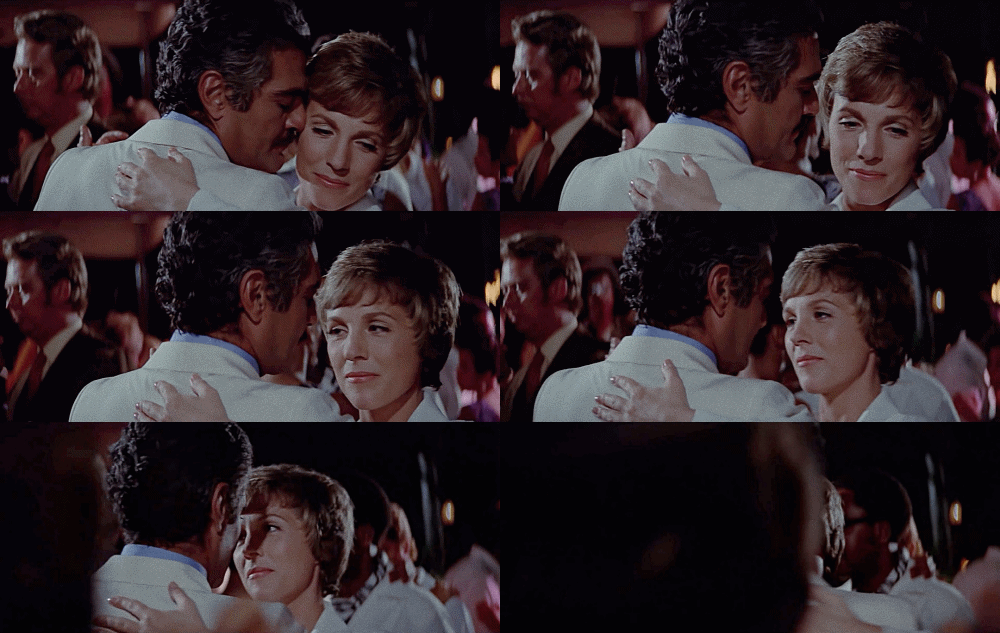
Judith Farrow (Julie Andrews) is still grieving over the breakup of a rather lurid liaison with her married paramour Group Captain Richard Patterson (David Baron). She is vacationing in Barbados, attempting to clear her muddled mind and heal her broken heart, when she meets the suave Colonel Feodor Sverdlov (Omar Shariff), a Soviet military attaché who is also vacationing for a respite. Feodor works in the Paris embassy circle and happens to know Captain Patterson. Coincidentally, he is also acquainted with Sam Neilson of the British Home Office, for whom Judith works as a personal assistant. 

Back in London, British intelligence officer Jack Loder (Anthony Quayle) and Home Secretary Fergus Stephenson (Daniel O'Herlihy) are curious as to why Feodor is in Barbados and decide to keep surveillance on him and his supposedly coincidental encounter with Judith. Loder believes Feodor is conspiring to win Judith over "to the other side" so that the Russians could use her as an inside agent. 

Judith thought she met a kind and understanding friend on her holiday but when Loder approaches her with his suspicions of Feodor's motives for meeting her, she begins to wonder if she is indeed being used as a pawn in a political chess game between the East and the West. 

The Tamarind Seed is an engrossing romantic espionage drama from director Blake Edwards. It is a long picture (125-minutes), and the pace is slow, yet the story is riveting and the film never becomes tiresome. This is due to the fine performances of all the principal players and Edwards' compelling script, which was based on Evelyn Anthony's 1971 bestselling novel. 

Julie Andrews, who was married to Edwards at the time, delivers an excellent performance as the bewildered Ms. Farrow. Andrews portrays Judith as a woman of intelligence and strength, lost and confused though she may be. Judith follows her heart, in spite of being warned against doing so. "He's going to recruit you, isn't he?" Loder tells her. "You're wrong. He'll never do anything like that. I know him." "Do you? I doubt that, Mrs. Farrow"...."If you are right and he tries to involve me in anything, I will tell you, but I will not be used to spy against him," she replies. 

Feodor does indeed seem to be the honest undeceptive gentleman she believes him to be. As their holiday in Barbados comes to a close, they agree to meet again - discreetly - in Paris. Here Feodor informs her that he told his superior General Golitsyn (Oskar Homolka) that he is building a relationship with her in the hopes of recruiting her as a KGB agent and that she must be frank and tell Loder of their meeting as well. “Let me teach you the first lesson about these little games,” Feodor explains. “You must try to tell the truth as long as possible. That way, when times change and you have to lie, there is a great chance that you will be believed.” 

Judith has no taste for these Soviet cat-and-mouse games and yet she finds herself embroiled in them through her relationship with Feodor, a relationship she has no intention of pursuing since he is a married man and decidedly Marxist. "It is a good sign that we have many dialectic disagreements and yet get along so well together", Feodor exclaims. Perhaps so, but when Feodor's life becomes endangered, Judith must weigh her feelings for him against her loyalty to her own values.

The Tamarind Seed was released in theaters in the summer of 1974 and was received with critical acclaim. The film was chosen to be shown for a Royal Command Performance and returned over three times its $2.4 million budget at the box office.

Freddie Young's beautiful cinematography elevates the film beyond a standard espionage drama and makes you feel like you are watching an epic. Indeed, with location filming in London, Paris, Barbados, and Switzerland and John Barry's lush score (not to mention Wilma Reading's wonderful rendition of "Play it Again"), it could very well be classified as a dramatic spy epic.

Also in the cast are Sylvia Syms, Bryan Marshall, Kate O'Mara, and Celia Bannerman.

The Tamarind Seed is currently available on DVD and via streaming on Tubi.