Friday, October 24, 2014

The Faces of Jack Pierce

Jack Pierce himself only had one face, one which wasn't particularly liked in Hollywood, but - as a makeup artist - Pierce created many faces. So many that the few we will highlight in this post will only scratch the grease-painted surface of this man's talent. 

These days Pierce is best remembered for his work in the creation of the "look" of the Universal monsters with the exception of The Creature from the Black Lagoon. It is for this work that he - posthumously - earned a lifetime achievement award from the Hollywood Make-Up Artist and Hairstyle Guild. 

Jack Pierce was born in Greece in 1889 ( he was christened Janus Piccoulas by birth ) and came to America with his parents in the early 1900s. He started in the film industry working as a projectionist and then a stuntman before becoming an actor. Between 1915 and 1925 he played in twelve different films, usually being cast as a villain.

Pierce often applied his own makeup while being an actor and he enjoyed creating different effects to detract from his shortness ( he was 5' 5" ). He got his first chance at applying makeup to other actors when he stepped in to transform actor Jacques Lernier into a speaking simian for his role in Raoul Walsh's The Monkey Talks ( 1926 ). This work was observed by Carl Laemmle who hired him full-time at Universal, where one of his very first assignments was applying the makeup for Conrad Viedt in The Man Who Laughs ( 1928 ). 

In 1930, Pierce was assigned to work on Dracula and created a special color greasepaint for the sanguinary count, portrayed by Bela Lugosi. However, Lugosi had always applied his own makeup ( a common practice for stage actors ) and so he refused to let Jack Pierce do his makeup. Lugosi reflected later that Pierce got his revenge on him when he designed such torturous makeup as Ygor and the Frankenstein for him to wear. 


The 1930s 


Frankenstein ( 1931 )

It was during the 1930s that Pierce rose to fame beginning with his work on The Monster in Carl Laemle Jr.'s FrankentsteinMary Shelley wasn't all too specific about the Monster's appearance in her 1818 novel, and so Pierce let his imagination run free and decided to give the pastiched character a flat-topped head with very heavy eyelids. A nice sleepy look. Unfortunately for Karloff, the makeup application was a six hour process involving the attachment of a skullpiece for the black hair, then a layer of cotton and spirit gum for the forehead, followed by a glob of specially designed putty around the eyes, a nice dirty scar, some electrifying bolts, and a topping of green-grey greasepaint. Karloff personally contributed the sunken cheekbones by having a dental bridge removed. 


Murders in the Rue Morgue ( 1932 )

This juicy horror flick gave Pierce a chance to paint Bela Lugosi an entirely different face. The bushy eyebrows of the Count can be seen again, but now they are connected with a bridge of hair, making Dr. Mirakle look like he has one giant eyebrow. 


White Zombie ( 1932 ) 

Once again Bela got to sit in the makeup chair, with Jack Pierce transforming him this time into the devilish voodoo master, Murder Legendre. With curling beard strands, heavy dark eyebrows and a very low widow's peak, Murder was a character guaranteed to frighten women and children out of the theatres. 


The Mummy ( 1932 ) 

Karloff thought the Monster was an elaborate makeup process, but The Mummy offered him a chance to really test his patience. It was complete head-to-toe makeup application. The wrappings of the mummy were treated with flames and acid to age it properly then dipped in collodion ( a strong smelling liquid plastic ) and stretched over Boris Karloff's face. Pierce applied Fuller's Earth over the wrappings after it was dried to give it an "arid" look. Check out this great article on the mummifying process, originally printed in Mechanix magazine. 


The Invisible Man ( 1933 ) 

There really wasn't much monster makeup involved in The Invisible Man, but the coloring applied to all of the supporting players really enhanced the look of the film. This scene doesn't display any of Pierce's skill, just Una O'Connor's facial expression was so good we had to include it. 


The Bride of Frankenstein ( 1935 ) 

One of the reasons that Jack Pierce was not very much loved in the Hollywood circle was because he was such a demanding make-up artist. Film Historian Greg Mank interviewed Elsa Lanchester at one time and this is what she had to say about the Bride's makeup process, " [Pierce] took ages to make a scar that hardly shows under my chin. For a whole hour he would draw two lines of glue, put a red line down the middle, then start making up the white edges of the scar - meticulously done. Well, frankly, I'm sure he could have bought such a scar for ten cents in a joke shop.....After the scar came the eyebrows, and the hair. It's my own hair. I had it lifted up from my face, all the way around; then they placed a cage on my head and combed my own hair over that cage. Then they put the gray-streak hairpieces in afterwards."


The Werewolf of London ( 1935 ) 

This was the first of the Universal "wolf man" films, even though it often gets overlooked in favor of the Lon Chaney version. Henry Hull, who was cast in the title role, objected to Pierce's original concept of how Wolfie should look, claiming that it obscured his features. The final design pleased both Pierce and Hull even though it left barely a resemblance to the actor.
                   _____________________________________________________

In addition to all of these monster classics, Jack Pierce was kept busy working as the makeup artist for Great Expectations ( 1934 ), Diamond Jim ( 1935 ), Magnificent Obsession ( 1935 ), Show Boat ( 1936 ), and Three Smart Girls ( 1936 ), to name a few. 


The 1940s 


The 1940s was Pierce's busiest decade and he worked on all of the Mummy sequels ( regardless of Chaney's personal dislike for him ), the Frankenstein sequels, and the Dracula sequels. He also created some menacing new faces in films like Man Made Monster ( 1941 ) The Phantom of the Opera ( 1943 ), The Mad Ghoul ( 1943 ) and Cobra Woman ( 1944 ).

The Wolf Man ( 1941 ) 

For Universal's second venture into lycanthrope land, Pierce created an entirely different look for the "wolf man", adding much more hair around the cheekbones and a bushy head of hair. Chaney reportedly hated working with Pierce due to the tedious transformation process he made him undergo, which included having yak hair glued to his face. 


The Scarlet Claw ( 1944 )

This film was the eighth entry in the popular Universal Sherlock Holmes series starring Basil Rathbone and Nigel Bruce. The detective duo set out to the backwoods of Canada to capture a criminal who was once a former actor ( and a makeup artist himself ) and this fellow uses his skill to create different identities for himself, one of which is a fleeting glowing shadow in the marshland. Holmes got to try out some disguises himself and in this scene he is seeing if Watson can recognize him as a messenger. We can't even recognize him as being Rathbone.

In addition to working on The Scarlet Claw, Pierce also designed the makeup for four other Sherlock Holmes films. By the mid-1940s however, mystery and horror films were beginning to wane with the public taste. Pierce found himself doing the work of an everyday Hollywood makeup artist and applying cakes of powder and rouge to celebrities such as Deanna Durbin ( Because of Him, I'll Be Yours ), Susan Hayward ( Canyon Passage, Smash Up: The Story of a Woman ) and Abbott and Costello ( Little Giant and The Time of Their Lives ).

The 1940s brought about unwanted change for a traditionalist like Jack Pierce. Younger makeup artists were dropping the "out of the kit" techniques in favor of the quicker and more comfortable latex forms. Studio heads at Universal were in favor of these techniques because they saved time and cost during the making of a film. Pierce held on to his style and was eventually let go from Universal in 1946. 

Jack Pierce turned to doing television work in the early 1950s and when budget monster classics became the rage in the latter years of the decade he once again took to creating monsters. Some of these included the Beast ( Beauty and the Beast ), The Amazing Transparent Man, and burly conquistador in The Giant from the Unknown. His final work was on Mister Ed, where he was the show's regular makeup artist.

Monday, October 20, 2014

Jane Wyatt: Lovely Inside and Out

Jane Wyatt was a true lady in every sense of the word. Though she gained stardom on stage, screen, and television, she is, in my opinion, overlooked by modern viewers and therefore my choice of a forgotten movie star.


Miss Wyatt was born on August 12, 1910 in Mahwah, New Jersey to a well-respected Wall Street investment broker and a drama critic who wrote for the publication "Catholic World". Her background was quite illustrious. Her mother's family, the Van Renssalaer's, had settled in the early American colonies and owned much of what would become New York City. For this reason, the state of New York named Renssalaer County in their honor.

A young Jane attended the elite Chapin School and became a student at Barnard College before she joined the Berkshire Playhouse for a short and productive season. She exercised her budding acting muscles playing an assortment of fascinating characters. Her time at the playhouse proved to be a very wise career move because it opened the door to Broadway. She graced the celebrated stage in a string of plays such as: "Give Me Yesterday", "Dinner at  Eight", and "Conquest" and she soon became an understudy to actress Rose Hobart during the production of "Trade Winds".

Jane's success on Broadway brought her a contract with Universal Pictures and the studio soon had her working on a selection of neat films starting with One More River ( 1934 ) and as Pip's beloved Estella in Charles Dickens's Great Expectations.

It was during this busy decade in Jane's life that she married Mr. Edgar Bethune Ward, an investment broker whom she met in the late 1920's when they were both houseguests at Hyde Park, the home of her distant cousin Eleanor and her husband Franklin D. Roosevelt.


Two years later, Jane earned the coveted role of Sondra in Columbia Pictures's big budget production of James Hilton's novel The Lost Horizon alongside the dashing Ronald Colman. The film featured magnificent set design and splendid cinematography and its 1937 release came at a most trying time in world history. As the threat of war loomed throughout Europe, here was a film which spoke of global peace and hope. If only this film's message could have been taken to heart sooner thereby preventing the sorrows which millions of people would soon feel.

Jane's portrayal in Lost Horizon lifted her career to new heights and she found ample work on stage in "Save Me the Waltz"and "Night Music" and at RKO in Army Surgeon and as Aggie Hunter in the sad drama None but the Lonely Heart with Cary Grant. Two films which stand out in Jane's career include her role as Madge Harvey in Elia Kazan's 1947 triumph Boomerang! and in Gentleman's Agreement, both of which she made for 20th Century Fox.

It was during this time that actor Robert Young ( a favorite star of mine ) and his business partner Eugene Rodney were paving the way for a television show based on Young's much loved NBC radio show "Father Knows Best" which had debuted in 1949 and starred Young and Jean Vander Pyl ( who would go on to voice Wilma Flintstone on "The Flintstones". )

When Young secured a Sunday night time slot with CBS, he and Mr. Rodney decided to sign on a new female lead to play Margaret Anderson. Within a short time, they mutually agreed to cast Jane Wyatt, who not only fit the role perfectly but had previous experience on radio as well.

Surprisingly, Jane didn't immediately jump at the offer but after she agreed to join the cast in 1954 and had played in the first few episodes, CBS hastily pulled the plug on the show when the network became disappointed with its early ratings. CBS soon found their mail room flooded with letters from viewers who asked that the show be put back on television despite the studio executives's initial misgivings. So to calm these stormy seas, NBC proposed to take "Father Knows Best" off CBS's hands and aired it on Wednesday nights at 8:30 p.m. and it became one of America's favorite family sitcoms.

Jim and Margaret Anderson were the ideal couple who made every effort to help their children: Betty ( Elinor Donahue ), Robby "Bud" ( Billy Gray ), and Kathy ( Lauren Chapin ) become good Christians. Jane is lovely as Margaret and she earned a Primetime Emmy Award for Outstanding Lead Actress in a Comedy Series three years in a row. Despite her busy work schedule, Jane became a spokeswoman for "All" detergent and appeared as a guest star on several television dramas as well as a guest, alongside Robert Young, on the hit game show "What's My Line?"

Jane's popularity earned her a golden star on Hollywood's famous Walk of Fame and after "Father Knows Best" ended after its seven season run in 1960, she spread her wings and played on numerous much- loved shows throughout the 1960's and 1970's like: "The Virginian", "Wagon Train", "Star Trek", "Fantasy Island", and "Love Boat". She had a co-starring role in the 1965 Warner Brothers comedy Never Too Late about a married couple ( Paul Ford and Maureen O'Sullivan ) who get the surprise of their lives when, despite their advanced age, they find out they're going to have a baby.

Jane also had a brief but, nonetheless, important role as Johnny Doran's kindly Aunt Effie in Walt Disney's 1976 adventure Treasure of Matecumbe. It is a little known film but definitely worth seeing about a young boy and his close friend who search for riches left to him by his father in the dangerous swamps of the Florida Keys in the late 1800's.

The following year, the cast of "Father Knows Best" was reunited in a TV movie in which Margaret yearns to see her grown children who now live in different parts of the country and are raising families of their own. Complications arise when widowed Betty rekindles a romance with her former college beau and Bud admits to having marriage troubles with his wife. Thankfully, Dad and Mom are close at hand to help guide their children into the right direction.


Though Jane was now in her seventies, the 1980's proved to be a fruitful decade for her with roles on "Hotel","Baby Boom", "St. Elsewhere", and a reprisal as Spock's human mother Amanda in 1986's "Star Trek IV: The Voyage Home". Her role in "Star Trek" and on "Father Knows Best" have became her signature parts, cementing her image of the perfect mother in the hearts of fans around the world.

When the 1990's rolled in, Miss Wyatt chose to step away from the camera and retired to her California home, spending her quality time with her children and grandchildren. She passed away peacefully on October 20, 2006 at the age of ninety-six.

I admire Miss Wyatt for her cheerful disposition, strong work ethic, and good morals. She was married only once, bore four beautiful children, was a tireless worker for the March of Dimes and was a member of the Academy of Motion Picture Arts and Sciences.

It is a shame that she doesn't receive more attention for her immense talent and goodness of heart. I am excited to watch more of her films and television performances in the near future. Though she may be forgotten by some, she is remembered and loved by many classic film fans, one of which is myself.

By Diana Metzinger

This post is our contribution to the Forgetton Stars Blogathon, being hosted by the Classic Movie Blog Association. To read more articles about forgotten Hollywood stars, click here

Friday, October 17, 2014

Nanny and the Professor ( 1970-1971 )

"Is it magic or is it love?"

Is Nanny's influence over the Everett household purely magic, or love? This is the question posed to the audience in the titular song of the opening credits of each episode of Nanny and the Professor. After a brief viewing, it's easy to answer that question. Nanny's "powers" of magic rarely extend beyond a few bursts of ESP - answering the doorbell and telephone before it rings, anticipating someones thoughts or desires, and knowing the names of strangers before being introduced - but her power of love goes a great deal beyond that. 

Nanny and the Professor was a half-hour television series that debuted on January 21, 1970 as a mid-season replacement for The Flying Nun. It enjoyed a very successful debut and was picked up as a full season series...which ran until it was most regrettably cancelled midway through its third season. The show focused on the daily trials and tribulations of a suburban widower, Professor Harold Everett ( Richard Long ) and his three spunky children - scientific Hal ( age 12 ), playful Butch ( age 8 ) and little Prudence ( age 4 ). Most of their trials were minor and all of their tribulations were resolved by the resourcefulness and abstractly level-headed thinking of their beloved housekeeper/governess/cook/pet caretaker : Phoebe Figalilly, better known as Nanny ( Juliet Mills ). 


This "wise and wonderful" woman arrived unannounced one day declaring herself the new nanny that Harold Everett didn't request. As a college professor, Everett did not have much time to spend keeping his children in line and a succession of incidents and the household menagerie of animals ( the pet guinea pigs, Waldo the sheepdog, and Sebastian the rooster ) drove away the last four nannies. Miss Figalilly arrived at the opportune moment to set the household in order and step in as a surrogate mother to the youngsters. 

Nanny always knew her priorities and would never let her charges sway from what was right or wrong or most important in life. Namely, the values of honesty, truth, and goodness of heart. Hardly the qualities possessed by a witch, which is what some near-sighted neighbors almost considered her to be. Nanny was just a woman wise beyond her years with an upstanding character that undoubtedly stemmed from her fine upbringing and the sage advice passed down to her from her innumerable relatives. 

Like a rudder, she steered the family through safe waters and always guided their way with patience understanding....all without them being aware of her influence. Well, until her fiancee Cholmondeley Featherstonehaugh ( pronounced "Chumley Fenshaw" ) arrived on their doorstop to whisk her away in holy matrimony. Then they realized just how good a nanny they had and her importance to the family. 

Whether she was helping to preserve an old tree from being chopped down, or making a teacher realize what it is he wants in life, or befriending a lonely hobo, Nanny trotted around in her Inverness cape and hat, setting the neighborhood problems aright. 


In addition to foretelling the future, Nanny enjoyed chatting with Waldo, the family dog and sputtering around in her 1930 Model A roadster, lovingly nicknamed "Arabella" in honor of a favorite aunt. Whenever a fortuitous event occurred to benefit one of the members of the family, Professor Everett suspected Nanny had a hand in making it happen and more often than not, he was right...but he just never could prove anything. Crafty gal she was. A tinkle-tinkle of a chime let the audience know when Nanny's "magic" was at work. 

Nanny and the Professor was the brain-child of screenwriter and playwright, AJ Carothers, who was best known for penning four Walt Disney films in the 1960s ( including The Happiest Millionaire ). Its premise was clearly inspired by Mary Poppins ( 1965 ), one of Walt Disney's greatest successes at the time. Producer David Gelber arranged to have a pilot film made with Juliet Mills in 1968, but it turned out to be a fantastic flop. Eight months later she was called back to film another pilot, this time with an entire new cast and it came out much better, with ABC putting it on the shelf to bide its chance to air.

"I've been in the business long enough to know failures and disappointments", Mills remarked at the time, "so when I heard we were going in as a mid-season replacement, I just counted on 14 weeks of work [in Hollywood]"*. But not surprisingly, the show became a success and those weeks turned into three seasons.

When Nanny and the Professor was originally aired it was sandwiched between The Brady Bunch and The Partridge Family during ABC's Friday night line-up. Amusing as those two sugar-pop confections were, Nanny and the Professor offered much more nourishing entertainment. In each episode Nanny delivered one particularly poignant phrase which summarized a valuable lesson to be learned. Like Aesop's fables these episodes scattered seeds of wisdom to the listeners while providing an entertaining scenario to make it appetizing for children. 

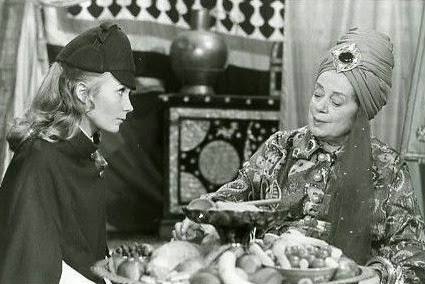
In the same format as Family Affair, its story-lines often featured parallels between the children and the main adult character, drawing in both youngsters and their parents and featured a number of fine guest stars that adults could familiarize with. Most of these guest stars portrayed relatives of Phoebe or Harold. They included Elsa Lanchester as Aunt Henrietta, Ida Lupino as Aunt Justine, Margarie Bennett as Aunt Agatha, Ray Bolger as Uncle Horace, John Mills as Uncle Alfred, Robert Sterling as Harold's brother Benjamin, and Van Johnson as his brother Robert. There was also a pleasant appearance in one episode by Lee Merriwether as Harold's former girlfriend.


Nanny and the Professor displayed the requisite bold and brightly colored opening of the 1970s, with an animated rainbow taking center stage. The shows catchy theme song was written and performed by the Addrissi brothers, a semi-popular group of the era. "You can make the impossible happen, Nanny told us. Have a little bit of faith and lots of love"......lyrics like these summarized the theme of the series.


When Nanny and the Professor was moved to Monday nights, it faced competition from Gunsmoke and its rating went down, eventually leading to the series being cancelled altogether. In 1972, the cast reunited for two animated cartoons which aired on ABC Saturday Night Movie, one of which was Nanny and the Professor and the Phantom of the Circus which had Pheobe playing a sleuth and solving a mystery at her Aunt Henrietta's traveling circus.


CAST

Richard Long ( Professor Harold Everett ) - Long had a long career before becoming the head of a family of youngsters. He started in 1946 in the film, Tomorrow is Forever starring Claudette Colbert. After a number of juvenile leads, he trotted into westerns and found a niche, before hitting it really big on television with Bourbon Street Beat ( 1959 ). After guest starring in a number of other television series he landed the role of Jerrod Barkley in The Big Valley, directing a few episodes as well. Long died of a heart-attack in 1974, just one year after Nanny ended. 

Juliet Mills ( Phoebe Figalilly ) - the lovely Juliet stemmed from a great acting family which included papa Sir John Mills, and baby sister Hayley Mills. Juliet, the lily blossom of the bouquet, got her start as a child actress appearing in her father's picture In Which We Serve as an 11-month year old baby. In 1958 she got her first starring role on stage in Five Finger Exercise and was nominated for a Tony Award for her performance. Although she made a number of films ( notably The Rare Breed ), she found her place in television and enjoyed great success in the 1960s in guest starring roles before she was cast as Miss Figalilly. During the 1970s she appeared in the Emmy award winning miniseries QB VII and had a recurring role on NBC's Born Free. Today she continues to keep busy on television ( From Here on OUT ) and appears on stage periodically. 

David Doremus ( Hal Everett ) -  Doremus was thirteen years old when he landed the role of Hal on Nanny and the Professor. He had performed in a few television commercials before trying out for the part, even though his real aspiration was to become a dentist. After the series ended, he appeared on The Waltons as George Haines, boyfriend of Mary Ellen Walton. Doremus retired from acting in the early 1980s and today is a businessman working in the mobile electronics industry. He is the father of four children. 

Trent Lehman ( Bentley "Butch" Everett ) - Lehman appeared in a few roles on television ( Gunsmoke, The Christine Jorgenson Story ) before being cast as Butch in Nanny and the Professor at the age of nine. After the show he headed home to Colorado to get a job near his family. His girlfriend convinced him to move back to California but once there a series of setbacks led to despondency and Lehmen committed suicide in 1982, at the young age of 20. 


Kim Richards ( Prudence Everett ) - Richards followed in the footsteps of her older sister ( Kathy Hilton ) and entered the acting industry at the age of six. After Nanny and the Professor went off the air, the Walt Disney Studios snatched Richards away and plopped her in a series of juvenile live-action features including Escape to Witch Mountain, The Whiz Kid series, and No Deposit, No Return. During the late 1970s she guest-starred on just about every television show and also appeared as a regular on James at 15/16 and Hello Larry. Currently she is popular playing herself on The Real Housewives of Beverly Hills. She is the aunt of Paris and Nikki Hilton.

FAVORITE EPISODES

The Scientific Approach ( S1 - Ep4 )

The Professor invites a lady psychologist home to dinner and finds that she does not react well to Nanny's flights of fancy.

The Astronomers ( S1-Ep5 )

With his dad's old telescope, Butch makes an astronomical discovery that shakes the scientific world.

An Element of Risk ( S1-Ep12 )

Prudence is heartbroken when her favorite balloon gets busted and decides she does not want to blow up the new one for fear that it too will be destroyed. Meanwhile, the Professor finds he does not want to meet his old highschool sweetheart, because he rather remember the good days then face the change.

Back to Nature ( S2-Ep5 )

Professor Everett, the children and Nanny head off to the woods to enjoy a weekend camping.

One for the Road ( S3-EP13 )

Hal convinces his dad that he is responsible enough to take his first solo bus trip to visit his uncle, but he discovers he may not be responsible enough to get beyond the bus depot. 

MERCHANDISE

Like most television shows of the 1970s, Nanny and the Professor had a plethora of great merchandise released in conjunction with the show. Most of these items were geared towards youngsters and included colorform sets, coloring books, comic books, paper dolls and Viewmaster reels. 


A lunchbox with Nanny and the gang couldn't be found, and - pooh! - there were no Nanny Barbie dolls either. However, as consolation for those who wished the series continued, William Johnston penned three paperback chapter books featuring the Everett family and Nanny. These were released by Lancer books in 1970. 

* The Milwaukee Journal, March 14, 1971.

Tuesday, October 14, 2014

TV/Movie Set : Doctor Dolittle ( 1967 )

For this edition of TV/Movie sets we will be looking at the beautiful home of Dr. John Dolittle, known to his friends simply as Doctor Dolittle or "that maahvelous man". Rex Harrison was the titular star in the extravagant 1967 musical based on the children's classic by Hugh Dowling. Dolittle was one of the very first veterinarians, an animal doctor who was not only sympathetic to animals, but understood them as well. Literally. Polynesia, Dolittle's pet parrot, taught him how to speak 499 animal languages....just a drop in the bucket to the nearly 2,000 languages that Polynesia spoke herself. 

Doctor Dolittle is a wonderful film, very entertaining and very underrated. It's a simple story about the doctor trekking off in quest of the Giant Pink Sea Snail...after he deals with a number of smaller tasks at home. Anthony Newley portrays Dolittle's friend, Matthew, who decides to join Dolittle on his quest along with his little pal Tommy ( William Dix ). Samantha Eggar tags along as well, not having anything better to do.


When Doctor Dolittle was released it was not a smash hit. In fact, it was a downright flop, retrieving only half of its $18 million dollar budget in ticket sales. Children were not interested in listening to Rex Harrison "sing" through seven different songs, and its 152 minute run-time, crawling along at a snails pace, was much too long for children to sit through. But, from an adult perspective, it is quite entertaining and, above all, it exudes the most happifying mood. This is a great deal due to the beautiful cinematography, sumptuous costumes, and most importantly - the sets. 


While all the sets are beautiful in the film, for this post we will be looking at one in particular - the home of Doctor Dolittle. This animal lover lives in the small village of Puddleby-on-the-Marsh, in a stone cottage near the outskirts of town. While practicing as a medical doctor he resided here with his sister, Sarah, but after she discovered pigeons in the linen closet, snakes in the drawer, and mice in the cupboards, she huffed out of the place. 


After her abrupt dismissal, Dolittle went about making a few changes to make his cottage more comfortable..namely, cluttering the place up. Nothing like a good mess to give a home the nesting feel! 

In the pre-veternarian days, Dolittle had a clean desk.
One of these changes was making the house more accessible for his patients. The double row of stairs would never do for cows, horses and such, especially injured ones, and so, a ramp was installed leading down into the living room. 


Paintings of Grecian goddesses were replaced with practical drawings of animal anatomy and bird plummage and every little empty nook and cranny was converted into a home for a stray animal. Even a ladder was built along the stair rail to assist the birds in climbing to the upper chambers. 


Dolittle is quite at home living with the animals and never complains about it, unless they decide to snitch his breakfast. When Tommy Stubbins first meets the doctor, he is trying to communicate with a flock of goldfish. The next day, he gets to see the doctor in action and assist him when his patients come streaming in...


which includes a mother fox and her cubs; and helping a clumsy mouse who continually gets his tail bent in a trap. Dolittle devised a particularly clever machine to straighten mice tails.


Italian art director Mario Chiari was put in charge of the production design of Doctor Dolittle, and it was this man who supervised the design and construction of all of the sets featured in the film. Prior to Doctor Dolittle, he had worked on only a few films as a production designer. Chiari wore many hats, including that of a writer, costume designer, director, assistant director, set decorator, and art director. 

Look at the fabulous stationary set!
Doctor Dolittle was the most important motion picture that he worked on during the 1960s and was undoubtedly the best of his career. Working closely with him were art directors Ed Graves and Jack Martin Smith who had designed the sets for Our Man Flint, Von Ryan's Express, Meet Me in St. Louis, The Valley of the Kings,The Best of Everything, Cleopatra, and Tora Tora Tora!, to name a few.


Jack Martin Smith's work dates back to the early days of Hollywood, and it was his sketches of Emerald City that were used in the final sets for The Wizard of Oz. 

The nook looking like an ark.
What is most impressive is the sheer amount of detail that can be seen in each of the sets. The pictures on the wall, the loose feathers in the corners, the bric-a-brac of a doctor of the mid-1800s, the worn look of the furniture, etc. These small details can all be attributed to the keen and artistic eyes of the set decoraters, Stuart A. Reiss, and Walter M. Scott.

The nook before the animals moved in.
Stuart Reiss was an excellent set decorator and had worked with Jack Martin Smith on The Best of Everything, The Second Time Around, Mr. Hobbs Takes a Vacation, Five Weeks in a Balloon, What a Way to Go!, Fantastic Voyage and many other films. 


Dolittle's house appears to be built on a sloping hill with the living room being the lowest level in the house. From the wide and inviting entryway a visitor would make a left turn and take six steps down to get into the living room, which is a very bright and cheerful open space. French doors lead out to a stone terrace which also acts as an exit door for Dolittle's four-legged patients. 

Dolittle's Foyer
The stairway in the photo above leads to upper rooms which are not shown in the film. Presumbably these rooms are occupied by Dolittle's long-term patients. 


Cheetah, the chimp, doesn't have time to monkey around. She acts as the resident housekeeper and cook and prepares Dolittle's strictly vegetarian meals in the wood burning fireplace near the nook. We're sure she is a far better cook than sister Sarah. This appears to be the only "kitchen" we see in the house. In the early 19th century few houses had separate kitchens. Especially in England.

The door to Dolittle's bedroom. The linen closet is to the left.
At the head of the stairway situated in the living room is the bedroom where Dr. Dolittle sleeps. It is not much bigger than an attic storage room, but that has no effect on Dolittle. In this scene he is dreaming of what he could accomplish once he acquires the skill of talking with animals. 


The set design for the interior of Doctor Dolittle's house is similar in style to those used for the homes of Professor Lindenbrook in Journey to the Center of the Earth ( 1959 ), and George Wells in The Time Machine ( 1960 ); each of them featuring a rustic and strongly masculine style of decoration. 


The outside of Dolittle's cottage features typical Cotswold architecture, with its stone and stucco walls and fairy-tale style sloping roofs. One wonders how the grass was cut in the mid-1800s. Whatever method other people employed, Dolittle probably took a shortcut and talked some of the local cows into chewing his grass down to a manageable height. 

Even though he was considered a "quack" in the village, we really envy the doctor's lifestyle and especially his home. As Mr. Blossom so aptly put it, "I've never seen anything like it in my life!".

Sunday, October 12, 2014

Hollywood Home Tour - Claude Rains

The Hollywood Homes Tour was temporarily cancelled the last few weeks owing to motor trouble, but now the bus is fixed and revving to go and Al, our driver, is here to tell all the passengers where the bus will be taking them next. 

357 Rt. 109, Sandwich, New Hampshire

"Hello everybody! It's good to be back in the driver's seat today, and to thank you for your patience, I've got a real treat in store. We will be going on an extended journey for this outing. In fact, we won't even be anywhere near Hollywood. So if you want to take a bathroom break please do so now, because we will be on the road for 46 hours. We're off to Sandwich, New Hampshire! Did I not tell you that you will be getting your money's worth for this ticket price?

"If you want to grab a sandwich, it might be a good idea to get that now too, for who knows if they serve sandwiches in Sandwich. In spite of the long hours, it is well worth the road trip to drive past the home of one of the greatest character actors Hollywood ever saw the likes of - the great Claude Rains. 

"Rains began his acting career at the age of 10 when he performed on stage in his hometown of London, England. By 1914 he was in New York working at New York Theatre Guild, and by the end of the 1920s was in Hollywood, where he stayed for the remainder of his career after becoming a smash success in the 1933 Universal horror classic The Invisible Man

"As much as he loved acting, he never desired to live among the glitter and glamour of Hollywood. Rains always wanted a farm and in 1933, at the age of 44, he used his savings to purchase a 50-acre farm in Hunterton Hills of New Jersey. Once he was raking in the big-dough he upgraded to a 320-acre estate in West Bradford Township, Pennsylvania where he, his fourth wife, and only daughter, lived from 1941-1956.

"It was after Rains married his sixth wife in 1960 that he decided to move to New Hampshire. His friend Charles Uhle, was a summer resident of Sandwich and often invited Rains to visit him there. The quaint town touched his heart and he purchased this stately country house at the junction of Little Pond Road and Rt.109 in 1963. He believed in honoring the integrity of historic homes and kept much of the house as it was when he purchased it, except for updating the kitchen and turning an ice house into an art studio for his wife Rosemary.

"Rains is an avid reader and this house boasts a bookshelf that reaches from floor to ceiling with books that Rains cherishes. He also takes pride in the yard and, as you can't see ( because it is autumn ) it is brimming with magnolias, hydrangeas and lilacs. Townsfolk claim he often takes long walks but since we won't be staying long I'm afraid we probably will not be catching a glimpse of him outside the house. Too bad, for they say he wears a cape, broad-brimmed hat and dark glasses so as not to be recognized. Perhaps he really is invisible under that disguise!

Up-to-Date Info : Claude and Rosemary Rains died in the late 1960s and are buried at Red Hill Cemetery in Center Harbor, New Hampshire. On his stone is the epitaph "All things once/Are things forever/Soul once living/lives forever"

Monday, October 6, 2014

Nugget Reviews - 14


The Adventures of Robin Hood ( 1938 ) 24k


When Prince John takes over the throne of England in King Richard's absence, Sir Robin Hood of Locksley, dons the green tights and rallies up the Normans to fight against Prince John's tyrannical rule.  Errol Flynn, Olivia de Havilland, Basil Rathbone, Alan Hale, Claude Rains, Eugene Pallette, Patric Knowles. Warner Brothers. Directed by Michael Curtiz.

There just isn't any adventure film more entertaining than this gem! Errol Flynn, Olivia de Havilland and the whole cast were in their prime and they clearly were enjoying their roles. The beautiful cinematography, especially during the Sherwood forest sequences ( filmed in Bidwell Park, California ), make this a storybook tale come to life. 
___________________________________________________________


That Certain Age ( 1938 ) 14k


A young girl falls in love with a visiting reporter at her family estate. He tries his best to snap her out of her puppy love. Deanna Durbin, Jackie Cooper, Melvyn Douglas, John Halliday, Irene Rich, Nancy Carroll. Universal Pictures. Directed by Edward Ludwig. 

Ah yes, the puppy love age. In this case, who could blame Alice for falling in love with the dashing Vincent ( Melvyn Douglas )? Sigh. The film starts off rather slow but picks up in pace midway through with Durbin singing the lovely tune "My Own". Cooper was just seventeen when this film was made and he plays again with his co-star from The Champ ( 1932 ), Irene Rich. That Certain Age marks the final film appearance of silent actress Nancy Carroll, who was rumored to have received more fan mail than any other actress in Hollywood during the 1930s.
___________________________________________________________


Stanley and Livingstone ( 1939 ) 14k


New York Herald reporter Henry Stanley is assigned to deepest darkest Africa to discover whether Dr. Livingstone is still living or not. The Herald's competing newspaper, The London Globe, claims he is dead. Spencer Tracy, Charles Coburn, Walter Brennan, Cedric Hardwicke, Nancy Kelly, and Richard Greene. 

Spencer Tracy really enjoyed picking meaty roles in the 1930s. This one he got to sink his teeth firmly into and did quite well with it....until his character came to the realization of the importance of spiritual matters. Here, Tracy floundered and couldn't quite convince the audience of his transformation. Acting can only go so far, Mr. Tracy. Walter Brennan and Charles Coburn are splendid supports, and overall this is a really fine adventure film. Makes one feel like trekking across Africa even today!  
___________________________________________________________


Wife, Husband and Friend ( 1939 ) 18k


A woman decides to take up opera singing, against her husbands pleas of protest. She discovers she is a flop, and in the mean time, her husband finds he has quite a voice hidden within him! Loretta Young, Warner Baxter, Binnie Barnes, Eugene Palette, Cesar Romero. 20th Century Fox. Directed by Gregory Ratoff.

Warner Baxter was such an underrated talent. He was a most versatile actor and excelled in musicals, mysteries, and dramas alike. Here, he plays for laughs and, once again, is great. After the success of Wife, Doctor, and Nurse ( 1937 ), Young and Baxter teamed up for this spoof and they proved to be a winning duo. Too bad they didn't make more films together. Nunnally Johnson penned the screenplay to this amusing screwball, which was remade as Everybody Does It ( 1949 ).
___________________________________________________________


A Date with Judy ( 1948 )  18k 


Judy Foster falls in love with the new soda jerk in town, much to the chagrin of her steady beau, Oogie. Whilst in the rapture of puppy bliss she discovers that her father is seeing another woman...a rumbo teacher! Jane Powell, Scotty Beckett, Robert Stack, Elizabeth Taylor, Wallace Beery, Selena Royle, Carmen Miranda, Xavier Cugat. Metro-Goldwyn-Mayer. Directed by Richard Thorpe.

Some movies have a special place in your heart just because of the memories they bring to mind. This film we often watched on a Saturday morning while our mother gave us breakfast in bed. We'll forever classify it along with Bachelor and the Bobby Soxer and Good News. Re-watching it recently, we find it to be just as fun as we remembered, if not more so. Beery is such a lovable papa...maybe he wasn't at all like his character in real life, but he sure knew how to act like a lamb. Two thumbs for this film's "feel good" quality alone. Simply delightful.