Friday, July 10, 2015

350 Movie Stills on Auction This Sunday!

When we are not busy watching movies or blogging, my sister and I sell original movie stills on eBay through our store Silverbanks Pictures and this Sunday, starting at 8pm ET, we will be holding the biggest movie stills auction we ever held with over 350 photos ending within the auction's two-hour span. Proceeds from the auction will be donated to the UCLA Film & Television Archive so please head on over to the auctions and try your luck at bidding on some of these beautiful still photos. You will help contribute to a worthy cause - film preservation! - and get a chance to own a great piece of Hollywood history in the bargain. Woo-woo!  All photos start at $9.95. 

To wet your appetite, here is a sampling of some of the photos that will be auctioned off :


A Splendid Hazard ( 1924 ) 
In this lovely scene Napoleon is seen contemplating the meaning of life by the water's edge. 


The Mystery of Edwin Drood ( 1935 ) 
Valerie Hobson and Heather Angel are looking chipper as Douglass Montgomery looks on. 


Rita Johnson ( 1941 )
Rita is looking too darn elegant to be seated in front of that little belly stove.


Seven Days Leave ( 1942 ) 
This handsome couple is none other than a young Lucille Ball and the beefy Victor Mature.


The Wedding March ( 1928 ) 
Erich Von Stroheim seems to be giving instructions to this soldiers, not that it looks like they need any. 


The Wedding March ( 1925 ) 
Here is Stroheim again, this time wooing his beloved Fay Wray in the garden.


Mrs. Miniver ( 1942 ) 
Two charming actresses, the lovely Teresa Wright and Dame May Whitty


How Green Was My Valley ( 1941 ) 
Maureen O'Hara in a beautiful lace wedding gown looking surprisingly happy, considering she isn't marrying the man she loves. 


The Song of Bernadette ( 1943 ) 
Anne Revere made so many excellent films in the 1940s and this was one of them. We're also selling some stills of her in Gentleman's Agreement. 


Shepherd of the Hills ( 1941 ) 
John Wayne is uber-young here and that's Harry Carey besides him ( I think... )


I Take This Woman ( 1939 )
Your guess is as good as mine as to which woman Spence is taking, but our bet is riding on Hedy Lamarr. That's Paul Cavanaugh standing across from her, a great character actor. 


The Arab ( 1924 ) 
Alice Terry is enthralled with Ramon Navarro but I'm more amazed at that background scenery. It looks like it was filmed on location!


Wee Willie Winkie ( 1937 )
Shirley Temple films always featured a young couple having a romance ( to entertain the adult crowd ). In this picture it's June Lang and Michael Whalen having a tete-a-tete on the back porch.


Today We Live ( 1933 ) 
Gary Cooper and Joan Crawford are looking somber as they survey the names on the list engraved within the church walls. 


Random Harvest ( 1943 ) 
This was a great scene. Ronald Colman is staring out the window while listening to an old hymn tune...it sounds familiar to him but darn! he just can't remember where he heard it before.


White Feather ( 1955 ) 
Robert Wagner and Jeffrey Hunter are watching the man with the feathers as intently as if he were going to make the rain fall. 


The Barbarian ( 1933 ) 
Rudolph Valentino couldn't light a candle to Ramon Navarro ( personal opinion ) but obviously Myrna Loy agrees with us for she is bedazzled by this Arab sheik.


Four Daughters ( 1938 ) 
A rare photo of all four daughters ( the Lane sisters plus one non-Lane ) and their father ( Claude Rains ) and aunt ( May Robson ). 


A Holy Terror ( 1931 ) 
George O'Brien is looking mighty hunky in his polo costume and he is sparkling just as much as the Packard he is standing beside. 


Janet Gaynor ( 1930s ) 
Bon Voyage Janie! I don't know how you ended up in Bremen but I hope you have a good voyage back home.


Joel McCrea ( 1930s )
Joel McCrea was one of the hottest actors of the 1930s. Here he is at the beach lathering on the sun lotion...but get a look at how empty that beach is!

We hope you enjoyed our sampling. Click here to hop on over to our eBay store and browse over 350 stills ending this Sunday ( and 800 more photos that are currently in stock ). Other titles include Gone with the Wind, Rear Window, The Birds, Young Mr. Lincoln, Andy Hardy Gets Spring Fever, The Quiet Man, Viva Villa, To Kill a Mockingbird, King Solomon's Mines and Gunga Din. 

Feel free to save the images, pin them on Pinterest, use them on your blog, or best of all.....buy them to frame! 

Wednesday, July 8, 2015

Nugget Reviews - 18


Ladies in Love ( 1936 ) 14k


Three women rent an apartment in Budapest and make a wish to find romance. Loretta Young, Janet Gaynor, Constance Bennett, Tyrone Power, Don Ameche, Paul Lukas. Twentieth Century Fox. Directed by Edward H. Griffith.

Think of this as Three Coins in a Fountain, How to Marry a Millionaire and The Best of Everything all rolled into one mid-1930s package. Loretta Young, Janet Gaynor, and Constance Bennett were three of the biggest stars in Hollywood at the time and it was a jim dandy idea to team them up. Ladies in Love gives each of the gals an equal 1/3 share of the spotlight. Don Ameche is adorable in only his third film and Alan Mowbray actually plays a not-so-villainous character. Also, a very young Simone Simon has a supporting role although I couldn't understand a word of what she was saying. 
___________________________________________________________


April Love ( 1957 ) 14k


A clean-cut young man arrives at the trotting-horse farm of his aunt and uncle in order to cool his heels when he gets his driving license revoked. He then promptly falls in love with two of the neighbor's daughters. That's what happens in April. Pat Boone, Shirley Jones, Dolores Michaels, Arthur O'Connell, Jeanette Nolan. Twentieth Century Fox. Directed by Henry Levin. 

Pat Boone just isn't convincing as a juvenile delinquent and, although you have the notion that the plot initially called for the character to be a trouble-maker, Boone makes him out to be quiet a noble young man. Jones isn't very convincing either as a "tomboy" ( they rarely wear lipstick and eye shadow ) but what the hay! the film is in Technicolor, features some lovely 50s tunes, and trots along at a gentle pace....that makes it a winner. 
___________________________________________________________


The Major and the Minor ( 1942 ) 18k


In order to obtain the half-fare rate onboard a train, a young woman dresses down as a girl and finds herself at a boys military academy and falling in love with a major! Ginger Rogers, Ray Milland, Rita Johnson, Diana Lynn, Robert Benchley. Paramount Pictures. Directed by Billy Wilder. 

Most of the Billy Wilder fans either love this film or hate it. There is no middle ground. We're on the loving side of the stadium and find this to be one of Wilder's best comedies. Rogers is adorable as "Sue-Sue" and, unlike what others may say, does not portray the character with too much goo. She strikes just the right balance between the cynical city-gal and a young woman who finds herself in a predicament she cannot escape from gracefully. The plot-line re-appeared in the 1956 Dean Martin and Jerry Lewis comedy You're Never Too Young with the added touch of a robbery in the mix. Diana Lynn appeared in both films. 
___________________________________________________________


Let's Do it Again ( 1953 ) Elct.


A songwriter and his wife break up. When the wife tries to find a new husband she realizes how much she loves her first husband. Jane Wyman, Ray Milland, Aldo Ray, Tom Helmore. Columbia Pictures. Directed by Alexander Hall.

Alexander Hall was a competent director in the 1930s and 1940s, with a number of great comedies under his belt ( notably The Doctor Takes a Wife ) but he was certainly no Leo McCarey. This film was a semi-remake of McCarey's 1937 box-office hit The Awful Truth but it is nowhere near as entertaining. Milland lost his screwball flair by the 1950s but Wyman remained unscathed through this fiasco and even managed to dazzle singing three great song numbers.

___________________________________________________________


There's Always Tomorrow ( 1955 )  14k 


The nosy son of a toy manufacturer believes his dad is having an affair with another woman and tries to break it up before his mother finds out. Barbara Stanwyck, Fred MacMurray, Joan Bennett, William Reynolds, Judy Nugent. Universal Pictures. Directed by Douglas Sirk.

Douglas Sirk was the reigning king of Soap ( with a capital S ) in the 1950s. This one is missing his customary lush Technicolor setting but features plenty of colorful characters, notably the grown children of toy manufacturer Clifford Groves portrayed by William Reynolds and Gigi Perreau. The time and attention that they deny their father is funneled into their warped desire to alienate him from the family and make him out to be a heel. It's an absorbing study of what happens when children neglect their fathers and the bitter ending makes you wish papa bear left home to find happiness in another cave. Pat Crowley and Barbara Stanwyck play the only decent characters in this moody melodrama. 

Friday, July 3, 2015

What Price, Hollywood?

Debbie Reynolds was one shrewd cookie. On May 3, 1970, David Weisz Co. auctioned off the contents from seven sound stages at Metro-Goldwyn-Mayer studios which included 350,000 costumes. While this 20-day auction event was being held, Miss Reynolds' fellow thespians were lounging comfortably in their palatial Beverly Hills homes lamenting the final curtain call of MGM studios, while the actress herself was emptying her bank account - some $600,000 - and attending each auction, buying up all the costumes and props she could afford. She wanted to preserve some of the treasured mementos from the greatest film studio in Hollywood. 

"They literally threw away our history and I just got caught up in it", Reynolds explained. She also had the foresight to recognize that the props and costumes which were termed "worthless" would be worth quite a penny in the near future. 

Reynolds wasn't the only person to savor the thrill of owning a piece of film history and its investment potential. Movie memorabilia collecting existed long before MGM's famed auction. Why, as far back as 1938 my grandmother was saving the posters from the films that were showing at the Serbian theatre that she worked at as an usherette. Alright, she didn't realize they were of any monetary value, instead her mother used them as wallpaper in their outhouse ( she often claimed they had the prettiest - and warmest - outhouse in their village ). Nevertheless, collecting memorabilia is good business and, even if it weren't, it is too fun an activity for the average film fan not to participate in. 


Through online auction sites, you can - for as little as $1.00 - own a piece of history. Now how cool is that? We're not talking about collectibles here - that's an entirely different field ( and one not worth spending money on ). Memorabilia are genuine articles used in the promotion or making of a motion picture. Collectibles are all the knick-knacks that various companies manufacture to cash in on popular films or celebrities. That Elvis Presley lamp hiding in your uncle's basement is a collectible. If Elvis owned it himself ( how vain! ), it would be memorabilia.


When it comes to memorabilia there are several different buying routes you can explore. You can purchase original material used for publicity purposes ( movie stills, lobby cards, posters, fan cards, tickets, pressbooks ); items used in the making of the film itself ( props, costumes, set pieces ); behind-the-scenes memorabilia ( scripts, clapboards, film cameras, office memos ); or even personal items owned by a celebrity ( like Richard Burton's diary ). 

Since we're in the movie stills business, we recommend that a novice collector begin their purchasing quest buying movie stills, publicity photos, lobby cards and the like. They are inexpensive, easy to maintain, and great to frame. Movie stills were distributed by studios to newspapers, magazines and movie theatres for the promotion of their upcoming releases. They were also assembled in "key books" and archived within the studios' own libraries. With most films, several hundred photos were taken, so it is very likely that you will find a still from a favorite scene. 


Other publicity photos include posed shots of actors in costume for their roles. These are not from scenes in the films and are therefore a bit rarer. They usually include the leading couple getting cozy for the camera or a staging of one of the key scenes in the film, sans the props. Studio artists used these photos as reference when painting the poster artwork. 

The next best memorabilia to begin with would be scripts. Original scripts were printed in limited quantities ( generally less than 50-75 copies ) and therefore their price can range from $10 ( for a new film's script ) to $5000 ( eg. for a script used in the making of Gone with the Wind ). Scripts are good investments since they are made of paper. As the years go by it gets more difficult to find scripts in really good condition, hence they become rarer. 

Scripts from Battleground, Bad Day at Black Rock and Undercurrent

If you are not interested in owning a script then why not purchase a small prop? These can include items such as handkerchiefs, office memos, stationary, cuff-links, watches, etc. Small props are easy to store as well and - although their value does not increase too much - it's just neat owning a piece that was actually used in a movie. 

Once you start buying small props, it is very easy to get lured into the big game...the ultimate props. These are the iconic items that you see predominately in your favorite motion pictures. If you have a few hundred grand to spare, then these are great items to have around the house. However, since most of us cannot afford to buy Charlie Chaplin's bowler hat or Terry-Thomas' spare teeth, we thought we'd share photos of these iconic items instead ( along with the prices that they sold for ). The workers at those film studios never knew what treasures they were handling on a daily basis! 


Harpo Marx gifted Debbie Reynolds with one of his beloved hat and wig combos but after keeping it for years Debbie realized she had no use for Harpo's wig since she wasn't planning on donning his garb and honking at anyone. The wig went up on auction two years ago and sold for $22,500. Now she has something to honk about!


The great Paul Lukas wore this beautiful tweed coat in his role as Professor Bhaer in the original 1933 film version of Little Women starring Katharine Hepburn. Walter Plunkett designed the coat for the picture and oddly enough, it only sold for $275. It costs more to buy a coat like that new. 


Mae West's dazzling ensemble fetched quite a bit more than Professor Bhaer's coat. It sold for $8,500....$3,500 more than anticipated. Travis Banton was the creative mind behind this design, which was worn by Miss West in Belle of the Nineties ( 1934 ).


If you think that amount is a lot to spend on one costume, someone paid $150,000 to have just the head of Gort the robot. The famed alien helmet from The Day the Earth Stood Still ( 1953 ) was made of wood and fiberglass and held up very well over the years. Aliens always did know how to keep their heads intact.


This prop is more in line with our budget. In the 1985 James Bond film A View to a Kill, Max Zorin ( Christopher Walken ) pulls out his checkbook and write a $1,000,000 check paid out to Stacye Sutton ( Tanya Roberts ). Stacey promptly tears it up so we're assuming that prop no longer exists, but someone saved a clean Zorin check...just in case she made a mistake! This one sold for $300.


If there were any two stars who could take the cake for wearing the most elaborate costumes it would be Jeanette MacDonald and Nelson Eddy. This beautiful Adrian-designed military outfit was worn by Eddy in the 1938 operetta Sweethearts. It sold for $1,100.


The ten commandments .....unbroken! Can you imagine telling your friends that you purchased the original ten commandments? No, these aren't the ones that the Lord engraved, but they are second to it in fame having appeared with Charlton Heston in The Ten Commandments ( 1956 ). Some lucky buyer purchased these fiberglass tablets for the mere sum of $60,000 ( cough-cough ).


The person who bought the ten commandments must have also bought the ark of the covenant ( where else would you store them? ). This wooden construction cost the tidy sum of $13,000 and looks just as good as the day it appeared in David in Bathsheba ( 1951 ).


While we're on the subject of Old Testament memorabilia, here is King David's tunic from the same film. When Gregory Peck wore it, the tunic had a whiter shade to it, but then everything yellows over time. This tunic sold for $3,000.


Not all of us have the room to store a beautiful designer gown, so for those who don't want to invest in clothing...there are costume sketches to be had! This beautiful rendering by Helen Rose was created for High Society ( 1955 ), MGM's remake of their own A Philadelphia Story ( 1940 ). It sold for $4,000.


Of all the memorabilia from past auctions this piece amazed us the most. This is the title lettering artwork for My Fair Lady ( 1964 ). It was painted on a 22 x 31 inch plate of glass with the white letters in "Warner Bros Pictures" being painted on the front and the black shading on the back of the glass ( to give it depth ). This plate of glass sold for $10,000... Yikes!


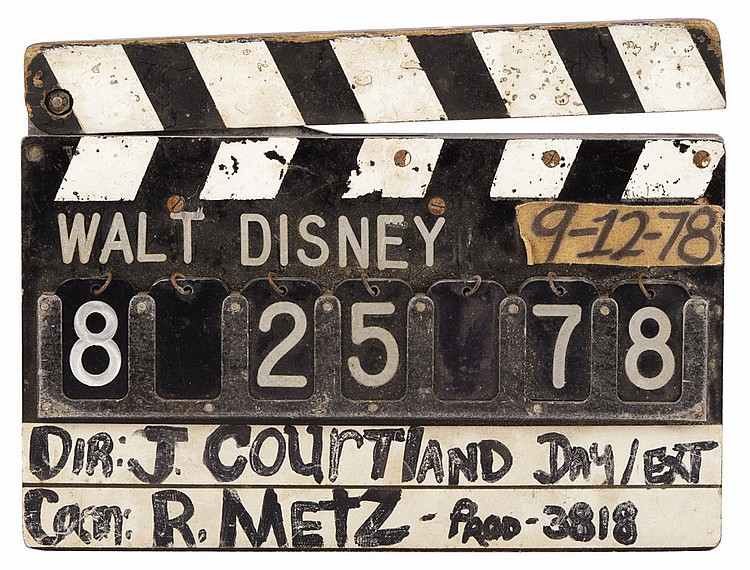
Jerome Courtland used this clapboard while directing an episode of Walt Disney's The Wonderful World of Color in 1978. You would have thought that they wiped the names of the crew cleaned and just reused the clapboards, but perhaps they thought this one was old enough to retire as is. It sold for $2,250 on auction. 


The vamp of the silent era - Theda Bara - wore this bejeweling brassiere in the 1917 silent classic Cleopatra. By itself it doesn't look like much, but on Theda..wow. Someone obviously thought they could pull off wearing it just as well as she did and forked over $8000 to buy it. 


The ultimate Star Wars prop would probably be Darth Vader's helmet, but second best would be this DL-44 blaster owned by Hans Solo ( Harrison Ford ). He zapped a whole ton of space slugs and Vader villians with this baby. Although it doesn't "blast", someone thought it worth dishing out $200,000 for. 


Lastly, a treasure to behold! The entire cast - and many of the crew members - of The Adventures of Robin Hood ( 1938 ) gathered together to sign a 1936 Rand McNally edition of Robin Hood by Howard Pyle. A truly collectible item and it sold for a truly collectible price - $8,000. 

So there you have it...a few gems that were put up on the auction block and currently enshrined in the homes of devout collectors. Every week items like these are being auctioned off across America and - unlike the prices you see above - great deals are still to be had on props that you would never have believed were preserved.

All of the photographs used in this post were obtained from Invaluable.com - the online site where the world's premier auction houses auction their valuables. The majority of these items were auctioned off between 2012-2014 from Profiles in History, which hosted Debbie Reynolds' Hollywood auctions. Click here to view and search more movie props, costumes, and rare memorabilia from past auctions!

Sunday, June 28, 2015

1936 - A Grand Year in Film

Silent Screenings and Once Upon a Screen have teamed up with Movies Silently to revive their popular Classic Movie History Project Blogathon covering all of the major periods in film history. We have decided to tackle 1936 for the Golden Era of this event. Many critics tout 1939 as the wunder-year of Hollywood film and that is quite true, but if there was one year that was pivotal in the operation of each of the five major film studios it was 1936. 

There was a notable difference in quality in the releases of 1936 compared to those made prior to 1935. Technical advancements were made in the sound departments, make-up was no longer being caked on as heavily as it had been ( men stopped wearing lipstick, thank goodness! ) and directors were experimenting with new filming techniques. The title cards of the silent-era, which were used to explain plot changes or passages of time, were slowly being discarded for dialogue-driven story-telling. 

Though the Depression was but a not-so-distant memory, life had improved for many with employment on the increase and families now having money to spare. This, naturally, effected the movie industry and on a whole it was doing phenomenal business with grosses up $250 million dollars from 1935.

Major Hollywood Happenings


Deanna Durbin made her film debut in Three Smart Girls, a frolicsome feature in the vein of The Parent Trap. She soon became the No. 1 money maker for Universal studios and just in the nick of time, for the studio nearly went bankrupt in the summer of 1936. Charles Rogers took over production of the studio after Carl Laemmle Jr. raked up substantial debts in the creation of prestigious productions throughout the early 1930s. Rogers reduced the number of productions ( and the quality ) of Universal's output for the coming decade. Indeed, aside from Durbin's films there were meager pickings among the Universal crop in the years to come. 

Dorothy Lamour became a star overnight when she appeared wrapped in a sarong in The Jungle Princess, a routine jungle yarn from Paramount. Prior to this film she was a minor band and radio singer.


Mervyn LeRoy made his last major production for Warner Brothers - Anthony Adverse. Beginning with the acquisition of A Midsummer Night's Dream the previous year, Warner Brothers hoped to present themselves to the public with a new image as a prestigious film company and acquired the rights to a number of best-selling novels. Anthony Adverse was a huge financial success for the studio and helped to promote this new image. Losing Mervyn LeRoy was a major loss for the studio but, on the other hand, they signed composer Max Steiner ( who had left RKO ) over the summer. Steiner was one of the top music-makers in the industry. You win some, you lose some.

The Boy Wonder, Irving Thalberg, died at age 37. His wife, actress Norma Shearer, was devasted and vowed to never remarry. But she did. In 1942, she wed a ski-intructor from Sun Valley. Thalberg had forged MGM into the studio that it was and, after his death, production came to a standstill - for one day. Then Louis B. Mayer took the reigns as king of the Lion's lair and gave birth to a new era of wholesome top-notch productions. He was not entirely cold towards his former boss however, and ordered the erection on the MGM lot of a vast new multi-million dollar Irving Thalberg Administration Building named in honor of the Boy Wonder. Thalberg did not live long enough to see his pet-project, The Good Earth, completed. 

Walt Disney signed a distribution deal with RKO. Even though it would be two more years before Disney released his first full-length motion picture, Snow White and the Seven Dwarfs, he had the foresight to recognize television as being a major factor in the entertainment industry of the future. RKO had close ties with RCA, then the leading sponser in the video development field, and so Disney made his bid early. Coo...now that's what I call thinking ahead! Television may have been years away but it was often talked about in the media and even Columbia Pictures released a film in 1936 entitled Trapped by Television about a television pioneer ( Lyle Talbot ).

Warner Brothers attempted to break new ground with their release of The Green Pastures, basically a re-telling of the Bible as seen through the eyes of black children in an out-of-the-way Sunday school. Today, the film is considered racist for its portrayal of blacks as shuffling simpletons.


Silent film star John Gilbert died of a heart attack at the age of 38. Garbo's former lover never did learn how to "talk" for talkies and so the advent of sound put an early end to his career.

Bette Davis sued Warner Brothers for putting her in crummy low-budget films and they, in turn, sued her right back for breaking her contract and signing with producer Ludovic Toeplitz. Politics, politics......Anyway, Bette got the better end of the deal and Jack Warner decided to give her some better productions.

Historic epics were all the rage and the studios vied to outdo each other in splendid extravagance. Warner Brothers released The Charge of the Light Brigade, a G. A. Henty style yarn set in the North West Frontier; 20th Century Fox premiered Lloyds of London, the story of the famous insurance company; and MGM undertook the destruction of a city in San Francisco, featuring an earth-shaking finale.

Humphrey Bogart made a name for himself as a hood in A Petrified Forest. This was a role originally slated for Eddie G. Robinson.

The release of My Man Godfrey cemented Carole Lombard's reputation as one of the most beautiful and accomplished comediennes of the 1930s.

Biographical films were big box-office. The Story of Louis Pasteur not only became one of the top films of the year but it earned star Paul Muni an Academy Award for Best Actor for his portrayal of the imminent doctor of medicine. Other biographical films released in 1936 included Mary, Queen of Scotland; The Great Ziegfeld ( Best Picture of the year ); Rembrandt; and Sutter's Gold.


William Powell and Myrna Loy continued their box-office success teaming up in three more great films, After the Thin Man, The Great Ziegfeld and Libeled Lady.

"B" films became the norm. For years cinemas had been experimenting with what to give audiences as an extra treat at the theatres. They tried live shows, shorts, newsreels, double features - until they hit on the "big/little" scenario. Audiences enjoyed seeing one minor film and one quality production. B films were being made by all the major studios to support their A productions, and they used these B films to test out new directors, actors, and special effects. 

Director Frank Capra got his name put above the title in Mr. Deeds Goes to Town. Capra believed that movies could have a social conscience and he struck a cord with post-Depression audiences in his latest retelling of his little-man-pitted-against-the-world philosophy. 

Irene Dunne makes her comedic debut. Dunne had scored a hit with Show Boat earlier in the year and then was cast, against her wishes, in a comedy - Theodora Goes Wild. She did not consider herself to be a comedienne but audiences certainly thought so and many more comedies soon followed. 


Technicolor Pictures hit theatres. Well, officially Becky Sharp, released in 1935, was the first full-length Technicolor film, but it wasn't until 1936 that the process was really perfected. Paramount released Trail of the Lonesome Pine, the first Technicolor picture filmed outdoors and United Artists featured Marlene Dietrich and Charles Boyer in blazing spectrums in The Garden of Allah.

Notable Releases of 1936


  • The Charge of the Light Brigade 
  • The Prisoner of Shark Island 
  • Mr. Deeds Goes to Town
  • Trail of the Lonesome Pine
  • The Great Ziegfeld
  • Modern Times
  • San Francisco
  • Libeled Lady
  • Follow the Fleet
  • Swing Time
  • Mary, Queen of Scotland
  • My Man Godfrey
  • The Petrified Forest
  • Lloyds of London
  • Theodora Goes Wild
  • Three Smart Girls
  • Anything Goes
  • The Plainsman
  • Show Boat
  • The Milky Way
  • Desire
  • Romeo and Juliet
  • Dodsworth
  • The Big Broadcast of 1937
  • Little Lord Fauntleroy
  • These Three
  • The Garden of Allah
  • Things to Come


Top Box-Office Films

1. San Francisco

2. Modern Times

3. Strike Me Pink

4. The Trail of the Lonesome Pine

5. A Midsummer Night's Dream


Popular Actors of 1936

Every year since 1932 Quigley's International Motion Picture Almanac polled movie exhibitors across America to determine the Top Money Making Stars - those actors who consistently bring in audiences - and these were the results from 1936's poll. 


1) Shirley Temple 
2) Clark Gable 
3) Fred Astaire and Ginger Rogers 
4) Robert Taylor 
5) Joe. E Brown 
6) Dick Powell 
7) Joan Crawford 
8) Claudette Colbert 
9) Jeanette MacDonald 
10) Gary Cooper 
11) Jane Withers 
12) James Cagney 
13) William Powell 
14) Jean Harlow 
15) Wallace Beery