Showing posts with label Annette Funicello. Show all posts

Saturday, August 17, 2024

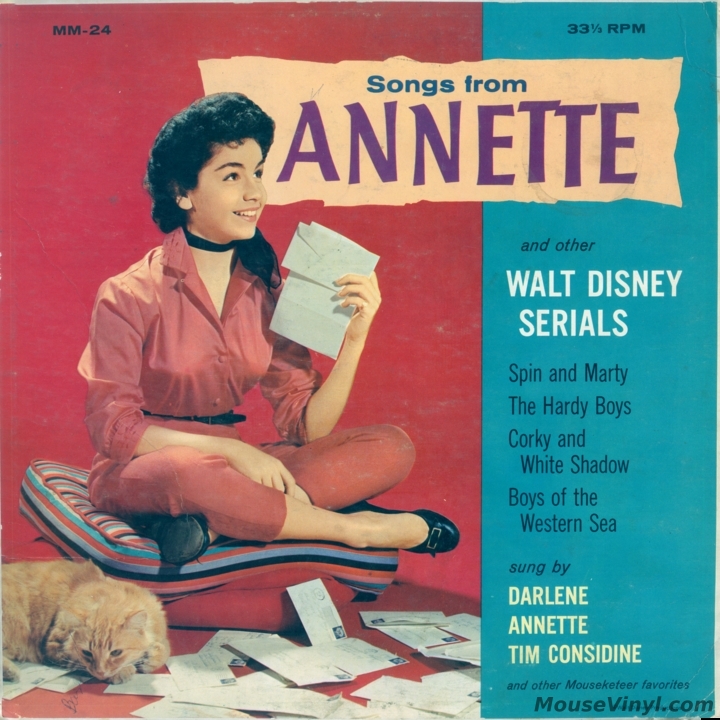
Film Albums: Songs from Annette and other Walt Disney Serials


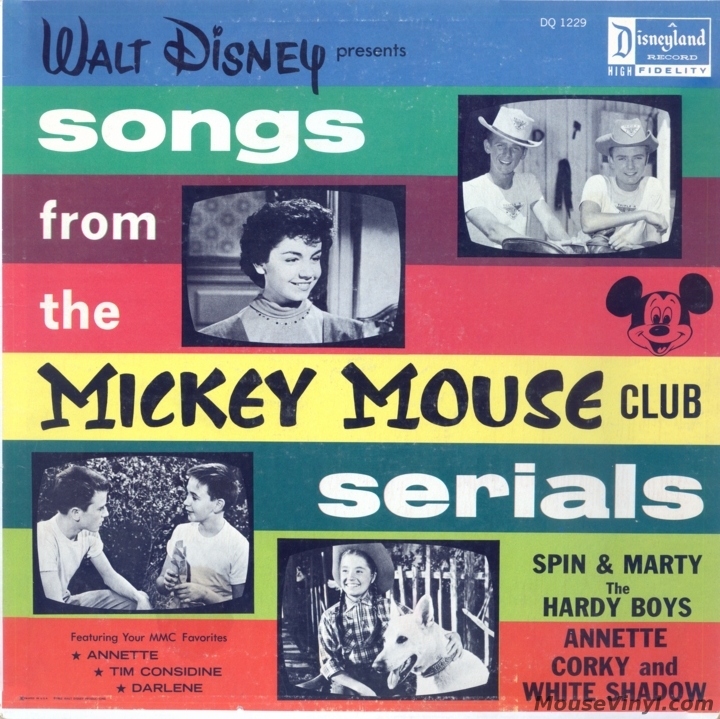
Every once in a while you come across a gem of an album that you never even knew existed. This one caught my attention because Annette Funicello was on the cover but then I saw the subtitle "and other Walt Disney serials" and my heart skipped a beat. This album is actually just an updated release of Disney's "Songs from the Mickey Mouse Club Serials" album (another one I never knew existed) but with the inclusion of Annette's music from her latest serial Annette. If you enjoy Walt Disney serials then that one is well worth watching. 

This album features songs from some of the popular Mickey Mouse Club members including Tim Considine, David Stollery, Darlene, and Annette, as well as tunes performed by the Walt Disney studio chorus. In my own humble opinion, these are the best ones on the album. There is a ripping version of "Pieces of Eight", the theme song to The Hardy Boys - The Mystery of Applegate Treasure; a lilting tune called "Moochie" (about Moochie, of course); a rosing version of The Boys of the Western Sea, the theme from a rare serial about Norwegian fishermen; and "Annette" performed by Jimmie Dodd. 
Click here to listen to the album in full on Youtube. 


Track Listing


Side One

How Will I Know My Love

Annette

Meetin' at the Malt Shop

Buckwheat Cakes

Hap-Happy Snowman

Pieces of Eight

What I Want to Be Theme


Side Two:

Don't Jump to Conclusions

Theme from Spin and Marty

Triple R Song

Uncle Dan

Moochie

The Boys of the Western Sea


Top Picks: Annette, Pieces of Eight, Meetin' at the Malt Shop, Theme from Spin and Marty, Moochie

Thursday, June 11, 2015

Back to the Beach ( 1987 )

Speakeasy and Silver Screenings have kicked off the cowabunga Beach Party Blogathon over at their sites and we staked our claim of hot turf with Back to the Beach ( 1988 ), one of the best of the Frankie Avalon beach party films which included Beach Party ( 1963 ), Bikini Beach ( 1964 ), Muscle Beach Party ( 1964 ), Beach Blanket Bingo ( 1965 ), and How to Stuff a Wild Bikini ( 1965 ). In most of the films, Frankie portrayed a young surfer who had to continually create schemes to protect his gal Dee-Dee ( Annette Funicello ) from other surfing suitors. They were zany teen films to be sure and Back to the Beach fits right in among them even though it was released 22 years after the last beach film. James Komack ( The Courtship of Eddie's Father ) dreamed up a plot as wild as the originals, this time telling the story of what happens to surfers after they curl their last wave. 

It was fairly easy for the audience to guess that Frankie and Dee-Dee tied the knot after their flings in the California sun. As their punk son Bobby explains in the beginning of the film: 

"25 years ago my parents were the most popular teenagers in America. It's true. My dad was a teen idol. Girls threw themselves at him, but it being 1962, he had to throw them back. When dad wasn't singing he spent his life on a surfboard. They called him the Big Kahuna. When I was born my dad wanted to call me the little Kahuna - luckily he settled for Bobby. As for mom, she joined that strange cult called the Mouseketeers. She became the first pin-up queen for boys under twelve. Anyway, they got married and moved to Ohio right after the accident....20 years ago, while surfing, this humongous wave knocked the Kahuna right out of dad and he's never been the same since. The closest he gets to the water now is to play the surf king in order to sell cars on TV. Yep, the Big Kahuna now owns Friendly Ford, the largest dealership in Ohio". 

Eventually, Frankie finds himself stressed out with work and the family decides to take a vacation in Hawaii. En route they make a stop in Los Angeles to check on their grown daughter Sandi, portrayed by Lori Laughlin ( Full House ) in a Kim MacAfee style role. While in LA, Frankie meets up with his former flame Connie ( Connie Stevens ) and the old Beach Party jealousy plot shifts into gear once again. 

What makes this beach bash so entertaining are all of the references to past films and Frankie and Annette's careers. It becomes a nostalgic - and highly amusing - look at the old California beach cult. To entice youngsters, the film explodes with New Wave color and characters. There is a sub-plot aimed at teens involving Sandi and her fiancee ( Tommy Hinkley ) who are shacking up on the pier, and one for the kids with Bobby getting himself initiated into a leather-clad surf gang. Also, Frankie has to take to the waves once again to prove that he isn't clucked and is still the true King of the Surf. 

"He'll be back. I know that in my heart."  - Annette
"You know, you're awful sweet Mom" - Bobby
"And then I'll make him suffer." - Annette

Great guest stars include Don Adams as the harbor patrol master, Bob Denver and Alan Hale Jr. reprising their Gilligan's Island roles, Ed "Kookie" Byrnes ( still valeting ), Barbara Billingsly, Tony Dow, and Jerry Mathers.

The film also features some hip-swinging musical numbers. Dick Dale and at least two of the Del Tones make an appearance performing "California Sun" with Frankie and "Pipeline" as a duet with Stevie Ray Vaughn; Pee-Wee Herman goes wild with the "Bird is the Word", and Annette gets to sing the best number - "Jamaica Ska" - along with Airhead. 


Back to the Beach was released on August 7, 1987, and was received with mild reception at the box office. Annette Funicello was diagnosed with MS shortly after filming wrapped and her part as the Skippy-loving mother in Back to the Beach became her final film role. It was also the final film appearance of Bob Denver and Alan Hale Jr.

"We tried to figure out where to take you last night, but you kept saying, 'Why oh, why oh, why oh, did I ever leave Ohio?'" - Michael
"That's a damn good question" - the Big Kahuna


For us, the film has a special place in our memory box. Growing up, we had no cable television and the only films we saw were those that were playing in the theatres, the drive-in ( suitable for youngsters ), and the VHS tapes that our parents rented from the local library. Two tapes our mother continually brought home for us from the library were Back to the Beach and Grandpa's Music Box. Even though the film was PG-rated and most of the wisecracks eluded us, we loved the feel of the film. It quickly became our favorite and within a few viewings we learned enough surf-talk to last us a lifetime. 

To us, Back to the Beach will forever conjure up memories of childhood, hot summer days, homemade popsicles, carefree Saturdays, and pink Barbie clothing. We live only two short miles from the beach but on days when we don't feel like burning in the sun, all we have to do is watch Back to the Beach and the surf will practically be washing into the house. 

Duuude, ready to get amped about the surf and sand?? Click here to check out rad posts on all of your favorite beach films of the past. Cowabunga!!

Tuesday, June 3, 2014

The Shaggy Dog ( 1959 )

In the mid-1950s, Walt Disney gave ABC network their very first full-hour western television program - Davy Crockett. The series was such a success that the network soon launched many other similar series such as Maverick, Wyatt Earp, and Lawman. These westerns brought ABC so much income that in 1957, when Walt Disney approached them with a fresh idea for a sitcom (sans the gun belts and tumbleweed) they turned him away. This minor detail didn't bother Mr.Disney in the least since he turned the material that he had offered ABC into a feature film release. The Shaggy Dog became one of the top-grossing films of 1959 earning $9,000,000 at the box-office and out-performing The Diary of Anne Frank and North by Northwest. That's something to bark about. 

What made this low-budget comedy such a smashing hit? For one thing, it was a novelty. After a decade of musicals, crime dramas, spectacles, and method-acting melodramas, here was a little film that played out like a television series, a Leave it to Beaver versus Enemy Agents. It was unique. It was fun. And above all, it was great family entertainment. Walt knew how to appeal to all ages and The Shaggy Dog provided entertainment and humor for the young and old alike. It was filled with excitement, clever dialogue, and plenty of visual gags. The studio went on to recycle many of these gags in their recurring films.

Unlike the other box-office hits of 1959, The Shaggy Dog did not have any moments of great splendor, instead it leisurely followed the story line only to stop occasionally to wittily comment on the social status at the time or sprinkle gentle humor. Writer Bill Walsh penned the amusing screenplay based on the 1930 novel, "The Hound of Florence", by Austrian author Felix Salten (Bambi).


The Shaggy Dog follows the adventures of a junior scientist who accidentally recites an ancient Borgia curse that releases a 400-year-old shape-shifting spell. With the magical words "In Canis Corpore Transmuto," Wilby Daniels transforms himself into a big, shaggy dog - a Bratislavian sheepdog to be precise - belonging to the new neighbors on the block. It is while being in the four-footed state that Wilby overhears a plot to steal a secret missile plan at the nearby air base. It's Shaggy to the rescue then as he tries to convince his father, and the local authorities, that Continental spies are at work in the neighborhood!  

"In Canis Corpore Transmuto...In Canis Corpore Transmuto....it's a dosy do and awaaaay we go!"

The Shaggy Dog boasted a fine cast of young players, all of whom would come to be associated with the Walt Disney Studios. Tim Considine took a radical turn from his wholesome Spin and Marty role to play Wilby's scheming friend Buzz. At the expense of his good ol' pal, he whizzes around in his hot-rod wooing the most eligible girls in town. One of these girls just happens to be Allison, played by Annette Funicello in a brief part, her first film appearance. She is soon replaced as Girl No. 1 when sophisticated Franceska Andrassy (Roberta Shore) moves in with her father in the big Victorian manor across the street. If this street looks familiar, it is because it is the Universal cul-se-sac featured in The Munsters, The Burbs and Leave it To Beaver. 

Tommy Kirk proves to be in top form as Wilby Daniels. Although he made many more films with Walt Disney during the 1960s, none of his roles would be as appealing as Wilby. Tagging along as a mischievous helpmate is his little brother Moochie, naturally played by Mickey Mouse Club "Moochie" himself - Kevin Corcoran. Moochie doesn't display much surprise when he discovers his brother is a dog, but rather jumps at the notion of having a pet playmate to take on walks and throw sticks to. Corcoran later went on to become a producer with the Walt Disney studios in the 1970s and 1980s. 


Unlike the childish, bumbling crooks seen throughout the Walt Disney productions of the 1990s, The Shaggy Dog featured some pretty normal rough-and-tough criminals (played by Anthony Scourby and Jacques Aubuchon), although in this flick they are spies and quite debonair to look at. In fact, they are so suave that our damsel-in-distress does not even realize they are up to no good until after they kidnap her. Our devious villains conjure up images of the sophisticated foils that were so popular in series of the 1940s, such as those seen in Sherlock Holmes, Michael Shayne, or The Three Stooges shorts. These criminals are upstanding citizens loaded with wealth which they love to lavish on their collections of fine art and furniture. No one in the community would even dare consider them to be enemies of the state.

Fred MacMurray had been making films covering every possible genre since he began his career back in 1929. After making a number of mediocre pictures during the 1950s, Disney asked Fred if he would be willing to try his hand at comedy once again. The Shaggy Dog marked the beginning of a seven picture association he had with Walt Disney Studios. In the film, MacMurray plays a retired mailman and the father of our two leading lads. He has an allergic reaction to dogs that makes him despise the mere mention of their name and prompts him to bring out his trusty double-barreled shotgun from the hall closet. 

"You know that dog thing is all in your mind"

"All in my mind?! I itch, my sinuses are bloating up, my throat is constricting so that I can hardly breath, those old Pekingese wounds on my ankle are throbbing like bongo drums...and you say it's all in my mind!" 

One of Fred's best scenes involved him trying to convince the head of security at the missile plant that his son is a dog. Variety magazine noted, "It's a pleasure to see such a master of timing and emphasis as Fred MacMurray back in comedy again, even though he is somewhat limited in his material. Where he has a good line, he shows that he has few peers in this special field of comedy". 

Playing his wife is the lovely Jean Hagen, another gal who had her share of duds before snagging this wholesome part. Cecil Kellaway, Paul Frees (a legendary voice-over actor for Walt Disney Studios), Forest Lewis and Gordon Jones rounded out the great cast, but let's not forget the film's star player - the shaggy dog. "Chiffon" was in fact Sammy's Shadow, a talented pooch belonging to a California State Division of Highways clerk. He had an illustrious pedigree and, after enrolling in William Koehler's obedience training classes at the age of 4 months, he joined the Allied Movie Dogs firm and landed this wild and woolly part. Twenty sheepdogs had been tested for the part but Koehler knew he had a winner with Sammy and it is truly the dog performing all of the stunts seen in the film ( except for one talking sequence where a hand puppet was used ). Sammy went on to win the 1960 PATSY (Picture Animal Top Star of the Year) award for his performance in The Shaggy Dog. 


The Shaggy Dog has held up well over time, which is a testament to the enduring strength of a simple story told well. It is also notable for instigating important changes within Disney's production outlook for the coming decades. It was the first film to use animated title sequences and the picture's success told the studio that live-action comedy films were a profitable venture not to be overlooked. Unfortunately, they held to its "formula" so closely that many of the later Disney productions lacked novelty. 

This post is our contribution to the Snoopathon, a celebration of spies and agents being held over at Movies Silently. Be sure to check out the site and read  all of the great posts!