Showing posts with label Mystery. Show all posts

Wednesday, November 5, 2025

The Spiral Staircase (1946)

Few thrillers have ever wrapped terror in such beauty as Robert Siodmak's The Spiral Staircase (1946). Adapted from Ethel Lina White's novel "Some Must Watch", it is one of the crown jewels of the "old dark house" tradition. 

The story takes place in 1916 in a quiet New England village that is shaken by a killer who is stalking women he deems "imperfect." Inside the great Warren mansion, the latest potential target, Helen Capel (Dorothy McGuire), a young mute servant girl, tends to her bedridden employer Mrs. Warren (Ethel Barrymore), unaware that danger lurks within the corridors of the house she calls home. 

Director Robert Siodmak, fresh from his work at Universal, infused the picture with the eerie elegance of German Expressionism. His camera glides through the Warren house teasing us with glimpses of views through mirrors and banisters, as though we were the unseen watcher. The most iconic frame of the film is undoubtably his close-up of the killer's eye and its reflection of the titular staircase. 

Dorothy McGuire gives a remarkable delicate performance as Helen. One forgets her muteness entirely, instead we sense her vulnerability and every thought of fear through her expressions alone. The grand old dame Barrymore gives a barnstorming turn as the sharp-tongued ailing dowager, a role which earned her an Academy Award nomination. George Brent and Gordon Oliver are each cloaked in just enough mystery to keep the viewer guessing, while Kent Smith lends a touch of romance to the proceedings as the young Dr. Parry who is anxious for Helen to regain her speech. The always appealing Rhonda Fleming costars as Mr. Warren's secretary; Elsa Lanchester brings some tipsy humor to the household gloom, and Sara Allgood and Rhys Williams round out the cast of servants. 

Visually, the film is a feast. Nicholas Musuraca's cinematography - that deep-focus chiaroscuro he perfected in Cat People and The Seventh Victim - breathes life into Albert D'Agostino's rambling and gloomy Victorian sets. 

The mystery itself may not stump many modern viewers, but The Spiral Staircase was never about surprise...it is about suspense - that exquisite tightening of the nerves as Helen's silence grows unbearable. In its refinement and restraint, The Spiral Staircase anticipates the psychological thrillers of decades to come and remains a Gothic masterpiece preserved on celluloid.

Saturday, October 25, 2025

Alfred Hitchcock Presents: The Perfect Crime (1957)

On October 20, 1957, television audiences were treated to a rare pairing of two masters of suspense: Alfred Hitchcock and Vincent Price in, what is hard to believe, their only work together. In The Perfect Crime, the third episode of Season 3 of Alfred Hitchcock Presents, Price dons the role of Charles Courtney, a smug prosecutor with a penchant for collecting case mementos—each one neatly labeled and shelved like trophies in a macabre curio cabinet. But there’s one conspicuous gap on the shelf, reserved for what he calls “The Perfect Crime.” You can guess where this is going.

Enter James Gregory as John Gregory (yes, the names are confusing), a defense attorney with a bone to pick. He believes Courtney sent an innocent man to the gallows, and he’s got the evidence to prove it. What follows is a tense tête-à-tête that spirals into murder and a chilling twist that only Hitchcock could deliver with such dry wit.

Price is in his element here—oozing charm, arrogance, and just the right amount of menace. However, much of the episode unfolds through Gregory’s riveting narration, as he reconstructs the tragic events that lead to the innocent man's unjust prosecution. 

Hitchcock, ever the showman, introduces the episode wearing a deerstalker and puffing bubbles from a calabash pipe—a cheeky nod to Sherlock Holmes and a wink to the audience that this mystery is anything but elementary.

The episode is one of only seventeen directed by Hitchcock himself, and it shows. The pacing is taut, the dialogue crisp, and the conclusion deliciously absurd. It’s a compact gem that reminds us why Alfred Hitchcock Presents remains a gold standard in televised suspense.

So if you’re in the mood for a little murder, a lot of ego, and a kiln that doubles as a crime scene, The Perfect Crime is a must-watch. Just don’t ask what’s in the vase.

Saturday, September 28, 2024

Paganini Strikes Again (1977) - A CFF Film

We are continuing our coverage of Children's Film Foundation (CFF) films with Paganini Strikes Again, a rare mystery/adventure from 1977. The "Paganini" in the title refers to Mike (Andrew Bowen) and his friend Bill (Philip Bliss) who are both violin students. On their way to music class, they get stuck in the elevator of a small building and from their viewpoint are only able to see work boots of a man running up a flight of stairs. They later find out that a robbery had taken place and realize that this was the robber escaping. 

Inspector Mainwaring (John Arnatt) of the London police does not believe their shoe clue is enough to begin a search and so the boys decide to play detectives themselves and hunt down the man with the boots. Unbeknownst to them, he happens to be the uncle of one of their classmates. 

Paganini Strikes Again cannot really be classified as a mystery because everything is shown to the audience. The robbery is evident, and it is clear that Raddings (Dudley Sutton) is the criminal. However, watching the boys track him down is entertaining and for light Saturday afternoon juvenile fare (which this was intended to be) Paganini Strikes Again is pleasant enough. It doesn't rank as one of the best CFF films, nor the worst. 

Both Bowen and Bliss do a good job of acting as the young musician detectives. Bowen had done some acting previously (Bachelor Father) and would later appear in the television series Grange Hill. Dudley Sutton (Lovejoy), a veteran of British television, plays one of his usual nasty criminal roles. Arnatt is good as the Inspector, Patrick Jordan plays a detective, and Julia Dawn Cole has a small part as the sister of one of the boys. 

Paganini Strikes Again is currently not available on DVD or on Youtube, but check every once in a while as it may appear again. 

Tuesday, April 16, 2024

Who Done It? (1956)

Benny Hill done it, that's who! Before the famed English comedian made a name for himself on television as the star of The Benny Hill Show, he made this fast-moving farce playing a detective who sets out to capture enemy agents bent on destroying England with a weather-making machine. 

Hill stars as Hugo Dill, an ice sweeper at a skating rink who long dreamed of becoming a private detective. When he wins £100 and a bloodhound in a contest, he feels he is ready to embark on his new career. Within one day of opening his office doors, he gets embroiled in a scheme by a ruthless Iron Curtain gang to control England by using Professor Stumpf's newly-invented weather-making machine. Can you imagine what havoc the enemy could wreak if they caused rain to fall on England on a daily basis? 

Benny Hill had a natural flair for comedy and he is highly entertaining in Who Done It?, his first starring film and the last. Later on, Hill had roles in Skywatch (1960) and Chitty Chitty Bang Bang (1970) and guest appearances in a few other films, but he never got a picture entirely to himself again... which is a shame, since he could carry a film better than many of his comedic peers. 

The script, by T.E.B. Clarke, was written especially for Hill and has some amusing moments, especially during the finale where Hill appears in drag (of course!) but, at the theaters, the movie did not bring in the tickets expected and Ealing Studios decided not to make another Benny Hill film. In fact, after many years of outputting fine comedies, this comedy was Ealing Studios' last. Hill made a number of suggestions to improve the script prior to filming, but director Basil Dearden rejected them all. Too bad...audiences would probably have come in droves to see Hill's unique and cheeky humor on display in full force. 

Co-starring with Hill is the delightful Belinda Lee who was a busy up-and-rising star at the time. She made a number of British films before moving to Rome to focus on Italian pictures. Unfortunately, her life was cut short when she died in a car accident at the age of 25. 

Also in the cast is David Kossoff as the ringleader of the Iron Curtain group. Kossoff later appeared in one of our favorite Disney spy films The London Connection as Professor Buchinski. What makes Who Done It? so fun to watch is all of the familiar character actors who make brief appearances. These characters include Thorley Walters, Ernest Thesinger, Irene Handl, Arthur Lowe, Terence Alexander, Glyn Houston, and the always entertaining Nicholas Phipps, who was wasted in such a small part. 

While Who Done It? may not appeal to some due to its broad humor, it's a pleasant way to spend a rainy afternoon and get a few laughs. And, if you are one of the many Benny Hill fans, you'd be pleased to see him in his first screen appearance. 

Friday, February 23, 2024

Sh! The Octopus (1937)


"Gripping!..Daring!....Too Too Touching"

So reads the advertisement. 
I thought I saw 'em all, but this film tops the Beyond Incredulous list.


Kelly and Dempsey, two befuddled detectives, are driving along a secluded road one dark and stormy night when they hear a scream and out from the woods dashes a young Joan Crawford look-alike. She promptly faints in front of them as any good Joan Crawford look-alike ought to do and then proceeds to tell them that she saw the body of her stepfather... muuuurdered....  hanging by his feet from the top of the lighthouse.... dripping blood!

"What lighthouse?" 

"The lighthouse a few miles from shore." 

"Why?" 

"My stepfather is the inventor of a radium ray gun....so powerful that whoever controls it controls the world. Every nation is searching for it!"


The super-duper high-power radium ray gun is gone? Stolen by the arch-villain The Octopus??!! ( Shhh.. )

Holy tentacles, Batman! 

Our intrepid heroes, not ones to leave a lady in distress (even though Kelly's wife is having a baby and he is leaving her in her distress), decide to pop on over to the lighthouse to investigate. After all, it's only a few miles across the ocean via motorboat in a thunderstorm...with seven foot waves. What's a little water? 


GLAboutMeBedtimeBookCover

And so begins one of the wackiest films to ever be churned out of Warner Brothers studio. 

Sh! The Octopus (1937) has rather a cult reputation of being a wild parody of old-dark-house parodies themselves. When you find a film with supporting actors such as Hugh Herbert and Allen Jenkins playing the leads, you know you are in for watching a B movie, but in this case the "B" should be for "bewaaare". It truly is surreal, folks. 


A remote lighthouse, octopi, stolen plans, secret panels, an old sea captain, a hag with a witch's cackle...all prime ingredients for a thrilling mystery are thrown in this soup and then heaped on with a goodly dollop of unabashed burlesque. 


You can tell this was originally a stage play. For a lighthouse that is miles out at sea, it can get awfully crowded and the cast members are continually disappearing into rooms we never see. There is the so-called artist who purchased the lighthouse, then a retired seaman comes into the picture, Captain Hook (don't ask), the damsel's nanny (she was out for a stroll and stumbled upon the lighthouse), and a wise-cracking dame who happened to come ashore after her ship went down. Margaret Irving plays this role and she really is the highlight of the film. If this was an Abbott and Costello picture co-starring Joan Davis this would be a six-star picture. Casting can make all the difference. 


"Sh! The Octopus" was the concoction of Donald Gallagher and Ralph Murphy, who wrote the original stage play. Donald Gallagher had scored a success with The Gorilla on stage (later made into a film) and so in 1928 he teamed up with Murphy to bring this play to the Royale Theatre in New York, where it continued on for 47 performances. Harry Kelly and Clifford Dempsey starred as Kelly and Dempsey (who else?). 


In the film version, Allen Jenkins, the Irish Brooklynite, is excellent in his role as straight-man Dempsey, while Hugh Herbert performs his routine flibberity-jibbit quite flibberly. 

My sister and I watch movies in parts just before we head off to slumberland, usually 20 minutes per night, and we laughed ourselves silly with this film. Obviously, it held our attention for 3 days! The old witch's unmasking at the end is truly harrowing too. It has amazing special effects for its time (if you don't look at the strings on the octopus). 


" Quiet, while I do a little deducting...I'm just commencing to add two and two"

" Next week you'll be working on the alphabet"

There were a number of good one-liners and alot of "woo-woo"s but the funniest aspect of the picture is the film itself. Sh! The Octopus has a hypnotic attraction that makes you want to continue watching it even though it is woefully incoherent and just plain rotten. That's the beauty of it. The playwrights either thought their audience were complete idiots or just assumed that they can feed the public any mumbo-jumbo and get away with it so long as they take on the "Surprise! it's all a dream" ending. It didn't work this time, Mr. Gallagher.


Actually, I enjoyed the exploding lighthouse end much better. They should have cut the umbilical cord right there and left the audience walking out of the theater wondering "did we really just watch that??"...something we are left wondering anyway. 

You really need to see it to believe it. 


This post is our contribution to the So Bad It's Good Blogathon being hosted by Rebecca Deniston at her blog Taking Up Room. Be sure to stop by to read more reviews of awful films that are so bad you just have to see them! 

Tuesday, October 31, 2023

The Hour of 13 (1952)

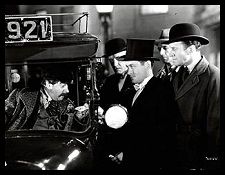
Metro-Goldwyn-Mayer Studios always had a flair for making period films, especially those with a Victorian setting.....and they made quite a number of them, too. Being quite a savvy production company, they also discovered that a good script is worth repeating. Hence, many of the Victorian-era thrillers that the studio made in the 1930s and 1940s were later remade. One such film was The Mystery of Mr. X (1935) which they remade in 1952 under the title The Hour of 13

Robert Montgomery starred in the original film as dapper gentleman thief Nicholas Revel. A killer known as "Mr. X" is on the loose in London targeting police constables. By a strange coincidence, his latest killing occurred the same night and in the same location as one of Revel's latest robberies. In order to clear his name, Revel decides to play an amateur detective and track down the fiend himself, all the while dodging the suspicious eye of Police Commissioner Sir Herbert Frensham (Henry Stephenson). 

The Mystery of Mr. X was based on the novel "X vs Rex", written by Philip MacDonald (The List of Adrian Messenger). Howard Emmett Rogers worked it into a quick and thrilling script and MGM had another winning Robert Montgomery picture in the theaters. 

What works once can work again, hence, seventeen years later, producer Hayes Goetz blew the dust off the script and hired screenwriter Leon Gordon to rework it into a vehicle for MGM's young star, Peter Lawford. What resulted was a charming gaslit London mystery that holds up quite well for its age. 

This time, Nicholas Revel is tracking down the killer known as The Terror. The police - primarily Inspector Connor (Roland Culver), believe that if they find the thief who stole Lady Elmbridge's emerald, they find the Terror. Since Revel stole the emerald, he wants the real Terror caught before they fence him in for a series of murders he did not commit. 

The Hour of 13 was made at the MGM-British Studios in Borehamwood, England and, while there are not many location scenes, the film sets are excellent and perfectly evoke that Jack-the-Ripper setting of old London. 

Peter Lawford is not my idea of a gentleman thief (Stewart Granger would have been excellent in this part) but he is surprisingly good. In fact, it would have been nice to see him in a series of Nicholas Revel mysteries. Playing his leading lady is English actress Dawn Addams who had a long career with MGM and an even longer career working in television. Also in the cast is Michael Hordern as Sir Henry Frensham, Derek Bond, Leslie Dwyer, and Colin Gordon. 

The Hour of 13 is available on DVD via Warner Archives.

Friday, February 17, 2023

Snowbound ( 1948 )

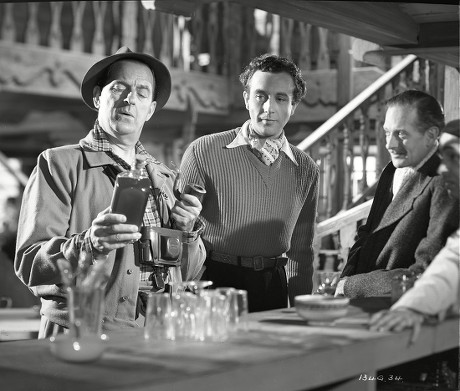
Dennis Price and Stanley Holloway head to the Swiss Alps in the 1948 British thriller Snowbound. Price is assigned to pose as a screenwriter gathering material for a new film when in reality he is to gather information about the people who are staying at a mountain chalet and report that information to a former British espionage agent ( Leo Genn ). Within days, his cover is exposed and he quickly finds that everyone staying at the chalet is there for a secret reason...and not for "their health" as they claim. Among the suspicious characters are Marcel Dalio, Mila Parely, Herbert Lom, and Guy Middleton.

Snowbound is a quick thriller that has some nice Alpine location filming. While the story is easy to follow, the film could have been improved upon by a little less dialogue and more action. Aside from an occasional visit to the hotel down the mountain, most of the action takes place within the chalet, making it seem rather stage-like. This is surprising since the story is from a novel ( The Lonely Skier by Hammond Innes ) that was adapted directly to the screen. 

Variety magazine's review of the film claimed that the "main failing of the yarn is that situations do not thrill sufficiently", which is quite true. The action does not build up until the second half of the film, but then it does conclude with an exciting finale. 

Sydney Box produced the film, which was distributed stateside by RKO. Sydney was the head of Gainsborough Studios and produced a number of fine British films on his own as well. His sister Betty Box was also a prolific producer of many great British classics. 

Snowbound is worth watching for its cast of character actors ( Dennis Price makes a good "spy"  ) and its snowy mountain location. It is especially enjoyable to watch on a winter afternoon, but if you miss it airing on television, it really is not worth going out of your way to hunt it down.  

Thursday, November 10, 2022

Murder at the Gallop ( 1963 )

"Yes, old Enderby was frightened to death!"

One afternoon, while collecting funds for charity, Miss Marple witnesses the death of Mr. Enderby, a death that the doctor claims was due to a heart attack. Miss Marple believes it was deliberate murder: a heart attack triggered by the sight of a cat. Mr. Enderby, a rich recluse, had "a weak heart and a pathological horror of cats. What easier than for some interested party to slip a cat into the house, a cat that the old man would come upon accidentally. Yes, old Enderby was frightened to death!"

She takes her suspicions to Inspector Craddock of the local police, whom she had worked with on a previous murder case. Craddock found her to be "of some small help" before but, upon hearing this new theory of hers, suggests she read fewer thrillers.

At the reading of the will, Mr. Enderby's family members are shocked to hear demure Aunt Cora also suggest that his death was deliberate. "He was murdered....wasn't he?" When Aunt Cora is dispatched with - by a hatpin of all weapons! - Miss Marple decides to don her Sherlock Holmes cap and solve the mystery herself. 

Murder at the Gallop was the second of four Miss Marple mysteries made in the 1960s starring the engaging English character actress Dame Margaret Rutherford. It was a follow-up to Murder, She Said ( 1961 ) and many of the elements used in Murder, She Said are repeated in this second outing, notably the family inheritance plot line, the eccentric male lead ( this time played by the perpetually baffled-faced Robert Morley ), the surly stablehand, and the multiple murders. Yes, when Miss Marple attempts to solve a case, murder is never a solitary occurrence. Even the finale of Miss Marple receiving a marriage proposal is repeated. 

The members of the Enderby family are not as interesting as the Ackenthorpes of Murder, She Said but they do make wonderful murder suspects. Each of them received a goodly inheritance from old Mr. Enderby, but one of them is obviously out for a larger share of the money. 

Hector Enderby ( Robert Morley ) leads the list of suspects as the head of the family and proprietor of the Gallop Hotel, where the Enderbys, Aunt Cora's companion Miss Milcrest, and Miss Marple are all staying. Hector loves to be in the saddle more than anything else and he sees "this whole murder business" and the police's presence as interference with running his business establishment. 

His niece Rosamund, portrayed by Katya Douglas, is a spoiled and demanding woman. She is not overly interested in the Enderby fortune because her mind is preoccupied with curiosity as to why her husband Michael ( James Villiers ) lied about what he was doing the afternoon Enderby died. Nephew George ( Robert Urquhart ) is certainly greedy enough to murder. He quickly becomes Miss Marple's prime suspect, but when he turns up dead, she - and the audience - are forced to re-examine the case. 

"Agatha Christie should be compulsory reading for the police force."

Murder at the Gallop is one of the best of MGM's Miss Marple mysteries. It was loosely based on Agatha Christie's 1953 Hercule Poirot novel "After the Funeral". Credit should be given to screenwriter James P. Cavanaugh ( a frequent writer of episodes of Alfred Hitchcock Presents ) for reworking the story into such an entertaining yet baffling mystery. Murder mysteries are often filmed as dramas or comedies but Murder at the Gallop straddles both of these genres. It is neither serious drama nor farce. It is simply an enjoyable - and highly amusing - tea and crumpet mystery. 

Ron Goodwin's sprightly harpsichord music greatly contributes to the entertainment and the overall production is top-notch. The cinematography by Arthur Ibbetson is properly atmospheric and the location filming around Buckinghamshire adds to the film's appeal. But make no doubt about it, the film's most charming asset is Dame Margaret Rutherford herself, the endearing star of these films.

Rutherford's characterization of the popular sleuthing spinster bears little resemblance to the Jane Marple you will find in Agatha Christie's novels. Plump and energetic, Rutherford completely transformed Miss Marple into a spunky, emancipated, lovable old gal with a taste for mystery and mayhem. With jowls jiggling and a tongue firmly jutted in her cheek, Jane swings her tweed cape about her, squares her shoulders, and is ready to face any danger that stands in the way of her amateur sleuthing. She has an indomitable spirit that will suffer no nonsense - not even from a murderer!

Often aiding Miss Marple in her detective work is her loyal friend, Mr. Stringer, custodian of the local library in Milchester. This character was newly created for the series to give Margaret Rutherford's husband, Stringer Davis, a co-starring role in the series. Mr. Stringer, or "dear Jim" as Miss Marple affectionately calls him, is an invaluable source of support and the perfect partner to Jane. In Murder at the Gallop, he does the "leg work" in town for Miss Marple while she remains at the Gallop Hotel keeping a close eye on the suspects. At the exciting climax, they also get to perform the twist together!

The remaining cast, which includes Finlay Currie, the talented Flora Robson, Charles Tingwell as the kindly Inspector Craddock, and Duncan Lamont, add to making this an overall delightfully entertaining mystery.....one that even a loyal Agatha Christie fan would enjoy. 

This post is our contribution to the Movies are Murder! Blogathon being hosted by the Classic Movie Blog Association. Click here to read more reviews of murder-themed classic films and click here to view the original trailer for Murder at the Gallop

Sunday, October 16, 2022

Orson Welles' Great Mysteries

Orson Welles always loved a scary tale. In 1938, he and other players of his Mercury Theater company put on a radio play of H.G. Wells' "War of the Worlds" for Halloween that scared the heebie-jeebies out of most of his listeners. Then in 1951, while taking a break from filming Othello in Ireland, he filmed a short horror film called Return to Glennascaul about a man who unknowingly gives two ghosts a ride on a deserted country road. 

While most of his films steered clear of horror or suspense, he delved deep into the muddy waters of mystery in 1973 when he played host to a British anthology series entitled Orson Welles' Great Mysteries. The series was very similar to the classic Alfred Hitchcock Presents and, like Hitchcock, Orson Welles merely had to act as host, introducing and closing each episode with some pithy words. Unlike Alfred Hitchcock Presents, the episodes of Great Mysteries were all based on famous works or short stories by authors like Sir Arthur Conan Doyle, Wilkie Collins, Honoré de Balzac, and Charles Dickens. 

Orson Welles had a long career as a director, producer, screenwriter, and actor, but by the early 1970s he was in debt ( owing money to the IRS for back taxes ) and, unable to fund his latest docudrama F for Fake, he began to do numerous television appearances to help raise money. In the early months of 1973, he crossed the pond to England to film the intros/outros to the series at the Anglia Television studios in Norwich ( East Anglia ).

Welles was known to be a difficult person to work with and the production team at Anglia studios found this to be true ( in fact, the Sky Arts series Urban Myths made an entire episode in 2020 about his visit called "Orson Welles in Norwich" ). Nevertheless, he gave a marvelous performance as a mystery host. He donned a black cape and hat and, purring sardonic wit, he beautifully introduced each tale of the macabre in his deep silky voice. 

Orson Welles' Great Mysteries ran for two seasons with a total of 26 episodes being produced. Some of the titles included were "The Monkey's Paw", based on the short story by W.W. Jacobs, and "La Grande Breteche" by Honoré de Balzac. What made the episodes entertaining was all of the stories selected had unexpected endings, usually with a sting.

John Barry composed a haunting but typically 70s theme for the series ( it could have worked equally well for a James Bond and the Haunted House film ) and the episodes were similarly chilling like other popular British anthology series of the time ( namely Brian Clemens' Thriller and Hammer House of Horror ) but not nearly as violent or gory. 

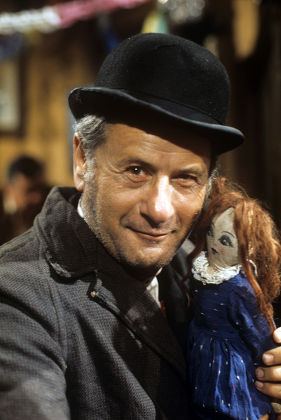
With a 25-minute runtime, the tales entertained without getting boring. Plus, there was the added bonus of playing spot the actor with each episode featuring numerous British character actors plus acting legends such as Eli Wallach, Joan Collins, Christopher Lee, Richard Johnson, Claire Bloom, Peter Cushing, Jane Seymour, Dean Stockwell, Jose Ferrer, and Shirley Knight. 

Network Distributing released the entire Orson Welles Great Mysteries on DVD in two volumes.

Saturday, April 30, 2022

Way Down Cellar ( 1968 )

Three boys discover a secret tunnel under the vacant lot where they practice football and find that it leads to the old Burden house, where a gang of crooks is printing counterfeit money. 

Butch Patrick stars in Way Down Cellar, a made-for-tv movie that first aired on Walt Disney's The Wonderful World of Color in 1968. Butch was an established star of The Munsters and, when the series ended in 1966, he continued to have guest star roles in television series like I Dream of Jeannie, Gunsmoke, and Family Affair. This was one of two television films that Butch made for Walt Disney Studios that year, the other being The Young Loner

In Way Down Cellar, Butch Patrick plays Frank Wilson, a new boy in town, who quickly finds two chums, Beans and Skeeter ( Sheldon Collins, Lindy Davis ), who share his passion for flag football. The boys like to practice on the vacant lot next to the Burden house even though they know that the new owner of the place, Ethan Markus ( Ben Wright ), is rather mean and takes their footballs. When one of the boys accidentally falls into a trap in the ground, they discover an old tunnel dating back to the Revolutionary War that leads right to the basement of the Burden house. There they hear strange noises and bravely decide to investigate one evening when their parents are away....unfortunately, their snooping leads to capture!

Many of the films that were made for The Wonderful World of Color were aimed at a juvenile audience but entertained adults as well. Way Down Cellar is rather short on adult entertainment but it includes all the elements that you would want to see in a children's mystery - a secret tunnel, an intelligent crook ( with a bumbling sidekick ), some engaging lead characters, and a simple plot. 

The film was based on a book by Philip Strong ( State Fair ) which Herman Groves adapted for the screen. He did a lot of work for Disney, including the more engaging juvenile classic - Alvin the Magnificent aka The Whiz Kid and the Mystery at Riverton ( 1973 )

Way Down Cellar was shot on the Walt Disney Studio backlot so Disney fans will recognize familiar houses that reappeared in other Disney films. Car enthusiasts would also enjoy seeing the 1966 Lincoln Continental that one of the counterfeiters drive. 

Ben Wright is great as Ethan Markus, the elegant crook, but the best performance is by Richard Bakalyan, a favorite Disney character actor. Also in the cast is Frank McHugh as the sheriff, Grace Lee Whitney ( Yeoman Rand on Star Trek ), and David McLean as Frank's dad, Professor Wilson. 

Way Down Cellar is yet another film that Disney has yet to release on DVD or via streaming, but you can catch it here, thanks to a generous fan. 

Saturday, July 31, 2021

After Office Hours ( 1935 )

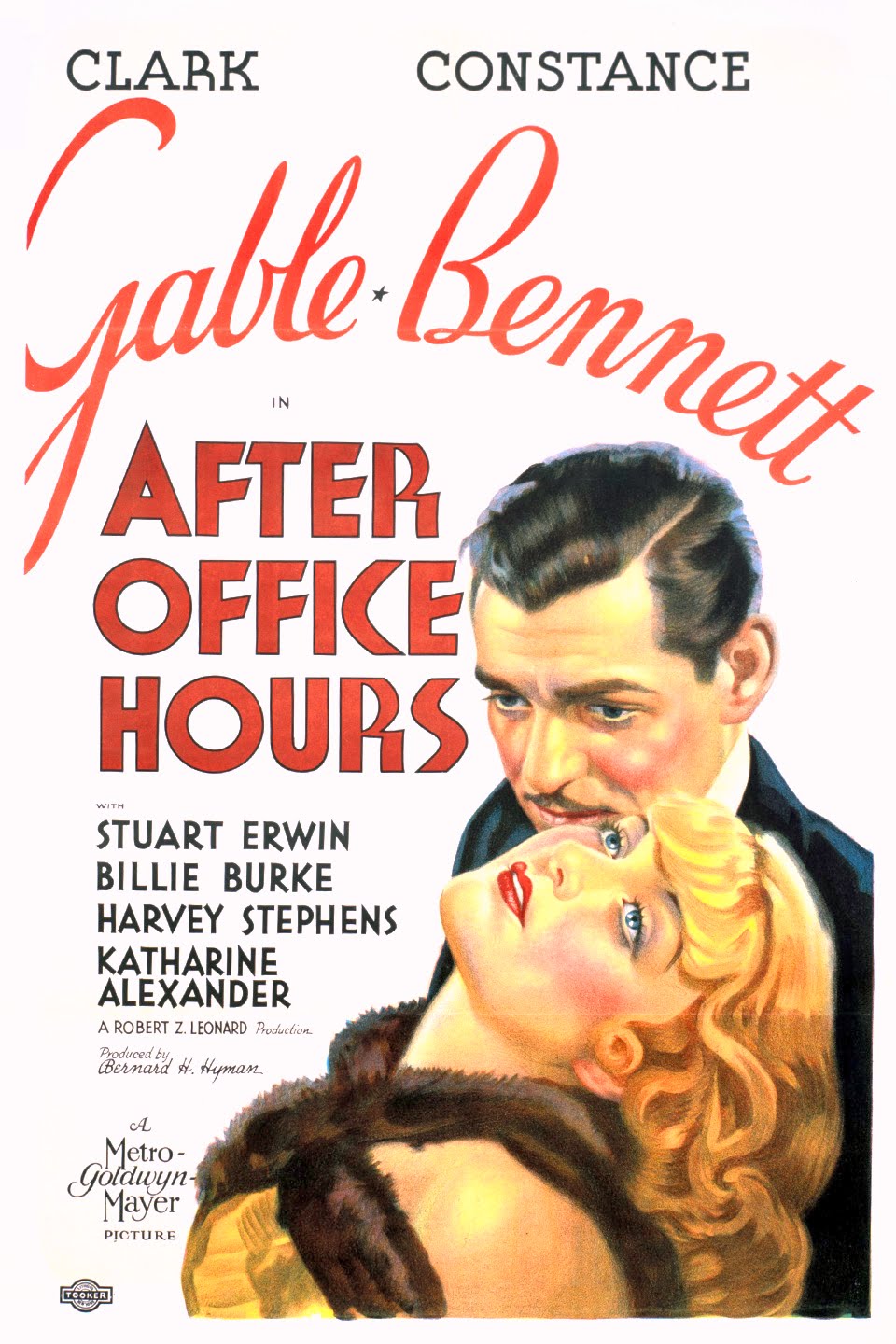
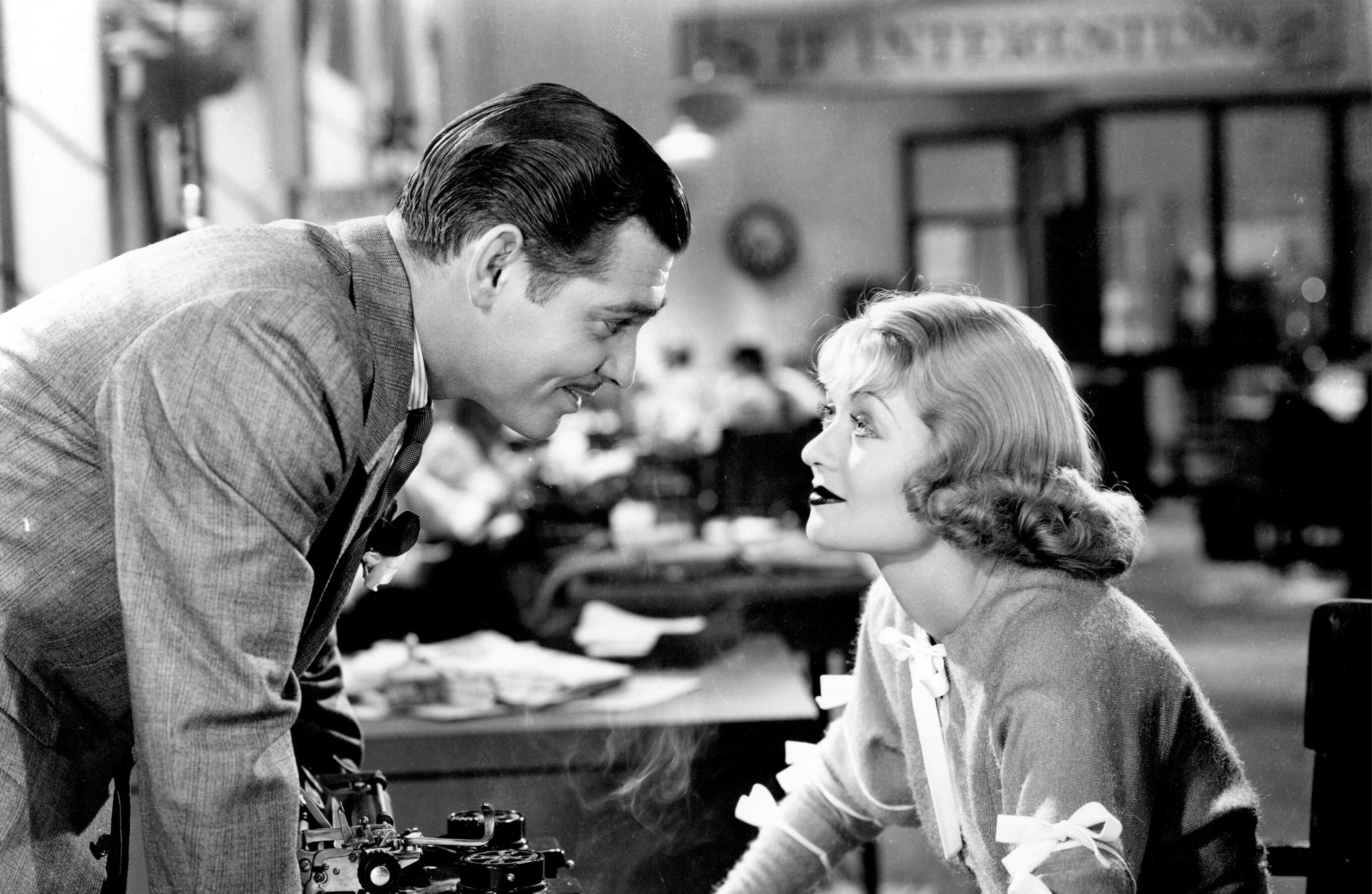
Clark Gable and Constance Bennett, two of the biggest stars in Hollywood in the early 1930s, teamed up only once for a fast-paced mystery/drama called After Office Hours ( 1935 ). 

This MGM release featured the King of Hollywood in a typical Gable-like role as Jim Branch, a hard-hitting New York news reporter who would do anything to scoop the headlines from his rival newspaper. The latest sensation is a rumor that Tommy Bannister ( Harvey Stephens ) is having an affair with the wife of millionaire Henry King Patterson ( Hale Hamilton ). Jim wants the dirt about the story but Henry King's circle of friends is strictly society grade. Luckily, he has Sharon Norwood ( Constance Bennett ) on his staff. She happens to be a socialite who is playing a working gal for a lark. She also happens to be good friends with Tommy Bannister. Jim decides to use her to get the inside story but falls in love with her in the process!

After Office Hours was clearly MGM's attempt to capitalize on the success of Columbia Studios' It Happened One Night ( 1934 ). Metro-Goldwyn-Mayer had loaned Gable out to Columbia as punishment for his affair with Joan Crawford. Frank Capra cast him as the cocky reporter in that film and it turned out to be a box-office smash, raking in nearly $2.5 million. When MGM received their golden boy back they quickly cast him in a film with a similar story. He's not chomping on a carrot in this film but his Bugs Bunny mannerisms are on display just like they were in It Happened One Night

The only thing After Office Hours lacked was the presence of a comedienne like Claudette Colbert. Ms. Bennett resembled a porcelain doll and was just as fragile. Herman Mankiewicz wrote a script packed with clever verbal repartee but Bennett lacked the ability to give her dialogue a humorous touch hence there was no zest in their interchanges. An actress like Claudette Colbert or Loretta Young would have made the film much more entertaining. 

Nevertheless, if you want a fast-paced mystery with some top-notch talent, then it is well worth checking out After Office Hours. Robert Z. Leonard did a great job of directing the film and MGM would later recognize his talents and give him big-budget assignments such as The Great Ziegfeld, Pride and Prejudice, and the Nelson Eddy/Jeanette MacDonald films. 

Also in the cast is Billie Burke, Stuart Erwin, Henry Travers, and Katharine Alexander. 

Saturday, May 8, 2021

Check It Out! - The Definitive Guide to "Murder, She Wrote" Website

Are you a "Murder, She Wrote" fan? If you're not yet, then a visit to the website The Definitive Guide to "Murder, She Wrote" will make you one! 

The highly addictive mystery series premiered in 1984 with a star-studded pilot episode and went on to become one of the longest-running drama series in television history, lasting 12 seasons. Series star Angela Lansbury portrayed Mrs. Jessica Fletcher, a retired New England schoolteacher turned author who takes time out from writing to solve crimes...many of which take place in the not-so-sleepy village of Cabot Cove, Maine. 

Dr. Anne Del Borgo, a veterinarian living in Maine, put together this great website covering every episode of the series, trivia, an image gallery, interviews ( including one with series co-creator Peter S. Fischer ), and a really neat scrapbook chock full of clippings from newspapers, magazines, and press reports. There are also sections on the history of the series, statistics, and a bio of Angela Lansbury. 

For fans of the Murder, She Wrote book series there is a treasure-trove of material as well. You can find reviews of every book MSW-themed and plenty of stories submitted by fans just like yourself. 

Check it out and see for yourself! 

Click here to visit The Definitive Guide to "Murder, She Wrote"

Tuesday, April 27, 2021

The Black Rider ( 1954 )

In the village of Swanhaven, a recent newspaper story about the mysterious Black Rider is sending a chill down the backs of the local townsfolk. After leaving the town pub one moonlit night, a drunk reported seeing the cloaked figure of the Black Rider while he was taking a shortcut through the old ruins of Brockham Castle. Legend has it that he is none other than the devil himself and anyone who looks upon his apparition is cast into the fires of hell. 

The drunk considers himself lucky to have escaped alive. Little does anyone realize that a gang of smugglers is using the old legend of The Black Rider to scare away people from Brockham Castle while they undertake to smuggle atomic sabotage equipment across the Channel. It takes some quick thinking from young reporter Jerry Marsh to capture the band of crooks. 

The Black Rider is a fun little British B-film from the newly formed Balbair Productions Co. Its Scooby-Doo-like plot is devoid of mystery ( there is only one suspect so it must be him ), but nevertheless, it is highly entertaining and runs just a little over an hour. Jerry Marsh, played by Jimmy Hanley, makes a jolly hero and it would have been nice to see him appear in several other films. Jerry's fiancee Mary ( Rona Anderson ) is the village librarian and her father Mr. Plack ( Leslie Dwyer ) is the editor of the newspaper Jerry writes for. 

Jerry just purchased a motorbike and this becomes a sub-plot in the film, with members of his motorcycling club helping him hunt for the smugglers in the final scenes. Motorcycling was becoming a popular hobby sport for many people in the 1950s and motorcycle clubs were sprouting up all across England at the time. Mr. Plack disapproves of Jerry's new mode of transportation but, by the end of the film, he comes to like the "machines". 

Fans of British B-films will easily recognize many of the actors in the film. Jimmy Handley was popular in the Huggetts film series. Leslie Dwyer played in a number of films of the 1940s and 1950s, usually as a grouchy middle-class shopowner. Rona Anderson made several good mystery films and looks particularly lovely in this picture with her hair dyed blonde...and last, but certainly not least, the great character actor Lionel Jeffries, who plays the debonair villain in The Black Rider

Director Wolf Rilla ( Village of the Damned ) did a fine job of keeping the film moving along at a brisk pace and the script, by A.R. Rawlinson, has a number of humorous touches. All in all, a great little mystery to enjoy!