Showing posts with label Charles Schneer. Show all posts

Tuesday, July 12, 2016

The Golden Voyage of Sinbad ( 1974 )

Exotic adventure, thrills and romance were all to be had in The Golden Voyage of Sinbad, the second of three Sinbad movies that special-effects animator Ray Harryhausen helped to create during the 1950s-1970s. The first film - The 7th Voyage of Sinbad ( 1958 ) - was a storybook Arabian Nights fantasy that combined an exciting tale of adventure with amazing stop-motion animated creatures, a powerful Bernard Herrmann score, and beautiful location scenery. It was extremely popular with children and adults alike during its initial release, but its creators, Harryhausen and producer Charles Schneer, had several other projects in the stewpot and did not concentrate on developing another Sinbad film to follow up on its success until the early 1970s. 

This film, aptly titled The Golden Voyage of Sinbad, found the turbaned sailor ( John Philip Law ) on a quest for the missing pieces of an ancient golden tablet that points the way to an island which contains a mythical fountain granting eternal wealth and power to the man who bathes in its waters. Over land and sea Sinbad journeyed with the evil magician Koura ( Tom Baker ) ever on his tail. Koura desperately sought the restoring power of the fountain because his life force was draining out of him with every incantation he chanted. 
This story plot provided Ray Harryhausen with ample opportunities to pit various creatures against our hero and the film featured some of Harryhausen's best Dynamation work including the bat-like Homonicus, a messenger to Koura; the wooden figurehead which comes to life; the terrifying centaur; and the griffin, defender of the magic fountain. Also, who could possibly forget the six-armed statue of Kali? Despite being slow on its feet, it was nimble with its swordplay. 

Aside from creating the stop-motion sequences of mythical creatures and other characters, Harryhausen helped flesh out the stories to almost all of the films he worked on. He also created extremely detailed storyboards allowing the directors to simply follow each block like a comic book.

The Golden Voyage of Sinbad was three years in the making with Harryhausen spending one year strictly at work filming the creatures. Critical reception was generally negative upon its release but that did not deter its creators from making a third Sinbad film several years later - Sinbad and the Eye of the Tiger ( 1977 ). 

Screenwriter Brian Clemens ( of The Avengers fame ) penned a marvelous script for The Golden Voyage of Sinbad filled with nonstop action. Combined with the talented cast, a sweeping Miklos Rozsa score, and Harryhausen's "magic", it has now gained the rightful reputation of being the best of the Sinbad series.

Of the three actors who portrayed Sinbad in each of the Harryhausen pictures, John Philip Law, the star of The Golden Voyage of Sinbad, was certainly the most convincing, capturing the adventurous spirit and the inspiring leadership of the fabled sailor. With Law portraying Sinbad, it is easy to see why his sailors followed him to the four corners of the world.
Tom Baker is also excellent as Koura, the master of the black arts, with his intense eyes and imposing presence. Christopher Lee was originally slated to play this part, but through a stroke of good fortune Baker was cast. This film would be instrumental in Baker obtaining the role of the fourth doctor in the television series, Dr. Who.

Also cast in the film was Caroline Munro as the buxom slave girl Marinda, Douglas Wilmer as the mysterious gold-masked vizier, and Kurt Christian as Sinbad's friend Haroun, included for comic relief. 

This post is our contribution to The Ray Harryhausen Blogathon being hosted by Wolffian Classics Movies Digest. To read more posts about Harryhausen, his life, and his work, check out this link!

Saturday, March 5, 2016

The 3 Worlds of Gulliver ( 1960 )

Producer Charles Schneer and special effects maestro Ray Harryhausen teamed up in the late 1950s and early 1960s to create a series of adventure films mixing live-action with stop-motion animation. The 7th Voyage of Sinbad ( 1958 ), Jason and the Argonauts ( 1964 ), and First Men in the Moon ( 1964 ) were some of their most popular titles. 

The 7th Voyage of Sinbad was a huge box-office success upon its initial theatrical release and so Charles Schneer and Ray Harryhausen wanted to select another story, as famous as the Sinbad tales, to ride on the heels of its success. They wanted a plot-line that would also have a fantasy element and offer possibilities in the story for stop-motion animation. They chose Jonathon Swift's 1726 novel "Gulliver's Travels".....a great idea. 

Kerwin Mathews, the star of Sinbad, was cast as Lemuel Gulliver, a doctor who is tired of collecting chickens and vegetables as his fee and decides to set off on an ocean voyage to find his fortune and make a name for himself. His fiancee Elizabeth ( June Thorburn ) is not pleased with this idea but nevertheless sneaks aboard ship to be near him. During a storm at sea, they wash overboard and become separated. Gulliver lands first on the island of Lilliput, inhabited by tiny people, and then on an island of giants where he reunites with Elizabeth. 


The 3 Worlds of Gulliver was geared towards a juvenile audience, much like The 7th Voyage of Sinbad, but unlike that film, it fails to entertain adults as well. The New York Times film critic Eugene Archer praised the stop-motion animation of The 3 World of Gulliver but noted that "adults will find it all too mechanical to really capture the imagination, and may resent the unclear ending that seems certain to provoke some youthful queries." We couldn't agree more. The opening sequence and the Lilliputian segment are very enjoyable, however, once Gulliver and his sweetheart find themselves among the giants of Brobdingnag, the story condensends to a child's level with especially over-the-top performances from the King ( Gregoire Aslan ) and Queen ( Mary Ellis ). 

"I stop wars, put out fires, feed people, give them hope and peace and prosperity - how can I be a traitor?"

Gulliver and Elizabeth manage to escape the Brobdingnag's by the end of the film and they once again find themselves washed upon a shore...but this time they are back in England. Their final dialogue seems to suggest that what happened to them was all a dream ( two people dreaming the same dream? ). And Gulliver's final explanation of the transformations that occurred to them made little sense. 

Jonathan Swift's novel originally had Gulliver travelling to four different lands, with each land providing an opportunity for Swift to make ironic commentary on human nature. The film version limits Gulliver's encounters to two worlds ( the third world being England ), and retains some of the satire of the novel but in a much more family-oriented manner. 

Kerwin Mathews is very entertaining as Dr. Gulliver, and the always lovely British actress June Thorborn is excellent as well. Also in the cast are Jo Morrow, Lee Patterson, Basil Sydney, Martin Benson, and Sherri Alberoni ( as the big little Glumdalclitch ). 

Today The 3 Worlds of Gulliver is not counted as one of the most beloved films among Harryhausen's filmography most likely due to its overly juvenile enactment and its lack of creatures. Aside from the squirrel and the giant lizard attack near the end of the film, Gulliver does not encounter any beasts during his multiple maroonings. However, the optical illusions that Harryhausen created for the film are extremely well done.


For their next project, Charles Schneer and Ray Harryhausen returned to entertaining adults and children alike with their adaptation of Jules Verne's Mysterious Island ( 1961 )....and that picture was a smashing success.

Thursday, February 20, 2014

First Men in the Moon ( 1964 )

Charles Schneer and Ray Harryhausen, two of the foremost producers of sci-fi films of the 1960s, had in 1963 recently completed their sea-faring mythology extravaganza " Jason and the Argonauts "  when they decided to embark upon a screen-telling of H.G Well's famous Victorian fantasy novel "First Men in the Moon".

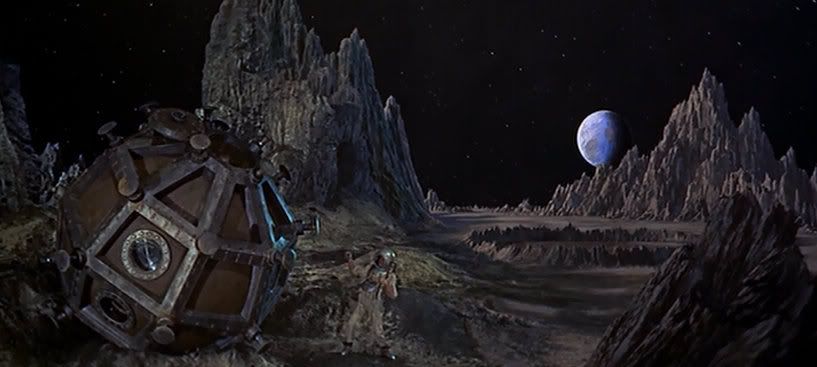
Filmed in astounding "Dynamation!" the movie begins in modern times with a UN space ship rocketing to the moon. Amidst cheers on Earth for the historic moment, the very first men walk on the surface of the moon.....but lo! within steps from their rocket ship these astronauts discover a flag - a Union Jack flag.  And along with the flag, a declaration ( written on the back side of a summons for Katherine Callender ) claiming British subjects had honorably walked that solitary surface in 1899....and had claimed the moon for her majesty, Queen Victoria.


Quickly a UN investigation team is dispatched to the tiny village of Dymschurch to question Katherine Callender, but when they discover that she had since died, they seek explantations from her husband Arnold who is now living in a nursing home.

After his initial shock at seeing photographs of the flag he had helped to place on the moon, he relates the story of their voyage.....

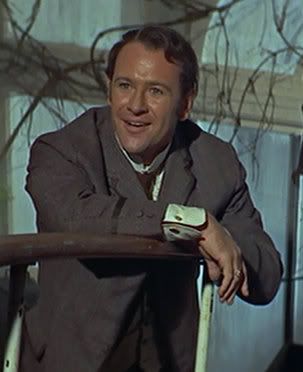
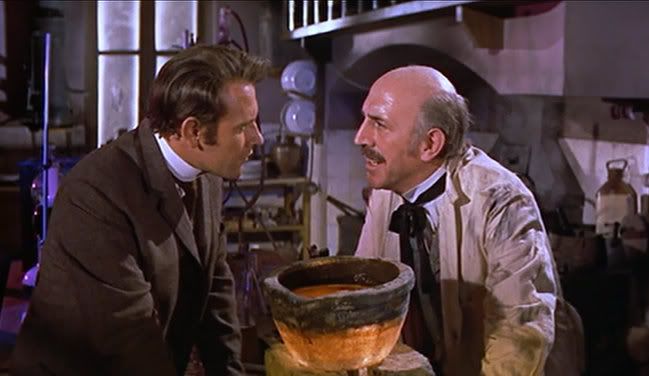
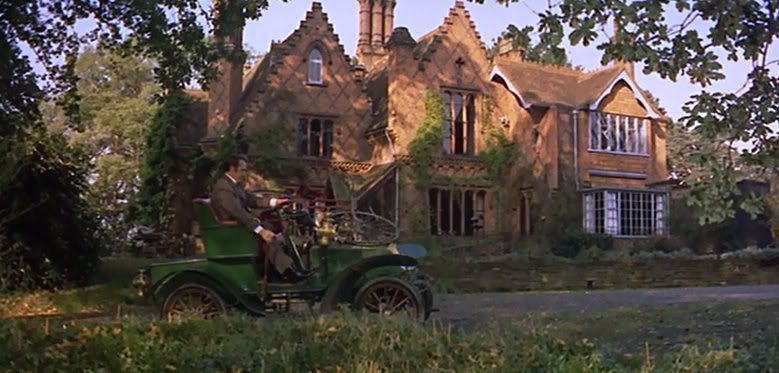
In the secluded country village in England, Arnold Bedford ( Edward Judd ) is working ( or rather....not working ) on his play. Always looking for a new way to make some money, he becomes fascinated with the scientific substance his neighbor, an eccentric scientist named Joseph Cavor ( admirably played by Lionel Jeffries ) has recently invented....Cavorite it is called. A liquid substance it be, and it deflects the force of gravitity on any object that it is painted unto. Seeing a very lucrative business opprotunity here, Arnold talks his way into becoming partners with Cavor.


Cavor explains that his main use for Cavorite will be to apply it to the surface of a bathysphere that he has constructed in his greenhouse with the intention of flying to the moon...and of course, Arnold is astonished at this fool hardy scheme...UNTIL that is, he hears the reason why. "There be gold in them thar mountains!" Ah yes, to the depths Man would fanthom for the pursuit of wealth.

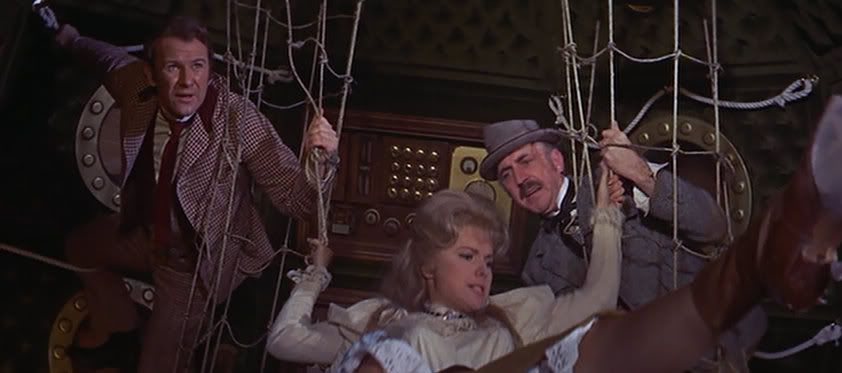
And so, in no time at all our merry duo hastily prepare for their sojourn to the Moon. Unlike the book, where Bedford and Cavor remain the only passengers on this journey, the film added a female character - Bedford's fiancee, Katherine ( Martha Hyer ) known simply as "Kate" to tag along with the boys on their ride through space. A pretty addition she is too.

" Stop calling me Mrs. Bedford. We are not married! " ....." Not married?!... Madam ....kindly leave the room! "
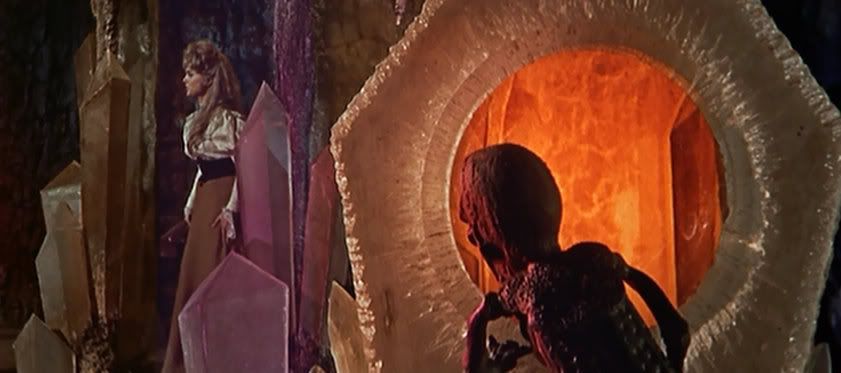
Once on the moon we see the handiwork of model-maker extrodinaire Ray Harryhausen with magnificent space sequences, a gigantic brained Grand Lunar ( seated on a throne behind a veiled screen, much like the Wizard of Oz ), a caterpillar-like mooncalf, and a number of little Selenites....which are actually children in suits, so maybe that doesn't count as Harryhausen handiwork.


"First Men in the Moon" has always been my favorite of all of the Charles Schneer/Ray Harryhausen pictures because of the mood it evokes. There is a beautiful Victorian flavour throughout the film and the pre-moon scenes are my especially favorites ( oddly enough, these are the ones that have no special effects at all and make up about 45 minutes of the picture ).


" It's....simply.....imperial "

Laurie Johnson, one of England's most renowned television and film composers at the time, wrote a haunting and atmospheric theme to "First Men in the Moon" as well as a lovely romantic ballad that can be heard softly in the background whilst our characters are at Cherry Cottage and during the greenhouse sequences. The complete soundtrack to the film has been released on audio cd but unfortunately, is quite a rare album to find today.


Peter Finch happened to stop by the set one day to visit his good friend, Lionel Jeffries, and found himself being used for a guest spot as the baliff who serves Kate her legal summons. Aside from his appearence there are not too many well-known character actors with the exception of Milles Malleson who does one of his characterisitc dithery/absent-minded impersonations as the church registar.

" Poor Cavor...he always did have that nasty cold "

"First Men in the Moon" takes us on a wonderful light-hearted sojourn to a Victorian era, a period when the spirit of exploration was at its peak and there were new and exciting worlds just waiting to be explored....and conquered. Some say this film drags on until the scenes when they land on the moon and see the "creatures" but I disagree. But then, that may be because I have never been much of a sci-fi film fan.

Anyway, overall the film is a delight to watch and the recent DVD release has just astounding sound and remarkable color restoration. Details you never thought to notice stand out bright and bold. It is a relaxing movie and what I like best of all about it is the carefree way our heroes go about on their expedition to the moon. They pack a few cans of sardines, a couple of chickens and are off on their way in no time at all. Where modern scientists take months and months of planning and preperation for a routine space flight, Bedford and Cavor simply put on their jackets, hop in their sphere....and enjoy the ride! What comes, comes.

Quite right.....the only way to travel.

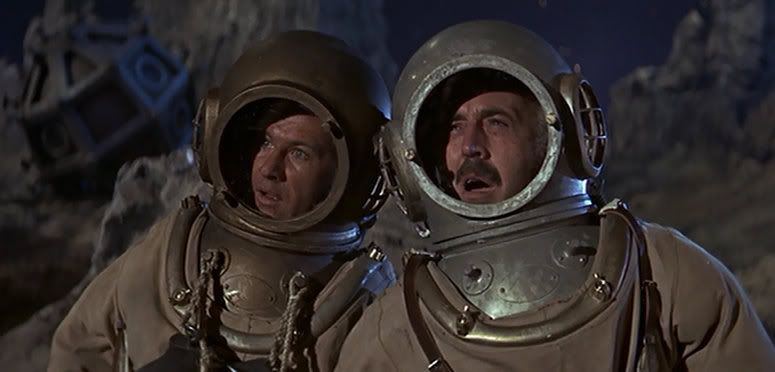
Two chumps having a jolly good time on the Moon

This post was originally published on The Absent-Minded Buccaneer blog. 

Tuesday, June 25, 2013

The Films of Ray Harryhausen

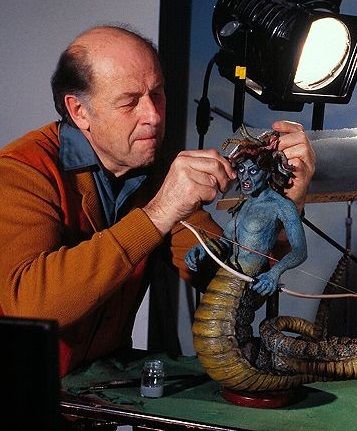
Ray Harryhausen was one of Hollywood's most famous stop-motion animators and most influential special effects innovators. Prior to the development of computerized special effects, stop-motion animation played a key role in adventure and sci-fi filmmaking from the 1940s up until the 1980s. Of those that were skilled in this technique there were relatively few. Ray Harryhausen not only mastered the slow and delicate art of animation but he made large strides in what can be done - with a little bit of patience - using simple models and photography. 


When "Jason and the Argonauts" hit the big screen in 1963 audiences were in awe of Jason's fight against the army of skeletons. Harryhausen breathed life into those inanimate objects with bone-clattering violence. A pterodactyl silently swooping down upon a lone cave woman, a goddess taking the form of a ship's figurehead, a giant bronze statue creaking to life to wreak vengeance on the men who stole the sacred treasure of the gods, these were all memorable moments on screen that not only seemed amazing in youth but continues to astound today, even in the midst of mind-boggling CGI effects. 

George Lucas, claimed that "if it hadn't been for Harryhausen there would have never been a Star Wars". Directors Peter Jackson and James Cameron also cite Harryhausen as their inspiration and his films their incentive to pursue film-making as a career. 

This post is called The Films of Ray Harryhausen because, although he was not an auteur filmmaker and his role in the movies that he made could not be confused with that of the director, he did much more than his simple credit of "special visual effects" justified. It was often Harryhausen who proposed the initial story concept, scouted the locations, helped work on the script, the art direction and the design of the film. It's no wonder that these films have a distinguishable style that sets them apart from other adventure films of the era. They all bear the Harryhausen stamp. 

Ray Harryhausen ( June 29, 1920 - May 7, 2013 )


Mighty Joe Young ( 1949 )

A young girl in Africa raises a gorilla and must decide whether to expose him to the "jungle" of New York when a promoter decides to exhibit the creature. Terry Moore, Ben Johnson, Robert Armstrong. Directed by Ernest Schoedsack. 

The stop-motion Pioneer Willis O'Brien, was approached by a teenage Ray Harryhausen in the early 1940s and asked if he could study under him, O'Brien told him to go to art school and practice his craft all he can. He did, and later, in 1948, O'Brien asked him if he would like to work with him on his upcoming picture "Mr. Joseph Young of Africa". Did he! "Mighty Joe Young" was essentially a remake of Willis O'Brien's own classic "King Kong" ( 1933 ), but it became the launching pad into a world of feature film animation for Ray Harryhausen. 


The Beast from 20,000 Fanthoms ( 1953 ) 

Scientists discover that a prehistoric dinosaur was reawakened to life during an Arctic atomic bomb test. Paul Christian, Paula Raymond, Cecil Kellaway, Kenneth Tobey. 

"The Beast from 20,000 Fanthoms" was Harryhausen's first solo project and the film where he developed the split-screen animation technique which was later to be known as Dynamation. "Beast" was a great commercial succcess and opened the doors to greater projects for Harryhausen. 


It Came From Beneath the Sea ( 1955 ) 

Radiation from bomb tests conducted in California change the feeding habits of an octopus by creating a ferocious appetite! Kenneth Tobey, Faith Domergue, Donald Curtis, Ian Keith. 

Following the success of "The Beast from 20,000 Fanthoms", came this creature flick from out of the primordial depths of Charles Schneer's imagination. The young producer from Columbia Pictures was introduced to the budding animator and together they created this monster classic - as well as a partnership that spanned over three decades. 


Earth Vs. The Flying Saucers ( 1956 ) 

A scientist is contacted by alien beings who secretly plan to enslave all inhabitants of Earth. Hugh Marlowe, Joan Taylor, Donald Curtis, Grandon Rhodes. 

What better way to follow up a monster movie than to make a sci-fi film? And no sci-fi film would be complete without retro UFOs. "Earth Vs the Flying Saucers" contains an excellent sequence of the alien flying discs attacking the nation's capital, Washington D.C. 


20 Million Miles to Earth ( 1957 ) 

A giant reptilian-like creature from Venus stows away on the return flight of a US spaceship and wreaks havoc in Europe. William Hopper, Joan Taylor, Frank Puglia. 

The death of the giant prehistoric Ymir - part dinosaur, part fish - at the close of this film was reminiscent of Willis O'Brien's classic "King Kong". Harryhausen always wished to create his own legendary figure that would move an audience to feel pathos at the creature's demise, much like Kong did, and with "20 Million Miles to Earth" he succeeded in doing just that. 


The 7th Voyage of Sinbad ( 1958 ) 

Sinbad undertakes a quest to a mysterious island to obtain the ingredients to cure a princess of a curse she received by a wicked magician. Kerwin Matthews, Kathryn Grant, Richard Eyer, Torin Thatcher. 

"The 7th Voyage of Sinbad" was Harryhausen's first foray into the realm of color filmmaking. Although he had done a number of short stop-motion animation films in color this was the first time he would experiment with Dynamation in color. Within his studio confines he had the added hassle of matching the lighting and coloring of his filming with that used in the live-action sequences. The result was stunning. "The 7th Voyage of Sinbad" remains one of Harryhausen's most memorable movies. 


The 3 Worlds of Gulliver ( 1960 ) 

A man is washed away during a storm at sea and lands on an island inhabited by little people...Lilliputians. Kerwin Matthews, June Thorburn, Jo Morrow, Lee Paterson. 

"The 3 Worlds of Gulliver" is one of the least known films of Harryhausen, notably because of the lack of any large beastly creature. It has, however, some really great special effects and was the first of his films to be billed as using the "Superdynamation" process. 


Mysterious Island ( 1961 ) 

A group of prisoners of war during the Civil War escape in an air balloon and are washed ashore on an island inhabited by strange beasts and a mysterious visitor. Michael Craig, Joan Greenwood, Michael Callan, Gary Merrill. 

After Ray Harryhausen's modifications to Jules Verne's 1874 novel, "Mysterious Island" did not bear much resemblance to its source, which is just as well. Verne's sequel to "20,000 Leagues Under the Sea" did not contain much excitement in itself, but with Harryhausen's additions of a giant man-eating crab, an underwater city, a prehistoric baby bird attack, a 15ft. tall bee, and pirates, it was a beaut. 

Jason and the Argonauts ( 1963 ) 

The Greek hero, Jason, sets off on a voyage, along with a hand-picked crew, to the land of Carcus to capture the golden fleece. Todd Armstrong, Nancy Kovack, Gary Raymond, Laurence Naismith. 

Undoubtedly Harryhausen's most famous film ( it is his personal favorite as well ). This mythological classic featured the stunning skeleton sword fight, Talos the giant guardian of the god's treasures, and the six-headed hydra. Although it was not a box-office success upon its release it gained momentous popularity in the decades since and is now regarded as one of the greatest adventure films of the 1960s. 


One Million Years B.C ( 1966 ) 

The life of a lone caveman and his mate in a land inhabited by dinosaurs and hostile neighbors. John Richardson, Raquel Welch, Percy Herbert.

Harryhausen had a chance to return to creating dinosaurs in Hammer Studio's production of "One Million Years B.C". It was a loose remake of "One Million B.C" ( 1940 ) which featured very poorly done special effects. With the addition of Raquel Welch's own special eye-popping effects "One Million Years B.C" became a huge international success. 


The Valley of Gwangi ( 1969 ) 

In the Forbidden Valley in Mexico resides a Tyrannosaurus Rex whom a cowboy captures to gain fame by exhibiting in a circus. James Franciscus, Gila Golan, Richard Carlson. 

Back in 1941 Willis O'Brien conceived of a dramatic dinosaur western and called it "Gwangi". His pet project was never realized until Ray Harryhausen pitched the idea to Charles Schneer in 1967. "Gwangi" contains one of Ray's most elaborate animation sequences - the roping of Gwangi by cowboys. 


The Golden Voyage of Sinbad ( 1973 ) 

Sinbad meets a vizier who has part of a golden map, one of the which parts matches Sinbad's own, and together they voyage out to solve the riddle of the map, with an evil sorcerer on their tail. John Phillip Law, Caroline Munro, Philip Baker.

After the completion of "Jason and the Argonauts" in 1963, Ray Harryhausen wanted to develop another Sinbad adventure, intending on calling this feature "Sinbad's 8th Voyage". The idea was placed on the back-burner however until 1969 when it was put to simmer once more and developed into what became "The Golden Voyage of Sinbad". The dancing statue of six-armed Kali and the one-eyed centaur are just some of the highlights of this rousing adventure. 


Sinbad and the Eye of the Tiger ( 1977 ) 

Sinbad helps a cursed prince by sailing on a voyage to a dangerous island to seek a cure, whereupon a witch attempts to thwart their plans. Patrick Wayne, Taryn Power, Margaret Whiting.

Sinbad returned to the screen once more in this thrilling installment which included the classic baboon prince and the evil sorceress Zenobia. Harryhausen developed a plot treatment of the story back in 1974 but it was not until 1976 that filming began. 


Clash of the Titans ( 1981 ) 

Perseus goes on a journey to save the Princess Andromeda and encounters Kraken, a sea monster and Medusa along the way. Laurence Olivier, Maggie Smith, Harry Hamlin, Claire Bloom.

"Clash of the Titans" was given an enormous budget of $16 million by MGM to make ( Columbia had turned down the project ) but it went on to become a worldwide success raking in $41 million in the U.S alone. Beverley Cross, the screenwriter who worked on almost all of Harryhausen's films, developed the premise for this story, which was billed as "An Epic Entertainment Spectacular".


The dynamic threesome of Charles Schneer, Ray Harryhausen and Beverley Cross teamed up once more to create another classic legend epic, this time to be called "Force of the Trojans", a story about the journey of Aeneas from Troy to found Rome. MGM once again agreed to finance the project but over the years it languished. 

Hence, "Clash of the Titans" became the final film in Harryhausen's fantastic filmography. Perhaps in the future one of his ardent fans, such as Peter Jackson, may resurrect "Force of the Trojans" and make it the classic it would have undoubtedly become. Although, they must be careful how they go about it for as Harryhausen once said " If you make things too real, sometimes you bring it down to mundane "

Bibliography : 

Ray Harryhausen's Fantasy Scrapbook : Models, Artwork and Memories from 65 Years of Filmmaking - Ray Harryhausen and Tony Dalton. Aurum Press. 


Further Reading : 


The Art of Ray Harryhausen - Ray Harryhausen and Tony Dalton. Aurum Press 

Ray Harryhausen : An Animated Life - Ray Harryhausen and Tony Dalton. Billboard Books.

Saturday, June 22, 2013

Ray Harryhausen and the Creation of Dynamation


Ray Harryhausen was the stop-motion animator extraordinaire behind such fantasmagorical creatures as the fighting skeletons, the cyclops, Medusa, Kraken, and the beast from 20,000 fanthoms in such classics as "Jason and the Argonauts" ( 1963 ), "The 7th Voyage of Sinbad" ( 1958 ), and "Clash of the Titans" ( 1981 ). 

As part of our tribute to the late Ray Harryhausen we thought we'd include a brief introduction to the process he created known commercially as DynamationIt can also be called the "split-screen" process because of the way the screen appears to be split while the animation is being enacted in the middle layer.  

Prior to Harryhausen's development of this technique most animation was created for sequences that did not require "live" actor interaction within the scene. For instance, in an adventure film a group of archaeologists may come across a dinosaur grazing on grass in the distance. The director of the movie would film the actors expression of surprise upon seeing the dinosaur and an animator would film the stop-motion sequence of the dinosaur but when completed these scenes would remain separate...actors in one scene, animation in another. However, with the split-screen process, viewers were able to see the actors directly interacting with the animation..e.g a dinosaur with a man struggling to get free from his grasp.

In three-dimensional stop-motion animation, an object, or a poseable model, is photographed one frame at a time using a traditional film camera. In between each frame the animator moves the arms or legs of the model a fraction of an inch before photographing the object again. When these still shots are run through a projector the rapid succession of images creates the illusion of movement. A standard 35mm film projector runs the film at 24 frames per second, and so 24 separate photographed frames have to be taken to make each second of animation on screen. Hence, a 2-minute sequence of a giant cyclops eyeing a tasty morsel for dinner would take 2,880 separate frames to compose. Quite a time-consuming task! 


Stop-motion animation can be traced back to the beginning of movie-making, in the late 1800s.  Some of the earliest animated films include Vitagraph's "The Humpty Dumpty Circus" ( 1897 ) by Albert E. Smith and J. Stuart Blackton, featuring a circus of acrobats and animals coming to life, and "The Haunted Hotel" by J. Stuart Blackton ( 1907 ). 

Willis O'Brien was the resounding king of animation during the early days of talking pictures. He brought to life the prehistoric creatures of yor in First National Pictures adaption of Arthur Conan Doyle's "The Lost World" ( 1925 ) and later, in one of the most iconic films of the century, "King Kong" ( 1933 ), where he created a creature so lifelike in appearance and emotion that many viewers were brought to tears at his demise at the end of the film. 

It was Willis O'Brien's work on "King Kong" that instilled in Ray Harryhausen the desire to make stop-motion animation his career. The Eighth Wonder of the World inspired the young 14-year-old Ray to attempt creating his own model Kong, which led to his discovery of the stop-motion animation process. 


Under O'Brien's tutelage, Harryhausen learned the filmmaker's craft from the ground up and by 1948 was working alongside O'Brien on his first feature film, "Mighty Joe Young" ( 1948 ). O'Brien had utilized the multi-dimensional process of interacting animation with the actors through the means of sandwiching his models between two glass paintings, one of which was painted foreground, and shooting "through" them with the camera.

It was while working solo on his second feature film ,"The Beast from 20,000 Fanthoms", that Harryhausen realized what a tiresome and time-consuming process painting foreground could be and knew that it would never work for that particular film due to the low budget the production had. He had been experimenting with using mattes as far back as 1938 to create a "split-screen" and so on "The Beast from 20,000 Fanthoms" he put those tests to use. 


The split-screen was a simple process that used mattes to block out portions of the film. Since film only develops from the light that escapes through the eye of a camera, any portion that is blackened out remains undeveloped. If the film is rewound the portion that was blackened can then be used again. This technique was used as far back as the early 1900s.

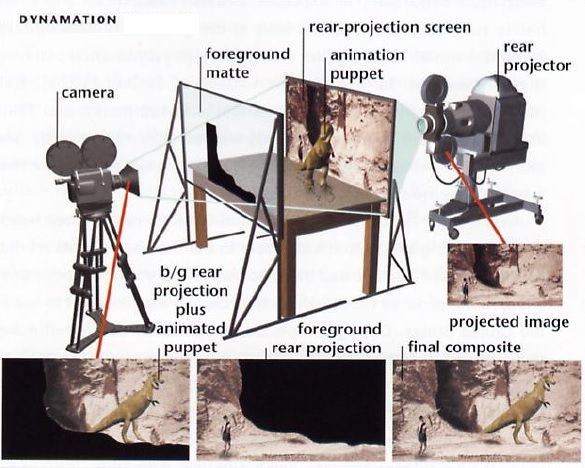
Dynamation however, used a model in between the matte and the background image to create a three layered image. The first step in the Dynamation process was to plan out in detail the movements the model, or creature, was to make and then to film the live-action scene with the actors and usually a stick or stand-in crew members to represent the movements and position of the creature. 


This film was developed and rear-projected on a screen. Harryhausen would place his model on an animation stand in front of this screen and then place a large pane of glass in front of that. On this glass he painted in black the foreground that he wished to block out. After filming the animated sequence so that the creature interacted with the actors as planned, he then rewound the film and filmed through the glass again, this time with the image he had previously filmed blackened out. 


Although it sounds like a very tiresome process, it was actually much easier to utilize mattes then to build and film miniature sets for the models to move in.

In 1957, Charles Schneer, the producer of many of Harryhausen's films during the late 50s and 1960s, dubbed this split-screen technique Dynamation. He was sitting in his Buick one day while waiting for traffic and noticed the Dynaflow logo written on the dashboard...he thought the prefix dyna would be the perfect marketing term for Harryhausen's animation process. 

Harryhausen used Dynamation in "It Came from Beneath the Sea" ( 1954 ), "Earth Versus the Flying Saucers" ( 1956 ), "The Animal World" ( 1956 ) and "20 Million Miles to Earth" ( 1957 ) but it was not until "The 7th Voyage of Sinbad" ( 1958 ) that it was exploited as a merchandising feature. 

"Dynamation will be brought to the screen for the first time in COLOR!"


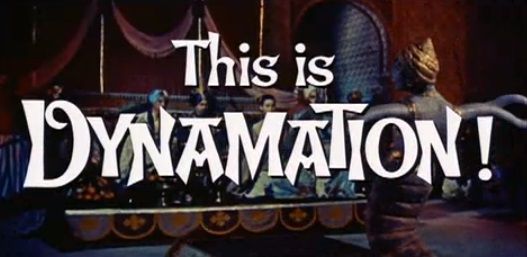
In the short trailer "This is Dynamation!" ( 1957 ) used to promote "The 7th Voyage of Sinbad", the narrator announces the glorious wonders of the technique and how "anything that the mind can conceive can now be brought to the screen". 


Dynamation was utilized on all of the Ray Harryhausen films up until his final feature motion picture, "Clash of the Titans" in 1981. Today, most special effects are created using computer graphic programs ( CGI ) but somehow, in spite of the amazing realism provided by digital graphics there is something very unique, very alive, about Harryhausen's technique. Perhaps the creatures we see created by computer effects have lost their awe because we know the secret behind their existence  The mysterious process of Dynamation was kept from the public during the release of many of his biggest films... and this was one more element that added to the magic of the Harryhausen pictures. 

Cyclops     Gwangi