Showing posts with label Lionel Jeffries. Show all posts

Thursday, May 28, 2020

Nugget Reviews - 26

It is has been long, long time since we have shared some nugget reviews, so we are starting up that series once again with a motley assortment of American and British classics. 

Chasing Yesterday ( 1935 ) 14k


Sylvestre Bonnard, a Parisian bibliophile, is in search of an old and rare book that he and his long-lost love once tore a page from. He travels to her country estate and discovers that she had a daughter, who has only recently become an orphan. Sylvestre attempts to adopt her after he meets with her cruel and miserly guardian. Anne Shirley, O.P. Heggie, Elizabeth Patterson, Etienne Girardot. Directed by George Nicholls Jr., RKO Pictures. 

When I first heard about this story I thought it was about an old man who fell in love with a teenage girl and I stayed cleared of it for many years, but I should have known that RKO would only put out wholesome fare with their favorite child actress - Anne Shirley. It is really a sweet film and O.P. Heggie is adorable as the Parisian book lover. Simple 1930s entertainment, but enjoyable. 

                 ____________________________________________________


Moment to Moment ( 1966 ) 14k 

A married woman meets a handsome young sailor while vacationing on the French Riviera and, while attempting to break up their affair, accidentally shoots him. Together with her neighbor, she disposes of his body over a cliff but quickly finds the police on her doorstep asking questions. Jean Seberg, Sean Garrison, Honor Blackman, Arthur Kennedy. Directed by Mervyn LeRoy. Universal Pictures. 

Alfred Hitchcock was the master of suspense films throughout the 1950s and 1960s but director Mervyn LeRoy clearly gave him some competition with this production. Moment to Moment is classified as a "psychological thriller" which means if you like cat-and-mouse detective films you'll love this one. It has a clever twist at the end, features beautiful on-location filming in France, a lush Henry Mancini score, and who can resist pretty Jean Seberg? Especially when she gets to have a romance with a John Gavin look-a-like!

                 ____________________________________________________


The Franchise Affair ( 1951 ) 14k


A lawyer is called to defend two women who are accused of kidnapping and imprisoning a young schoolgirl in their house. Michael Denison, Ann Stephens, Dulcie Gray, Marjorie Fielding. Directed by Lawrence Huntington. Associated British-Pathe. 

The British always had such great scriptwriters! This film has a simple plot and yet it is so engrossing. Two spinsters are accused of kidnapping a schoolgirl...everyone in town believes they did it, all the evidence points towards them, and yet Michael Denison believes them innocent ( and so does the audience ). So what is going on? A good mystery, that's what. 
                 ____________________________________________________


Tarzan the Magnificent ( 1960 ) Eltc.


Tarzan must escort a prisoner out of the jungle in order that he can claim the reward, however, the prisoner's father and brother are hot in pursuit and are bent on killing Tarzan. Gordon Scott, Charles Tingwell, Lionel Jeffries, Betta St. John. Directed by Robert Day. Paramount Pictures. 

Ever since Johnny Weismuller first donned the loincloth as the jungle man Tarzan, he was a good box-office drawer throughout the 1930s-1950s. By the 1960s, Weismuller was showing his age, so Gordon Scott took over the role and quite admirably, too. This film had great African location filming, a good cast ( Lionel Jeffries is always a delight ) but unfortunately, the script was too simple. It was mainly a chase between the bad guys and the good guys. 

                 ____________________________________________________


Easy to Love ( 1953 ) 14k


An overworked and underpaid performer at Cypress Gardens finally decides to leave her boss and have a fling in New York City, but then discovers that she loves her boss and wishes to return. Esther Williams, Van Johnson, Tony Martin, Edna Skinner. Directed by Charles Walters. Metro-Goldwyn-Mayer. 

Who can resist a Esther Williams film? They're colorful, comical and often feature some great musical numbers, too. Easy to Love has a particularly catchy-tune performed by Tony Martin: "That's What a Rainy Day is For".  It's a jolly fun film and the water-skiing finale at Cypress Gardens is uber impressive. 

Monday, July 13, 2015

Journey to the Unknown

This planet and all its wonders are not enough to satisfy man's unending quest to discover the unknown. To go where man has never gone before; to reach the unfathomable; to see the unseen; these desires have been etched in his soul from the beginning of Creation. 

" Why does man freeze to death to try and reach the North Pole? Why does man drive himself to suffer the steam and heat to discover the Amazon? Why does he stagger his mind with the math of the sky? Once a question arises in the human brain the answer must be found, whether it takes a hundred years or a thousand years. " 

These were the words of Alec McEwen in Journey to the Center of the Earth

The ultimate aim of all Science is to penetrate the unknown. And that's what the following films featured - daring men willing to stake their lives and undertake a perilous journey to reach this pinnacle of achievement for the future of Science and Mankind. And these "unknowns" are still a mystery to us today.


JOURNEY TO THE CENTER OF THE EARTH ( 1959 )

Scientists spent years exploring the many features of the Earth's surface but who has penetrated its depths? Arne Soknesson has! ....or so this movie claims. The 15th century explorer was ridiculed for his preposterous attempt to reach the Earth's core, but 400 years later, Professor Oliver Lindenbrook ( James Mason ) stumbles upon evidence that proves he did just that, and ventures forth to go there himself. Of course, by the time he leaves, the party has grown to five members : a student of his at the University of Edinburgh ( Pat Boone ), the widow of a fellow explorer ( Arlene Dahl ), a burly Norwegian ( Thayer David ), and his pet duck Gertrude ( herself ). Spending a year beneath the surface, they encounter a cavern of luminescent crystals, large deposits of salt, an ocean, the lost city of Atlantis, and even another explorer...bent on making sure his own name goes down in history as the first man to reach the center of the Earth! 


FIRST MEN IN THE MOON ( 1964 )

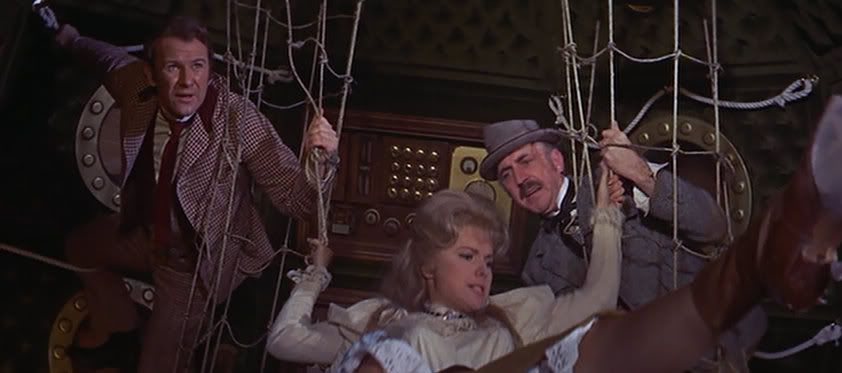
The year is 1899 and Professor Cavor ( Lionel Jeffries ) is busy working in his country home, perfecting Cavorite, a paste that, when applied to any object, renders it ineffectual to the force of gravity. Whoosh! upwards it will travel unless something blocks its path or a shield is placed over the Cavorite. What possible commercial value could Cavorite have? It could send a ship to the Moon of course, where unheard of deposits of rare minerals, gems, and gold could be just sitting on the surface! And that could make them rich, rich, rich! At least that's what Cavor and Arnold Bedford ( Edward Judd ) think. Arnold's fiancee Kate ( Martha Hyer ) accidentally comes along for the ride, but venturing inside the moon was not apart of their plan. Neither was an encounter with the Selenites - the insect-like creatures of the Moon.


THE TIME MACHINE ( 1960 )

Time - the cause of eternal bewilderment to man. It travels always onward, oblivious of events occurring within its domain, continually venturing forward into unexplored territory, ever unchanging and unstoppable. But scientists continue to explore this intangible mystery of our existence. Could altering the Past affect the Future? ( there is a good Outer Limits episode about that topic ); Could a journey into the Future help us make better decisions for Today? Well, these questions bothered George Wells ( Rod Taylor ) too. And besides, he felt like he never belonged in the era he was living ( that's nothing new ). So he constructs a time machine and after fiddling with the dials a bit, propels himself to the year 802,701 A.D. A blond-haired, blue-eyed race of humans called Eloi populate the Earth eating giant veggies and fruits, lounging around with no work to be done, and dashing off at sundown when the terrible mutants known as the Morlocks come out of their caverns to ....eek!...eat them. 

Our intrepid explorers have traveled to the center of the Earth, the inside of the Moon, and through the Ages of Time, and so what unknown territory is left?..... The Fourth Dimension. 


THE 4-D MAN ( 1959 )

Tony Nelson ( James Congdon ), a research scientist, is experimenting with a means to separate particles of matter from each other with an amplifier and, in doing so, discovers a way that one can "pass through" any object. His brother Scott ( Robert Lansing ) becomes jealous of his newfound knowledge - he's also sore because Tony stole his fiancee Linda ( Lee Merriwether in her first film ) - and steals this amplifier unit from him. But what he doesn't know is that every time he passes through an object, he ages! And even worse than that ( yes... there is something worse than aging ) touching another human causes instant death to them, but gives him renewed youth..... I'll let the movie explain the details of that phenomenon. 

___________________________________________________

Well, there you have it. As happy viewers munching on our popcorn, we can sit back and enjoy these explorations to the unknown, heartily cheering on our daring heroes while they endanger their lives for the benefit of our entertainment. And who knows? Maybe someday Man will take a hurdling leap into the Future and find our descendants, 350 years from now, enjoying these very same films.

Wednesday, May 7, 2014

Nugget Reviews - 11

Another eclectic mix of films, with a generous sprinkling of Brit comedies thrown in :


Blue Murder at St. Trinians ( 1957 ) 14k


The girls of St. Trinians steal their way into winning a UNSECO contest in order to get a free bus trip throughout Europe. One of the girl's fathers, wanted for a diamond robbery, sneaks along as the new "headmistress", while Policewoman Ruby Gates tails them closely. Lionel Jeffries, Terry-Thomas, George Cole, Joyce Grenfell, Lloyd Lamble. Alastair Sim. John Harvel Productions. Directed by Frank Launder.

An entertaining episode in the St. Trinian's series...although it bears a very misleading title. We didn't see any murder in the whole film. Aside from the diamond robbery the biggest crime was the editor cutting out many of Joyce Grenfell's scenes. Or at least it seems like some of them were cut out. Terry-Thomas is marvelous as Captain Ricketts, the manager of a rickety bus line; Jeffries makes a surprisingly good headmistress; but disappointingly Sim only returns to bookend the film in two brief scenes. Overall, a bumpy beginning leads into a fun romp with the naughty gals of St. Trinians.  

              ________________________________________________________


Judge Hardy and Son ( 1939  ) 14k


Andy gets himself into debt anticipating that he will win the $50 prize in a school essay contest, but finds that his debts amount to very little when Mother Hardy gets ill. Meanwhile, Judge Hardy searches for the lost daughter of a poor Russian couple. Mickey Rooney, Lewis Stone, Ann Rutherford, Martha O'Driscoll, Maria Ospenkaya. Metro-Goldwyn-Mayer Studios. Directed by George B. Seitz.

"Andy Dandy" gets himself into a mess of money and girl trouble in this eighth installment in the Hardy series. Unlike the previous films, Judge Hardy and Son takes on a solemn mood mid-way through when Mrs. Hardy comes near dying. By the end of the film though, Andy's back to his cavalier ways and is whoop-whooping with joy when he gets to take Polly to the Fourth of July fireworks show.

                 ________________________________________________________


Good Morning Boys! ( 1937 ) Elct.


A schoolteacher takes his students to Paris and wind up capturing a gang of art thieves who plan on stealing a famous painting at the Louvre museum. Will Hay, Martita Hunt, Graham Moffet, Lilli Palmer, Peter Gawthorne. Gainsborough Pictures. Directed by Marcel Varnel.

Will Hay may have been a big comedian in England but after seeing this film I understand where American and British humor differ. There were some moments of amusement in the scenes themselves but Will Hay did not provide many laughs. I'd take Frankie Howerd over Hay any ol' day. And speaking of Frankie Howerd....

                ________________________________________________________


The Runaway Bus ( 1954 ) 14k


An airport bus gets lost in the fog en route to Blackbush and discovers that a master criminal known as The Banker is hiding on board, with several million pounds in stolen bullion stashed in the boot of the bus. Frankie Howerd, Margaret Rutherford, Petula Clark, Terence Alexander, George Coulouris. Val Guest Productions. Directed by Val Guest. 

It's a lesser known comedy from Val Guest but nevertheless boasts a great Brit cast and a nice little Hitchcockian twist at the end. Great rainy day viewing, and it's nice to see Pet Clark in her post-kiddie-flick-pre-Downtown era. But good luck trying to find a clean copy of the movie.....you'll have to do a lot of squinting to see the actors through the fog. Blimey! 

________________________________________________________


Charlie Chan at the Racetrack ( 1936 ) 14k


Charlie Chan takes a sea cruise to the mainland to uncover the murderer of a famous horse breeder. Warner Oland, Keye Luke, Helen Wood, Gavin Muir, Thomas Beck, Alan Dinehart.  20th Century Fox. Directed by H. Bruce Humberstone.

This is the twelfth of sixteen Charlie Chan films that Warner Oland made and we think it's one of the best. There are a lot of really good "Chan" moments in the film as well as some great verbal play between him and number one son, Lee. A slew of Chan regulars have brief roles; there is the swell setting at the track and on board the ship; and the usual suspense thrown in among the comedy ( Chan even gets shot in the leg on this voyage! ).

Thursday, February 20, 2014

First Men in the Moon ( 1964 )

Charles Schneer and Ray Harryhausen, two of the foremost producers of sci-fi films of the 1960s, had in 1963 recently completed their sea-faring mythology extravaganza " Jason and the Argonauts "  when they decided to embark upon a screen-telling of H.G Well's famous Victorian fantasy novel "First Men in the Moon".

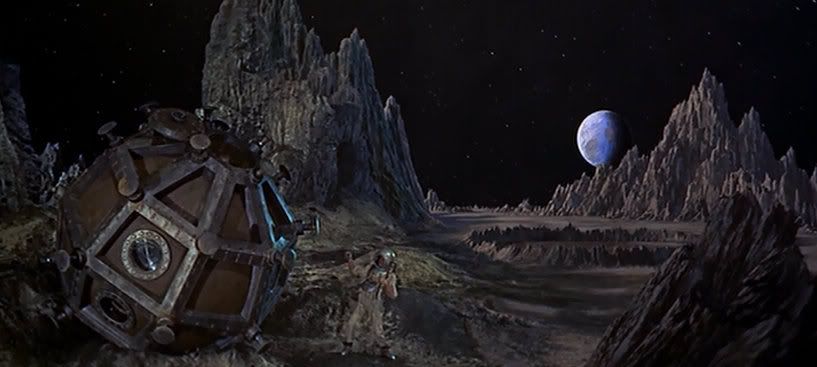
Filmed in astounding "Dynamation!" the movie begins in modern times with a UN space ship rocketing to the moon. Amidst cheers on Earth for the historic moment, the very first men walk on the surface of the moon.....but lo! within steps from their rocket ship these astronauts discover a flag - a Union Jack flag.  And along with the flag, a declaration ( written on the back side of a summons for Katherine Callender ) claiming British subjects had honorably walked that solitary surface in 1899....and had claimed the moon for her majesty, Queen Victoria.


Quickly a UN investigation team is dispatched to the tiny village of Dymschurch to question Katherine Callender, but when they discover that she had since died, they seek explantations from her husband Arnold who is now living in a nursing home.

After his initial shock at seeing photographs of the flag he had helped to place on the moon, he relates the story of their voyage.....

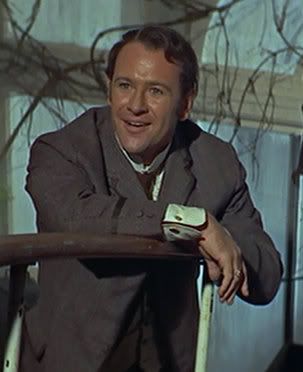
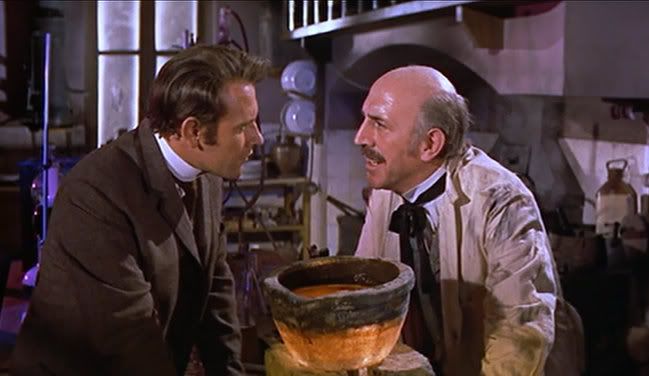
In the secluded country village in England, Arnold Bedford ( Edward Judd ) is working ( or rather....not working ) on his play. Always looking for a new way to make some money, he becomes fascinated with the scientific substance his neighbor, an eccentric scientist named Joseph Cavor ( admirably played by Lionel Jeffries ) has recently invented....Cavorite it is called. A liquid substance it be, and it deflects the force of gravitity on any object that it is painted unto. Seeing a very lucrative business opprotunity here, Arnold talks his way into becoming partners with Cavor.


Cavor explains that his main use for Cavorite will be to apply it to the surface of a bathysphere that he has constructed in his greenhouse with the intention of flying to the moon...and of course, Arnold is astonished at this fool hardy scheme...UNTIL that is, he hears the reason why. "There be gold in them thar mountains!" Ah yes, to the depths Man would fanthom for the pursuit of wealth.

And so, in no time at all our merry duo hastily prepare for their sojourn to the Moon. Unlike the book, where Bedford and Cavor remain the only passengers on this journey, the film added a female character - Bedford's fiancee, Katherine ( Martha Hyer ) known simply as "Kate" to tag along with the boys on their ride through space. A pretty addition she is too.

" Stop calling me Mrs. Bedford. We are not married! " ....." Not married?!... Madam ....kindly leave the room! "
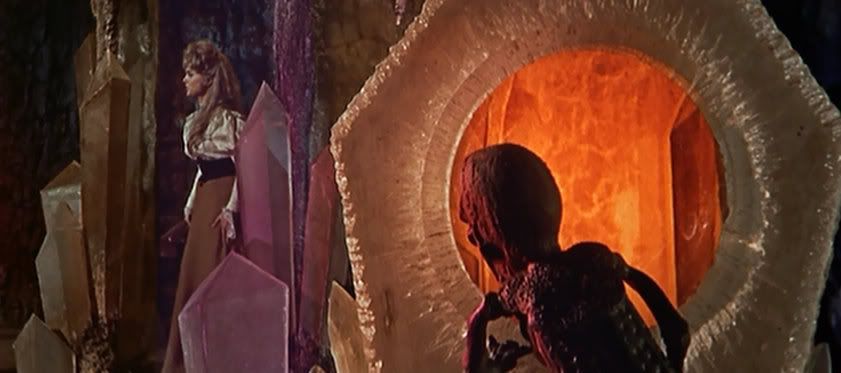
Once on the moon we see the handiwork of model-maker extrodinaire Ray Harryhausen with magnificent space sequences, a gigantic brained Grand Lunar ( seated on a throne behind a veiled screen, much like the Wizard of Oz ), a caterpillar-like mooncalf, and a number of little Selenites....which are actually children in suits, so maybe that doesn't count as Harryhausen handiwork.


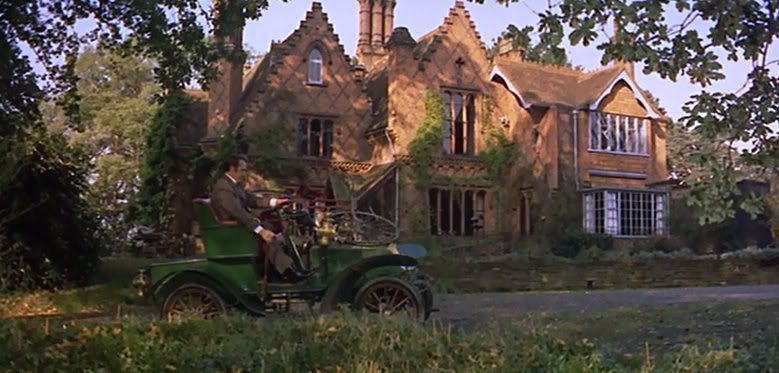
"First Men in the Moon" has always been my favorite of all of the Charles Schneer/Ray Harryhausen pictures because of the mood it evokes. There is a beautiful Victorian flavour throughout the film and the pre-moon scenes are my especially favorites ( oddly enough, these are the ones that have no special effects at all and make up about 45 minutes of the picture ).


" It's....simply.....imperial "

Laurie Johnson, one of England's most renowned television and film composers at the time, wrote a haunting and atmospheric theme to "First Men in the Moon" as well as a lovely romantic ballad that can be heard softly in the background whilst our characters are at Cherry Cottage and during the greenhouse sequences. The complete soundtrack to the film has been released on audio cd but unfortunately, is quite a rare album to find today.


Peter Finch happened to stop by the set one day to visit his good friend, Lionel Jeffries, and found himself being used for a guest spot as the baliff who serves Kate her legal summons. Aside from his appearence there are not too many well-known character actors with the exception of Milles Malleson who does one of his characterisitc dithery/absent-minded impersonations as the church registar.

" Poor Cavor...he always did have that nasty cold "

"First Men in the Moon" takes us on a wonderful light-hearted sojourn to a Victorian era, a period when the spirit of exploration was at its peak and there were new and exciting worlds just waiting to be explored....and conquered. Some say this film drags on until the scenes when they land on the moon and see the "creatures" but I disagree. But then, that may be because I have never been much of a sci-fi film fan.

Anyway, overall the film is a delight to watch and the recent DVD release has just astounding sound and remarkable color restoration. Details you never thought to notice stand out bright and bold. It is a relaxing movie and what I like best of all about it is the carefree way our heroes go about on their expedition to the moon. They pack a few cans of sardines, a couple of chickens and are off on their way in no time at all. Where modern scientists take months and months of planning and preperation for a routine space flight, Bedford and Cavor simply put on their jackets, hop in their sphere....and enjoy the ride! What comes, comes.

Quite right.....the only way to travel.

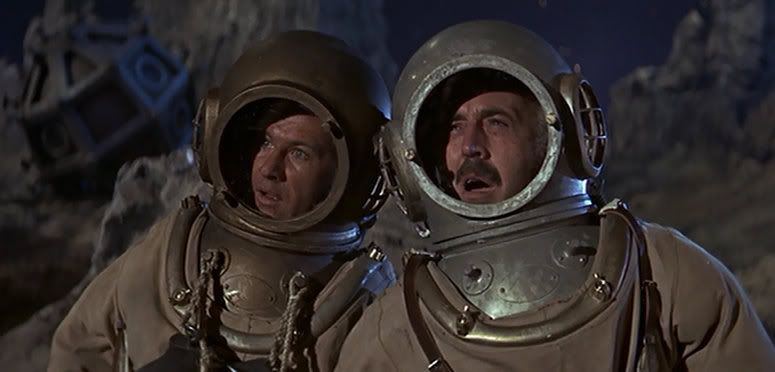
Two chumps having a jolly good time on the Moon

This post was originally published on The Absent-Minded Buccaneer blog. 

Sunday, November 10, 2013

Lionel Jeffries - What a Character! Blogathon

Lionel Jeffries was one of the most delightful and unique character actors to ever grace the British cinema. Bald, bewhiskered and bumbling he was an instantly recognizable actor in over 100 films, and however brief his appearances he was always an asset in comedies, thrillers, and dramas alike. Whether he be Grandpa Potts in Chitty Chitty Bang Bang or the inventor Cavor in First Men in the Moon, Jeffries excelled at playing charming crackpots and inquisitive and spirited characters.

Unlike Terry-Thomas who exaggerated toothy eccentrics for comic effect, Jeffries portrayed peculiar personas in a compelling and queer manner which made them strangely believable. His characterizations were of people that you might find and meet one day. Lionel Jeffries brought an element of reality to every character he portrayed. 

"I was constantly rewriting the words of the characters I was given to bring them a comic humanity. Most of the people I played were caught in desperation. In their hearts they knew they were failures - but they would never admit it, even to themselves."

Jeffries was born on June 10, 1926 in Forest Hill, London. As a boy he attended Queen Elizabeth Grammer School in Wimborne Minster, Dorset while his parents worked in a mission in London's East End with the Salvation Army. 


At the age of 19, he received a commission in the Oxford and Buckinghamshire Light Infantry, serving first in Burma, where he worked for the Rangoon radio station and later with the Royal West African Frontier Force where he rose to the rank of captain in 1945. After the war he trained at the Royal Academy of Dramatic Arts, where one short year later he won the Kendel award for his acting and writing. He felt out of place at the Academy however, being the only bald student among the bunch. He had lost all of his hair before the age of 20! Perhaps the war had that bad of an effect on his head. 

"Of course I was upset. Tried a toupee once, but it looked like a dead moth on a boiled egg". 

Upon completing his schooling in the early 1950s he quickly embraced the film medium and plunged into a series of roles in some memorable British comedies and spy thrillers in spite of being told by his agent that he was too young for character parts and not good-looking enough for leading man roles. His baldness certainly put him at a disadvantage but he took his egghead and used it to his advantage instead. 

One of his first film roles was a small part in Hitchcock's marvelous little thriller, Stage Fright ( 1950 ). Roles in Windfall and The Black Rider followed but then he hit a rough patch and as his agent predicted, parts were hard to come by and few and far in between. In 1953 he turned to stage and appeared in the Westminster Theatre production of Carrington VC with Alec Clunes. Stage was not his cup of tea and although he did a few more productions he quickly stepped out of the stage scene and was not behind the floodlights again until 1984, when he played Horace Vandergelder in Hello Dolly! at the Prince of Wales theatre in London. 


One day, in early 1955, he attended the cast audition for The Colditz Story and with holes in his shoes he walked away with the third lead to Eric Portman and John Mills. From then on he was always in demand for his quirky characterizations, often playing an officious policeman or bungling crook in these early roles. Some of his most memorable parts of the 1950s included the inquisitive reporter in The Quatermass Xperiment, Gelignite Joe, the diamond robber in Blue Murder at St. Trinians, Major Proudfoot in Law and Order, and a prison officer in The Two-Way Stretch, a Peter Sellars comedy. Jeffries also appeared in a number of dramas and crime films including the suspenseful Vicious Circle with John Mills, Hour of Decision and Man in the Sky with the always competent Jack Hawkins. 


It was in the 1960s, however, that Lionel Jeffries reached his comedic peak, first with his role of a priest in the wacky Bob Hope spy flick, Call Me Bwana, then as key suspect Captain Rhumstone in Murder Ahoy, and lastly in one of my all-time favorite roles, as the highly-strung Professor Cavor in the delightful Charles Schneer/Ray Harryhausen adaptation of H.G Wells' First Men in the Moon featuring Edward Judd and Martha Hyer. Here, Jeffries plays a reclusive scientist who invented a paste that combats gravity and, not wanting to dilly-dally with simple everyday uses, intends to launch a sphere into space on a voyage to the moon. 

Jules Verne's Rocket to the Moon was another film that featured Lionel Jeffries in a similiar role, but that same year he starred in one of his most memorable films - Chitty Chitty Bang Bang. Jeffries gladly accepted the role of Grandpa Potts, Caractacus' travel-loving father, even though he was in fact six months younger than Dick Van Dyke. 


Jeffries thoroughly enjoyed playing in wholesome children's films such as Chitty. He believed there were more wise children than wise adults and wanted to see entertainment geared towards children that adults could enjoy as well. In an era when society was bombarded with images of sex and violence Lionel Jeffries stood out for his gentler sensibilities. He was a devoted Catholic and deplored permissivism. Unlike alot of Hollywood marriages, Jeffries remained married to one woman, former actress Eileen Walsh, for over 59 years ( until his death ), with whom he had one son and two daughters. One day, his eight-year old daughter Martha came to him with a book she was reading - Edith Nesbit's delightful classic "The Railway Children" - and told her father "I think this would make a good film". Papa agreed and he promptly purchased a short option on the film rights for £300. 


He wrote a script that retained all of the charm of Nesbit's book and took it to Bryan Forbes, then head of Elstree Studios, to get his opinion of it. Jeffries and his wife had met Forbes at Richmond Hill, home of Sir John Mills, where they often socialized with the Oliviers, the Nivens, and the Attenboroughs.  Jeffries confined to Forbes that he "secretly harbored a longing to direct the film" himself. The Railway Children was indeed Jeffries first experience behind the camera as a director and it was a smash hit. The film, featuring Bernard Cribbins, Jenny Agutter, and Dinah Sheridan remains a cult classic in Britain, being shown year after year at Christmas Time. 


On the wake of its success, Jeffries was inspired to direct some more children's films but continually hit a stone wall when it came time to finding a producer. They were indifferent at best, and he came to the conclusion that "No one wants family entertainment anymore. They want explicit sex". Nevertheless he did find backers to several more productions, The Amazing Mr. Blunden ( 1972 ), Baxter! ( 1973 ), Wobbling Free ( 1977 ) and, his final film as a director, The Water Babies ( 1978 ). 


Throughout the 1980s and 1990s, Lionel Jeffries turned to television, a medium which he had originally shunned years before because of its inferior production values. An appearance in the drama Cream in My Coffee altered his opinion and launched a belated career on the tiny tube. He had guest appearances in Inspector Morse, The Collectors, Lovejoy and portrayed grandpas in Rich, Tea and Sympathy and Woof!.

For years Lionel Jeffries was playing characters older than himself because of his premature baldness, but in these later roles, his age had finally caught up with his missing hair! Lionel Jeffries passed away on February 18, 2010 after several years of suffering from declining health ailments. He was 83 years old.

This post is our contribution to the What a Character! blogathon, a celebration of some of the most talented actors in Hollywood, the beloved "character actors". Don't miss visiting Once Upon a Screen or Paula's Cinema Club to view a complete schedule and find links to great posts on nearly fifty other great character actors.