Showing posts with label Ray Harryhausen. Show all posts

Saturday, February 5, 2022

The 7th Voyage of Sinbad ( 1958 )

"From the land beyond beyond, from the world past hope and fear, I bid you Genie now appear!"

Legendary adventurer Sinbad the Sailor (Kerwin Mathews) lands on the island of Colossa for provisions when he encounters and helps rescue the magician Sokurah (Torin Thatcher) who is fleeing from the giant cyclops on the island. After their boat is overturned in the escape, Sokurah loses the magic lamp he was carrying which is then retrieved by the cyclops. The conniving magician attempts to bribe Sinbad to return to the island for the lamp but to no avail and so he shrinks Princess Parisa (Kathryn Grant), Sinbad's betrothed, to the size of a doll. The potion to restore her to her normal size requires the shell of a bird's egg that can only be found on Colossa. With no choice before him, Sinbad agrees to make the journey back to Colossa where he must fight the cyclops and battle with Sokurah's magic to save the princess. 

The 7th Voyage of Sinbad was producer Charles Schneer's fourth film collaboration with special effects artist Ray Harryhausen and it features some of Harryhausen's finest stop-motion animation, including the first appearance of his famous fighting skeleton figure. This film was also notable for being the first fantasy film that Harryhausen worked on, having previously created creatures for science-fiction films such as 20 Million Miles to Earth (1957) 

In Sinbad, our hero encounters a wide array of beasts that he must contend with. There is the giant man-eating cyclops, the two-headed roc, the fighting skeleton, and the fierce guardian dragon Taro, all of which were created by Harryhausen in the newly-dubbed Dynamation process. 


Charles Schneer pulled out all the stops with The 7th Voyage of Sinbad and it had the largest budget of any of his films to date - $650,000. It took Harryhausen eleven months to create the stop-motion effects alone, in which time the cast was filming the live-action sequences under the capable hand of director Nathan Juran. Location filming took place in sunny Spain, a locale that would be used in most of Schneer's subsequent fantasy films. 

The brilliant composer Bernard Herrmann (a favorite of Alfred Hitchcock) was called in to compose the score for Sinbad and what he created was a marvelous and imaginative composition that conjures up ancient Arabia in its musical strains. He teamed up with Charles Schneer and Ray Harryhausen again to create the music for Mysterious Island (1961) and Jason and the Argonauts (1963).

Kerwin Mathews plays our Arabian hero Captain Sinbad and he does a wonderful job with the part. His loyal companion is Harufa, portrayed by Alfred Brown, and his beloved Princess Parisa is played by pretty Kathryn Grant. Child-actor Richard Eyer also gives a good performance the echo-voiced genie, Barani. Being a loyal albeit reluctant genie, no matter what deed he is asked to perform Barani does his best to accomplish, meekly answering, "I shall try, o master, I shall try."

Also in the cast is the great character actor Torin Thatcher who redefined the word villain with his performance of the devious magician Sokurah. He desperately wants the genie's lamp and would willingly trade all the treasure hoarded by the cyclops' in place of that lamp, knowing full well the power it wields. 
The 7th Voyage of Sinbad would be classified as juvenile fare, but it really does entertain no matter what age you are. From its opening sequence at sea to its finale, it features non-stop action. The film was very popular at the box office earning over $3 million in receipts and inspiring Harryhausen to pursue more fantasy films, but it would not be until 1973 that audiences would see another Sinbad film - The Golden Voyage of Sinbad, which was later followed by the equally entertaining Sinbad and the Eye of the Tiger (1977). 

Sunday, March 14, 2021

Mysterious Island ( 1961 )

A world beyond imagination! Adventure beyond belief! 

A band of Union Army prisoners, a Confederate soldier, and a journalist escape in a hot air balloon during the Civil War and are carried off by a storm to an uncharted island populated with giant creatures. This same storm blows in two ladies who were the only survivors of a shipwreck. They band together to survive, staving off giant chickens, bees and pirates before making an attempt to escape the island with the aid of Captain Nemo. 

Jules Verne's 1874 novel "Mysterious Island" was used as a basis for this marvelous adventure film. Special effects maestro Ray Harryhausen teamed up with producer Charles Schneer for the sixth time to create this dandy fantasy film that Time magazine declared would "thrill the geewillikers out of anyone!"

It does indeed! Mysterious Island combines a great cast with a fine script, a fantastic Bernard Herrmann score, and great special effects, making it a winner all-around. Even though it was released by Columbia Pictures, it is a British-made production with a primarily English cast playing Civil War soldiers. Michael Craig heads the cast as Captain Cyrus Harding. He quickly takes command when the balloon party lands on the island. Harding is your quintessential cookie-cutter captain who does things by the book. Even though he seems like the kind of character who would be given a love-interest, he remains single the entire film. 

Gary Merrill is excellent as Mr. Spilitt, an engaging journalist who enjoys jesting with Lady Fairchild, one of the shipwrecked ladies, played by the impeccably British Joan Greenwood. Percy Herbert plays a tough-talking Confederate, Dan Jackson is the loyal strongman Corporal Neb and, to draw in the teenage crowd, Michael Callan plays a young soldier who overcomes his cowardice when he attempts to rescue his new sweetheart, the miniskirt clad Elena Fairchild ( Beth Rogan ). 

Let's not forget Captain Nemo.....Herbert Lom plays the famous inventor. He adds a bit more gruffness to the character than James Mason did in Twenty Thousand Leagues Under the Sea ( 1954 ). A dash of humor and more showmanship would have given greater interest to his character, but he was in keeping with Verne's description so we're not complaining. 

Mysterious Island was shot at Shepperton Studios, England, and on location in Sa Conca Bay, Spain. Unlike some of Harryhausen's other films, this picture uses a number of matte shots and they really help to create the storybook-like setting of the island. Check out the site Matte Shot to see more screenshots of the mattes used in the film. 

Harryhausen must have had a ball creating the miniatures for Mysterious Island. He made a fantastic model of the Nautilus, a truly frightening giant bee, a giant baby chicken, man-eating crab, and an octopus. It took him months to film these creatures in stop-motion, moving each armature a little bit at a time until the scene played out just right. 

Impressive as these creatures are, my favorite of his creations was the miniature air balloon. As you can see from this behind-the-scenes photo, this miniature was not as tiny as you would think. The soldiers make their escape in the balloon during a heavy storm and Harryhausen had to create this setting within the confines of Shepperton Studios. It is amazing to see the balloon tossed about in the storm over the ocean, forgetting that there was no storm or ocean in reality!


Mysterious Island premiered in the theatres Christmas Week 1961 and was a huge box-office success. It played to packed theaters worldwide and the film received glowing reviews critically as well. It is currently available for viewing on DVD and in an excellent newly restored blu-ray edition from Powerhouse packed with special features. 

Saturday, July 4, 2020

Book Review: Harryhausen - The Lost Movies

This year marks the 100th anniversary of the birth of stop-motion special effects maestro Ray Harryhausen. I've been enjoying re-watching many of his films throughout the year but doubly entertaining is discovering all the wonderful books written about Harryhausen and his work. 

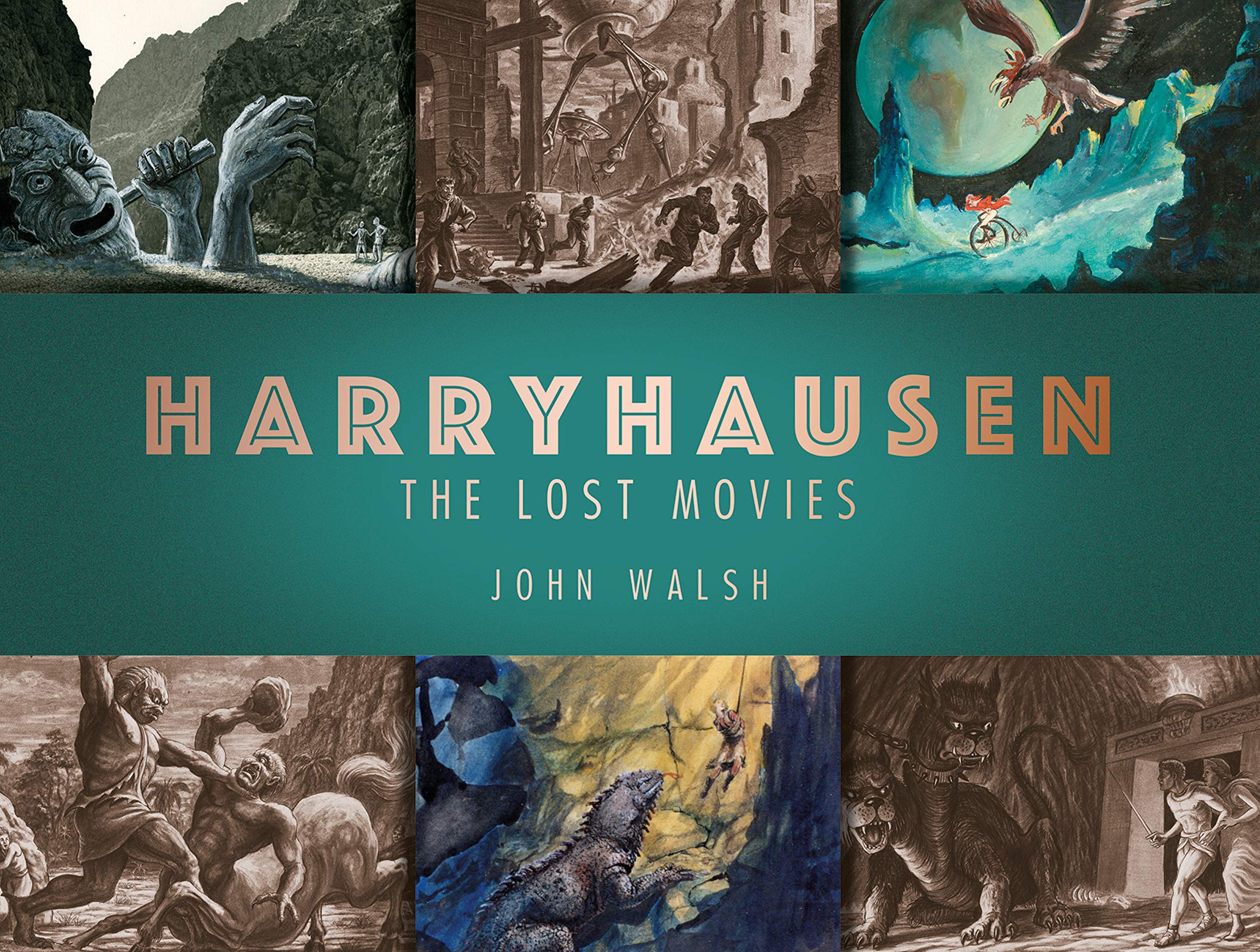
A recent find is Harryhausen-The Lost Movies written by John Walsh. This glossy 188-page book from Titan Books is packed with illustrations, storyboard sketches, posters and photographs that shed some light on the nearly 70 film projects that Ray Harryhausen began but never completed. These were ideas that were conceived but never quite made it to the incubation stage. 

Some of them are really quite fascinating - The Time Machine ( 1954 ), King of Geniis ( 1969 ) and Conan ( 1969 ). Also interesting are the projects that Ray Harryhausen turned down - Moby Dick ( creating the whale model of Moby Dick for the 1956 film version ) and Night of the Demon ( 1959 ). 

The title is a little misleading because the book is mainly comprised of "Unused Ideas" and were not films that were lost overtime - merely potential projects that went unrealized. But, title confusion aside, Harryhausen - The Lost Movies ( $39.95 ) makes a great addition to the library of any Harryhausen fan. 

Thursday, July 11, 2019

From the Archives: The Valley of Gwangi ( 1969 )


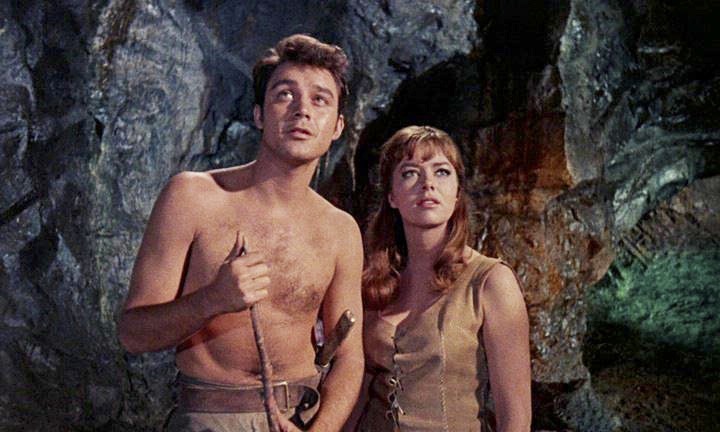
This month's From the Archive photo isn't really from our archives but it was such a great shot we could not resist sharing it: James Franciscus and Gila Golan were captured in this candid snapshot on the set of The Valley of Gwangi ( 1969 ). This adventure film is most famous for its special effects which were created by Ray Harryhausen. 

Wednesday, July 26, 2017

The Valley of Gwangi ( 1969 )

In the late 1960s, adventure and sci-fi films weren't all too popular in the theaters. The younger generation preferred films that portrayed gritty realism; films that dealt with problems they could relate to. The older generation were wondering what became of the musicals and noirs they loved and preferred to stay at home watching their favorite old-time actors on the late-late movie on television. 

Hence, a fantasy-western like The Valley of Gwangi - even with the name of Ray Harryhausen behind it - was destined for instant obscurity. Today, it is still buried under the stop-motion maestro's other works. 

The Valley of Gwangi features an imaginative story line and - naturally - some great special effects, but it doesn't come off as particularly entertaining fare, partly owing to the bland performances of the two main leads, James Franciscus and Gila Golan ( which sounds like a Harryhausen creature itself ).
The story begins in the desert of Mexico where a gypsy steals a small creature known as "El Diablo" from the Forbidden Valley. This turns out to be the miniature prehistoric ancestor to the modern horse. T.J Breckenridge ( Golan ) gets a hold of this creature and hopes to feature it in an upcoming act for her travelling circus. When paleontologist Horace Bromley ( Laurence Naismith ) hears about this find, he convinces a band of gypsies to steal it and return it to the Forbidden Valley so he can discover if more of these creatures exist. Tuck Kirby ( Franciscus ) follows these gypsies into the valley attempting to re-capture El Diablo for Breckenridge.....but instead discovers a litany of living dinosaurs! Along with other members of the circus, Kirby and Professor Bromley try to capture Gwangi, a belligerent Allosaurus, to make the starring attraction of the circus instead. 

Ultimately, what rescues The Valley of Gwangi from becoming a quick drive-in picture is the exciting theme music ( by Jerome Moross ), and the visual style of the film....scenes of the professor in the desert hunting for dinosaur bones, close-ups of the old gypsy woman uttering curses, and Gwangi struggling to free himself from the metal cage at the circus. Harryhausen's animation during the final sequence within the church is especially good, too. 
After the release of Gwangi, Harryhausen and producer Charles Schneer began work on The Golden Voyage of Sinbad ( 1973 ), a film that took several years to produce but which proved to be a much bigger success at the box-office.

Tuesday, July 12, 2016

The Golden Voyage of Sinbad ( 1974 )

Exotic adventure, thrills and romance were all to be had in The Golden Voyage of Sinbad, the second of three Sinbad movies that special-effects animator Ray Harryhausen helped to create during the 1950s-1970s. The first film - The 7th Voyage of Sinbad ( 1958 ) - was a storybook Arabian Nights fantasy that combined an exciting tale of adventure with amazing stop-motion animated creatures, a powerful Bernard Herrmann score, and beautiful location scenery. It was extremely popular with children and adults alike during its initial release, but its creators, Harryhausen and producer Charles Schneer, had several other projects in the stewpot and did not concentrate on developing another Sinbad film to follow up on its success until the early 1970s. 

This film, aptly titled The Golden Voyage of Sinbad, found the turbaned sailor ( John Philip Law ) on a quest for the missing pieces of an ancient golden tablet that points the way to an island which contains a mythical fountain granting eternal wealth and power to the man who bathes in its waters. Over land and sea Sinbad journeyed with the evil magician Koura ( Tom Baker ) ever on his tail. Koura desperately sought the restoring power of the fountain because his life force was draining out of him with every incantation he chanted. 
This story plot provided Ray Harryhausen with ample opportunities to pit various creatures against our hero and the film featured some of Harryhausen's best Dynamation work including the bat-like Homonicus, a messenger to Koura; the wooden figurehead which comes to life; the terrifying centaur; and the griffin, defender of the magic fountain. Also, who could possibly forget the six-armed statue of Kali? Despite being slow on its feet, it was nimble with its swordplay. 

Aside from creating the stop-motion sequences of mythical creatures and other characters, Harryhausen helped flesh out the stories to almost all of the films he worked on. He also created extremely detailed storyboards allowing the directors to simply follow each block like a comic book.

The Golden Voyage of Sinbad was three years in the making with Harryhausen spending one year strictly at work filming the creatures. Critical reception was generally negative upon its release but that did not deter its creators from making a third Sinbad film several years later - Sinbad and the Eye of the Tiger ( 1977 ). 

Screenwriter Brian Clemens ( of The Avengers fame ) penned a marvelous script for The Golden Voyage of Sinbad filled with nonstop action. Combined with the talented cast, a sweeping Miklos Rozsa score, and Harryhausen's "magic", it has now gained the rightful reputation of being the best of the Sinbad series.

Of the three actors who portrayed Sinbad in each of the Harryhausen pictures, John Philip Law, the star of The Golden Voyage of Sinbad, was certainly the most convincing, capturing the adventurous spirit and the inspiring leadership of the fabled sailor. With Law portraying Sinbad, it is easy to see why his sailors followed him to the four corners of the world.
Tom Baker is also excellent as Koura, the master of the black arts, with his intense eyes and imposing presence. Christopher Lee was originally slated to play this part, but through a stroke of good fortune Baker was cast. This film would be instrumental in Baker obtaining the role of the fourth doctor in the television series, Dr. Who.

Also cast in the film was Caroline Munro as the buxom slave girl Marinda, Douglas Wilmer as the mysterious gold-masked vizier, and Kurt Christian as Sinbad's friend Haroun, included for comic relief. 

This post is our contribution to The Ray Harryhausen Blogathon being hosted by Wolffian Classics Movies Digest. To read more posts about Harryhausen, his life, and his work, check out this link!

Saturday, July 9, 2016

Ray Harryhausen and the Creation of Dynamation


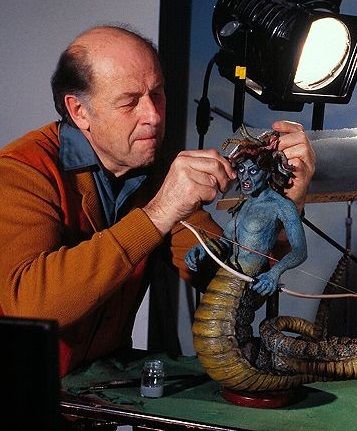
Wolffian Classics Movies Digest is currently hosting a blogathon in tribute to Ray Harryhausen, the stop-motion animator extraordinaire behind such fantasmagorical creatures as the fighting skeletons, the cyclops, Medusa, Kraken, and the beast from 20,000 fanthoms in such classics as Jason and the Argonauts ( 1963 ), The 7th Voyage of Sinbad ( 1958 ), and Clash of the Titans ( 1981 ). 

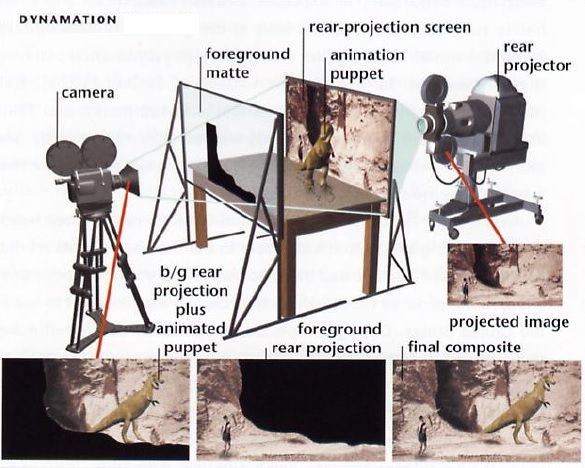
As part of this tribute to this talented man we thought we'd include a brief introduction to the process he created, known commercially as DynamationIt can also be called the "split-screen" process because of the way the screen appears to be split while the animation is being enacted in the middle layer.  

Prior to Harryhausen's development of this technique most animation was created for sequences that did not require "live" actor interaction within the scene. For instance, in an adventure film a group of archaeologists may come across a dinosaur grazing on grass in the distance. The director of the movie would film the actors expression of surprise upon seeing the dinosaur and an animator would film the stop-motion sequence of the dinosaur but when completed these scenes would remain separate...actors in one scene, animation in another. However, with the split-screen process, viewers were able to see the actors directly interacting with the animation..e.g a dinosaur with a man struggling to get free from his grasp.

In three-dimensional stop-motion animation, an object, or a poseable model, is photographed one frame at a time using a traditional film camera. In between each frame the animator moves the arms or legs of the model a fraction of an inch before photographing the object again. When these still shots are run through a projector the rapid succession of images creates the illusion of movement. A standard 35mm film projector runs the film at 24 frames per second, and so 24 separate photographed frames have to be taken to make each second of animation on screen. Hence, a 2-minute sequence of a giant cyclops eyeing a tasty morsel for dinner would take 2,880 separate frames to compose. Quite a time-consuming task! 
Stop-motion animation can be traced back to the beginning of movie-making, in the late 1800s.  Some of the earliest animated films include Vitagraph's The Humpty Dumpty Circus ( 1897 ) by Albert E. Smith and J. Stuart Blackton, featuring a circus of acrobats and animals coming to life, and The Haunted Hotel by J. Stuart Blackton ( 1907 ). 

Willis O'Brien was the resounding king of animation during the early days of talking pictures. He brought to life the prehistoric creatures of yor in First National Pictures adaption of Arthur Conan Doyle's The Lost World ( 1925 ) and later, in one of the most iconic films of the century, King Kong ( 1933 ), where he created a creature so lifelike in appearance and emotion that many viewers were brought to tears at his demise at the end of the film. 

It was Willis O'Brien's work on King Kong that instilled in Ray Harryhausen the desire to make stop-motion animation his career. The Eighth Wonder of the World inspired the young 14-year-old Ray to attempt creating his own model Kong, which led to his discovery of the stop-motion animation process. 
Under O'Brien's tutelage, Harryhausen learned the filmmaker's craft from the ground up and by 1948 was working alongside O'Brien on his first feature film, Mighty Joe Young ( 1948 ). O'Brien had utilized the multi-dimensional process of interacting animation with the actors through the means of sandwiching his models between two glass paintings, one of which was painted foreground, and shooting "through" them with the camera.

It was while working solo on his second feature film ,The Beast from 20,000 Fanthoms, that Harryhausen realized what a tiresome and time-consuming process painting foreground could be and knew that it would never work for that particular film due to the low budget the production had. He had been experimenting with using mattes as far back as 1938 to create a "split-screen" and so on The Beast from 20,000 Fanthoms he put those tests to use. 
The split-screen was a simple process that used mattes to block out portions of the film. Since film only develops from the light that escapes through the eye of a camera, any portion that is blackened out remains undeveloped. If the film is rewound the portion that was blackened can then be used again. This technique was used as far back as the early 1900s.

Dynamation however, used a model in between the matte and the background image to create a three layered image. The first step in the Dynamation process was to plan out in detail the movements the model, or creature, was to make and then to film the live-action scene with the actors and usually a stick or stand-in crew members to represent the movements and position of the creature. 
This film was developed and rear-projected on a screen. Harryhausen would place his model on an animation stand in front of this screen and then place a large pane of glass in front of that. On this glass he painted in black the foreground that he wished to block out. After filming the animated sequence so that the creature interacted with the actors as planned, he then rewound the film and filmed through the glass again, this time with the image he had previously filmed blackened out. 
Although it sounds like a very tiresome process, it was actually much easier to utilize mattes then to build and film miniature sets for the models to move in.

In 1957, Charles Schneer, the producer of many of Harryhausen's films during the late 50s and 1960s, dubbed this split-screen technique Dynamation. He was sitting in his Buick one day while waiting for traffic and noticed the Dynaflow logo written on the dashboard...he thought the prefix dyna would be the perfect marketing term for Harryhausen's animation process. 

Harryhausen used Dynamation in It Came from Beneath the Sea ( 1954 ), Earth Versus the Flying Saucers ( 1956 ), The Animal World ( 1956 ) and 20 Million Miles to Earth ( 1957 ) but it was not until The 7th Voyage of Sinbad ( 1958 ) that it was exploited as a merchandising feature. 

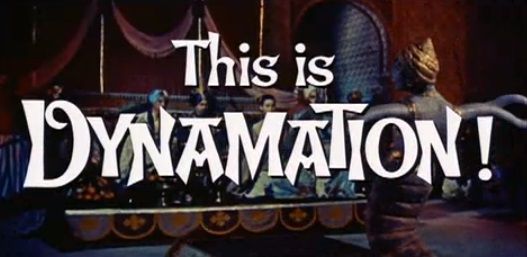
"Dynamation will be brought to the screen for the first time in COLOR!"


In the short trailer This is Dynamation! ( 1957 ) used to promote The 7th Voyage of Sinbad, the narrator announces the glorious wonders of the technique and how "anything that the mind can conceive can now be brought to the screen". 
Dynamation was utilized on all of the Ray Harryhausen films up until his final feature motion picture, Clash of the Titans in 1981. Today, most special effects are created using computer graphic programs ( CGI ) but somehow, in spite of the amazing realism provided by digital graphics there is something very unique, very alive, about Harryhausen's technique. Perhaps the creatures we see created by computer effects have lost their awe because we know the secret behind their existence  The mysterious process of Dynamation was kept from the public during the release of many of his biggest films... and this was one more element that added to the magic of the Harryhausen pictures. 
This post is our contribution to the Ray Harryhausen Blogathon being hosted by Wolffian Classics Movies Digest. It was originally published here on Silver Scenes in June, 2013. Click this link to read more posts about Harryhausen, his work, and his films. Enjoy! 

Saturday, March 5, 2016

The 3 Worlds of Gulliver ( 1960 )

Producer Charles Schneer and special effects maestro Ray Harryhausen teamed up in the late 1950s and early 1960s to create a series of adventure films mixing live-action with stop-motion animation. The 7th Voyage of Sinbad ( 1958 ), Jason and the Argonauts ( 1964 ), and First Men in the Moon ( 1964 ) were some of their most popular titles. 

The 7th Voyage of Sinbad was a huge box-office success upon its initial theatrical release and so Charles Schneer and Ray Harryhausen wanted to select another story, as famous as the Sinbad tales, to ride on the heels of its success. They wanted a plot-line that would also have a fantasy element and offer possibilities in the story for stop-motion animation. They chose Jonathon Swift's 1726 novel "Gulliver's Travels".....a great idea. 

Kerwin Mathews, the star of Sinbad, was cast as Lemuel Gulliver, a doctor who is tired of collecting chickens and vegetables as his fee and decides to set off on an ocean voyage to find his fortune and make a name for himself. His fiancee Elizabeth ( June Thorburn ) is not pleased with this idea but nevertheless sneaks aboard ship to be near him. During a storm at sea, they wash overboard and become separated. Gulliver lands first on the island of Lilliput, inhabited by tiny people, and then on an island of giants where he reunites with Elizabeth. 


The 3 Worlds of Gulliver was geared towards a juvenile audience, much like The 7th Voyage of Sinbad, but unlike that film, it fails to entertain adults as well. The New York Times film critic Eugene Archer praised the stop-motion animation of The 3 World of Gulliver but noted that "adults will find it all too mechanical to really capture the imagination, and may resent the unclear ending that seems certain to provoke some youthful queries." We couldn't agree more. The opening sequence and the Lilliputian segment are very enjoyable, however, once Gulliver and his sweetheart find themselves among the giants of Brobdingnag, the story condensends to a child's level with especially over-the-top performances from the King ( Gregoire Aslan ) and Queen ( Mary Ellis ). 

"I stop wars, put out fires, feed people, give them hope and peace and prosperity - how can I be a traitor?"

Gulliver and Elizabeth manage to escape the Brobdingnag's by the end of the film and they once again find themselves washed upon a shore...but this time they are back in England. Their final dialogue seems to suggest that what happened to them was all a dream ( two people dreaming the same dream? ). And Gulliver's final explanation of the transformations that occurred to them made little sense. 

Jonathan Swift's novel originally had Gulliver travelling to four different lands, with each land providing an opportunity for Swift to make ironic commentary on human nature. The film version limits Gulliver's encounters to two worlds ( the third world being England ), and retains some of the satire of the novel but in a much more family-oriented manner. 

Kerwin Mathews is very entertaining as Dr. Gulliver, and the always lovely British actress June Thorborn is excellent as well. Also in the cast are Jo Morrow, Lee Patterson, Basil Sydney, Martin Benson, and Sherri Alberoni ( as the big little Glumdalclitch ). 

Today The 3 Worlds of Gulliver is not counted as one of the most beloved films among Harryhausen's filmography most likely due to its overly juvenile enactment and its lack of creatures. Aside from the squirrel and the giant lizard attack near the end of the film, Gulliver does not encounter any beasts during his multiple maroonings. However, the optical illusions that Harryhausen created for the film are extremely well done.


For their next project, Charles Schneer and Ray Harryhausen returned to entertaining adults and children alike with their adaptation of Jules Verne's Mysterious Island ( 1961 )....and that picture was a smashing success.

Thursday, February 20, 2014

First Men in the Moon ( 1964 )

Charles Schneer and Ray Harryhausen, two of the foremost producers of sci-fi films of the 1960s, had in 1963 recently completed their sea-faring mythology extravaganza " Jason and the Argonauts "  when they decided to embark upon a screen-telling of H.G Well's famous Victorian fantasy novel "First Men in the Moon".

Filmed in astounding "Dynamation!" the movie begins in modern times with a UN space ship rocketing to the moon. Amidst cheers on Earth for the historic moment, the very first men walk on the surface of the moon.....but lo! within steps from their rocket ship these astronauts discover a flag - a Union Jack flag.  And along with the flag, a declaration ( written on the back side of a summons for Katherine Callender ) claiming British subjects had honorably walked that solitary surface in 1899....and had claimed the moon for her majesty, Queen Victoria.


Quickly a UN investigation team is dispatched to the tiny village of Dymschurch to question Katherine Callender, but when they discover that she had since died, they seek explantations from her husband Arnold who is now living in a nursing home.

After his initial shock at seeing photographs of the flag he had helped to place on the moon, he relates the story of their voyage.....

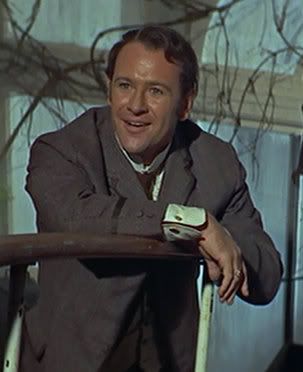
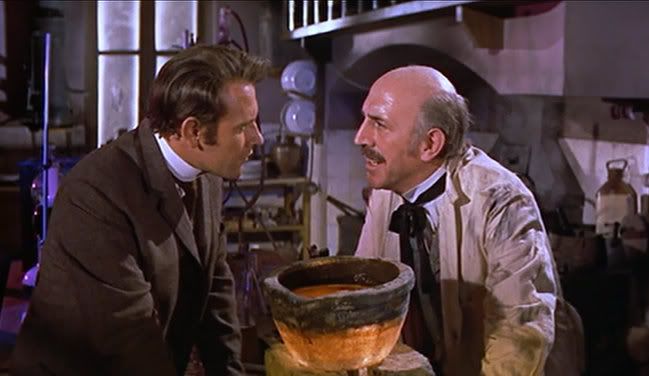
In the secluded country village in England, Arnold Bedford ( Edward Judd ) is working ( or rather....not working ) on his play. Always looking for a new way to make some money, he becomes fascinated with the scientific substance his neighbor, an eccentric scientist named Joseph Cavor ( admirably played by Lionel Jeffries ) has recently invented....Cavorite it is called. A liquid substance it be, and it deflects the force of gravitity on any object that it is painted unto. Seeing a very lucrative business opprotunity here, Arnold talks his way into becoming partners with Cavor.


Cavor explains that his main use for Cavorite will be to apply it to the surface of a bathysphere that he has constructed in his greenhouse with the intention of flying to the moon...and of course, Arnold is astonished at this fool hardy scheme...UNTIL that is, he hears the reason why. "There be gold in them thar mountains!" Ah yes, to the depths Man would fanthom for the pursuit of wealth.

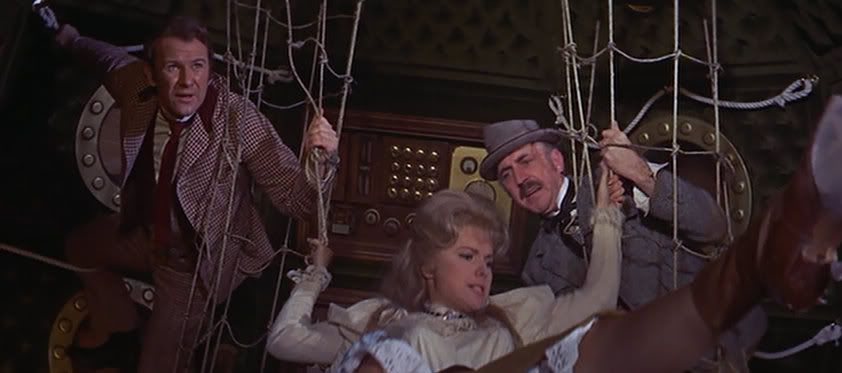
And so, in no time at all our merry duo hastily prepare for their sojourn to the Moon. Unlike the book, where Bedford and Cavor remain the only passengers on this journey, the film added a female character - Bedford's fiancee, Katherine ( Martha Hyer ) known simply as "Kate" to tag along with the boys on their ride through space. A pretty addition she is too.

" Stop calling me Mrs. Bedford. We are not married! " ....." Not married?!... Madam ....kindly leave the room! "
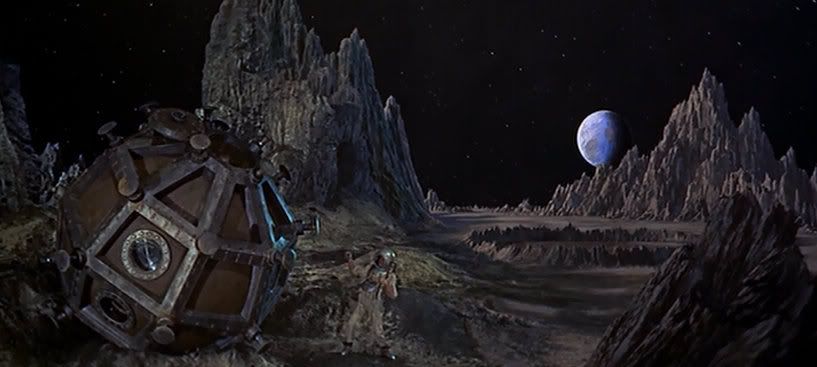
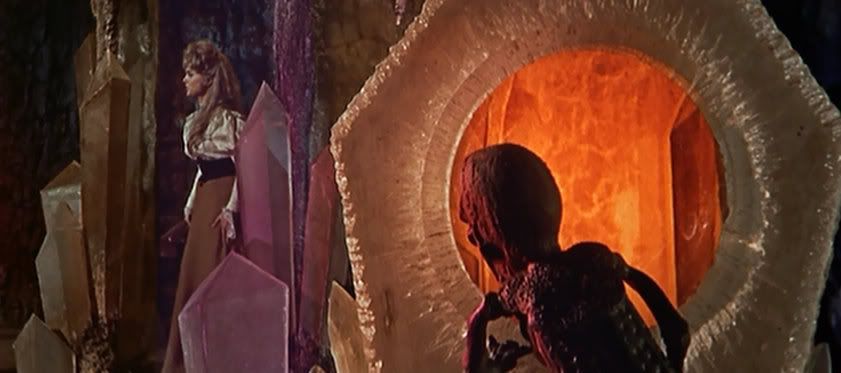
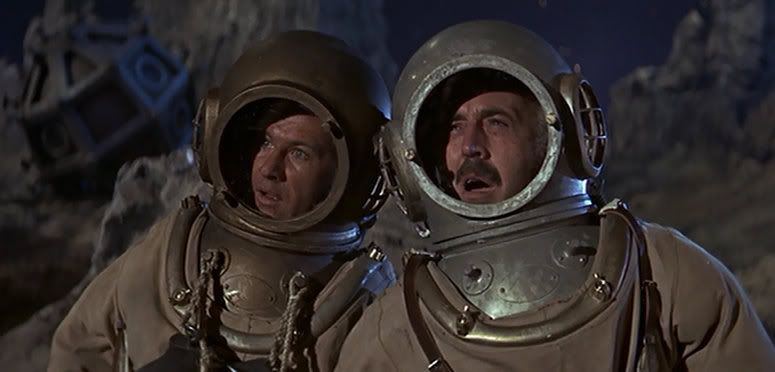
Once on the moon we see the handiwork of model-maker extrodinaire Ray Harryhausen with magnificent space sequences, a gigantic brained Grand Lunar ( seated on a throne behind a veiled screen, much like the Wizard of Oz ), a caterpillar-like mooncalf, and a number of little Selenites....which are actually children in suits, so maybe that doesn't count as Harryhausen handiwork.


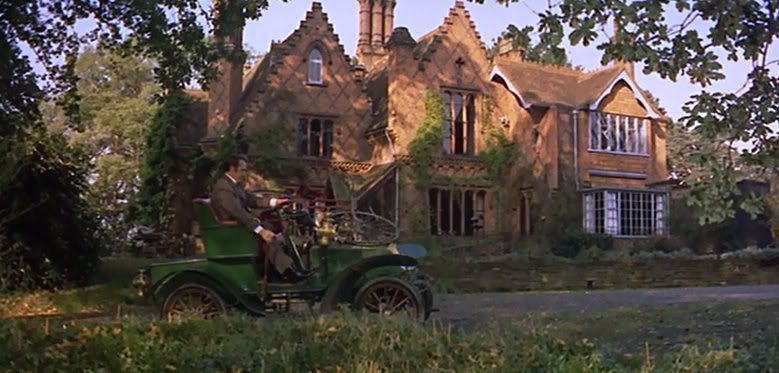
"First Men in the Moon" has always been my favorite of all of the Charles Schneer/Ray Harryhausen pictures because of the mood it evokes. There is a beautiful Victorian flavour throughout the film and the pre-moon scenes are my especially favorites ( oddly enough, these are the ones that have no special effects at all and make up about 45 minutes of the picture ).


" It's....simply.....imperial "

Laurie Johnson, one of England's most renowned television and film composers at the time, wrote a haunting and atmospheric theme to "First Men in the Moon" as well as a lovely romantic ballad that can be heard softly in the background whilst our characters are at Cherry Cottage and during the greenhouse sequences. The complete soundtrack to the film has been released on audio cd but unfortunately, is quite a rare album to find today.


Peter Finch happened to stop by the set one day to visit his good friend, Lionel Jeffries, and found himself being used for a guest spot as the baliff who serves Kate her legal summons. Aside from his appearence there are not too many well-known character actors with the exception of Milles Malleson who does one of his characterisitc dithery/absent-minded impersonations as the church registar.

" Poor Cavor...he always did have that nasty cold "

"First Men in the Moon" takes us on a wonderful light-hearted sojourn to a Victorian era, a period when the spirit of exploration was at its peak and there were new and exciting worlds just waiting to be explored....and conquered. Some say this film drags on until the scenes when they land on the moon and see the "creatures" but I disagree. But then, that may be because I have never been much of a sci-fi film fan.

Anyway, overall the film is a delight to watch and the recent DVD release has just astounding sound and remarkable color restoration. Details you never thought to notice stand out bright and bold. It is a relaxing movie and what I like best of all about it is the carefree way our heroes go about on their expedition to the moon. They pack a few cans of sardines, a couple of chickens and are off on their way in no time at all. Where modern scientists take months and months of planning and preperation for a routine space flight, Bedford and Cavor simply put on their jackets, hop in their sphere....and enjoy the ride! What comes, comes.

Quite right.....the only way to travel.

Two chumps having a jolly good time on the Moon

This post was originally published on The Absent-Minded Buccaneer blog. 

Sunday, November 10, 2013

Lionel Jeffries - What a Character! Blogathon

Lionel Jeffries was one of the most delightful and unique character actors to ever grace the British cinema. Bald, bewhiskered and bumbling he was an instantly recognizable actor in over 100 films, and however brief his appearances he was always an asset in comedies, thrillers, and dramas alike. Whether he be Grandpa Potts in Chitty Chitty Bang Bang or the inventor Cavor in First Men in the Moon, Jeffries excelled at playing charming crackpots and inquisitive and spirited characters.

Unlike Terry-Thomas who exaggerated toothy eccentrics for comic effect, Jeffries portrayed peculiar personas in a compelling and queer manner which made them strangely believable. His characterizations were of people that you might find and meet one day. Lionel Jeffries brought an element of reality to every character he portrayed. 

"I was constantly rewriting the words of the characters I was given to bring them a comic humanity. Most of the people I played were caught in desperation. In their hearts they knew they were failures - but they would never admit it, even to themselves."

Jeffries was born on June 10, 1926 in Forest Hill, London. As a boy he attended Queen Elizabeth Grammer School in Wimborne Minster, Dorset while his parents worked in a mission in London's East End with the Salvation Army. 


At the age of 19, he received a commission in the Oxford and Buckinghamshire Light Infantry, serving first in Burma, where he worked for the Rangoon radio station and later with the Royal West African Frontier Force where he rose to the rank of captain in 1945. After the war he trained at the Royal Academy of Dramatic Arts, where one short year later he won the Kendel award for his acting and writing. He felt out of place at the Academy however, being the only bald student among the bunch. He had lost all of his hair before the age of 20! Perhaps the war had that bad of an effect on his head. 

"Of course I was upset. Tried a toupee once, but it looked like a dead moth on a boiled egg". 

Upon completing his schooling in the early 1950s he quickly embraced the film medium and plunged into a series of roles in some memorable British comedies and spy thrillers in spite of being told by his agent that he was too young for character parts and not good-looking enough for leading man roles. His baldness certainly put him at a disadvantage but he took his egghead and used it to his advantage instead. 

One of his first film roles was a small part in Hitchcock's marvelous little thriller, Stage Fright ( 1950 ). Roles in Windfall and The Black Rider followed but then he hit a rough patch and as his agent predicted, parts were hard to come by and few and far in between. In 1953 he turned to stage and appeared in the Westminster Theatre production of Carrington VC with Alec Clunes. Stage was not his cup of tea and although he did a few more productions he quickly stepped out of the stage scene and was not behind the floodlights again until 1984, when he played Horace Vandergelder in Hello Dolly! at the Prince of Wales theatre in London. 


One day, in early 1955, he attended the cast audition for The Colditz Story and with holes in his shoes he walked away with the third lead to Eric Portman and John Mills. From then on he was always in demand for his quirky characterizations, often playing an officious policeman or bungling crook in these early roles. Some of his most memorable parts of the 1950s included the inquisitive reporter in The Quatermass Xperiment, Gelignite Joe, the diamond robber in Blue Murder at St. Trinians, Major Proudfoot in Law and Order, and a prison officer in The Two-Way Stretch, a Peter Sellars comedy. Jeffries also appeared in a number of dramas and crime films including the suspenseful Vicious Circle with John Mills, Hour of Decision and Man in the Sky with the always competent Jack Hawkins. 


It was in the 1960s, however, that Lionel Jeffries reached his comedic peak, first with his role of a priest in the wacky Bob Hope spy flick, Call Me Bwana, then as key suspect Captain Rhumstone in Murder Ahoy, and lastly in one of my all-time favorite roles, as the highly-strung Professor Cavor in the delightful Charles Schneer/Ray Harryhausen adaptation of H.G Wells' First Men in the Moon featuring Edward Judd and Martha Hyer. Here, Jeffries plays a reclusive scientist who invented a paste that combats gravity and, not wanting to dilly-dally with simple everyday uses, intends to launch a sphere into space on a voyage to the moon. 

Jules Verne's Rocket to the Moon was another film that featured Lionel Jeffries in a similiar role, but that same year he starred in one of his most memorable films - Chitty Chitty Bang Bang. Jeffries gladly accepted the role of Grandpa Potts, Caractacus' travel-loving father, even though he was in fact six months younger than Dick Van Dyke. 


Jeffries thoroughly enjoyed playing in wholesome children's films such as Chitty. He believed there were more wise children than wise adults and wanted to see entertainment geared towards children that adults could enjoy as well. In an era when society was bombarded with images of sex and violence Lionel Jeffries stood out for his gentler sensibilities. He was a devoted Catholic and deplored permissivism. Unlike alot of Hollywood marriages, Jeffries remained married to one woman, former actress Eileen Walsh, for over 59 years ( until his death ), with whom he had one son and two daughters. One day, his eight-year old daughter Martha came to him with a book she was reading - Edith Nesbit's delightful classic "The Railway Children" - and told her father "I think this would make a good film". Papa agreed and he promptly purchased a short option on the film rights for £300. 


He wrote a script that retained all of the charm of Nesbit's book and took it to Bryan Forbes, then head of Elstree Studios, to get his opinion of it. Jeffries and his wife had met Forbes at Richmond Hill, home of Sir John Mills, where they often socialized with the Oliviers, the Nivens, and the Attenboroughs.  Jeffries confined to Forbes that he "secretly harbored a longing to direct the film" himself. The Railway Children was indeed Jeffries first experience behind the camera as a director and it was a smash hit. The film, featuring Bernard Cribbins, Jenny Agutter, and Dinah Sheridan remains a cult classic in Britain, being shown year after year at Christmas Time. 


On the wake of its success, Jeffries was inspired to direct some more children's films but continually hit a stone wall when it came time to finding a producer. They were indifferent at best, and he came to the conclusion that "No one wants family entertainment anymore. They want explicit sex". Nevertheless he did find backers to several more productions, The Amazing Mr. Blunden ( 1972 ), Baxter! ( 1973 ), Wobbling Free ( 1977 ) and, his final film as a director, The Water Babies ( 1978 ). 


Throughout the 1980s and 1990s, Lionel Jeffries turned to television, a medium which he had originally shunned years before because of its inferior production values. An appearance in the drama Cream in My Coffee altered his opinion and launched a belated career on the tiny tube. He had guest appearances in Inspector Morse, The Collectors, Lovejoy and portrayed grandpas in Rich, Tea and Sympathy and Woof!.

For years Lionel Jeffries was playing characters older than himself because of his premature baldness, but in these later roles, his age had finally caught up with his missing hair! Lionel Jeffries passed away on February 18, 2010 after several years of suffering from declining health ailments. He was 83 years old.

This post is our contribution to the What a Character! blogathon, a celebration of some of the most talented actors in Hollywood, the beloved "character actors". Don't miss visiting Once Upon a Screen or Paula's Cinema Club to view a complete schedule and find links to great posts on nearly fifty other great character actors.