Showing posts with label Clifton Webb. Show all posts

Thursday, June 15, 2023

Mr. Belvedere Rings the Bell ( 1951 )

In 1948, 20th Century Fox released Sitting Pretty, a comedy featuring a character named Lynn Belvedere who was unlike any other that ever appeared in books, radio, or film. Belvedere was an author and lecturer and a very well-educated snob. He didn't just know a little bit about everything, he was an authority in every field. Mr. Belvedere was a bonafide genius and knew it. He was terribly vain and would make sure that everyone else knew he was a genius as well. 

"I have a very ordinary face. It's only my eyes that reveal my amazing intelligence."

Belvedere had a keen wit, a superior air, and a biting tongue that could quickly put others in their proper place: beneath him.

The one quality that Mr. Belvedere had and did not often boast about was his benevolence. Under his crusty exterior, he was a do-gooder at heart and delighted in helping those whom he deemed worthy of his aid. 

In Sitting Pretty, Clifton Webb portrayed Mr. Belvedere, and he was able to convey both of these sides of his nature brilliantly. Very few actors could have tackled this part, yet Webb did so easily and made Belvedere an all-around lovable character. 

Sitting Pretty had Mr. Belvedere take on the job of a nanny and attempt to prove that he could raise three rambunctious children better than their parents. The film was such a hit at the box office, that Fox followed it up with two more Mr. Belvedere pictures. 

Mr. Belvedere Rings the Bell, released in 1951, was the third in the series and the best of the three. It was also unique for featuring a plot set in the unlikeliest of places - a nursing home. 

While on a lecture tour, Belvedere overhears some elderly people in a park complaining about life and their various ailments. The idea of getting old before his time intrigues him and he wonders whether there is "any point in living to be 80." 

Being the man of action that he is, he abandons his tour - much to the chagrin of his publicity agent (Zero Mostel) - and decides to enter himself into the Church of John Home for the Aged to see what life in a nursing home is like. Entrance is not as easy as it seems for they do not accept people under 70. But fortune favors the bold and Mr. Belvedere is mistaken to be a Mr. Erwenter, a 77-year-old man who had already enrolled...so he simply assumes his identity. 

The inhabitants of the old age home welcome him with excitement because "Mr. Erwenter" isn't a bit like themselves. He has a zest for living and, strangely enough, doesn't look like he is 77 years old at all!

"We're very happy to have you with us, Mr. Erwenter. It will make a nice change." - Nurse Harriet

"You've no idea how much of a change it will make!" - Mr. Belvedere

Belvedere's original intention in coming to the Church of John may have been to preview his future but once he arrives and sees the downhearted spirits of his fellow lodgers, he makes up his mind to become an instigator of change, an intentional gust of wind to stir their minds and blow new life into their dull and uneventful lives. 
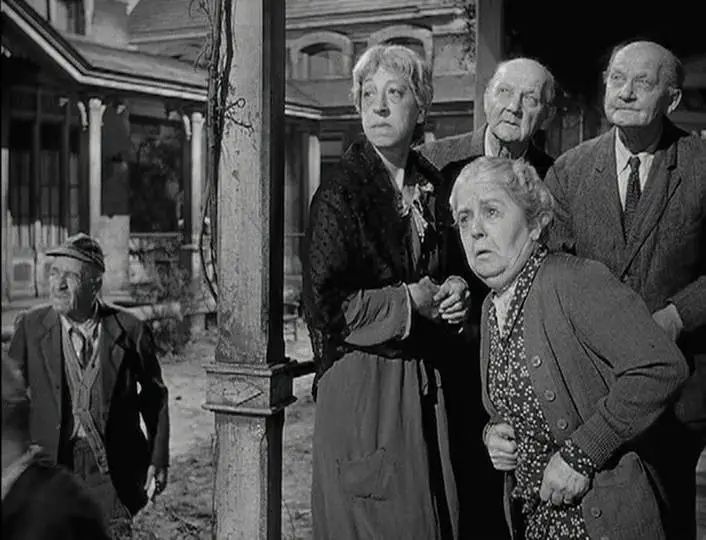
Each of the inhabitants is touched in a profound way by this one man. Mr. Beebe (Billy Lynn) is especially affected by Belvedere's arrival. Mr. Beebe has no interest in life. He is waiting for spring, even while knowing that the spring to come will only resemble the winter that was. 

Mr. Cherry (Harry Hines) is downhearted, too. He eats the food that is set before him but wishes the church had the funds to buy him a new set of teeth. Ms. Hoadley drinks ("Nobody has a right to be that happy, " a fellow lodger comments); Ms. Sampler only talks of "love, love, love" and the three marriages she had; and saddest of all is Mrs. Hammer (Doro Merande) who hides her loneliness behind snarky - although amusing - remarks. 

"Eat and sleep, sleep and eat. The only action we get around here is in our stomachs."

Nurse Harriet (Joanne Dru) always has a cheerful smile and tries her best to tend to their needs and liven their spirits. "Someday we'll have a wonderful garden with green grass and pretty flowers," she says. "Flowers won't grow here. The whole place is old, even the ground. You ought to be ashamed to run an old dump," Mrs. Hammer replies. 

Harriet is in love with Reverand Watson (Hugh Marlowe) but he seems oblivious to her. The reverend wants the best for the elderly left in his charge but he has become so preoccupied with bills and the needs of the church that he has neglected their spiritual needs. 

"Bills, bills, bills! Religion has become so expensive, only the wicked can afford it."

They all need a shot of vitality and this is what Mr. Erwenter aka Mr. Belvedere provides in the form of a secret youth potion. He tells them of the days he spent with the great Lo Chin Po, a 112-year-old Tibetan, and how together they discovered a formula for restoring youth. "I will write to Lo Chin Po and ask him to send me some more pills for you," Mr. Erwenter announces. The excitement of the thought of being young again makes everyone come alive. 
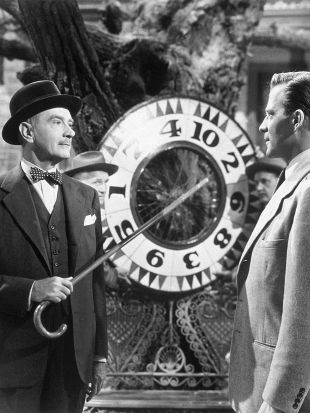
Mr. Erwenter also arranges a bazaar to help the church raise money for Mr. Cherry's new set of teeth and Mrs. Hammer's appendix operation. He gives them all something to look forward to, a new lease on life. But the happiness they feel and their faith in Mr. Erwenter crumble suddenly when they discover that he is not Mr. Erwenter at all, but a 45-year-old author named Mr. Belvedere who has been "feeding us lies."

With a plot such as this you would imagine that Mr. Belvedere Rings the Bell is a depressing film to watch. After all, it is set in a rundown nursing home filled with characters who are waiting to die. But it is quite the contrary - it is a gem of a comedy. The script, by Ranald MacDougall, is marvelously witty and benefits from having talented character actors deliver the lines with such humor. 

Doro Merande is especially wonderful in the role of bitter Mrs. Hammer. Most of the actors were much younger than the characters they were playing but they tottered around looking convincingly old. Billy Lynn, as Mr. Beebe, gives a touching performance of a heartbroken old man. Like a child who just discovered that Santa Claus is only a fable, Mr. Beebe is hurt more so than the others by Mr. Belvedere's "betrayal" because he had the most faith in him.  

"Being young is the way you think! Live every moment as if it is going to be the last one you will ever have. Believe you're young and you will be young. That's my secret."

Hugh Marlowe is wonderful as always as the kindly minister whose life and outlook of life is changed by Belvedere's arrival, and Joanne Dru, as Harriet, is a lovely ray of sunshine in their bleak world. Also in the cast are Warren Stevens, Jane Marbury, and Hugh Beaumont as a policeman. 

The story was based on the play "The Silver Whistle" by Robert E. McEnroe, which featured a cheerful hobo named Wilfred Tasbinder who takes on the persona of Mr. Erwenter and helps the lives of those in a nursing home. Ranald MacDougall took the character of Belvedere from Gwen Davenport's 1947 novel and blended him into McEnroe's story, sprinkling the script with wry humor. 

20th Century Fox released a number of fine light-hearted comedies like this in the late 1940s and early 1950s. They all were given a healthy budget and a great production staff. Henry Koster (The Luck of the Irish, Harvey) was put in charge of directing Mr. Belvedere Rings the Bell and he had a marvelous flair for making films that were both sentimental and humorous...and shared a message. This picture was ideal for his talents and featured a story about a beneficial intruder not unlike the leading characters found in The Bishop's Wife and Come to the Stable, both of which he directed. 

Mr. Belvedere Rings the Bell has a beautiful message about enjoying life and making every moment count. At one point in the film, Belvedere asks Harriet, "It's close to 10 o'clock now. 9 o'clock is gone and we can never bring it back and live it over. What have you done with the thousands of moments in the past two years?" This question is directed at Harriet the nurse and yet it is asked of the audience as well. Mr. Belvedere, in his vast 45 years of age, has lived a full life. In the one brief week he spends at the Church of John Home of the Aged, he stepped into the lives of the people there unexpectedly and touched each one with his presence. With the thousands of moments we all have, it makes you wonder if you cannot do the same and see how rich life can be. 

This post is our contribution to The Intruder Blogathon being hosted by yours truly, Silver Scenes, from June 16-18, 2023. Click here to read more reviews of films featuring characters that "intrude" in the lives of others and touch them for the better. 

Friday, April 15, 2022

Titanic ( 1953 )

On April 15th, 1912, in the early morning hours, the luxury liner RMS Titanic sank in the waters of the North Atlantic after striking an iceberg. Over 1,500 passengers perished in one of the worst ocean disasters in history. Today marks the 110th anniversary of this tragic event, and so we'll be reviewing one of the many films that were made about the Titanic. 

Jean Negulesco's Oscar-nominated drama Titanic (1953) was not the first film telling of the famous tragedy, but it certainly ranks as one of the best with its lush setting and star-studded cast. Clifton Webb and Barbara Stanwyck star as an unhappily married couple who struggle with family issues onboard the Titanic. These issues suddenly don't seem very serious when they face perishing in the icy waters. Traveling with them is their daughter Annette (Audrey Dalton), a young and beautiful socialite, and their son Norman (Harper Carter), a bright lad who is devoted to his father. Julia (Barbara Stanwyck) thinks her husband Richard is an elegant snob with very little character and sees that their children are becoming just as pompous as he, so she is whisking them off to America to get them away from the European society environment they are used to. Richard boldly sneaks onboard the ship and connives to lure the children back but when the iceberg hits the Titanic, he realizes their safety is more important than anything else. 

The story of this family may be fictional but it plays out within a framework of facts. The opening sequence states that "All navigational details of this film - conversations, incidents, and general data - are taken verbatim from the published reports of inquiries held in 1912 by the Congress of the United States and the British Board of Trade."

Titanic was one of 20th Century Fox's top productions of 1953 and it is clearly evident that all involved did their research in making the film historically accurate. The RMS Titanic sets are so meticulously crafted that the ship itself takes the center spotlight in every scene. Stanwyck probably never dreamt that she would have to vie with set props for the audience's attention. 

Lyle Wheeler, Maurice Ransford, and Stuart Reiss won an Academy Award nomination for their work on the film's art and set direction and must be applauded for their marvelous special effects, too, which included the sinking of a 22-foot model of the liner. 

Charles Brackett and Walter Reisch penned a great tear-inducing script that holds your attention from the start. It is amazing how much drama is packed into this picture considering its runtime is half the length of James Cameron's 1997 telling of the Titanic.  

The film also boasts a stellar cast of supporting players and character actors including a young and handsome Robert Wagner, Richard Basehart, Brian Aherne as the ship's Captain Smith, Thelma Ritter in a "Molly Brown"-ish role, Allyn Joslyn, and Frances Bergen. 


Titanic is available on DVD, Blu-Ray, and through streaming via Tubi. You can also watch it for free online at Tubitv.com

Saturday, October 9, 2021

Clifton Webb's Bachelor Abode

In the 1950s there was a great film magazine called Film Show that released an annual book filled with articles written by the stars themselves or as they so aptly subtitled it "The Stars Tell Their Own Stories". Whether or not the actors really did write these articles does not matter because they are very entertaining to read regardless. One which we will share with you below is by Clifton Webb who decided to tell his fans a little bit about his "bachelor abode". This one does indeed seem to be written with the haughtiness/snobbery you would expect from Mr. Belvedere or Waldo Lydecker. 

____________________________________

When I first arrived in Hollywood to make Laura all I had was a solitary suitcase in my hand. With me were my mother and Earnest, my French poodle. 20th Century-Fox had persuaded me to sign a contract. They liked a test they had made of me for a part in Laura. Otto Preminger, who had seen me in "Blithe Spirit" when it played in Los Angeles, had suggested the test. While he was finishing the script of Laura I was still on the road tour of "Blithe Spirit". Word reached me that I was needed at 20th to begin work on Laura

Spring floods sweeping the Middle West disarranged all train schedules, and in the upset my six trunkfuls of wardrobe were lost en route. They caught up with me later, but in the meantime we settled in the house I had leased from Constance Bennett. It had twenty-two rooms, a tennis court, and a swimming pool. 

When I decided to settle in Hollywood, I bought my own place - a Spanish-style home [ Author's note: This house was located at 1005 Rexford Drive and was once owned by Grace Moore. Webb claimed it was haunted by her but we'll cover that story in another post ]. Eventually, instead of building a new house, I set about changing the architecture and some of the interior. What I have achieved is rather a mystery as far as style goes - perhaps it has some relation to Georgian, but it is just what I wanted as bachelor quarters. A new house could hardly have cost more. However, I think I have managed to make my home the setting for a civilized life. 

Clifton Webb's House - Image Courtesy of the Los Angeles Public Library
During my travels I acquired paintings that have interested several museum directors who have seen them. One, a painting of me as a youngster of thirteen, always attracts attention - not because I was the subject matter; it happens to be signed by the late George Bellows whose work is now coveted by collectors. In my collection, I have the works of artists who were more or less obscure when I bought their paintings. For instance there are examples of Fabrizzio Caricci, Buffet, Stumpfig, Pagliacci. I value highly several paintings by Bakst. Don't think I'm posing as a man of rare judgment, but I do feel there is real satisfaction in recognizing merit in the work of an unknown. I will admit, too, it is cheaper - much; to acquire the work of a popular and established artist takes money - lots of it. 

Portrait of Clifton Webb by George Bellows
My bachelor adobe is presided over by Maybelle - with charm; she's my invaluable friend - my mother. Around us are pieces of furniture and treasures gathered from various trips to Europe. Many things too, have come from friends. Some have interesting histories or recall pleasurable associations. For instance, beneath the Bellows painting of me is a marble-topped bench which I brought from my New York apartment which the late Lady Mendly, when she was Elsie de Wolf, helped me furnish. In those days she was a well-known interior decorator. 

On the bench are three vases, treasured because they were once the property of my very good friend Syre Maugham, a woman of great taste who was at one time the wife of Somerset Maugham. 

Many friends ask about a rather odd little chair with short legs that stands in the hall outside the living room. It's a Sixteenth-Century prie-dieu. It came from Hier, France, and those who have a knowledge of antiques have often tried to get it away from me. 

My most treasured possessions are the dining room table and chairs which I first had in a home in London while playing in the theatre there. The dining room is Georgian with a chandelier of crystal - it is elaborate and I like it. 

In the living room are overstuffed chairs covered with chintz to give an informal air, and a green sofa. I'm not dedicated to antiques or period furniture -in this room, there is a touch of California; in front of the sofa stands a long teak coffee table I designed myself. 

At times I wonder why I should have such a large house for just the two of us - or I should say four, Razor and Baci share it with us  - they are two lovable French poodles ( Earnest has departed ). But, through my years in the theatre and films, I have gathered many things and I like to have them around. Many are housed in the playroom which opens onto the swimming pool. There is a fire chief's helmet given to me by Philadelphia's Poor Richard's Club. The Lamb's Club in New York sent me a baton used by the late John Philip Sousa. The walls are hung with autographed photos of many stage and screen stars. 

Those who know me only by the type of role I play might not recit me with having much sentiment. I'm willing to admit I'm not a hundred percent the sophisticate. I'm a fellow who loves a home and garden - I am especially fond of camellias. I enjoy digging, pruning, and the hundred and one things that have to be done. It might be disappointing to some who visualize me only as a dapper man-about-town as my pictures would have you believe. At home, I'm just someone who has fallen for the dolce far niente life of Hollywood. 

The above article was reprinted from the 1952 issue of The New Film Show Annual.