Showing posts with label Elizabeth Taylor. Show all posts

Tuesday, July 28, 2026

Film Album: Love Themes from Cleopatra (1963)


Most film albums feature a variety of themes from different films and title their album with the key theme, such as "Theme from the VIPS and other Film Hits".... but this album struck me as unique because Ferrante and Teicher decided to focus strictly on the music of Cleopatra (1963). Or so one would think with the title "Love Themes from Cleopatra" but if you read the back liner notes you will find that there are really just two songs from the 1963 Elizabeth Taylor epic ("Caesar and Cleopatra Theme" and "Anthony and Cleopatra Theme") with the remaining songs being "an assortment of romantic melodies steeped in an exotic orientation." What a lovely way to phrase this! 

The dueling pianists Ferrante and Teicher had a major hit with their version of the love theme "Anthony and Cleopatra," so it is no surprise that it headlined an album of its own. What is a surprise is that Ferrante and Teicher's names appear as composers on two songs in this album - "Sirocco" and "Sands of Time". Very interesting. 

Check out this album and, even if ancient orient themed music isn't your cup of tea, you may be surprised to find out how entertaining this album is! Listen to it in full on Youtube here. 

Track Listing

Side One:

Anthony and Cleopatra

Caravan

Moonlight on the Ganges

In a Persian Market

Sirocco

Sheherazade


Side Two: 

Caesar and Cleopatra

Samson and Delilah (not the film theme)

Devotion

Orientale

Sands of Time

Procession of Sardar

Top Picks: Sirocco, Caesar and Cleopatra, Orientale, Sands of Time

Thursday, December 20, 2018

From the Archives: Little Women ( 1949 )

June Allyson ( Jo ), Elizabeth Taylor ( Amy ), Mary Astor ( Marmee ) and Janet Leigh ( Meg ) gather around little Margaret O'Brien ( Beth ) who has just received a piano as a present from the kindly neighbor Mr. Lawrence in this still photo from MGM's Little Women ( 1949 ). 

From the Archives is our latest series of posts where we share photos from the Silverbanks Pictures collection. Some of these may have been sold in the past, and others may still be available for purchase at our eBay store : http://stores.ebay.com/Silverbanks-Pictures

Tuesday, November 13, 2018

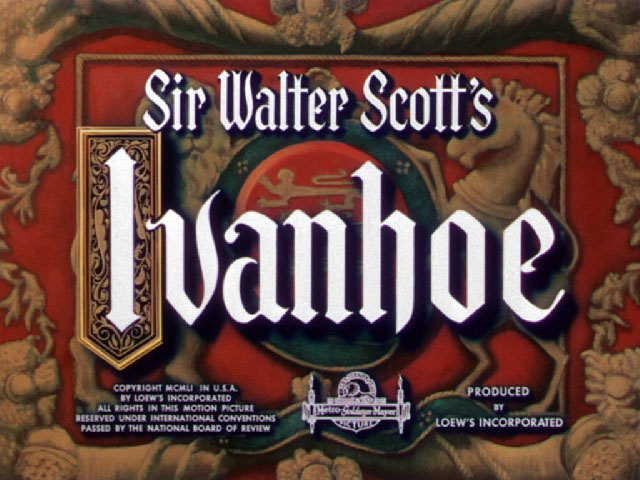
Ivanhoe ( 1952 )

Sir Walter Scott's 1819 epic medieval novel "Ivanhoe" was brought to the big screen in 1952 as a gorgeous Technicolor adaptation released through Metro-Goldwyn-Mayer Studios. Like many medieval films of the era, it combined romance, drama, and a good deal of swordplay into an adventure-packed 100-minute runtime. 

Ivanhoe was first brought to the screen in 1913, as a silent film starring King Baggot and Leah Baird. Surprisingly, it was not filmed again in the 1920s ( Ronald Colman missed out on a great opportunity here ), nor in the 1930s and 1940s. 

Finally, in 1952, when Pandro S. Berman undertook to produce it, he hired that old pro at MGM, Richard Thorpe, to direct the film. Thorpe whipped together a scrumptious feast of derring-do and the success of this film lead him to helm several other similarly themed pictures, including The Prisoner of Zenda ( 1952 ), Knights of the Round Table ( 1953 ), and The Adventures of Quentin Durward ( 1955 ), two of which starred Robert Taylor, the titular hero of Ivanhoe. 
Robert Taylor was "Taylor-made" for roles such as Sir William of Ivanhoe, convincing audiences that he was the embodiment of noble virtues such as bravery, honesty, gentleness, and honor. In this film, he is the famous chivalrous Anglo-Saxon knight who is on a mission to return the imprisoned king, Sir Richard the Lionheart, to his throne which has been usurped by his nefarious brother Prince John ( Guy Rolfe ). With the aid of Isaac ( Felix Aylmer ), the old leader of a Jewish community, he collects the necessary ransom amount to free the king but must first clash swords with the knight De Bois-Guilbert ( George Sanders ) before he sees Richard seated in his rightful place again. 

Unlike some studios, Metro-Goldwyn-Mayer never made films in a half-hearted fashion, and Ivanhoe was no exception. It had a budget of nearly $4,000,000 which permitted the cast to be sent to England for interior and exterior shooting at the MGM British Studios in Borehamwood and Ashby de-la Zouch, villages steeped in English history. Alfred Junge designed the interiors of all of the sets, with Roger Furse ( Henry V ) providing the scrumptious costumes for the knights and ladies, which included Joan Fontaine as Rowena and Elizabeth Taylor as Rebecca.

Elizabeth Taylor was only nineteen-years-old at the time, but so expressive in her acting and certainly the most beautiful actress to ever portray Rebecca. Also in the excellent cast was Emlyn Williams as Wamba, Robert Douglas, Finlay Currie, Basil Sydney, Megs Jenkins, Francis de Wolff, and Harold Warrender as Robin Hood. 

Some have claimed that Ivanhoe is not entirely faithful to the book, but surely some allowances had to be made for the sake of condensation. The thrill of seeing the story that unfolds onscreen inspires one to read the novel. This should be the aim of any great literary-to-film adaptation, and Ivanhoe accomplishes this. 
Upon its release, Ivanhoe was a huge earner at the box-office, both in the States and in England, grossing over $10,000,000 in sales. It also triggered the birth of a medieval genre of films that had not been popular since Errol Flynn starred in The Adventures of Robin Hood in 1938. 

Wednesday, August 20, 2014

Set Design: Elephant Walk ( 1954 )

Elizabeth Taylor was caught in the middle of a love triangle and an elephant stampede in Paramount's 1954 adventure Elephant Walk. Dana Andrews and Peter Finch portrayed the two tea plantation owners vying for her affection. As lovely as Ms. Taylor was however, the real star of the show was the titular "Elephant Walk", Finch's sprawling "bungalow" in Ceylon, India. Built by Finch's father, it's name came from the fact that he had it constructed directly on the ancient old path that the elephants use to travel to their watering hole. He liked to be stubborn in that sort of way....but elephants can be stubborn too and they are not ready to give up their path so easily. 


Let's take a trek to the land of the monsoons and gawk at these glorious Technicolor screenshots of Elephant Walk, featuring the design work of Joseph McMillan Johnson and Hal Pereira. 

The film begins on a rainy day in England where we see Elizabeth Taylor as a book dealer ( the job doesn't suit her ) in the tiny village of Shillingworth. We only get to see a shilling's worth of the town in a rainy view of the window outside of Taylor's bookshop but the interior of this quaint little shop makes one love the village nonetheless. 


That's the wonderful British character actress Norma Varden who has her back turned towards the screen. Finch meets Taylor during one of this annual business expeditions to England and the two marry, whence he takes his new bride to Ceylon to live. 


"Why, I married a millionaire!" Taylor exclaims upon seeing the interior of her new home....as though she would ever marry a commoner. Finch whisks the happy bride over the threshold and then that's about it, as far as the marriageable bliss angle. Instead of consummating their marriage, her husband rather socialize with his pals on their first night home.  


The cronies come to stay every weekend and sponge off their ol' bean, enjoying "the gov'nas" Madeira, first class cigars, and of course...a rousing game of bicyclette polo ( you'll have to watch the movie to see how its played ), and Taylor realizes then that there are no British womenfolk for miles to have any tupperware parties with.


Johnson and Pereira did a marvelous job of designing a palatial manor befitting a British tea mogul. Black wood floors and heavy beam columns hearken the spirit of the imperialistic conqueror, while bare marble floors echo the coldness of Taylor's love life. 


The kitchen is especially grand. Taylor decides to preoccupy herself by taking over the kitchen and other "women's work"....but the chief caretaker, Appuhamy, highly disapproves. And one does not cross paths with Appuhamy ( unless you're an elephant ).


Even if she doesn't have a social life, she never has to worry about starving on the plantation. Take a look at that kitchen pantry!  


Finch takes a spill over the banister during one of the polo games and ends up with a busted leg. This puts him in an ornery mood and obeying doctor's orders, is confined to the upstairs bedroom. Elephant Walk must have at least a dozen bedrooms, but unfortunately, this is the only one we get to see. 


Those intricately carved edges around the doorways are gilded in a sparkling silver, which glitters enormously depending on the resolution of your television set. Outside the bedroom is a wide balcony with the perfect little wicker writing desk, which Taylor uses to pen letters to her mother back in Shillingworth-on-the-Thames. She isn't all together happy at the Ceylon stomping grounds since she found out about the spirit of Finch's old man residing there. 

Her only ally among the men folk is Dana Andrews, who wants her to run away from Elephant Walk and all its symbolic references to the past, and marry him instead. 

Andrews doesn't own an Elephant Walk, he owns a real bungalow instead...a small one: 


( Be sure to take advantage of our sloppy pastiche and click on the image for a larger view. )
Seeing what a swell place he has, she decides maybe it is best to leave Finch and go with Andrews instead, but.....


...a cholera breaks out on the plantation! Drats. Now Ruth and Dick ( that's Taylor and Andrews' characters ) are kept within the confines of the place and cannot leave. The plantation gets turned into a hospital and Elephant Walk becomes a veritable warehouse for medical supplies. 


After seeing how she handles the situation, Appuhamy comes to respect Taylor as the new mistress of Elephant Walk, but the elephants, led by Old Bull, are still resentful no matter who resides there. They want their path back and are willing to bust through the barriers to get to it. 

When Elephant Walk was released, Liz Taylor and its marvelous elephant stampede sequence were touted as the film's drawing features. We think the whole atmosphere of the film make it enjoyable to watch, and this of course, is due to the talents of its art directors and set decorators. 


The set decorators did a great job with all the tiny details. Just look at the wear on those old crates, and even the cups and saucers used in the house bear the Elephant Walk tea logo. The set decoration for Elephant Walk was handled by Sam Comer and Grace Gregory, two highly talented individuals who beautified the sets of White Christmas, Houseboat, Omar Khayyam, The Naked Jungle, Blue Hawaii and The Ten Commandments. 

Monday, May 26, 2014

Giant ( 1956 )

"Bick, you shoulda shot that fella a long time ago. Now he's too rich to kill"

Uncle Bawley's words do not fall on deaf ears, rather they echo the sentiment felt by the entire Benedict family and little do they realize that Jett Rink's solitary oil well on Reata land will launch the emergence of an industry that will change the face of Texas.

Edna Ferber's sprawling western saga of a Texan family comes to life in George Steven's 1956 film adaptation. Giant tells the story of a wealthy cattle baron, Jordan "Bick" Benedict ( Rock Hudson ) who comes to Maryland to purchase a horse from Horace Lynnton ( Paul Fix ), a socially prominent doctor. While staying at his home he meets, falls in love with and marries Lynnton's beautiful daughter Leslie ( Elizabeth Taylor ). Bick transports her from the lush green countryside of Maryland to his dusty isolated ranch called Reata, an enormous 600,000 acre cattle spread run by himself, his sister ( Mercedes MacCambridge ) and his staff of Mexican farmhands.


Once at Reata, Leslie undertakes changes that reflect her well-bred upbringing and stubbornly refuses to let Texan folkways stop her from being considerate and helpful to the Mexican people. We follow Leslie as she grows from a delicate flower from the east into a tough leathered matriarch. We follow Bick as he rises from a cattle rancher to an oil millionaire in his competition against Jett Rink ( James Dean ), a despised ranch hand who first strikes oil on Reata land. Together they build a marriage mixed with tenderness and turbulence to create a dynasty spanning three generations.


At its heart Giant is an intimate story of compromise and adjustment. Leslie learns to adapt herself to her surroundings and become a true Texan without compromising her values. She becomes such a part of the ranch that none of Bick's family, friends or neighbors could imagine what Reata would be like without her. More importantly, Bick comes to accept that life on Reata cannot remain the same as when his father ran the ranch. He comes to accept that his children want to lead lives of their own in different professions and, in the subtle finale, finds that his racial views have been completely changed.

"Honey, you don't act that way towards those people. You're a Texan now"
"Is being a Texan a state of mind? I'm still myself"

The evolving Benedict family symbolizes the state of Texas itself which was adapting and moving away from its agrarian existence. Modern ways of thinking were pushing out old-fashioned notions of bigotry, child-rearing, and woman's place in the home.

The strong-willed Leslie was the instigator to many of these changes but even more so was that substance known as black gold - oil. The oozing stinking liquid was converting humble farmers into millionaires overnight and, with their pockets bulging with more cash than they knew what to do with, they had little desire to hold onto archaic beliefs of the past. It was an exciting time and they were proud to be in the throes of new inventions, discoveries, ideas, and new modes of transportation.

When Edna Ferber's epic novel was first published in 1952 it received much criticism. Texans resented being known as racially intolerant folk and despised the character of Jett Rink. Nevertheless, the book was immensely popular and, like Ferber's previous novels, quickly caught the attention of Hollywood producers who clamored to obtain the film rights. In making her decision, Ferber chose to go with Warner Brothers because George Stevens was undertaking the project. She appreciated his love for the story and his promise to remain faithful to her novel. 


Many actors in Hollywood were eager to get a part in the film, predicting what a prestigious production it would be. For the three leading characters, Stevens considered casting Grace Kelly, William Holden and Montogomery Clift. Alan Ladd and Robert Mitchum were also under consideration for the role of Jett Rink, but Stevens chose to go with James Dean, a talented young man who was quickly making a name for himself at Warner Brothers.


The cast of Giant was primarily very youthful. Rock Hudson, only 29 at the time, was given one of his first opportunities to demonstrate his dramatic acting ability and proved to be excellent as Bick Benedict. This was a pivotal film for Elizabeth Taylor as well who, at only 23 years of age, was launched to new heights as a dramatic actress. In Giant she recreates the literary Leslie and gives her a depth which was lacking in the original novel.


Carroll Baker was making her debut film performance as Luz, the Benedict's daughter, even though she was three years older than Taylor. Dennis Hopper had a brief, but substantial role himself as Jordy, their independent-minded son.

Along with these youthful characters, Stevens cast a number of excellent seasoned supporting actors including tough-as-nails Mercedes McCambridge; the delightful Jane Withers as the Benedict's neighbor and best friend ( who had been called out of retirement for this part ); the lovable Chill Wills as Uncle Bawley, a gentle man whom Leslie particularly adores; and Paul Fix as Dr. Lynnton. Also rounding out the cast is Sal Mineo, Earl Holliman, Elsa Cardanas, Rod Taylor ( billed as Rodney Taylor ), Judith Evelyn, Carolyn Craig, and Victor Millan.

"Money isn't everything, Jett" 
"Not when you've got it"


Location shooting for Giant began on June 6, 1955 in Marfa, a small town south of Pecos, Texas, where the cast and crew spent two months filming the scenes in and around Reata. 

"It was such a happy time", Jane Withers recalled, sharing a sentiment felt by most of the cast. However, tragedy struck eight days after Dean's final scenes were shot, when the cast, assembled in the screening room at Marfa, heard that James Dean had been killed in a car crash. Warner Brothers had banned Dean from racing during the production for fear that he may injure himself while filming was progressing.

In addition to its fine script and cast, a major part of Giant's appeal lay in its magnificent score, composed by the Russian immigrant Dimitri Tiomkin, who was one of Hollywood's most talented western film composers. His score for Giant weaves strains of old Texan favorites such as The Yellow Rose of Texas with classical music ( Clair de Lune ) and heart-thumping melodies of grandeur.

George Stevens invested three years of his life into making Giant, taking no pay for his work as director, instead choosing to have part interest in the final film rights. Stevens had faith in the script, production crew, and his own directorial skill; he had profound respect for his audience and for this reason made certain that every scene was the best it could be, no matter how many retakes or different camera angles it took to get a scene just right.


"Well....after a hundred years the Benedict family is finally a success"

At one point, nearing the end of the long editing stage, George Stevens Jr. grew impatient to complete the picture. Stevens reminded him, "Just think how many man hours people will spend watching this film over the years. Don't you think it's worth a little more of our time making it a better experience for them?"

Giant was released at a unique time during the 1950s when America was at its grandest. Texas was huge and booming with energy and so was the rest of the country. When Giant premiered on Nov. 24, 1956, it earned critical acclaim and became the top grossing film in Warner Brothers history. In some theatres it played for three months straight. The film was nominated for 11 Academy Awards but went on to win only one Oscar ( for Best Director ) competing against Mike Todd's epic Around the World in 80 Days.


That extra effort that Stevens and the cast and crew put into making the film all that more special has been appreciated by audiences for nearly 60 years. In its gentle way Giant grows from an intimate portrait of two newlyweds to a film of gigantic proportions, equal to the entertainment it provides. Decades later, other sagas such as Dynasty, Dallas, and The Thorn Birds imitated Giant's scope which drew the audience into the individual characters and the family as a whole. 

The film inspires a love for the tumbleweed ridden country known as Texas, its cattle, its oil, its people, and its history. Giant makes you proud to be a Texan, whether you were born one or not, and inspired audiences around the world to share in an admiration for the state that has become so much apart of America's heritage. 

This post is our contribution to the Classic Movie Blog Association's marvelous Fabulous Films of the 1950s Blogathon. Be sure to head over to the main site to check out all the great coverage of your favorite films of the '50s.