Showing posts with label Great Villain Blogathon. Show all posts

Saturday, April 22, 2017

Sir Percy - A Ripping Good Scoundrel

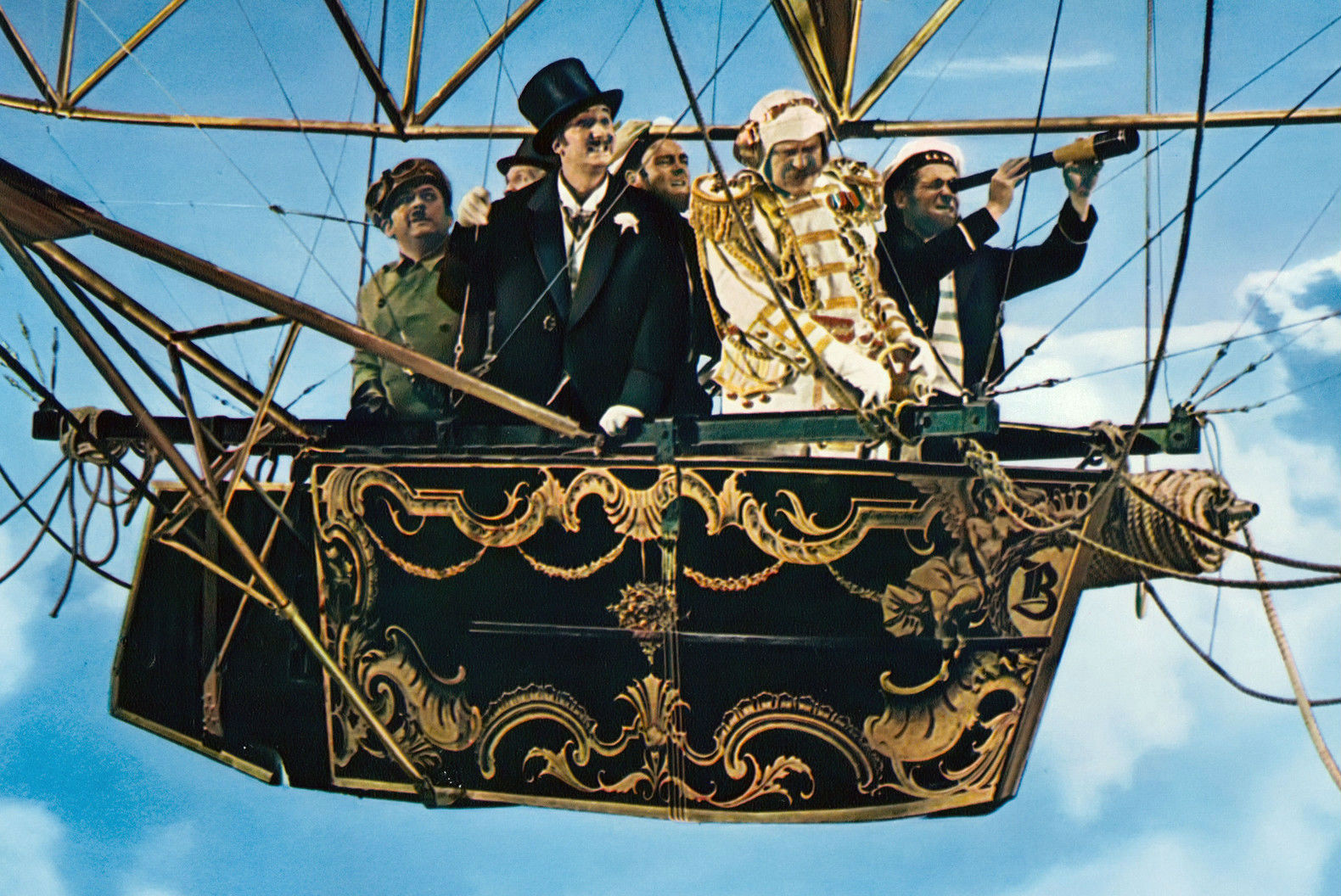
If I had to list the most praiseworthy and lovable scoundrel of all the dastardly villains that ever dared show their face on the silver screen, Sir Percival Ware-Armitage of Those Magnificent Men in Their Flying Machines ( 1965 ) would rank high on the list. 

Like Jack Lemmon's marvelous portrayal of Professor Fate in that equally entertaining race classic The Great Race ( 1965 ), Terry-Thomas made the part of Sir Percy completely his own. It could never be replicated by another actor, for even the name Sir Percy tends to conjures up images of Terry-Thomas' gap-toothed grin. 

Speakeasy, Shadows and Satin, and Silver Screenings are co-hosting the 4th annual Great Villain Blogathon which gives me the opportunity to gush about what makes Sir Percy such a stupendous bounder. But before I go into this let me just give you a brief account of the setting of Those Magnificent Men in Their Flying Machines : 

The year is 1910 and Lord Rawnsley, a wealthy newspaper publisher, sets out to prove that Britain rules the air as well as the sea by sponsoring an International Air Race from London to Paris. Flyers from all around the world are invited to take part in the race. These magnificent men include an Italian count ( Alberto Sordi ), an amiable Texan ( Stuart Whitman ), an intrepid German ( Gert Forbe ), a Japanese man ( Yujiro Ishihara ), a womanizing Frenchman ( Jean-Pierre Cassel ) and Britain's very own hero the dashing Richard Mays ( James Fox ). Where there is a hero you will often find a wrongdoer as well, and in this case it is none other than Sir Percival Ware-Armitage, whose skulduggery endangers all the flyers. Naturally....


The ultimate test of any disrespectable villain is his ability to maintain the lowest of standards. Now Sir Percy is not an forthright evil man, and you'll never catch him directly murdering a fellow ( he may arrange to get him smashed to pieces in an accident instead ), molesting children ( does sticking a lollipop in their hair count? ), or stalking someone ( that's what his stooge is paid to do ), but nevertheless he embodies certain qualities and lives up to a code that I believe all villains should strive for : 

1. An Untrustworthy Appearance 

Anyone should be able to recognize a villain by his appearance. Shifty eyes are a given, but added to that must be some thoroughly unsavory facial expressions such as sneering, muttering to oneself, and biting one's lip. Sir Percy nails these traits. A handlebar mustache and a dangling cigar only add to his charm. Since he is an English "gentleman", too, he dresses to the tee in all occasions. Pip-pip, old bean!

2. Ingenuity

Sabotage isn't easy and it takes a great deal of creative thought to devise schemes on the fly. Sir Percy had to tax his ingenuity to the limit for the International Air Race from cutting the wires on his opponent's planes to spiking their drinks with poison. 


3. Perseverance

When the going gets really tough and you find all your brilliant plans of sabotage lying to waste on the wayside - Hard cheese! - that's the time you need perseverance. Sir Percy desperately wanted to win the air race so he never let set-backs get him down. After stomping his foot and pouting a bit he would grit his teeth and start to work on a new tactic. 

4. The Ability to Hiss

It's taken for granted that all villains hiss, but in reality few can be proven as having done so. Sir Percy is a bonafide hisser....with Terry-Thomas portraying him he was bound to be one! Gapped teeth are a rare commodity in the acting world and so Terry-Thomas made the most of his natural born gift and whistles whenever possible. 


5. Knowing How to Lose Like a Villain

If you find yourself thoroughly beaten at the end of the day and quite knackered, then there is no reason to play noble. Here is your opportunity to shake your fist at your opponent, curse him, or throw yourself on the floor and cry ( kicking up your legs as you do so ). If Sir Percy had the German flyer's blunderbuss on hand when he was defeated he surely would have used it on the winner of the race. 

This post is our contribution to The Great Villain Blogathon being hosted by Speakeasy, Silver Screenings, and Shadows and Satin. Be sure to head on over to any of their blogs to read posts about some rattling good villains of the silver screen.

Friday, May 20, 2016

Baron von Bomburst of Chitty Chitty Bang Bang ( 1968 )

"I vaaahnt dat caaar!"

When Baron von Bomburst wants something you can be sure he'll get it, for his minions will go to any length to satisfy the childish whims of their dictator, or else.....their heads would roll! 

Baron von Bomburst is different than your usual villain because he doesn't look dangerous. In fact, he looks quite amiable with his curly Bavarian mustache and beady black eyes. But mentally, he is quite verrückt. He's a pirate masquerdaing as a king, with no interest whatsoever in the well-being of his people. The baron believes that the peasants are only there to serve him, and his subordinates realize that the only way they can spare their own lives is by kowtowing to the demands of their mad ruler. 

One day, while patroling the sea for ships to capture, the Baron happens to spy Professor Caractacus Pott's beautiful motorcar Chitty Chitty Bang Bang skimming gracefully across the waters, and decides then and there that he must get his hands on the floating car to add to his collection of toys. ( Yes, he's a pirate who likes toys ). When he discovers that the car can fly, too, he demands its capture and employs his top henchmen to retrieve it for him....namely, his two spies X and Bacon. Together, they devise ingenious ways to capture the car, but when all else fails, the Baron resorts to kidnapping the Professor to build the same such motorcar for himself...only, being the blunderer that he is, he kidnaps Grandpa Pott's instead! 
Caractacus Potts and the children witness the kidnapping and follow Bomburst's airship which leads them to his castle in Vulgaria. There, they not only rescue Grandpa but lead an ambush on the castle to dethrone the baron and free the hundreds of children he kept locked in his dungeons. 

German actor Gert Frobe ( best known as Auric Goldfinger in Goldfinger ) plays the part brilliantly, and, from his first appearance onscreen, we anticipate his downfall. Frobe played a similar character in Those Magnificent Men in their Flying Machines ( 1965 ) but, in that film, he managed to create a scoundrel that was both comical and quite lovable. Baron von Bomburst is simply bombastic. 

While Ian Fleming initially created the character of Bomburst in his 1964 children's book "Chitty Chitty Bang Bang", he was nothing like the man we see on screen. Screenwriter Roald Dahl is the creative genius who transformed him into such a marvelous and outrageous villain for the 1968 musical film adaptation. 

Dahl combines in Bomburst all of the qualities a child would imagine in a storybook villain without any of the devilry of villains seen in adult films. He's not a pyschologically complex character...he's just a bellowing obnoxious bear in ridiculious costume, wielding power and money to satisfy any demand he could possibly make. 

Among his collection of toys is his wife ( Anna Quayle ), an "oochie choochie" doll he initially adored, and then, like his other toys, grew bored with. Instead of casting her aside he likes to try different methods of disposing of her - none of which work. 
Both the Baron and Baroness are repulsed by children, and so, to rid Vulgaria of their presence, he lets loose the Child-Catcher. This man is certainly one of the most frightening characters to ever appear in a children's film. With his long black hair, pointy nose, snow-white skin, and flowing cape, he prances throughout the streets of the town singing out "treacle tarts, gum drops..." to lure children to their doom: the caged wagon from whence they are thrown into the damp dungeon of the castle. 

Robert Helpmann, one of England's great ballet stars, is fantastic in this part and can be credited with giving more children nightmares than any other actor on both sides of the Atlantic. 
It's ironic that both Bomburst and his wife despise children so much, considering they are both juvenile in nature themselves. Bomburst is a middle-aged man going through his second-childhood, obsessed with owning the most unique car ever built - a flying car. He needs constant entertainment to squelch his boredom ( and his tantrums ) and even employs toymakers to continuously create new forms of amusement for him. 

It is this childish quality about Baron von Bomburst that makes him the brute you love to hate. He's like a silent-film villain who would tie a damsel to a train-track and then suck his thumb in gleeful anticipation of an approaching train. 

What makes Gert Forbe's portrayal of Bomburst so great is that he isn't playing the part for laughs. He takes his role seriously, and - like Robert Helpmann, too - ends up creating a character that inspires hisses and boos after repeated viewings. And that's, ultimately, what being a great villain is all about. 

This post is our contribution to the annual The Great Villain Blogathon being hosted by Speakeasy, Silver Screenings, and Shadows and Satin. Be sure to check out the complete roster for more great posts about wicked kings, evil-doers, and conniving churls of the silver screen.

Saturday, May 14, 2016

Gangsters in Comedy 1940 - 1955

In 1940, one of my favorite of all film characters featured in comedy appeared on screen for the first time - the gangster goons - and for the next 15 years they would remain to get bumped, kicked, elbowed and knocked out by our bumbling comedian heroes.

These were no modern Disney villains who trip over their own shoelaces and could scarcely hold a gun. Nay, these were full-fledged “tough guys” of the meanest sort...ones who have earned their facial scars and busted noses. These were characters like Raspy Kelly, the strong silent type – “Moose Matson” a gourmet gangster - or “Left-eye Louie” who keeps you up nights wondering what happened to his right eye. And who can forget “Angel” from Shivering Sherlocks ( Three Stooges )?

Hardly the angelic sort!

The beginning of the era of comedy/villain films stems from Universal Studios in 1940 with the release of The Ghost Breakers starring Bob Hope and Paulette Goddard. Whilst there were a few slapstick shorts that featured thugs prior to this, it was The Ghost Breakers that really triggered the comic-gets-mixed-up-with-gangsters theme that continued into the mid-1950s. These gangsters appeared in the form of bank robbers, mobsters, art thieves, foreign spies and various other private syndicates. In this particular film, Bob Hope fled from Frenchy Duval’s gang in the nick of time just to fall into the hands of another villain out to scare Paulette Goddard from her family’s estate of Black Island in deep fog-engulfed Cuba.
One year later, Bud Abbott and Lou Costello were pitted against “Moose” Matson and his henchmen in the rollicking comedy Hold That Ghost ( 1941 ). Richard Carlson, Evelyn Ankers, and Joan Davis are stranded along with Abbott and Costello in a secluded roadhouse - during a thunderstorm, of course - where, unbeknownst to them, a gangster's fortune lay hiding within. 
That same year Red Skelton had to contend with one of the most notorious of filmdom’s vicious stereotyped actors – Conrad Veidt – in Whistling in the Dark ( 1941 ) when Veidt, as the leader of a swindling cult, need to hush up our hero from squawking about their criminal activity.
Throughout the 1940s, the Three Stooges were continually being thrown into the hot spot of gangster’s lairs as well. In Hold That Lion! they try to collect on their grandiose inheritance but come up against Ichabod Snipp, an underhanded broker. In Crime on their Hands ( 1948 ) they try to scoop a news story about a stolen diamond but Shemp almost gets cut in two by Dapper and his henchman Muscles when he accidentally swallows the rock instead. Ouch! Character actor Kenneth MacDonald often portrayed the villain in these Stooges shorts in spite of his gentlemanly appearance.
Even the four-footed equine Francis had to contend with a gang of art thieves for his final film…Francis in the Haunted House ( 1956 ). Donald O'Connor opted out of this entry and Mickey Rooney took his place in aiding Francis to save the hapless heroine of MacLeod castle from the so-called "ghost" of the estate. 
Bugs Bunny, Daffy Duck and other looney tunes poked fun of goony gangsters in such classics as “Bugs and Thugs” and “Catty Cornered” and “Rackateer Rabbit”. Big clunky Mugsy was the epitome of a henchman – clearly a former boxer who had his brains knocked out once too many times.
But King of all tough-talking, fast-acting, eye-glaring gangsters was Sheldon Leonard. This poor guy was stereotyped so badly that even when a role did not call for any skull-duggery he gave the appearance that he had a few tricks up his sleeve. Just look at those shifty eyes.
Mike Masurki and Mark Lawrence were popular con men of the 1940s too. Mark Lawrence played the mysterious “Charlie Smith” in Hold that Ghost and was bumped off faster than you can bat an eye by person or persons unknown. Alas, that’s often the fate for a scripted gangster.
In the 1950s comedians such as Abbott and Costello, The Three Stooges and Red Skelton were waning in popularity and so the studios turned to box-office draws such as Danny Kaye and Bob Hope and a duo which were the newest hit nightclub sensation of New York- Martin and Lewis.

These comedians fought crooked racing bookies, diamond thieves, murderers, international spies as fast as the screenwriters could churn out plots in such semi-classics as The Lemon Drop Kid, My Favorite Spy, My Favorite Brunette, The Secret of Walter Mitty, Knock on Wood, Paris Holiday and one of the last of the comedy-gangster films – You’re Never Too Young ( 1955 ). Raymond Burr played our baddie in this colorful remake of The Major and the Minor.
By the mid-1950s audiences were tired of seeing the same plot of mix-ups with thugs and goons…especially when films focusing on realistic teen crime were hitting the screen ( Blackboard Jungle, East of Eden ).

Nevertheless, in the 1960s there was a brief return to making films with a light-hearted approach to catching spies after the James Bond spy mania swept the world. As a mild-mannered archeology professor with a magical amulet, Tom Poston was fleeing from Russian agents as early as 1962 in Zotz!
Today, this genre of film no longer exists. While Walt Disney continues to make a handful of kiddie capers with bungling crooks, we no longer have full-fledged comedians fleeing from rough and tough gangsters who want their diamonds back, or bank robbers trying to silence their only eye-witness. 

Too bad really...they were such enjoyable films. 
"Alright Lefty.....you got us beat now. But beware, we'll be back!"

This post is our contribution to The Great Villain Blogathon being hosted by Speakeasy, Silver Screenings, and Shadows and Satin. Be sure to check out the complete roster for more great posts about gangsters, goons, and other grimly characters of the silver screen. 

Saturday, April 26, 2014

Professor Fate of "The Great Race" ( 1965 )

Blogathon season is in full force and Speakeasy, Shadows and Satin, and Silver Screenings have teamed up to devise the fiendishly clever Great Villain Blogathon to add to the mix. In our opinion there is no dastardly scheming archetypal villain greater than Professor Fate and so, naturally, we have chosen to spotlight him as our contribution to the event. 

The maniacal evil laugh of Professor Fate rings throughout The Great Race, Blake Edward's 1965 epic homage to the Golden Age of slapstick comedy. When he is not playing his four-tiered player-organ, Fate spends his energy hatching deviously diabolical plans to foil the Great Leslie. His all consuming passion is to become the greatest daredevil in the world, and only the tan-faced, spotlessly clean, lily-white clad Leslie stands in his way. When Leslie proposes a world-wide automobile race - the ultimate test in endurance - Professor Fate cannot resist the challenge to prove his superiority and what results is a wild and wacky adventurous match of two of the greatest slapstick daredevils filmdom has ever seen. 

Blake Edwards had great success in the early 1960s with such blockbuster hits as Breakfast at Tiffany's, The Pink Panther and A Shot in the Dark, but he had yet to make a epic comedy ( which he later became known for ) in the vein of It's a Mad, Mad, Mad, Mad World ( 1963 ).


The Great Race was to be his greatest comedy to date and, with such lofty intentions in mind, he plunged the generous sum of $6 million dollars into the project. Natalie Wood was - reluctantly - cast as the beautiful heroine of the picture, Maggie DuBois, a spunky suffragette who was always more than willing to put herself in peril for "the cause". 

Robert Wagner was Edwards original choice for Leslie Gallant III, but when he turned it down Edwards offered it to Charleton Heston, who thought it highly amusing, but nevertheless declined the part as well. George Peppard and Burt Lancaster were also considered before Tony Curtis was given the part ( Jack Warner's original choice ). 

" Ha, ha, ha.....Haaaaaaaa! "

While choices for the lead actors were hopping to and fro, there was no doubt in Edwards mind that Jack Lemmon was the man he wanted as Professor Fate. Complete with curling mustache, black cape and his sinister crooked top hat, Lemmon created a magnificent character role that defined what we have come to know as cliches of the "master villain". 

Peter Falk, who had given a marvelous performance as the Brooklyn taxi cab driver in It's a Mad, Mad, Mad, Mad World was cast as Professor Fates faithful servant, mechanic, henchman, and all-around dog, Max. Kennan Wynn, Arthur O'Connell, Dorothy Provine, Vivian Vance, and Larry Storch rounded out the "Great" cast. 


The Great Race took five months to complete and by the time it was ready for release, the enormous sum of $12,000,000 had been racked up on its bill. It became the most expensive comedy every made. In spite of Edward's great hopes for the film, it floundered desperately upon its initial release, with critics giving it mixed reviews ranging from "weak" to "adequate" in terms of belly-laugh ratings. Since then it has gained an enormous following with Professor Fate's engaging character being one of its most notable drawing features.

Professor Fate's Inventions

For years Fate and Leslie have been building elaborate contraptions to break speed records, soar to new heights, and make ladies swoon in terror of their unabashed bravery and continually Fate has tried to sabotage Leslie and send him to his doom. When the Great Leslie announces he will strap himself in a stray-jacket, hang upside down while an air balloon carries him high in the sky and wriggle free in time to descend safely to the ground, Fate is there - with a missile in hand - prepared to shoot him down. 


Like Wiley Coyote, destroying Leslie becomes Fate's all-consuming passion and he is ever ready with his ACME inventions to hail disaster down on his singular enemy. 

" Maaaaaaaaax!!!! "

When the Great Leslie attempts to break the speed record on water in his glittering white speedboat, Professor Fate and Max bring out their latest sound-seeking torpedo to blow him to smithereens. The plan backfires on him.

When the Great Leslie announces that he will drive the custom-built Leslie Special in an automobile race to end all automobile races, Fate hovers above in a two-cycled powered miniature zeppelin, prepared to destroy the car before it is even unveiled. He blows himself and Max up.

Fate is not just foiling the Great Leslie at every chance he can get....he is busily working at establishing himself as a great daredevil too. However, while Leslie has women swarming around him with puckered lips ready for kissing, the only crowds Fate manages to draw are jeering children and skeptical reporters. With his skull-faced equipment and loyal Max by his side, Fate always attempts the impossible, begins to get away with it...and then finds himself covered in the dirt of a humiliating crash. 


When the Great New York to Paris automobile race is announced, Fate takes up the gauntlet and enters himself and his greatest invention to date into the race - the Hannibal Twin-8. This machine, which hardly resembles an automobile, was built with endurance and villainy in mind. It features six wheels ( complete with caterpillar tracks ), an ice-melting heat iron, miniature cannon, smoke generator and an escalating mechanism. 

Jack Lemmon took the typical silent-era style villain and raised him to magnificent heights in his portrayal of Professor Fate, creating a character that entices the audience to hiss, jeer, boo, and cheer all in one breath. What other villain inspires children to write "Fate is a Fink" on the gates outside his house? He is a failure through and through ( even his initials bring to mind the dreaded school grade of "F" ) and yet one can't help applauding him for his marvelously cunning mind and unstoppable drive. 


Professor Fate became such an inspiring creation that Hanna-Barbera continued the character on in their cartoonified Great Race animated series, The Wacky Races. Fate became the famous Dastardly Dan, while Max was incarnated into what he truly was - a big shaggy dog. Today, children the world over still love these cartoons and they are introducing them to the great film that is The Great Race.