Showing posts with label Ruth Leuwerik. Show all posts

Wednesday, February 28, 2018

Vater Braucht Eine Frau ( 1952 ) aka Father Needs a Wife


Who wants to get a new housekeeper when you can have a new mother? 

Widower Hans Neumeister and his four children have just lost their most recent housekeeper who, like the other women before her, stormed out in aggravation over the children's playful antics. So Papa Neumeister is once again on the hunt for a housekeeper...but his children have other plans. They would rather have a permanent live-in housekeeper - a new mother! 

On behalf of their father, they place an ad in the marriage column of a local newspaper and within a day receive over 30 written responses from a variety of women, many of whom included a photograph of themselves. One photo, in particular, catches their eye, that of Susanne Meissner who happens to be standing in front of a chateau next to a Mercedes 300. The children do not realize that Susanne is not a well-to-do society woman, but simply a fashion model. However, once their father has a chance to meet her, her lack of high-society status becomes very unimportant. 

Vater Braucht Eine Frau is a charming film that combines all the elements of great family entertainment: humor, romance, and parallel plots that both children and adults could enjoy. The dialogue is timeless, the cinematography ideal, and the music ( by Franz Grothe ) is lovely....but what really makes the film work is the spot-on casting. Each of the principal actors is wonderful in their parts. 
This was the first film to feature the pairing of Ruth Leuwerik with Dieter Borsche and it established them as one of the most popular onscreen duos of the 1950s. They would go on to make five films together. 

Dieter Borsche brought warmth and a surprising comedic flair to the role of Hans. This unusual casting, at the time, echoed Walt Disney's unorthodox casting of Western hero Brian Keith as Hayley Mill's father in the family comedy The Parent Trap ( 1961 ). Who would have guessed that these men were so good at comedy? In one scene, Hans returns home to his apartment after a date with Susanne and, being on cloud nine, releases his joy by swinging on his children's indoor swing. Without a word, Dieter manages to express the elation of a widower who didn't believe he could ever fall in love again. 

Ruth Leuwerik is lovely as Susanne. Although she made one film before Vater Braucht Eine Frau, it was this comedy that launched her to stardom. Her role as Maria von Trapp in Die Trapp Familie and Die Trapp Familie in Amerika later established her as "The First Lady of German Cinema". Ruth had a way of projecting so much emotion with the slightest of gestures and she brings a hint of a maternal nature to Susanne which helps draw her to the children. 
Angelika Meissner leads the children's cast as Hans' eldest daughter Ulla. Like Ruth, Angelika had very expressive eyes and often conveyed more than what the script may have called for. She was excellent in parts like this. She later went on to play Dick in Die Mädels vom Immenhof ( 1955 ) one of the most popular family films of all-time ( in Germany ). Portraying the younger Neumeister boys are curly-haired brothers Urs and Migg Hess and little runny-nose Oliver Grimm. 

Also in the cast is Günther Lüders, a well-beloved German comedian, and Bruni Löbel as "Cuckoo".

Sunday, December 24, 2017

The Trapp Family ( 1956 ) - The Original Sound of Music

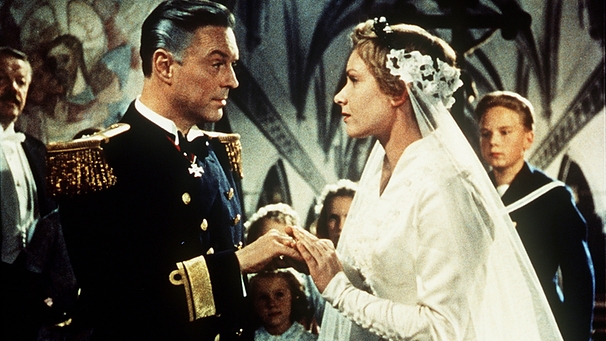
Every Christmas season for the past ten years, ABC has been airing The Sound of Music ( 1965 ) which has sparked a new holiday-viewing tradition for many. Well, nine years before Julie Andrews portrayed the real-life nun-turned-governess Maria von Trapp in the famous musical, Ruth Leuwerik took on this role in Die Trapp-Familie aka The Trapp Family ( 1956 ). 

Anyone who has not seen this German classic would be surprised at just how similar it is to the 1965 Robert Wise remake... and how quickly the story chugs along without the musical interludes. Yes, the original The Sound of Music was not a musical! There are, of course, a few numbers that the children perform for their audiences ( and one lovely piece that Ruth Leuwerik sings to the children ), but instead, the film focuses more on Maria befriending the Trapp household and how they made their start in America as a family. 

Die Trapp-Familie begins in Salzburg in the early 1930s. Maria, a happy energetic novice who teaches children at a convent, learns from her superior that she will be sent to the home of Captain von Trapp ( Hans Holt ) to tutor his seven children. The task is not an easy one for the children have driven away 26 governesses within the past four years, but Maria quickly gains their admiration and their love. She also wins the affection of their father, and within a short period they wed. As the children's governess, Maria had taught the children to laugh and play - and to sing - which is something they had not done with the disciplinarian naval captain. 
When the local priest, Dr. Wasner ( Josef Meinrad ) hears the children singing together, he helps to train them so that they may perform for charity benefits. It is during one of these benefits that a talent scout for an American song agency notices them and offers the family a contract to perform in the States. This proves to be a fortunate invitation because Captain von Trapp had lost much of his wealth during the Depression and the Nazis emergence made Maria and the Captain realize it was time to leave Austria which was becoming a totalitarian regime. However, their arrival in the States isn't all roses and fanfare, especially when the talent scout informs them that their act is no longer wanted and they find themselves Trapp-ed at Ellis Island! 

Die Trapp Familie is a beautiful film with a lot of heart. It bears many similarities to The Sound of Music, from the lovely cinematography down to the almost identical costume designs, and it differs only in its emphasis on certain aspects of the von Trapps' life. For example, the drama of the rise of the Nazi power and how this influenced the Captain to flee Austria is very much downplayed. Also, the children are not as predominately featured and are younger than they were cast in The Sound of Music. 
What I enjoyed most about the original film is its realistic portrayal of the von Trapps coming to America. In typical Hollywood fashion, The Sound of Music closes sensationally with Christopher Plummer, Julie Andrews, and the children climbing the Alps into Switzerland carrying all of their belongings on their backs. In Die Trapp Familie we see them at the overcrowded immigration gateway of Ellis Island huddled together with other immigrants awaiting entrance into the States. When they are told that it would be weeks before they are permitted to work, Maria cries, blaming herself for bringing the family into this situation. Somehow this seems much more credible! 

The film also boasts an impressive cast comprised of some of Germany's most famous stars. Ruth Leuwerik, who is often cited as the First Lady of German Cinema, is an enchanting Maria von Trapp. She deftly portrays Maria in all her stages of growth: as a youthful zealous nun, to a clever governess, to a protective mother of seven. Hans Holt is a much more appealing Captain von Trapp than Christopher Plummer, while the children are excellently cast, too. 
Upon its release, Die Trapp Familie was such a box-office sensation in Europe that a sequel - Die Trapp-Familie in Amerika - shortly followed which depicted the family's continuing adventures in Vermont. Unfortunately, the US release of The Trapp Family in 1956 did not fare well. It was not until The Sound of Music hit theaters in 1965 that audiences fell in love with the story of the von Trapps, undoubtedly due to the appeal of the beautiful Rodgers & Hammerstein melodies.