Showing posts with label Shirley Jones. Show all posts

Friday, April 9, 2021

From the Archives: April Love ( 1957 )

 
Shirley Jones is about to enjoy a kiss from Pat Boone in this scene from April Love ( 1957 ), a delightful musical remake of the 1944 film Home in Indiana. It was a big hit at the box office and the title song was nominated for an Academy Award. It is also one of Pat Boone's personal favorites, "the kind of movie I wish I could have made 20 more of".

From the Archives is our latest series of posts where we share photos from the Silverbanks Pictures collection. Some of these may have been sold in the past, and others may still be available for purchase at our eBay store : http://stores.ebay.com/Silverbanks-Pictures

Thursday, January 8, 2015

Set Design - The Courtship of Eddie's Father ( 1963 )

2015 is kicking off in a nice relaxing way. Sales with our business have finally slowed down and we have been able to savor the pleasure of re-viewing favorite films, one of which is this gem from 1963 - The Courtship of Eddie's Father starring Glenn Ford and based upon the best-selling novel of the same name. Mark Toby's book was such a hit when it was published in 1961 that Vincente Minnelli snatched hold of the screen rights and plunged into making this lush and lovely adaptation the next year. 

The Courtship of Eddie's Father tells the story of a young boy, Eddie ( Ron Howard ), who tries to steer his recently widowed father's attention away from Rita, the skinny-eyed brunette ( Dina Merrill ) he is currently dating to Elizabeth, the wide-eyed blonde across the hall from their apartment ( Shirley Jones ), in the hopes that she would be his new mother. Although the poster advertisements for the film give the impression that Eddie is lining up three women for his dad, only two really come into play...the curvaceous red-headed Dolly Daly ( Stella Stevens ) and his favorite, Elizabeth. Rita just snuck in like any busty no-good villainous woman. 

Glenn Ford is marvelous as Tom Corbett, the flustered father, and he plays this part with a gentle bewilderment that is really quite appealing. Ford and Minnelli had worked well together a year prior making Four Horsemen of the Acopolyse, so it is no wonder that Minnelli lassoed him into making another film together. 


Ron Howard took a break from playing Opie on The Andy Griffith Show to make The Courtship of Eddie's Father and he was re-teamed with Shirley Jones, whom he had worked with in The Music Man ( 1960 ). 

Unlike our regular Movie/TV set series, in which we cover just one main house set, our Set Design series features all the sets in any given film ( or at least, most of them ). Taking the screenshots for The Courtship of Eddie's Father was a sheer delight so be prepared to be swamped with images for this outing. 


In total, there were over nine sets constructed : the interior of the Corbett apartment, the apartment hallway and Miss Marten's apartment ( these were all on one large set ), the outer and inner offices of Corbett's work environment, Norman's radio lair, the bowling alley ( this was probably filmed at a nearby bowling lane but we're lost as to which one ), the jazz club, the fancy restaurant, another fancy restaurant, the arcade, Eddie's camp cabin, and finally, Miss Behren's apartment.

Let's look at them in more detail one at a time, starting with the location settings : 

The Arcade :

Things are slowly getting back to normal after Eddie's mother dies. The newly-hired "sleep-out" housekeeper, Mrs. Livingston arrived to take the helm of the housework and Eddie just returned from his first day back at kindergarten. To celebrate, Pop and son took in one of those western flicks where they cheat with the horses and are now ready to enjoy some dandy Chinese food when this eye-catching window display flashes out at Mr.Corbett. 


He decides they should play a few rounds of skee-ball before supper...which they never do, for they meet Dolly Daly instead. She wants to borrow his son to have a tie painted. You never know where mashers may be hiding, so she says. This doesn't look like their kind of hide-out ( unless they are of the teenage variety ), but the art directors did a great job of capturing that noising arcade feel in these scenes. 

Corbett's Office 


Tom Corbett works as a program manager when he is not playing skeet-ball with Eddie, but while away during his mourning period, Norman - the station's star disc jockey - gets carried away with his smooth-talk on the air, much to the chagrin of Tom.


Corbett's office was designed in typical New York City corporate style and it was several years ahead of its time in terms of color combinations and that wood grained look. 


Corbett's extra large speaker system can be seen in our sloppy image pastiche of his private office. We had two of those speakers built into the wall-to-wall fireplace of our house when we were growing up. Our father never used them however, so he removed the speakers and now they are bookshelves. Never let anyone tell you that ingenuity is not the best ingredient to great design. 


After Corbett gave Norman a mild warning about using the radio to pick up dates, he introduced him to Dolly Daly hoping he'd find a task for her to help her build her self-esteem. All she really needed to do that trick was find Norman, so this happy twosome went off on a double date to the local bowling alley with Corbett and Rita, a fashion editor.


I doubt the bowling alley was a set, but judging from the great design of the other The Courtship of Eddie's Father settings, it may well be. In this scene we get a glimpse of the feminist side of Rita Behren, who wants no man walking in front of her on her path through life. Artificial plants are a requisite in dining area sets and this one blends in nicely with the textured wallpapered decor. 


Norman and Dolly sneak off to a jazz club to have some chit-chat and Norman asks the musicians to let Dolly have a whirl at the drums...to help her with her self-esteem issue. The popular Italian character actor, Vito Scotti, makes an appearance as a clarinet player in the John LaSalle jazz combo. This set, as well as the restaurant below, are reused in a later scene when Corbett takes Rita on the town. 


When Eddie meets Rita for the first time it is at this very formal restaurant, which puts Eddie in a defensive mood. He doesn't like Rita. But I like the set. 


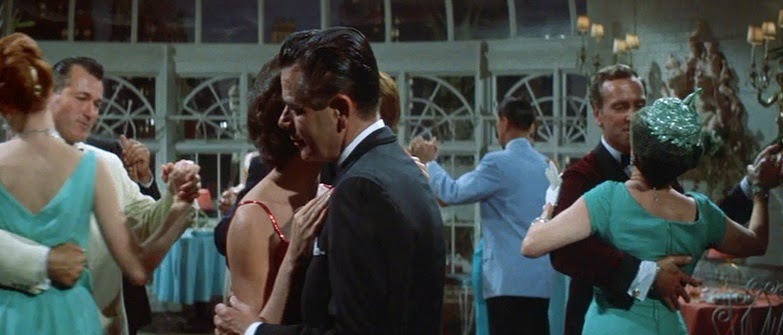
This lovely restaurant - or dancing pavilion - only appears for a few seconds near the end of the film, when Corbett is wooing Rita. Those lovely glass windows remind me of the set in The Happiest Millionaire ( 1967 ) during the "Are We Dancing?" number. 

Rita's Apartment 


Corbett doesn't spend much time at Rita's apartment and it is just as well, the rooms are decorated in a eclectic mix of modern New York, french traditional and ancient Japanese. Odd as the combinations seem ( along with the wild purple walls! ) it actually works. At least, for Rita. 


Here are some more potted artificial plants. Rubber trees always look good in apartments, even those that have purple walls. 

Elizabeth's Apartment 

The cameras do not get to linger around too much at Elizabeth's apartment either - Tom Corbett doesn't even step foot in her domain - but you can see what a great contrast the art directors set up between her and Rita's rooms. 


While Elizabeth's room is still very feminine, it is much more warm and inviting...like Shirley Jones' character. Speaking of the maestros - the art direction for The Courtship of Eddie's Father was handled by George W. Davis and Urie McCleary, two exceptional designers who did a slew of great films throughout the 1940s -1970s. 


Davis did the marvelous designs for the San Diego lake-view house in A Ticklish Affair, which was released the same year as Courtship. Shirley Jones had two minor hits in '63 with these films.  The kitchen/bathroom is never shown in Elizabeth's apartment but I think we can assume that it is off to the left of that plush white sofa. Being a single girl, she lives in a one bedroom suite. 

Corbett's Apartment

Now for the creme de la creme, the main set of the film - Corbett's apartment. This two bedroom pad was situated at the end of a short hallway on the sixth floor of a building right smack in the heart of New York. Corbett had a good job so this place probably cost him a pretty penny. It, too, is not very masculine, probably owing to the fact that Eddie's mother stayed at home most of the time and so that was her realm. 

Let's start off with the kitchen : 


The film begins with a harried Corbett making a last-minute breakfast for his little boy before whisking Eddie off to kindergarten. Take a look at the Oatmeal packaging on the table. It hasn't changed in 40 years. 


While he is doing this he is listening to Norman cooing on the radio and decides to make note of an action that needs to be done - STOP NORM. These rolling telephone notepads were very common in the 1960s. Our dad told us that making this was a common woodshop project in high school. This one, of course, is made with plastic. 


Mrs. Livingstone ( Roberta Sherwood ) is seen here whipping up some goodies for the children during Eddie's birthday party. This was Sherwood's first and only film appearance, although she made a handful of TV guest spots. She was a country singer by trade but did a swell job acting as Mrs. Livingston. 


When she first arrives she marvels over Corbett's modern kitchen layout.."A dishwashing machine and a garbage disposal! You better watch out for the floozies. Why, there's women who would marry you this very minute for the equipment you have in this apartment"

All the finishing touches and little items in the kitchen, as well as throughout the apartment, are courtesy of the talents of the set decorators, Keogh Gleason and Henry Grace. Both fellows were favorites of George W Davis. 

Henry Grace worked with Davis on the sets for Designing Woman ( 1959 ), Bells are Ringing ( 1960 ), The Time Machine ( 1960 ), Bachelor in Paradise ( 1961 ) and How the West Was Won ( 1962 ) among many many others. 


There aren't many hallways in Corbett's apartment, owing to it being only two bedrooms to begin with, but this is one of the hallways and it is just off to the right of the sofa. Eddie's room is the first door, across is a bathroom or closet, and at the end of the hall - Tom's room, which is connected with Eddie's. 


The Corbett's were avid TV lovers, or else that television-on-a-stand got moved from room to room. It's first seen in Tom's bedroom, then in Eddie's and finally in the living room when Tom watches Mogambo one lonely night. 


This is the only glimpse we get to see of the bathroom and it looks like it is the only masculine decorated room in the apartment. The double sink and window view is great. Tom is more concerned with getting the painted wristwatch off of Eddie's arm. 


Eddie's room is very neatly cluttered with toys that any 6 year-old boy would have screamed for back in 1963. If the kid wasn't happy with what he had here, he certainly was after his birthday....


...when he was given Astro Base (!), a fighter jet, and the Robby the Robot toy ( from Forbidden Planet ). In this scene Eddie is complimenting this dad on being "swell..All the kids thought so.". Hefty praise from a little one. 


During Eddie's birthday party Ronnie Howard's little brother Clint makes an appearance as an Indian chief. We also get to see the balcony as it looked in the daylight. 


The Courtship of Eddie's Father was the first time Minnelli teamed up with producer Joe Pasternak. They made a great team and this is one of those films where all the little details just fall into place beautifully. 


The film has a lot of heart and there isn't one scene I would change. No matter how many times I watch it, I laugh and cry and smile during all the same spots. These are a few of those spots : Elizabeth bringing her fudge ( "riddled with nuts" ), and Eddie finishing off the cha-cha-cha ( "You missed it! ). Just darling. 


On second look, that is a different television set. It's also unusual that this apartment would have two sliding doors leading out to the same small balcony. 


Summer Camp 


The camp that Eddie attends is not nearly as nice as the one the twins go to in The Parent Trap ( 1961 ), but it sure is a lot more idyllic than any today. Eddie shares his cabin with Mike, a blonde haired kid who likes axes obviously. 


The cabin looks like it is just a small hut, but in a later scene - when Eddie runs away - we get a glimpse of Tom being ushered into the bathroom by the camp leader ( Ron Howard's father ) to answer a phone call and it appears that it may be connected to a larger building. I like thinking it is just a small cabin however. 

Well, that wraps up another Set Design post. We hope you enjoyed this look at The Courtship of Eddie's Father sets and if you haven't seen the film yet, then take a gander as this little known gem. 

Monday, July 7, 2014

The Making of The Music Man ( 1962 )

The Music Man captures the spirit of small town America in a way unlike any other film. It enthralled audiences when it first debuted as a stage show in 1957 and continues to delight classic film fans today who, like us, won't consider Independence Day complete without watching it. There are some films that get tiresome with repeated viewings, but The Music Man is one of those gems that only get better which each subsequent viewing.

Often, it is the films that we watch the most often that we know the least about.The Music Man was one of those pictures for us and so after this Fourth of July we delved into the making of it and found it to be the stuff that blogs are made of. Let's begin at the very beginning......


Meredith Willson was a popular film composer ( The Great Dictator ), radio actor ( The Burns and Allen Show ), songwriter ( You and I, It's Beginning to Look a Lot Like Christmas ) and conductor before he wrote the music and play for The Music Man, but it was this production which catapulted him to fame and to this day is his most memorable musical work. 


For several years Willson toyed with the idea of writing a book about the childhood memories and good feelings he had for his hometown of Mason City, Iowa but it was not until 1948, when he was pushed by his wife and his old crony Frank Loesser, that he began work on putting together a play featuring his beloved hometown and the charming Hawkeyes that resided there. 

Willson incorporated into the play songs that he had written over the years and in 1956, five short years later, "The Music Man" was completed. Many of his friends and neighbors from back home were turned into characters for his play, and in the years after "The Music Man"'s success, Willson spilled which characters represented whom....but he always left Professor Harold Hill's real counterpart an enigma. 

In spite of its promising story and great musical numbers, Willson had difficulty in finding anyone to finance the show. CBS was interested in the material and decided to turn it into a one time television special starring Ray Bolger, but the deal fell through...and it was a good thing too, for Willson found backers for the stage show. Great honk! 

Barbara Cook was selected as the leading lady, Marion Paroo; Pert Kelton was cast as her mother, Eddie Hodges as Winthrop Paroo, and David Burns as Mayor Shinn....but Danny Kaye had turned down the leading part of Professor Harold Hill. For that matter, so did Dan Dailey, Gene Kelly, and Phil Harris, thinking the story was too corny. It was the show's director, Morton Da Costa, who insisted that Robert Preston would be perfect for the role, even though Willson had his doubts about him. 


"Cowards die a thousand deaths, the brave man.....only 500"

On December 19, 1957 "The Music Man" premiered on Broadway at the Majestic Theatre. It was a box-office sensation and a critical success and ran for 1,375 performances during its five year stint. Ye gods! 

An established hit always makes it to the silver screen eventually, but Warner Brothers did not want to wait for the eventual to happen too late so they dished out $1,000,000 for the screen rights to The Music Man. Choice casting was critical and a top-drawing name to pull in the audiences was forefront in the minds of Warner Brother's producers. Frank Sinatra was the leading candidate for the screen version, but when Meredith Willson heard these whisperings he exclaimed, "No Preston, No Music Man!". So much for those early doubts. 


"For score and seven years ago...."


Pert Kelton ( Mama Paroo ), The Buffalo Bills, and Susan Luckey ( Zeneeta Shins ) were all recruited from the original stage version, while Paul Ford was selected to play Mayor Shinns, the English stage actress Hermoine Gingold as his wife, Buddy Hackett as Marcellus Washburn, Timmy Everett as Tommy, Ron Howard as Winthrop Paroo ( who was selected from a talent contest ) and Shirley Jones as the beautiful, but skeptic, librarian Marion. The film also featured a plethora of great character actors such as Mary Wickes, Charles Lane, Hank Worden, and Charles Karel. 

Warner Brother's went all out in the production of The Music Man, setting aside over $900,000 for the budget and recruiting the stage director, Morton De Costa, to direct; Onna White to plot the choreography ( it was her first film ); Dorothy Jeakins to create the sumptuous costumes, and Paul Grosse ( one of MGM's leading art directors ) to design the 18+ sets used in the picture, including the dainty ice cream parlor and the charming Madison Library interior ( which was reused for Rome Adventure that same year ). 

In the music department, Ray Heindorf, the head of the Warner Brothers, conducted lovely new arrangements of Willson's music by Frank Comstock...arrangements which earned him the Academy Award by the way.

Shirley Jones, Robert Preston, The Buffalo Bills and principal players gathered at the lot seven weeks prior to when actual filming began, recording their numbers and rehearsing for the three big dance sequences - Marion the Librarian, 76 Trombones, and the biggest of 'em all, Shipoopi. By the time filming began in the spring of 1962 the cast and dancers were thoroughly shipooped. Meanwhile, across the pond, The Music Man opened in London with Van Johnson in the lead and Patricia Lambert as Marian Paroo. 


Most of The Music Man was filmed on the backlot of Warner Brothers where a complete replica of River City was built on 3 acres. Three months into the filming Shirley Jones discovered she was pregnant with her son, Patrick Cassidy, and that put a little snag into the production. DaCosta told her to keep it hush and it was kept as a secret for several months, until her bump was becoming too evident to hide ( although Dorothy Jeakins did her best to cover it up with plenty of lace and flowers ). Robert Preston noticed the little fella when he gave a big kick during Preston's one and only love scene with Shirley Jones on the bridge ( Till There Was You ).


After five weeks of filming, the editors went to work trimming the film down into a manageable length, while Pacific Title's creative team tackled the snail-paced process of stop-animation filming for their creation of the marching men in the title credit sequence designed by Wayne Fitzgerald.


"So what the heck? You're welcome! Join us at the picnic, you can eat your fill of all the food you bring yourself"

The Music Man premiered on June 19, 1962 in Willson's hometown of Mason City, Iowa. Over 100,000 Iowans attended the event, which was highlighted by a marching band contest among 100 different schools. 


The film went on to become the 7th highest grossing picture of the year. In addition to being popular among audiences, critics loved it as well, and it garnered six Academy Award nominations. 


There's som'thin' spthecial in store for each of us every Fourth of July when we watch The Music Man. Fifty-two years later and Professor Harold Hill is still marching along to those 76 trombones and gathering potential band players. And who knows, if we put the think system to use ourselves maybe we'll all be playing the Minuet in G with him by July 4, 2015. 

Tuesday, December 31, 2013

Happy New Year!!

Bring on the champagne and get ready to celebrate a happy New Year....or as Tom Corbert would say, "Here's to a better New Year". Happy 2014 dear readers! 


Wednesday, August 28, 2013

A Ticklish Affair ( 1963 )

In 1962, Shirley Jones, fresh from her success as Marian the librarian in the film adaptation of The Music Man, was assigned the leading role in MGM's A Ticklish Affair

After Jones had won an Academy Award for her dramatic performance in "Elmer Gantry"( 1960 ) she thought the studio would finally give her a chance to exercise her dramatic skills to greater use....instead they ushered her into light-hearted comedies.  

"Before and after Gantry, I did a string of comedies including The Courtship of Eddies Father ( 1963 ) with Glenn Ford, A Ticklish Affair with Gig Young, and my favorite, Bedtime Story ( 1964 ) with David Niven and Marlon Brando. I wasn't thrilled with the idea of doing comedy. The studios usually referred to them as 'sophisticated comedies'. Too often they were neither. "

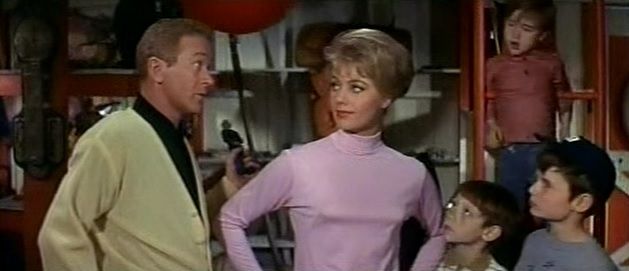
A Ticklish Affair tells the story of a Navy widow with three boys, a lovely home overlooking San Diego harbor, and a heart shut out to romance. Amy Martin ( Shirley Jones ) grew up as a Navy brat living out of a suitcase as her father got transferred from place to place. After her husband passes away she decides she wants stability for her children and vows to never get involved with another Navy man again. One afternoon her boys are playing a game and send an SOS signal using a signal lamp, it is spotted by a docked Navy vessel which sends them hurrying out to her house to investigate. The Commander ( Gig Young ) is instantly smitten with the comely mother - with shapely legs - and decides to become a frequent guest. No objection from Amy...until she finds herself falling in love again. 


A Ticklish Affair was released fifty years ago on August 18, 1963. Critics did not take to the film favorably, panning it's overly sentimental story, but audience members who watched it upon its release ( or even in more recent late-night television airings ) remember the film vividly. Quite often it is those light-hearted comedies that are the most fondly remembered....

Jean Simmons was originally slated to star in A Ticklish Affair, but due to contractual obligations Shirley Jones was reassigned the role. Doris Day - or even Debbie Reynolds - could have easily played her part too, and in some aspects a Doris Day is what the film needed. Although Jones does a splendid job, the film is thin on plot and really needed a strong leading persona to help carry it successfully. 

The film hoped to make up for it with a stellar cast. Carolyn Jones and Red Buttons ( as sister-in-law and brother ) provided steady support for Mrs. Martin, with Edgar Buchanan in a minor role as her father-in-law. Other familiar faces include Edward Platt ( Get Smart ), as Young's commanding officer, Eddie Applegate ( The Patty Duke Show ) as a Navy seabee, and Billy Mumy ( Lost in Space ), Bryan Russell ( Bye Bye Birdie ) and Peter Robbins ( Charlie Brown ) as the three little cadets. 


" More fun than marriage! "


So hailed the tagline. That would depend on one's marriage though. 

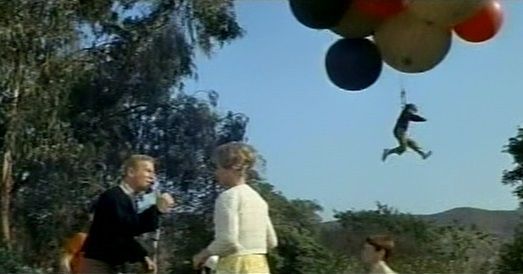
The major draw to the film is its colorful San Diego locations, beautiful house set ( who wouldn't want to live in a rustic colonial with ocean-view? ) and its climax : the Martin boys continually receive super fun gifts from their Uncle Cy ( Buttons ), the latest being a bundle of surplus weather balloons. Cy tells the children that they can pretend they are "moon walking" by tying themselves to the balloons and letting them carry them off the ground. Grover Martin, the youngest of the boys, cuts himself loose from the rope tethering himself to the weather balloons and slowly drifts over the city and out towards the sea in an attempt to get the Commander to rescue him. Some children will do anything for attention....


A Ticklish Affair meanders along at a leisurely pace and although it doesn't quite tickle its audience enough as it could have, it does have a cheerful tone about it and quite frankly that more than makes up for its shortcomings.