Showing posts with label The Ghost and Mrs. Muir. Show all posts

Sunday, August 14, 2022

The Portrait of Captain Gregg

Several years ago we posted an article on the whereabouts of the oil painting of Captain Gregg from the 1947 film classic The Ghost and Mrs. MuirThis post ( Whatever Became of the Portrait of Captain Gregg? ) is one of our most viewed posts and I was surprised by how much interest film fans have in that particular painting. My sister and I have long considered The Ghost and Mrs. Muir to be one of our favorite films but we had not known that it is considered to be a favorite by many. Two things most fans like best about it is the beautiful setting - Gull Cottage at Whitecliff-by-the-Sea - and the portrait of Captain Gregg that came with the house that Mrs. Muir rented. 

Several people commented that they would like to own the portrait of Captain Gregg but, if you read the article, you will see that it no longer exists as it was seen in the film, having been painted over with the likeness of Edward Mulhare for use in the 1968 television series The Ghost and Mrs. Muir. 

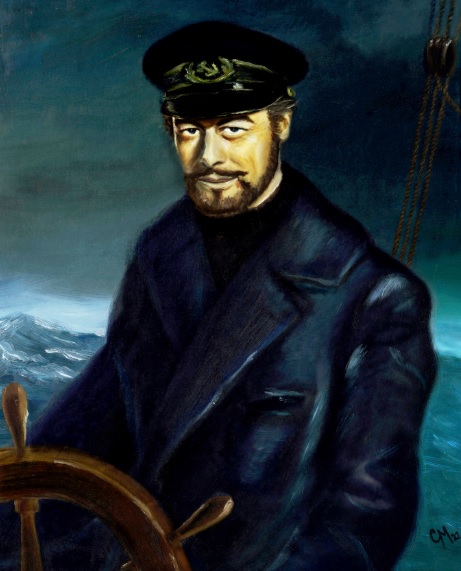
Since even a print of this handsome captain was unattainable, I decided to paint a version for myself. It's been a good 15 years since I have painted in oils but the result turned out fairly well....Captain Gregg himself would have been pleased, methinks. 

It took a few days to make and, after the painting was finished, I scanned it. Then, with the magic of Picasa ( Google's now-obsolete photo editing software ), I enhanced the portrait. You can buy it now on Etsy as a digital download for $6.99. The resulting file size is large enough to make a 36" x 45" print from, so anyone can print it on canvas and have their very own "Portrait of Captain Gregg" hanging in their seaside retreat. 

There is no guarantee that the ghost of Captain Gregg will emerge when you hang it up, but it will make a nice conversation piece nonetheless. 

Click here to view the listing on Etsy.

Wednesday, May 20, 2020

Classics for Comfort - Five Favorite Comfort Films

Comfort Films was the chosen theme for this year's Classic Movie Blog Association spring blogathon and what a perfect choice it is! With most people confined to their homes because of Covid-19, we are turning to our favorite old films for some comfort. 

A whole bunch of titles popped into my mind at the mere thought of comfort films but then I got to thinking, just what is a "comfort film"? Is it a film you turn to for merriment? Is it a film that allows you to cry freely, or is it a film that brings to mind old and cherished memories? For as many definitions as there are of the word comfort, there are films that will fill that need, but thankfully, we are limited to only five choices for this event! 

The Chalk Garden ( 1964 ) - Emotionally Satisfying

There are a LOT of films that I find emotionally satisfying but this one really fills a need. I haven't figured out yet just what that "need" is, but I feel so happy and sooo comfortable when I get to sit back with a cup of tea and enjoy The Chalk Garden. It is probably one of my most well-worn DVDs and what I love about the disc is it's one of those that loops around when the film ends, so I get to enjoy the opening credits ( and Sir Malcolm Arnold's lush score ) all over again right after the film ends. 
Enid Bagnold's play is rich with hidden meaning and crisp biting dialogue. On the surface, it is a story about a young teenager ( Hayley Mills ) who attempts to delve into her new governess' mysterious past and expose her secrets so that her grandmother ( Edith Evans ) can fire her. "Everyone has something in their past. Some dark and terrible secret, " she explains. Along with the butler Maitland ( John Mills ), she relishes crime stories, so this is quite a fun challenge for her, but the latest governess proves to be quite a hard nut to crack. That is the plot on the surface, but beneath it, Bagnold touches on so many different facets of life, sharing wisdom about honesty, trust, relationships, independence, and love. We all have our own chalk gardens that we are not tending to. 

The cat-and-mouse aspect of the film is also strangely satisfying. With the first viewing, you are anxious to see whether Miss Madrigal will expose Laurel's deep secrets before her own are exposed, but with subsequent viewings, it is more entertaining to watch the relationship that develops between these "beloved enemies". Laurel later discovers that her perceived enemy turns out to be her dearest friend...another valuable life lesson that many of us learn in time. 

If you like this one then you'd also enjoy Marnie, another psychological thriller. This one is from the master of suspense - Alfred Hitchcock. I'm a nut for real thought-provoking dramas. 

Read my full review of The Chalk Garden here. 

Miss Marple Mysteries - Rainy Day Comfort

On some days you just want to sit back and enjoy a rainy day with an old friend, and what better old friend than Miss Marple? I'm referring to the Margaret Rutherford mysteries, of course. Agatha Christie fans can argue till their face is blue that Rutherford was nothing at all like the Miss Marple of the novels, but I love her for precisely that reason - she made the character uniquely her own. 

There were four Miss Marple films made between 1961-1965, all staring the indomitable Ms. Rutherford and her husband Stringer Davis. Murder She Said launched the series and remains one of the best, but all the others are entertaining in their own way. Murder at the Gallop ( 1963 ) takes place at a riding establishment, Murder Ahoy ( 1964 ) on a ship, and Murder Most Foul ( 1965 ) in a theater. 
Ron Goodwin's catchy theme music puts a smile on my face every time and, if it's an especially rainy morning, these are great films to play on the tele while you take forty winks.

Read my full review of the Miss Marple Mysteries here

The Ghost and Mrs. Muir - ( 1948 ) - Romantic Mushy Comfort

We all need our occasional dose of romantic mush. The Ghost and Mrs. Muir is wonderful because it isn't your usual love story - it is about a widow ( Gene Tierney ) who falls in love with the ghost of a sea captain ( Rex Harrison ) in a coastal town in England in the 1900s. The film is beautifully filmed, atmospheric, has a great Bernard Herrmann score, and what I like best about it is the setting - Whitecliff by the Sea. The movie was actually filmed in Monterey, California, but it seems so quintessentially British. 
If you like this one, too, then you have to check out The Loves of Joanna Godden, a British film which was released the same year and is also set in 1900s England. My sister and I only recently discovered this Edwardian gem and it has already been viewed six times over. Like The Ghost and Mrs. Muir, it spans time in segments and features an independent single woman as its main character. It is quickly becoming our new comfort film favorite. 

Read my full review of The Ghost and Mrs. Muir here. 

Blue Hawaii ( 1961 ) - Sick-in-Bed Comfort/Cheers-me-up Comfort

Another form of comfort that movies provide is distraction. When that beef stew unsettles your tummy, then it's nice to crawl into bed and let it grumble aloud while you watch a colorful film that takes your mind off of your stomach...and Blue Hawaii is just what the doctor ordered. It was filmed on location in beautiful blue Hawaii at the height of the tourist season and is packed with music, good humor, a bevy of bathing beauties, and the "King of Rock 'n Roll" himself, Elvis Presley. This film has long been my bedside remedy for any kind of ailment and it never fails to provide a good dose of comfort. 

The Trouble with Angels ( 1966 ) - Soul-Satisfying

Lastly, and most importantly, we all need a little soul nourishment. The Trouble with Angels always brings a smile to my heart and my soul. Hayley Mills and June Harding play two mischievous school girls who are forced to attend an all-girls Catholic school in Pennslyvania. The school is run by the stern-faced ( but warm-hearted ) Mother Superior played by Rosalind Russell. 

The film spans all four years in the girl's school life and, in wonderful little vignettes, reveals their comedic escapades throughout the terms. This would make it just a great comedy but what adds depth to the film is the drama as Hayley Mills comes to understand Mother Superior and decides for herself that she wants a relationship with God more than anything else. 
After countless viewings, I'm always discovering subtle touches in the story, the filming, and especially the acting. It always makes me cry and wonder anew at how beautiful life is. This was the last film that Ida Lupino directed and certainly her best. Sadly, actress June Harding passed away just a few months ago. 

Read my full review of The Trouble with Angels here. 


This post was my contribution to the Classics for Comfort Blogathon being hosted by the Classic Movie Blog Association. How would you define a comfort film? Check out this link here to read about all the films that other classic film fans considered to give them comfort.  

Monday, March 31, 2014

Screenwriter - Philip Dunne

Certain names, when rolling on the credits, are guarantees that you are in for a good film. Philip Dunne is one of those names. He was one of the most prolific writers at 20th Century Fox during the heydey when Darryl F. Zanuck headed the studio, writing the scripts to films such as How Green Was My Valley, The Ghost and Mrs. Muir, David and Bathsheba and The Robe

Philip Dunne started working at Fox studios in 1930 as a script reader but when they fired him, during one of their recurring financial crises, he obtained a job at MGM where he worked on his first script, The Student Tour. Although the script was very bad, according to Dunne's own opinion, it led him to becoming a junior writer for Jesse L. Lasky, an independent producer at Fox. Here, he collaborated with Rowland Lee on an original script for a film called I Am Suzanne and on the swashbuckler The Count of Monte Cristo ( 1934 ) starring Robert Donat. The New York Times praised the script and its high fidelity to Dumas dialogue, remarking that it was amazing how well his words had survived in lucidity and grandeur through over a century. In truth, only seven words of dialogue were from Dumas' own writing! Philip Dunne had not even read the book prior to writing the script. 


Later, Dunne attributed the success he achieved in his career as a screenwriter to Rowland Lee. After contributing work on several screenplays for Jesse L. Lasky ( Helldorado, Under Pressure, Magnificent Obsession, The Last of the Mohicans ), Dunne received a telegram in 1935 announcing that he had received a long-term contract from Darryl F. Zanuck to work at 20th Century Fox studios. He remained there for twenty-five years. 

Angharad: 
Look now, you are king in the chapel. But I will be queen in my own kitchen. 

Mr. Gruffydd 
You will be queen wherever you walk.

Angharad 
What does that mean? 

Mr. Gruffydd 
I should not have said it. 

Angharad 
Why?

Mr. Gruffydd 
I have no right to speak to you so. [he starts to leave]

Angharad 
Mr. Gruffydd, if the right is mine to give, you have it. 

The 1940s were Dunne's golden decade, an era when he wrote a number of extremely fine scripts for some of the best films to come out of 20th Century Fox. It all began with Stanley and Livingstone, released during that prime year in Hollywood - 1939. This film established Dunne as an excellent screenwriter at the studio and led him to many other fine projects, such as The Rains Came ( based on Louis Bromfield's bestseller ), and Johnny Apollo. In late 1940, Zanuck handed Dunne the novel "How Green Was My Valley" and asked him to write an epic script for an epic film. How Green Was My Valley was going to be 20th Century Fox's answer to Gone with the Wind. Twelve weeks later, when Dunne submitted his four-hour long script, as promised, he was told that it was "twice too long". Along with director William Wyler, Dunne worked to cut the script to a manageable length, but couldn't find out how until Roddy MacDowall was selected as the leading character, Huew. He was such a delightful child that Dunne and Wyler decided to eliminate their original idea of having Huew grow to manhood mid-way through the film ( Tyrone Power was supposed to have played Huew as a man ). 

How Green Was My Valley earned ten Academy Award nominations, winning in the best picture, best director, best supporting actor, best cinematography and best art direction categories. Here Comes Mr. Jordan snagged the Best Writing, Screenplay award, which left Dunne disappointed. Nevertheless, he bounced back quickly and began work on Son of Fury: The Story of Benjamin Blake ( 1942 ) starring Tyrone Power. 


The Late George Apley ( 1947 ) was another one of Dunne's witty screen adaptations. John P. Marquard, author of the novel, once told Dunne that he preferred his screenplay to the George S. Kaufman stage adaptation. The production was a happy one; it was a great success at its premiere at Radio City Music Hall and the New York Times gave it rave reviews, but alas, outside of the East, it did not fare well at the box-office. Nevertheless, since the production team enjoyed each other's company so much, director Joseph L. Mankiewicz, producer Fred Kohlmar and Dunne reunited to bring another best-selling novel to the screen - the delightful The Ghost and Mrs. Muir. 

Dunne spent seven weeks in the desert splendor of Palm Springs working on the script and, even though he did not have to alter the book's dialogue very much, created a highly entertaining fantasy which, once again, only fared moderately upon its release. However, since then, it has become one of 20th Century Fox's most endearing films, and as Dunne said in his autobiography "I am asked more questions about The Ghost and Mrs. Muir than about any other picture of mine except How Green Was My Valley"


Captain Gregg: 
[discussing Mr. Fairley] And the way he was smirking at you, like a cat in the fishmonger's! You should have slapped his face!
Lucy Muir: 
Why? I found him... rather charming.
Captain Gregg: 
"Rather charming" Now you're starting to talk like him!
Lucy Muir: 
How in blazes do you want me to talk?!
Captain Gregg: 
That's better!

In the 1950s, Dunne, his wife Amanda and their three daughters, moved to a Malibu beach house built to suit. It would remain their home for the next 40 years and become a social and political hotspot for Hollywood liberals throughout the next decade. Dunne was active in politics ever since he arrived in Los Angeles in the early 1930s. During World War II he headed the Motion Picture Bureau of the Office of War Information, helped form the Committee for the First Amendment ( along with William Wyler and John Huston ) and was also one of the founders of the American Screen Writers Guild. 


Biblical films were all the rage in the 1950s and it was work on one of these ( David and Bathsheba ) that earned Dunne his second Academy Award nomination. David and Bathsheba proved to be a box-office success and the big brass at Fox, not one to turn their heads to a profit-making venture, decided to plunge the studios talents into another dramatic biblical adaptation - The Robe. This film, starring Richard Burton and Jean Simmons and featuring the talented writing of Dunne, became an even greater success than David and Bathsheba, grossing over $36,000,000 upon its release. 

Quickly following on its heels was a sequel, again penned by Dunne, entitled Demitrius and the Gladiators ( 1954 ). An entertaining - but lesser known - film about an Egyptian doctor during the eighteenth dynasty of Egypt, The Egyptian ( 1954 ), was Dunne's final screen assignment before he ventured into becoming both a screenwriter and director. 


One of his first films, The View from Pompey's Head, was a lovely little melodrama, dripping with soap and starring some mighty pretty folk such as Dana Wynter and Richard Egan. Dunne must of enjoyed being in control of the filming of the scripts that he penned, for he directed ten more films in the next ten years, including Ten North Frederick, Blue Denim, In Love and War, Wild in the Country and Lisa. 

His final film, Blindfold ( 1965 ) gave him the cue that it was time to end his directing career. Talented as he was, his pencil was indeed sharper than his camera eye. During the 1970s and 1980s, Dunne quit the entertainment industry entirely and concentrated on writing as a syndicated columnist and essayist for the Los Angeles Times and Time magazine. He also worked on his memoirs, Take Two: A Life in Movies and Politics, which much of this article was based upon. 

Philip Dunne passed away on June 2, 1992 at the age of 84....but like most writers, his words will never pass on, always being revived on the screen with each subsequent viewing of his films.

You must make your own life amoungst the living and, whether you meet fair winds or foul, find your own way to harbor in the end. 
( The Ghost and Mrs. Muir )

Friday, November 22, 2013

Whatever Became of the Portrait of Captain Gregg?


In the 20th Century Fox classic The Ghost and Mrs. Muir ( 1947 ), the portrait of Captain Daniel Gregg ( Rex Harrison ) plays a prominent part in the movie. When Lucy Muir ( Gene Tierney ) first arrives at Gull Cottage as a prospective buyer she opens the door to the living room and finds two eyes glaring at her....it turns out to be the light reflecting off of an oil portrait of the former owner, Captain Gregg. "I thought for a moment....." 

After she decides to rent the cottage and meets Captain Gregg in person - spirit though he be - he agrees to let her stay in his house but makes one special request as part of the bargain, "I want me painting hung in the bedroom". Mrs. Muir is reluctant to do so and doesn't think the portrait does him justice..."Must I? It's a very poor painting"...but nevertheless she does as he bids and comes to love the painting as much as we, the audience, do. 

Later, when Captain Gregg steps out of her life, she tells Martha one day, "I think we might put that portrait of Captain Gregg up in the attic..it was a silly idea to hang it in here. I don't know what possessed me. Atmosphere, I suppose."

And so he got chucked in the attic. 


But now we ask....Whatever became of the portrait of Captain Gregg? I was pondering this a few days ago and this led me to wondering what happened to many of the other famous "oil portraits" seen on films...the enormous Mary Meredith portrait in The Uninvited, the Alice Alquist Empress Theodora portrait in Gaslight, the famous "blue velvet" Scarlett O'Hara full-figured portrait in Gone With the Wind and of course, the unforgettable portrait of Laura Hunt, in Laura.

Most of these oil portraits were painted from a photograph of the actor/actress posing in costume, while some - such as the Laura portrait - were in fact, acrylic brushings over an enlargement of the photo itself. We'll look into all of these portraits in another post, right now we want to focus on Captain Gregg. 


A newspaper from 1947 stated the following about the portrait : "Being a perfectionist, Rex Harrison, who made his American film debut in Anna and the King of Siam, felt that his role as the ghost in The Ghost and Mrs. Muir required a beard. The studio objected to hiding the face that all the ladies love. Nevertheless, together with Ben Nye, makeup director, and artist John George Vogel, Harrison had his portrait painted wearing a beard. When this was shown to Darryl F. Zanuck, he was immediately sold on Mr. Harrison's beard and rescinded his orders that the Harrison face remain clean-shaven."


Just who is John George Vogel? He was an English portrait painter. In 1946 he had a showing apart of the Francis Taylor gallery held at the Beverly Hills Hotel ( Elizabeth Taylor's father ran this popular gallery in Hollywood ) and the attention this event garnered may have contributed to his fame in the tinsel town at this time. Vogel was an instructor at an art school in Hollywood during the late 1940s and Linda Darnell, Van Johnson, Diana Lewis, Anita Colby and Paul Hesse were among his students at one point.

Whether it was Vogel who painted the portrait seen in the film we do not know, and even if it was he, that still doesn't answer our question....whatever became of the portrait? During the early 1960s the painting popped up in several classic comedies... All Hands on Deck ( 1961 ) where it is hanging in the office of the Navy admiral; and Mr.Hobbs Takes A Vacation, where it is hiding in the back hallway behind the stairs ( shame on them for not putting it in the living room! ). 

In 1968, The Ghost and Mrs. Muir was brought to the small screen in a television series starring Hope Lange as Mrs. Muir and Edward Mulhare as Captain Gregg but lo! the familiar portrait was replaced by a new one bearing the great Mulhare's likeness. This beautiful portrait was painted by Eddie Martinez who shared with us the actual whereabouts of the original Captain Gregg portrait. 

Martinez had an amazing career in the Los Angeles area, working on portraits, murals, and production design in film, television, and in the theme park industry. He was a versatile imagineer like Marc Davis and Herbert Ryman and today spends his time in retirement doing his favorite work, researching and illustrating historical figures. In addition to The Ghost and Mrs. Muir he also created portrait paintings for Peyton Place, The Dean Martin Show, The Tonight Show and Batman. More info about his work can be found here


As Martinez explained, "I was asked to paint Edward Mulhare's face over the original Captain Gregg portrait of Rex Harrison. As you can see in the photographs, I also removed the ship's wheel on the bottom left of the painting". 

After the series ended, Martinez's wife attended an auction at 20th Century Fox in an attempt to bid on the portrait, but it was sold to a businessman...Leland Ayers, who later became the mayor of Burbank and was instrumental in acquiring the Bob Hope Airport from Lockheed Corp. Mr. Ayers passed away on Sept. 2, 2013 and it is presumed that the painting is still kept in his family.

A mystery we - and many other fans - have pondered over for years has now been solved...and we would like to give a special thanks to Eddie Martinez for sharing with us the real story behind the whereabouts of this beautiful portrait of Captain Gregg, a character larger than life. 

Update: A print of a newly painted oil portrait of Captain Gregg is now available on Etsy. Click here to check it out.