Showing posts with label Hayley Mills. Show all posts

Friday, March 6, 2026

From the Archives: That Darn Cat! (1965)


Oh, no! Things can get really dirty when you are trying to fingerprint.. ahem, pawprint.. a cat. Federal agent Zeke Kelso (Dean Jones) finally found the perfect print - he took it off his forehead! Hayley Mills looks on at Zeke and the mess he made in this NBC-TV release photo from Walt Disney's That Darn Cat! (1965). 

From the Archives is our latest series of posts where we share photos from the Silverbanks Pictures collection. Some of these may have been sold in the past, and others may still be available for purchase at our eBay store: http://stores.ebay.com/Silverbanks-Pictures 

Monday, January 5, 2026

From the Archives: The Moon-Spinners (1964)


Every year on the day before we take our Christmas tree down, we watch The Moon-Spinners (1964). It's such a lovely tradition and I don't even recall how it started, but this is one of my favorite scenes in the film. Nikki (Hayley Mills) and Mark (Peter McEnery) spend the night in the ruins of a Greek temple inhabited by stray cats. In the morning, they meet the helpful Anthony Gamble (John Le Mesurier). 

From the Archives is our latest series of posts where we share photos from the Silverbanks Pictures collection. Some of these may have been sold in the past, and others may still be available for purchase at our eBay store: http://stores.ebay.com/Silverbanks-Pictures 

Saturday, November 16, 2024

Film Albums: The Trouble with Angels (1966)

In 1966, Jerry Goldsmith was relatively new to soundtrack scoring for comedy films (he was making a name for himself writing music for western films and television series), but nevertheless he created a marvelous score for the dramatic comedy The Trouble with Angels starring Hayley Mills and Rosalind Russell. He mixes a light-hearted upbeat tempo (reflecting the rebellious teens) with a solemn church-like theme to create an entirely new sound. It's a happy score with hints of religious themes and it was perfectly suited to the picture. 

The complete album is available on Youtube. Just click on the link below to enjoy: 

The Trouble with Angels Original Soundtrack

Track Listing

Main Title

Welcome to St. Francis

Warning #1

Dirty Dishes

Changing Seasons

Snow Birds

Silent Sunday

True Feelings

A Pot of Tea

Angels We Have Heard on High

The Sewing Circle

Future Plans

Sad Sunday

Graduation

Rachel Says Goodbye

End Title

Top Picks: Main Title, Welcome to St. Francis, Snow Birds, Rachel Says Goodbye

Tuesday, January 31, 2023

Mr. Forbush and the Penguins ( 1971 )

Richard Forbush is a rich young philanderer. He likes to woo girls and wear smart-looking clothes to college. His professor considers him to be one of the most academically brilliant students in his class with "the potential to be an outstanding biologist," but Forbush has little interest in biology, only mating. 

One day, he meets Tara (Hayley Mills), the new waitress at his local pub, and, smitten with her, attempts to impress her with tales of how he will go "down the Amazon" and be one of the last men to undertake a great scientific adventure. When his professor offers him the opportunity to live the great adventure by spending six months in Antarctica tracking the population and habits of a penguin colony, he turns it down.... until a casual remark made by Tara changes his mind. 

"That's all you are. Wind. Empty wind."

He is aghast that Tara does not succumb to his charms and is downright offended when she calls him "empty wind". He decides to accept the position after all but begins to regret it soon after. 

"It's a grim prospect, all that ice. I don't know how I am going to get back in one piece. I feel rather like poor Captain Oates. Remember what he said when he walked into the blizzard to die, 'I'm just going outside and may be some time'"

Within a few weeks, Forbush is dropped off at Shackleton's Hut at Cape Royds with a two-way radio being his only link to the outside world. He is told not to interfere with nature but he grows attached to the penguins he is studying and their plight to survive. After months of watching skuas steal the penguins' eggs, he attempts to destroy them by building a catapult to hurl rocks at them. All is in vain and Forbush comes home realizing that every living creature depends in some way upon every other.

Mr. Forbush and the Penguins, also released as Cry of the Penguins, is not your typical arctic adventure film. Instead of the man-battling-the-elements plot line, this film focuses on how six months spent alone with penguins can change a man. It does indeed transform Mr. Forbush dramatically. 

John Hurt gives a wonderful sensitive portrayal of the young playboy turned penguin fancier. It is hard to imagine that the man throwing rocks at the invading skuas at the end of the film is the same Mr. Forbush who showed little to no interest in arctic birds at the beginning of the picture. Hurt has such a marvelously silky voice that it is a pleasure to hear him narrate the penguin sequences. Hayley Mills also gives a good performance in what is strangely listed on the credits as a guest appearance. Also in the cast is Tony Britton as Forbush's professor, Dudley Sutton, Thorley Walters, and Judy Campbell.

The production for Mr. Forbush and the Penguins was rather rocky. Alfred Viola, a commercial director, was making his directorial debut when he signed on for the production but mid-way through was dismissed by producer Roy Boulting, who took over directing himself. Boulting also put his wife Hayley Mills in the role of Tara, in place of Susan Fleetwood, whom Hurt preferred. Swedish director Arne Sucksdorff flew to the Arctic for location filming and captured some beautiful footage of the penguins in their natural habitat while John Addison (Tom Jones) created a compelling score for the film. 

Unfortunately, after all that effort (and a nearly £600,000 investment), Mr. Forbush and the Penguins tanked at the box office.  The publicity department mistakenly tried to publicize the movie as a comedy, plastering the posters with corny taglines like "It's not often that 740,000 penguins can help a love affair!" and "the zaniest bunch of birds on the South Pole!". 

If one is looking for comedy, then this film would fall short. In fact, the first 15 minutes are rather a drag. But after the professor hands Forbush his opportunity to become an explorer of old, the film becomes an absorbing blend of documentary and drama. A look into the life of one man and over half-a-million tuxedo-clad arctic birds.... quite a novel idea for a film. And speaking of novels, if you want to enjoy this story in print, read Graham Billing's original 1965 novel "Forbush and the Penguins". 

Wednesday, January 25, 2023

The Family Way ( 1966 )

The Family Way is one of those films that you have probably heard a lot about but never bothered to watch, thinking it to be just a routine British drama. But it is not routine. And it is worth watching. The plot may sound simple, certainly not something one would build a film around, and yet it is deceptively rich. This is because the characters are so well created and so very well performed. 

Playwright Bill Naughton's tale focuses on a working-class family in England. Arthur Fitton ( Hywel Bennett ) has just married his childhood sweetheart Jenny ( Hayley Mills ) and they are both looking forward to taking their honeymoon in Majorca. Unfortunately, the travel agent absconds with their money and they find themselves starting their marriage in the upstairs room of Arthur's parents' house...where the walls are "paper thin". Arthur is a sensitive young man and he finds it difficult to make love in a house where one can hear every whisper. So he sits and listens to Beethoven while Jenny patiently waits for him to come to bed. Their marriage remains unconsummated several weeks later and Arthur and Jenny begin to feel frustrated - for different reasons. Jenny feels she may not appeal to Arthur and Arthur thinks something must be wrong with himself. Their struggle with arousing sexual urgings generates much of the humor of the story but it also stirs up revelations from Arthur's parents about their own marriage which leads into the real heart of the story. 
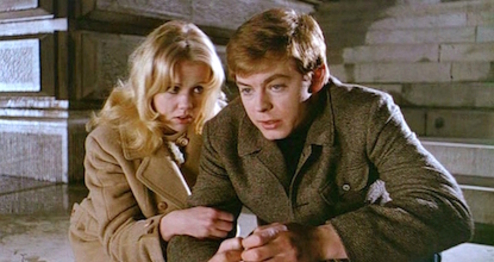
John Mills and Marjorie Rhodes give stellar performances in the role of Arthur's parents, Ezra and Lucy. The Frittons are an everyday family from Yorkshire with Papa Fritton going off to work each morning leaving his wife to tend to the washing and cooking. Arthur works, too, but, unlike his father, he does not spend his free time in pubs drinking with his friends. He is a loner who would rather spend time at home reading and listening to his records. This clash in personalities has made Arthur feel distant from his father and closer to his mother. 

The Frittons have another son, Arthur's younger brother Geoffrey ( Murray Head in a non-singing role ). Geoffrey is not like his father either but this does not seem to bother Ezra much, perhaps because he is not the eldest. Ezra wants Arthur to be a man and his quiet interests make him worry that Lucy's gentle upbringing of the lad has made him queer. 

Surprisingly, when Jenny's parents come to the Fritton's house for a private talk "about Arthur", we discover that Ezra's friendship in his youth with an old pal named Billy may have looked strange to outsiders as well. After all, how many newlywed men take along their best friend on their honeymoon?

Lucy's recollections of her unorthodox first days of marriage bring up memories best forgotten. This old friend, Billy, who "suddenly left" one day without a word may have meant more to Ezra and Lucy than both are willing to admit. 

Ezra's final line "He looked just like Billy" ( speaking of Arthur as he was leaving ) makes one wonder whether Arthur even was Ezra's son at all, and not Billy's. Naughton's script gives the audience only vague hints about the Frittons' past, which lends the story a richness that would have been spoilt had all been revealed. 

The Family Way began as a television play ( titled Honeymoon Postponed ) by Bill Naughton for ABC's Armchair Theatre in 1961. Naughton later adapted it into a theatrical play that premiered in 1963 with Bernard Miles in the role of Ezra Fitton. John Mills happened to catch this performance and was so enthralled with the part that he went backstage hoping to discuss purchasing the film rights as a vehicle for him and his daughter. He was told that the Boulting brothers and an American had already purchased the rights. Roy Boulting had hoped to make the film with Peter Sellars in the lead but after the project was put on hold for several years, he contacted John Mills, who was tickled pink and considered it to be "the best part I've had since Hobson's Choice". 

Indeed, it was. Mills gave a wonderful performance of a lower working-class father whose thoughts and ways are quite different from his more sensitive son. Marjorie Rhodes deserves equal credit for a powerfully understated performance. Also excellent are the two young leads. Hayley Mills, whose acting always standouts, looks especially lovely in this film. Perhaps it was the glow of a young woman in love captured on film ( Mills was having a romance with The Family Way's director Ray Boulting at the time ). 

Hywel Bennett was relatively new to film but had experience in theater. The success of The Family Way led to a contract with British Lion films and two more pictures opposite Hayley Mills ( Twisted Nerve and Endless Night ). Roger Ebert called Bennett "one of England's best young actors" in 1969. Today, he is best known for his role as James Shelley in the popular sitcom Shelley ( 1979-1984 ) and for his voiceover work for the British Rail television adverts of the 1980s. Also in the cast are Liz Fraser, Avril Angers, John Comer, and Barry Foster. 

In addition to its empathetic script and fine performances, The Family Way is noted for its soundtrack, particularly its theme song by Paul McCartney. It is George Martin who really deserves credit for creating the score, having just a 15-second piano piece from Paul to work with. He turned a simple tune into a beautiful and subtle score. 

You can watch The Family Way for free on Tubi ( via Roku or online at tubitv.com ) or on DVD. 

Tuesday, November 8, 2022

Take a Girl Like You ( 1970 )

If you were to look for a summary of Take a Girl Like You, you would probably find a plot description labeling it as a sex comedy because it is....well...about sex. But oddly enough, it does not fit into that genre at all. There are hardly any bedroom scenes ( certainly nothing graphic ) and not much comedy either. It is more of a drama that talks about sex and virginity. Not my usual cup of tea.... and yet, I found it quite appealing. 

Hayley Mills is one of the main reasons this film came off as enjoyable. Another actress may not have been able to convincingly play a virgin with morals. That is what Take a Girl Like You is really about: morals regarding pre-marital sex. 

Hayley Mills stars as Jenny Bunn, a new schoolteacher in town. She meets Patrick, an art teacher ( Oliver Reed ), whom she is attracted to even though she knows that he likes to "play the field". When he invites her to his apartment one evening ( and not to look at his sketches ), she surprises him by telling him she is a virgin and intends to stay that way until she marries. Patrick wants to bed her and so he goes on with a lot of debates about how "nobody cares about that" anymore and such. Jenny obviously cares and - if Patrick cared for her - would respect her views, but this isn't a film about respect. It is just about Patrick trying to have "it" with Jenny.

There is not much in the plot worth building a script around. Even the fluff surrounding this basic plot ( which includes her landlord trying to run for a labor party ) does not have much substance...and yet, the film was still entertaining. 

Perhaps it was the location scenery. Take a Girl Like You was shot in and around Middlesex in southeast England and we get a glimpse of an average working town of the late 1960s. 

Or perhaps it was the music. The peppy opening theme was sung by The Foundations who were one of the biggest British soul bands of the era. The music for the picture was scored by Stanley Myers who, in spite of the unfamiliarity of his name to most people, penned quite a bit of film and television music from the 1950s-1980s. 

It certainly had nothing to do with Oliver Reed being in the film. He was never my idea of a leading man and a more handsome and engaging fellow, such as Michael Caine, would have made this story much more entertaining. Noel Harrison's presence in the film helps quite a bit. The rest of the supporting cast was made up of familiar British character actors: John Bird, Sheila Hancock, Penelope Keith, and Aimi MacDonald. 

Take a Girl Like You was based on the 1960 Kingsley Amis novel of the same name. Director Jonathan Miller thought that "it was probably one of Amis' best novels but there were a lot of things to be said against filming it." Indeed, Miller felt like he had lost control of the filming as it progressed and it ultimately turned into a critical and commercial flop. 

That is not surprising. It is not the kind of film you would watch with your family or even your spouse. In fact, I cannot picture dating couples attending the film in 1970 and walking out of the theater with smiles on their faces...and yet, if you watch it by yourself, it keeps you entertained. In fact, I may just watch the film again this week. 

Take a Girl Like You is available for streaming on Tubi or, if you want to hear some insightful commentaries, on Blu-ray DVD. 

Wednesday, May 20, 2020

Classics for Comfort - Five Favorite Comfort Films

Comfort Films was the chosen theme for this year's Classic Movie Blog Association spring blogathon and what a perfect choice it is! With most people confined to their homes because of Covid-19, we are turning to our favorite old films for some comfort. 

A whole bunch of titles popped into my mind at the mere thought of comfort films but then I got to thinking, just what is a "comfort film"? Is it a film you turn to for merriment? Is it a film that allows you to cry freely, or is it a film that brings to mind old and cherished memories? For as many definitions as there are of the word comfort, there are films that will fill that need, but thankfully, we are limited to only five choices for this event! 

The Chalk Garden ( 1964 ) - Emotionally Satisfying

There are a LOT of films that I find emotionally satisfying but this one really fills a need. I haven't figured out yet just what that "need" is, but I feel so happy and sooo comfortable when I get to sit back with a cup of tea and enjoy The Chalk Garden. It is probably one of my most well-worn DVDs and what I love about the disc is it's one of those that loops around when the film ends, so I get to enjoy the opening credits ( and Sir Malcolm Arnold's lush score ) all over again right after the film ends. 
Enid Bagnold's play is rich with hidden meaning and crisp biting dialogue. On the surface, it is a story about a young teenager ( Hayley Mills ) who attempts to delve into her new governess' mysterious past and expose her secrets so that her grandmother ( Edith Evans ) can fire her. "Everyone has something in their past. Some dark and terrible secret, " she explains. Along with the butler Maitland ( John Mills ), she relishes crime stories, so this is quite a fun challenge for her, but the latest governess proves to be quite a hard nut to crack. That is the plot on the surface, but beneath it, Bagnold touches on so many different facets of life, sharing wisdom about honesty, trust, relationships, independence, and love. We all have our own chalk gardens that we are not tending to. 

The cat-and-mouse aspect of the film is also strangely satisfying. With the first viewing, you are anxious to see whether Miss Madrigal will expose Laurel's deep secrets before her own are exposed, but with subsequent viewings, it is more entertaining to watch the relationship that develops between these "beloved enemies". Laurel later discovers that her perceived enemy turns out to be her dearest friend...another valuable life lesson that many of us learn in time. 

If you like this one then you'd also enjoy Marnie, another psychological thriller. This one is from the master of suspense - Alfred Hitchcock. I'm a nut for real thought-provoking dramas. 

Read my full review of The Chalk Garden here. 

Miss Marple Mysteries - Rainy Day Comfort

On some days you just want to sit back and enjoy a rainy day with an old friend, and what better old friend than Miss Marple? I'm referring to the Margaret Rutherford mysteries, of course. Agatha Christie fans can argue till their face is blue that Rutherford was nothing at all like the Miss Marple of the novels, but I love her for precisely that reason - she made the character uniquely her own. 

There were four Miss Marple films made between 1961-1965, all staring the indomitable Ms. Rutherford and her husband Stringer Davis. Murder She Said launched the series and remains one of the best, but all the others are entertaining in their own way. Murder at the Gallop ( 1963 ) takes place at a riding establishment, Murder Ahoy ( 1964 ) on a ship, and Murder Most Foul ( 1965 ) in a theater. 
Ron Goodwin's catchy theme music puts a smile on my face every time and, if it's an especially rainy morning, these are great films to play on the tele while you take forty winks.

Read my full review of the Miss Marple Mysteries here. 

The Ghost and Mrs. Muir - ( 1948 ) - Romantic Mushy Comfort

We all need our occasional dose of romantic mush. The Ghost and Mrs. Muir is wonderful because it isn't your usual love story - it is about a widow ( Gene Tierney ) who falls in love with the ghost of a sea captain ( Rex Harrison ) in a coastal town in England in the 1900s. The film is beautifully filmed, atmospheric, has a great Bernard Herrmann score, and what I like best about it is the setting - Whitecliff by the Sea. The movie was actually filmed in Monterey, California, but it seems so quintessentially British. 
If you like this one, too, then you have to check out The Loves of Joanna Godden, a British film which was released the same year and is also set in 1900s England. My sister and I only recently discovered this Edwardian gem and it has already been viewed six times over. Like The Ghost and Mrs. Muir, it spans time in segments and features an independent single woman as its main character. It is quickly becoming our new comfort film favorite. 

Read my full review of The Ghost and Mrs. Muir here. 

Blue Hawaii ( 1961 ) - Sick-in-Bed Comfort/Cheers-me-up Comfort

Another form of comfort that movies provide is distraction. When that beef stew unsettles your tummy, then it's nice to crawl into bed and let it grumble aloud while you watch a colorful film that takes your mind off of your stomach...and Blue Hawaii is just what the doctor ordered. It was filmed on location in beautiful blue Hawaii at the height of the tourist season and is packed with music, good humor, a bevy of bathing beauties, and the "King of Rock 'n Roll" himself, Elvis Presley. This film has long been my bedside remedy for any kind of ailment and it never fails to provide a good dose of comfort. 

The Trouble with Angels ( 1966 ) - Soul-Satisfying

Lastly, and most importantly, we all need a little soul nourishment. The Trouble with Angels always brings a smile to my heart and my soul. Hayley Mills and June Harding play two mischievous school girls who are forced to attend an all-girls Catholic school in Pennslyvania. The school is run by the stern-faced ( but warm-hearted ) Mother Superior played by Rosalind Russell. 

The film spans all four years in the girl's school life and, in wonderful little vignettes, reveals their comedic escapades throughout the terms. This would make it just a great comedy but what adds depth to the film is the drama as Hayley Mills comes to understand Mother Superior and decides for herself that she wants a relationship with God more than anything else. 
After countless viewings, I'm always discovering subtle touches in the story, the filming, and especially the acting. It always makes me cry and wonder anew at how beautiful life is. This was the last film that Ida Lupino directed and certainly her best. Sadly, actress June Harding passed away just a few months ago. 

Read my full review of The Trouble with Angels here. 


This post was my contribution to the Classics for Comfort Blogathon being hosted by the Classic Movie Blog Association. How would you define a comfort film? Check out this link here to read about all the films that other classic film fans considered to give them comfort.  

Saturday, May 16, 2020

6 From the '60s - Favorite Films of the 1960s

Back in March, Rick of the Classic Film and TV Cafe announced the subject for the annual National Classic Movie Day blogathon - 6 From the '60s - and what fun it has been trying to narrow down the choices to only six favorites.

My sister and I were first introduced to classic movies through the films of the 1960s since this was the decade that our father loved the most growing up in. He started us off on children's classics from this time period and then worked us back to his favorites from the 1950s and then 1940s. Most of my personal favorite films have ended up being the ones from the 1960s as well, so it was difficult to choose only six. These are not what anyone would call "top recommendations" or "best films" of the 1960s - they are just six favorites that are especially dear to me ( and I am sure to many others as well ). 

Enjoy!
            _________________________________________________________


Send Me No Flowers ( 1964 ) 

How can one write about favorite films of the 1960s and not even think about Rock Hudson and Doris Day! This lovely couple practically started a whole new genre of "bedroom comedies". Of the four films that they made together, Send Me No Flowers is probably the most underrated. Rock Hudson plays a man who thinks he is dying and, with the aid of his friend Tony Randall, plots to find a husband for his wife Doris Day after he is gone. This was the film that introduced me to Doris Day and it has always remained my favorite. The suburban setting is marvelous, the dialogue is very witty and the comedic delivery of this dialogue from all the main actors is what makes this such a gem. The main title theme song - performed by Day of course - is happiness itself.  

Favorite Scene: The country club dance, especially when Burt ( Clint Walker ) begins to dance with Judy and steps on her toes!

Good Neighbor Sam ( 1964 )

And speaking of suburban settings....here is another underrated gem that features some beautiful suburban ranch sets. Good Neighbor Sam showcases Jack Lemmon in one of the funniest roles he ever played. Sam ( Lemmon ) and his wife Min ( Dorothy Provine ) help her old school friend Janice ( Romy Schneider ) move in next door. When Janice discovers that she inherited $15 million from a long-lost uncle, they naturally help her claim her inheritance - which includes proving that she is still happily married. The catch is, she isn't. So Sam pretends to be her husband and things work well until her real ex-husband shows up! I've watched this film countless times and never tire of it. It's chock full of familiar character actors from film and television, including Edward G. Robinson, Edward Andrews, Louis Nye, Charles Lane, and Joyce Jameson. The location scenes around San Francisco are great, Romy Schneider never looked more alluring and the whole plot idea of a woman "loaning" her husband to her best friend is too much fun. 

Favorite Scene: When Sam spends the evening at Janice's house, eats a steak dinner, and then comes home and pretends he hasn't eaten, only to be fed burnt macaroni and cheese ( "Here's some more of that crust that you love" ). 


The Pink Panther ( 1963 ) 

Now, this is a real childhood favorite and one that's probably a favorite for many. Heist films were all the rage in the 1960s, but The Pink Panther is great because it is played for laughs. David Niven makes such a debonair jewel thief ( he also starred in the original Raffles ) and the beautiful location setting of the film ( in Paris, Cortina d'Ampezzo and Rome ) really make this a delight. My sister and I loved watching this on winter evenings when we were youngsters. Peter Sellars made the character of Inspector Clouseau so lovably bumbling that he reprised the role in four more films. 

Favorite Scene: The informal dinner party at the Princess' mountain lodge. Sir Charles thinks he is going to have a private dinner with the princess and then discovers that it is a party affair. 

The Parent Trap ( 1961 ) 

No favorite list of mine would be complete without a Hayley Mills film included and, in this case, there are two - both from Walt Disney Studios. The Parent Trap tells the story of twin sisters who were separated at birth and meet up at a summer camp by accident. They then switch places with each other in order to meet the parent they never knew. This was the movie that launched Hayley Mills career in Hollywood. She was such a talented child actress and she plays both parts so well that you really DO believe that there are twins in this movie! 

Most favorite films are chosen for a reason and, in my case, location settings have a lot to do with why I enjoy a certain movie. The Parent Trap was filmed in and around beautiful Big Bear Lake in California and at the Walt Disney ranch and these sets conjure up wonderful summer feelings of camping, hiking, and being out in the woods. Since they are a family of two sisters and a mother and father, it also makes me think of my own home life...especially Saturday evenings with my mom cooking stew in the kitchen. 

Favorite Scene: There are too many favorite scenes in this movie, but the stew scene does stand out as one of the tops. This is when Mitch ( Keith ) and the twins come back from a camping trip with Vicki and Mitch sees Maggie ( O'Hara ) in the kitchen making stew. It reminds him of the old days when they were married and he realizes that he still loves her and wants to marry her again. 


That Darn Cat ( 1965 ) 

This Disney classic was made when Hayley was a few years older and this acted as a nice transition film for her. She was no longer a child star and not quite ready for adult roles. In the film, she plays Patty, a teenager who has a bent for getting into trouble. Her cat comes home one night with a wristwatch around its neck and scrawled on its backside are the letters HEL. Patty believes it belongs to a kidnapped woman who was trying to write "help" and so she enlists the aid of the FBI and her cat becomes an agent. This is a light-hearted mystery comedy and always enjoyable to watch. Walt Disney knew how to pick good talent and the cast in That Darn Cat is especially great - Dean Jones as the FBI agent, Dorothy Provine as Patty's sister, Frank Gorshin as one of the criminals, William Demarest and Elsa Lancaster as the neighbors, and Roddy McDowall as an obnoxious coworker. 

Favorite Scene: When Zeke ( Dean Jones ) tracks "DC" the cat around the town and follows her into the drive-in movie theatre where Patty and her boyfriend ( Tom Lowell ) happen to be watching a surfing film. 
Chitty Chitty Bang Bang ( 1968 ) 

Ian Fleming's classic story about a magical motorcar was brought to the big screen by Albert "Cubby" Broccoli in an attempt to mimic a Walt Disney film. He hired the best crew, including the Sherman Brothers to compose such a wonderful score, and created quite an entertaining musical. This is another childhood favorite that I simply cannot resist. Although, I must admit that the first half of the film is what intrigues me the most. Once Professor Potts and his family arrive at the castle of Baron Bomburst the story is primarily fantasy. Nevertheless, it is a favorite I never tire of. Sally Ann Howes is "truly scrumptious" and, once again, the settings are beautiful. The movie was shot on location in France, Germany, and England ( at a windmill that Hayley Mills later purchased for herself ). This film also reminds me of my own childhood and seeing the children wait while their father repairs the car, brings back fond memories of hearing my dad clanking away in the garage repairing automobiles. 

Favorite Scene: When Sally Ann Howes sings "A Lovely Lonely Man" on the grounds of her mansion ( which happens to be Heatherton Hall at Pinewood Studios ). 

So there you have it....six favorites from the 1960s. And not a single drama in the lot!

It was very difficult making a choice of only six films for this blogathon, especially because The Comfort Films Blogathon is next week and so many of these titles would have been repeated for that list. So, because of that, favorites like The Chalk Garden, Blue Hawaii, and the Miss Marple Mysteries were omitted. Other runner-ups include It's a Mad, Mad, Mad, Mad World ( 1963 ), The Ghost and Mr. Chicken ( 1966 ), The Prime of Miss Jean Brodie ( 1968 ) and First Men in the Moon ( 1964 ). 

Be sure to check out other film fan favorites from this blogathon by clicking the link here. 

Thank you, Rick, for picking such a swell topic for this year's National Classic Movie Day blogathon!

Sunday, January 5, 2020

The Moon-Spinners ( 1964 )

In 1963, Hayley Mills, one of the most popular child stars of the decade, set off for Greece to star in Walt Disney's family-friendly adaptation of Mary Stewart's thrilling novel "The Moon-Spinners".

Mills stars as Nikky Ferris, a young girl who is traveling throughout Europe with her Aunt Frances (Joan Greenwood) to record folk songs for the BBC. They arrive at The Moon-Spinners Inn on the island of Crete where they stumble into a dangerous web of intrigue involving a handsome young Englishman (Peter McEnery) and a desperate jewel smuggler named Stratos (Eli Wallach).

The Moon-Spinners is a delightful mystery-adventure that combines an exciting plot with marvelous Cretian atmosphere. In fact, it is the location filming and exotic setting of The Moon-Spinners that truly lends the film its appeal. 

"They cannot have lied. The stars cannot lie." - Stratos
"Everybody lies when it serves their purpose, even the stars." - Madame Habib
Mary Stewart was a prolific British novelist who developed the romantic-mystery genre. Her books, most of which took place in exotic locations throughout Europe, always featured a young heroine who would find romance in the midst of a dangerous situation. 

Hayley Mills was quickly growing out of her childhood film roles and this was an ideal production that helped transition her into more mature teen roles. Her character Nikki is head-strong and capable, yet vulnerable enough to need to be rescued by the handsome tourist Mark, portrayed by Peter McEnery. This young English actor was making his American film debut in The Moon-Spinners and - while he didn't have the charm of James MacArthur or Kurt Russell - he was perfect for this role. Walt Disney liked this affable young gentleman so much that he starred him in another feature the following year: The Fighting Prince of Donegal. 

Like most Disney films, The Moon-Spinners features an excellent cast of supporting players. Eli Wallach, with his dark glaring eyes, is ideal as Uncle Stratos, a "much lousy man" who would willingly commit murder in his desperation for wealth. The beautiful Grecian actress Irene Papas is given a small but memorable role as Stratos' sister, the owner of The Moon-Spinners Inn. 

Joan Greenwood, with her delicious purring voice, is Nikki's aunt. She spends most of her vacation worrying about Nikki's whereabouts, not even knowing that there is a crime being committed right before her eyes. Also in the cast is Greenwood's husband Andre Morrell in a brief part as the captain of The Minotaur, the fabulous yacht owned by Madame Habib, a role that was portrayed by the great silent film star Pola Negri. Walt Disney personally coaxed her out of retirement to make an appearance in the film and she delivers a grand performance.
John Le Mesurier is perfect as the English consulate who lives in a palatial manor overlooking the Mediterranean Sea with his discontented wife, the tipsy "Angel of Eastbourne" portrayed by Sheila Hancock. Paul Stassino (Thunderball) is once again playing a villain but most entertaining of all the secondary roles in that of Alexis, delightfully portrayed by Michael Davis. The young Greek lad who aids Nikki and Mark in their escape is actually an American boy! Fancy that. 

The Moon-Spinners is unlike other Disney films of the era because it doesn't feature much humor or any musical interludes but it does feature plenty of adventure (the windmill escape and the fantastic ride through the King Minos parade in a hearst are highlights) and a memorable musical score by Ron Grainer. “The Moon-Spinners Song” is especially lovely, evoking the sounds of a traditional Greek folk melody. It was written by Terry Gilkyson and is beautifully performed over the title credits by Gilkyson, Carson and Van Dyke Parks and other members of the folk group The Easy Riders. 

Wednesday, May 8, 2019

From the Archives: The Chalk Garden ( 1964 )

At the dinner table, "Puppy" ( Felix Alymer ) relates a juicy tale to Laurel ( Hayley Mills ) about one of the criminal cases he had to judge years ago. Maitland ( John Mills ) looks on in this lobby card scene from the delightful mystery/drama The Chalk Garden ( 1964 ). 

From the Archives is our latest series of posts where we share photos from the Silverbanks Pictures collection. Some of these may have been sold in the past, and others may still be available for purchase at our eBay store : http://stores.ebay.com/Silverbanks-Pictures

Saturday, March 10, 2018

Hayley Mills & The Chitty Chitty Bang Bang Windmill

Every fan of the 1968 musical Chitty Chitty Bang Bang remembers inventor Caractacus Potts' beautiful workshop, but what many do not know is that the windmill where it was filmed was once owned by Hayley Mills, the star of numerous Walt Disney films of the 1960s. 

In 1967, producer Albert "Cubby" Broccoli sent location scouts throughout the English countryside to select a picturesque windmill to become the workshop of the magnificent inventor Professor Potts, portrayed by Dick Van Dyke. In the parish of Ibstone in Buckinghamshire, they discovered Cobstone Mill, a lovely 1816 smock mill that was used to grind cereal until the late 1800s. After a fire damaged the center post, the mill went into disrepair and, by the time the scouts discovered it, it needed extensive renovation. Broccoli footed the bill for a cosmetic restoration....of the exterior only. Paper sails were fitted to mock blades that actually worked, making the sails turn in the wind. Since the scenes featuring the interior of the workshop would be shot on a soundstage, there was no need for repairs to be made on the inside of the mill. 
Three years after Chitty Chitty Bang Bang was released in theaters, Hayley Mills and her husband, director Roy Boulting, discovered the mill and purchased it at an auction for £30,000. Over the next four years, they invested nearly £90,000 in restoring the mill, which proved to be quite a challenge. By 1975, they had the mill up for sale...at a cost that just about covered their restoration expenses. It looks like Mills was put through the mill for that purchase.

Since the 1960s, Cobstone Mill has been seen in television episodes of The New Avengers, Midsomer Murders, Jonathan Creek, and Little Britain. Today, it still stands proudly overlooking the village of Turville and is admired by the occasional Chitty Chitty Bang Bang fan who happens to be passing by. 

This entry is a part of our series entitled "Did You Know?".....sometimes we just feel like sharing interesting fragments of television and movie history and now we have a place to do just that. If you have a hot tip that you would like us to share on Silver Scenes, drop us a line!

Saturday, August 26, 2017

The Parent Trap ( 1961 )

All of us have favorite films that are a little extra special to us because we grew up with them. The Parent Trap, featuring Hayley Mills, is one of those films for my sister and I. It was a favorite to watch on Saturdays when we were wee ones and it is still a beloved Saturday film that conjures up good feelings and happy memories of childhood. 

Not surprisingly, The Parent Trap has been, and still is, a family favorite for many worldwide. It encapsulates everything that family entertainment should be, appealing to both parents and children. It features a wonderful cast, great music ( courtesy of Richard and Robert Sherman ), gorgeous sets ( thanks to Carroll Clark and Emile Kuri ), and a witty script. What more could you ask for?

Hayley Mills was one of the Disney Studio's prime assets and, after proving her worth in Pollyanna a year earlier, Walt Disney cast her in a double role for The Parent Trap ( 1961 ), playing twin sisters Susan and Sharon. If there is anything better than watching a Hayley Mills performance, it's watching two Hayley Mills performances! 

"The nerve of that girl, coming here with your face!"

The Parent Trap tells the simple tale of identical twin sisters who were separated at birth by their divorced parents and who accidentally meet up at a posh summer camp. When the girls discover they are sisters each rave about the parent who raised them and decide to get together to reunite father and mother "for now, for always". What is their brilliant scheme to accomplish this? Swap places. California-native Susan attempts a Boston accent while Bostonian Sharon gets her hair clipped and chews her nails so Dad won't have any suspicions about her. Strangely enough, both parents are so busy with ranch duties and charity work they don't realize the change in their daughters. It is Grandpa McKendrick ( Charlie Ruggles ) who first notices the difference in "Sharon" and faithful housekeeper Verbena ( Una Merkel ) who sees through "Susan". 
The twin's plan to spend some quality time with their parents gets foiled when Sharon discovers that her dad is about to wed a catty young gold-digger named Vicki ( Joanna Barnes ). As "nicely put-together" as Vicki is, it's all just a front and she oozes venom in her speech. It takes a surprise visit from mother and a camping trip in the woods to send this cunning fiancée home packing. 

"Get me outta this stinkin' fresh air!"

This outdoor camping sequence, as well as the opening one, act as bookends to The Parent Trap and reinforce the California summer atmosphere of the film. Camping, hiking, horseback riding, and canoeing are the ideal recreational activities that most young girls fantasize about when they look forward to a summer vacation. 
The Parent Trap was based on Erich Kastner's 1949 best-selling novel "Das doppelte Lottchen" about twins who reunite at a Lake Bohren summer camp. It was brought to the silver screen twice before Disney purchased the rights to the novel.... first in Germany in 1950 as Das doppelte Lottchen, and then again in 1953 in the UK as Twice Upon a Time with Hugh Williams and Elizabeth Allen playing the parents ( and Emeric Pressburger directing ). 
Some critics claim that the Disney film is much too long and, while it's true that certain sequences are stretched, The Parent Trap is never tiresome. The comedy deftly hops between broad humor and subtle satire. Brian Keith is especially amusing in his interchanges with Sharon, whom he believes to be Susan. For instance, in one scene when Sharon inquires about her mother, Keith misunderstands the drift of the question and awkwardly attempts to relate to her the "facts of life". It's one of many scenes where'll you find your chuckle develop into a belly laugh. Walt Disney certainly deserves credit for recognizing Brian Keith's comedy and romantic lead potential. Prior to The Parent Trap, Keith was primarily a serious action/western actor. 

Maureen O'Hara was always adept at comedy but never was she more lovely than she is here playing Susan and Sharon's mother. She makes middle-aged maturity an enviable stage in life, and the romantic scenes between her and Keith are especially touching. Bill Thomas, who was the costume designer for the majority of Walt Disney's live-action films, decked O'Hara out in one beautiful ensemble after another. Even the cooking outfit she had on to make stew was eye-catching!

Supporting the principal players were a bevy of talented character actors including Charlie Ruggles, Leo G. Carroll ( as the priest who finds Keith's marriage situation "fraught with humor" ), Una Merkel, Cathleen Nesbitt, Nancy Kulp, and Linda Watkins. 

"It's none of my business....if he wants to make a ninny of himself with all those women. I don't say a word!"

Upon its release The Parent Trap was a smashing box-office success, raking in over $25 million in the U.S. alone. It received a number of fine reviews from critics as well, most of whom singled out Hayley Mills persuasive duel performance. Indeed, we'd rank Hayley as the best child actress of the 1960s. Not only did she convincingly portray two separate characters in this film but she also captured the "American spirit" and made you believe one girl was truly Californian and the other Bostonian, while Hayley herself was British! 

Saturday, June 24, 2017

Summer Magic ( 1963 )

Kate Douglas Wiggin's popular 1911 novel "Mother Carey's Chickens" was an ideal bit of literary property for Walt Disney Studios. It featured genteel characters, old-fashioned humor, a sweet story line, and a healthy dose of gaps in the plot ideal for musical intervals.

The story centered around a widowed mother ( Dorothy McGuire ) from Boston who moves her brood out of the city and into a long-vacant farmhouse in Maine. With the generous help of the local general store owner/postman/justice-of-the-peace Osh Popham ( Burl Ives ), they renovate the house unbeknownst to its owner, Tom Hamilton ( Peter Brown ), who is away in China. When Mr. Hamilton returns, he certainly is surprised to find his house being occupied by a family ( and rent free, at that! ).....but he soon comes to be smitten with the eldest daughter and everything turns out honky-dory. 

When Walt Disney decided to film the story in 1963 as Summer Magic, he gathered together some of his favorite leading players ( Hayley Mills, Dorothy McGuire, and Deborah Walley ) and a crackerjack pair of homespun character actors ( Burl Ives and Una Merkel ), dressed them up in colorful Bill Thomas period costumes, and surrounded them with bright and cheerful Carroll Clark sets. But he felt the story still needed some extra pizzazz, and so he asked the Sherman Brothers to pen some nostalgic-sounding tunes.... they came up with seven songs ( you could always trust the Sherman brothers to give more than what was needed ). What resulted was a pleasing, albeit fluffy, version of "Mother Carey's Chickens".
Summer Magic is a leisurely paced film that meanders along like sleepy folk heading home from an evening picnic. It captures that gentle lazy spirit of summer but not in so entertaining a way as Disney's own Pollyanna ( 1960 ) or MGM's Two Weeks with Love ( 1950 ). 

While the songs are fabulous ( especially noteworthy are "On the Front Porch", "The Ugly-Bug Ball", and "Femininity" ), the clever little touches of humor that are present in most Disney films was lacking, and both Hayley Mills and Deborah Walley's talents were wasted in parts that could have had more punch. The few scenes they played together were fun - especially the summer party croquet sequence - but there simply weren't enough of them. Screenwriter Sally Benson is at fault here, which is unusual considering she was the talented writer behind Meet Me in St. Louis ( 1944 ), Junior Miss ( 1946 ), and Come to the Stable ( 1949 ). 
Still, Hayley is a delight to watch and, even with the absence of the traditional Disney sparkle, sitting back with Summer Magic makes a pleasant way to spend a hot summer evening. Also cast in the film were Eddie Hodges, Michael J. Pollard, James Stacey, Peter Brown, and Jimmy Mathers ( younger brother to Jerry "Beaver" Mathers ). 

Wednesday, March 29, 2017

The Trouble with Angels ( 1966 )

"I just thought of a scathingly brilliant idea!"

Mary ( Hayley Mills ) is chock-full of scathingly brilliant ideas, most of them taking the form of pranks to play on the nuns at St. Francis Academy, the convent school for girls that she and her partner-in-crime Rachel ( played by newcomer June Harding ) attend. These teenage girls are naturally bent towards mischief, and trying the patience of Mother Superior ( Rosalind Russell ) is their sole source of amusement. But just when there seems to be no hope for these incorrigible students, Mary has a change of heart and finds that life at St. Francis can be quite habit-forming. 

Ida Lupino stepped behind the camera, after a 13-year hiatus, to direct The Trouble with Angels, a humorous and endearing family film based upon "Life with Mother Superior", Jane Trahey's highly amusing autobiographical account of her years spent in a convent school. 

Producer William Frye had attempted to coax Greta Garbo out of retirement with a $1,000,000 offer to portray Mother Superior in the film, but, having failed, secured the talents of another MGM alumni, the great Roz Russell. This old pro was an ideal choice for the part, not only because she was a devout Catholic in real life, but because Russell could bring out the commanding ( almost frightening ) presence that the role of Mother Superior required, and yet make her as beloved as any of the other characters. She holds you in her thrall, whether she is barking orders like a drill sergeant, reacting to soap bubbles coming out of her tea, or purring like a kitten over the "blessedly quiet" new furnace. Russell is also given an ample amount of barbed quips to fling at the girls, which only she could do so well.
"I'm convinced that it would be a cruel and un-Christian act to let you two loose on an unsuspecting world. The world is not yet ready for you!" 

Both Mary and Rachel's antics are innocent bits of defiance, meant to while away the long - and boring - days at St. Francis, and they range from smoking cigars in the school's basement, to encasing another student's face with Plaster of Paris. Rachel is a "born follower", gawky, and not particularly clever having been educated at the progressive school of New Trends ( where she was instructed in valuable subjects like "silent piano" lessons ). She meets Mary on the bus en route to the school and quickly becomes her stooge, sharing in the pranks which continually put her in hot-soup with Mother Superior, and usually result in the punishment of washing school pots. "I wonder if my father knows he's paying good money to have his daughter educated as a janitor", she muses. June Harding was making her film debut after doing several television episodes ( notably The Richard Boone Show ) and she is adorable as Rachel.

Hayley Mills is simply marvelous as Mary Clancy. She had enjoyed a long career with Walt Disney as a child actress and The Trouble with Angels served as an excellent transitional film, introducing her fans to the fact that Mills was no longer a child and was gradually becoming a young woman. She brings an authentic rebelliousness to the part of Mary, allowing other teenage girls to sympathize with her resentment of the school and religion. And yet, she gives heart to this delinquent. Mary is an orphan, sent to St. Francis by her Uncle George ( Kent Smith ), a wealthy man who wants her out of the way so he can enjoy the "companionship" of his secretaries. She has a mature outlook on life and sees the cynical side to everything. 

As much as Mary resents Mother Superior, she is fascinated by her and often watches her, wondering what made her - or any of the nuns, for that matter - decide to take the veil. She finds that behind Mother Superior's cold demeanor is much inner pain. Little does she realize how much she has in common with her. 

Blanche Hanalis' extremely quotable script puts equal emphasis on the plights of both the girls and the nuns. The audience never takes sides. We aren't rooting for Mary to knock-out Mother Superior and win the bout, neither do we wish to see Mother Superior "convert" these little devils into angels. As stern as Mother Superior is, she genuinely cares for the girls in her charge and desires to prepare them to make their own way in the real world. 

"To bend but not to break...to yield but not capitulate...to have pride but also humility. This has always been my struggle, Sister. Can I be less tolerant of Mary than the church has been of me?"

Each year at St. Francis, Mary finds her pre-conceived notions of religion shattering as Mother Superior, quite unknowingly, bends her gently towards God. Both Mills performance and Lupino's skillful direction made this a gradual evolution of character, brought out through subtle scenes in key moments, notably the death of Sister Luguiri ( Marge Redmond ), Sister Constance's ( Camilla Sparv ) decision to leave the convent, and Mary's visit to the nursing home, where she witnesses the failings of human love.
Rounding out the cast are some notable character actresses such as Gypsy Rose Lee ( as a visiting dance instructor ), Mary Wickes, Binnie Barnes, Judith Lowry, and Marjorie Eaton as the Sisters. Jim Hutton also makes an uncredited appearance as Mr. Petrie, headmaster of New Trends. 

The Trouble with Angels was so popular upon its release that it spawned the sequel Where Angels Go Trouble Follows ( 1968 ), but, without Ida Lupino's compassionate eye guiding the film, it failed to create characters of depth or leave a memorable impression....making audiences realize just how scathingly brilliant this original film was. 

This post is our contribution to The Early Women Filmmakers Blogathon being hosted by Movies Silently. Be sure to check out all of the great posts about female-directed films! Also, any fan of Angels would want to read June Harding's letters home to her mother during the making of the film. They are great fun to read and provide insight into the development of the motion picture.