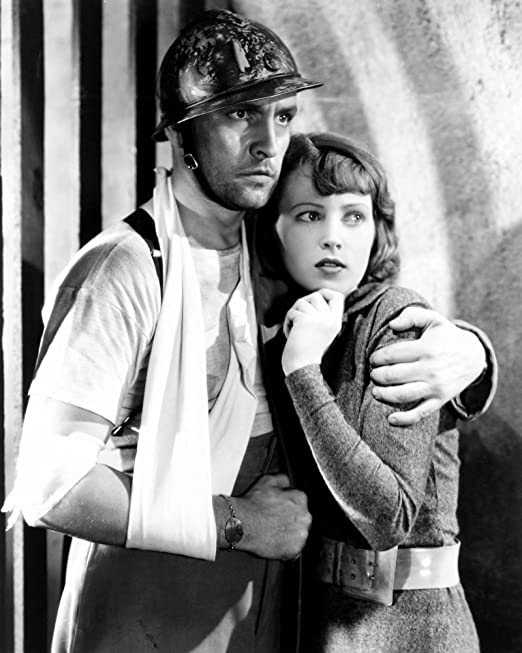
Like many films before it, World War I provided the setting for Hollywood's favorite love triangle formula - two boys and a girl - in Howard Hawks' The Road to Glory.
Warner Baxter and Frederic March star as the two men who vie for the love of June Lang, a pretty nurse. It is a simple formula that never gets tiresome, providing it is well-acted and in The Road to Glory it certainly is. Screenwriters William Faulkner and Joel Sayre used this formula as the basis of their script, but the real meat of the story was its depiction of the brutalities of the war itself and the courageousness of the soldiers who fought it.
Warner Baxter stars as Captain La Roche, a soldier who has witnessed death first-hand many times in the trenches of France. His company of the 2nd Battalion of the 39th Regiment is often called upon to fight in the most dangerous situations and most of his men do not come back from the trenches alive. La Roche is always receiving new replacement soldiers which he must, in turn, send out on perilous missions. He is disgusted with death and the ravages of trench warfare and he drowns his disgust in liqueur and aspirin. His only comfort is Monique La Coste ( Lang ), a young nurse whom he met when he first came to his post. She is drawn to him out of pity and gratitude for his kindness to her and her family. Monique thinks she loves him but realizes what true love is when she meets Lt. Michel Denet ( March ), the new officer in La Roche's regiment.
La Roche and Denet get off to a bad start when they first meet, but as Denet fights alongside La Roche, he comes to admire his captain and serves proudly under him. Naturally, when he discovers that his newfound love is his captain's sweetheart, he feels torn between being loyal to La Roche or being true to his heart.
Howard Hawks was one of the most versatile directors that ever came out of Hollywood and while The Road to Glory is not often regarded as one of his most famous films, it certainly bears his trademark stamp of excellence. In fact, The Road to Glory should rank as one of the finest WWI films ever made. The cinematography is dark and moody and the depictions of all of the battle scenes are impressive. It is excellently paced and features all of the elements of a good drama...including a touch of humor. The film bears many resemblances to The Dawn Patrol ( 1930 ), which was also directed by Hawks. Both films are set in World War I and focus on the relationship between an officer and his commanding officer. Both also realistically depict the horrors of war.
Trench warfare was brutal. Just looking above the trench meant risking your head being shot off. One poor soldier gets stuck on barbed wire and wails for hours. The few soldiers that attempt to rescue him are shot down and, eventually, La Roche decides to shoot him just to put him out of his misery - like a horse with a wounded leg.
Warner Baxter is excellent as Captain La Roche. This hagged officer has such a burden to carry on his soldiers and then his father ( Lionel Barrymore ), an old veteran of the Franco-Prussian wars, secretly enlists in his regiment and adds to his concerns. Throughout their missions, he now worries whether his father will come through unscathed. Barrymore does not make his first appearance until twenty minutes into the film, yet being the legendary character actor that he was, he makes his part as compelling as the two leading roles.
Fredric March gives a fine performance ( as usual ) and June Lang is equally well-cast. Also in the cast is Gregory Ratoff as a whistling Russian soldier, Victor Kilian as a loyal sergeant, John Qualan, Paul Fix and Leonid Kinsky.
Showing posts with label Warner Baxter. Show all posts
Sunday, March 15, 2020
Thursday, November 14, 2013
Hollywood Home Tour - Warner Baxter
We're off on another bus tour again! This time the Silver Scenes bus is taking us past the beautiful Tudor estate of that delectably debonair actor Warner Baxter. With his rugged masculine face Ohio-born Baxter became a star in the early 1920s in silent pictures such as The Great Gatsby and...
"Hold on a minute gals! Who's conducting this tour?"
Oh gosh, that's right....sorry Al. Go right ahead, we'll just head back in the kitchen and make some more chicken sandwiches for the passengers.
"As the girls were saying, Baxter became a Hollywood star during the silent era, but once the soundies came he catapulted into mega-stardom. He played the Cisco Kid in In Old Arizona ( 1928 ) which became his most famous early, talking role. He earned an Oscar for this too, making him the first American to win a Best Actor award. Baxter then went on to make such hits as 42nd Street ( 1933 ), Broadway Bill ( 1934 ) and Kidnapped ( 1938 ). He reached his peak in popularity in the mid-1930s and was the highest paid actor in Hollywood at that time, earning $284,000 a year.

"It was during this time that Warner Baxter and his wife, Winifred, moved from their lodgings at 138 S. Beachwood Drive into this beautiful Tudor estate in Bel-Air. You can see it coming up on your right folks, just over the hill.
"Look at those lovely lush gardens...Warner Baxter was one of the first actors allowed to build in Bel-Air and in 1932, construction began on this magnificent home. Baxter, inspired by early spook films, added a network of secret panels so you could play hide-and-seek throughout the house. And what a place to hide! At 16,000 square feet, it was one of the largest homes built by any Hollywood star. The estate included 18 bathrooms, seven kitchens and well over forty bedrooms ( no one took the time - or effort - to count them all ). Some of the closets alone are bigger than most people's living rooms.
At the time the house had a beautiful view of the Pacific Ocean, but recent tree plantings are beginning to obscure it. Baxter was a quite a tinkler when he was not acting and surely he must have had a room set aside as a workshop where he could invent. One of his inventions is in constant use today...a radio device that permits emergency crews to change a traffic signal from over two blocks away.
"During the 1940s, when Baxter began to drift into B-films and The Crime Doctor series, his family downsized to a comfortable estate at 911 North Roxbury Drive.
"Warner Baxter died on May 7, 1951 at the age of 62, after suffering from a bout of pneumonia."
Update: Today this lovely home no longer stands, having been replaced by a modern glass and concrete structure. Jack Ryan purchased the property in late 1962 and turned the house into, what the Daytona Beach News, dubbed "The greatest glittering pad in Bel-Air". Ryan had made his fortune in doll designs...anyone heard of Barbie doll? Just down the street is Kirkeby estate where The Beverly Hillbillies were filmed and Elizabeth Montgomery, who later starred in the popular television series Bewitched, purchased Baxter's Roxbury Drive residence in the mid-1960s.
"Hold on a minute gals! Who's conducting this tour?"
![]() |
| 688 Nimes Road, Bel-Air |
Oh gosh, that's right....sorry Al. Go right ahead, we'll just head back in the kitchen and make some more chicken sandwiches for the passengers.
"As the girls were saying, Baxter became a Hollywood star during the silent era, but once the soundies came he catapulted into mega-stardom. He played the Cisco Kid in In Old Arizona ( 1928 ) which became his most famous early, talking role. He earned an Oscar for this too, making him the first American to win a Best Actor award. Baxter then went on to make such hits as 42nd Street ( 1933 ), Broadway Bill ( 1934 ) and Kidnapped ( 1938 ). He reached his peak in popularity in the mid-1930s and was the highest paid actor in Hollywood at that time, earning $284,000 a year.

"It was during this time that Warner Baxter and his wife, Winifred, moved from their lodgings at 138 S. Beachwood Drive into this beautiful Tudor estate in Bel-Air. You can see it coming up on your right folks, just over the hill.
"Look at those lovely lush gardens...Warner Baxter was one of the first actors allowed to build in Bel-Air and in 1932, construction began on this magnificent home. Baxter, inspired by early spook films, added a network of secret panels so you could play hide-and-seek throughout the house. And what a place to hide! At 16,000 square feet, it was one of the largest homes built by any Hollywood star. The estate included 18 bathrooms, seven kitchens and well over forty bedrooms ( no one took the time - or effort - to count them all ). Some of the closets alone are bigger than most people's living rooms.
At the time the house had a beautiful view of the Pacific Ocean, but recent tree plantings are beginning to obscure it. Baxter was a quite a tinkler when he was not acting and surely he must have had a room set aside as a workshop where he could invent. One of his inventions is in constant use today...a radio device that permits emergency crews to change a traffic signal from over two blocks away.
"Warner Baxter died on May 7, 1951 at the age of 62, after suffering from a bout of pneumonia."
Update: Today this lovely home no longer stands, having been replaced by a modern glass and concrete structure. Jack Ryan purchased the property in late 1962 and turned the house into, what the Daytona Beach News, dubbed "The greatest glittering pad in Bel-Air". Ryan had made his fortune in doll designs...anyone heard of Barbie doll? Just down the street is Kirkeby estate where The Beverly Hillbillies were filmed and Elizabeth Montgomery, who later starred in the popular television series Bewitched, purchased Baxter's Roxbury Drive residence in the mid-1960s.
Subscribe to:
Posts (Atom)


