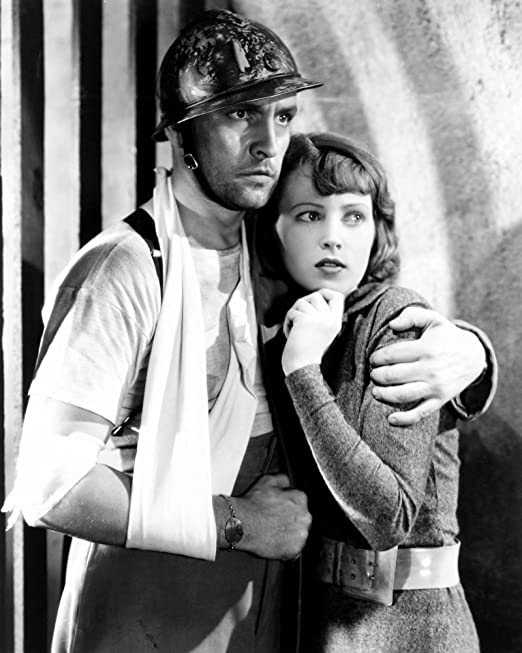
Like many films before it, World War I provided the setting for Hollywood's favorite love triangle formula - two boys and a girl - in Howard Hawks' The Road to Glory.
Warner Baxter and Frederic March star as the two men who vie for the love of June Lang, a pretty nurse. It is a simple formula that never gets tiresome, providing it is well-acted and in The Road to Glory it certainly is. Screenwriters William Faulkner and Joel Sayre used this formula as the basis of their script, but the real meat of the story was its depiction of the brutalities of the war itself and the courageousness of the soldiers who fought it.
Warner Baxter stars as Captain La Roche, a soldier who has witnessed death first-hand many times in the trenches of France. His company of the 2nd Battalion of the 39th Regiment is often called upon to fight in the most dangerous situations and most of his men do not come back from the trenches alive. La Roche is always receiving new replacement soldiers which he must, in turn, send out on perilous missions. He is disgusted with death and the ravages of trench warfare and he drowns his disgust in liqueur and aspirin. His only comfort is Monique La Coste ( Lang ), a young nurse whom he met when he first came to his post. She is drawn to him out of pity and gratitude for his kindness to her and her family. Monique thinks she loves him but realizes what true love is when she meets Lt. Michel Denet ( March ), the new officer in La Roche's regiment.
La Roche and Denet get off to a bad start when they first meet, but as Denet fights alongside La Roche, he comes to admire his captain and serves proudly under him. Naturally, when he discovers that his newfound love is his captain's sweetheart, he feels torn between being loyal to La Roche or being true to his heart.
Howard Hawks was one of the most versatile directors that ever came out of Hollywood and while The Road to Glory is not often regarded as one of his most famous films, it certainly bears his trademark stamp of excellence. In fact, The Road to Glory should rank as one of the finest WWI films ever made. The cinematography is dark and moody and the depictions of all of the battle scenes are impressive. It is excellently paced and features all of the elements of a good drama...including a touch of humor. The film bears many resemblances to The Dawn Patrol ( 1930 ), which was also directed by Hawks. Both films are set in World War I and focus on the relationship between an officer and his commanding officer. Both also realistically depict the horrors of war.
Trench warfare was brutal. Just looking above the trench meant risking your head being shot off. One poor soldier gets stuck on barbed wire and wails for hours. The few soldiers that attempt to rescue him are shot down and, eventually, La Roche decides to shoot him just to put him out of his misery - like a horse with a wounded leg.
Warner Baxter is excellent as Captain La Roche. This hagged officer has such a burden to carry on his soldiers and then his father ( Lionel Barrymore ), an old veteran of the Franco-Prussian wars, secretly enlists in his regiment and adds to his concerns. Throughout their missions, he now worries whether his father will come through unscathed. Barrymore does not make his first appearance until twenty minutes into the film, yet being the legendary character actor that he was, he makes his part as compelling as the two leading roles.
Fredric March gives a fine performance ( as usual ) and June Lang is equally well-cast. Also in the cast is Gregory Ratoff as a whistling Russian soldier, Victor Kilian as a loyal sergeant, John Qualan, Paul Fix and Leonid Kinsky.
Showing posts with label Fredric March. Show all posts
Sunday, March 15, 2020
Wednesday, October 31, 2018
Victorian Thrillers of the 1930s & 1940s
Victorian London, steeped in a dark and romantic aura, has always been the ideal setting for murders and mysteries in films of the 1930s and 40s. Lurking beneath the white facade of stately manors inhabited by fashionable ladies and gentlemen with high morals and social sensibilities lay seedy districts reeking with crime and misery....districts where foul deeds were not uncommon. Opium-addicts, prostitutes, music hall wenches, and rum-guzzling sailors were wildly cavorting with Destiny on a nightly basis.
It was this contrast between wealthy society and dredging poverty that gave birth to so many tantalizing stories of horror in the "Penny Dreadful”'s of the day; stories with characters like Sweeny Todd the Demon Barber of Fleet Street and Jack Sheppard. All of them were loosely based on news accounts these authors were reading about on a daily basis of the serial killer Jack-the-Ripper.
In these gentle times even whispers of innuendo were received by ladies with a good dose of smelling salts, nevertheless, these tales of true-life terror were repeated throughout the city and developed into short stories of legendary fame. They featured crimes that super-sleuths like Sherlock Holmes could solve on a weekly basis or settings that gentlemen thieves such as Raffles could prowl around in. Once motion pictures gained popularity, these stories were brought to life in visual splendor. One of the earliest films to depict this atmospheric era to perfection was Dr. Jekyll and Mr. Hyde (1931) starring Frederic March, Mariam Hopkins, and Rose Hobart. Director Rouben Mamoulian's pre-code horror classic transported audiences to a dark and dangerous London of the late 1800s, where they were able to witness first-hand the transformation of the reserved Dr. Jekyll into the hideous Mr. Hyde.
It was this contrast between wealthy society and dredging poverty that gave birth to so many tantalizing stories of horror in the "Penny Dreadful”'s of the day; stories with characters like Sweeny Todd the Demon Barber of Fleet Street and Jack Sheppard. All of them were loosely based on news accounts these authors were reading about on a daily basis of the serial killer Jack-the-Ripper.
In these gentle times even whispers of innuendo were received by ladies with a good dose of smelling salts, nevertheless, these tales of true-life terror were repeated throughout the city and developed into short stories of legendary fame. They featured crimes that super-sleuths like Sherlock Holmes could solve on a weekly basis or settings that gentlemen thieves such as Raffles could prowl around in. Once motion pictures gained popularity, these stories were brought to life in visual splendor. One of the earliest films to depict this atmospheric era to perfection was Dr. Jekyll and Mr. Hyde (1931) starring Frederic March, Mariam Hopkins, and Rose Hobart. Director Rouben Mamoulian's pre-code horror classic transported audiences to a dark and dangerous London of the late 1800s, where they were able to witness first-hand the transformation of the reserved Dr. Jekyll into the hideous Mr. Hyde.
Here are a few more well-known Victorian London thrillers brought to the silver screen :
The Mystery of Mr. X (1935) - This decisively Jack-the-Ripperish story features Robert Montgomery as our light-fingered gentleman hero who is being implicated as the killer of nine grisly London murders done by a murderer who always strikes in a different neighborhood and leaves his mark next to his victims…the signature of Mr. X! Peter Lawford starred in a remake of this tale in MGM’s The Hour of 13 (1952).
The Adventures of Sherlock Holmes (1939) - A grisly midnight murder in a secluded city park, mysterious South American funeral dirges, suspiciously heavy footprints, missing crown jewels from the Tower of London and a puzzling drawing of an albatross add up to making this one of Sherlock Holmes’ most intriguing cases. Ida Lupino and Alan Marshall star with Basil Rathbone and Nigel Bruce in this second Sherlock Holmes feature from the 20th Century Fox studios. A visual Victorian feast for the eyes it be.
Dr. Jekyll and Mr. Hyde (1941) - MGM pulled out all the stops in this ultra-glossy gas-lit masterpiece based on Robert Louis Stevenson's classic tale of a man's double nature - the law-abiding Dr. Jekyll and the positively hairy sexual sadist Mr. Hyde, the creature within himself that he created whilst experimenting to scientifically suppress the evil nature residing within mankind. The all-star cast includes Spencer Tracy in the title role, Ingrid Bergman as buxom barmaid Ivy, Lana Turner, Donald Crisp, and Ian Hunter. Directed by Victor Fleming.
The Lodger (1943) - Laird Crager, a great burly hulk of an actor, portrayed the very essence of a creepy social recluse in The Lodger where, as Slade - a quiet pathology student residing at the home of the Burtons (Sir Cedric Hardwicke and Sara Allgood) - he is suspected of being none other than Jack the Ripper. Gasp! The gorgeous moody photography of John Brahm transports us into the cobblestoned mire of Whitechapel through its heavy fog-encased settings, period detail, and its disturbing visual vignettes. George Sanders and Merle Oberon also star.
Gaslight (1944) – Charles Boyer, Ingrid Bergman and Joseph Cotton star in this intrepid MGM remake of the 1940 British classic Gaslight featuring Anton Walbrook and Diana Wynyard. Twenty years after a wealthy woman was murdered in her home in Thorton Square her niece moves into the London dwelling with her husband, a suave and sinister gentleman who plots to drive his wife mad because he has a dark secret to hide. MGM attempted to destroy all available prints of the English version of this psychological thriller but fortunately a few remained and today we can enjoy both editions on DVD.
The Picture of Dorian Gray (1944) - Oscar Wilde's fantasy about the inner state of the soul of one Dorian Gray was given A-class treatment in director Albert Lewin's pet project The Picture of Dorian Gray, released through MGM. Silky smooth 26-year-old Hurd Hatfield played the title character (a role which made him very unpopular in Hollywood) along with an impressive cast including George Sanders, Donna Reed, Angela Lansbury, Peter Lawford and Sherlock Holmes veteran actor Miles Mander. Incidentally, Basil Rathbone wanted the role of Lord Henry but was overlooked because he was already being too closely identified with the legendary detective of Baker Street. Stunning cinematography, a strong narrative, and eye-popping Technicolor sequences make this a most memorable film.
Hangover Square (1945) - Laird Cregar returned to the screen as another downright suspicious madman, this time as a pianist who had to struggle with mental turmoil - and the compulsion to wreak destruction - whenever he hears the ping! of a certain note.John Brahm’s filming is atmospheric and eerie in its dreamlike sequences and the film has a great cast including George Sanders and Linda Darnell.
Labels:
1930s,
1940s,
20th Century Fox,
Angela Lansbury,
Basil Rathbone,
Fredric March,
Halloween,
Horror,
MGM,
Mystery,
Nigel Bruce,
Robert Montgomery,
Sherlock Holmes,
Universal Pictures
Thursday, September 24, 2015
Hollywood Home Tour - Fredric March
It's been awhile since the Hollywood Home Tour bus last passed by any celebrity homes, but Al is here today to introduce you to the latest home you will see :
"Hi folks! It's Al here, welcoming you back to the Hollywood Home Tour bus. We're heading away from Bette Davis' home to take a gander at one of the truly legendary Bel-Air structures.
"Back in 1932, Fredric March and his wife Florence Eldridge, commissioned architect Wallace Neff to design a spacious home for the couple to reside in while in Hollywood making films. What resulted was a 12,000 square foot French Normandy estate set in beautiful Bel-Air, a rural area at the time.
"Let me stop the bus so that you can take pictures. Here it is on your right. Construction on the home began in 1933, in the midst of the Great Depression. As one of the biggest stars of the era, March had his home built as extravagantly as one would expect of a star. There were twenty-two rooms, eleven bathrooms, an octagonal dovecote tower, a private screening room, his-and-her living rooms, a wine cellar, an enormous swimming pool and, of course, the prerequisite tennis courts.
"Wallace Neff had also designed Pickfair - the home of Douglas Fairbanks and Mary Pickford - as well as homes for Greta Garbo, John Gilbert, and Charlie Chaplin. He is often referred to as the Architect of Hollywood's Golden Age so it is no wonder that Fredric March chose him to design his residence.
"If you take a glance across the street you can see Frank Morgan's beautiful home. We'll get a better look at that house a little later in the tour."
Up-to-Date Info : Brad Pitt and Jennifer Aniston purchased the house in 2001 for $13 million, spent a tidy sum renovating it, and then sold it for $28 million five years later. Click here to see pictures of the March house when it was under construction.
![]() |
| 1065 Ridgedale Drive, Bel-Air |
"Hi folks! It's Al here, welcoming you back to the Hollywood Home Tour bus. We're heading away from Bette Davis' home to take a gander at one of the truly legendary Bel-Air structures.
"Let me stop the bus so that you can take pictures. Here it is on your right. Construction on the home began in 1933, in the midst of the Great Depression. As one of the biggest stars of the era, March had his home built as extravagantly as one would expect of a star. There were twenty-two rooms, eleven bathrooms, an octagonal dovecote tower, a private screening room, his-and-her living rooms, a wine cellar, an enormous swimming pool and, of course, the prerequisite tennis courts.
"Wallace Neff had also designed Pickfair - the home of Douglas Fairbanks and Mary Pickford - as well as homes for Greta Garbo, John Gilbert, and Charlie Chaplin. He is often referred to as the Architect of Hollywood's Golden Age so it is no wonder that Fredric March chose him to design his residence.
"If you take a glance across the street you can see Frank Morgan's beautiful home. We'll get a better look at that house a little later in the tour."
Up-to-Date Info : Brad Pitt and Jennifer Aniston purchased the house in 2001 for $13 million, spent a tidy sum renovating it, and then sold it for $28 million five years later. Click here to see pictures of the March house when it was under construction.
Subscribe to:
Posts (Atom)