Wednesday, September 27, 2017

Les Anges Du Péché ( 1943 ) aka Angels of Sin

"If you hear God's word joining you to another, listen to no other words - they are merely its echo." - St. Catherine of Siena

Director Robert Bresson's first feature film, the underrated gem Les Anges du Péché aka Angels of Sin, explores the indistinguishable line between will and chance and the effect people have in determining each other's destinies, a theme that resonated throughout Bresson's later works (The Diary of a Country Priest, A Man Escaped). 

The story follows Sœur Anne-Marie (Renée Faure) a young bourgeois-born novice at a Dominican convent who is convinced that she was sent by God to save the soul of Sœur Thérèse (Jany Holt), an impenitent murderess who joins the order to seek shelter from the police. 

Father Bruckberger, an acquaintance of Bresson's, had suggested he read "The Dominicans of the Prisons" by Father Lelong and proposed a film about the Sisters of Bethany in France, an order of nuns devoted to working with female ex-convicts. The order, founded in 1866, gives these women the opportunity to overcome the sins that led them to become criminals. Some choose to remain at the convent and become nuns while others venture on to begin a new life. 

Although Bresson was ignorant of Bethany, he was intrigued by the premise and developed an engrossing scenario around it that weaves in key elements that Bresson would return to in every subsequent film he made. He was particularly fascinated with the theme of two lives coming together and forging a preordained course, one which ends in redemption for both. 

While Sœur Anne-Marie is the main character in Les Anges du Péché and dominates the majority of the scenes, her presence is merely a clever red-herring from Bresson for the film is truly about Sœur Thérèse. It is her soul's redemption that is the driving force of the picture, and all the events that take place at the abbey from the day of her arrival act as stepping stones of grace leading up to her redemption. 

In one scene, the nuns gather for a ceremony where each sister receives a maxim, a randomly chosen quote, that will become their motto for the year. These maxims miraculously suit the personality of each sister. St. Catherine's quote about hearing "God's word joining you to another" is handed to Anne-Marie and has a particularly awe-inspiring effect upon her because she felt an invisible Hand drawing her towards the prison, specifically towards Thérèse, ever since she arrived at the convent. 

Evidently, Sœur Anne-Marie's heavenly calling to save such a lost lamb as Thérèse was conceived before she even meets her, but she ultimately succeeds in her task only when she comes to recognize her own failures and humble herself. Her optimistic determination to accomplishing what she considers God's will, and her pride in her divine vocation, others perceive merely as sinful arrogance. She recognizes this when she subjects herself to "sisterly correction" and goes cell to cell asking each sister "How do you value me?". She finds that they see her as being selfish, ambitious, and showing no understanding of others. The nuns do not recognize her irrepressible fervor as being a sign of deeper spirituality. Only Thérèse refuses to rebuke her. 

Thérèse considers herself dead to sin. She is unrepentant. She has accomplished her murderous act of revenge towards the man who let her be wrongfully incarcerated and is now the most obedient nun at the convent, finding life there preferable - if not dissimilar - to life imprisonment. Yet, she is impatient with Anne-Marie's chastenings and is relieved when the prioress sends Anne-Marie away from the convent, not realizing that even that act is simply another step leading her towards her preordained destiny - the path of redemption.

Robert Bresson would later favor a sparse naturalistic approach to filming, using a minimum amount of background music, little dialogue, and completely renouncing professional actors. Les Anges du Péché and Les Dames du Bois de Boulogne (1945) were the only two films he made with professional actors, a choice which he strangely regretted. Bresson, who in his Notes cautioned himself against drawing "tears from the public with the tears of your models" failed to realize that naturalism can only entertain to a point. Its novelty wears off and the audience yearns to see emotions and characterizations that professional actors demonstrate best.


The performances of Renée Faure, Jany Holt, and Louise Sylvie (as La Prieure) are expressive and beautiful and add depth to the characters in such a subtle way that non-professional actors could not have accomplished. Holt, in particular, gives a touching understated performance while Faure is convincingly innocent and saintlike.
A strong supporting cast (Mila Parély, Silvia Monfort, Louis Seigner), gorgeous cinematography by Philippe Agostini, and a powerful score by Jean-Jacques Grünenwald add up to making this an impressive directorial debut from Bresson and a true French cinema classic. 

Tuesday, September 26, 2017

From the Archives : Camelot ( 1967 )

"In short, there's simply not a more congenial spot for happily-ever-aftering than here in Camelot." 

This original program cover from the 1967 movie musical Camelot features gorgeous artwork from Bob Peak, a legendary commercial illustrator whose art graced the covers of TV Guide, Time Magazine, and hundreds of movie posters. 

From the Archives is our latest series of posts where we share photos from the Silverbanks Pictures collection. Some of these may have been sold in the past, and others may still be available for purchase at our eBay store : http://stores.ebay.com/Silverbanks-Pictures

Sunday, September 24, 2017

Passionate Summer ( 1958 ) aka Storm Over Jamaica

An island paradise...where all human emotions are exposed under a tropic sun.

In spite of its engaging tagline, Passionate Summer, also known as Storm Over Jamaica, gives its audience a light drizzle of drama compared to the raging storm promised. It focuses on the traditional one-man/two-women love triangle with a little time off to pursue some interesting side plots. 

Bill Travers stars as Douglas Lockwood, a gifted teacher at Leonard Pawley's experimental school situated in the outskirts of Jamaica. During one summer, a private plane crashes into the mountains a short distance from the school. Lockwood helps rescue passenger Judy Waring ( Virginia McKenna ) and quickly develops a romantic interest in her while she convalesces at the school, much to the chagrin of love-starved Mrs. Pawley ( Yvonne Mitchell ) who was openly pursuing Lockwood. 

One of Lockwood's students, Sylvia ( Ellen Barrie ) is a holy-terror, an unruly emotionally disturbed girl who only delights in testing Lockwood's patience. Since he is a well-bred English chap, he came equipped with plenty of patience and insists on trying to reform Sylvia without punishment, a practice that Mr. Pawley ( Alexander Knox ) supports. What Pawley doesn't realize is that Lockwood seems to have trouble getting his own life untangled, and wrestles with his love for Judy Waring, knowing very well that she may just be using him. 

Bill Travers and Virginia McKenna, who married in real-life, were both talented actors even though their range was limited. They each bring a fair amount of passion to their parts, but never let their emotions get out of hand.....a quality that Hollywood would have eagerly exploited had they snatched the rights to Richard Mason's novel, which Passionate Summer was based upon. 
Yvonne Mitchell, on the other hand, did an excellent job of portraying the slightly neurotic wife of headmaster Pawley. Pawley's indifference towards her is plain and - during the titular storm - she shows no shame in flaunting her love for Lockwood. 

The film features some good set design and beautiful Jamaican location filming which was shot in Eastman colour, but fails to leave a memorable impression after viewing. Even the music, penned by Angelo Francesco Lavagnino, is rather bland compared to his fine work on Conspiracy of Hearts ( 1960 ). 

Friday, September 22, 2017

James MacArthur and Janet Munro - A Disney Duo

Every once in a while when you are watching a film you probably find yourself proclaiming, "Hey! These two actors also played together in [fill in the blank]!" 
Well, like you, the bloggers behind The Flapper Dame and Phyllis Loves Classic Movies experienced this, too, and so they decided to launch The Duo Double Feature Blogathon giving us clever film buffs a chance to compare the different characters and films of a duo of our choice. I chose James MacArthur and Janet Munro. They were an adorable young couple who starred together in only two Walt Disney films: Third Man on the Mountain ( 1959 ) and Swiss Family Robinson ( 1960 ), and then went on their own separate acting paths, with MacArthur focusing on television work and Monro attempting to alter her wholesome image with spicier British dramas. 

James MacArthur, the son of screenwriter Charles MacArthur and actress Helen Hayes, made his Disney debut in Light in the Forest ( 1958 ), opposite Carol Lynley, and he proved himself to be a talented and very personable actor. Walt Disney liked his honest face and natural acting ability, and young girls liked his rugged good looks and shy demeanor. He was an ideal hero for Disney's live-action features. 

Third Man on the Mountain was his second feature for the studio and Janet Munro was selected to portray his sweetheart Lizbeth in the film. Munro caught the eye of Disney when she came to audition among 300 other actresses for the part of Katie O'Gill, the green-eyed winsome Irish lass in Darby O'Gill and the Little People ( 1959 ). She had an appealing spunky nature and was quickly signed to a five-picture contract for the studio.

Third Man on the Mountain tells the story of a boy who joins a famous mountaineer's climbing expedition in the hopes of discovering a route to reach the top of the Matterhorn, which was long deemed insurmountable. His mother and uncle aim to curtail the boy's desire to become a mountain guide but he is encouraged to pursue his passion by two dear friends, hotel owner Theo ( Laurence Naismith ) and Lizbeth ( Munro ). 

MacArthur's character, Rudi, is a bright lad who has a love for mountaineering ingrained in his heart. His father died attempting to find a path to the Matterhorn's pinnacle, and so he understands his family's fear for him when he takes off climbing but, at the same time, he knows that this is his passion and what he was meant to do in life. He is brave enough to stand up against the other mountain guides who ridicule him as a "mere boy" but he finds he must curb his impetuousness during his climbs, especially when it endangers the lives of those whom he is guiding. 
Munro's character, Lizbeth, is only happy when Rudi is happy. Together with Theo, she helps Rudi train for his climb up the Matterhorn, keeps him focused on climbing, and also strengthens his confidence. She is a sweet girl who always has a smile on her face. She is also frank and fearless. She tells Rudi exactly what she thinks of him if he fails in any way to live up to the hero she believes him to be. 

MacArthur and Monro's second film together came just a year later. Swiss Family Robinson was an adventurous re-working of Johann Wyss' famous 1812 novel about a family ( John Mills, Dorothy McGuire, Tommy Kirk, MacArthur, and Kevin Corcoran ) who get shipwrecked on an uncharted island. Janet Munro's character, Roberta, shows up unexpectedly when she and her father arrive on the island as prisoners of pirates.  

MacArthur's character, Fritz, is quite a different fellow compared to Rudi. He is practically a grown man; he displays admirable leadership qualities, is willing to work hard with his family to make the island a decent home, and demonstrates good judgment in difficult situations. Roberta admires these qualities, but at times he seems too proud and cock-sure of himself, and so she amuses herself with his younger brother Ernst ( Kirk ), sparking jealous feelings between the brothers. 

Roberta isn't the carefree country girl of Third Man in the Mountain. She is a well-bred young lady from London's society. To her the prospect of choosing to live in seclusion on a deserted island is preposterous. But Fritz's pioneering spirit and his hard-working ways eventually win her over and, at the end of the time, we are to suppose that they wed. 

A wedding between MacArthur and Monro is something that I for one would have liked to have seen happen in real life because they made such a lovely couple onscreen. Offscreen, there was no spark of romance between them ( Munro was actually married at the time of filming Third Man on the Mountain ), but had Munro or MacArthur pursued their careers with Walt Disney studios I'm sure they would have been teamed up again.

Tuesday, September 19, 2017

In Kaye's Kitchen : Danny Kaye Cooks More than Comedy

Danny Kaye loved to try new things and was always open to learning the necessary skills and then plunging right into an experience...with no fear of making a fool of himself. With this bravado he acquired proficiency in a number of different fields over the years: flying commercial aircraft, conducting world-famous orchestras ( without knowing a note of music ), dancing, juggling, playing baseball....and cooking. In fact, he became quite an accomplished chef. 

Chef Ruth Reichl, a good friend of Kaye's reminisced about the man shortly after his death and said "Danny Kaye didn't cook like a star. He didn't coddle you with caviar or smother you in truffles. He had no interest in complicated concoctions or exotic ingredients. His taste was absolutely true, and he was the least-pretentious cook I've ever encountered. The meals he made were little symphonies--balanced, perfectly timed, totally rounded. "

French chefs, including Paul Bocuse and Jacques Pepin, often said the best restaurant in California was Danny Kaye's house. Dana Kaye, Danny's daughter, recalled the kitchen in their wisteria-covered Beverly Hills home : 


"This room, with ruffled curtains and a huge island, was the pulse of our lives. My father, in par­ticular, loved the tiny break­fast nook with walls full of cookbooks and an old-fash­ioned wooden table covered in a red-and-white-checked tablecloth. Many mornings he’d sit in his terry cloth robe, make phone calls and offer a cup of coffee to whoever wan­dered in, like the plumber. "

Chinese cooking was his specialty. It all started when Kaye began frequenting Johnny Kan's Chinese restaurant in San Francisco in the late 1960s. He loved the cuisine, the simplicity of the ingredients, and the quick preparation of Chinese food and began a self-appointed apprenticeship to learn what he could about cooking these meals himself. 

Suddenly, Kaye's simple kitchen sprouted a new "Chinese Kitchen" wing that featured a 10-foot long three-wok restaurant stove, shelves which held his hand-made cleavers, a vertical roasting oven, Chinese lanterns, and a round table that accommodated eight. Guests who enjoyed his nine-course Chinese dinner were varied and during any night you may have seen Roddy McDowall, Rudolf Nureyev, Audrey Hepburn, or Zubin Mehta seated in Kaye's Kitchen. 
“The trouble with Danny's cooking,” Olive Behrendt, president of the Los Angeles Philharmonic, once said, “is it spoils you forever for going to restaurants. You could eat in this home every night for a month and never be served the same dish twice.” Luciano Pavarotti considered Kaye's fegato alla veneziana the best in the world.

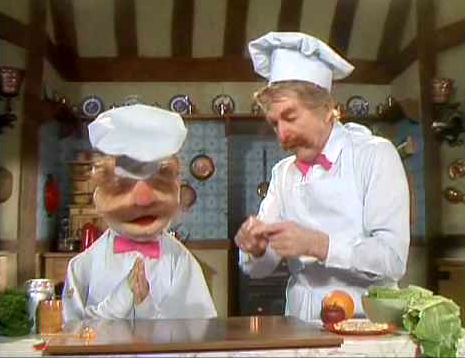
His fame as a chef spread throughout Hollywood and those who doubted his mastery in the kitchen quickly sang a different tune after tasting one of his meals. In 1979, Kaye was honored with the ultimate compliment: when he guest-starred on The Muppet Show he was permitted to cook alongside the famous Swedish Chef! 

This entry is a part of our series entitled "Did You Know?".....sometimes we just feel like sharing interesting fragments of television and movie history and now we have a place to do just that. If you have a hot tip that you would like us to share on Silver Scenes, drop us a line!

Friday, September 15, 2017

Raising a Riot! ( 1955 )

What does a man do when his wife asks him to mind their three youngsters when she must leave the country for a few weeks to care for her aging mother? 

If you think he would raise a riot, you're quite mistaken, for the man in this situation is played by Kenneth More....and any character that More portrays would never balk at caring for children. In fact, this chap - Tony, a naval officer - begs for the opportunity to spend some quality time with his children: Anne, Peter, and Fusty. He's been away at sea for so long he fears they may come to think of him as a stranger. And so, in one frantic afternoon, he packs the brood into his convertible and whisks them off to Seaview, a windmill house in the country where his father "Grampy" lives. 

The children adore the place. Father thinks it needs a heap of work. Over the next few weeks, he attempts to put some order in the place while the children enjoy a good romp in the countryside.
Raising a Riot was filmed in Technicolor in 1955 and received moderate box-office success upon its release. The film is clearly based on a book for it lacks a driving plot and instead is built up of a series of amusing incidents centering on household disasters at the old windmill. It delivers gentle humor at a leisurely pace. British comedies like this were quite common in the 1950s-1960s but, unfortunately, they are no longer being made. Studio execs probably don't want to waste time and money on a picture that has no chance of being the "comedy hit of the year". Such a shame, for they are such entertaining films. 

The youngsters ( played by Mandy Miller, Gary Billings, and Fusty Bentine ) are all well-suited to their roles, as is Grampy ( Ronald Squire ), and Jan Miller is especially adorable as a young American neighbor with a crush on the handsome officer. Parts like Tony were tailor-made for Kenneth More, who had such a winning personality. It's no wonder he attracts young women in addition to winning the hearts of his own children! 
Alfred Toombs, who penned the titular book in 1949, had a number of children of his own, and this account was autobiographical. Toombs had been away in the Navy for three years and, upon his return home, had to care for his kiddies when his wife left the country. Housework, cooking, and child-rearing were all new experiences for him and he wrote about them in such a humorous fashion that the resulting book sold quite a number of copies. In the film, Tony is frequently seen typing about his day-to-day mishaps with the little ones, but oddly enough the audience is never told what becomes of Tony's writings. Instead, at the end of the film, he finds himself called back into service again and blesses his wife with the words: "I wouldn't be a woman if the entire United Nations got down on their knees and begged me! Do you know what a woman has to be? She has to be a cross between a saint and a drayhorse, a diplomat and an automatic washing machine, and a psychologist and a bulldozer!" 

Wednesday, September 13, 2017

The Impossibly Difficult Name that Movie Game


"Inspection!!" Never look a gift horse in the mouth.....but this commanding officer doesn't like the looks of one the horses. Do you remember this scene? Unfortunately, it's yet another blurry screenshot. However, put your thinking cap on! There are enough clues in this scene to solve the puzzle. 

As always, if you are not familiar with the rules to the Impossibly Difficult Name that Movie game or the prize, click here!