Showing posts with label British TV. Show all posts

Wednesday, April 15, 2026

Soldier and Me (1974)

In 1974, Granada Television aired one of the most gripping afternoon adventure serials ever aimed at younger audiences, the nine-part thriller Soldier and Me. This unusually intelligent series plunged its viewers into a world of Cold War spies, urban grit, and genuine danger, proving that teenage drama could be every bit as tense and sophisticated as adult thrillers.

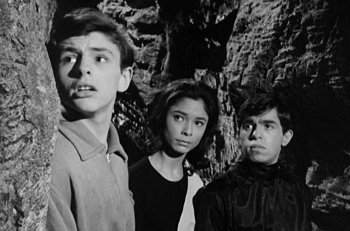
Its story begins in a rough northern schoolyard, where Jim Woolcott (Gerry Sundquist), a tough but fundamentally decent Manchester schoolboy, comes to the aid of a bespectacled Czech refugee named Istvan Szolda (Richard Willis). Jim jokingly shortens his awkward surname into “Soldier,” and from that moment the two boys, so different in temperament and background, are drawn into an uneasy friendship that soon becomes a desperate alliance when Soldier overhears a plot between Czech agents to eliminate a dissident - "an old crippled man." 

Soldier has a dickens of a time persuading Jim that what he heard was true, but when they do investigate they become unwilling witnesses to the murder of this man. The police don't believe the boys, especially when they go to visit the old man and he is very much alive ("Did anyone shoot you tonight?" the police ask him). However, the Czech agents know they witnessed the killing and before long the boys are racing across northern England pursued by these men who are determined to silence them forever.

This is when Soldier and Me veers away from city drama and turns into a breathless cross-country pursuit through the Pennines and the Lake District, with the boys fleeing through forests, scrambling over hillsides, hiding in an abandoned quarry, and even leaping from a moving train. Unlike many children’s serials of the period, this one never softens the reality of the boys’ plight. Hunger, exhaustion, fear, and the chilling realization that adults cannot be trusted all become part of their journey.

"It's a technical map....a technical map!!"

In many ways, Soldier and Me plays out like a parallel English version of The Secret of Boyne Castle (1969). In that serial, which aired on Walt Disney's The Wonderful World of Color, Kurt Russell and Patrick Dawson were the two boys being pursued by spies, only it was set in Ireland instead of England. There were 4-5 agents in that story as well who, like in Soldier and Me, appear to cover every road in all directions. In spite of the constant danger the lads were in, the chase seemed thrilling - almost fun - in the Disney version, even while the action was similar (being chased on a motorbike, jumping off a train, running across fields, being kidnapped, etc). Not so in this series. The boys are having anything but fun. It also doesn't help that Soldier gets on Jim's nerves so much that throughout the chase he is wishing the "twit" would get lost. 

The relationship between these two young leads is what makes this series especially memorable. Gerry Sundquist gives Jim a dry, deadpan resilience that perfectly suits the hard-edged realism of the production, while Richard Willis makes Soldier both impossibly "twit"ish and yet quietly courageous. At first, Jim regards the younger refugee boy as an annoyance who simply refuses to go away, but as the pursuit intensifies, their friendship deepens into one forged by fear, hunger, and survival. The gradual shift from irritation to mutual trust gives the serial its emotional ballast and keeps it from becoming merely a chase story. Jim's narration throughout the series also provides the humor the series required, as he makes his thoughts known to the audience. 

Like The Owl Service and The Intruder, two other great Brit series of the 1970s, Soldier and Me carries an almost documentary sense of realism, no doubt helped by its location filming and its no-nonsense direction. The script was based on the book "Run for Your Life" written by Lionel Davidson ("The Night of Wenceslas"), an adventure writer who took up the pseudonym of David Line for this young adult novel. After Soldier and Me's popularity on television, Line penned a similar spy-adventure thriller "Mike and Me" in 1974. 

Soldier and Me can be viewed on Youtube here

Friday, February 27, 2026

The Model World of Robert Symes (1979)

The British Broadcasting Corporation, better known as the BBC, has released on Youtube a wealth of fantastic television programs and documentaries from their vast archives. These programs vary in subject from gardening to travel to education to the histories of just about anything and everything related to England. The documentaries about crafts and craftsmen are the most fascinating and top of this line-up is The Model World of Robert Symes, a 48-minute presentation released on BBC in 1979.

Robert Symes was a teddy-bearish television host best known for co-hosting Tomorrow's World in the 1960s. Off-screen, he was a railway enthusiast and a model builder, two loves which he merged in the 1970s when he hosted the ten-part series Model World (1975). This series showcased various types of models and how to build them.

The Model World of Robert Symes spins off of that concept slightly and instead briefly spotlights the pleasures to be found in each different kind of model hobby: model railroading, toothpick modeling, R/C planes and automobiles and model dioramas. The only subject he neglected to cover was model sailboat racing. Symes examines each of these crafts and talks with an expert in each field. We also get to see Robert's own garden railway line in the backyard of his property.

Whether you are a miniature enthusiast or not, this is a highly entertaining program worth watching. Programs like these introduced youngsters and adults to the pleasures that can be found in model making. If only a new program would do the same!

Ready to watch The Model World of Robert Symes? Simply click here.

Friday, December 19, 2025

A Ghost Story for Christmas: The Treasure of Abbot Thomas (1974)

Ever since Victorian times, it has been a tradition in England to tell ghost stories at Christmastime and the BBC, in keeping with this tradition, aired an annual teleplay of a ghost story each year beginning in 1971. This series of supernatural tales were released under the title A Ghost Story for Christmas

They were inexpensive productions but their filming (in 16mm), by director Lawrence Gordon Clark, was excellent and the actors who starred in them were excellent as well. The series ran for 8 years and then it was revived again in 2004 and 2005 by BBC Four productions. 

Most of the original 1970s episodes were based on short stories by that legendary writer of the supernatural, Mr. M.R. James. Since his stories were short so were the episodes with most clocking in at under 40 minutes. It's not a lot of time to tell a chilling tale and yet the stories are surprisingly compact and manage indeed to send chills down your spine... especially if you watch them at night. 

One particular episode, The Treasure of Abbot Thomas, we do not recommend watching on Christmas Eve as it will leave you with a decidedly gooey feeling afterwards... but it's worth checking out this week before the holiday.

The Treasure of Abbot Thomas tells the tale of a young lord who is studying Latin under the tutelage of the Reverand Justin Somerton (Michael Bryant), a medieval historian and a clergyman. One of the documents that Lord Peter (Paul Lavers) is learning to decipher is a book written by Abbot Thomas, a monk from the 15th century who was disgraced by his involvement with alchemy. His words speak of a treasure of gold which he himself hid near the grounds of the very abbey where the Reverand and Lord Peter study. 

In the document, he shares the first clue to finding this treasure, which the twosome decide to investigate. It leads them to an old stained-glass window featuring images of four Biblical characters, each of whom have a cryptic phrase written in Latin beneath them (“They have on their vestments writing which no-one knoweth”, “On one stone are seven eyes” "He looks down high to see what is hidden"). These clues lead them eventually to a culvert where the Rev. Somerton believes the treasure may be hidden. Despite the fact that Abbot Thomas had warned that he "set a guardian" to protect his treasure, the Reverand goes in search of the fabled gold.... much to his regret. 

M.R. James' "The Treasure of Abbot Thomas" was heavily revised by screenwriter John Bowen for this teleplay but, unlike some script revisions, Bowen's improved upon the original. As in many of James’s tales, the plot follows academic characters whose rational worldview unravels when they encounter something supernatural. In the Reverand's case, we sense that he wanted to believe that there really was a legendary golden treasure to be found but at the same time, disbelieved in the message being true. It is only Lord Peter's eagerness and insistence that sparks Somerton's curiosity as well. Bowen's script adds new characters and situations to James' story but he also leaves in James' hints of ambiguity. At the end we are left wondering whether Lord Peter returned the treasure or kept it for himself. A nice touch. 

Michael Bryant and Paul Lavers play their parts so well that it makes one wish they had paired up again as these characters for a series of mysteries. It certainly would have been better than many of the crime shows that were available stateside in the 1970s. The music for this particular episode also contributes greatly to its eerie ambiance. It is a strange concoction of vocal chanting and drumming that was later mimicked in Children of the Stones (1977), another spine-tingling British television production. 

Feeling intrigued enough to watch this? Check it out on AMC+ or at this link

Thursday, October 30, 2025

G-G-Ghost!! 1960s British Pathe Ghost Clips

This month's featured British Pathe clip is actually three newsreels in one and all suitably spooky for Halloween. Titled "G-G-Ghost!", British Pathe assembled these spirited shorts dating from the 1950s and 1960s into one entertaining video. The first is from 1953's "Ghost Hunters" and features the Sussex ghost hunters examining an old country house and why three caretakers were frightened away it. If this sparks your interest, check out BBC's 1975 documentary "Ghost Hunters" to learn more about these Sussex fellows. 

The second newsreel is "Dig that Ghost" and features the haunted Chequers Inn in Amersham. This 18th-century inn once housed three men who were burned at the stake the following day for being Protestant. Finally, the last is 1957's "Pathe Probes that Ghost" where the ghost of half a man named George appears to the owner of the Pilgrim's Cottage in Wilbarston. He was supposedly disturbed by the digging up of tombstones in a nearby graveyard and is looking for a new resting place. 

Ready to watch "G-G-Ghost!"? Simply click on this link.  

Other similarly themed British Pathe shorts: 

English Witch Cave (1962) - 0:47 sec 

The Ghost Town of Lucknow (1967) - 1:08 sec 

Saturday, October 11, 2025

Codename Icarus (1981)

Just when you think you have discovered all the miniseries there are to discover, you find a new one. That was the case with Codename Icarus. We thought we had exhausted the field of British children's television programs and then Paul, a wonderful film collector, shared this hard-to-find title. 

Codename Icarus (1981), a quietly unsettling conspiracy thrillerwas the brainchild of screenwriter Richard Cooper. It poses the query, "what if an organization used gifted children to develop scientific breakthroughs for their own diabolical means?" If an organization could separate the children with advanced minds from their regular schools and then train them to work on problems for their own use, what could stop them? Well, in the series, one man could stop them. At least, he will try. 

Martin Smith (Barry Angel) is one of the eccentric gifted children who was most recently brought to Falconleigh, a private school in the country run by the shadowy Icarus Foundation. He was told that he could pursue his own studies and that teachers - who act more like servants - will be able to provide him with "challenges" which he can work on to engage his mind. These homework assignments are actually pieces of research projects that other scientists are having difficulty solving. 

At Falconleigh, pupils are addressed with strict formality, social bonds are discouraged, and “The Game” — conducted in a deserted squash court — subjects them to interrogation, hypnosis, and mental conditioning. Martin, who was at first delighted to be going to a school that recognized his talent, soon discovers the real "game" that Falconleigh is playing on the students. He wants to escape but is unable to. 

Parallel to the child-strand is an adult storyline, led by intelligence officer Andy Rutherford (Jack Galloway), investigating why British missiles keep failing in testing — and gradually tracing the threads of sabotage back to Falconleigh and Icarus. 

It’s this structural balance — the youthful and the grown-up plots proceeding in tandem — that makes Icarus feel less like “children’s TV with spies” and more like a compact, morally serious drama. British screenwriters always seem to be pushing the boundaries of what defines children's television and normally a program such as Codename Icarus would have been a treat to watch. However, Richard Cooper's script pushed the boundaries a bit too far. Why would children be anxious to tune into next week's program to watch other children undergo drug treatment or be interrogated? Even this extreme possibility may have happened if Barry Angel made his Martin Smith character a likable chap. 

Codename Icarus could have been a series about two or three highly intelligent children banding together to escape the school and expose its founder to the British secret service. Adults would have enjoyed the trials of Andy Rutherford while children could have related to Martin and his compatriots. Instead, Martin is an uneasy, brittle centre: he’s prickly, defensive, and full of resentment at being misunderstood....in short, a thoroughly unentertaining character to watch. The adult cast, especially Galloway’s Rutherford, offers counterweight, but not enough to save the series from just being a dark and unsettling bit of sci-fi television. 

If you cherish the BBC’s tradition of intelligent children’s serials, then you are better off exploring Timeslip (1970), Escape into Night (1972), Children of the Stones (1977), The Bells of Astercote (1980), or The Witches and the Grinnygog (1983). Not only are these more entertaining, but they spark the imagination far more vividly.

Thursday, October 9, 2025

The Onedin Line Re-Imagined

A few days ago, my sister and I were watching
The Heiress (1949) and seeing the 1850s period costumes and setting reminded me of that excellent 1970s British series The Onedin Line which was also set during that time, except in England not in Washington Square. Then it occurred to me that The Onedin Line would have made a fantastic film in the 1940s and Olivia de Havilland would have been ideally cast as Captain James Onedin's first wife, Anne. Of course, that led to the question of who would have been cast in all of the other roles if this was indeed a Hollywood production from the 1940s.....

Before I get into my casting picks for this imaginary production, check out Wikipedia's summary of the long-running series if you are not familiar with it. Like Upstairs, Downstairs, it will probably be re-vamped into another popular PBS mini-series in the near future but, for now, let's have fun with doing a backdated casting of The Onedin Line. 

James Onedin, who was so perfectly played by Peter Gilmore, would have been the most difficult character to cast. The role called for a man who is headstrong and aggressive and yet very likeable.... such as James Cagney. He would have been a little old for the part in the late 1940s and Onedin is a tall man, so that led me to choose Burt Lancaster. Thanks to the magic of Midjourney, you can picture this choice in the beautiful rendering below. Olivia de Havilland is ideal as his wife Anne. James married her for her dowry but she proved to be such a good wife and business partner that he fell in love with her later. Her father - who liked to tipple - could have been played by Charles Coburn, and Joseph Cotten would have performed the part of James' brother Robert splendidly. 

Now Jame's sister Elizabeth, who was both beautiful and impetuous, could have been played by Lana Turner, and Zachary Scott could have tackled the role of the debonair Mr. Frazer. Lastly, there was Daniel Fogarty, the handsome seaman who loved Elizabeth.... ideally played by Alan Marshall. 

After doing these imaginary castings, I wondered what choices ChatGPT would have made. Every once in a while I like to throw it a question to test its capabilities, so this seemed like a fun question to pose.... and it responded with some surprisingly good picks! 

This is the answer to the question, "If The Onedin Line was a feature film made in 1948, who would you have cast in that film? It could be a British production or a Hollywood production."

That’s a marvelous what-if! The Onedin Line — with its blend of maritime adventure, class struggle, and passionate ambition — would have made a magnificent 1948 feature film, whether produced by Ealing Studios or a Hollywood studio like MGM or Warner Bros.

Let’s imagine two versions — one British (authentic, gritty, and character-driven), and one Hollywood (lavish, romantic, with a stronger focus on spectacle and glamour).


British Production (Ealing Studios or Rank Organisation, 1948)

Director: Charles Frend (Scott of the Antarctic) or David Lean (Great Expectations, Oliver Twist)

James OnedinTrevor Howard
→ Rugged, determined, with that flinty intelligence and undercurrent of pride. Perfect as a man clawing his way up from poverty to respectability.

Anne Webster/OnedinJean Simmons
→ Fresh-faced, tender yet strong-willed. She’d bring the quiet emotional backbone that tempers James’s ambition.

Elizabeth FrazerValerie Hobson
→ Elegant and high-born, with that refined coolness that makes her both sympathetic and formidable.

Robert OnedinMichael Redgrave
→ Polished and respectable, in contrast to James’s rougher edge; his moral conflicts would play beautifully in Redgrave’s hands.

Captain Webster (Anne’s father)Cecil Parker
→ A kindly but stubborn sea captain with a moral compass and a soft spot for his daughter.

Daniel FogartyStewart Granger
→ Handsome, brash, and charming — a perfect rival for James both in love and ambition.

Mrs. Sarah Onedin (James and Robert’s mother)Flora Robson
→ Warm, weary, and wise — the moral heart of the family.

Music by: Alan Rawsthorne or Ralph Vaughan Williams
→ For sweeping maritime grandeur and emotional resonance.

Cinematography: Guy Green (beautiful North Sea light and dramatic shipboard scenes)


🌊 Hollywood Production (Warner Bros or MGM, 1948)

Director: Michael Curtiz (Captain Blood, The Sea Hawk) or Victor Saville (Green Dolphin Street)

James OnedinGregory Peck
→ Strong, stoic, with moral gravity and a romantic streak. Perfectly suited to a man rising from sailor to shipowner.

Anne Webster/OnedinDeborah Kerr
→ Graceful, compassionate, with quiet strength — the ideal moral and emotional counterweight to Peck’s intensity.

Elizabeth FrazerGreer Garson
→ Elegant and poised, but with hidden vulnerability — she’d elevate Elizabeth’s role into one of quiet tragedy and dignity.

Robert OnedinDavid Niven
→ Urbane and slightly superior, but ultimately loyal; a perfect foil to Peck’s intensity.

Captain WebsterCharles Laughton
→ Gruff but warmhearted, with a deep love for the sea. His scenes would be unforgettable.

Daniel FogartyTyrone Power
→ Dashing, ambitious, and romantic — an ideal rival for both Anne’s heart and James’s business.

Mrs. OnedinGladys Cooper
→ Regal and reserved, representing the family’s dignity amidst turmoil.

Music by: Erich Wolfgang Korngold
→ Lush, heroic, and sweeping — full of salt air and stormy romance.

Technicolor cinematography by Sol Polito or Jack Cardiff
→ Tall ships in the Mersey glinting under golden sunlight, with lavish seascapes and tempestuous skies.


Optional Alternate Visions

  • Powell & Pressburger version (1948) – beautifully surreal, with Roger Livesey as James, Wendy Hiller as Anne, and Anton Walbrook as Robert — a more allegorical, poetic take on ambition and love.

  • British Lion Studios version (grittier) – Richard Burton as a younger, more volatile James; perhaps made in black and white with a social realist tone, emphasizing class conflict.


I like the casting for the Powell and Pressburger and British Lion productions, too. Spot on! Look at the director choices, too. How did it know I was thinking about Green Dolphin Street? Eerie. I then ran this same question in Microsoft's CoPilot to see what it generated and it has some excellent choices, too. Again, it placed the British production first and its Hollywood version second. 

🎬 Hypothetical 1948 Casting for The Onedin Line


🧭 James Onedin – The ambitious, brooding shipping magnate

  • Trevor Howard – Known for his intensity and gravitas (Brief Encounter, The Third Man), he'd bring a steely resolve to James.

  • Michael Redgrave – A commanding presence with emotional depth, perfect for portraying James’s inner conflicts.

  • Stewart Granger – Handsome and charismatic, with a flair for adventure (Scaramouche, King Solomon’s Mines), ideal for the romantic and ruthless aspects of James.

💼 Robert Onedin – The pragmatic, business-minded brother

  • Nigel Patrick – Slick and sharp, often cast as urbane professionals, he’d suit Robert’s calculating nature.

  • Cecil Parker – For a slightly older take, his dry wit and businesslike demeanor would fit Robert’s role well.

  • Jack Hawkins – Solid and dependable, with a commanding voice and presence, he could portray Robert’s more grounded side.

💃 Elizabeth Onedin – The strong-willed sister navigating a patriarchal world

  • Deborah Kerr – Elegant and intelligent, with a quiet strength (Black Narcissus, The Life and Death of Colonel Blimp).

  • Jean Simmons – Youthful but fiery, she could capture Elizabeth’s ambition and emotional complexity.

  • Margaret Lockwood – Known for her spirited roles and dramatic flair (The Wicked Lady, The Man in Grey), she’d bring edge and charisma.

🎬 Hypothetical 1948 Hollywood Casting for The Onedin Line


🧭 James Onedin – The ambitious, brooding shipping magnate

  • Gregory Peck – Tall, commanding, and morally complex (Captain Horatio Hornblower, Gentleman's Agreement), perfect for a man torn between love and ambition.

  • Tyrone Power – Dashing and intense, with a flair for adventure (The Black Swan, Nightmare Alley), ideal for James’s romantic and ruthless sides.

  • Humphrey Bogart – For a grittier take, Bogart’s edge and charisma (The Treasure of the Sierra Madre) could make James a darker antihero.

💼 Robert Onedin – The pragmatic, business-minded brother

  • Fred MacMurray – Often cast as the affable businessman (Double Indemnity, The Apartment), he’d bring a smooth, calculating charm.

  • Edward G. Robinson – Sharp, shrewd, and intense (Key Largo, The Woman in the Window), perfect for a more hard-nosed Robert.

  • Joseph Cotten – Thoughtful and understated (Shadow of a Doubt, The Third Man), ideal for a quieter but strategic sibling.

💃 Elizabeth Onedin – The strong-willed sister navigating a patriarchal world

  • Olivia de Havilland – Graceful and resilient (The Heiress, To Each His Own), she’d bring depth and dignity to Elizabeth.

  • Barbara Stanwyck – Fierce, independent, and emotionally complex (Sorry, Wrong Number, Double Indemnity), perfect for a woman fighting for agency.

  • Gene Tierney – Elegant and enigmatic (Laura, Leave Her to Heaven), she’d add mystery and allure to Elizabeth’s arc.


Interestingly, both selected Trevor Howard in the lead, which as you can see in the rendering at the top of the post, does indeed seem to be a good choice. Now we just have to wait five years and by that time I can probably prompt these AI chats to create the whole film. Exciting! 

If you are familiar with The Onedin Line, share your top casting picks in the comment box below. Who would you have cast?

Friday, September 26, 2025

Check it Out! How TV Series

Have you ever heard of "How"? I'm sure you haven't....at least, most Americans have not. This was a British series geared towards children but enjoyable for all ages. A panel of four presenters shared various "how-to"s within a half-hour span. The series was so entertaining that it lasted for 17 seasons between 1966 and 1981. 

Next month we are going to give a more thorough look into this fascinating show but, for now, check out a clip from a 1980 episode and see just how interesting this series was! 

Friday, January 31, 2025

Robert's Robots (1973-1974)

Robert Summerby is not your ordinary brilliant eccentric inventor. He has developed a group of humanoid robots in the laboratory of the country house he shares with his aunt and uses two of them - the clunky "KT" and the much more advanced Eric - to help him build and develop other robots as well as do chores around the house. The scrapes that he and his robots get into formed the basis of Bob Block's 1973 children's sitcom Robert's Robots... and they certainly got into a lot of them! 

Bob Block was the brains behind several memorable children's comedies, including Pardon My Genie and Rentaghost, so when his name comes on the screen, you know it's going to be a funny show. What provides the most humor in Robert's Robots is the fact that Robert Summerby wants to keep his humanoid robots a secret, even from his fiancée Angela, and comes up with wild excuses for the way they sometimes behave. Adding to the fun is Mr. Marken and Mr. Gimble. Marken (Leon Lissek) represents a foreign electronics firm who wants to find out what Summerby's latest invention is and so he hires Mr. Gimble (Richard Davies), a private detective, to find out. Each episode has the twosome peering into or above bushes trying to look into Summerby's laboratory. Marken speaks English well enough but has a tendency to pick other words that sound like the ones he wants to use. 

"I can smell from the aroma that this is not immediate coffee. Has it been soiled?"

"He means ground."

John Clive was cast as Robert Summerby and he is marvelous as the English inventor always coming up with new ideas or ways to improve the robots... for example, he recircuited Eric's emotional control once to make him less impatient and more caring towards humans. This backfired of course, but it was a clever idea. Clive tends to talk nervously so luckily his calm and comforting Aunt Millie (Doris Rogers) is always there to give him some stability. She thinks Robert's work is wonderful and uses the robots throughout the house. Katie "KT" (Brian Coburn) always listens to Aunt Millie but sometimes does things wrong. "And what did we do wrong, Katie?" she asks him every time he busts through the door without opening it first. 

Eric (Nigel Pegram) on the other hand, never makes mistakes and often rolls his eyes at Katie and the other robots' incompetency. Eric is so life-like that Robert's fiancée Angela (Jenny Hanley) thinks he is Robert's lab assistant. It is not until the final episode of season 1, that she realizes he is a strange character... and then we never see Angela again. Season 2 brought a few other changes, like the replacement of Mr. Gimble with Mr. Plummer (David Pugh) as the private "eyeball". 

Unfortunately, Robert's Robots lasted just two seasons and, since they were UK shows, each season only have 7 episodes so it was a short-lived program but a memorable and a funny one. 

Saturday, September 28, 2024

Paganini Strikes Again (1977) - A CFF Film

We are continuing our coverage of Children's Film Foundation (CFF) films with Paganini Strikes Again, a rare mystery/adventure from 1977. The "Paganini" in the title refers to Mike (Andrew Bowen) and his friend Bill (Philip Bliss) who are both violin students. On their way to music class, they get stuck in the elevator of a small building and from their viewpoint are only able to see work boots of a man running up a flight of stairs. They later find out that a robbery had taken place and realize that this was the robber escaping. 

Inspector Mainwaring (John Arnatt) of the London police does not believe their shoe clue is enough to begin a search and so the boys decide to play detectives themselves and hunt down the man with the boots. Unbeknownst to them, he happens to be the uncle of one of their classmates. 

Paganini Strikes Again cannot really be classified as a mystery because everything is shown to the audience. The robbery is evident, and it is clear that Raddings (Dudley Sutton) is the criminal. However, watching the boys track him down is entertaining and for light Saturday afternoon juvenile fare (which this was intended to be) Paganini Strikes Again is pleasant enough. It doesn't rank as one of the best CFF films, nor the worst. 

Both Bowen and Bliss do a good job of acting as the young musician detectives. Bowen had done some acting previously (Bachelor Father) and would later appear in the television series Grange Hill. Dudley Sutton (Lovejoy), a veteran of British television, plays one of his usual nasty criminal roles. Arnatt is good as the Inspector, Patrick Jordan plays a detective, and Julia Dawn Cole has a small part as the sister of one of the boys. 

Paganini Strikes Again is currently not available on DVD or on Youtube, but check every once in a while as it may appear again. 

Saturday, September 14, 2024

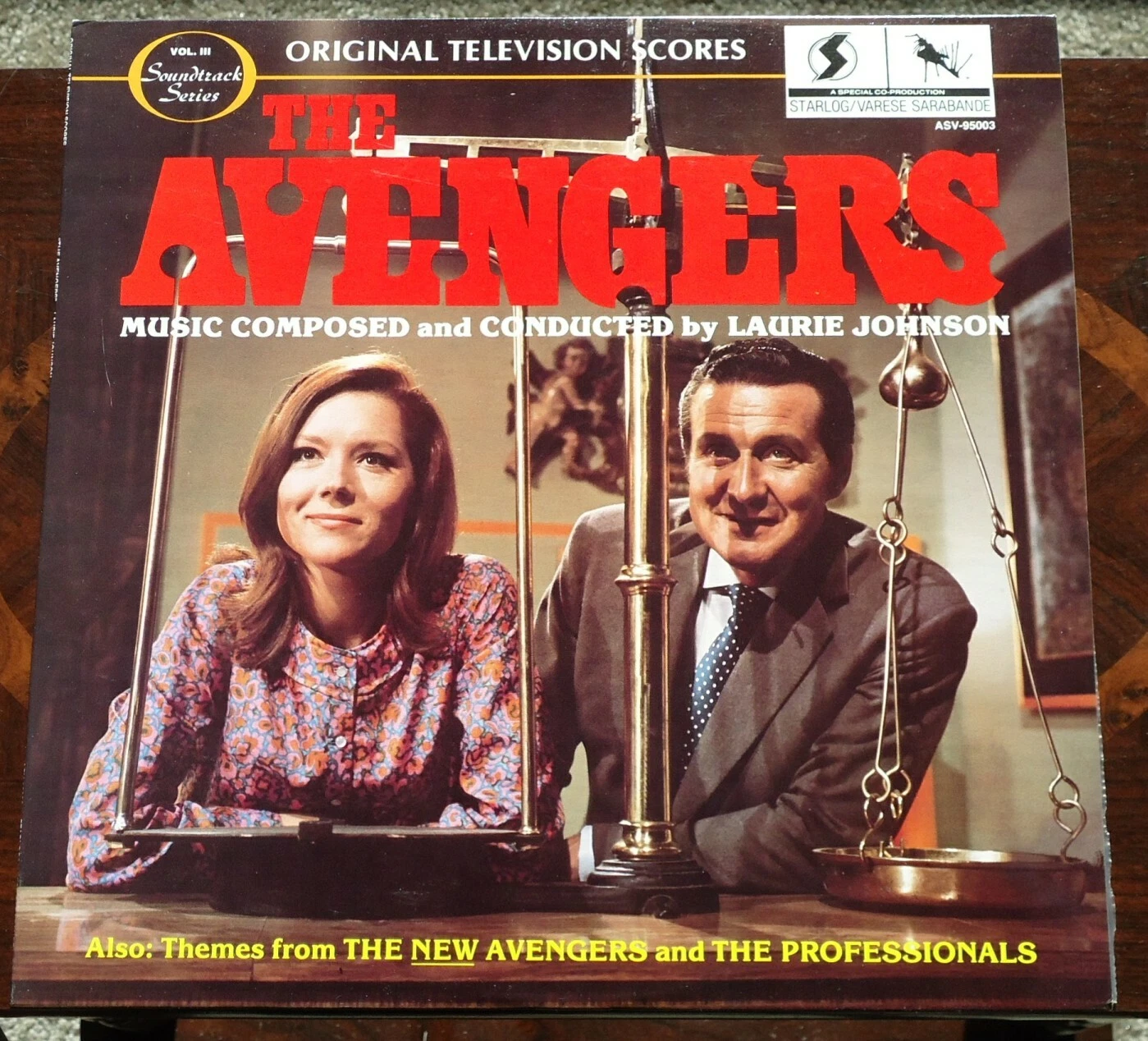
Film Albums: The Avengers Album


This month's film album is actually a compact disc album and it's an oldie and a goodie: The Avengers by the London Studio Orchestra. The cover states in big letters that it also includes themes from Dr. Strangelove, First Men in the Moon, etc... but Laurie Johnson's name is in small print at the bottom. The album really should have been called "The Music of Laurie Johnson" because it features a lovely sampling of some of his most popular themes. 

This was a Varese Sarabande release (VCD 47270) that implements songs from one of its Soundtrack Series LP releases from 1982 titled The Avengers. 


Of course, "The Avengers" theme is the highlight of the album but you don't want to miss hearing "The Joker" theme from the famous Emma Peel episode, or the lovely romance theme from "First Men in the Moon." The themes to "Hedda" and "Captain Kronos" are also worth listening to. 

Click here to listen to the album in full on Youtube. 


Track Listing


The Avengers - Suite

Theme 

Pandora

The Joker

The New Avengers - Suite

Theme 

Cat Amongst the Pigeons

Obsession

Tale of the Big Why

Dr. Strangelove

The Bomb Run

First Men in the Moon

Title

Moonscape and Descent

The Selenites

Trek to the Giant Doors

Monster Caterpillar

Eclipse and Staircase

Escape of the Sphere

End Title

Hedda - Suite

Title

Hedda and Thea

Judge Brack

Hedda and Lovborg

The Manuscript

Death and End Title

Captain Kronos, Vampire Hunter

Title

Death Duel

Top Picks: The Avengers, The Joker, First Men in the Moon main title, Hedda main title.

Saturday, May 18, 2024

Counter-Attack (1960)

A little-known fact of World War II history is that the German forces occupied the Channel Islands for five long years. We all know that stalwart English citizens such as Professor Emelius Brown and Eglantine Price helped to stave off coastal attacks from German troops, but how many of us know that nearly 20,000 Germans were parked only 80 miles from England's shore?


Whether this is news to you or not, you are sure to enjoy Counter-Attack, a wonderful seven-part children's miniseries that showed how three youths - Terry, Cliff, and Carol - reacted to the Nazi occupation of their homeland in 1940. 

Like most Brits, they instinctively knew to spit in the eyes of the Nazis. However, Terry (14-year-old Jeremy Bulloch) the eldest of the main characters, feels that tripping soldiers and throwing mud in their face isn't quite enough and so he decides to turn the children's club - the Argos - into a counter-attack unit of resistance. 

Hidden away in an old mill and armed with a crude radio set, the children plan out their attacks and then relay messages to British forces on the mainland. The British officers receiving these messages do not realize that the mysterious "Argo" are a group of children and so they tell them to be on the lookout for an agent that they will be sneaking onto the island at midnight. Their task is to hide him from the Nazis and aid him in destroying the German's ammunition dump. How exciting! Things get really hot to handle when Major Wolf (Joseph Furst) of the German army and his junior officer Kurt billets the house where the children are staying.

Counter-Attack was released on television in the U.K. in January of 1960...just twenty years after the occupation of the Channel Islands, so many viewers vividly remembered the experiences and feelings the characters were going through. While the series was aimed at children, it is entertaining for all ages. Cliff and Carol's older sister Jean (Etain O'Dell) has a slight romance with the agent (Oliver Neville) the children are hiding out and there is enough wartime excitement to keep the adults hooked. 

ITV producer Sidney Newman announced in a TV Times interview that "..if [the series] is one tenth as fantastic as the truth about the wartime occupation of the Channel Islands, I will be happy!" Well, he had much to be pleased about with Peter Ling's script even though Ling knew that the teatime adventure series would be "on the cautious side". Mary Field, the programme advisor, drew on her own experiences of growing up on the Channel Islands during the occupation and Ling wove these reminiscences into his script. 

All of the child actors do a good job with their parts, especially Jeremy Bulloch who did a number of children's series in the early 1960s but is probably best known for playing Boba Fett in the Star Wars franchise. Young Cliff (Murray Yeo) could be a handful at times, but that was what created most of the drama for the episodes' cliffhangers. Children aren't always as cautious as their parents would hope. 

Counter-Attack has not yet been released on DVD but is available for viewing online. 

Tuesday, February 6, 2024

Night Ferry (1976) - A CFF Film

An ancient Egyptian mummy is stolen from The British Museum and young Jeff (Graham Fletcher) witnesses the criminals carrying the mummy case to their hiding place at the railyards. He wants to go to the police but is afraid to since it would mean confessing that he trespassed on railway property while searching for his model plane. This dangerous act caused a railway worker to be injured. Instead, he recruits his two friends, Nick (Engin Eshref) and Carol (Jayne Tottman) to keep an eye on the master criminal known as Pyramid (Bernard Cribbins) and see if they can track down the mummy themselves.

Night Ferry was one of many Children's Film Foundations distributions released in the United Kingdom during the 1970s. This one is a cut above the rest since the criminals are not the usual bungling sort, although it still is very much juvenile fare. The location scenes around London's Victoria and Clapham stations are nice and the film clips along at a good pace. It actually builds up a fair amount of tension towards the climax when the criminals discover that the children are on their trail. 

Night Ferry was directed by David Eady and written by Michael Barnes who also teamed up to produce the film. This is one of several films that they made together for the Children's Film Foundation. The child actors do an adequate job, although young Jeff was a bit wooden. Bernard Cribbins (The Railway Children, Jackanory) stars as the criminal Pyramid, a master-of-disguise who arranges crimes to order. In this case, a private collector in France wants the mummy for his own collection so they are delivering him via the night ferry across the channel. 

Also in the cast is Aubrey Morris, Jeremy Bulloch and Carole Rousseau...whom some may recognize as the host of the BBC French instructional video course A Vous La France (1984).

Since Night Ferry is only one-hour long, it was later aired on television as one episode of the children's anthology series called Once Upon a Classic, hosted by Bill Bixby. It is currently available on DVD as one of three films on the BFI's Children's Film Foundation Collection "London Tales".

Sunday, March 26, 2023

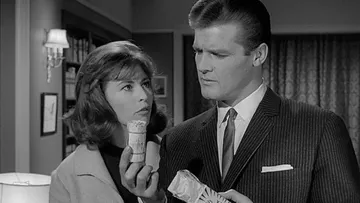
The Saint: The Miracle Tea Party ( 1964 )

Terence Canote, over at A Shroud of Thoughts is hosting The 9th Annual Favorite TV Show Episode Blogathon and our contribution to the event is an episode from the classic British action series The Saint, starring Roger Moore. It is hard enough to pick a favorite television show, let alone a favorite episode for this event, but whenever I think of favorite shows The Saint always comes to mind....and The Miracle Tea Party happens to be one of my favorite episodes ( of many ). 

The Saint was a one-hour series produced by ITV that first aired in 1962. Roger Moore played the suave Simon Templar, a former cat burglar who now works as a sort of private detective. Instead of working for pay, he simply likes to help people in distress ( "people" generally being pretty young women ). Since there is always a villain trying to gain something dishonestly, Simon usually thinks up a clever scheme to help his client, foil the villain, and collect a tidy reward for himself at the villain's expense. 

The Miracle Tea Party features Nanette Newman as the heroine in distress. She plays a nurse who witnesses a man being snuffed out in a phone booth at Waterloo Station. Templar happens to be making a phone call in the next booth and rushes to her aid. Alas, it is too late and the man is already dead. He works at the same naval base that Nurse MacLeod does and she was just talking to him prior to his death. To help calm the nerves of the lovely nurse, Simon offers to take her out to dinner. It is then, that they notice they are being followed. Later, at Simon's apartment, Ms. MacLeod finds a box of Miracle Tea in her purse and wonders where it came from. Simon thinks the dead man must have slipped it into her purse before he was murdered and that's why she is being followed. They open the package and find £500 rolled up inside. The package has a notice that states that if you listen to the Miracle Tea radio program you have a chance to win a prize, so they tune in and hear a series of numbers being read off. 

Simon and Ms. MacLeod then endeavor to discover what the numbers mean and what the £500 payoff money was doing in the Miracle Tea box....and what all of this has to do with the murdered man and the Portland naval base. 

The Miracle Tea Party was the premiere episode of the third season of The Saint, a season of some really good Saint episodes. Nurse MacLeod is an innocent victim who not only has the bad fortune of witnessing a murder but also having an item placed in her purse that the villains want. This is one of my favorite scenarios in a mystery thriller, one that Alfred Hitchcock also adored and used frequently in his films. 


The screenplay, by Paddy Manning O'Brine, was based on a 1938 novella by Leslie Charteris, the creator of
The Saint. Unlike some other Saint episodes, there really is no mystery for you to solve here, it is just a matter of watching Simon track down the culprit. But this in itself is enjoyable, especially when Simon befriends and recruits Aunt Hattie ( Fabia Drake ), a burly elderly woman who loves yachting and photography. She is a spunky grandmotherly type of woman who has the gruff manner of an old sea salt, which is probably why Simon takes to her from the onset. Fabia Drake was Roger Moore's former teacher at RADA and he invited her to appear in this episode of The Saint ( which he also directed ). She later returned in the fourth season in a similar role, that of Aunt Prudence in The Smart Detective


Another feature I enjoy about this episode is the sets, especially Aunt Hattie's house, which has a timber-framed cottage exterior while inside it resembles an old tavern with well-worn wooden beams, comfy sofas scattered about, and sailing ship models on display. This set reminds me of the interior of the seaside inn in The Old Treasure Story, another favorite episode of The Saint.

Most viewers will recognize some familiar British character actors such as Conrad Phillips ( Murder, She Said ), Basil Dingham, Charles Houston and Robert Brown, who is probably best known for taking over the role of M from Bernard Lee in the James Bond film series starring Roger Moore. 

If you enjoy this episode, then be sure to check out The Frightened Inn-keeper, also from season three of The Saint

Head on over to A Shroud of Thoughts to read more reviews of favorite TV show episodes from other bloggers. 

Saturday, January 28, 2023

Rentaghost ( 1976-1984 )

"If your mansion house needs haunting just call Rentaghost..." 

Growing up in England in the 1970s, you would no doubt remember Rentaghost, a children's show that had a delightful blend of punny humor and downright silliness, not to mention an unforgettable theme song! A ghost never dies....and neither does Rentaghost, which is now being introduced to newer generations through streaming on BritBox. 

The series was created and written by Bob Block ( who was also responsible for devising the equally silly Pardon My Genie and Robert's Robots ) and concerned a ghost rental agency, run by Fred Mumford ( Anthony Jackson ) a recently deceased young man.

Fred was a failure all of his life and, unfortunately, he dies before he can rectify that situation. Now that he is dead, he decides to start a business back on Earth to have a second chance at starting a successful enterprise. He creates Rentaghost, a ghost rental service "Poltergeists in your parlor? Don't suffer from lack of exorcise - send for us!"

To aid him in this new business, he recruits two other ghosts who were failures when they were on Earth - Mr. Hubert Davenport, a Victorian gentleman, and Mister Timothy Claypole, a medieval court jester who is now a mischievous poltergeist. This threesome tries its best to make Rentaghost a success, but each undertaking turns into a dismal failure by the end of the episode. 

Their landlord Mr. Meeker ( Edward Brayshaw ) knows that his tenants are a "bunch of flippin' layabout spooks!" and, in spite of being disgusted by their ineptitude, becomes their business manager and tries to dream up new ways for the gang to make money. Each week they try their hand at different enterprises - a moving service, taxi business, storage service, detective agency, etc. There is no shortage of occupations a ghost can undertake!

Most of the humorous situations in the series arise from the ghosts running out of "psychic energy" or teleporting themselves at the wrong time to the wrong places. Fred is particularly lousy when it comes to teleporting since he is relatively new to the ghosting process, having just been dead for six months. All he has to do is hold his head back and pinch his nose but he always ends up landing somewhere he shouldn't be....such as in a closet. This is particularly embarrassing when Fred visits his parents. He never had the heart to tell them that he died and so he tries to act normal but strange things happen when you are a spirit. His mother is especially worried about Fred's lack of appetite. "He always chucks away his food!" she tells his father, not knowing that ghosts don't eat. 

Occasionally, Mr. Davenport's own mother ( long since dead ) visits to scold her son. She is a young woman in her twenties. Even Mr. Davenport finds it unsettling to have a mother half his age but she died much younger than he so naturally she would not be older in the spirit world. Mr. Davenport is quite a gentleman and much of the ways of the modern world shock him...especially "pop" music and those "frightfully noisy aeroplanes". 

Mister Claypole is even more astounded by modern technology! Being from the middle ages, much of what he sees amuses him....like the box with the little people in it ( a TV set ) and the machine that talks back ( telephone ). Fred's modern lingo usually goes over his head and he tends to take everything said literally. When Fred tells him to help Mr. Meeker "move house", Mister Claypole moves his house....with Mr. Meeker in it!

Later in the series, Mister Claypole becomes the leading character and other ghosts are added to the cast, including Hazel McWitch, Miss Popov and a pantomine horse called Dobbin. Unfortunately, beyond the fifth season, Rentaghost became rather childish and it no longer had its sitcom structure. 

The principal actors all do a grand job of getting "into the spirit" of their characters. Anthony Jackson is especially appealing as the clumsy Fred Mumford. When Michael Darbyshire ( Mr. Davenport ) passed away in 1979, Jackson did not want to continue the series without him and so both characters were written off the series. They were said to be on an extended tour haunting the stately homes of England. 

In fact, all three lead actors have since passed on. Darbyshire died at the age of 62, Michael Staniforth ( Claypole ) at the age of 44, and Jackson at the age of 62. Even Edward Brayshaw ( Mr. Meeker ) died at the age of 57, so none of the original cast members are alive today. Perhaps the spirit world did not look kindly upon this playful spook sitcom. 

Rentaghost ran for a total of 9 series, beginning in 1976. The show only had 5-6 episodes per series, so there are not as many episodes as one may expect to find. BBC destroyed the few episodes that were made when, in the late 1990s, they wiped ( taped over ) many of their children's programming videotapes, discounting the programs as "low priority". Thankfully, the television station UK GOLD were airing episodes of Rentaghost at the time and had backup copies. 

Memorable as the characters may have been to youngsters, even more memorable is the Rentaghost theme song, written and performed by none other than Michael Staniforth himself. It's a catchy jingle that perfectly captures the light-hearted "spirit" of the show. 

Click here to have a listen to the theme.....and here to view one of the episodes. 

Saturday, October 22, 2022

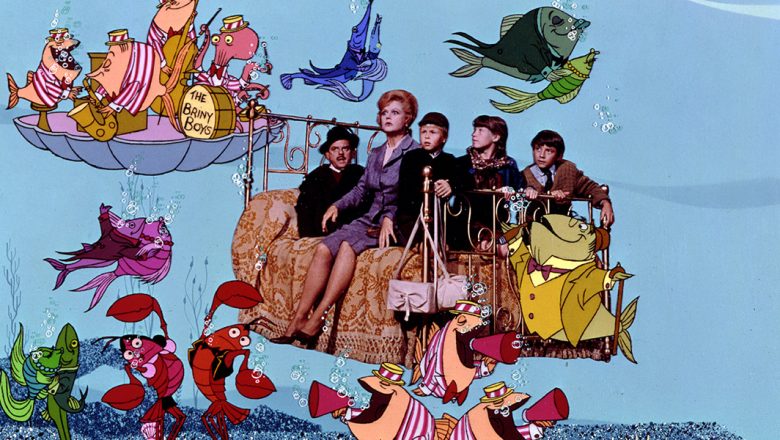
Check it Out! - Preparing for Bedknobs and Broomsticks

On October 7, 1971, Walt Disney's Bedknobs and Broomsticks, a delightful and magical musical starring the late great Angela Lansbury and David Tomlinson, had its world premiere in London. Earlier that day, John Noakes, the host of Britain's popular children's series Blue Peter, was in Leicester Square, helping the owner of the famed Odeon Theater prepare for this event. 

It takes quite a bit of doing to hang up those large BEDKNOBS letters outside the theater, not to mention suspending from the roof the lifesize mockup of Angela Lansbury as the witch Eglantine, so it is hard to believe that they undertook this task the very morning of the premiere! John was his usual brave self and climbed up those amazingly long ladders with ease. Check out the clip here: 

BBC Archive - Bedknobs and Broomsticks ( 1971 )

Unlike most Disney-related promo clips, this one did not follow up the news bit with footage from the film. I was hoping to find some newsreel clips of the actual premiere but had no luck, so you will just have to imagine what it was like that evening. 

Sunday, October 16, 2022

Orson Welles' Great Mysteries

Orson Welles always loved a scary tale. In 1938, he and other players of his Mercury Theater company put on a radio play of H.G. Wells' "War of the Worlds" for Halloween that scared the heebie-jeebies out of most of his listeners. Then in 1951, while taking a break from filming Othello in Ireland, he filmed a short horror film called Return to Glennascaul about a man who unknowingly gives two ghosts a ride on a deserted country road. 

While most of his films steered clear of horror or suspense, he delved deep into the muddy waters of mystery in 1973 when he played host to a British anthology series entitled Orson Welles' Great Mysteries. The series was very similar to the classic Alfred Hitchcock Presents and, like Hitchcock, Orson Welles merely had to act as host, introducing and closing each episode with some pithy words. Unlike Alfred Hitchcock Presents, the episodes of Great Mysteries were all based on famous works or short stories by authors like Sir Arthur Conan Doyle, Wilkie Collins, Honoré de Balzac, and Charles Dickens. 

Orson Welles had a long career as a director, producer, screenwriter, and actor, but by the early 1970s he was in debt ( owing money to the IRS for back taxes ) and, unable to fund his latest docudrama F for Fake, he began to do numerous television appearances to help raise money. In the early months of 1973, he crossed the pond to England to film the intros/outros to the series at the Anglia Television studios in Norwich ( East Anglia ).

Welles was known to be a difficult person to work with and the production team at Anglia studios found this to be true ( in fact, the Sky Arts series Urban Myths made an entire episode in 2020 about his visit called "Orson Welles in Norwich" ). Nevertheless, he gave a marvelous performance as a mystery host. He donned a black cape and hat and, purring sardonic wit, he beautifully introduced each tale of the macabre in his deep silky voice. 

Orson Welles' Great Mysteries ran for two seasons with a total of 26 episodes being produced. Some of the titles included were "The Monkey's Paw", based on the short story by W.W. Jacobs, and "La Grande Breteche" by Honoré de Balzac. What made the episodes entertaining was all of the stories selected had unexpected endings, usually with a sting.

John Barry composed a haunting but typically 70s theme for the series ( it could have worked equally well for a James Bond and the Haunted House film ) and the episodes were similarly chilling like other popular British anthology series of the time ( namely Brian Clemens' Thriller and Hammer House of Horror ) but not nearly as violent or gory. 

With a 25-minute runtime, the tales entertained without getting boring. Plus, there was the added bonus of playing spot the actor with each episode featuring numerous British character actors plus acting legends such as Eli Wallach, Joan Collins, Christopher Lee, Richard Johnson, Claire Bloom, Peter Cushing, Jane Seymour, Dean Stockwell, Jose Ferrer, and Shirley Knight. 

Network Distributing released the entire Orson Welles Great Mysteries on DVD in two volumes.

Sunday, July 31, 2022

Masters of Venus ( 1962 )

Before America became stricken with space fever in the mid-1960s, Britain was already coming down with symptoms of this consuming affliction. Evidence in proof of this can be seen in television and film series of the era, especially those aimed at youngsters. 

One such program was Masters of Venus, an 8-part science-fiction serial that was released between September 1962 and November 1962 throughout the UK. It was an engrossing serial that was shown in theaters on Saturday mornings, usually before a matinee feature, in 16-minute parts.  

Masters of Venus was a production of the CCF ( Children's Film Foundation ), which produced a number of serials like this in the late 1950s and 1960s. The story is about a team of scientists who are preparing to launch a rocket - Astarte - to Venus. One day two saboteurs break into the rocket center in an attempt to destroy the Astarte, but they were thwarted in their plans by Jim and Pat, the two intelligent children of the rocket's inventor, Dr. Ballantyne ( Norman Wooland ). The pilots are knocked unconscious and, unbeknownst to the children, the rocket is prematurely sent into outer space - with them in the capsule! 

Like most Saturday morning serials, every episode ends with a cliffhanger, and Masters of Venus has some jim-dandy ones. The pilots ( Patrick Kavanagh, Robin Hunter ) revive in time to set Astarte's course to Venus, but once they land on the planet they discover it to be inhabited by rather hostile Venusians, who are actually a band of super-advanced survivors of the ancient kingdom of Atlantis. 

The plot may seem far-fetched and the sets and "scientific procedure" rather simple, but the series is very entertaining to watch, especially for children. The principal actors all do a wonderful job of making the story seem real. Robin Stewart, who portrays young Jim, went on to become a popular actor in the UK on television ( Bless This House ) and in films ( The Legend of the 7 Golden Vampires ). Mandy Harper, who plays Pat, was a child actress who had a number of uncredited roles in films of the 1950s. The same year she filmed Masters of Venus she starred in Swallows and Amazons based on Arthur Ransome's famous novel.