Showing posts with label Dame May Whitty. Show all posts

Thursday, August 11, 2016

My Name is Julia Ross ( 1945 )

Quiggy, of The Midnite Drive-In, is hosting The Film Noir Blogathon this week, celebrating those atmospheric black and white thrillers commonly known as "noirs". 

Noirs have long been a favorite genre of classic film fans, most likely because it was a style of filming that is no longer seen in films today. Noirs were a short-lived genre. They originated in the late 1930s, were perfected throughout the 1940s, and then petered out by the late 1950s. However, within that twenty year span nearly 750 noirs were released, many of which are counted among the best films ever made.

We would like to turn the spotlight on My Name is Julia Ross ( 1945 ) which was certainly one of the best film noirs to come out of Columbia's B-movie unit. It was a Gothic thriller along the lines of Gaslight with an equally engrossing script, a great cast ( Dame May Whitty adds prestige to any film she appears in ), and remarkable production values, especially considering its budget. 

Nina Foch stars as Julia, an unemployed London secretary, who is hired to become a live-in assistant to a kindly old lady ( Whitty )....or so she was told. In truth, she was hired because of her amazing resemblance to Marion, the dead wife of the old gal's psychotic son Ralph, portrayed with aloof malevolence by the scar-faced George Macready. Mother and son are plotting to convince the town that Marion is still alive, but has gone mad, and is on the brink of committing suicide. 

"You haven't forgotten us again, have you, Marion?"
My Name is Julia Ross was directed by Joseph H. Lewis who was an old hand at cranking out low-budget westerns on a weekly basis for studios such as Universal, RKO, and Monogram. Lewis viewed each production he was assigned as a chance to hone his directorial skills and experiment with lighting, camerawork, framing, and other stylistic devices. During the mid-1940s, Columbia began a "fewer and better" B-movie initiative with a bigger budget ( $200,000 ) and a shooting schedule of 12 days, twice as long as the average western that Lewis was accustomed to filming. 
When Lewis first read the script to the film he knew he had a gem in the making, and so, with such time and resources at hand, he made the most of his experience and lavished his attention on creating a stand-out B-noir. The result was striking. Like most noirs, Lewis builds on the suspense of the film visually using dramatic camerawork and compositions filled with shadows to create a sinister atmosphere. 

"Why try to save her? Let her die. That's what we want." - Ralph
"Don't be stupid, Ralph. If she's taken poison, we must act as though we cared." - Mama

B-movie productions done well always seem more impressive than full-length features because, like a short story, there is no room for wasted words or action. The editing is measured precisely and each scene counts towards furthering the story. My Name is Julia Ross certainly packs a punch in its brief 65 minute run-time. It also offers a foretaste of Lewis' later work, which included two more classic noirs - Gun Crazy ( 1950 ) and The Big Combo ( 1955 ). 

The preview footage of My Name is Julia Ross impressed the front office at Columbia so much that they decided to release the film as a top-of-the-bill feature. It was a wise decision because the picture earned nearly $4,000,000 in box-office returns. 

Be sure to head on over to The Midnite Drive-In to check out more reviews of famous film-noirs through the ages. 

Sunday, September 7, 2014

TV/Movie Set : Lassie Come Home ( 1943 )

For this month's featured TV/Movie set we chose the classic Lassie Come Home, not because it's a particularly noteworthy bit of set design, but rather because the movie has two oh-so-cute cottages....and because we happened to have a 'hole bunch o' loverly screenshots handy. 

The Fadden's Cottage

Lassie Come Home was the very first of the Lassie films and it was such a success upon its release that Metro-Goldwyn-Mayer made the collie a star of the studio and featured her in a series of pictures : Son of Lassie, Courage of Lassie, Hills of Home, The Sun Comes Up, Challenge to Lassie and The Painted Hills.

The Carraclough Cottage

Like a lot of other Hollywood canine stars, Lassie wasn't her real name and actually - gasp! - she was not a she but a he named Pal. Pal won the role after a nationwide search and played in the next five Lassie pictures, being admirably trained by his owner, Rudd Weatherwax. Pal's long line of heirs continued the Lassie acting tradition for him up until the late 1980s. Incidently, Rudd Weatherwax is one member of a large family of animal trainers and is the uncle of Ken Weatherwax, who is best known for playing Pugsley on The Addams Family television show.

Inside Lassie's home

Lassie Comes Home is undoubtedly the best of all the pooch's films and its simple story was often times remade by a number of studios in the coming years. In this film Lassie follows her beloved master, Joe Carraclough ( Roddy McDowall ) to school everyday and waits outside the schoolhouse at 4pm precisely, when Joe leaves school, to walk home with him. Everyone in the village knows what time it is when they see dear Lassie pass by. Her internal clock never fails her. Of course, her being a big dog makes her have a big appetite and Joe's parents ( Donald Crisp and Elsa Lancaster ) just don't have the money to support her, let alone themselves, being as poor as they are. 

Outside Lassie's home

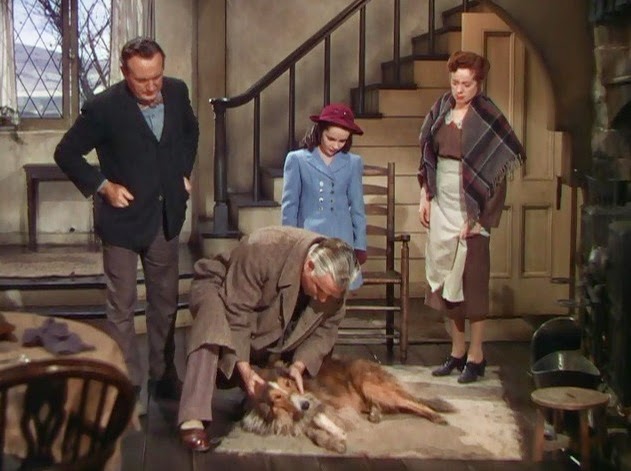
So to solve this situation they sell Lassie to a kindly dog breeder, the Duke of Rudling, ( Nigel Bruce ) who takes her off to Scotland to groom for some upcoming shows. Lassie doesn't enjoy the duke's idea of prime accommodations however and decides to hike back to his master - it being only several hundred miles to home. On route to Yorkshire he meets a few kind souls who sustain him on his journey, one of them being Rowlie the "pots" man ( played by the adorable Edmund Gwenn ) and the Faddens, Daniel and Dally Fadden ( Ben Webster and Dame May Whitty ).

Who would sell a dog that can curtsy?
Pal was a real ham when it came to acting and - viewer beware - you need a good pile of kleenexs on hand to watch this film. If Academy Awards were given to animals then Lassie would have earned one hands down ( I mean, paws down ) for his performance here.
What a ham!

Like most MGM films of the 1930s-1950s, Cedric Gibbons was billed as the art director with Edwin B. Willis handling the set decoration. Gibbons and Willis had a particular flair for creating old and weather-worn sets and the both the Clarracough and Fadden cottages have the look of being handed down from generations past. 


As poor as Lassie's family was it looks as though they lived in a bigger cottage than the Faddens for they had two bedrooms, with Joe having a room of his own upstairs. Downstairs there was only the main room, a country kitchen with fireplace and a round dining table which doubles as a desk for homework and sewing work.

In the Fadden cottage there is the main room as well with a door leading to the kitchen or possibly to the bedroom. It couldn't be more than 800 square feet and yet how comfortable a home it is! Just the right size. For a couple and a dog, that is....


Another bit of interesting trivia : Ben Webster and May Whitty were husband and wife in real life and you can see their comradery in their scenes together. Reminds us of that other great acting couple, Stringer Davis and Margaret Rutherford. 


After they rescue the poor wee dog during a rainstorm, Dally asks her husband to bring her some milk to feed Lassie with and we get to hear this wonderful bit of dialogue : 

"That's the last of the milk Dally. Won't be any for your tea tomorrow morning"

"It won't matter Dan. I often think we do things just from habit. In America they say that they always drink their tea without milk"

"Well.... that's because they haven't learned any better"

Tsk, tsk, tsk...those Americans are something else. Can't even drink a cup of tea properly!


It's a wonder no one has undertaken to build retirement homes of this size for elderly ( or newlywed ) couples. Although with the amount of "stuff" most people have these days, this size home wouldn't even be big enough to store what the average person has in their garage. 

Thursday, November 7, 2013

Dame May Whitty - What a Character! Blogathon


Dame May Whitty was a delightful character actress of numerous first-class productions of the late 1930s and 1940s. Typically playing a distinguished aunt, mother, grandmother, or dowager, her presence brought an authentic English air to any film....possibly even more so than Gladys Cooper. Proud, gentle, kindly, and altogether charming, she was indeed the ideal symbol of British dignity. 

Dame May Whitty was born on June 19, 1865 in Liverpool, England, the daughter of a newspaper journalist/editor. Her first encounter with the world of acting was in a stage production of The Mountain Sylph at the court theatre in Liverpool. She was sixteen years old and danced in the chorus. Within a year, she made her London stage debut and quickly became a seasoned performer. By the turn of the century she was well-known on both sides of the Atlantic. 

In 1918, she was created a Dame Commander of the British Empire ( being the first actress to receive that honor ) for her philanthropic services with the Red Cross during The Great War. Always willing to serve a good cause, she displayed her selfless service again by helping out for the war effort during World War II. She also appeared in Forever and a Day and Stage Door Canteen, both made to boost morale and the sales of war bonds. Even upon her death her will requested that rather then giving flowers at her funeral the money should be used to send CARE packages to England. 


Whitty was busy across the pond and on Broadway during the 1920s and 30s, and it was in 1932 that she was offered the co-starring role in Emlyn William's new play, "Night Must Fall." Reluctant at first to accept the role of the wheel-chair bound, chocolate-loving old lady who is beguiled by a psychopathic killer, it was to become one of her best performances. The show was a great success in England, and she reprised the role on Broadway and once again in 1937 for the MGM film of the same name opposite Robert Montgomery. At the tender age of 72 she made her Hollywood film debut. Her first experience in front of the cameras was a happy one, one which she enjoyed immensely. However, there was one sequence she had trepidation over - toward the end of the film, Whitty had to play a two-and-a-half-minute scene of rising tension, culminating in hysteria. She suggested to director Richard Thorpe that she do a run-through, just to show him what she had done in the play and then he could tell her what to do for the camera. But he didn't...he simply shot the scene as it was, unbroken and unaltered, in a single take. This earned her the title of "One-take Whitty". 

It was a magnificent performance altogether and she received an Academy Award nomination as Best Supporting Actress. Thus began a wonderful career as a supporting actress in many fine productions for MGM and other studios. 


In 1937, she played the medium in MGM's The Thirteenth Chair and the next year starred in her most memorable role, that of charming old Miss Froy, an espionage agent who mysteriously disappears onboard a train while returning home to England, in Alfred Hitchcock's The Lady Vanishes

In 1940, Dame May was asked if she thought of retiring, 

"Quit? Only the aged and infirm quit, and I am neither. So long as I can do my bit, I'll keep right on doing it." 


In the early 1940s, she reached the peak of her film productivity and played in a number of fine films for MGM and other studios...in Raffles ( 1940 ) she played the Lady Kitty Melrose whose diamonds are stolen by the renowned Amateur Cracksman; in Suspicion ( 1941 ) she played Joan Fontaine's mother, and in Mrs.Miniver ( 1942 ) she was Lady Beldon, the perennial winner of the town's annual rose competition, and aunt to Teresa Wright. 

In this film Whitty demonstrated her flair for portraying characters with multiple facets of emotion. In the beginning of Mrs. Miniver we see Lady Beldon engaging with various characters in conversation and freely donating her blunt opinions to each of them. Whitty had a masterful way of unloading carefully timed barbs in such a direct manner while retaining her cuddly lovable cantankerous self. It is as the film progresses however that her depth of character is revealed. Lady Beldon is a crusty coconut, hard and bristly on the outside and sweet and milky within, and one by one the layers of her shell are peeled away to reveal this inner nature...first, by the kindly Mrs. Miniver, and then by the brutal circumstances of war. This performance earned May Whitty her second Academy Award nomination. 


For a change from her more usual high-society roles, she played the down-to-earth Dolly ( her real-life husband Ben Webster played her spouse in the film ) in Lassie Come Home; she was the elderly villager of Penny Green in If Winter Comes ; and in The White Cliffs of Dover ( 1944 ) she played the lovable governess Nanny. Gaslight saw her returning to her prestigious roles, this time as Ingrid Bergman's garrulous neighbor on Thorton Square. 


In the thriller My Name is Julia Ross Whitty had an usually biting role as the wealthy mother who tries to convince secretary Nina Foch that she was her son's wife, and in Green Dolphin Street she did a complete reversal and magically transformed herself in the wise Mother Superior for Donna Reed. 

In 1947 her husband of 55 years, Ben Webster, passed away. Dame May Whitty made the films The Sign of the Ram ( with Susan Peters ) and The Return of October that year but had to be replaced by Lucille Watson in Julia Misbehaves due to illness. 

On May 29, 1948 she died at the age of 82. Many of Hollywood's British colony friends attended the funeral including C.Aubrey Smith, Edmund Gwenn, Herbert Marshall, Brian Aherne and Boris Karloff. 

Her daughter Margaret Webster was a famous actress herself as well as a notable stage producer and director and in 1969 she wrote an autobiography, "The Same Only Different", covering both her and her mother's careers.


This post is our contribution to the What a Character! blogathon, a celebration of some of the most talented actors in Hollywood, the beloved "character actors". Don't miss visiting Once Upon a Screen or Paula's Cinema Club to view a complete schedule and find links to great posts on nearly fifty other great character actors.