Showing posts with label Elsa Lanchester. Show all posts

Wednesday, November 5, 2025

The Spiral Staircase (1946)

Few thrillers have ever wrapped terror in such beauty as Robert Siodmak's The Spiral Staircase (1946). Adapted from Ethel Lina White's novel "Some Must Watch", it is one of the crown jewels of the "old dark house" tradition. 

The story takes place in 1916 in a quiet New England village that is shaken by a killer who is stalking women he deems "imperfect." Inside the great Warren mansion, the latest potential target, Helen Capel (Dorothy McGuire), a young mute servant girl, tends to her bedridden employer Mrs. Warren (Ethel Barrymore), unaware that danger lurks within the corridors of the house she calls home. 

Director Robert Siodmak, fresh from his work at Universal, infused the picture with the eerie elegance of German Expressionism. His camera glides through the Warren house teasing us with glimpses of views through mirrors and banisters, as though we were the unseen watcher. The most iconic frame of the film is undoubtably his close-up of the killer's eye and its reflection of the titular staircase. 

Dorothy McGuire gives a remarkable delicate performance as Helen. One forgets her muteness entirely, instead we sense her vulnerability and every thought of fear through her expressions alone. The grand old dame Barrymore gives a barnstorming turn as the sharp-tongued ailing dowager, a role which earned her an Academy Award nomination. George Brent and Gordon Oliver are each cloaked in just enough mystery to keep the viewer guessing, while Kent Smith lends a touch of romance to the proceedings as the young Dr. Parry who is anxious for Helen to regain her speech. The always appealing Rhonda Fleming costars as Mr. Warren's secretary; Elsa Lanchester brings some tipsy humor to the household gloom, and Sara Allgood and Rhys Williams round out the cast of servants. 

Visually, the film is a feast. Nicholas Musuraca's cinematography - that deep-focus chiaroscuro he perfected in Cat People and The Seventh Victim - breathes life into Albert D'Agostino's rambling and gloomy Victorian sets. 

The mystery itself may not stump many modern viewers, but The Spiral Staircase was never about surprise...it is about suspense - that exquisite tightening of the nerves as Helen's silence grows unbearable. In its refinement and restraint, The Spiral Staircase anticipates the psychological thrillers of decades to come and remains a Gothic masterpiece preserved on celluloid.

Monday, November 7, 2016

The Secret Garden ( 1949 )

"Aye, I know wha' tis said. He locked the gate and buried the key, and nary's been in there since."

A secret garden. It has been locked up for years and is now overgrowing with weeds and bramble for want of anyone to tend to it. When the young orphan Mary Lennox first discovers this enchanted place at the estate of her uncle, she views the garden as an amusing diversion from her loneliness and boredom, but she soon finds that the key that unlocked its door may hold the answer to unlocking the buried secret in her uncle's past. 

The Secret Garden was based upon a 1910 novel by the beloved children's book author Frances Hodgson Burnett. To this day it remains her most popular book, along with "Little Lord Fauntleroy" and "The Little Princess", all of which were adapted to film numerous times over the years. The enduring popularity of these stories can be attributed to Burnett's flair for writing about story elements that children find appealing such as mysterious passageways, orphans from exotic lands, strange characters, locked doors, and hidden gardens. Her stories also consistently featured children as the heroes.


Mary Lennox (portrayed by Margaret O'Brien) is a strange heroine, however, for a book or a film. She is bratty and spoiled having been accustomed to servants waiting on her hand and foot in India. After her parents die from cholera, she is shipped off to England to reside in an oppressive mansion with her uncle, Lord Archibald Craven (Herbert Marshall), a bitter brooding man. Each night Mary hears a screaming voice echoing through the myriad hallways. The servants attempt to quench her curiosity, explaining it simply as "the wind howling from the moors", but Mary finds that they are coming from the bedchamber of a small boy, Colin Craven (Dean Stockwell), her uncle's son. From constant coddling, Master Craven has become an invalid and, believing that he will grow into a hunchback one day, finds living futile. Mary finds her match in Colin because he, too, is spoiled and prone to screaming tantrums. It is only after Mary befriends Dickon, a neighbor boy, and discovers the secret garden, that she learns to find contentment in the simple pleasures of life. 
The Secret Garden is a Clarence Brown production and his visual style is evident throughout the film, but most of the credit for the quality of the film should be given to director Fred Wilcox who established a wonderful moody atmosphere through great use of light and shadow. As an added touch, a Technicolor sequence was utilized to give that extra emotional punch, while the beautiful Cedric Gibbons sets bring the story to life in a fashion that even location filming could not have equaled. 

Metro-Goldwyn-Mayer excelled at adapting novels to lush film productions and, like most of their output in the late 1940s, The Secret Garden featured some of the best talent to be found in Hollywood, both in front and behind the camera. Those tried-and-true child actors, Dean Stockwell and Margaret O'Brien, were excellent in their roles, as was newcomer Brian Roper in the part of Dickon (interestingly, he was 20 years old at the time). 

The adult roles are so well cast that one tends to forget that they are mostly caricatures: Dame Gladys Cooper as the stern housekeeper; Elsa Lanchester as the irrepressibly happy maid; dour Reginald Owen as the old nosy gardener. Even the small cameo performances sparkle with Metro's character talents: Billy Bevan as an overheated British soldier in India; Dennis Hoey as Marshall's stern valet; Aubrey Mather and George Zucco as young Stockwell's doctors; and Norma Varden as his wise nurse.

Sunday, September 7, 2014

TV/Movie Set : Lassie Come Home ( 1943 )

For this month's featured TV/Movie set we chose the classic Lassie Come Home, not because it's a particularly noteworthy bit of set design, but rather because the movie has two oh-so-cute cottages....and because we happened to have a 'hole bunch o' loverly screenshots handy. 

The Fadden's Cottage

Lassie Come Home was the very first of the Lassie films and it was such a success upon its release that Metro-Goldwyn-Mayer made the collie a star of the studio and featured her in a series of pictures : Son of Lassie, Courage of Lassie, Hills of Home, The Sun Comes Up, Challenge to Lassie and The Painted Hills.

The Carraclough Cottage

Like a lot of other Hollywood canine stars, Lassie wasn't her real name and actually - gasp! - she was not a she but a he named Pal. Pal won the role after a nationwide search and played in the next five Lassie pictures, being admirably trained by his owner, Rudd Weatherwax. Pal's long line of heirs continued the Lassie acting tradition for him up until the late 1980s. Incidently, Rudd Weatherwax is one member of a large family of animal trainers and is the uncle of Ken Weatherwax, who is best known for playing Pugsley on The Addams Family television show.

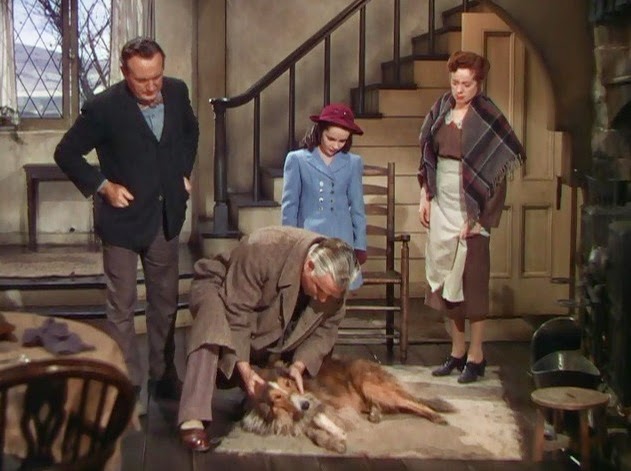
Inside Lassie's home

Lassie Comes Home is undoubtedly the best of all the pooch's films and its simple story was often times remade by a number of studios in the coming years. In this film Lassie follows her beloved master, Joe Carraclough ( Roddy McDowall ) to school everyday and waits outside the schoolhouse at 4pm precisely, when Joe leaves school, to walk home with him. Everyone in the village knows what time it is when they see dear Lassie pass by. Her internal clock never fails her. Of course, her being a big dog makes her have a big appetite and Joe's parents ( Donald Crisp and Elsa Lancaster ) just don't have the money to support her, let alone themselves, being as poor as they are. 

Outside Lassie's home

So to solve this situation they sell Lassie to a kindly dog breeder, the Duke of Rudling, ( Nigel Bruce ) who takes her off to Scotland to groom for some upcoming shows. Lassie doesn't enjoy the duke's idea of prime accommodations however and decides to hike back to his master - it being only several hundred miles to home. On route to Yorkshire he meets a few kind souls who sustain him on his journey, one of them being Rowlie the "pots" man ( played by the adorable Edmund Gwenn ) and the Faddens, Daniel and Dally Fadden ( Ben Webster and Dame May Whitty ).

Who would sell a dog that can curtsy?
Pal was a real ham when it came to acting and - viewer beware - you need a good pile of kleenexs on hand to watch this film. If Academy Awards were given to animals then Lassie would have earned one hands down ( I mean, paws down ) for his performance here.

What a ham!

Like most MGM films of the 1930s-1950s, Cedric Gibbons was billed as the art director with Edwin B. Willis handling the set decoration. Gibbons and Willis had a particular flair for creating old and weather-worn sets and the both the Clarracough and Fadden cottages have the look of being handed down from generations past. 


As poor as Lassie's family was it looks as though they lived in a bigger cottage than the Faddens for they had two bedrooms, with Joe having a room of his own upstairs. Downstairs there was only the main room, a country kitchen with fireplace and a round dining table which doubles as a desk for homework and sewing work.

In the Fadden cottage there is the main room as well with a door leading to the kitchen or possibly to the bedroom. It couldn't be more than 800 square feet and yet how comfortable a home it is! Just the right size. For a couple and a dog, that is....


Another bit of interesting trivia : Ben Webster and May Whitty were husband and wife in real life and you can see their comradery in their scenes together. Reminds us of that other great acting couple, Stringer Davis and Margaret Rutherford. 


After they rescue the poor wee dog during a rainstorm, Dally asks her husband to bring her some milk to feed Lassie with and we get to hear this wonderful bit of dialogue : 

"That's the last of the milk Dally. Won't be any for your tea tomorrow morning"

"It won't matter Dan. I often think we do things just from habit. In America they say that they always drink their tea without milk"

"Well.... that's because they haven't learned any better"

Tsk, tsk, tsk...those Americans are something else. Can't even drink a cup of tea properly!


It's a wonder no one has undertaken to build retirement homes of this size for elderly ( or newlywed ) couples. Although with the amount of "stuff" most people have these days, this size home wouldn't even be big enough to store what the average person has in their garage.