Showing posts with label Suspense. Show all posts

Wednesday, November 5, 2025

The Spiral Staircase (1946)

Few thrillers have ever wrapped terror in such beauty as Robert Siodmak's The Spiral Staircase (1946). Adapted from Ethel Lina White's novel "Some Must Watch", it is one of the crown jewels of the "old dark house" tradition. 

The story takes place in 1916 in a quiet New England village that is shaken by a killer who is stalking women he deems "imperfect." Inside the great Warren mansion, the latest potential target, Helen Capel (Dorothy McGuire), a young mute servant girl, tends to her bedridden employer Mrs. Warren (Ethel Barrymore), unaware that danger lurks within the corridors of the house she calls home. 

Director Robert Siodmak, fresh from his work at Universal, infused the picture with the eerie elegance of German Expressionism. His camera glides through the Warren house teasing us with glimpses of views through mirrors and banisters, as though we were the unseen watcher. The most iconic frame of the film is undoubtably his close-up of the killer's eye and its reflection of the titular staircase. 

Dorothy McGuire gives a remarkable delicate performance as Helen. One forgets her muteness entirely, instead we sense her vulnerability and every thought of fear through her expressions alone. The grand old dame Barrymore gives a barnstorming turn as the sharp-tongued ailing dowager, a role which earned her an Academy Award nomination. George Brent and Gordon Oliver are each cloaked in just enough mystery to keep the viewer guessing, while Kent Smith lends a touch of romance to the proceedings as the young Dr. Parry who is anxious for Helen to regain her speech. The always appealing Rhonda Fleming costars as Mr. Warren's secretary; Elsa Lanchester brings some tipsy humor to the household gloom, and Sara Allgood and Rhys Williams round out the cast of servants. 

Visually, the film is a feast. Nicholas Musuraca's cinematography - that deep-focus chiaroscuro he perfected in Cat People and The Seventh Victim - breathes life into Albert D'Agostino's rambling and gloomy Victorian sets. 

The mystery itself may not stump many modern viewers, but The Spiral Staircase was never about surprise...it is about suspense - that exquisite tightening of the nerves as Helen's silence grows unbearable. In its refinement and restraint, The Spiral Staircase anticipates the psychological thrillers of decades to come and remains a Gothic masterpiece preserved on celluloid.

Saturday, October 12, 2019

Rome Express ( 1932 )

"Romance and Adventure Roaring Through the Night!"

A valuable Van Dyck painting has been stolen from an art museum in Paris and the thief (Conrad Veidt) is onboard the Rome Express heading to Italy. This sinister criminal is in search of a Mr. Poole (Donald Calthrop, Blackmail) who snatched the painting from him in an attempt to double-cross him. 

There is also a motley band of characters onboard the train whose lives will all intertwine with this criminal during the course of their journey to Rome. There is Asta Marvelle (Esther Ralston) a beautiful American movie star; Alistair McBain (Cedric Hardwicke) a millionaire philanthropist who is traveling with his secretary Mills (Eliot Makeham); a pair of adulterous lovers (Harold Huth and Joan Barry); a golfing bore (Gordon Harker); and a beetle-hunting police chief (Frank Vosper). 

Rome Express was one of the very first thrillers set on a train and it inspired a number of similarly themed films, including Alfred Hitchcock's The Lady Vanishes (1935). Walter Forde beautifully directed this taut little picture and utilized a number of innovative filming tricks including long panning shots and fast cuts between scenes, but what makes it truly stand out is its snappy dialogue by Frank Vosper and Sidney Gilliat who, not surprisingly, also penned the scripts to The Lady Vanishes and Night Train to Munich (1940).
Rome Express speeds along at a fast pace and is never tiresome. The ending could have been tied up a little more snugly but on the whole, it is good entertainment. The interactions between the various characters, most of whom are strangers to one another, drive the story forward and in this respect, Rome Express is similar to The Ghost Train (1931), which, not surprisingly, was also directed by Walter Forde. 

Conrad Veidt, who was making his English-speaking debut, is devilishly charming as the villain while Cedric Hardwicke is entertaining to watch as the penny-pinching philanthropist who delights in being demeaning to his secretary Mills. Also in the cast is Hugh Williams and Finlay Currie.
Rome Express is currently available on DVD and Blu-Ray through Network Distributing. 

Thursday, January 17, 2019

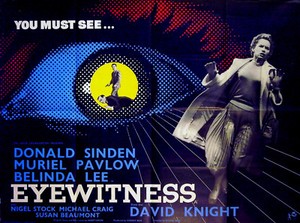
Eyewitness ( 1956 )

"A young woman lies dangerously ill in a hospital bed. Concealed in the shadows outside her window is a ruthless killer, ready to murder again to silence this woman, the only eyewitness to his crime..." 

So reads the press release to Eyewitness, a grand little thriller from Rank Studios. It was a Muriel Box film produced by her husband Sidney Box ( brother of the famous British producer Betty Box ). Janet Green penned the script, which was brisk and clever, albeit a bit far-fetched. 
Lucy Church accidentally witnesses a robbery at a movie theatre one evening and, while she is attempting to run away from one of the robbers, gets hit by a bus. Hard luck! She is taken to a hospital, suffering from a minor concussion. There, instead of getting much-needed rest, her life is in danger by the very same robbers. One of them wants to smother her before she comes to and can describe them to the police. 

Most of the action takes place within the hospital or on the grounds outside it. This facility, with its modern architecture, is predominantly glass - which at night time, with a killer on the prowl, can make it seem doubly dangerous. 
One of the patients at the hospital is "Granny", an old lady with two bulging eyes that see everything that goes on around her. Ada Reeve portrays this character and steals every scene she is in. "Nurse! Nurse! There's a man! I saw a man trying to come in!" she hollers. "She's always seeing men. Wishful thinking," the staff respond. 

Muriel Pavlow ( Murder, She Said ) was not a well-known actress but certainly a capable one, as she proves in her portrayal of Lucy... brief as it is. Belinda Lee, who plays the nurse at the hospital, was a lovely British bombshell whose life and career ended much too early. Michael Craig has a minor role as Lucy's husband, but the real stars of the film are Donald Sinden and Nigel Stock, who portray the two amateur crooks. Dangerous as they are, they are quite likable, which adds to the film's appeal. 
The film rarely appears on television but is available on DVD and through streaming on Amazon Prime. 

Thursday, August 11, 2016

My Name is Julia Ross ( 1945 )

Quiggy, of The Midnite Drive-In, is hosting The Film Noir Blogathon this week, celebrating those atmospheric black and white thrillers commonly known as "noirs". 

Noirs have long been a favorite genre of classic film fans, most likely because it was a style of filming that is no longer seen in films today. Noirs were a short-lived genre. They originated in the late 1930s, were perfected throughout the 1940s, and then petered out by the late 1950s. However, within that twenty year span nearly 750 noirs were released, many of which are counted among the best films ever made.

We would like to turn the spotlight on My Name is Julia Ross ( 1945 ) which was certainly one of the best film noirs to come out of Columbia's B-movie unit. It was a Gothic thriller along the lines of Gaslight with an equally engrossing script, a great cast ( Dame May Whitty adds prestige to any film she appears in ), and remarkable production values, especially considering its budget. 

Nina Foch stars as Julia, an unemployed London secretary, who is hired to become a live-in assistant to a kindly old lady ( Whitty )....or so she was told. In truth, she was hired because of her amazing resemblance to Marion, the dead wife of the old gal's psychotic son Ralph, portrayed with aloof malevolence by the scar-faced George Macready. Mother and son are plotting to convince the town that Marion is still alive, but has gone mad, and is on the brink of committing suicide. 

"You haven't forgotten us again, have you, Marion?"
My Name is Julia Ross was directed by Joseph H. Lewis who was an old hand at cranking out low-budget westerns on a weekly basis for studios such as Universal, RKO, and Monogram. Lewis viewed each production he was assigned as a chance to hone his directorial skills and experiment with lighting, camerawork, framing, and other stylistic devices. During the mid-1940s, Columbia began a "fewer and better" B-movie initiative with a bigger budget ( $200,000 ) and a shooting schedule of 12 days, twice as long as the average western that Lewis was accustomed to filming. 
When Lewis first read the script to the film he knew he had a gem in the making, and so, with such time and resources at hand, he made the most of his experience and lavished his attention on creating a stand-out B-noir. The result was striking. Like most noirs, Lewis builds on the suspense of the film visually using dramatic camerawork and compositions filled with shadows to create a sinister atmosphere. 

"Why try to save her? Let her die. That's what we want." - Ralph
"Don't be stupid, Ralph. If she's taken poison, we must act as though we cared." - Mama

B-movie productions done well always seem more impressive than full-length features because, like a short story, there is no room for wasted words or action. The editing is measured precisely and each scene counts towards furthering the story. My Name is Julia Ross certainly packs a punch in its brief 65 minute run-time. It also offers a foretaste of Lewis' later work, which included two more classic noirs - Gun Crazy ( 1950 ) and The Big Combo ( 1955 ). 

The preview footage of My Name is Julia Ross impressed the front office at Columbia so much that they decided to release the film as a top-of-the-bill feature. It was a wise decision because the picture earned nearly $4,000,000 in box-office returns. 

Be sure to head on over to The Midnite Drive-In to check out more reviews of famous film-noirs through the ages.