Showing posts with label Debra Paget. Show all posts

Thursday, July 27, 2023

Broken Arrow ( 1950 )

The Legends of Western Cinema Blogathon is taking place this week celebrating great Western films, television series, and stars of Westerns. Our choice for this event is a review of the classic James Stewart western Broken Arrow, released in 1950. 

This was the first dramatic western that James Stewart ever made and he was so well suited to the genre that he went on to star in sixteen more westerns within the next 25 years. The story is one of friendship, love, and cultural understanding set against the backdrop of the tumultuous Apache Wars in the Arizona Territory in 1870.

James Stewart portrays veteran scout Tom Jeffords who is tired of the warfare between the whites and the Apaches. He reasons that intelligence and understanding must be used in putting a halt to the war. He learns the Apache language and their customs and then rides into their camp to prevail upon their leader Cochise to allow the overland mail riders to pass unharmed. This is a small step in what Tom hopes will be the beginning of peace negotiations. 

Jeffords slowly gains the trust of Cochise who agrees to talk peace terms with General Oliver Otis Howard who is acting as an ambassador to the "Great White Chief", President Ulysses S. Grant. Cochise eventually agrees to "break the arrow" with the white people, a symbol of the Apaches to stop fighting, but there are men on both sides who resist extending the olive branch of peace. 

"To talk of peace is not hard. To live it is very hard."

If you enjoy action-packed westerns, then Broken Arrow is not for you. It meanders along like a gentle brook and the only tension to be had is in wondering whether the peace treaty will be broken by either party before they have a chance to cement their relationship. However, the story is so engrossing that action is not needed. It is a touching and thought-provoking film. When Tom first enters Apache territory, he expects to encounter a hostile warrior and isn't even certain he will leave the area alive. Instead, he finds a man as tired of war as he is. Cochise admires Jeffords courage in approaching his camp and is touched that he took the time and effort to learn the Apache language and way of life. In turn, Jeffords comes to respect Cochise and the care he has for his people. A strong bond is forged between him and Cochise, one built on mutual admiration. 

Jeff Chandler gives a wonderful and dignified performance as the wise warrior. He was such a handsome man and had a natural flair for acting. With his expressive face, minimal dialogue was needed for him to convey a message, making him an ideal actor for this role. Cochise was a man who used actions instead of words. Chandler was nominated for an Academy Award for his role and - according to Kim Newman, author of "Wild West Movies" - he established Cochise as the "1950s model of an Indian hero."

James Stewart also gives a sensitive performance as the weary scout. Jeffords is a middle-aged man who has been alone all of his life. Now that he is getting older, all he wants is peace and the settler's life he never had. When he enters Apache Territory the last thing he expects to find is romance, but he falls in love with the beautiful Sonseeahray (16-year-old Debra Paget making her screen debut ) the moment he sees her and asks Cochise for her hand in marriage. 

"It won't be easy for you both....You will go far away, always to new places but your eyes will never see anything because they will always be turned backwards...towards home."
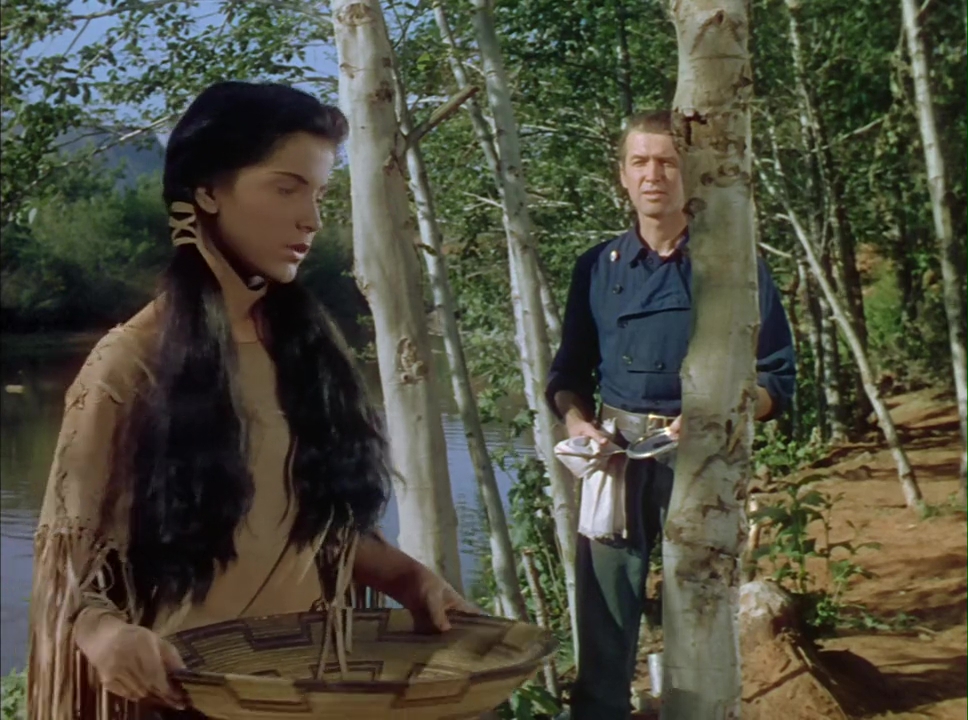

Also in the cast is Basil Ruysdael as the "Christian General", Jay Silverheels as Geronimo, and Frank McGrath. Delmar Daves does a wonderful job directing the film and creating a compelling narrative. This was the first western he directed and it inspired a genre of "pro-Indian" films in the 1950s. The cinematography is also beautiful and captures the breathtaking beauty of the American Southwest with its desert landscapes and majestic mountains. 

Broken Arrow was based on the 1947 novel "Blood Brother" by Elliott Arnold which, in turn, was based on a true occurrence between Cochise and frontier scout Tom Jeffords, who was also the superintendent of the overland mail in Arizona Territory in the 1860s. The film was notable at the time for being one of the first Westerns to show a compassionate view of the Native Americans. 

Shortly after filming wrapped, James Stewart began work on Winchester '73 directed by Anthony Mann. This would be the first of six westerns he would make with Mann in the 1950s. Broken Arrow and Winchester '73 were released within two months of each other in the summer of 1950 and both were box-office hits. Broken Arrow was nominated for three Academy Awards and also earned a Golden Globe for Best Film Promoting International Understanding.

Broken Arrow is available on DVD and for free through streaming via the Tubi and Roku apps. You can also watch it online at tubitv.com.

Be sure to check out more great reviews and other fun Western theme posts from the Legends of Western Cinema Week being hosted by Hamlette's Soliloquy, Along the Brandywine and Meanwhile in Rivendell. 

Wednesday, February 26, 2014

Omar Khayyam ( 1957 )

"Could you and I alone with Fate conspire" 

In the 1940s and early 1950s colorfully costumed Arabian adventure films were all the rage. Universal studios started this string of sword and sandal spectacles in Hollywood when it released Arabian Nights, a modest box-office success starring Jon Hall. Ali Baba and the 40 Thieves (also with Jon Hall), The Prince Who Was a Thief, Son of Ali Baba, A Thousand and One Nights, and Sinbad soon followed. By 1957, however, the genre was beginning to wane in popularity and it was in this year that Paramount Pictures decided to release Omar Khayyam starring Cornel Wilde and Debra Paget. 

Omar Khayyam was a fictional biographical account of the life of the 11th century mathematician-poet who lived in Bagdad. Since very little details of his life are known, Barre Lyndon freely took the opportunity to weave a script which included sultans, thieves, intrigue, harems, and a beautiful princess. All the prime ingredients for an Arabian night fantasy. 

It begins with our hero, the wise poet, discovering that his beloved is to become the Shah's newest bride. Forlorn at the thought of losing her, he obtains a position at the palace as chief astronomer to be near her, and lo! what does he discover here but schemes of betrayal stirring within the palace walls!


Cornel Wilde, who rose to fame in Hollywood for his swashbuckling films (he was a champion fencer), lacks the pizzazz that he had in his other pictures and understandably so since the role calls for a distressed lovelorn poet, not a swashbuckling hero. However, the supporting cast in Omar Khayyam is marvelous and more than makes up for Wilde's mild performance. Michael Rennie, always a familiar face in costumed dramas, is excellent in the role of Hasani, one of Khayyam's dear friends and later his adversary. Sebastion Cabot is also one of Khayyam's childhood friends who helps give Omar an audience with the shah, which later earns the poet the position of counselor and astronomer at the palace. 

Raymond Massey, the man of one face, looks surprisingly Arabic in appearance in his role as the mighty Shah who surrounds himself with wise counselors and his two fighting sons, played by John Derek and Perry Lopez. Yma Sumac, the exotic four-octave range singer (check out her amazing performances with the Les Baxter Orchestra) has a brief appearance to do some warbling while Joan Taylor and Margaret Hayes round out the cast of femme fetales. Debra Paget is ravishingly beautiful as ever and was well-chosen by the Shah to be his newest wife. 

Other familiar faces include Edward Platt ("Sorry about that, Chief"), John Abbott, and Dick Elliott (Mayor Pike on The Andy Griffith Show). 

The film boasts some stunning costumes by Ralph Jester who did only a handful of costume design work in films such as The Ten Commandents, Soloman and Sheba, and The Buccanneer.

William Dietrele discontinued his 27-year long Hollywood career after completing Omar Khayyam and it is no wonder he was dissatisfied with what he was being given. As colorful and vibrant as Khayyam is (it was filmed in VistaVision) the movie is a far cry from Dietrele's earlier biopics, such as The Story of Louis Pasteur and The Life of Emile Zola. One cannot help wondering how great it could have been had the film been approached differently. Perhaps with a different leading man, or even if it were turned into a musical.... with Howard Keel.


Nevertheless, for loyal followers of sword-and-sandal Arabian Nights flicks this is highly recommended viewing. Especially on a Saturday morning. As Khayyam would say, "A bowl of oatmeal, a jug of juice, and thou...great television set. Give me the sweet pleasures of life to while my days away".