Showing posts with label James Stewart. Show all posts

Thursday, July 27, 2023

Broken Arrow ( 1950 )

The Legends of Western Cinema Blogathon is taking place this week celebrating great Western films, television series, and stars of Westerns. Our choice for this event is a review of the classic James Stewart western Broken Arrow, released in 1950. 

This was the first dramatic western that James Stewart ever made and he was so well suited to the genre that he went on to star in sixteen more westerns within the next 25 years. The story is one of friendship, love, and cultural understanding set against the backdrop of the tumultuous Apache Wars in the Arizona Territory in 1870.

James Stewart portrays veteran scout Tom Jeffords who is tired of the warfare between the whites and the Apaches. He reasons that intelligence and understanding must be used in putting a halt to the war. He learns the Apache language and their customs and then rides into their camp to prevail upon their leader Cochise to allow the overland mail riders to pass unharmed. This is a small step in what Tom hopes will be the beginning of peace negotiations. 

Jeffords slowly gains the trust of Cochise who agrees to talk peace terms with General Oliver Otis Howard who is acting as an ambassador to the "Great White Chief", President Ulysses S. Grant. Cochise eventually agrees to "break the arrow" with the white people, a symbol of the Apaches to stop fighting, but there are men on both sides who resist extending the olive branch of peace. 

"To talk of peace is not hard. To live it is very hard."

If you enjoy action-packed westerns, then Broken Arrow is not for you. It meanders along like a gentle brook and the only tension to be had is in wondering whether the peace treaty will be broken by either party before they have a chance to cement their relationship. However, the story is so engrossing that action is not needed. It is a touching and thought-provoking film. When Tom first enters Apache territory, he expects to encounter a hostile warrior and isn't even certain he will leave the area alive. Instead, he finds a man as tired of war as he is. Cochise admires Jeffords courage in approaching his camp and is touched that he took the time and effort to learn the Apache language and way of life. In turn, Jeffords comes to respect Cochise and the care he has for his people. A strong bond is forged between him and Cochise, one built on mutual admiration. 

Jeff Chandler gives a wonderful and dignified performance as the wise warrior. He was such a handsome man and had a natural flair for acting. With his expressive face, minimal dialogue was needed for him to convey a message, making him an ideal actor for this role. Cochise was a man who used actions instead of words. Chandler was nominated for an Academy Award for his role and - according to Kim Newman, author of "Wild West Movies" - he established Cochise as the "1950s model of an Indian hero."

James Stewart also gives a sensitive performance as the weary scout. Jeffords is a middle-aged man who has been alone all of his life. Now that he is getting older, all he wants is peace and the settler's life he never had. When he enters Apache Territory the last thing he expects to find is romance, but he falls in love with the beautiful Sonseeahray (16-year-old Debra Paget making her screen debut ) the moment he sees her and asks Cochise for her hand in marriage. 

"It won't be easy for you both....You will go far away, always to new places but your eyes will never see anything because they will always be turned backwards...towards home."
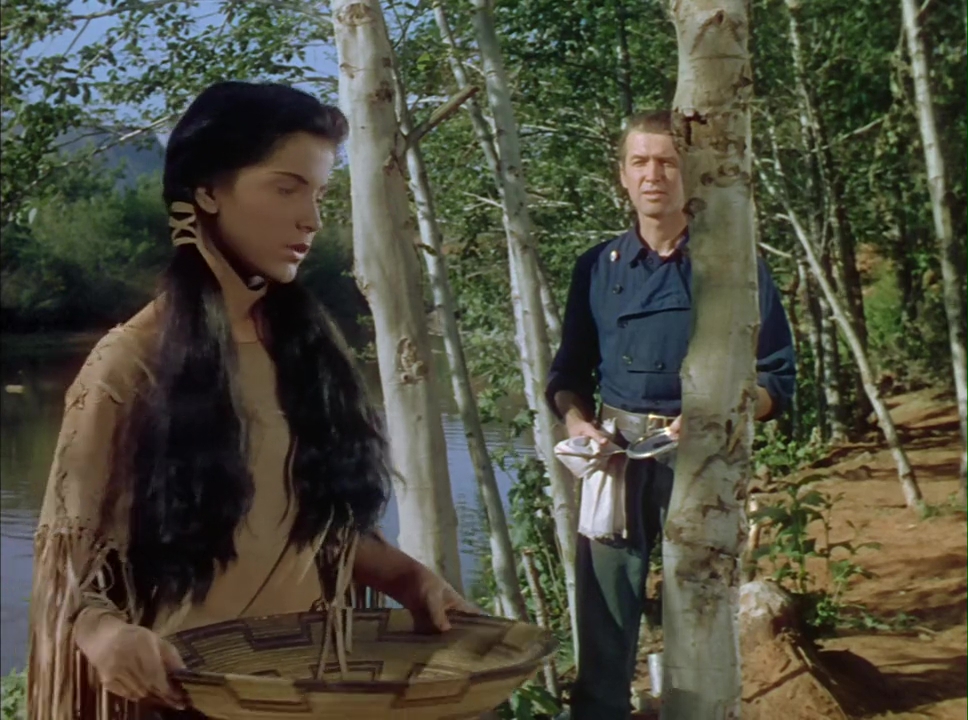

Also in the cast is Basil Ruysdael as the "Christian General", Jay Silverheels as Geronimo, and Frank McGrath. Delmar Daves does a wonderful job directing the film and creating a compelling narrative. This was the first western he directed and it inspired a genre of "pro-Indian" films in the 1950s. The cinematography is also beautiful and captures the breathtaking beauty of the American Southwest with its desert landscapes and majestic mountains. 

Broken Arrow was based on the 1947 novel "Blood Brother" by Elliott Arnold which, in turn, was based on a true occurrence between Cochise and frontier scout Tom Jeffords, who was also the superintendent of the overland mail in Arizona Territory in the 1860s. The film was notable at the time for being one of the first Westerns to show a compassionate view of the Native Americans. 

Shortly after filming wrapped, James Stewart began work on Winchester '73 directed by Anthony Mann. This would be the first of six westerns he would make with Mann in the 1950s. Broken Arrow and Winchester '73 were released within two months of each other in the summer of 1950 and both were box-office hits. Broken Arrow was nominated for three Academy Awards and also earned a Golden Globe for Best Film Promoting International Understanding.

Broken Arrow is available on DVD and for free through streaming via the Tubi and Roku apps. You can also watch it online at tubitv.com.

Be sure to check out more great reviews and other fun Western theme posts from the Legends of Western Cinema Week being hosted by Hamlette's Soliloquy, Along the Brandywine and Meanwhile in Rivendell. 

Monday, July 22, 2019

Favorite Western Films - A Photo Collection

Legends of Western Cinema Week is taking place right now and since we love westerns, it was very difficult to decide which film/actor to write about for the event. We'll be taking part by contributing western reviews of two favorites: Tribute to a Bad Man ( 1956 ) and Gun Glory ( 1956 ).....but, since these two films are only a tiny, tiny, tip of the wealth to be mined in the western genre, we wanted to cover a broader range of films. Hence, a photo collection! 

Below you will find some of our favorite classic western films which, if you are unfamiliar with the genre, will aid you in mapping your way around the terrain or at least introduce you to a few new titles. 


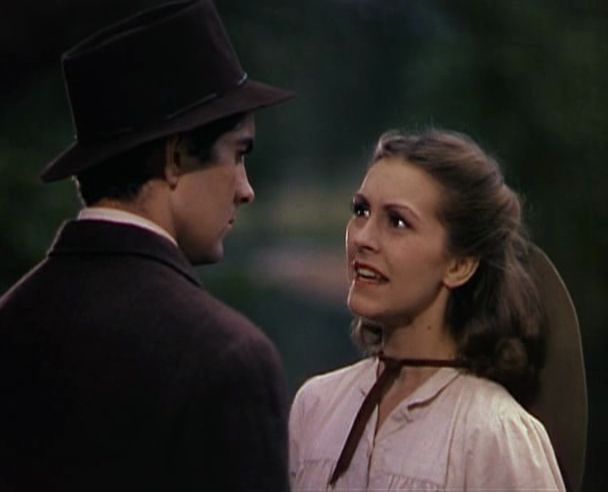
The Big Trail ( 1930 ) 

John Wayne, Tyrone Power Sr, Marguerite Churchill


Jesse James ( 1939 ) 

Tyrone Power, Henry Fonda, Nancy Kelly, Randolph Scott


Stagecoach ( 1939 ) 

John Wayne, Claire Trevor, John Carradine


Tall in the Saddle ( 1944 ) 

John Wayne, Ella Raines, Ward Bond


West of the Pecos ( 1945 )

Robert Mitchum, Barbara Hale, Thurston Hall


Canyon Passage ( 1946 )

Dana Andrews, Susan Hayward, Brian Donlevy


My Darling Clementine ( 1946 ) 

Henry Fonda, Linda Darnell, Victor Mature, Walter Brennan


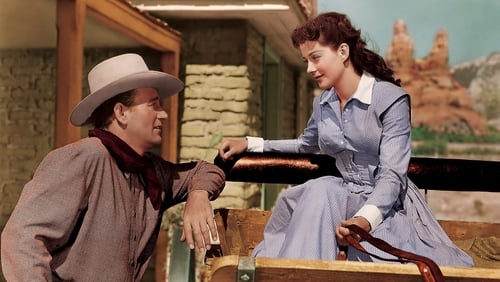
Angel and the Badman ( 1947 ) 

John Wayne, Gail Russell


Four Faces West ( 1948 )

Joel McCrea, Frances Dee, Charles Bickford


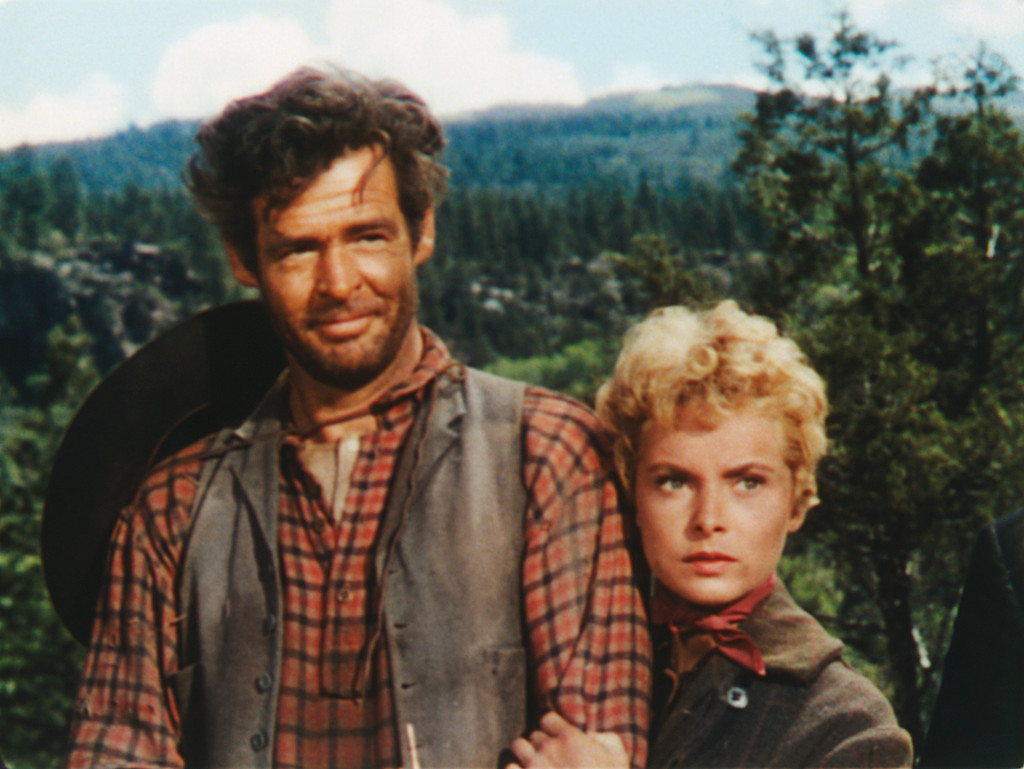
Broken Arrow ( 1950 )

James Stewart, Jeff Chandler, Debra Paget


The Outriders ( 1950 )

Joel McCrea, Arlene Dahl, Barry Sullivan


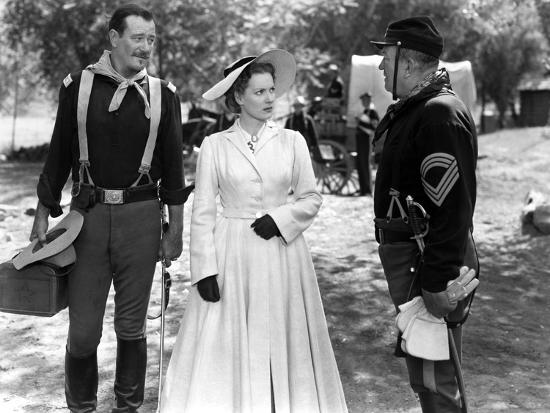
Rio Grande ( 1950 )

John Wayne, Victor MacLagen, Maureen O'Hara, Claude Jarmin Jr.


Rawhide ( 1951 ) 

Tyrone Power, Susan Hayward, Dean Jagger, Hugh Marlowe


Bend of the River ( 1952 )

James Stewart, Julie Adams, Rock Hudson, Arthur Kennedy


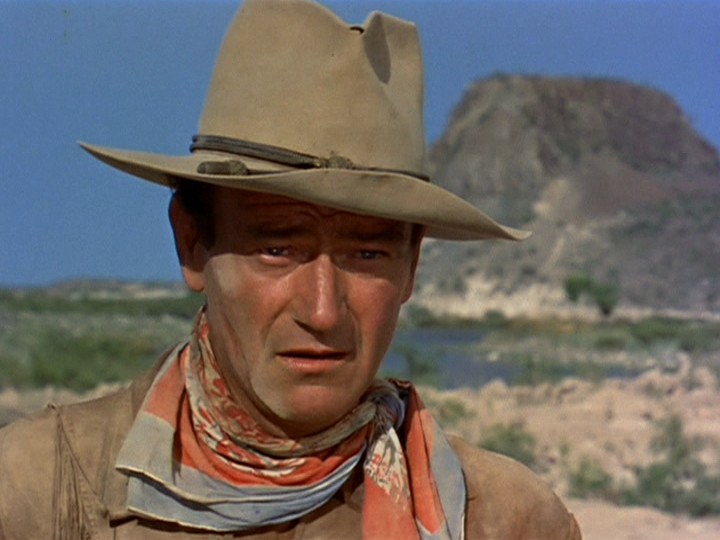
Hondo ( 1953 )

John Wayne, Geraldine Page, Ward Bond


The Man from the Alamo ( 1953 )

Glenn Ford, Julie Adams, Chill Wills


The Naked Spur ( 1953 )

James Stewart, Robert Ryan, Janet Leigh


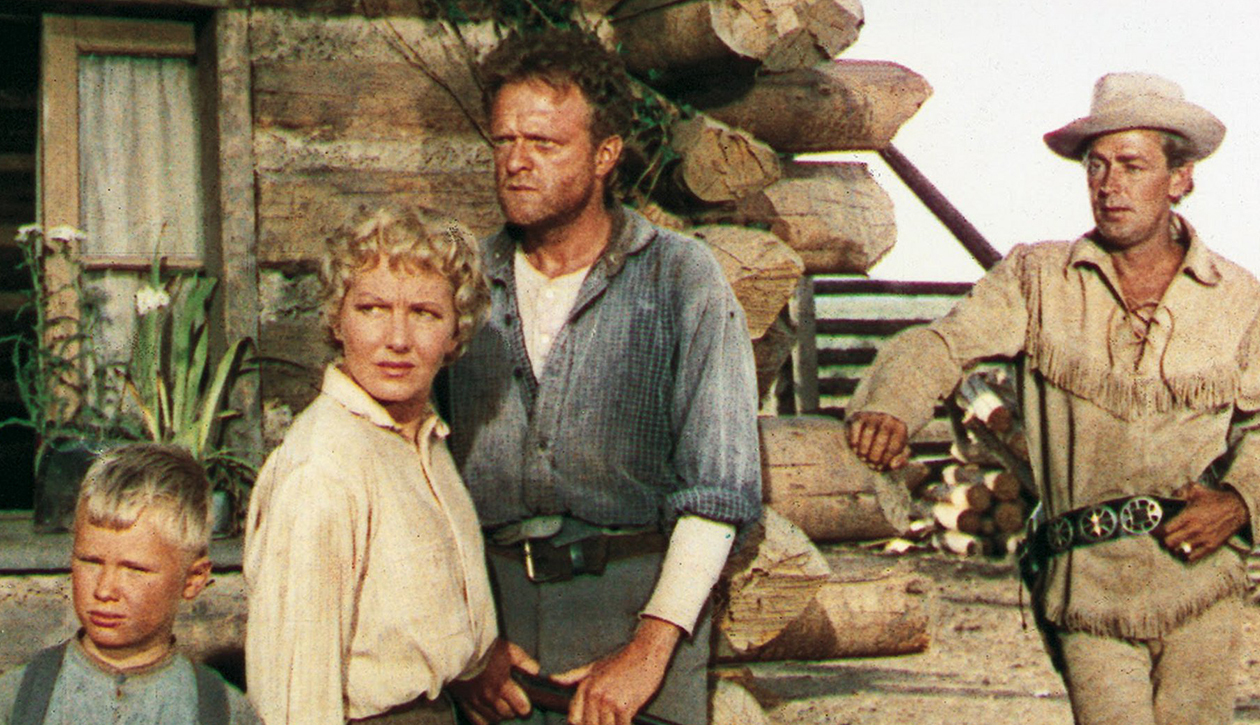
Shane ( 1953 )

Alan Ladd, Ven Heflin, Jean Arthur, Brandon deWilde


River of No Return ( 1954 ) 

Robert Mitchum, Marilyn Monroe, Rory Calhoun


The Man from Laramie ( 1955 )

James Stewart, Cathy O'Donnell, Donald Crisp, Alex Nicol


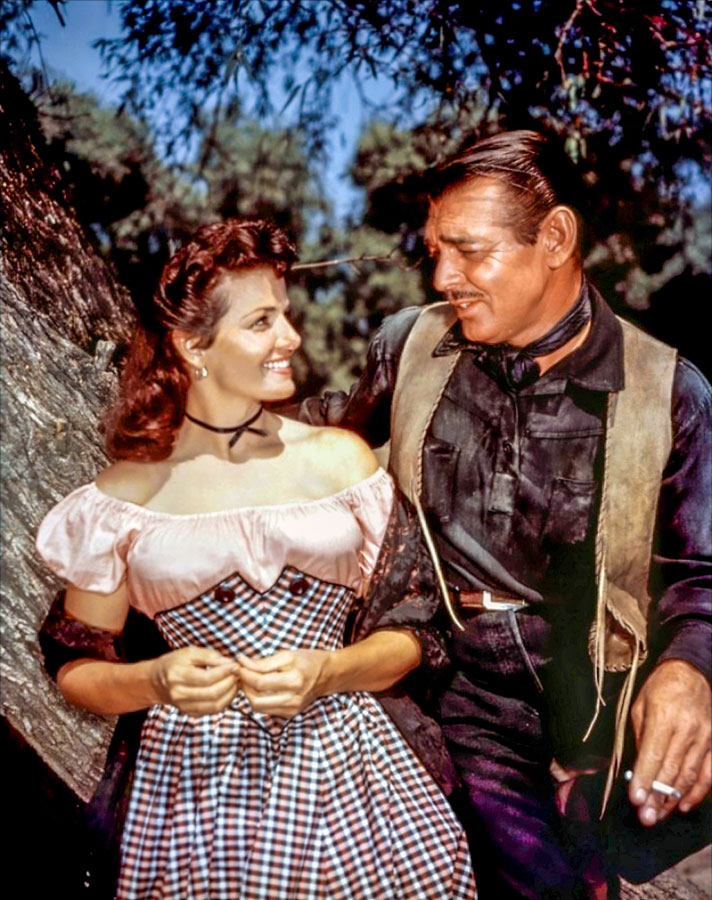
The Tall Men ( 1955 ) 

Clark Gable, Robert Ryan, Jane Russell


Tribute to a Bad Man ( 1956 )

James Cagney, Don Dubbins, Irene Papas, Stephen McNally


Gun Glory ( 1957 ) 

Stewart Granger, Rhonda Fleming, Chill Wills


Cowboy ( 1958 )

Glenn Ford, Jack Lemmon, Dick York, Brian Donlevy


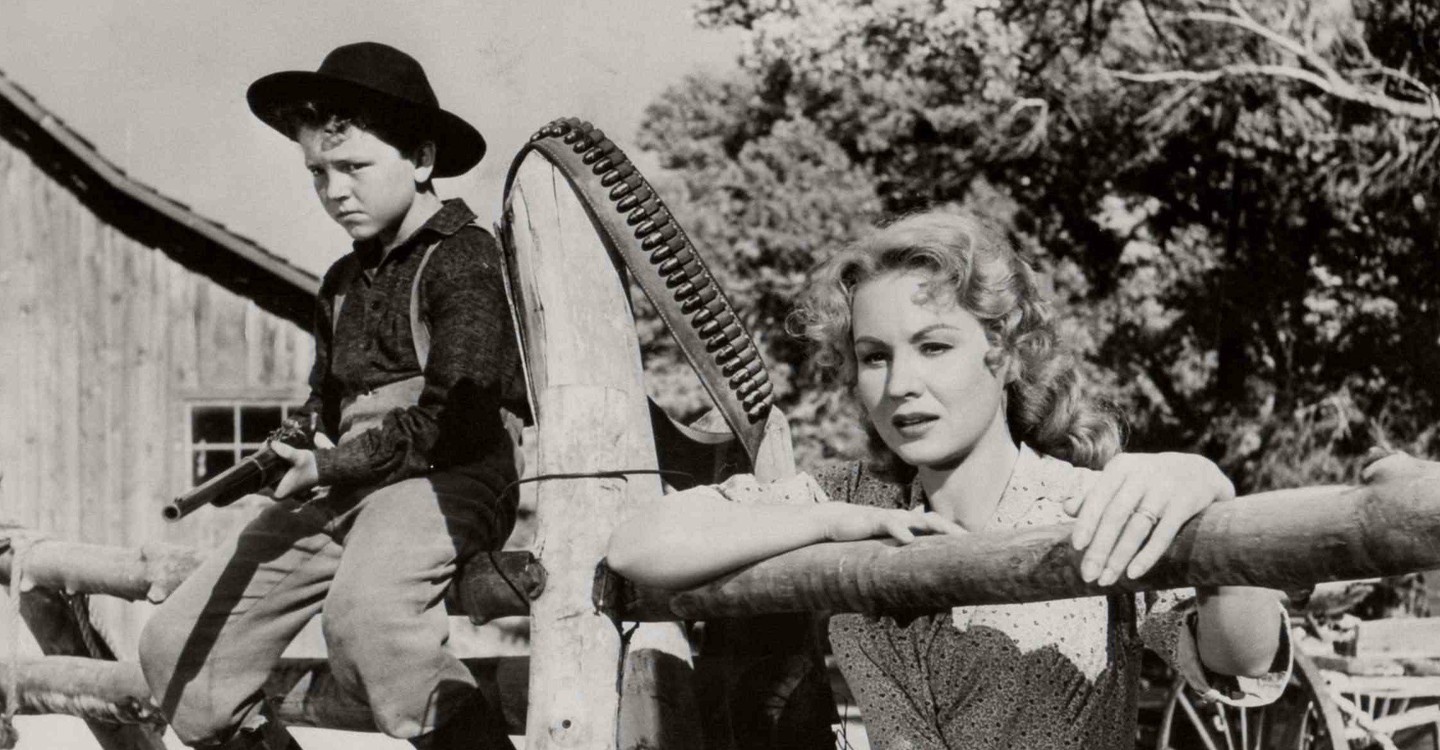
Fort Dobbs ( 1958 )

Clint Walker, Virginia Mayo, Richard Eyer


The Big Country ( 1958 ) 

Gregory Peck, Jean Simmons, Charlton Heston, Carroll Baker


How the West Was Won ( 1962 ) 

Debbie Reynolds, Gregory Peck, Robert Preston, Carroll Baker


Ride the High Country ( 1962 ) 

Joel McCrea, Randolph Scott, Mariette Hartley


Lonely are the Brave ( 1962 )

Kirk Douglas, George Kennedy, Walter Matthau

Putting together this post made us realize that there are still hundreds of westerns for us yet to see ( and many more forgotten films from our past to revisit ), so it is certainly not complete! But that's the fun part about watching movies....there are so many films to explore. It's an endless form of entertainment! 

This post is our contribution to Legends of Western Cinema Week hosted by Along the Brandywine, Hamlette's Soliloquy and Meanwhile, in Rivendell. Be sure to stop by any of these blogs for a chance to win some western-themed prizes, participate in a tag, and read reviews of favorite westerns and western stars. 

Saturday, November 19, 2016

The Greatest Show on Earth ( 1952 )

For Cecil B. DeMille there was no such thing as a regular feature film...it always had to be a spectacle

Circus films were a dime a dozen in the 1930s, but none of them really captured that thrill of seeing a circus in person. A circus was meant to be a spectacle, and the circus itself had to take the center ring in a film; it couldn't be relegated to merely a background setting. 

Cecil B. DeMille knew all this, and he also knew that if he wanted to see a honest-to-goodness tribute to the American circus he would have to make the film himself. 

As early as 1949, DeMille started the wheels of production spinning. He spent over a year touring with Ringling Barnum and Bailey Circus, photographing the best acts in the business and discovering ways to transport that thrill of a real circus onto the big screen. What resulted was indeed The Greatest Show on Earth, a spectacle beyond all spectacles. This film really packs a punch and captures everything audiences love about the circus - daring acts on the flying trapeze, elephants on parade, glittering costumes, the smoky atmosphere within the tent, the heroic natures of the stars of the rings, even the drama of the circus people themselves. 
This drama centers around Brad Braden ( Charlton Heston ), manager of the Ringling Brothers circus. He has just engaged The Great Sebastian ( Cornel Wilde ), a popular trapeze artist, to ensure a full profitable season, even though it means moving his girlfriend Holly ( Betty Hutton ), another trapeze artist, from her hard-won center ring. Sebastian and Holly begin a playful, but dangerous, one-upmanship duel in the ring until the inevitable accident stops the show. 

James Stewart also has a big part as a former doctor now in hiding from the police for a mercy killing several years back. To keep his identity a secret he never removes his makeup as Buttons the Clown. It is not until Brad's life is endangered in a massive train wreck that Buttons must reveal his true profession. 
Gloria Grahame, Lyle Bettger, Dorothy Lamour, and Henry Wilcoxon make up the rest of the cast, in addition to 85 acts from the Ringling Brothers circus including aerialist Antionette Concello, midget Cucciola, and veteran clowns Emmett Kelly and Lou Jacobs. All of the scenes within the tent were filmed at Ringling Brothers' winter home in Sarasota, or live during one of their performances. Obviously, the circus pros had no issues doing the stunts, but what was most impressive was how well Cornel Wilde ( who had a fear of heights ) and Betty Hutton performed on the trapeze. It took them months to learn their technique and it clearly showed. Had their Hollywood careers fizzled, they could have easily joined up with a circus. 

When The Greatest Show on Earth premiered its box-office receipts were higher than even The Great Sebastian could soar, with kids of all ages packing the theatres in droves. It's no wonder, too.....Cecil B. DeMille paralleled the real Ringling Brothers circus and gave audiences one great moment after another to behold in this star-studded spectacle. 

Fredric Frank and Barre Lyndon penned a cotton-candy script with a straightforward plot line because, after all, who comes to a circus to be engrossed in deep drama? We want to have fun, ooh and aah at some thrilling acts, and see plenty of spangles and sawdust. 

So next time you're itching to go to the circus, get yourself some popcorn, and sit back and enjoy The Greatest Show on Earth. 

This post is our entry in the "At the Circus Blogathon" being hosted by Critica Retro and Serendiptious Anachronisms. Be sure to head on over to their blogs to read more reviews about circus films!

Saturday, January 23, 2016

Director Henry Koster and James Stewart

James Stewart and director Henry Koster made a wonderful team. They worked together on five films, beginning with the highly entertaining Harvey. Stewart had made numerous comedies in the 1930s and 1940s and had a natural knack for comedy, but in the 1950s and 1960s he was turning more and more towards dramatic roles in westerns, biopics, and war films. The few comedies that he made in this period, almost all of which were directed by Koster, gave him a chance to return to the charming, and rather clumsy, type of characters that fans came to love in his earlier films. 

The Director

Henry Koster arrived in Hollywood from Germany in 1936 and, along with his friend, producer Joe Pasternak, managed to convince Universal to let him make Three Smart Girls. The film was a great success, pulling Universal from the verge of bankruptcy, and it launched the 14-year old Deanna Durbin, who was making her first film, to stardom. His next film - 100 Men and a Girl - established Durbin, Pasternak, and himself on top and for the next decade they were busy with Durbin's musicals. It wasn't until 1947 that Koster attempted a dramatic picture - The Unfinished Dance. This film, made at MGM, demonstrated Koster's flair for elevating a good story and script to great entertainment. His follow-up film, The Bishop's Wife ( 1948 ) earned him his first Academy Award nomination for best director. 

Henry Koster with James and Gloria Stewart

A Key Collaboration 

James Stewart was a favorite actor among many directors. He made eight films with Anthony Mann, four with John Ford, and three with Frank Capra. The five-picture collaboration he had with Henry Koster began with Harvey ( 1950 ), a film which Stewart claimed was his favorite motion picture. His portrayal of a whimsical middle-aged man who has an invisible giant rabbit for a companion earned him a Best Actor Oscar nomination. 

Preston Sturges had initially expressed interest in purchasing the screenrights to the popular stage play "Harvey" in the mid-1940s, but luckily Universal bought it first and it became a project for Henry Koster. Sturges may have made the film more amusing, but Koster gave it heart, and plenty of it. Like Frank Capra, Koster had a way of reaching out to his audience, leaving them with a little moral to ponder when the film is over, but he did so in a much subtler manner. His films tend to give you a warm feeling and inspire sympathy for one's fellow man. 

Henry Koster had directed some of the biggest names in Hollywood ( Loretta Young, Celeste Holm, Elsa Lanchester, and Richard Burton all received Oscar nominations for roles in Koster films ), but working with James Stewart was a special experience for him. "[Working with him was] without any doubt one of the most pleasant experiences in my life....It must have been his spirit. There was very little friction, ever, only ambition and craftsmanship and precision, just doing it right professionally. On top of that he put the whipped cream of great talent."

Harvey became Koster's biggest success to date and was a fan favorite upon its initial release. Stewart and Koster were both unable to attend the premiere of the film however, because they were in England, already hard at work on their next picture - No Highway in the Sky ( 1951 )James Stewart once again portrayed an eccentric character, but this time as a aeronautical engineer with a dire warning for an airline company. 

James Stewart and Glynis Johns in No Highway in the Sky


Three Fox Comedies

James Stewart had a busy filming schedule throughout the 1950s, filming numerous westerns, two Alfred Hitchcock thrillers, and biopics such as The Glenn Miller Story ( 1954 ) and The Spirit of St. Louis ( 1957 ). It would be more than a decade before he would reunite with Henry Koster for Mr. Hobbs Takes a Vacation ( 1962 ), a colorful creampuff comedy geared towards teens and adults alike. 

Based on a novel by Edward Streeter ( "Father of the Bride" ), it tells the story of a businessman ( Stewart ) who wants to spend a vacation alone with his wife minus their children. Instead, he finds himself hoodwinked into spending the summer at a ramshackled house on the beach with his whole brood - grandchildren, son-in-laws, and all. Maureen O'Hara couldn't look any more stunning than she did in this film, and singing-sensation Fabian drew in the younger female audience. The film was strewn with little incidents that all bore Koster's trademark of subtle humor. 

Audiences loved seeing Stewart playing a harassed father and the success of the movie inspired Koster to produce their next film together, Take Her, She's Mine ( 1963 )James Stewart reprised his befuddled-father act, this time playing a lawyer concerned that his daughter ( Sandra Dee ) is becoming a "loose" woman while away at college. It seems everyone recognizes that his daughter has matured into a woman except Papa. This was a subject not often tackled in movies. Writers Henry and Phoebe Ephron penned the play based upon their own experiences with their college-aged daughter, Nora. Screenwriter Nunnally Johnson adapted the play into a script, adding a clever running gag of Frank Michaelson ( Stewart ) constantly being mistaken for James Stewart! 


Take Her, She's Mine lacked the charm Mr. Hobbs possessed, but nevertheless it did well at the box-office, and so Koster and Stewart teamed up once more for a third comedy in the same vein - Dear Brigitte ( 1965 ). Billy Mumy starred as a 10-year old boy genius who devised a system for picking winning horses. He has a crush on Brigitte Bardot and gets his wish of visiting her in France after he agrees to help his father's university raise scholarship funds.   

James Stewart was reunited with his No Highway in the Sky co-star Glynis Johns to play Mumy's parents, both bewildered by the fuss the media is making over their son. Dear Brigitte was one of the last of the light-hearted family comedies made in the 1960s, and while a handful were produced after this, they often dealt with more serious "teen issues" involving sex and drugs. 


After Dear Brigitte, Henry Koster made one more film - The Singing Nun - before deciding that it was time to hang up his hat and retire from directing. He spent his leisure hours persuing another great passion - painting. He even created a painting of his dear friend Jimmy Stewart. 

Jimmy, on the other hand, continued acting on stage and in films throughout the 1970s and 1980s. Twenty years after the release of Koster and Stewart's first film together, he starred in a triumphant Broadway revival of "Harvey" opposite Helen Hayes. 

This post is our contribution to the Classic Symbiotic Collaborations Blogathon being hosted by Cinemaven's Essays from the Couch. Head on over to her site to check out more posts on popular directors and the stars they made multiple films with. 

Thursday, December 3, 2015

Winter Sports in Films of the 1930s and 1940s

Whether you were born in a warm climate or the heart of the Arctic itself, the appeal of winter sports is undeniable. The crisp cold air, the thrill of the high-speeds, the beauty of the surrounding scenery capped off with the enjoyment of warming up with a cup of hot cocoa while sitting beside a roaring fire is one of the best pleasures to be had in winter. And if you are lucky enough to have a roasted sweet-potato near by, grab it. 

However, if there are palm trees blowing gently in the breeze outside your window, or so much snow has fallen that you can't shovel your way out of the house, then the next best thing to participating in winter sports is watching others romp in the snow. 


So grab a cola, find some pretty brunettes ( or a Jerry Colonna ) to sit beside and enjoy some good old-fashioned winter fun courtesy of Hollywood's dream factory. 

SKATING

All of the popular stars of the 1930s and 1940s strapped on a pair of skates and hit the ice ( sometimes the hard way ) for at least one film. Sonja Henie, the most famous ice skater of the 1930s starred in ten productions for 20th Century Fox during her reign as the studio's ice queen. You can see her twirl in dizzying circles in One in a Million ( 1936 ), Happy Landing ( 1938 ), Second Fiddle ( 1939 ) and Wintertime ( 1943 ) where she starred opposite such glamour boys as Don Ameche and Cesar Romero.

Don't go expecting any triple-salchows however. While Sonja was the top in her field in her day ( she won three Olympic gold medals ), ten-year old skaters can outdo her moves these days. The Norwegian gal with the dimples had charm and that made up for a large part of her star appeal. Incidentally, the "ice" that she skated on was primarily frozen milk. On black and white film, water did not give off the milky white texture that the studios wanted so they mixed some cow's milk into it to give it a shine. 

The Ice Follies, which began in 1936 and toured around the world, were all the rage in the 1930s and, of course, when something is the rage Hollywood is bound to make a film about it. Joan Crawford was pushed onto the ice along with James Stewart and Lew Ayres ( playing a drunk again ) in The Ice Follies of 1939. The movie has its entertaining moments ( including a sparkling Technicolor finale with Roy and Eddie Shipstad, the founders of the Ice Follies, doing some of the skating routines ) but it crashed at the box office. 


That didn't stop Republic from releasing another Follies-themed film just two years later : Ice-Capades starring James Ellison. He looked good on ice, and so did Clark Gable and Jean Harlow when they attempted to glide without falling in Wife Vs. Secretary ( 1936 ). 

Bette Davis tried skating, too, but she fell on her rump in The Man Who Came to Dinner ( 1942 ). If you want to learn how to showoff on skates like Joseph Cotten did in The Farmer's Daughter ( 1946 ), then it's best to watch a tutorial first. Mickey Mouse gives viewers some points in On Ice ( 1935 ). 


Of course, having a partner to support you helps - just look at how much fun Loretta Young had with Cary Grant in The Bishop's Wife ( 1947 ). 


SKIING 

If you don't care for the graceful art of figure skating then how about experiencing the thrill of cold air rushing against your face as you head down the slopes on a pair of skis? We're cross-country ski enthusiasts ourselves, so instead of risking our necks on the mountainside we prefer to watch our favorite stars hit the slopes...by standing in front of a backdrop screen. 


One of our all-time favorite actors - Melvyn Douglas - could often be found playing in the artificial snow. Claudette Colbert met him on the slopes at St. Moritz in I Met Him in Paris ( 1937 ) and Mary Astor stumbled down the hill with him in And So They Were Married ( 1936 ). 

Greta Garbo also found him in the snowbanks in Idaho in Two-Faced Woman ( 1941 ). Barbara Stanwyck went to Lake Arrowhead to look for Melvyn but all she found was George Brent in My Reputation ( 1946 ). It cost her her reputation too. 

That's what happens when you don't know how to ski, you end up bumping into fellows you didn't plan on meeting. If that is a common problem then it's best to learn the fundamentals of skiing. Goofy demonstrates proper technique in The Art of Skiing ( 1941 ) with comical results. It makes you want to consider buying life insurance. 

The Alps were the ideal place and definitely the "in" place to ski during the 1930s. European socialites would go sloping on the mountains for amusement just as American society went slumming in the cities. 

Even members of royalty like Prince Rudolph ( Tyrone Power ) went to Switzerland to enjoy the fresh mountain air and the excitement of downhill skiing. It was his only form of relaxation, poor boy. Not only did he manage to get a few days of skiing into his busy schedule but he met another winter sports enthusiast ( Sonja Henie ) whom he fell in love with in Thin Ice ( 1937 ). Robert Young found romance with Florence Eldridge on the Alpine slopes as well in Paradise for Three ( 1938 ).

Most Americans could not afford to travel to the Alps, so they opted to head to the most famous ski resort of the West - Sun Valley, Idaho. 

Not only was the snow perfect for skiing but you could find Sonja Henie there too ( she certainly got around ). In Sun Valley Serenade ( 1941 ) she played a Norwegian refugee showing off her skiing and skating talent to the band manager at a Sun Valley resort - who just happened to be played by John Payne, another actor who looked great in cold-climate pictures. 

Bud Abbott and Lou Costello caught ski-fever when they headed out to Sun Valley for Hit the Ice ( 1943 ). They tried dog-sledding but found out that rolling like a snowball gets you down a hill faster! 

American society enjoyed the fun to be had in Sun Valley too. Gene Tierney played an heiress who meets a swell looking guy ( Tyrone Power ) at a resort in That Wonderful Urge ( 1948 ). Alright, he turned out to be a reporter, but heiresses can't expect everything to be perfect. 

Well, there you have it folks....these are just a few film suggestions to get you off of your couch and out of the house where you can enjoy the brisk cool air and the pleasure to be found in winter sports. 

See you on the slopes!
This post is our contribution to the Winter Sports Blogathon being hosted by Le Mot du Cinephiliaque . Be sure to head on over there to read more posts on films that featured your favorite winter sports.