Showing posts with label Edmund Gwenn. Show all posts

Saturday, May 17, 2025

The Student Prince (1954)

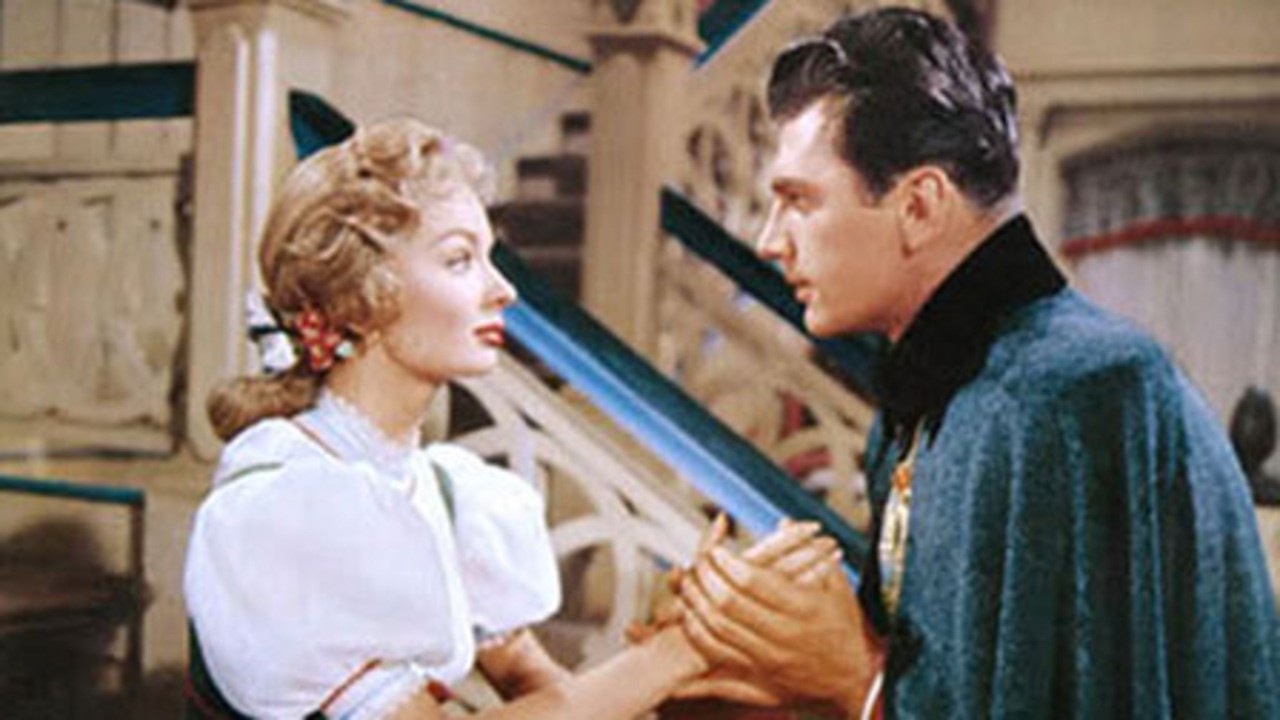
In 1954, Metro-Goldwyn-Mayer brought the delightful old play "The Student Prince" to the big screen. This lavish production was initially planned as a vehicle for their Italian singing sensation Mario Lanza, but this fun-loving tenor had put on a bit too much weight over the summer and ended up being axed as its star. Instead, the handsome English-import Edmund Purdum took on the lead role and lip-sung the songs that were pre-recorded by Mario Lanza. And it turned out quite well!

Sigmund Romberg musicalized the 1902 Wilhelm Meyer-Förster play "Old Heidelberg" in 1924 and turned it into one of the most popular operettas of the 20th century. The story centers around the young Prince Karl Franz of Karlsberg (Edmund Purdum), who is encouraged by his tutor, the kindly Doctor Engel (Edmund Gwenn), to attend the University of Heidelberg prior to capping the crown on his head. In this charming old German town, Prince Karl falls in love with Kathie (Ann Blyth), the barmaid at the local beerhall where all the students congregate after school. He wishes to marry Kathie but he is pledged to betroth Princess Johanna (Betta St. John), and so his heart is divided between his personal desire and duty for his country.

This simple but engaging plot was interwoven with over 15 glorious Romberg songs, including "Drink, Drink, Drink!", "Golden Days", the beautiful "Serenade", and "Deep in My Heart". Purdum did an excellent job of mimicking a tenor and Ann Blyth, of course, carried her own set of powerful lungs and sang better than she ever did on film. In between their romantic moments, Prinz Franz encountered some drama caused by a rival student (John Ericson), a little humor from the inn-keeper (S.Z. Sakall), and a good dose of paternal advice from his father King Ferdinand (Louis Calhern). Also in the cast was John Williams as the stiff valet Lutz, John Hoyt as the Prime Minister, and Richard Anderson as Franz's newfound friend at the university. 

The film looked beautiful in Cinemascope and the lovely Cedric Gibbons sets transported the audiences to old Germany and the grandeur of the German Empire before World War I began. 

"The Student Prince" was an immediate success upon its Broadway debut in 1924. It became the most popular musical of the 1920s, running even longer than "Show Boat". Hollywood brought it to the screen in 1927 as a silent film (!) starring Ramon Navarro and Norma Shearer and then it was shelved until this production in 1954. I always thought that it would have made an excellent Nelson Eddy-Jeannette MacDonald musical in the late 1930s but that never happened. 

This adaptation proved that a good story lasts for generations. MGM reaped more than double its return at the box-office and it launched Edmund Purdum's career in Hollywood. Shortly after The Student Prince was completed, Purdum went on to star in the epic The Egyptian over at 20th Century Fox. 

Monday, November 11, 2019

The Keys of the Kingdom ( 1944 )

Film studios always preferred a good novel adaptation over an original story idea. This was primarily because the producers knew they had an established audience who were waiting in anticipation for the release of the film. When a best-selling book became a box-office hit at the movie theatres, then the studios were anxious to secure the film rights to that author's next novel. Such was the case with A.J. Cronin, a Scottish physician and novelist. His 1937 best-selling novel about medical ethics "The Citadel" was adapted into an MGM film the following year starring Robert Donat and Rosalind Russell. It was a great success at the box-office and reaped four Oscar nominations at the Academy Awards. 

This success excited producers who knew that the name of A.J. Cronin would then draw in audiences to other film adaptations of his work. So they quickly went about snatching up the rights to his previous works and adapting them to film. His 1935 novel "The Stars Look Down" was brought to the screen by Carol Reed in 1939; "Hatter's Castle", Cronin's first novel, was made into a 1940 film starring Robert Newton and Deborah Kerr; "Vigil in the Night", a 1939 Good Housekeeping serial novella, was turned into a Carole Lombard weepie; and, in 1944 "The Keys of the Kingdom" was made into a rich drama by Twentieth-Century Fox studios. 

Cronin spent several years writing "The Keys of the Kingdom", an epic story about the trials and tribulations of a Catholic priest in China. He weaved elements of his own background ( Scottish upbringing, medical school, poor family, Catholic conversion ) into the novel which spans six decades in the life of one Father Francis Chisholm. The film, in spite of being 136-minutes long, condenses many aspects of the book and focuses instead on Father Francis' years in China and his work there as a missionary. 
Father Francis is a young Scotsman fresh out of seminary school who is sent by his local bishop to establish a missionary in the Chekhow province of China. The area was destroyed by flooding and all of the true Christians retreated to the mountain regions. Those who remained were "rice Christians", locals who were being paid in rice to attend church. Father Francis refuses to pay the citizens to visit the mission and so his congregation quickly dwindles to none.....until a young pilgrim named Joseph comes to help Father Francis rebuild his church. Over the years it grows into a thriving missionary and remains strong even in the midst of a battle between republican and imperial troops. 
The film rights to The Keys of the Kingdom were originally purchased by David O. Selznick but after a year of toying with the project, he sold it to Twentieth-Century Fox studios. Alfred Hitchcock had wanted to direct the production but chose instead to do Lifeboat that year. Nunnally Johnson and Joseph L. Mankiewicz ( who also produced the film ) took charge of re-working Cronin's novel into a compelling screenplay. It was an "A" production from the start and top-notch talent was used throughout the picture with John M. Stahl ( Leave Her to Heaven ) taking the reins as the director. 

Thomas Mitchell, Vincent Price, Anne Revere, Edmund Gwenn, Roddy McDowall, Peggy Ann Garner, Cedric Hardwicke, James Gleason, Sara Allgood, Arthur Shields, Philip Ahn, Ethel Griffies, and Edith Barrett were all given supporting roles in the production and a young Gregory Peck was cast in the lead as Father Francis. 

Peck had made only one film prior to being cast in this production and that was the lead role in Jacques Tourneur's war romance Days of Glory. He had distinguished himself so well in that part that multiple studios wanted him to sign long-term contracts with them. Instead, he chose to freelance and picked a non-exclusive contract with Fox studios enabling him to accept this part ( Spencer Tracy, Franchot Tone, and Gene Kelly were other actors considered for the role ). 
Peck gives an excellent performance as the zealous missionary and he was, deservedly, nominated for a Best Actor Academy Award. Starring opposite him was Rose Stradner as Mother Maria-Veronica, a nun who works side by side with Father Francis at the mission. Ingrid Bergman was initially considered for this role but Joseph L. Mankiewicz wanted the part to go to his wife, Rose, instead. She was a beautiful and talented Austrian actress but Bergman probably could have given more depth to the role of the aristocratic nun. 

Benson Fong gives a marvelous performance as Joseph, Father Francis' dear companion. His scenes also add a bit of humor to the film, which it sorely needed. The Green Years, another film based on an A.J. Cronin novel, also spanned many years but was rich with characters that the audience could attach to throughout the drama. Unlike that picture, The Keys of the Kingdom focuses primarily on the character of Father Francis and it never feels as though the audience gets a chance to know the other characters as well as Francis himself does. Mother Maria-Veronica is initially cold towards Father Francis when she first arrives and, even though she later explains the reason behind her behavior, it would have been better to witness her character's past unfold visually rather than verbally. One of the few characters who is given depth is Mr. Chia, portrayed admirably by Leonard Strong. His character develops from a superior nobleman to that of a true friend to Francis. 
The Keys of the Kingdom was received favorably by film critics but just managed to recoup its cost at the box-office. However, the film had the prestige of being nominated for four Academy Awards ( Best Art Direction, Best Cinematography, Best Actor, Best Original Music Score ). 

Friday, April 20, 2018

Louisa ( 1950 ) - When Grandma Starts Neckin'

What do you do with a meddling mother-in-law? That's a subject that has been addressed in many comedies over the years, one of which was Louisa ( 1950 ) which starred Spring Byington as the titular nuisance. Actor and former president Ronald Reagan, who always had a knack for playing comedy, portrayed the leading man in this amusing Universal Pictures comedy that has sadly fallen into the realm of obscurity. 
Hal Norton ( Reagan ) is a well-to-do architect whose life turns upside-down when he discovers that his widowed mother, Louisa, who lives at home with his wife and children, has fallen in love again and plans to re-marry. He had recently encouraged her to stop interfering in the lives of his family and to get out of the house and take part in social activities, but he did not expect her to woo the first man she met! This man happens to be the local grocer, Mr. Hammond ( Edmund Gwenn ), who doesn't resemble Hal's father in the least. Hal's children ( Piper Laurie, Jimmy Hunt ) find grandma's romantic behavior comical, while Hal simply thinks it is absurd. His dislike for Mr. Hammond changes when he invites his boss, Mr. Burnside ( Charles Coburn ), over for dinner and finds that he, too, has become smitten with his mother! Comic mayhem then ensues when the two beaus go head-to-head vying for the attention of the charming Mrs. Norton. 

The script, penned by Stanley Roberts, milks the over-65 romance angle to its fullest, cleverly hinting at how adults in love, at any age, behave like teenagers. Hal and his family learn a valuable lesson from the episode, too: they were interfering in Louisa's life as much as she interfered in theirs when she was certainly at an age to live her own life and make up her mind on whom she wished to marry. 

"There is no fury like a discarded lover of 65"

It's rare to see a December-December romance with older actors in the lead roles, getting all of the juicy dialogue to banter around; and it is even rarer to see one with such capable actors such as Charles Coburn, Spring Byington, and Edmund Gwenn taking on these parts. It is these actors who make Louisa such a delightful little comedy. Coburn especially steals every scene that he is in, in a role a bit reminiscent of his Uncle Stanley character in George Washington, Slept Here ( 1942 ). Also in the cast was Connie Gilchrist ( once again as a smart-alecky maid ), and Martin Milner. 

Sunday, September 7, 2014

TV/Movie Set : Lassie Come Home ( 1943 )

For this month's featured TV/Movie set we chose the classic Lassie Come Home, not because it's a particularly noteworthy bit of set design, but rather because the movie has two oh-so-cute cottages....and because we happened to have a 'hole bunch o' loverly screenshots handy. 

The Fadden's Cottage

Lassie Come Home was the very first of the Lassie films and it was such a success upon its release that Metro-Goldwyn-Mayer made the collie a star of the studio and featured her in a series of pictures : Son of Lassie, Courage of Lassie, Hills of Home, The Sun Comes Up, Challenge to Lassie and The Painted Hills.

The Carraclough Cottage

Like a lot of other Hollywood canine stars, Lassie wasn't her real name and actually - gasp! - she was not a she but a he named Pal. Pal won the role after a nationwide search and played in the next five Lassie pictures, being admirably trained by his owner, Rudd Weatherwax. Pal's long line of heirs continued the Lassie acting tradition for him up until the late 1980s. Incidently, Rudd Weatherwax is one member of a large family of animal trainers and is the uncle of Ken Weatherwax, who is best known for playing Pugsley on The Addams Family television show.

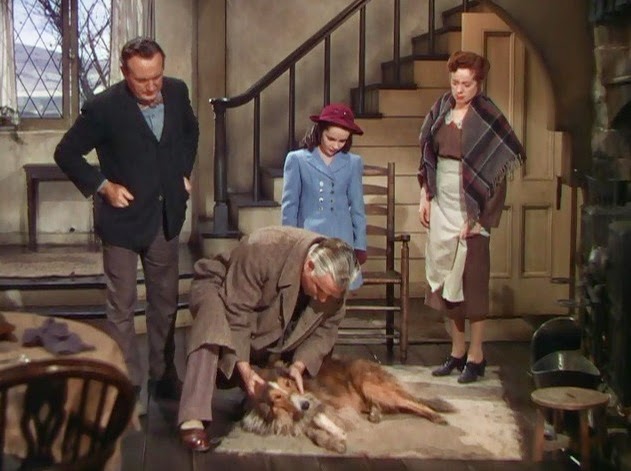
Inside Lassie's home

Lassie Comes Home is undoubtedly the best of all the pooch's films and its simple story was often times remade by a number of studios in the coming years. In this film Lassie follows her beloved master, Joe Carraclough ( Roddy McDowall ) to school everyday and waits outside the schoolhouse at 4pm precisely, when Joe leaves school, to walk home with him. Everyone in the village knows what time it is when they see dear Lassie pass by. Her internal clock never fails her. Of course, her being a big dog makes her have a big appetite and Joe's parents ( Donald Crisp and Elsa Lancaster ) just don't have the money to support her, let alone themselves, being as poor as they are. 

Outside Lassie's home

So to solve this situation they sell Lassie to a kindly dog breeder, the Duke of Rudling, ( Nigel Bruce ) who takes her off to Scotland to groom for some upcoming shows. Lassie doesn't enjoy the duke's idea of prime accommodations however and decides to hike back to his master - it being only several hundred miles to home. On route to Yorkshire he meets a few kind souls who sustain him on his journey, one of them being Rowlie the "pots" man ( played by the adorable Edmund Gwenn ) and the Faddens, Daniel and Dally Fadden ( Ben Webster and Dame May Whitty ).

Who would sell a dog that can curtsy?
Pal was a real ham when it came to acting and - viewer beware - you need a good pile of kleenexs on hand to watch this film. If Academy Awards were given to animals then Lassie would have earned one hands down ( I mean, paws down ) for his performance here.

What a ham!

Like most MGM films of the 1930s-1950s, Cedric Gibbons was billed as the art director with Edwin B. Willis handling the set decoration. Gibbons and Willis had a particular flair for creating old and weather-worn sets and the both the Clarracough and Fadden cottages have the look of being handed down from generations past. 


As poor as Lassie's family was it looks as though they lived in a bigger cottage than the Faddens for they had two bedrooms, with Joe having a room of his own upstairs. Downstairs there was only the main room, a country kitchen with fireplace and a round dining table which doubles as a desk for homework and sewing work.

In the Fadden cottage there is the main room as well with a door leading to the kitchen or possibly to the bedroom. It couldn't be more than 800 square feet and yet how comfortable a home it is! Just the right size. For a couple and a dog, that is....


Another bit of interesting trivia : Ben Webster and May Whitty were husband and wife in real life and you can see their comradery in their scenes together. Reminds us of that other great acting couple, Stringer Davis and Margaret Rutherford. 


After they rescue the poor wee dog during a rainstorm, Dally asks her husband to bring her some milk to feed Lassie with and we get to hear this wonderful bit of dialogue : 

"That's the last of the milk Dally. Won't be any for your tea tomorrow morning"

"It won't matter Dan. I often think we do things just from habit. In America they say that they always drink their tea without milk"

"Well.... that's because they haven't learned any better"

Tsk, tsk, tsk...those Americans are something else. Can't even drink a cup of tea properly!


It's a wonder no one has undertaken to build retirement homes of this size for elderly ( or newlywed ) couples. Although with the amount of "stuff" most people have these days, this size home wouldn't even be big enough to store what the average person has in their garage.