Showing posts with label Edward Judd. Show all posts

Thursday, October 26, 2023

Hammer Horror - The Golden Era (1956-1967)

Each year along with the approach of Halloween comes the bombardment of Hammer Horror films on television. Blood, gore, and buxom babes are splattered onscreen in brilliant Eastmancolor, while sanguinary counts and grimly ghoulish characters lurk stealthily in dark corners of seedy districts intent on carrying out nefarious deeds on their unsuspecting prey.

And we…sweet, kind, gentle, innocent viewers…sit by with pizza in hand, eyes-a-goggled and heart-a-pounding as we stare transfixed at our screens while these deliciously diabolical scenes are being carried out.

Prior to the British Hammer film, there really was no such thing as a “gory” film. There were lords of tiny European hamlets suffering from lycanthropy, mad scientists making pastiches out of gently worn body parts, secluded islands inhabited by horrific animal creatures, misguided poor souls continually making themselves disappear, and of course the all-too-common haunted house filled with frustrated spirits (and the occasional runaway gorilla)……but alas, no gore. Hammer Studios had found a niche and filled it capitally.

Just what would Halloween be without Christopher Lee and Peter Cushing entertaining us?  

Hammer Productions was formed in 1934 by William Hinds, a comedian and businessman who once went by the name of Will Hammer on stage. His films were low-budget and simply made but, even with his own distribution company, he wasn’t able to find a market for them and filed for bankruptcy in 1937.

A year later, his son, along with producer James Carreras, resurrected the production company and began work on a series of BBC radio adaptions such as Dick Barton Special Agent, and The Adventures of PC 49. Many films were made during the 1940s and early 50s but nothing of noteworthy attention, until, that is…1955. This was the year Hammer Studios released The Quatermass Xperiment, a wonderfully chilling adaption of the popular BBC television series of the same name. 

Quatermass, also known as The Creeping Unknown, was about a missile sent into space with three astronauts on board. Only one of the men return to Earth and with him, brings an alien infestation which turns him into an ‘orrible blood-sucking monster. Professor Bernard Quatermass (played by American actor Brian Donlevy) becomes the first of many, many scholarly extraterrestrial/mythical/vampyr hunters to be featured in Hammer film….Van Helsing being the most famous of these.

The film became the first to ever receive an X rating certificate from the British Film Board and was so successful that similarly themed pictures were quickly put into production and released.

X- The Unknown (1956) 

Radiation tests done by the British Army in a remote Scottish village unearth an unknown radioactive “blob” that leaves only the bodies of its burnt victims behind. Dr. Royston sets out to stop the beast before it grows bigger and bigger and feeds off of them all! Dean Jagger, Leo McKern, Edward Chapman, Anthony Newley.

Quatermass II: Enemy from Space (1957) 

Professor Quatermass explores a deadly gas that is originating from a hidden factory in rural England. Unusual creatures just may be planning something deadly for planet Earth and, once again, Quatermass is the man to stop them. Brian Donlevy, John Longden, Sidney James, Brian Forbes.

But it was when The Curse of Frankenstein came out in 1957 that the studio earned its infamous title as a House of Horror. This was, officially, the start of Hammer Horror.

The Curse of Frankenstein (1957) Using the hands of a pianist and the brains of a renowned scholar, Doctor Frankenstein sticks together a "human" from leftover bodies and finds that it didn’t quite turn out to be the success he had planned. Peter Cushing, Christopher Lee, Hazel Court.

Peter Cushing and Christopher Lee, heretofore relatively unknown company players, quickly earned worldwide recognition for their roles as Dr. Frankenstein and his Monster and for the next ten years basked in the sunshine – or rather moonlight – of success.

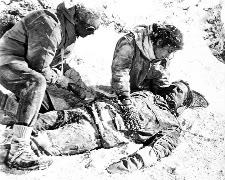
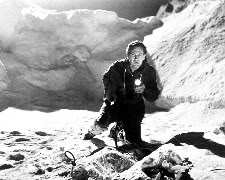
The Abominable Snowman (1958) High in the snow-covered Himalayan mountains, an English botanist and a burly American scientist lead an expedition to discover the legendary Yeti creature. Peter Cushing, Forrest Tucker, Maureen Connell.
Universal Studios was the American distributor of the Hammer horror series and since they earned such great returns off of them, they let them have access to their stock house of scripts. Numerous retellings of their horror classics were plotted out, and the studio focused all its efforts and funds on the making of these colorful adaptions.

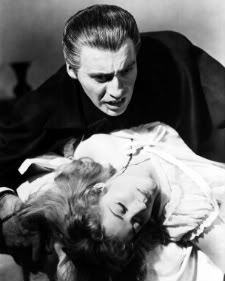
The Horror of Dracula (1958) After a man attacks Dracula in his castle (yes, bold man he be!), Dracula travels to a nearby village to seek revenge on his family and his fiancée. They turn to Professor Van Helsing, a fellow student of vampires, for help in destroying him. Peter Cushing, Christopher Lee, Michael Gough, Melissa Stribling.
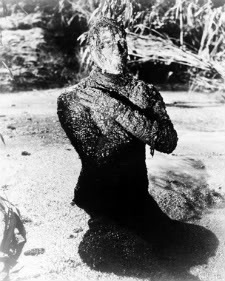
The Hound of the Baskervilles (1959) Sir Arthur Conan Doyle’s famous Sherlock Holmes novel gets a colorful retelling here, as the ace detective and his doctor friend come to the aid of a nobleman who is being threatened by supernatural hounds on the moors of his estate. Peter Cushing, Andre Morell, Christopher Lee, Marla Landi

The Hound of the Baskervilles was one of the less successful films in the series though Peter Cushing made an admirable Holmes, as did Andre Morell as Dr. Watson. During 1951 – 1967, Hammer Studios' home was in Bray, near Windsor, Buckinghamshire. A house (Down Place), a large backlot, and several smaller studios were on this property. The house was included in many of the films (it added a lot to that “Hammer atmosphere”) and the backlot was turned into a European village which was used again and again in different films. First in The Brides of Dracula, then as a Spanish village in The Curse of the Werewolf, as London in The Phantom of the Opera, and then as a Russian palace in Rasputin, the Mad Monk.

From 1960 on, Hammer consigned themselves to raising their monsters from their graves in sequels or rehashings of their previous successes…with the exception of The Phantom of the Opera, Curse of the Werewolf (another misfire), and The Gorgon…which were new characters to the series.

The Brides of Dracula (1960) A schoolteacher unknowingly sets free a young man ( of the undead variety ) in Transylvania, and worse yet, finds that he’s after her students at her school for girls. Peter Cushing, Martita Hunt, Yvonne Monlaur, David Peel

The Curse of the Werewolf (1961) A young Spanish boy on a hunting trip gets bitten by a wolf, and years later moonlights as a first-class howler in this retelling of the classic Universal The Wolf Man. Clifford Evans, Oliver Reed, Yvonne Romain

The Phantom of the Opera (1962) In Victorian London, a poor musical professor finds that his life work has been stolen by a corrupt lord and, with his fire-burnt disfigured face, he hides out in an Opera house as a “phantom” waiting for his moment of revenge. Herbert Lom, Edward de Souza, Michael Gough, Heather Sears

Kiss of the Vampire (1963) A young honeymooning couple gets stranded in a southern European village and are “helped” by an aristocratic family…who have a taste for newlywed blood. Clifford Evans, Edward de Souza.

Evil of Frankenstein (1964) – Penniless Baron Frankenstein, returns to his family castle to renew his work on his beloved Monster, only to find that an evil aid, Zoltan has been using his monster for his dirty work. Peter Cushing, Peter Woodthorpe, Duncan LaMont
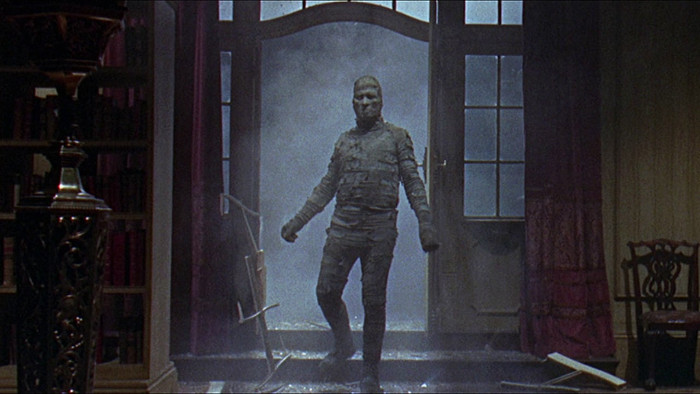
The Curse of the Mummy’s Tomb (1964) An Egyptian mummy is delivered to London, where it begins a rampage while under the control of a man with murderous intentions. Terence Morgan, Ronald Howard, Fred Clark

The Gorgon (1964)  In pre-WWII Germany, a small village is being plagued by a snake-haired gorgon who turns those who bear their eyes upon her to stone…only during full moons though. Professor Meister and Dr.Namaroff come to the aid of the townsfolk. Peter Cushing, Christopher Lee, Richard Pasco, Michael Goodliffe, Barbara Shelley

All of these Hammer Horror pictures really weren’t that scary (especially compared to today’s standards) but, in 1965, gore, as in bottles of oozy gooey goopy red ketchup, entered the picture. EEeeek!!

This was the year that the content of the Hammer films became more….ahem, mature…with the eyes of our blood-sucking fiendish friends glaring more fiercely, the bodices of their voluptuous prey creeping lower and lower, and pools of blood squirting to and fro, making Van Helsing’s appearance – along with his cross of Christ – all the more anticipated so we can see our anemic villains writhe in terror at their impending doom.

Dracula, Prince of Darkness (1966) Four unwary tourists take refuge in Count Dracula’s castle for the night (!). Within a few hours one of them is drained of his blood and his wife ( Shelley ) gets transformed into a vampire so the gruesome twosome can pursue the remaining two “guests”. Some hospitality. Christopher Lee, Barbara Shelley, Charles Tingwell

Island of Terror (1966) A group of doctors head to a remote island off the coast of Ireland to investigate a series of medical mysteries and discover a deadly lifeform unleashed. Peter Cushing, Edward Judd, Carole Gray, Keith Bell. 

Rasputin, The Mad Monk (1966) The story of the mad Russian “monk” Rasputin (aid to the Czars) is exploited in all its gory glory. Christopher Lee, Richard Pasco, Barbara Shelley, Suzan Farmer

Quatermass and the Pit (1967) While digging a subway in London, a construction crew discovers a skeleton and what seems to be a German missile….but in truth it is an alien spaceship. James Donald, Andrew Keir, Barbara Shelley

The Reptile (1966) While investigating his brother's death, a man and his wife move into his former cottage in a small village in England and become embroiled in a reptilian curse. Ray Barrett, Noel William, John Laurie, Jennifer Daniel. 

The Mummy's Shroud (1967) An archeological team discovers the remains of a mummy while on a dig in Egypt in 1920. Returning home to England with their find, the members are killed one by one. Andre Morrell, David Buck, Elizabeth Sellars, Maggie Kimberley.


There were also a number of "Scream Queens" that became associated with Hammer Horror (Hazel Court, Barbara Steele, and, later, Ingrid Pitt) but of them all, no one can top Barbara Shelley, that lovely English lady who somehow got caught in the vortex known as “the horror genre”. In total, she made seven pictures with the studio, sometimes as the victim, but not infrequently as a vampire herself.

Many believe that the golden age of Hammer Horror ended with Dracula: Prince of Darkness and that does indeed have some credibility to it, for the films made after this tend to be repetitious and rather malodorous.

All in all though, Hammer Studios had a long line of successes and it is during this bewitching month that we fans appreciate them the most. We get to sit back, have some popcorn, and enjoy Peter Cushing and those legendary ghouls give us goosebumps….what more fun could you have than that? 

Monday, July 13, 2015

Journey to the Unknown

This planet and all its wonders are not enough to satisfy man's unending quest to discover the unknown. To go where man has never gone before; to reach the unfathomable; to see the unseen; these desires have been etched in his soul from the beginning of Creation. 

" Why does man freeze to death to try and reach the North Pole? Why does man drive himself to suffer the steam and heat to discover the Amazon? Why does he stagger his mind with the math of the sky? Once a question arises in the human brain the answer must be found, whether it takes a hundred years or a thousand years. " 

These were the words of Alec McEwen in Journey to the Center of the Earth. 

The ultimate aim of all Science is to penetrate the unknown. And that's what the following films featured - daring men willing to stake their lives and undertake a perilous journey to reach this pinnacle of achievement for the future of Science and Mankind. And these "unknowns" are still a mystery to us today.


JOURNEY TO THE CENTER OF THE EARTH ( 1959 )

Scientists spent years exploring the many features of the Earth's surface but who has penetrated its depths? Arne Soknesson has! ....or so this movie claims. The 15th century explorer was ridiculed for his preposterous attempt to reach the Earth's core, but 400 years later, Professor Oliver Lindenbrook ( James Mason ) stumbles upon evidence that proves he did just that, and ventures forth to go there himself. Of course, by the time he leaves, the party has grown to five members : a student of his at the University of Edinburgh ( Pat Boone ), the widow of a fellow explorer ( Arlene Dahl ), a burly Norwegian ( Thayer David ), and his pet duck Gertrude ( herself ). Spending a year beneath the surface, they encounter a cavern of luminescent crystals, large deposits of salt, an ocean, the lost city of Atlantis, and even another explorer...bent on making sure his own name goes down in history as the first man to reach the center of the Earth! 


FIRST MEN IN THE MOON ( 1964 )

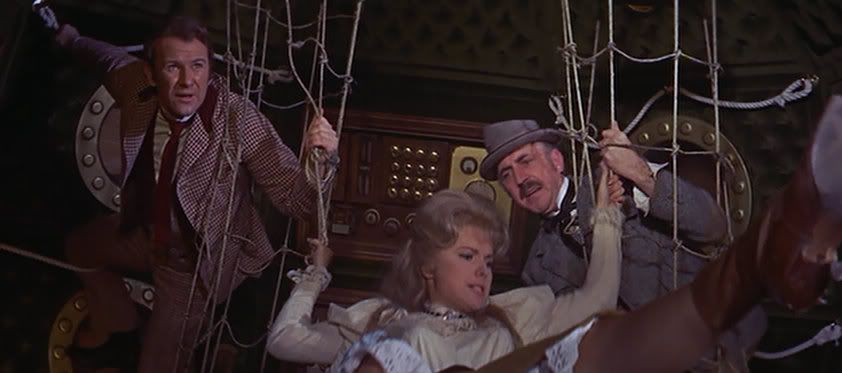
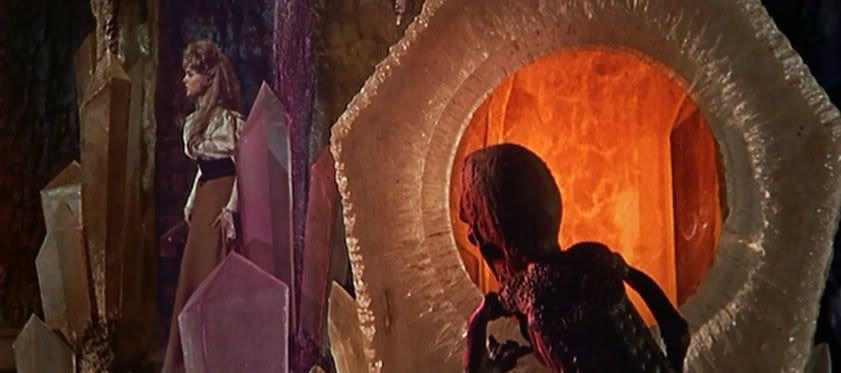
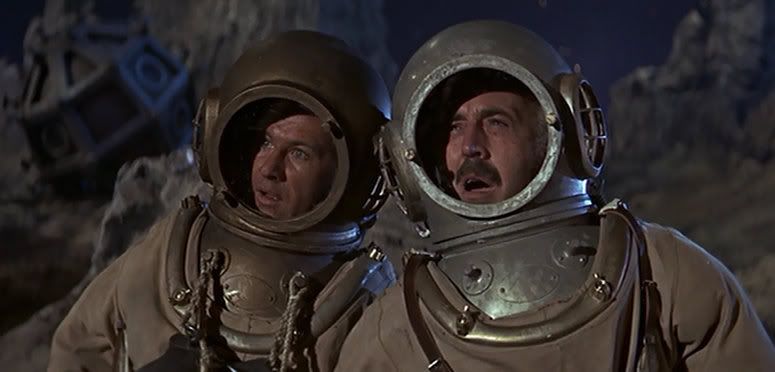
The year is 1899 and Professor Cavor ( Lionel Jeffries ) is busy working in his country home, perfecting Cavorite, a paste that, when applied to any object, renders it ineffectual to the force of gravity. Whoosh! upwards it will travel unless something blocks its path or a shield is placed over the Cavorite. What possible commercial value could Cavorite have? It could send a ship to the Moon of course, where unheard of deposits of rare minerals, gems, and gold could be just sitting on the surface! And that could make them rich, rich, rich! At least that's what Cavor and Arnold Bedford ( Edward Judd ) think. Arnold's fiancee Kate ( Martha Hyer ) accidentally comes along for the ride, but venturing inside the moon was not apart of their plan. Neither was an encounter with the Selenites - the insect-like creatures of the Moon.


THE TIME MACHINE ( 1960 )

Time - the cause of eternal bewilderment to man. It travels always onward, oblivious of events occurring within its domain, continually venturing forward into unexplored territory, ever unchanging and unstoppable. But scientists continue to explore this intangible mystery of our existence. Could altering the Past affect the Future? ( there is a good Outer Limits episode about that topic ); Could a journey into the Future help us make better decisions for Today? Well, these questions bothered George Wells ( Rod Taylor ) too. And besides, he felt like he never belonged in the era he was living ( that's nothing new ). So he constructs a time machine and after fiddling with the dials a bit, propels himself to the year 802,701 A.D. A blond-haired, blue-eyed race of humans called Eloi populate the Earth eating giant veggies and fruits, lounging around with no work to be done, and dashing off at sundown when the terrible mutants known as the Morlocks come out of their caverns to ....eek!...eat them. 

Our intrepid explorers have traveled to the center of the Earth, the inside of the Moon, and through the Ages of Time, and so what unknown territory is left?..... The Fourth Dimension. 


THE 4-D MAN ( 1959 )

Tony Nelson ( James Congdon ), a research scientist, is experimenting with a means to separate particles of matter from each other with an amplifier and, in doing so, discovers a way that one can "pass through" any object. His brother Scott ( Robert Lansing ) becomes jealous of his newfound knowledge - he's also sore because Tony stole his fiancee Linda ( Lee Merriwether in her first film ) - and steals this amplifier unit from him. But what he doesn't know is that every time he passes through an object, he ages! And even worse than that ( yes... there is something worse than aging ) touching another human causes instant death to them, but gives him renewed youth..... I'll let the movie explain the details of that phenomenon. 

___________________________________________________

Well, there you have it. As happy viewers munching on our popcorn, we can sit back and enjoy these explorations to the unknown, heartily cheering on our daring heroes while they endanger their lives for the benefit of our entertainment. And who knows? Maybe someday Man will take a hurdling leap into the Future and find our descendants, 350 years from now, enjoying these very same films.

Thursday, February 20, 2014

First Men in the Moon ( 1964 )

Charles Schneer and Ray Harryhausen, two of the foremost producers of sci-fi films of the 1960s, had in 1963 recently completed their sea-faring mythology extravaganza " Jason and the Argonauts "  when they decided to embark upon a screen-telling of H.G Well's famous Victorian fantasy novel "First Men in the Moon".

Filmed in astounding "Dynamation!" the movie begins in modern times with a UN space ship rocketing to the moon. Amidst cheers on Earth for the historic moment, the very first men walk on the surface of the moon.....but lo! within steps from their rocket ship these astronauts discover a flag - a Union Jack flag.  And along with the flag, a declaration ( written on the back side of a summons for Katherine Callender ) claiming British subjects had honorably walked that solitary surface in 1899....and had claimed the moon for her majesty, Queen Victoria.


Quickly a UN investigation team is dispatched to the tiny village of Dymschurch to question Katherine Callender, but when they discover that she had since died, they seek explantations from her husband Arnold who is now living in a nursing home.

After his initial shock at seeing photographs of the flag he had helped to place on the moon, he relates the story of their voyage.....

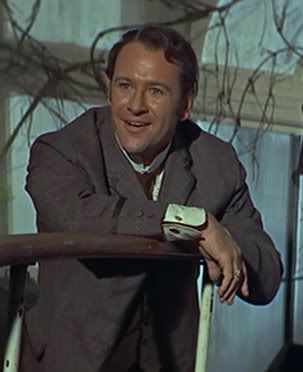
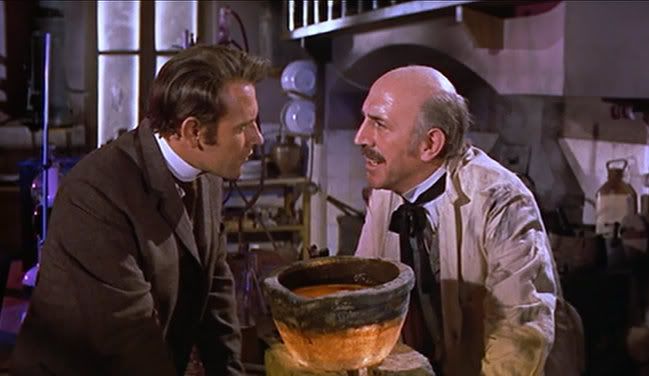
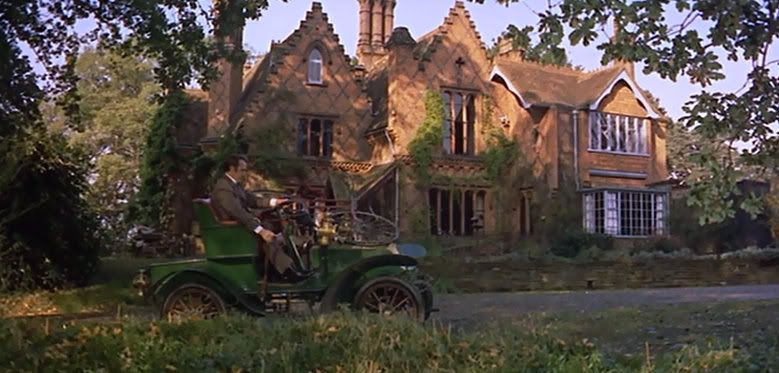
In the secluded country village in England, Arnold Bedford ( Edward Judd ) is working ( or rather....not working ) on his play. Always looking for a new way to make some money, he becomes fascinated with the scientific substance his neighbor, an eccentric scientist named Joseph Cavor ( admirably played by Lionel Jeffries ) has recently invented....Cavorite it is called. A liquid substance it be, and it deflects the force of gravitity on any object that it is painted unto. Seeing a very lucrative business opprotunity here, Arnold talks his way into becoming partners with Cavor.


Cavor explains that his main use for Cavorite will be to apply it to the surface of a bathysphere that he has constructed in his greenhouse with the intention of flying to the moon...and of course, Arnold is astonished at this fool hardy scheme...UNTIL that is, he hears the reason why. "There be gold in them thar mountains!" Ah yes, to the depths Man would fanthom for the pursuit of wealth.

And so, in no time at all our merry duo hastily prepare for their sojourn to the Moon. Unlike the book, where Bedford and Cavor remain the only passengers on this journey, the film added a female character - Bedford's fiancee, Katherine ( Martha Hyer ) known simply as "Kate" to tag along with the boys on their ride through space. A pretty addition she is too.

" Stop calling me Mrs. Bedford. We are not married! " ....." Not married?!... Madam ....kindly leave the room! "
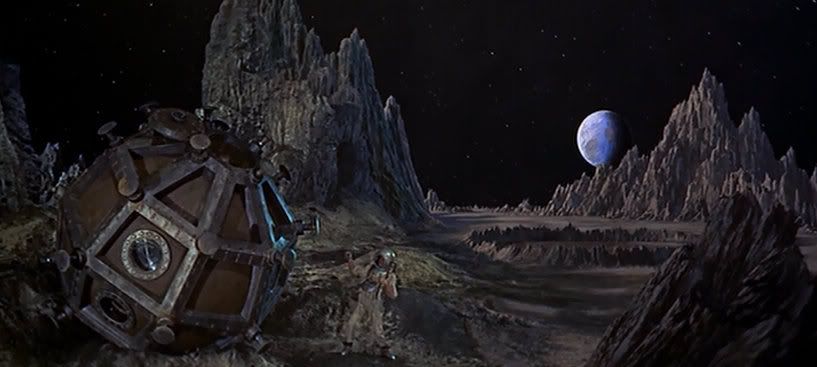
Once on the moon we see the handiwork of model-maker extrodinaire Ray Harryhausen with magnificent space sequences, a gigantic brained Grand Lunar ( seated on a throne behind a veiled screen, much like the Wizard of Oz ), a caterpillar-like mooncalf, and a number of little Selenites....which are actually children in suits, so maybe that doesn't count as Harryhausen handiwork.


"First Men in the Moon" has always been my favorite of all of the Charles Schneer/Ray Harryhausen pictures because of the mood it evokes. There is a beautiful Victorian flavour throughout the film and the pre-moon scenes are my especially favorites ( oddly enough, these are the ones that have no special effects at all and make up about 45 minutes of the picture ).


" It's....simply.....imperial "

Laurie Johnson, one of England's most renowned television and film composers at the time, wrote a haunting and atmospheric theme to "First Men in the Moon" as well as a lovely romantic ballad that can be heard softly in the background whilst our characters are at Cherry Cottage and during the greenhouse sequences. The complete soundtrack to the film has been released on audio cd but unfortunately, is quite a rare album to find today.


Peter Finch happened to stop by the set one day to visit his good friend, Lionel Jeffries, and found himself being used for a guest spot as the baliff who serves Kate her legal summons. Aside from his appearence there are not too many well-known character actors with the exception of Milles Malleson who does one of his characterisitc dithery/absent-minded impersonations as the church registar.

" Poor Cavor...he always did have that nasty cold "

"First Men in the Moon" takes us on a wonderful light-hearted sojourn to a Victorian era, a period when the spirit of exploration was at its peak and there were new and exciting worlds just waiting to be explored....and conquered. Some say this film drags on until the scenes when they land on the moon and see the "creatures" but I disagree. But then, that may be because I have never been much of a sci-fi film fan.

Anyway, overall the film is a delight to watch and the recent DVD release has just astounding sound and remarkable color restoration. Details you never thought to notice stand out bright and bold. It is a relaxing movie and what I like best of all about it is the carefree way our heroes go about on their expedition to the moon. They pack a few cans of sardines, a couple of chickens and are off on their way in no time at all. Where modern scientists take months and months of planning and preperation for a routine space flight, Bedford and Cavor simply put on their jackets, hop in their sphere....and enjoy the ride! What comes, comes.

Quite right.....the only way to travel.

Two chumps having a jolly good time on the Moon

This post was originally published on The Absent-Minded Buccaneer blog.