Showing posts with label Sci-Fi. Show all posts

Wednesday, July 17, 2024

Master of the World (1961)

In Morgantown, Pennsylvania, in 1868, a giant voice was heard booming from the mountain ridge known as The Great Eyrie. It was quoting from the Holy Book. John Strock (Charles Bronson), an agent for the United States Department of the Interior, decides to investigate this phenomenon and asks inventor/arms manufacturer Mr. Prudent (Henry Hull) to journey up to the mountain with him in his air balloon. Going along the ride is Prudent's daughter Dorothy (Mary Webster) and her fiancĂ©e Philip (David Frankham). 

However, the foursome never make it to the summit because their balloon is shot down by a giant airship called The Albatross. At the helm is Robur, a Nemo-like character who wants to stop warfare by forcing nations to disarm by the threat of destroying their instruments of war. Strock and the others are held prisoners onboard the Albatross until Strock hatches a plan to destroy Robur and his flying weapon. 

Producer Samuel Arkoff is best-known for his budget horror films (War of the Zombies, The Raven) and beach-party comedies (Bikini Beach, Beach Blanket Bingo) but Master of the World, released in 1961, marked his foray into Irwin Allen's territory of family-friendly sci-fi adventure. It wasn't a bad venture, either. 

Charles Bronson plays a likeable hero; the rest of the cast are engaging enough (especially Henry Hull), and the set design and bright color schemes are pleasant on the eye. The story, based on two novels by Jules Verne, is pretty much "20,000 Leagues Under the Sea" now set in the air. Vincent Price plays a good Robur, but he lacks the convincing anguish that James Mason gave to Nemo in the 1954 classic 20,000 Leagues Under the Sea and it is hard to feel compassion for his character. Perhaps it is because the audience is never given a reason why Robur is bent against stopping warfare, unlike Nemo whose family was killed in a war. 

The film could have used a sprinkling of comedy. 20th Century Fox's excellent sci-fi adventure Journey to the Center of the Earth was released just two years prior to Master of the World but what a world of difference in terms of production quality and entertainment. Master of the World would have been marvelous with James Mason, Pat Boone, Diane Baker and perhaps Richard Haydn cast as the aerial prisoners. Vito Scotti's kitchen humor just wasn't enough to add the element of fun to Master of the World, something the film needed. 

Nevertheless, the movie is one that I can re-watch numerous times. It is a classic steampunk picture released years before the term was even invented. 

The music, by conductor Les Baxter, is lovely and the supporting cast, made up of several less-known players are good in their parts. David Frankham, who plays Philip, was a familiar face on the small screen where he did numerous guest appearances in sitcoms, westerns, and dramas throughout the 1960s. Mary Webster was also a television actress (Arkoff was always mindful of the budget) and this was one of the rare feature films she made. Henry Hull was one of the few big-names on the roster, being an old character actor from the 1940s.

American International Pictures released Master of the World along with Konga as a double-feature in 1961, so if sci-fi did not appeal to the audience they could be entertained by a gorilla.

Sunday, July 7, 2024

From the Archives: The Deadly Mantis (1957)


William Hopper is giving Craig Stevens a hearty hello handshake but the Air Force-man only has eyes for Alix Talton....as does the men behind him. Of course, later all of them are more concerned about the giant mantis than romancing women from Washington. 

From the Archives is our latest series of posts where we share photos from the Silverbanks Pictures collection. Some of these may have been sold in the past, and others may still be available for purchase at our eBay store: http://stores.ebay.com/Silverbanks-Pictures

Sunday, August 29, 2021

The Flight That Disappeared ( 1961 )

Terror in the Sky....beyond known flight!

Just when you thought you explored all the sci-fi films of the 1960s, "new" titles appear in a book or while browsing online. For us, it was The Flight that Disappeared that magically appeared. If the title is new to you, too, it is probably because it was never released on VHS or DVD....and because it was produced by a not-so-famous independent production company: Harvard Film Corp. 

Today, it is available for viewing on Youtube and through streaming services such as Amazon Prime and Sling TV. The film is not worth going out of your way to track down but if it is easily accessible then give it a peek, you'll find it to be better than most B-films. 

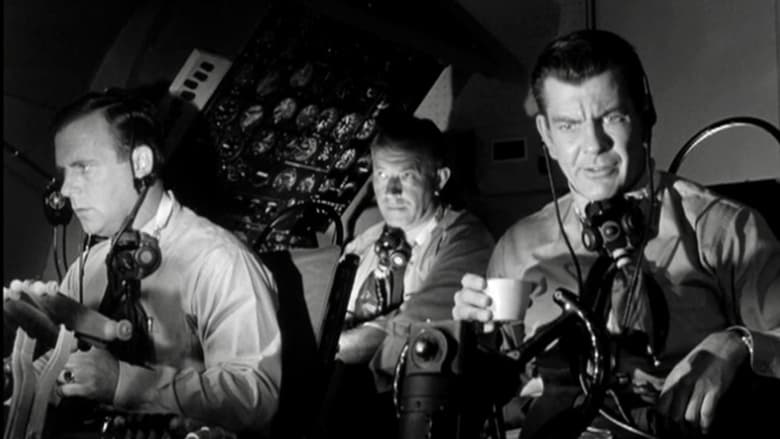
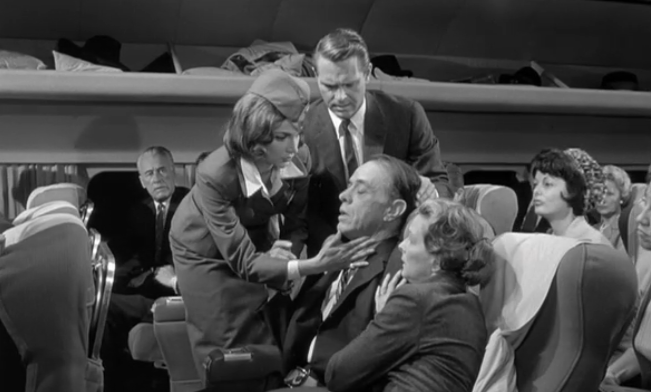
The movie begins on a jetliner en route to Washington D.C. Onboard is a nuclear physicist, a rocket expert, and a mathematical genius ( Craig Hill, Dayton Lummis, Paula Raymond ) who are all going to attend a conference at the Pentagon. Also onboard is a blind woman and her rather crazy husband ( Meg Wyllie and Harvey Stephens ), a pretty stewardess ( Nancy Hale ), and a handsome Dick Tracy-ish pilot ( John Bryant ). The flight begins smoothly until a mysterious force takes over the controls from the pilot and he finds the plane climbing on its own. It keeps right on climbing and climbing and climbing, even beyond the altitude that the jet was capable of withstanding. As the poster proclaims....What mysterious force took over the controls? 

It is at this point in the script that the film moves from an airplane adventure theme to science-fiction. Its plot may be a bit far-fetched for some, but there is a nice twist at the end that helps to ground it a bit more. 

The Flight that Disappeared has a runtime of only 72 minutes so it is a breeze to watch and the film features a great cast of B-actors. Craig Hill did a small number of films in the 1950s before he moved to Spain and became a lead actor in spaghetti westerns. He is best known for playing P.T. Moore in the television series The Whirlybirds ( 1957-1960 ). Paula Raymond had a long career in film and television but had few leading roles. Instead, she is best known for her appearances on Perry Mason ( and oddly enough, she resembles Della Street in this film ). 

John Bryant was also a frequent guest star on Perry Mason, but he is best known for playing Mark Fleming, the nephew of bank president John Fleming in the Vincent Price horror classic The Bat ( 1959 ) which, like this film, was released by Allied Artists. Interestingly, Harvey Stephens, who played John Fleming in The Bat, has a small part in this film, too. And lastly, there is Dayton Lummis, a very recognizable character actor who should have been given better parts than what he usually played. Right after filming wrapped on The Flight that Disappeared, Lummis teamed up with Craig Hill for another Harvard Film Corp. production - the drive-in classic Deadly Duo

Ready to take a look at The Flight that Disappeared? Grab yourself some popcorn and sit back and enjoy it right here

Friday, August 30, 2019

At the Earth's Core ( 1976 )

Kevin Connor is best known for directing a series of rather cheesy popcorn sci-fi/adventure film adaptations of Edgar Rice Burrough novels, a series which began with The Land That Time Forgot ( 1975 ).  Most of the films had great casts, adequate special effects and plenty of Jules Verne-ion atmosphere which helped off-set some of the - unfortunately frequent - boring scenes. 

Alas, At the Earth's Core's 89-minute runtime was made up primarily of yawn-inducing moments.  It had a great story premise but, like many of Kevin Connor's movies, was bogged down by too much emphasis on our heroes escape from the primitive tribe that was enslaving them. In this case, the tribe being the Mahars. 

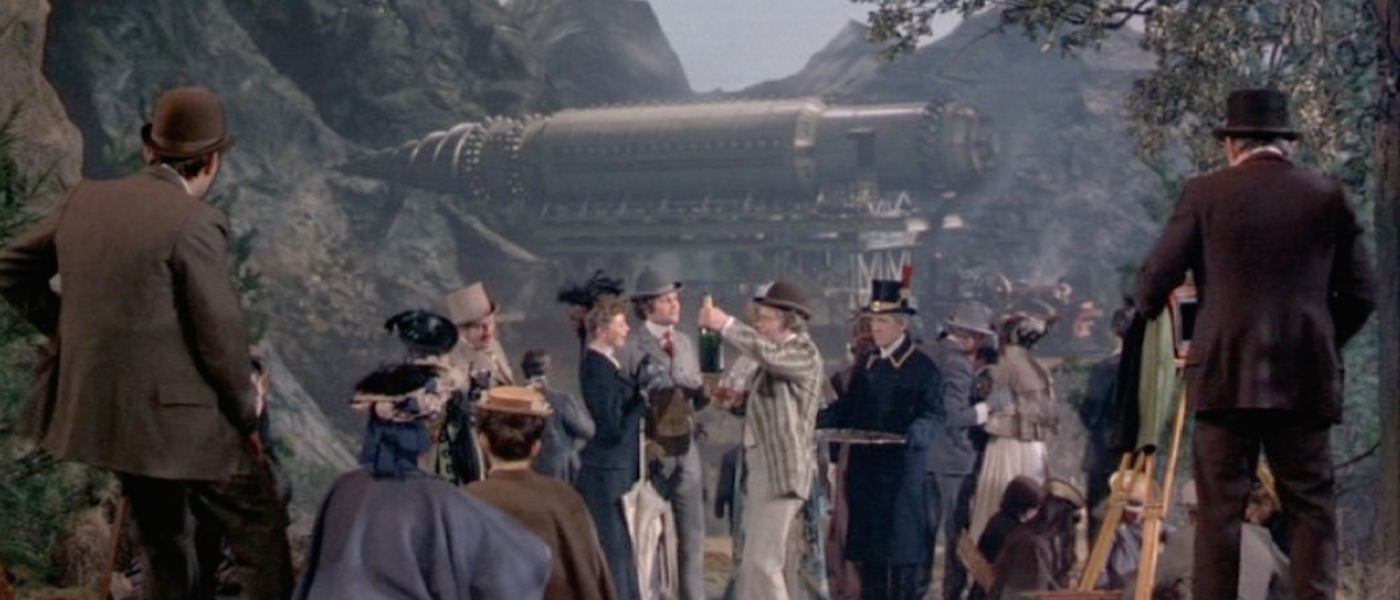
Peter Cushing gives a wonderful performance as the doddering Dr. Perry. This bespeckled British scientist has invented a machine called the Iron Mole which can bore through the Earth. Along with his partner, American financier David Innes ( Doug McClure ), they embark on a journey to the center of the Earth and discover a labyrinth where giant flying reptiles known as the Mahars rule a band of cavemen-like slaves. These slaves help to create tunnels where the Earth's molten lava is channeled away from their underground lair. Every once in awhile the Mahars get hungry and select a sacrificial victim to feast on. Princess Dia ( Caroline Munro ) is chosen to be their next dinner but David intervenes and rescues his newfound sweetheart, destroying the whole tunnel system in the process. 
A simple plot and a good one ( not unlike H.G Wells' First Men in the Moon ) but those darn Mahars were given too much of the film's attention. I am sure the male audience would have preferred the camera to linger on Caroline Munro rather than the giant reptiles. Not that there weren't other creatures to distract.....there were pig-snouted slave-drivers, giant rhino-like dinosaurs, and the mandatory pterodactyl. Yet, combined, they still weren't enough to wake-up the audience. 
It was refreshing to see Peter Cushing play a role so unlike the self-assured professor roles that he usually played in the Hammer films. Dr. Perry is eccentric but endearing and it would have been nice to see this character reappear in another film. Doug McClure gives his usual good performance and Caroline Munro is pleasant on the eyes ( she doesn't have much dialogue ). The remaining cast is obscured behind make-up, with the exception of Godfrey James and Cy Grant. 
At the Earth's Core was riding on the heels of the success of Kevin Connor's last film, The Land That Time Forgot ( 1975 ), and, in spite of its dull script, was very popular at the box-office. Connor would stick with his formula and make two more similiarly-themed films: The People That Time Forgot ( 1977 ) and Warlords of Atlantis ( 1979 ). 

Saturday, June 23, 2018

Space Academy ( 1977 ) - Television Series

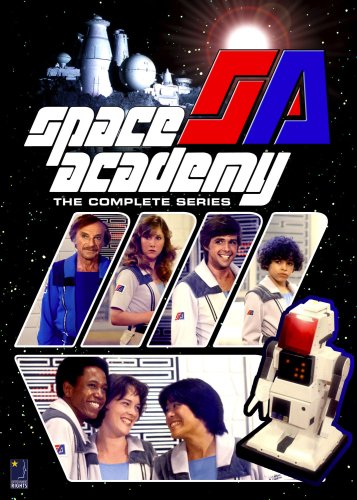
Shortly after Star Wars premiered in theatres in 1977, a space frenzy hit the entertainment industry and other similar-themed sci-fi films and television shows premiered, one of which was Space Academy. This half-hour production was aimed towards a juvenile audience and aired on Saturday mornings at 10:30am EST on the CBS network. It was set in the far far future and centered around a group of bright young students belonging to the intergalactic Space Academy ( "founded in the star year 3732" ) and the various lessons they learned from encountering strange beings from space and handling problems that arose on missions to different planets.

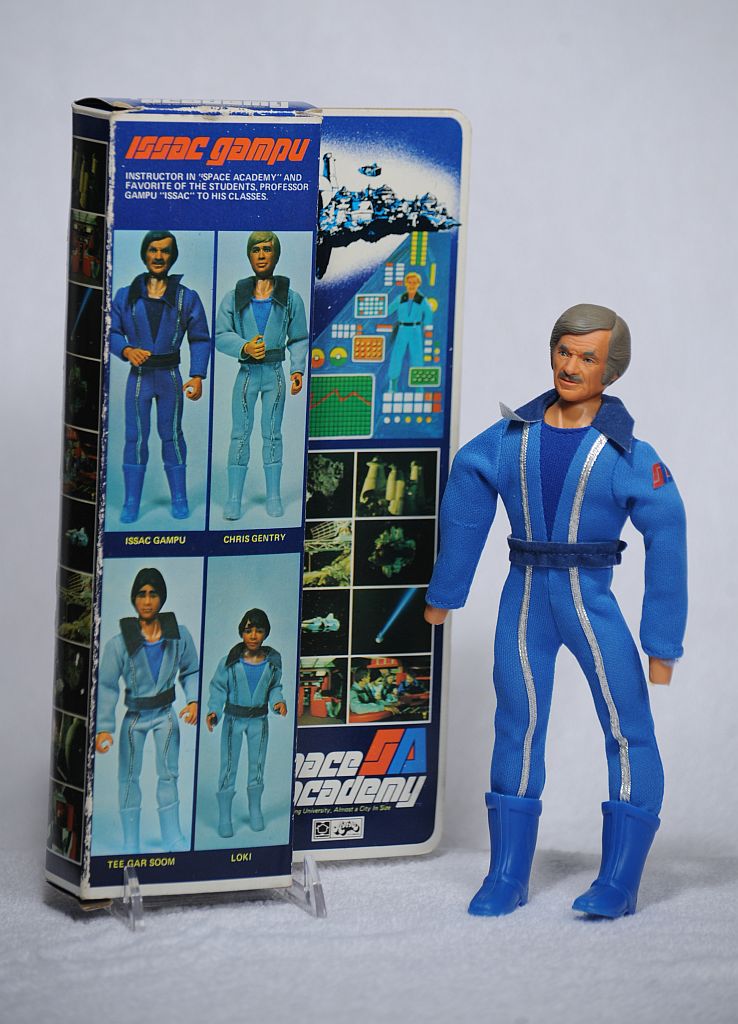
One of the heads of this academy was Commander Gampu, portrayed by none other than Jonathan Harris, the notorious Dr. Zachary Smith of Lost in Space. In Space Academy, his character is quite the opposite of Dr. Smith; he is a wise leader and a dear friend to all of the youngsters, especially little Loki, whom he rescued from the planet of Zalon. Indeed, it is Jonathan Harris' presence that makes the show so enjoyable.

This Filmation series featured excellent set design and special effects ( Space Academy had a $150,000 per episode budget ), especially considering this was a children's television show and not a feature film production. Most impressive are the shots of the Seeker, the Academy's smaller space-exploration vehicle ( the Ark II redressed ), returning to its port within the Space Academy's floating complex. 

Space Academy began its season with some clever storylines injected with appropriate morals but, as the series progressed, the scripts, unfortunately, became more and more juvenile in theme. Nevertheless, it is an entertaining series that has held up well over the years. 

Space Academy lasted but one season and then its spin-off Jason of Star Command took over its timeslot ( it was since moved to 12pm EST ) and this show did considerably better. The character of Commander Gampu was to have continued his leadership with a new group of students but Jonathan Harris had a "falling out" with Filmation and was replaced by James Doohan as Commander Canarvin, who was then replaced by the blue-faced Commander Stone ( John Russell ). 


The Characters 


Like Star Trek, each of the students belonging to Blue Team of Commander Gampu's squadron had various abilities as well as different character strengths and weaknesses. 

Commander Issac Gampu - Jonathan Harris

The 300-year-old Commander Gampu continually drives his cadets to do better and to think out problems for themselves. He is always there to dispense advice when needed and is an excellent leader, putting wisdom before action. 

Peepo

Peepo is a little robot that becomes indispensable to the Blue Team. He is actually a "self-determining type-A manu-droid" that Gampu had built years earlier. Peepo often displays human-like emotions such as happiness ( a high-pitched laughter sound ) and fear. Peepo is especially close to Laura. 

Chris Gentry - Ric Carrott

Chris is the captain of the Blue Team and chief pilot of the Seeker when they are sent out on intergalactic missions. He shares powers of telekinetics and astro-portation with his sister Laura. Chris also has a sweet-spot for Adrian. 

Laura Gentry - Pamelyn Ferdin

Laura is often placed second in command - "co-captain" - on missions and is a valuable team member, both on the Seeker and at the Academy where she helps to watch the monitors. She appears to be the most empathic of the group. 

Tee Gar Soom - Brian Tochi

Every team needs a good doctor. Tee Gar is not only the Blue Team's medical man but he is a whiz with electronics and karate as well. He carries out orders with promptness and is always there to give a helping hand. 

Paul Jerome - Ty Henderson

Paul comes from a "pioneer planet" where survival was of the utmost importance. After a rocky start with the Blue Team he comes to be relied upon as a trustworthy member of the team. He is often acting as co-pilot and is a role-model for little Loki. 

Adrian Pryce Jones - Maggie Cooper

Adrian is the scientist of the group, a geologist, and third in command. Whenever the team land on an alien planet, Adrian begins collecting soil samples and analyzing the minerals. She is also clever with gadgets and helps build devices that the Space Academy may use. 

Loki - Erik Greene

Named after the Norse god of mischief, this heavy-eyelashed youth was rescued from the planet Zalon by Commander Gampu and joins the Blue Team as their mascot, general errand boy, and chief troublemaker.

Merchandise 


Space Academy did not have the usual range of coloring books, posters, puzzles, etc, that most children's series inspired, but that is probably because the series ended after one season. The only collectible associated with the show that I was able to find was a series of dolls manufactured by the Aviva Toy Company of Hong Kong and distributed throughout the by F.W. Woolworth and Co. department stores. There were four dolls issued: Issac Gampu, Chris Gentry, Loki, and Tee Gar. They are quite valuable today since they are quite rare and were poorly made ( plastic deterioration is a concern ). 


Top 5 Favorite Episodes


Survivors of Zalon ( September 10, 1977 ) 

Unusual activity on Adrian's computer monitor suggests that there may be life on the planet Zalon, which is due to explode in 48 hours. Commander Gampu organizes a mission to Zalon with the Blue Team, and there they discover and rescue Loki, a curly-haired waif who has been tasked with guarding a pair of glowing crystals. 


Castaways in Time and Space ( November 17, 1977 )

Paul, a new recruit to the Academy, joins Chris and Tee Gar on a mission to rescue Commander Gampu and Laura who are stranded on an alien planet after entering a black hole with their Seeker. Paul and Chris share differences of opinion about risk, which relates to their backgrounds...Paul having come from a planet where personal survival is considered most important.


Countdown ( October 1, 1977 )

The Blue Team is sent in a Seeker to destroy floating space debris left-over from the Vegan Wars, three-hundred years ago. While surveying the surrounding area they discover a massive war vessel and explore it. Inside, in a freeze-chamber, is the body of a hostile Vegan named Roarg, and outside, attached to the hull, is an unexploded magnetic mine. 


The Rocks of Janus ( October 15, 1977 )

Two comets are hurtling towards the Space Academy and so Commander Gampu sends Blue Team out in a Seeker to plant explosive charges and destroy the comets before they come any closer. While Chris and the team set up the charges, Maggie and Laura take a rock sample - and discover that the rock they "tapped" bleeds! Once they discover it is a living organism they no longer wish to destroy it. 


My Favorite Marcia ( November 26, 1977 )

Commander Gampu leads a cadet team to study a star about to go supernova, when he determines that a "galactic distress beacon" has been activated on the fourth planet in a nearby star system. The signal is being sent by his old friend, Marcia, a rogue space trader who was hunting diamonds on the planet's surface when her spaceship's power was neutralized by an evil root - Robby the Robot ( of Forbidden Planet fame ).

Monday, February 29, 2016

Island at the Top of the World ( 1974 )

" Where the whales go to die. All those great creatures from every sea, lying there, from the beginning of time. "

Island at the Top of the World, an adventure film from Walt Disney Studios, has fallen into oblivion just like the burial grounds of the whales that the heroes of the picture are searching for. 

The arctic graveyard turns out to be quite an amazing sight...and so does the film, which combines a fun and thrilling plot with a fantastic visual theme. It takes place at the turn of the century and tells the story of an English aristocrat who employs the aid of a French airship captain and an American scientist to go to the Arctic to find his son, who went missing during an expedition to find the legendary whale burial grounds. In their quest for him, they discover a hidden island of Vikings untouched by civilization. 

Walt Disney Studios had made some stellar adventure films in the 1950s and 1960s such as 20,000 Leagues Under the Sea, Swiss Family Robinson, and In Search of the Castaways. However, after Disney's death in 1966, the studio was captained by a committee and the production values of their films declined drastically. 

Island at the Top of the World was the studio's attempt to recapture the glory days of Disney's live-action films and create an entertaining adventure picture for children and adults alike. As far as that goal was concerned, they accomplished it...but it took a few decades before the film found its audience. Island at the Top of the World was a dismal failure during its initial theatrical release.


The reason behind this? The timing just wasn't right. Critics and audiences during the early 1970s wanted something more than an old-fashioned steam-punk style adventure film. Also, the actors are not as engaging as they could have been, even though they handle their parts very well and, watching the film, you get a feeling that it was hurriedly assembled. Had Walt Disney been alive during its production the cast would have been top-notch, and the special effects made better. In truth, the film was six years in production, so time was not an issue. As far back as 1968 the studio was planning storyboard drawings to create this adaptation of Ian Cameron's 1961 book "The Lost Ones". 


The primary disappointment was the use of painted mattes throughout the film. In spite of being excellently painted by Peter Ellenshaw and Alan Maley, they hinder the realism of the picture during the action sequences. A less heavy reliance on the blue-screen, and the use of miniatures for the villages and volcanoes would have been better. These are the only major flaws in the film, however. The sequences of the airship "Hyperion" sailing through the foggy skies were extremely well filmed for its time and Maurice Jarre (Lawrence of Arabia) composed a memorable score for Island at the Top of the World, using ancient Nordic instruments to add to the film's authenticity. 


Donald Sinden, David Hartman, and Jacques Marin portray the principal characters with Mako playing a large supporting role as their Eskimo guide. David Gwillim and Agneta Eckemyr come in mid-way through the film to provide some youthful love interest as well. The characters travel high above icebergs, journey into a volcano, fight off killer whales, and are chased throughout the island by a mad and powerful Norseman known as the Godi, before they are able to escape back to Paris. 


If you are looking for an entertaining and action-packed film to watch on a Saturday evening, then don't steer away from Island at the Top of the World. It packs in more than its fair share of thrills and leaves you with the urge to set off on your own reckless journey into the skies with an airship. Great fun! 

Friday, November 20, 2015

Robinson Crusoe on Mars ( 1964 )

A lone astronaut pitted against all the odds beyond this earth. 

In the not too distant future, a two-manned spacecraft, the Mars Gravity Probe 1, nearly avoids a collision with an asteroid on its route to the red planet. The ship cannot hold altitude after altering its trajectory so the crew eject from the vessel, making a crash landing on Mars. 

Only Commander Kit Draper (Paul Mantee) and the ship's monkey Mona survive. His commanding officer Colonel McReady (Adam West) is killed in the collision. Draper leaves the wreckage behind and, with Mona in tow, proceeds to find shelter on Mars. He assesses his situation, takes stock of his supplies and begins to determine his needs. He finds the atmosphere thin and breathable for only short periods of time and so maintaining a continuous air supply becomes Draper's first priority. Later, he discovers sources of food and water. When alien spaceships come to Mars to recapture an escaped slave (Victor Lundin), Draper is relieved to find another person to converse with and helps the slave "Friday" hide from their watchful eye until they depart. 

Robinson Crusoe on Mars is unlike other science-fiction films of the era. While most pictures that were set in outer space pitted a crew of astronauts against a creature or creatures unknown, Robinson Crusoe on Mars focused on one man all alone in unfamiliar territory and his struggle to conquer loneliness, a beast more fearsome than any two-headed martian. 


Kit Draper strikes us as a modern intelligent human, not giving in to panic and capable of managing in extreme situations. He is a well-trained astronaut. Draper underwent months of vigorous pre-flight training and simulations of what he would encounter on Mars. He is prepared for any and all circumstances...or so he believes. What he is not prepared for is the chasm of loneliness he would feel in his new surroundings. He is grateful for the companionship of his monkey but longs for human conversation. Robinson Crusoe on Mars depicts interaction between people as a vital element to human survival, as necessary to man as oxygen or water and it is this facet of the film that makes it more realistic than other sci-fi films of the 1950s. 

Paul Mantee considered Draper a difficult character to portray since he had no one to interact with, but he handled the part beautifully. Unlike many films that portray solitary characters, Robinson Crusoe on Mars avoided giving audiences a mental voice-over from the main protagonist and instead we discover Draper's thoughts only through his discussions with Mona and his "diary", his recordings of his actions onto video and audio tape.

Victor Lundin had parts in television westerns and other series (primarily portraying Native Americans) before he was given his first starring feature film role as the intergalactic mining slave, Friday. Adam West had very little screen time and what little dialogue he had was uttered in his usual stilted manner but he more than made up for that by his surreal materialization in one truly spine-tingling hallucination sequence. Mona the monkey was portrayed by a talented newcomer named Barney who had to humble himself and endure wearing not only the miniature space-suit costume for the part but a fur-covered diaper as an undergarment.

The premise of Daniel Defoe's beloved 1719 novel "Robinson Crusoe" was transported into the space age by screenwriter Ib Melchoir who set out to create a realistic portrayal of an astronaut's experience on an unexplored planet. A heady task considering it would be five more years before mankind would even set foot on the moon. 


He retained all of the key elements of Defoe's novel - Crusoe's determination to survive, his methods of survival, and his struggle with loneliness - replacing only the cannibals with alien slavers to make the story more plausible. Ironically, it is Melchoir's faithfulness to the book that bogs down the final chapter of the film. Draper's solitary experience of survival and his encounter with the aliens would have made a fascinating picture in itself. The Egyptian-like slave sequence was unnecessary and tiresome.

Like the novel, Robinson Crusoe on Mars retains a strong religious subtext running through the film. At just the right moments, Draper's life is spared by the hand of God. Heat, shelter, food, companionship, all become available to him in his hour of need. While Draper may be all alone in the new world, he knows he always has God looking after him, giving him hope.


Crusoe's director, Byron Haskin, had a career stretching back as far as the silent era when he worked as a cinematographer to D.W. Griffith. During the 1930s and 40s, he headed up the visual effects department at Warner Brothers, working on such classics as The Sea Hawk, High Sierra, and Dive BomberHaskin had directed some iconic sci-fi films and television series (War of the Worlds, Conquest of Space, and several episodes of The Outer Limits) before taking the helm of Crusoe. 

His experience in visual effects is demonstrated in the marvelous long shots where we witness Draper exploring one vast territory of desolate landscape after another with only Albert Whitlock's matte paintings being utilized to create the backdrops of space. This skyline looks majestic and peaceful compared to the steaming hot surface of Mars or its cool polar icecaps. Location footage was shot in Death Valley where the clear skies were used as a natural "blue screen" and enabled the matte paintings to be implemented. 

Some of the other special effects in the film seem primitive and will look dated to modern viewers but Robinson Crusoe on Mars stands out for these dynamic visualizations of Mars. An entire harsh ecosystem is conveyed through its simple sets. Over fifty years later, it is impressive to see how accurately Mars was depicted in 1964. Wouldn't it be ironic if astronauts of the future land on Mars only to find the same landscape depicted in this film? 

This post is our contribution to the Criterion Blogathon being hosted by Criterion Blues, Speakeasy and Silver Screenings. To view the impressive line-up of film articles visit any one of these blogs for a complete list. 

Monday, July 13, 2015

Journey to the Unknown

This planet and all its wonders are not enough to satisfy man's unending quest to discover the unknown. To go where man has never gone before; to reach the unfathomable; to see the unseen; these desires have been etched in his soul from the beginning of Creation. 

" Why does man freeze to death to try and reach the North Pole? Why does man drive himself to suffer the steam and heat to discover the Amazon? Why does he stagger his mind with the math of the sky? Once a question arises in the human brain the answer must be found, whether it takes a hundred years or a thousand years. " 

These were the words of Alec McEwen in Journey to the Center of the Earth

The ultimate aim of all Science is to penetrate the unknown. And that's what the following films featured - daring men willing to stake their lives and undertake a perilous journey to reach this pinnacle of achievement for the future of Science and Mankind. And these "unknowns" are still a mystery to us today.


JOURNEY TO THE CENTER OF THE EARTH ( 1959 )

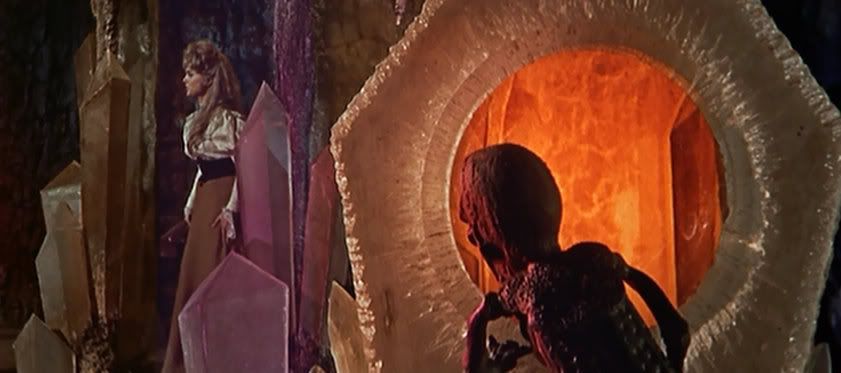
Scientists spent years exploring the many features of the Earth's surface but who has penetrated its depths? Arne Soknesson has! ....or so this movie claims. The 15th century explorer was ridiculed for his preposterous attempt to reach the Earth's core, but 400 years later, Professor Oliver Lindenbrook ( James Mason ) stumbles upon evidence that proves he did just that, and ventures forth to go there himself. Of course, by the time he leaves, the party has grown to five members : a student of his at the University of Edinburgh ( Pat Boone ), the widow of a fellow explorer ( Arlene Dahl ), a burly Norwegian ( Thayer David ), and his pet duck Gertrude ( herself ). Spending a year beneath the surface, they encounter a cavern of luminescent crystals, large deposits of salt, an ocean, the lost city of Atlantis, and even another explorer...bent on making sure his own name goes down in history as the first man to reach the center of the Earth! 


FIRST MEN IN THE MOON ( 1964 )

The year is 1899 and Professor Cavor ( Lionel Jeffries ) is busy working in his country home, perfecting Cavorite, a paste that, when applied to any object, renders it ineffectual to the force of gravity. Whoosh! upwards it will travel unless something blocks its path or a shield is placed over the Cavorite. What possible commercial value could Cavorite have? It could send a ship to the Moon of course, where unheard of deposits of rare minerals, gems, and gold could be just sitting on the surface! And that could make them rich, rich, rich! At least that's what Cavor and Arnold Bedford ( Edward Judd ) think. Arnold's fiancee Kate ( Martha Hyer ) accidentally comes along for the ride, but venturing inside the moon was not apart of their plan. Neither was an encounter with the Selenites - the insect-like creatures of the Moon.


THE TIME MACHINE ( 1960 )

Time - the cause of eternal bewilderment to man. It travels always onward, oblivious of events occurring within its domain, continually venturing forward into unexplored territory, ever unchanging and unstoppable. But scientists continue to explore this intangible mystery of our existence. Could altering the Past affect the Future? ( there is a good Outer Limits episode about that topic ); Could a journey into the Future help us make better decisions for Today? Well, these questions bothered George Wells ( Rod Taylor ) too. And besides, he felt like he never belonged in the era he was living ( that's nothing new ). So he constructs a time machine and after fiddling with the dials a bit, propels himself to the year 802,701 A.D. A blond-haired, blue-eyed race of humans called Eloi populate the Earth eating giant veggies and fruits, lounging around with no work to be done, and dashing off at sundown when the terrible mutants known as the Morlocks come out of their caverns to ....eek!...eat them. 

Our intrepid explorers have traveled to the center of the Earth, the inside of the Moon, and through the Ages of Time, and so what unknown territory is left?..... The Fourth Dimension. 


THE 4-D MAN ( 1959 )

Tony Nelson ( James Congdon ), a research scientist, is experimenting with a means to separate particles of matter from each other with an amplifier and, in doing so, discovers a way that one can "pass through" any object. His brother Scott ( Robert Lansing ) becomes jealous of his newfound knowledge - he's also sore because Tony stole his fiancee Linda ( Lee Merriwether in her first film ) - and steals this amplifier unit from him. But what he doesn't know is that every time he passes through an object, he ages! And even worse than that ( yes... there is something worse than aging ) touching another human causes instant death to them, but gives him renewed youth..... I'll let the movie explain the details of that phenomenon. 

___________________________________________________

Well, there you have it. As happy viewers munching on our popcorn, we can sit back and enjoy these explorations to the unknown, heartily cheering on our daring heroes while they endanger their lives for the benefit of our entertainment. And who knows? Maybe someday Man will take a hurdling leap into the Future and find our descendants, 350 years from now, enjoying these very same films.

Thursday, February 20, 2014

First Men in the Moon ( 1964 )

Charles Schneer and Ray Harryhausen, two of the foremost producers of sci-fi films of the 1960s, had in 1963 recently completed their sea-faring mythology extravaganza " Jason and the Argonauts "  when they decided to embark upon a screen-telling of H.G Well's famous Victorian fantasy novel "First Men in the Moon".

Filmed in astounding "Dynamation!" the movie begins in modern times with a UN space ship rocketing to the moon. Amidst cheers on Earth for the historic moment, the very first men walk on the surface of the moon.....but lo! within steps from their rocket ship these astronauts discover a flag - a Union Jack flag.  And along with the flag, a declaration ( written on the back side of a summons for Katherine Callender ) claiming British subjects had honorably walked that solitary surface in 1899....and had claimed the moon for her majesty, Queen Victoria.


Quickly a UN investigation team is dispatched to the tiny village of Dymschurch to question Katherine Callender, but when they discover that she had since died, they seek explantations from her husband Arnold who is now living in a nursing home.

After his initial shock at seeing photographs of the flag he had helped to place on the moon, he relates the story of their voyage.....

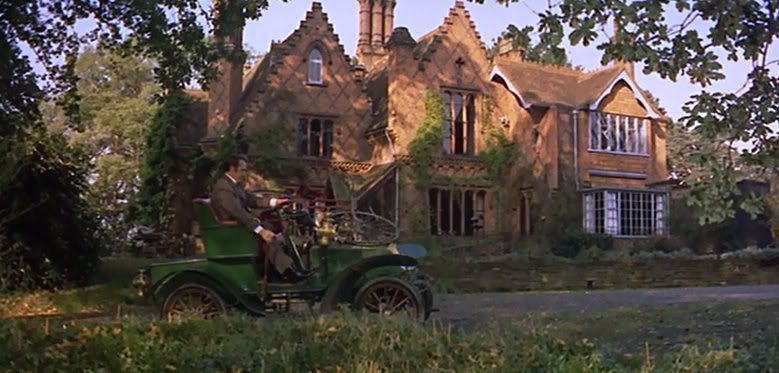
In the secluded country village in England, Arnold Bedford ( Edward Judd ) is working ( or rather....not working ) on his play. Always looking for a new way to make some money, he becomes fascinated with the scientific substance his neighbor, an eccentric scientist named Joseph Cavor ( admirably played by Lionel Jeffries ) has recently invented....Cavorite it is called. A liquid substance it be, and it deflects the force of gravitity on any object that it is painted unto. Seeing a very lucrative business opprotunity here, Arnold talks his way into becoming partners with Cavor.


Cavor explains that his main use for Cavorite will be to apply it to the surface of a bathysphere that he has constructed in his greenhouse with the intention of flying to the moon...and of course, Arnold is astonished at this fool hardy scheme...UNTIL that is, he hears the reason why. "There be gold in them thar mountains!" Ah yes, to the depths Man would fanthom for the pursuit of wealth.

And so, in no time at all our merry duo hastily prepare for their sojourn to the Moon. Unlike the book, where Bedford and Cavor remain the only passengers on this journey, the film added a female character - Bedford's fiancee, Katherine ( Martha Hyer ) known simply as "Kate" to tag along with the boys on their ride through space. A pretty addition she is too.

" Stop calling me Mrs. Bedford. We are not married! " ....." Not married?!... Madam ....kindly leave the room! "
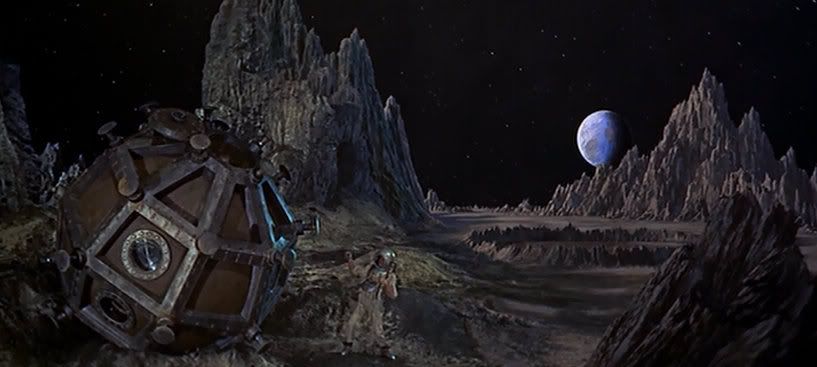
Once on the moon we see the handiwork of model-maker extrodinaire Ray Harryhausen with magnificent space sequences, a gigantic brained Grand Lunar ( seated on a throne behind a veiled screen, much like the Wizard of Oz ), a caterpillar-like mooncalf, and a number of little Selenites....which are actually children in suits, so maybe that doesn't count as Harryhausen handiwork.


"First Men in the Moon" has always been my favorite of all of the Charles Schneer/Ray Harryhausen pictures because of the mood it evokes. There is a beautiful Victorian flavour throughout the film and the pre-moon scenes are my especially favorites ( oddly enough, these are the ones that have no special effects at all and make up about 45 minutes of the picture ).


" It's....simply.....imperial "

Laurie Johnson, one of England's most renowned television and film composers at the time, wrote a haunting and atmospheric theme to "First Men in the Moon" as well as a lovely romantic ballad that can be heard softly in the background whilst our characters are at Cherry Cottage and during the greenhouse sequences. The complete soundtrack to the film has been released on audio cd but unfortunately, is quite a rare album to find today.


Peter Finch happened to stop by the set one day to visit his good friend, Lionel Jeffries, and found himself being used for a guest spot as the baliff who serves Kate her legal summons. Aside from his appearence there are not too many well-known character actors with the exception of Milles Malleson who does one of his characterisitc dithery/absent-minded impersonations as the church registar.

" Poor Cavor...he always did have that nasty cold "

"First Men in the Moon" takes us on a wonderful light-hearted sojourn to a Victorian era, a period when the spirit of exploration was at its peak and there were new and exciting worlds just waiting to be explored....and conquered. Some say this film drags on until the scenes when they land on the moon and see the "creatures" but I disagree. But then, that may be because I have never been much of a sci-fi film fan.

Anyway, overall the film is a delight to watch and the recent DVD release has just astounding sound and remarkable color restoration. Details you never thought to notice stand out bright and bold. It is a relaxing movie and what I like best of all about it is the carefree way our heroes go about on their expedition to the moon. They pack a few cans of sardines, a couple of chickens and are off on their way in no time at all. Where modern scientists take months and months of planning and preperation for a routine space flight, Bedford and Cavor simply put on their jackets, hop in their sphere....and enjoy the ride! What comes, comes.

Quite right.....the only way to travel.

Two chumps having a jolly good time on the Moon

This post was originally published on The Absent-Minded Buccaneer blog. 

Tuesday, November 5, 2013

The Quatermass Report - Part Two

In our continuing look at the influential Quatermass series of the mid-century we turn the spotlight onto Nigel Kneale's final serial of the 1950s - Quatermass and the Pit, as well as the final episode, simply entitled Quatermass from 1979. Part One is available to read here. 


QUATERMASS AND THE PIT

Andre Morrell, who had been the original choice for the role of Professor Quatermass when Kneale first conceived of the character in 1953, had finally consented to portray the now-famous bow-tied Brit. This third installment, released in 1958, combined the same elements of the previous series - an alien invasion through human takeover and a time-ticking race on Quatermass' part to stop this - but in a new and completely absorbing way. In fact, Quatermass and the Pit is one of the best of the series. 

"The last adventure, which I called Quatermass and the Pit, went way past the concerns of the time and into an ancient and diabolical race memory," said Kneale in an interview in 1996. "It sought to explain man's savagery and intolerance by way of imagines that had been throbbing away in the human brain since it first developed. Racial unrest, violence and purges were certainly with us in the 1950s, and I tried to speculate on where they first came from."


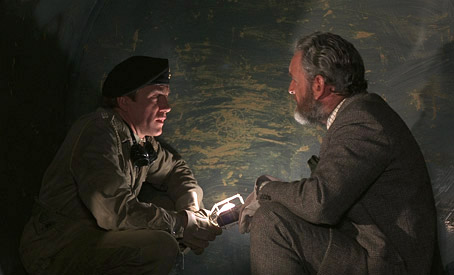
During routine engineering work at Hobbs' End underground station ( "Hob" is a folk name for Satan ), a group of bones and half complete skeletons of ape men are discovered, apparently drastically predating the era that scientists had established for those creatures. Later, an unusual metal container is unearthed. The authorities, led by the unimaginative Colonel Breen ( Julian Glover ), believe it to be an unexploded bomb left over from WW2, but when Professor Quatermass arrives on the scene, he proves otherwise. The contents inside reveal to him a discovery which shatters the accepted theory of Darwin's evolution and offers a dire warning for the future of mankind. 


Kneale ambitiously attempted to rationalize the nature of both supernatural hauntings and human concepts of the devil and, surprisingly, he translated those ideas into a convincing and plausible, if improbable, script. 

Quatermass and the Pit was broadcast in December 1958 and received much acclaim from television critics, with several reviewers praising Morell for having given the definitive portrayal of Professor Quatermass. Cic Linder, Anthony Bushnell, and John Stratton rounded out the great cast. 


As with the previous two serials, Hammer purchased the film rights to these monumental Pit episodes, however, partly due to the declining box-office receipts of Quatermass 2, Kneale's refusal to tolerate a drunken Donlevy once again, and Columbia disinterest in the series ( Hammer had recently struck a distribution deal with Columbia Pictures ), it was not brought to the big screen until February 16, 1968.

Instead, Hammer plunged into another film adaptation of a Kneale teleplay - this time of "The Creature" ( 1955 ), which they retitled The Abominable Snowman

Roy Ward Baker undertook the directorial responsibilities when Quatermass and the Pit was put into production in February 1967. Baker had directed a number of fine films during the 1950s, notably The October Man and A Night to Remember, but several recent failures made him turn to television, directing episodes of such popular crime-fighting series like The Saint and The Avengers. 


Kenneth More was Baker's original choice for the part of Quatermass, but eventually he selected Andrew Keir to replace Morell, who had turned down the chance to play the role again. This was a stroke of good fortune, for Keir brought an excellent steely determination to his characterization of the professor as well as injecting a very human fragility and vulnerability. 

James Donald adds great support to Keir, and Barbara Shelley, one of Hammer's most popular and prolific leading ladies, is excellent as fellow scientist, Barbara Judd. Quatermass and the Pit ( also known as Five Million Years to Earth ) was her final film for the studio. There are a swarm of delectable British character actors to enjoy as well, including Peter Copley, Bryan Marshall and Edwin Richfield.

Hammer's home base, the Associated British Studios in Elstree, Borehamwood did not allow for enough space to film and so the project was relocated to the MGM Borehamwood studios where no other film was being shot at the time, giving the crew - and especially the production designers - ample space to work with, which they utilized in creating the enormous Underground station and excavation settings. 


QUATERMASS 1979 

After Quatermass and the Pit, Hammer approached Kneale about the possibility of writing another script for a film follow-up but that idea never came to fruitation. Instead, Professor Quatermass made his final television appearance in the four-part 1979 Thames Television serial release, simply entitled Quatermass. Alas, it was a serial that should not have been made. In the mid 1960s, Nigel Kneale had written a dreary and depressing tale of the future state of London - and much of the world - where young people have formed violent gangs and attack bystanders without provocation while bands of hippies worship the ancient energies and dance around archaic stone monuments waiting to be transported by aliens into a faraway world. 


Quatermass was not put into production until late 1978, when these peace, love and hate incidents seemed oddly irrelevant.  What's worse, Professor Quatermass is no longer an optimistic man of science, but has warped into a bitter and discouraged old man. He has long been retired, living in retreat in the Scottish Highlands. His sole purpose in coming to London is to search for his missing teenage granddaughter. After a recent space mission goes horribly wrong, right before the public's eyes on live television, a young astronomer ( Simon MacCorkindale ) and Quatermass search to find the answers to this occurrence and other unusual happenings.
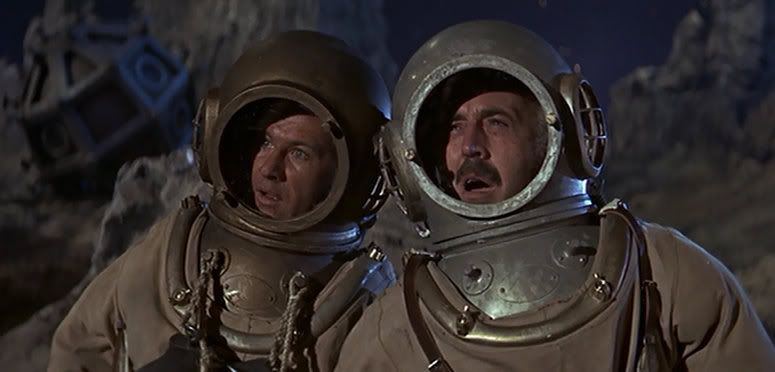
The series, and even the 100-minute feature film release The Quatermass Conclusion, progress along cumbersomely and convey a bleak dystopian setting, a far cry from the 1950s post-war Britain of the previous serials.

Whereas Kneale's original series were genre-defining and ground-breaking, this Quatermass lacks energy and quite frankly, fizzles out before it has a chance to begin. Not even John Mills' superb acting ability could inject new life into the character. 


THE QUATERMASS EXPERIMENT 2005

BBC Four attempted to revive Professor Quatermass for the younger generation 
in 2005, when they mounted a remake of the original Quatermass Experiment, this time with a much more youthful Jason Flemyng portraying the now tie-less Professor. More recently, Simon Oakes, the current CEO of Hammer Films has announced plans to dip into the archives and remake several of Hammer's post popular films, including the inimitable Quatermass.

The BBC Quatermass serials of yor did not rely on special effects but rather on interesting characters, good dialogue and an intelligent story, elements seen far too rarely in modern science fiction films, which hopefully will be remedied if a remake is undertaken. 

To this day Nigel Kneale's creation of Quatermass, and the serials that showcased this character, remain one of the BBC's finest achievements and influenced numerous science-fiction series including Doctor Who and Sapphire and Steele. 

Be sure to check out the Quatermass films available on DVD, as well as The Quatermass Film Music Collection.