Showing posts with label Emile Kuri. Show all posts

Friday, October 30, 2020

TV/Movie Set: Bedknobs and Broomsticks ( 1971 )

It has been a long, long time since we have featured a TV/Movie set article, so to bring the series back to life, my sister and I selected a house design that we have loved for years - the Bedknobs and Broomsticks manor. It's so fitting for this time of year, too. 

This beautiful English Tudor belonged to Eglantine Price ( Angela Lansbury ), the heroine of Bedknobs and Broomsticks, a bewitching 1971 musical from Walt Disney Studios. The film tells the story of a would-be witch who attempts to learn the secret of the missing spell of "Substituiary Locomotion" in order to help England defeat the Nazis during World War II. 

Miss Price's secluded house overlooked the chalky white cliffs of Dover. It was an ideal place for her to practice witchcraft without the citizens of Pepperinge Eye knowing what she was doing. She was disappointed to get saddled with three orphaned evacuee children from London, but once they learned that she was an apprentice witch, they come to her aid and help her to locate the missing spell.

Here is a quick sketch of the layout of the interior of the house. Since only one side of the living room was shown, I left that part of the sketch undone. 

Let's take a look at the house more closely with some screenshots......

EXTERIOR

John B. Mansbridge, a fabulous art director who was in charge of many of Walt Disney's productions throughout the 1960s and 1970s, was the art director of this film and he did a beautiful job of recreating a World War II-era English manor. Peter Ellenshaw is also credited as art director for the production, but since he was a matte artist, most of his work was probably painting the exterior shots of the house ( see the two screenshots above ). 

Like many old manor homes, Mansbridge designed the house to look like it had a number of additions added to it over the years. The "original" house did not have a kitchen, so as you can see in the sketch, it is one of the additions and located off the living room instead. 


When Miss Price first arrives home with the children in tow, we see a glimpse of a stone wall behind her. Later in the film, this would be the wall that the Nazis attempt to climb when they attack her house. 

Miss Price's house is very strongly built. The local clergyman ( Roddy McDowall ) knows this, too, and when he comes to deliver a telegram for Miss Price he tests out her porch by jumping up and down on it! He wants to have her house as his own, although the reason why is never expanded upon in the script. 

LIVING ROOM

Our first view of the interior is the living room. Isn't it charming? Miss Price's house is filled with numerous chairs, bric-a-brac, and lots of pictures hanging on the walls. The old beams add character to the place and it makes one think of the interior of an old inn. 


In this scene, Miss Price is heading towards a closet to stow away her new broomstick and below we see the stairs leading up to the room which she will give to the children to use. 

You can see the dining room behind Miss Price in this screenshot:

When the Nazis take over her house ( because of its prime location overlooking the Channel ), they make the living room their "headquarters". That's John Ericson as the handsome young Nazi captain. 


Emile Kuri and Hal Gausman were responsible for the set decoration and they did such a wonderful job. Both Kuri and Guasman had worked as set decorators on other Disney productions such as The Parent Trap ( 1961 ), Mary Poppins ( 1964 ), That Darn Cat ( 1965 ), The Secret of the Pirates Inn ( 1967 ), and Blackbeard's Ghost ( 1968 ). 


As Miss Price leads the children up the staircase we see lots of prints of hunt scenes and animals on the wall and, in the children's room, there is a picture of a military officer and battle scenes which gives us a hint into the character of Miss Price's father ( it was once his house ). 

CHILDREN'S ROOM


The fact that Miss Price left his room unchanged and told the children to "be very careful of everything in it" tells us a little bit about her character. 

Carrie is given the devon to sleep on and the boys will share the brass bed. Later, this becomes a traveling bed when the famous "traveling spell" is applied to one of the brass bedknobs. 

It's a plain room, but it gets plenty of light from the window. It could do with some new wallpaper, however. 

"Now how's a ruddy big bed like that going to get out of this room with those little windows?" asks Charlie. He's at the "age of not believing" and doubts magic altogether. But as you can see, the bed does indeed whisk itself away!

DINING ROOM

We don't get to see much of the dining room in the film. It's small but cozy. Miss Price serves the children cabbage buds, rose seeds, and other vegetarian goodies. The kids naturally like Mr. Brown's cooking better - he makes sausages and mash!

KITCHEN


Speaking of Mr. Brown, here he is. This floundering magician helps Miss Price in her hour of need and the more time they spend together the fonder she grows of him. He was portrayed by that wonderful English actor David Tomlinson ( Three Men in a Boat, Mary Poppins ). 

The kitchen is very bright and cheerful and has a beautiful hearth stove in one corner. Miss Price also keeps the pantry well stocked with garlic ( does she believe in vampires, too? )

THE WORKSHOP


Just off the kitchen is a storage room which we only get a glimpse of when the door to the workshop is open. This is the entry way leading to Miss Price's "witching room". She practices all of the latest spells from Mr. Brown's Correspondance College of Witchcraft here. 

She was especially excited when she got to fly her first broom. Cosmic Creepers, her cat, watched as she came tumbling down from the sky after her first attempt. It takes some practice to work a broom properly. 
Miss Price didn't have too much luck the first time she tried the Substituary Locomotion spell either and the household wardrobe began to take on a life of its own. 


At the end of the film we see this view from the front of the manor. I wonder if Miss Price knew what a prime piece of property she owned! Perhaps she did, and that was why she wanted to defend her corner of England...even via witchcraft. 

Saturday, January 7, 2017

Carroll Clark and Emile Kuri - Setting the Scene for Walt Disney

This edition of our Behind the Screen - The Hidden Masters of the Golden Age of Filmmaking series was going to be a feature on one of my favorite art directors - Carroll Clark. But it is very difficult to praise the work of an art director without giving due praise to the set decorator who, through the use of furnishings, props and small personal objects make the sets “come alive”. And so, this post will pay tribute to Carroll Clark and Emile Kuri…the art director and set decorator or just about every live-action Walt Disney film made between 1955-1972. Wow, is that a lot of movies! Due to the limited amount of space on this blog... I’ll just be highlighting these Disney films and will cover more detail about Clark's work in the 1940s in a future post. 

Carroll Clark was born in Mountain View, California on February 6, 1894. He got his formal training in architecture but decided to pursue commercial design instead, which eventually led to his getting a position as art director for Pathe studios during the mid-1920s.

In 1930 Howard Hughes selected him to be art director on his high-flying war adventure Hell’s Angels and Clark began to get more assignments his way. However, it was when he joined RKO studios two years later that he accomplished his real triumphs of design ingenuity.
Van Nest Polglase, one of the most influential production designers of the American cinema, was working on sets for Merium C. Cooper’s epic thriller King Kong ( 1933 ) and hired Carroll Clark as an assistant on the project. The two worked well together and soon after were sharing credit ( and Academy Award nods ) for creating the imaginative and elegant art deco sets for the Fred Astaire/Ginger Rogers films Flying Down to Rio, Roberta, Top Hat, and later Carefree.

Carroll Clark was kept busy throughout the 1930s and early 1940s, on films such as The Little Minister, Enchanted April, Hitler’s Children, Murder my Sweet, and The Enchanted Cottage. Clark made the "enchanted" cottage simple and cozy and inviting through his open-floor plan, and use of wide beams, diamond-paned windows, and stonework.

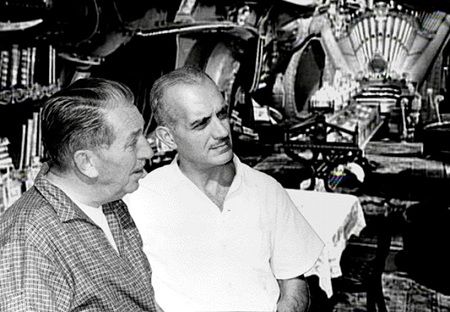
Now is a good time to introduce Emile Kuri, for around this year he was beginning to make his mark in Hollywood too. Emile Kuri was born in Mexico on June 14, 1907 to Lebanese parents. When Emile was only 12 years old, his father died, and needing to support his mother and siblings he found work at a furniture store in Hollywood. One day during lunch hour, while all the salespeople were away, a wealthy woman came into the store looking for articles to decorate a room in her house and Emile gladly made suggestions…even though his job was just to dust the furniture. She liked his taste and suggestions so much she asked if he could re-decorate her and her husband’s house. Her husband was Hal Roach.

Emile impressed Mr. Roach with his innate flair for decorating and soon found himself working as the set decorator on Roach’s comedy classic Topper ( 1938 ). His career as a set decorator had begun – and what an impression on film design he would make!

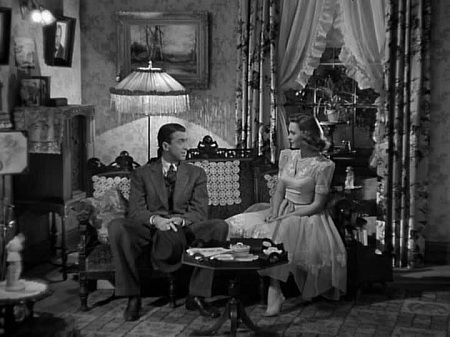
Throughout his career with Warner Brothers and Paramount studios during the 1940s and 50s he worked with such directors as William Wyler ( The Heiress ), Frank Capra ( It’s a Wonderful Life’s Bedford Falls was Emile’s creation ) George Stevens ( A Place in the Sun, Shane ) and Alfred Hitchcock ( Spellbound, Rope, Trouble with Harry ).

Carroll Clark was also working with Hitchcock during the 1940s ( Suspicion, Notorious ) and was busy creating beautiful sets for such classics as I Remember Mama ( 1948 ), The Bachelor and the Bobby-Soxer ( 1947 ), and Mr. Blandings Buildings His Dream House ( 1948 ).

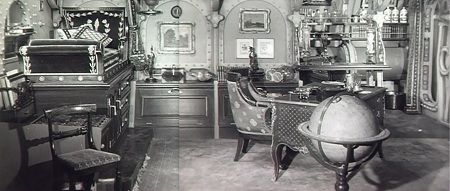
In 1953, Walt Disney hired Emile Kuri to give Walt Disney Studios’ office complex a face-lift. Plans for 20,000 Leagues Under the Sea were under way and once again Emile was in the right place at the right time. He became set decorator for the film, and his creative use of ironwork, velour, and ship parts earned him his second Academy Award and helped inspire a new Jules Verne Victorian fantasy style – Steampunk.

Carroll Clark arrived at Disney Studios not long after for his first assignment, Darby O’Gill and the Little People ( 1959 ) and thereafter the talented designing duo were working side by side for the next 15 years.

The sets and décor for Toby Tyler ( 1959 ), The Absent Minded Professor ( 1959 ), Pollyanna ( 1960 ), Babes in Toyland ( 1960 ), The Parent Trap ( 1961 ), Summer Magic ( 1963 ), Mary Poppins ( 1964 ), and That Darn Cat ( 1965 )were all their handiwork.

While an art director has the task of setting the scene, it is in the set decorator’s hands to furnish that setting with objects in keeping with the art director’s vision. "The most difficult thing," Kuri once told an interviewer, "is to make a set not look like a set, but like a home, as if the people just walked out."

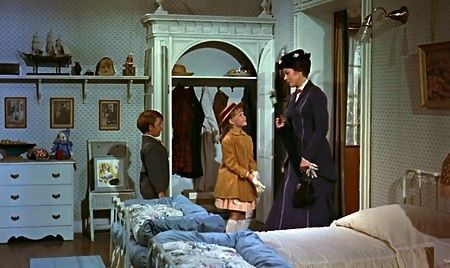
Emile Kuri knew how to convey character through the use of objects in a set. This is especially evident in A Place in the Sun, It’s A Wonderful Life, and in Pollyanna and Mary Poppins. The Banks household at 17 Cherry Tree Lane is very old "banker"ish and yet quite modern... and quite feminine... just overall a happy place to live in.


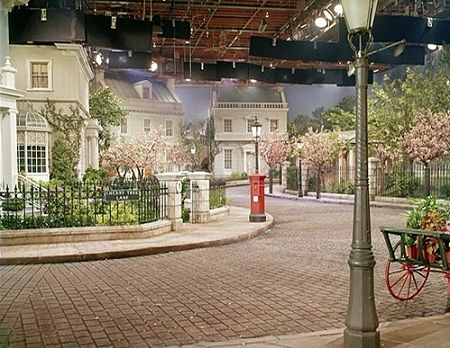
But let’s not forget that the look of Cherry Tree Lane itself came from the mind of the art director, Carroll Clark, too.

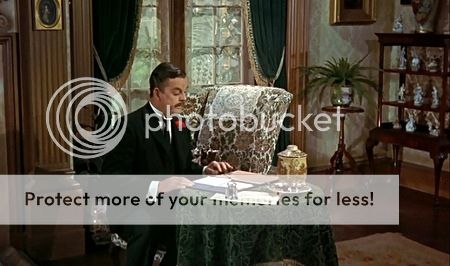
In The Happiest Millionaire and Pollyanna, Emile Kuri made great use of light toned furniture and abundant greenery to add color and cheerfulness to the Victorian residences of two wealthy upper-class families.

During the mid 1960s the team worked on such classic live-action films as The Ugly Dachshund, The Monkey’s Uncle, Adventures of Bullwhip Griffin, Blackbeard’s Ghost, The Horse in the Grey Flannel Suit and The Love Bug.

The Love Bug was Carroll Clark’s final feature. He passed away on May 17th, 1968, after designing the sets to over 172 feature films in his career.

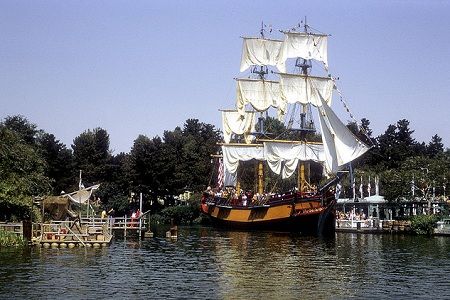
Emile Kuri continued to work at Walt Disney Studios up until his retirement in 1973. In addition to using his skill of set decorating for film, Emile Kuri worked on the sets of Disneyland as well, designing the interior to the Columbia sailing ship and the New Orleans Plaza Inn.

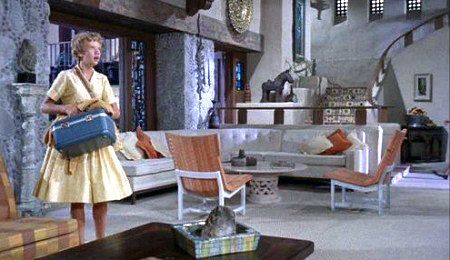
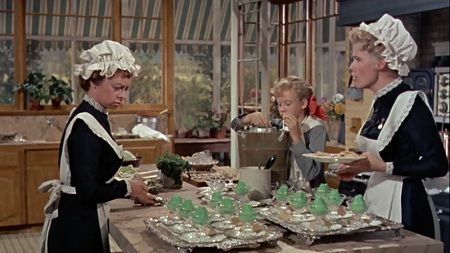
Emile Kuri earned 8 Academy Awards nominations in his lifetime, but more importantly than the awards and accolades he received was the wonderful interiors that he created for all those Walt Disney films that have become so memorable and identifiable with the film itself and the characters. Of all the films that Emile Kuri and Carroll Clark worked on, I love The Parent Trap set the best...and so, I'll close here with a screenshot from that magnificent modern kitchen.