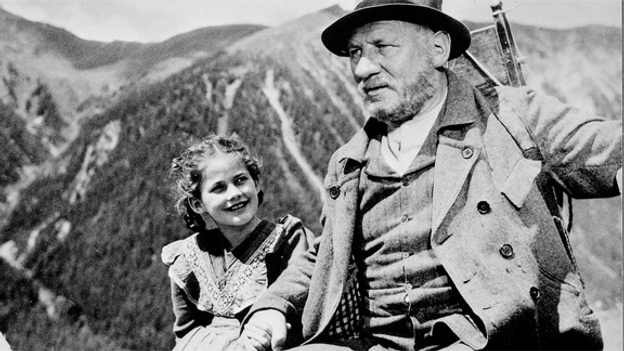
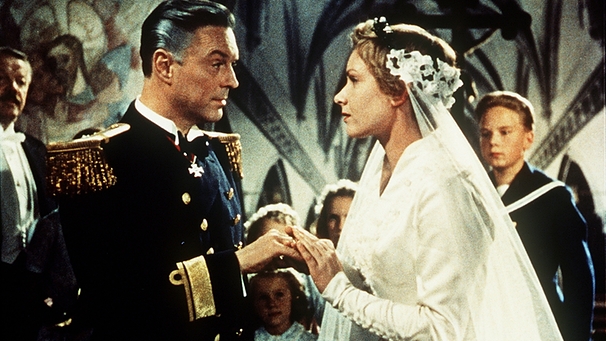
Haymo ( Erich Auer ) is the official "jäger" ( forest ranger ) for the monastery at Berchtesgaden. One day while patrolling the mountains he hears a cry for help. It is Gittli ( Marianne Koch ), a young woman who lost her footing on a dangerous cliffside while picking flowers. Haymo rescues her and falls in love with her at first sight.
Gittli brings the flowers that she picked to the bailiff hoping to win his favor as she pleads on behalf of her brother Wolfrat ( Kurt Heintel ) for extra time in paying the rent that is due for their family's hut. During the 1600s ( the time of the story's setting ), provinces in Germany were owned by princes who required their tenants to pay them rent money for their farms. Gittli's brother is a desperate man. He not only has no money for the rent, but his daughter is also terribly ill. The local "bader" ( country doctor ) tells him that only the sweat of an ibex can cure his daughter.
Hunting game of any kind is strictly verboten, but Wolfrat decides to risk being caught by the jäger Haymo in his attempt to shoot an ibex ( a large wild goat ) to save his daughter. However, he is spotted and, in fear, he stabs the jäger as he tries to escape. Poor Gittli then attempts to save the life of her beloved Haymo, while worrying that her brother will be caught for his crime.
Der Klosterjäger was the third film adaptation of Ludwig Ganghofer's classic novel of the same name. It paired two actors who were extremely popular in the Heimatfilme genre - Erich Auer and Marianne Koch. They made a lovely couple onscreen. Auer was an Austrian actor who became a rather unlikely leading man in the 1950s, often playing in historical films. Marianne Koch had a long career both in Germany, Italy, and the United States and is best known to American audiences for playing Marisol in A Fistful of Dollars ( 1964 ). For many years she was a panelist on the German version of "What's My Line?" and later switched careers to become a doctor.
Like most fairy tale romances, Der Klosterjäger has a predictable plot, yet this doesn't mean it fails to be entertaining. There is a mountaintop bear fight, plenty of drama, and the location filming in the Bavarian Alps is beautiful. The sets are also excellent, and the supporting cast is made up of many familiar German character actors including Willy Rösner, Karl Skraup, and Paul Hartmann. Also in the cast is Paul Richter who starred as Haymo in the 1935 film adaptation.
Der Klosterjäger is still shown frequently on ZDF, a German television channel, as one of the "classics". It is not available on DVD in the United States but appears occasionally on Youtube.
Showing posts with label Heimatfilme. Show all posts
Sunday, February 9, 2020
Monday, April 29, 2019
Heimweh....dort wo die Blumen Blüh'n ( 1957 )
Somewhere I read that if you watch one Heimatfilm you've seen them all. That is a bit of a stretch, but it is true that after seeing twenty or so, they begin to blur together.
In Hollywood pictures you would find character actors who appeared more frequently in one type of genre than in others...e.g Harry Carey Jr. or Edgar Buchanan liked westerns while Marjorie Main and Mary Wickes preferred comedies. In Germany, this was also the case, and many of the main actors and supporting players who starred in Heimatfilms enjoyed that genre and made a number of them. So you cannot rely on the actor's faces to bring to mind the title. Then, the similarities of the titles do not help matters much either. This film, Heimweh....dort wo die Blumen Blüh'n ( 1957 ), is not to be confused with Heimatlos ( 1958 ), Wenn die Alpenrosen blüh'n ( 1955 ), Solange noch die Rosen blüh'n ( 1956 ), or Dort oben, wo die Alpen glühen (1956). Lots of bloomin' titles!
In this film, you will find a little more drama than usual in a Heimatfilm. A young woman ( Sabine Bethman ) attempts to commit suicide by throwing herself into a river but is saved by a priest ( Hans Holt ) who is traveling with a busload of sängerknaben ( choir boys ). The priest takes her to the monastery and the boys and the parish staff all try to cheer her, but to no avail. It is not until she enters confession with Father Benedict and tells him the story of her lost romance that she feels her depression begin to subside. Of course, this flashback sequence is for the benefit of the audience who get to witness a little romance between her and her engineer supervisor ( Rudolf Prack ).
Heimweh has some pleasant moments but on the whole, it is very forgettable. The only memorable part of the film is its theme song "Heimweh" performed by Freddy Quinn and played throughout the movie. Freddy was an extremely popular entertainer from Austria and "Heimweh" ( the German version of Dean Martin's "Memories are Made of This" ) was his first million-selling hit single. So it seems as though Heimweh...dort wo die Blumen Bluh'n was the result of some screenwriters who hurriedly typed out a script to cash in on the popularity of the song.
The film also features a great supporting cast but unfortunately, their talents are all wasted in parts that are too insignificant. The lovable Joseph Egger could have been a comforting character to the poor young woman but instead, he is in only a few scenes tinkering with a radio or bickering with Annie Rosar, another great actress who has too small a part.
Hans Holt may be familiar to The Sound of Music fans because he played Captain von Trapp in the original Die Trapp Familie ( 1956 ). Rudolf Prack is always a pleasure to watch, and also in the cast is Paul Horbiger, a legend in German cinema.
Heimweh....dort wo die Blumen Blüh'n is not yet available on DVD but if you are willing to see where "the flowers bloom" then you can view it on Youtube.
Sunday, January 27, 2019
Heidi ( 1952 ) and Heidi ( 1965 )
Johanna Spyri's beloved children's novel "Heidi" ( 1881 ) was first brought to film in 1937 with Shirley Temple in the starring role. It was a sweet film that, I think, perfectly captured the heart of the novel even though it wasn't true to the original story. This still remains the most popular American production of "Heidi". There has been over 18 different film and television adaptions since, including a popular 1968 TV movie starring Maximilian Schell.
Heidi is about a little girl who comes to live in a secluded mountain chalet with her stern grandfather. One day, her aunt Dete takes her - against her will - to live in Frankfurt as a hired companion to a wealthy girl named Clara, who is regarded as an invalid. Even though Heidi is homesick, her simple kindness and positive outlook help to heal Clara. Eventually, she is taken back to her grandfather who then realizes how much he loves Heidi and how much he missed her.
In Europe, it was not until 1952 that "Heidi" was made into a movie and this version is still considered by many fans to be the most accurate adaptation of Spyri's novel. The film stars Elsbeth Sigmund in the title role and features a slew of popular European actors in supporting roles. The film was dubbed in both English ( in 1954 ) and French ( with Francoise Dorleac speaking as Heidi ).
Heidi is an adorable little girl but - since I'm partial to the Hollywood version - she seems to lack Shirley Temple's charm. Elsbeth Sigmund's Heidi neither possesses the influential nature to change Clara's outlook nor to soften both her aunt and governess Rottenmeier's attitudes.
The rest of the cast is wonderful. Heinrich Gretler, a marvelous actor, plays Heidi's grandfather; Isa Günther ( Das Doppelte Lottchen ) is Clara; Willy Birgel plays Clara's father, and Elsie Attenhofer is Dete. Theo Lingen, a very popular German actor and comedian of films of the 1940s-1960s, is great as Sebastian, Herr Sesemann's butler, and proves to be a fast friend to Heidi.
Heidi was so popular throughout Europe that Heidi und Peter, the sequel, was released just three years later. This film features the ending from the original novel with Clara coming to visit Heidi and her grandfather in the mountains and learning to walk.
In 1965, Heidi was also remade in color scene-for-scene in an Austrian production with Eva Maria Singhammer in the title role. Gustav Knuth played Heidi's Großvater and Rudolf Prack had a brief part as the priest. Like the 1952 version, this film featured beautiful music but it, too, lacked the heart needed to make the story come alive. So it looks like, in spite of all the film versions of "Heidi" that exist, the ideal one has yet to be made.
Monday, September 3, 2018
Love is Forever ( 1954 ) aka Und Ewig Bleibt die Liebe
Some films have a way of drawing you into the story within the first ten minutes. Perhaps it is a practice that screenwriters learned from newspaper journalists who knew how to "hook" the audience with the first lead line. Hollywood productions had this act down pat. German productions were not so good at this technique, and it usually takes twenty minutes before you find yourself attached to the characters. But there were some exceptions.
Une Ewig Bleibt die Liebe ( "Love is Forever" ) is one of those exceptions. The plot is rather simple and there is never anything exciting going on in the film and yet it has a lot of drama, and it is presented in such a soapy fashion to make it irresistible.
The Swedish beauty, Ulla Jacobssen, who made a name for herself in Arne Mattsson's One Summer of Happiness ( 1951 ), stars as Marieke, a young woman who was adopted by the Vogelreuther family as a baby. She recently discovered that her birth mother is none other than "die Elster" - "the Magpie" - ( Hilde von Stolz ), the village thief and drunkard. She was recently released from prison after serving eight years in jail. This shames Marieke to no end. She loves her adopted parents and sister more than anyone else but feels she ought to publicly acknowledge her birth mother.
This angst over her mother is ruining her love life, too. Georg ( Karlheinz Böhm ), her cousin, has loved her for years but she never returned his love because she knows he feels bound in gratitude to the Vogelreuther's as well and they want to see him marry Trude, Marieke's little sister. Georg does show affection for Trude ( Ingrid Andree ) and at the beginning of the film we learn they are to be wed in less than a week's time. Georg would still rather marry Marieke but she would never marry him now because she knows how much her sister loves him and her sister's happiness is more important to her than her own. So, as you can see, there is quite a bit of drama going on in the film.... And it is played out really well, especially by the principal leads.
Paul Dahlke and Magda Schneider ( Romy Schneider's mother ) also star in the film as Marieke's adopted parents.
Love is Forever was based on the play "Johannisfeuer/Fires of St. John" by Hermann Sudermann. In Germany, where the film takes place, the celebration of the midsummer solstice on St. John's Eve ( June 23/24 ) is extremely popular. People light huge bonfires which they dance around well into the night. The festival is featured in the film and also in Johannisnacht, released in 1956, which features this celebration near the climax.
The story of Und Ewig Bleibt die Liebe is a good example of how gratitude, when taken too far, can ruin people's lives. Instead of being honest with their feelings to those they love, both Marieke and George would rather sacrifice their own happiness for the family that raised them.
Want to watch Und Ewig Bleibt die Liebe right now? It's available on Youtube...just click here.
Une Ewig Bleibt die Liebe ( "Love is Forever" ) is one of those exceptions. The plot is rather simple and there is never anything exciting going on in the film and yet it has a lot of drama, and it is presented in such a soapy fashion to make it irresistible.
The Swedish beauty, Ulla Jacobssen, who made a name for herself in Arne Mattsson's One Summer of Happiness ( 1951 ), stars as Marieke, a young woman who was adopted by the Vogelreuther family as a baby. She recently discovered that her birth mother is none other than "die Elster" - "the Magpie" - ( Hilde von Stolz ), the village thief and drunkard. She was recently released from prison after serving eight years in jail. This shames Marieke to no end. She loves her adopted parents and sister more than anyone else but feels she ought to publicly acknowledge her birth mother.
This angst over her mother is ruining her love life, too. Georg ( Karlheinz Böhm ), her cousin, has loved her for years but she never returned his love because she knows he feels bound in gratitude to the Vogelreuther's as well and they want to see him marry Trude, Marieke's little sister. Georg does show affection for Trude ( Ingrid Andree ) and at the beginning of the film we learn they are to be wed in less than a week's time. Georg would still rather marry Marieke but she would never marry him now because she knows how much her sister loves him and her sister's happiness is more important to her than her own. So, as you can see, there is quite a bit of drama going on in the film.... And it is played out really well, especially by the principal leads.
Paul Dahlke and Magda Schneider ( Romy Schneider's mother ) also star in the film as Marieke's adopted parents. Love is Forever was based on the play "Johannisfeuer/Fires of St. John" by Hermann Sudermann. In Germany, where the film takes place, the celebration of the midsummer solstice on St. John's Eve ( June 23/24 ) is extremely popular. People light huge bonfires which they dance around well into the night. The festival is featured in the film and also in Johannisnacht, released in 1956, which features this celebration near the climax.
The story of Und Ewig Bleibt die Liebe is a good example of how gratitude, when taken too far, can ruin people's lives. Instead of being honest with their feelings to those they love, both Marieke and George would rather sacrifice their own happiness for the family that raised them.
Want to watch Und Ewig Bleibt die Liebe right now? It's available on Youtube...just click here.
Thursday, May 24, 2018
Das Doppelte Lottchen ( 1950 ) - The Original Parent Trap
If you ever read the credits to Walt Disney's The Parent Trap ( 1961 ) you would have noticed that the film was based upon a book by the popular German author Erich Kastner entitled "Das Doppelte Lottchen" which was written in 1949. As famous as The Parent Trap was in the States, few children or adults can claim to have read the book....ourselves included. But last week, we did see the original German film that Disney based The Parent Trap on, and it is absolutely delightful.
Like the Americanized version, Das Doppelte Lottchen tells the story of twin sisters who were separated at birth by their parents, with the father and the mother each taking one of the girls. The children meet up by accident at a summer camp and, once they realize they are sisters, they decide to switch places so that they can have the opportunity of meeting the parent they never knew. Of course, they know that their parents will notice the switch in due time but that is a part of their scheme, too, because their parents will then have to reunite to un-switch them. Clever gals!
Erich Kastner wrote the screenplay to and narrated this entertaining adaptation of his novel, which was directed by Josef von Báky, a Hungarian filmmaker best known for directing Munchausen ( 1943 ). Lotte and Luise, the twins, are portrayed by two real-life twins, actresses Jutta and Isa Gunther, and while they are not quite as appealing or as natural as Hayley Mills doubled-up, their performances are very good....and quite different.
Hayley's Susan and Sharon got easily frustrated with their parents ( especially their father's plans to remarry ), but Lotte and Luise take things with a calmer and sadder attitude, which seems a bit more true-to-life. This makes their parents' separation all the more heartbreaking because the two gals lack the independent spunk needed to offset their single-parent upbringing. Each one is especially close to the parent who raised them and, once they meet the father and mother they never knew, they come to love them, too. However, they have no scheme in mind for foiling their father's plan to remarry, which is an interesting change to note. In American films, children are often shown outwitting their parents, or cleverly manipulating them for their own benefit, because this appeals to younger audiences but, in Germany, one doesn't often find that kind of plot line in films.
The twins' father, Papa Ludwig ( Peter Mosbacher ) is a youthful good-natured man with a passion for music. He is a composer and conductor of opera and resides with Louise and their housekeeper in a large apartment in Vienna, Austria. Their mother, portrayed by Antje Weisgerber, works at a newspaper office. She is less formal, enjoys nature, and lives in a smaller apartment with Lotte in Munich. The differences between the children's upbringing are not as great as the screenwriters made it out to be in the 1961 Disney version, and so they are able to pull off the "switch" with greater ease. In fact, the parents have no inkling that their daughter is not the same girl who they dropped off at summer camp.
Das Doppelte Lottchen lacks the beautiful setting ( especially that fabulous California ranch that Mitch Brennan owned ) and the humor of Walt Disney's remake but more than makes up for it in heart. The affection that the parents show their children is wonderful to see and Erich Kastner's commentary throughout the film is enjoyable to listen to as well - rarely do authors narrate a film based on their own book!

Wednesday, February 28, 2018
Vater Braucht Eine Frau ( 1952 ) aka Father Needs a Wife

Who wants to get a new housekeeper when you can have a new mother?
Widower Hans Neumeister and his four children have just lost their most recent housekeeper who, like the other women before her, stormed out in aggravation over the children's playful antics. So Papa Neumeister is once again on the hunt for a housekeeper...but his children have other plans. They would rather have a permanent live-in housekeeper - a new mother!
On behalf of their father, they place an ad in the marriage column of a local newspaper and within a day receive over 30 written responses from a variety of women, many of whom included a photograph of themselves. One photo, in particular, catches their eye, that of Susanne Meissner who happens to be standing in front of a chateau next to a Mercedes 300. The children do not realize that Susanne is not a well-to-do society woman, but simply a fashion model. However, once their father has a chance to meet her, her lack of high-society status becomes very unimportant.
Vater Braucht Eine Frau is a charming film that combines all the elements of great family entertainment: humor, romance, and parallel plots that both children and adults could enjoy. The dialogue is timeless, the cinematography ideal, and the music ( by Franz Grothe ) is lovely....but what really makes the film work is the spot-on casting. Each of the principal actors is wonderful in their parts.
This was the first film to feature the pairing of Ruth Leuwerik with Dieter Borsche and it established them as one of the most popular onscreen duos of the 1950s. They would go on to make five films together.
Dieter Borsche brought warmth and a surprising comedic flair to the role of Hans. This unusual casting, at the time, echoed Walt Disney's unorthodox casting of Western hero Brian Keith as Hayley Mill's father in the family comedy The Parent Trap ( 1961 ). Who would have guessed that these men were so good at comedy? In one scene, Hans returns home to his apartment after a date with Susanne and, being on cloud nine, releases his joy by swinging on his children's indoor swing. Without a word, Dieter manages to express the elation of a widower who didn't believe he could ever fall in love again.
Ruth Leuwerik is lovely as Susanne. Although she made one film before Vater Braucht Eine Frau, it was this comedy that launched her to stardom. Her role as Maria von Trapp in Die Trapp Familie and Die Trapp Familie in Amerika later established her as "The First Lady of German Cinema". Ruth had a way of projecting so much emotion with the slightest of gestures and she brings a hint of a maternal nature to Susanne which helps draw her to the children.
Angelika Meissner leads the children's cast as Hans' eldest daughter Ulla. Like Ruth, Angelika had very expressive eyes and often conveyed more than what the script may have called for. She was excellent in parts like this. She later went on to play Dick in Die Mädels vom Immenhof ( 1955 ) one of the most popular family films of all-time ( in Germany ). Portraying the younger Neumeister boys are curly-haired brothers Urs and Migg Hess and little runny-nose Oliver Grimm.
Also in the cast is Günther Lüders, a well-beloved German comedian, and Bruni Löbel as "Cuckoo".
Sunday, December 24, 2017
The Trapp Family ( 1956 ) - The Original Sound of Music
Every Christmas season for the past ten years, ABC has been airing The Sound of Music ( 1965 ) which has sparked a new holiday-viewing tradition for many. Well, nine years before Julie Andrews portrayed the real-life nun-turned-governess Maria von Trapp in the famous musical, Ruth Leuwerik took on this role in Die Trapp-Familie aka The Trapp Family ( 1956 ).
Anyone who has not seen this German classic would be surprised at just how similar it is to the 1965 Robert Wise remake... and how quickly the story chugs along without the musical interludes. Yes, the original The Sound of Music was not a musical! There are, of course, a few numbers that the children perform for their audiences ( and one lovely piece that Ruth Leuwerik sings to the children ), but instead, the film focuses more on Maria befriending the Trapp household and how they made their start in America as a family.
Die Trapp-Familie begins in Salzburg in the early 1930s. Maria, a happy energetic novice who teaches children at a convent, learns from her superior that she will be sent to the home of Captain von Trapp ( Hans Holt ) to tutor his seven children. The task is not an easy one for the children have driven away 26 governesses within the past four years, but Maria quickly gains their admiration and their love. She also wins the affection of their father, and within a short period they wed. As the children's governess, Maria had taught the children to laugh and play - and to sing - which is something they had not done with the disciplinarian naval captain.
When the local priest, Dr. Wasner ( Josef Meinrad ) hears the children singing together, he helps to train them so that they may perform for charity benefits. It is during one of these benefits that a talent scout for an American song agency notices them and offers the family a contract to perform in the States. This proves to be a fortunate invitation because Captain von Trapp had lost much of his wealth during the Depression and the Nazis emergence made Maria and the Captain realize it was time to leave Austria which was becoming a totalitarian regime. However, their arrival in the States isn't all roses and fanfare, especially when the talent scout informs them that their act is no longer wanted and they find themselves Trapp-ed at Ellis Island!
Die Trapp Familie is a beautiful film with a lot of heart. It bears many similarities to The Sound of Music, from the lovely cinematography down to the almost identical costume designs, and it differs only in its emphasis on certain aspects of the von Trapps' life. For example, the drama of the rise of the Nazi power and how this influenced the Captain to flee Austria is very much downplayed. Also, the children are not as predominately featured and are younger than they were cast in The Sound of Music.
What I enjoyed most about the original film is its realistic portrayal of the von Trapps coming to America. In typical Hollywood fashion, The Sound of Music closes sensationally with Christopher Plummer, Julie Andrews, and the children climbing the Alps into Switzerland carrying all of their belongings on their backs. In Die Trapp Familie we see them at the overcrowded immigration gateway of Ellis Island huddled together with other immigrants awaiting entrance into the States. When they are told that it would be weeks before they are permitted to work, Maria cries, blaming herself for bringing the family into this situation. Somehow this seems much more credible!
The film also boasts an impressive cast comprised of some of Germany's most famous stars. Ruth Leuwerik, who is often cited as the First Lady of German Cinema, is an enchanting Maria von Trapp. She deftly portrays Maria in all her stages of growth: as a youthful zealous nun, to a clever governess, to a protective mother of seven. Hans Holt is a much more appealing Captain von Trapp than Christopher Plummer, while the children are excellently cast, too.
Upon its release, Die Trapp Familie was such a box-office sensation in Europe that a sequel - Die Trapp-Familie in Amerika - shortly followed which depicted the family's continuing adventures in Vermont. Unfortunately, the US release of The Trapp Family in 1956 did not fare well. It was not until The Sound of Music hit theaters in 1965 that audiences fell in love with the story of the von Trapps, undoubtedly due to the appeal of the beautiful Rodgers & Hammerstein melodies.
Sunday, November 26, 2017
Das Schweigen im Walde ( 1955 )
Well, Rudolf Lenz is a very recognizable face ( a handsome fellow he be ), and since he made so many Heimatfilms you are likely to see him in just about any one of the 1950s films that you choose to watch. He had a regal bearing, so he was generally cast as a count, duke, or other member of royalty.
In Das Schweigen im Walde ( Silence in the Forest ) he was Prinz Heinz of Ettingen, a prince who takes a hunting holiday in the forests near the Salzburg mountains. While resting from a hike in the woods he spies a beautiful young woman ( Sonja Sutter ) riding upon a donkey in the midst of the morning sun. She is a painter named Lo Petri who lives in the forest with her little brother Gustl ( Heinz Christian ). Prinz Heinz befriends her and comes to visit her daily....but never lets on that he is a prince.
Meanwhile, Toni Mazegger ( Peter Arens ), one of the paid hunters that was assigned to the prince, becomes jealous of the attention that he is paying to Lo, whom he fancies as his girl. In a fit of rage, he decides to do a bit of hunting on his own one afternoon....setting his gunsight on the prince himself!
Like many of the Heimatfilms of the 1950s, Das Schweigen im Walde was based upon a book that was filmed numerous times over. The 1899 Ludwig Ganghofer novel formed the basic plot of the original version which was a silent film released in 1929. Another version was made in 1937, and then a remake of this film was made in 1976, all bearing the same title.
Das Schweigen im Walde featured beautiful mountain scenery, a gentle romance between the prince and Lo, and some charming sets, but the story plot was not as engaging as some of the other Heimatfilms we have seen. The film lacked a humorous subplot as well as any traditional Alpine music, which is always nice to hear in the background.
However, if Rudolf Lenz catches your fancy be sure to check him out in Heimatlos ( 1958 ) and Der Priester und das Mädchen ( 1958 ), both with Marianne Hold.
Monday, October 16, 2017
Der Schönste Tag Meines Lebens ( 1957 )
The true Vienna choir boys not only sing but study and live together at the palatial Palais Augarten in Vienna. It becomes their school and their home for as long as they are members of the choir. One day per week their family and friends are permitted to visit them.
Schwester Maria, the den-mother/nurse at the school takes compassion on the boy and agrees to be his mother while he is there. Toni loves her so much that, later, when Schwester Maria gets blamed for losing 1,000 Deutsche marks from the choir's funds, Toni lies to save her job and wrongfully confesses that he stole the money.
Like most Heimatfilms, there is plenty of mountain scenery and some beautiful songs, sung by the Vienna choir boys, of course. But what makes this film really stand out is the performances from its principal players....Joseph Eggar in particular. He reminds me and my sister so much of our "Opa" ( our grandfather ), in his mannerisms and his genuine love for the little boy.
Ellinor Jensen is also adorable as the tender-hearted Maria whom Toni comes to adopt as his surrogate mother. Paul Bösiger has a small part as Maria's love interest, and that legend in the German film industry - Paul Hörbiger - portrays the director of the choir, a kindly man. Rounding out the cast is Thomas Hörbiger ( Paul's son ) as one of the kapellmeisters and Richard Eybner, who is present for comedy relief.
Sunday, September 3, 2017
Dort Oben, Wo Die Alpen Glühen ( 1956 )
"Up There Where the Alps Glow"....a rough translation of the title of this 1956 German production starring Vienna-born Albert Rueprecht. Like most Heimatfilms, it features its fair share of mountain scenery, romance, and drama, and in this case, the drama is spread on as thick as butter.
Rueprecht stars as Bertl Bruneder, a young woodcarver who guides tourists up mountains as a sideline job. When a pretty young woman named Andrea ( Ingmar Zeisberg ) arrives in the village with her uncle ( Erik Frey ), she becomes intrigued with the "mountain with no name", a mountain that can only be climbed by way of a dangerous wall. She asks for a guide to take her up there but all the local guides refuse....except Bruneder. He had climbed the wall once before to win a wager against the local innkeeper Jakob ( Hardo Hesse ).
This morning saunter eventually turns into an overnight adventure when heavy cloud coverage prevents the couple from returning down the mountain. It is while they are up in "the heavens" that Andrea finds herself falling in love with Bertl. Her feelings aren't mutual, however.
There is a legend that when a man plucks edelweiss - the white star-shaped flower that grows precipitately on the side of a mountain - it signifies that he has been true and faithful to his lover. When Bertl relates this story to Andrea, she asks if he will risk gathering some edelweiss for her, but he simply shakes his head.
He's a handsome fellow and back in the village he already has two blondes pining for him: Anna ( Lotte Ledl ) whom he fancies he loves, and Linda ( Gerlinde Locker ), the younger sister of Jakob. She is a lovely girl who is perfectly suited to Bertl, but he doesn't realize this.
After his adventure on the mountain, Anna teases him over his unfaithfulness towards her with Andrea and Bertl climbs up the "Gottesfinger" mountain to bring edelweiss to her to prove his devotion. It's a foolish undertaking for a foolish woman and Bertl nearly dies in his attempt to retrieve the elusive edelweiss.
Unlike most American productions, where the film studios were fearful of endangering the lives of their stars, the principal players of Dort Oben Wo Die Alpen Glühen all performed their own stunts, and so you can clearly see them tackling the side of a mountain while clouds drift by a mile below them. It's a wonder how they managed to get the camera crew up there, too. Location scenery was shot in Kals, a mountain village in Tirol, Austria.
Dort Oben, Wo Die Alpen Glühen is an engrossing drama and it features some good performances from Rueprecht and Zeisberg. However, the film lacks humor - and heart - which would have greatly added to its appeal. Also in the cast is Rudolf Carl and Peter Gruber.
Friday, August 18, 2017
Das Herz Einer Frau ( 1951 )
This past month my sister and I have been exploring German films of the 1950s, and in doing so we came across a popular genre that we were unaware of called Heimatfilms. These films were set in the mountainous areas of southern Germany, Switzerland, or Austria and often featured sentimental stories of love and friendship that centered on the traditional "heimat" ( homeland ) rural way of life. Many of them focused on the difference between this old German way of living and more modern progressive ways.
Since we have been enjoying these films so much we will review them as part of a new series - Heimatfilme and other Deutsche Films of the 1940s-1960s. If you ever feel in the mood for some sweet romance and yodeling than simply click on the banner on the right sidebar and you will find plenty of German films to enjoy for yourself.
To begin... Das Herz Einer Frau. This is not a Heimatfilm, rather a sehr schön family musical from Nova-Film, which was an Austrian production company that lasted only a few years in the early 1950s. It features Marianne Schönauer, that beautiful Viennese actress/singer, in the role of a musical stage star who befriends Konrad ( Kurti Baumgartner ), a little boy who is looking for a mother.
One day this boy happens to see an advertisement that has a picture of a mother with her child and, dissatisfied with his stern governess, he decides to find a woman just like the one in the ad. He does a little window shopping, comes across Theo Moreno ( Schönauer ) having a cup of coffee, and asks her to come home with him and be his mother. She finds him irresistible ( he is! ) and agrees to take him home, whence she meets Konrad's papa ( Stefan Stodler ), a widowed engineer. She continues to visit them on a daily basis, until papa finds out that she is a popular stage star and he gets the notion in his head that she may have been visiting his son merely for publicity purposes.
Das Herz Einer Frau has a number of lovely Nico Dostal tunes, all performed by Marianne Schönauer, including "Fur Jedes Herz Scheint ein Stern in der Welt" and "Das Schönste an der Liebe". I was more interested in the story plot than the musical numbers, so some of the songs Theo Moreno is performing on stage seem a little long, but then the audiences probably came to hear her sing so that's what the director focused on. And she does indeed have a beautiful singing voice.
Kurti Baumgartner is wonderful as little Konrad and he doesn't display any of that self-conscious cuteness that many modern child actors do. He only made three films, one of which was made right after this picture featuring Marianne Schönauer again - Maria Theresia.
Also in the cast is Walter Müller as Theo's publicity agent, Hella Ferstl, and Rudolph Brix.
Want to watch Das Herz Einer Frau right now? It's available on Youtube...just click here.
Subscribe to:
Posts (Atom)