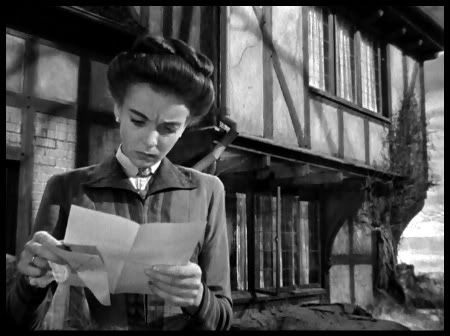
Mary ( Hayley Mills ) is chock-full of scathingly brilliant ideas, most of them taking the form of pranks to play on the nuns at St. Francis Academy, the convent school for girls that she and her partner-in-crime Rachel ( played by newcomer June Harding ) attend. These teenage girls are naturally bent towards mischief, and trying the patience of Mother Superior ( Rosalind Russell ) is their sole source of amusement. But just when there seems to be no hope for these incorrigible students, Mary has a change of heart and finds that life at St. Francis can be quite habit-forming.
Ida Lupino stepped behind the camera, after a 13-year hiatus, to direct The Trouble with Angels, a humorous and endearing family film based upon "Life with Mother Superior", Jane Trahey's highly amusing autobiographical account of her years spent in a convent school.
Producer William Frye had attempted to coax Greta Garbo out of retirement with a $1,000,000 offer to portray Mother Superior in the film, but, having failed, secured the talents of another MGM alumni, the great Roz Russell. This old pro was an ideal choice for the part, not only because she was a devout Catholic in real life, but because Russell could bring out the commanding ( almost frightening ) presence that the role of Mother Superior required, and yet make her as beloved as any of the other characters. She holds you in her thrall, whether she is barking orders like a drill sergeant, reacting to soap bubbles coming out of her tea, or purring like a kitten over the "blessedly quiet" new furnace. Russell is also given an ample amount of barbed quips to fling at the girls, which only she could do so well.

Both Mary and Rachel's antics are innocent bits of defiance, meant to while away the long - and boring - days at St. Francis, and they range from smoking cigars in the school's basement, to encasing another student's face with Plaster of Paris. Rachel is a "born follower", gawky, and not particularly clever having been educated at the progressive school of New Trends ( where she was instructed in valuable subjects like "silent piano" lessons ). She meets Mary on the bus en route to the school and quickly becomes her stooge, sharing in the pranks which continually put her in hot-soup with Mother Superior, and usually result in the punishment of washing school pots. "I wonder if my father knows he's paying good money to have his daughter educated as a janitor", she muses. June Harding was making her film debut after doing several television episodes ( notably The Richard Boone Show ) and she is adorable as Rachel.

As much as Mary resents Mother Superior, she is fascinated by her and often watches her, wondering what made her - or any of the nuns, for that matter - decide to take the veil. She finds that behind Mother Superior's cold demeanor is much inner pain. Little does she realize how much she has in common with her.
Blanche Hanalis' extremely quotable script puts equal emphasis on the plights of both the girls and the nuns. The audience never takes sides. We aren't rooting for Mary to knock-out Mother Superior and win the bout, neither do we wish to see Mother Superior "convert" these little devils into angels. As stern as Mother Superior is, she genuinely cares for the girls in her charge and desires to prepare them to make their own way in the real world.
"To bend but not to break...to yield but not capitulate...to have pride but also humility. This has always been my struggle, Sister. Can I be less tolerant of Mary than the church has been of me?"
Each year at St. Francis, Mary finds her pre-conceived notions of religion shattering as Mother Superior, quite unknowingly, bends her gently towards God. Both Mills performance and Lupino's skillful direction made this a gradual evolution of character, brought out through subtle scenes in key moments, notably the death of Sister Luguiri ( Marge Redmond ), Sister Constance's ( Camilla Sparv ) decision to leave the convent, and Mary's visit to the nursing home, where she witnesses the failings of human love.

The Trouble with Angels was so popular upon its release that it spawned the sequel Where Angels Go Trouble Follows ( 1968 ), but, without Ida Lupino's compassionate eye guiding the film, it failed to create characters of depth or leave a memorable impression....making audiences realize just how scathingly brilliant this original film was.
This post is our contribution to The Early Women Filmmakers Blogathon being hosted by Movies Silently. Be sure to check out all of the great posts about female-directed films! Also, any fan of Angels would want to read June Harding's letters home to her mother during the making of the film. They are great fun to read and provide insight into the development of the motion picture.