Showing posts with label Universal Pictures. Show all posts

Friday, October 9, 2026

The Universal Monsters Mystery Games of 1963

Hasbro is one of the largest toy and game manufacturers in the world today, but when they first started (back when they were labeled the Hassenfeld Brothers) they were primarily known as a toy maker and barely dabbled in the gaming industry. The few games that they did release met with little success. 

However - just like today - the Hassenfeld Brothers knew that any game would sell if it had a popular Movie/TV theme linked with it. So what would be popular with children in the early 1960s? Monsters! And what kind of monsters? The good ol' Universal monsters: Dracula, Frankenstein, The Mummy, The Creature from the Black Lagoon, etc, etc. So, in 1963, Hasbro released a board game for each of these famous monsters.... the only one that was missing was The Invisible Man. 

The Mummy Mystery Game

"Explore the Ancient Crypts of Egypt" teases the front box, but inside it is a simple spin-and-move game where you land on spaces marked "Take a Crypt Card" and must reach the end with 10 of these. Getting caught by the Mummy simply holds you back a little in this race game. The highlight of the game is the board itself with its marvelous painted mummy and the Egyptian desert scene. 

The Creature from the Black Lagoon Mystery Game

This game's object is "to escape from the Black Lagoon" but it appears that the fun part of the game is getting caught by the creature and being taken to its cave, so so much for wanting to escape....

Dracula Mystery Game

This one features some great early 1960s color schemes and once again is a simple roll-and-move race game. It appears that the players are attempting to escape Dracula's Castle and he has his own spinner as well, so he probably foils you if you are not lucky. Too bad he didn't "bite" your character and then you have to chase your opponents down and land on their space to turn them into vampires as well. That would be too imaginative a game for Hasbro. 


Frankenstein Mystery Game

This is another race game whose graphics are better than the game itself. Oddly enough, all of these games have the players using cardboard standees of the monsters as their own playing pieces and yet trying to escape from the monster via the board route. This one has little Monsters that are placed on a stylized German village. 


Wolfman Mystery Game

Another not-too-imaginative game involving the Wolf Man. Here players race to get from one camp to another and pass various dangers along the way, including a snake pit. Unfortunately, there are no gypsies and no Maria Ouspenskaya chanting the legend, "Even a man who is pure in heart and says his prayers at night....." featured in the game. Too bad....


The Phantom of the Opera Mystery Game

Lastly, there was The Phantom of the Opera and once again it features great art of the ghoulish organist. Sadly, it's pretty much the same game as the others with a simple spinner and playing pieces in the form of the phantom (why would players be dressed as the phantom and attempt to escape the phantom?), with the object being to - you guessed it! - escape the phantom's dungeon. 

Hasbro had the phan-tastic idea of making games themed around the famous Universal monsters - and they probably appealed to youngsters - but they are a little too simple for the 12-year old+ crowd... especially today's 12-year-olds! 

Today, these games are popular among collectors because of its monster theme. The Phantom of the Opera seems to be the rarest among the lot and most of these games fetch between $250-$400 a piece with better condition games topping $900. Now that's scary!

Note: All photos are courtesy of The Board Game Geek website. Check it out to read more about these games. 

Thursday, December 19, 2024

The Private War of Major Benson (1955)

Atten-shun!! Get ready to muster for some good family entertainment with The Private War of Major Benson, a little-known gem of a comedy from Universal Pictures. 
Charlton Heston stars as Major Benson, an overly strict army officer but one whose bark is worse than his bite. He opened his mouth once too often and ended up being booted from active service and assigned to command a military boarding school co-run by Catholic nuns. The "men" he needs to drill into soldiers range from age six to fifteen, one of whom has trouble keeping his pants up. 

"We've gotta turn these milkshake drinking school boys into whiskey drinking soldiers!"

If it isn't humiliating enough to be in this position, Major Benson gets pegged ten notches lower when the boys go over his head and sign a petition to have him ousted. Benson then does some soul searching to discover where he went wrong as a leader and, with the aid of Mother Redempta (Nana Bryant) and the lovely Ms. Lambert (Julie Adams), he tries to win back their approval. 

The Private War of Major Benson was one of many entertaining family comedies that Universal Pictures released in the 1950s. This came a year before Heston donned sandals and staff to portray Moses in Cecil B. DeMille's The Ten Commandments. No matter how rough Heston pretended to be as Major Benson, he still comes out looking like a swell guy - a little chipped, but still lovable. 

At least, the school's doctor Ms. Lambert aka "Lammy" thinks so. The boys think otherwise, especially little "Tiger" played by the scene-stealing Tim Hovey. The other boys who consider Benson a fink include Tim Considine, Sal Mineo, Butch Jones and Gary Pagett. 

"This is our school's founder. He was canonized in 1857." - Mother Redempta [showing Benson a portrait of a priest] 
"Aw, gee... That's too bad." - Major Benson

Jerry Hopper does a great job of directing The Private War of Major Benson and keeps the fun going from start to finish. The script was penned by Joe Connelly and Bob Mosher who later created "Leave it to Beaver" on television. Also in the cast is William Demarest as the school's handyman, Milburn Stone as Benson's commanding officer, and Don Haggerty. Major Benson doesn't have the makings of a four-star general, but he gets four stars for entertainment!

Thursday, November 14, 2024

You Never Can Tell (1951)

There's something about the comedies of the early 1950s that I find so likeable. Even when they have silly and incredulous plots, they are entertaining. You Never Can Tell is one of those films with an amusing yet decidedly implausible plot. In fact, it was publicized as "A Picture for People Who Think They've Seen Everything!" 

You may have heard of a man turning into a dog, but this film is about a dog turning into a man. Dick Powell stars as the reincarnated dog who continues to munch on kibbles and scratch behind his ear while in human form.

Powell plays Rex Shepard, a man who was known as "King" during his life on earth as a German Shepherd. King inherited millions from his eccentric owner and then was poisoned in order to clear the way for Ms. Ellen Hathaway (Peggy Dow) to be the next in line to inherit. 

When King goes to the Beastatory - the afterlife of animals - he requests to return to Earth to avenge his murder and clear his mistress Ellen of suspicion. Hence, private detective Rex Shepard suddenly appears along with his private secretary Goldie (Joyce Holden), who was formerly "Golden Harvest," a prize-winning racehorse. While the two-legged Palamino spends some time visiting her filly friends, Rex sets off to investigate his own murder and, in the process, falls in love with Ellen. 

You Never Can Tell sounds ridiculous and yet it is really an amiable bit of whimsy that's doggone addictive. The script - by David Chandler - is brimming over with canine quips and the casting is spot-on. Charles Drake plays a seemingly great guy and is re-united with his Harvey co-star Peggy Dow, while Albert Sharpe (of Darby O'Gill and the Little People) has an amusing role as Ellen's sea captain uncle. Also in the cast is Frank Nelson as a police chief. 

Wednesday, October 26, 2022

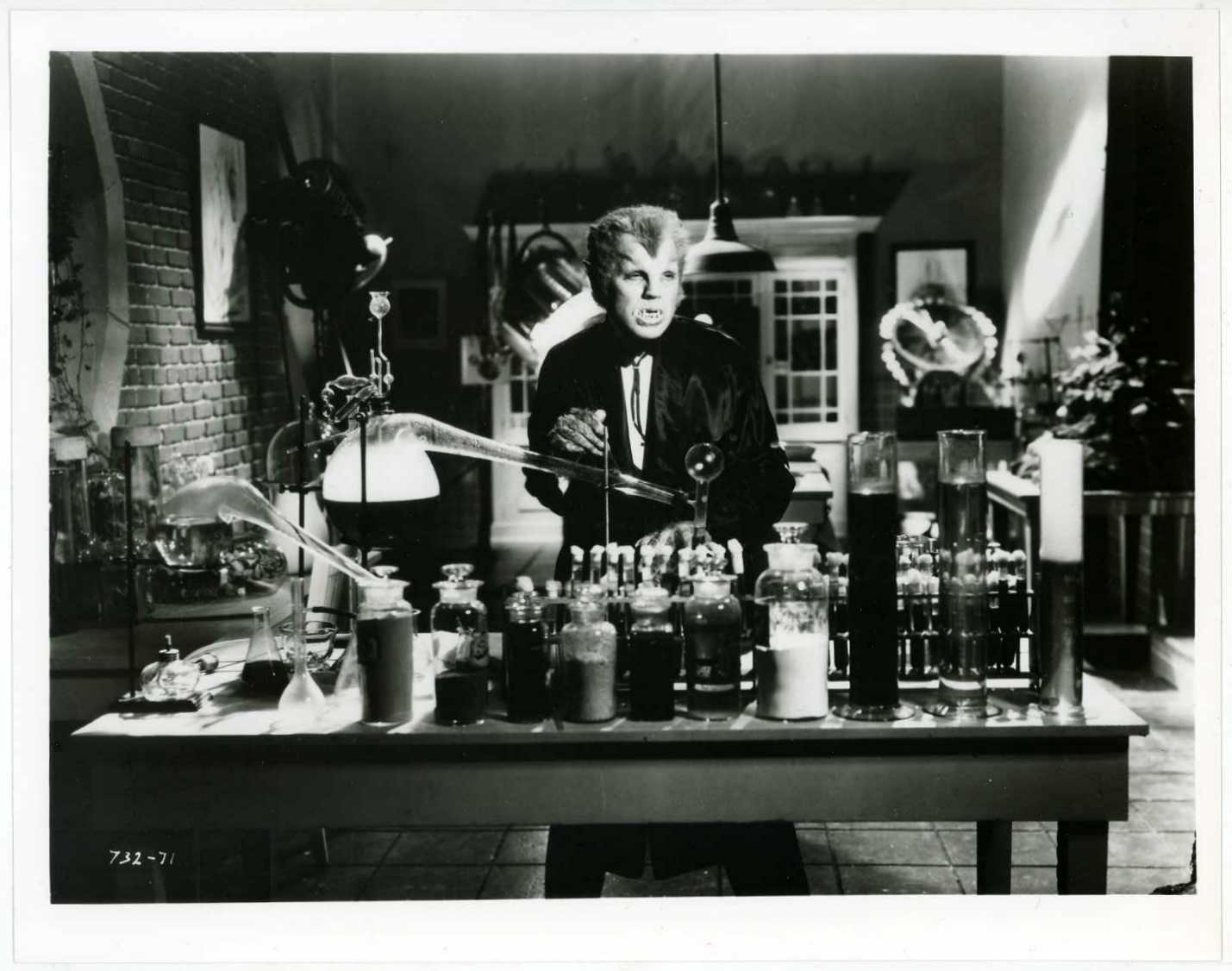
From the Archives: Werewolf of London ( 1935 )


Henry Hull, who usually plays kindly men in films, turned vicious in Universal Pictures' Werewolf of London ( 1935 ). Luckily, his friends and family only had to put up with his fierce lycanthropic side when the moon was full. 

From the Archives is our latest series of posts where we share photos from the Silverbanks Pictures collection. Some of these may have been sold in the past, and others may still be available for purchase at our eBay store : http://stores.ebay.com/Silverbanks-Pictures


Friday, October 15, 2021

From the Archives: The Wolf Man ( 1942 )


Poor Larry Talbot, all he wanted was to enjoy himself at the gypsy fair with his newfound sweetheart.  Instead, he got himself cursed and covered from head to toe with hair.....wolf's hair! In this publicity photo from The Wolf Man ( 1942 ), Lon Chaney Jr. dons the makeup of the wolfman and strikes this great pose with a bare tree. 

From the Archives is our latest series of posts where we share photos from the Silverbanks Pictures collection. Some of these may have been sold in the past, and others may still be available for purchase at our eBay store : http://stores.ebay.com/Silverbanks-Pictures

Sunday, October 25, 2020

The Phantom Stage - Universal's Haunted Stage 28

The old story of a phantom haunting a Hollywood sound stage was brought to television in a number of episodes of various series throughout the 1970s-1980s ( most notably in the two-part "The Hollywood Phantom" episode from The Hardy Boys/Nancy Drew Mysteries ) but did you know that this plot idea was actually based on a real legend? 

Stage 28 was one of the oldest sound stages built on the Universal Pictures lot in Hollywood. The studio was planning to film the horror classic The Phantom of the Opera ( featuring Lon Chaney ) and needed a stage large enough to house their own creation of the interior of the Paris Opera House. Construction on the 21,000 square foot stage began in July of 1924 and was completed in a few months. Because the set would need to be able to support hundreds of extras, the stage was built with steel girders in concrete...one of the first steel stages of its kind. The beautiful Opera House set was built inside and filming of The Phantom of the Opera began shortly thereafter. A strange occurrence also happened at that time: an electrician fell to his death, presumably while maneuvering around the catwalks at the top of the stage. 

Years later, rumors began to circulate that the ghost of a "phantom" running along the catwalks was seen. Others reported the lights flickering on and off suddenly and doors opening and shutting. 

The set to the Opera House remained at Stage 28 long after the film was completed. The studio thought that it may come in use in a future production...and indeed it did. Its most famous reappearances were in Todd Browning's Dracula ( as The Royal Albert Hall ), the 1943 color remake of The Phantom of the Opera starring Claude Rains, and the theatre sequences in Charade ( 1963 ). 

Even with the Opera House set still in place, there was plenty of space in Stage 28 to construct other sets and this stage was one of the most used at Universal Studios. The special effects department from The Bride of Frankenstein ( 1935 ) used this stage to film the destruction of Frankenstein's laboratory, Abbott and Costello's Here Come the Co-Eds ( 1945 ) was filmed within its doors, and the interiors of the Bates Motel in Psycho ( 1960 ) was also filmed inside Stage 28. 

In 2014, Universal Studios demolished the stage to make room for expanding their theme park but not before carefully dismantling The Phantom's famous Opera House set and putting it in storage. Perhaps one day, it will reappear in another film or be put on display for film fans to see. 

Saturday, October 10, 2020

Ma and Pa Kettle Back on the Farm ( 1951 )

Marjorie Main and Percy Kilbride made their fifth film appearance as country yokels Ma & Pa Kettle in Ma and Pa Kettle Back on the Farm ( 1951 ).  This delightful comedy had the pair returning to their old ramshackle home in the country and discovering uranium on the property. 

The characters of Ma and Pa Kettle first appeared in The Egg and I ( 1947 ) as farm neighbors to Betty and Bob MacDonald ( Claudette Colbert and Fred MacMurray ). They were then given their own film - Ma and Pa Kettle ( 1949 ) which in turn launched a ten-film series. Each of the movies could easily be watched on their own, but to understand the characters better, it is best to see them in order. 

Ma and Pa Kettle Back on the Farm was the fourth film in the series and had their eldest son Tom and his wife Kim expecting their first child. Ma struggles to get along with Kim's Bostonian parents, especially Kim's mother Barbara whose notions of proper child-rearing clash with Ma's. In order to stay clear of them for a spell, Ma and Pa Kettle move from their new suburban house back into their old farm. While there, Pa decides to dig a well and thinks he has discovered uranium when he finds he carries an electric charge on him.

This movie isn't the best in the series but it still provides a number of chuckles, especially Ma fussing over wearing a face mask ( apropos for the pandemic today ) and the conclusion with Pa Kettle driving madly in a jalopy to outrace a train. The script features a number of small dramas happening to the various characters, all of which intersect and conclude by the end of the film. Tom's mother-in-law Barbara Parker ( Barbara Brown ) clearly does approve of the Kettles but it is good to see her have a change of heart by the finale. Jonathan ( Ray Collins ) and Barbara Parker would later travel to Paris with the Kettles in the next film, Ma and Pa Kettle on Vacation ( 1952 ).

"Ma, I bet you once had an hour-glass figure" - Barbara

"Yeah...but the sand sure shifted!" - Ma

All of the Kettle films featured recurring characters from the first film and, in this installment, we see Pa's Indian friends Crowbar and Geoduck ( Teddy Hart and Oliver Blake ), shopowner Billy Reed ( Emory Parnell ), and Sheriff John ( Rex Lease ). Sadly missing is Birdie Hicks ( Esther Dale ), the Kettles arch-nemesis. 

The homespun humor of the Kettle series was box-office gold for Universal Pictures and this film alone raked in over $2 million dollars in ticket sales. 

Wednesday, October 30, 2019

Basil Gogos and the Monster Art of Universal Horror Films

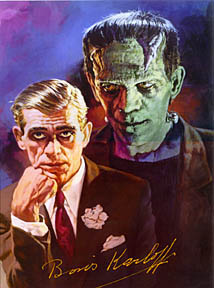
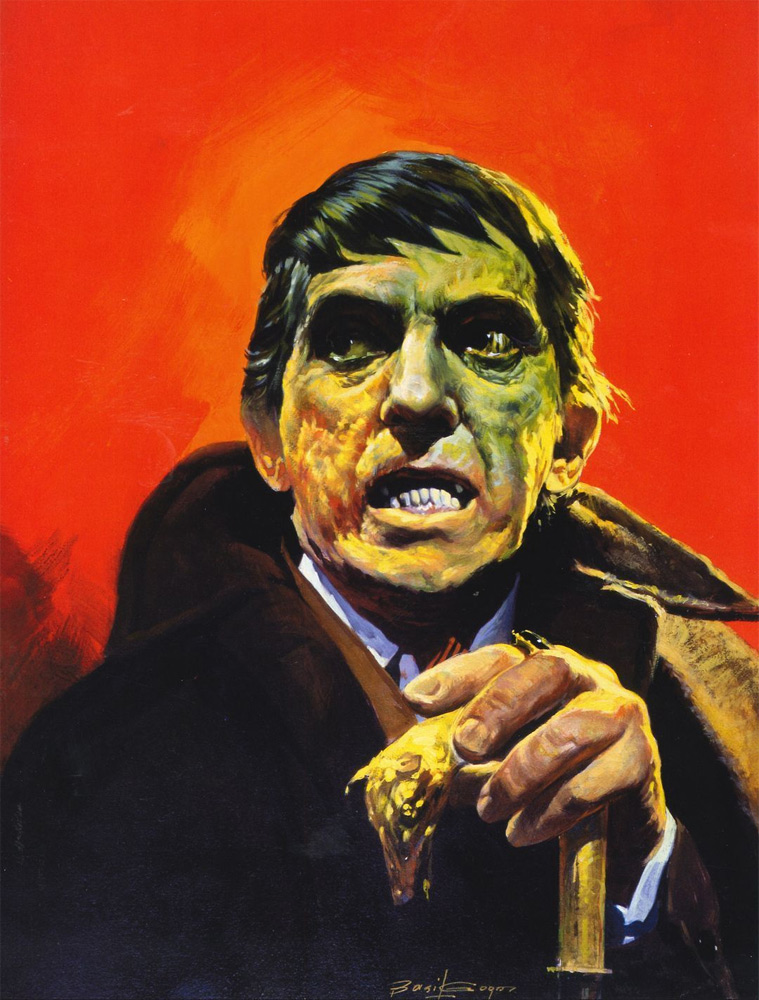
Basil Gogos was a fabulous illustrator who is best known for his movie monster portraits which graced the covers of Famous Monsters of Filmland magazines during the 1960s and 1970s. He combined his passion for art with his love of movie monsters to create these colorful and highly detailed oil portraits of such iconic creatures as Frankenstein's monster, Dracula, and the Wolf Man. 

Gogos was a Greek who came to America at the age of 16 to study art. He worked with the noted illustrator Frank J. Reilly and began his professional career of painting book and magazine covers when he received his first assignment to paint the cover to the western novel "Pursuit" in 1959. 

Throughout the 1960s, Gogos kept busy working as a commercial illustrator. The majority of his paintings were created for men's pulp adventure magazines and the monster magazines being issued by Warren Publishing ( Eerie, Creepy, Famous Monsters of Filmland ). During the 1970s, he took time off as a commercial illustrator to pursue his own personal fine art but still worked part-time at United Artists as a photo retouch artist in the ad department. His monster art found a new audience in the 1990s and Gogos returned to that genre to create more paintings that paid tribute to the great monsters of filmdom. 

Today, his paintings can be found in museums across the world and in two fantastic coffee table books, Famous Monster Movie Art of Basil Gogos by Kerry Gammill and The Monster Art of Basil Gogos by Linda Touby.

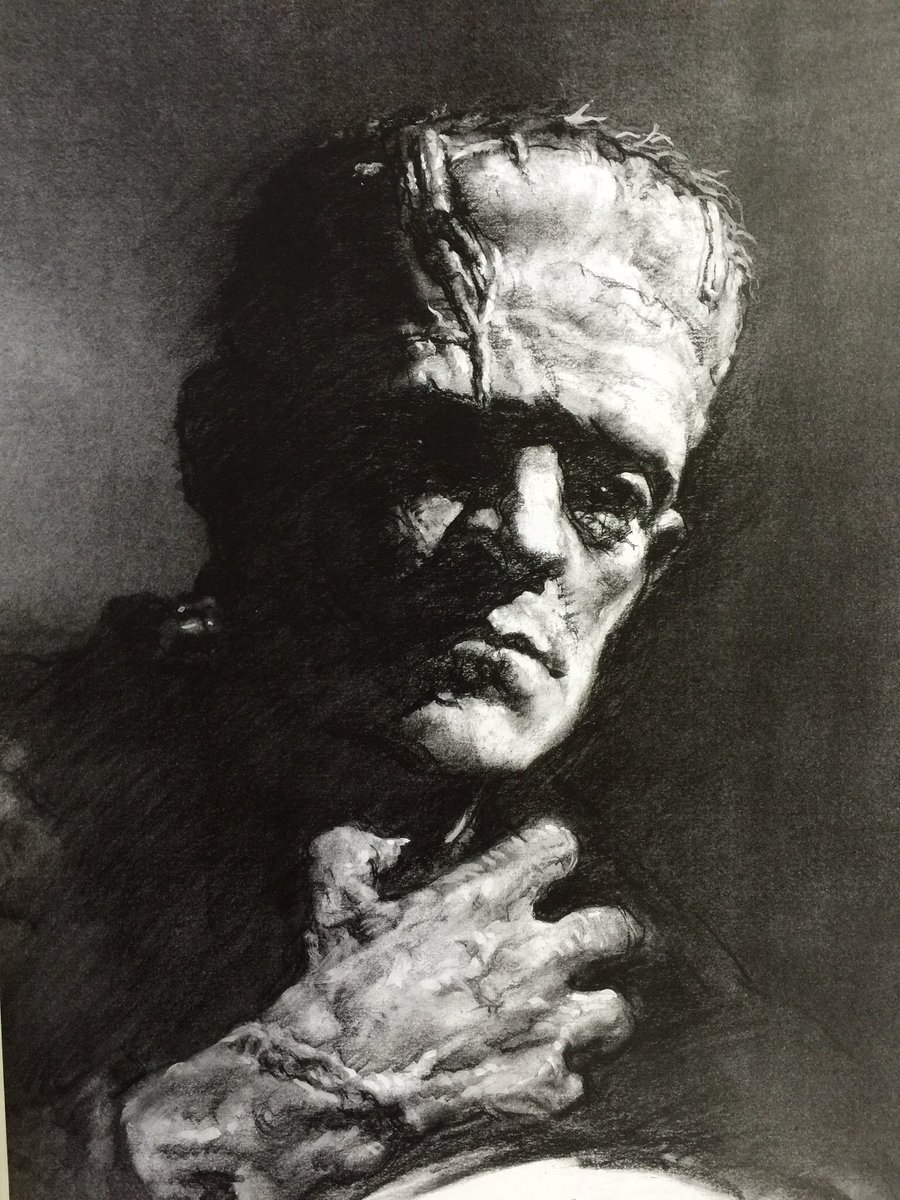
Since Halloween is just around the corner, we thought we would share some images of Gogos' best works. Let's begin with Dr. Frankenstein's monster....


THE BRIDE OF FRANKENSTEIN


THE MUMMY


DRACULA


THE WOLFMAN


CREATURE FROM THE BLACK LAGOON


OTHER MONSTERS OF FILM AND TV


THE USPS STAMP SERIES

In the 1990s, Basil Gogos had submitted these designs to the USPS for a Universal Monster series of stamps, but unfortunately, they were not chosen. They would have made fantastic stamps!